
PREPARING FOR A SUCCESSFUL MEDIA INTERVIEW A Systematic

- Slides: 48
PREPARING FOR A SUCCESSFUL MEDIA INTERVIEW A Systematic Approach for Success
“I have no power to prosecute. I have only the power to embarrass, to humiliate, to expose. ” Geraldo Rivera
Legitimate Pre-Interview Concerns: “Will the questions be fair? ” n “Does the reporter have a hidden agenda? ” n “Can I control the interview process? ” n “What are the rules of engagement? ” n “Will I be misquoted? ” n “Will the reporter understand the issues here? ” n
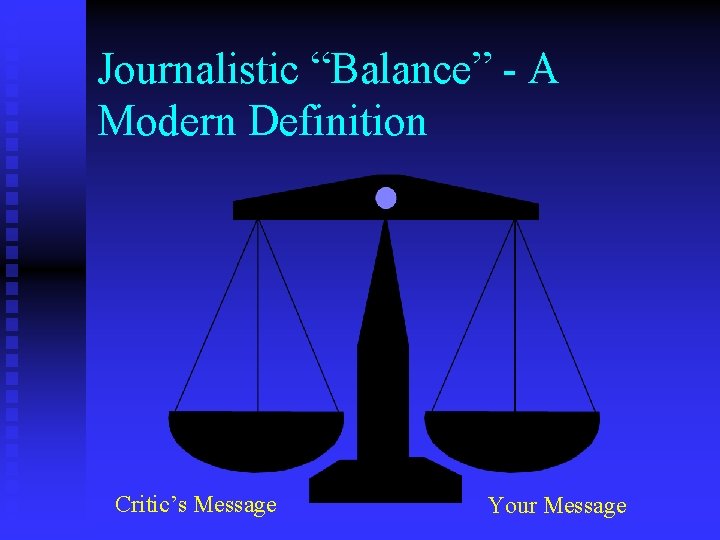
Journalistic “Balance” - A Modern Definition Critic’s Message Your Message
Why Do Interviews? Because a reporter has asked you questions? n Because you have Communications Objectives of your own n
Remember, This Process is About CONTROL Control of the media to the extent you can. n Control of yourself in all situations. n
Remember, you start in a great position. You have something the media wants……. . THE INFORMATION
You will be ready to conduct effective interviews when you. . . n n n Can identify the news questions you would ask if you were the reporter Can frame answers to those questions And can set your own agenda for news interviews
Interviews: The Reporter’s Perspective Heart and soul of the news n Give depth, background, perspective, and personality to news n Quotes are interview excerpts to explain, inform, & illuminate……They put the human face on journalism n Reporters expect to get enough background to understand any story they cover. n
Preparing for a media interview is a systematic effort n n n Establish a checklist and stay with it! Brevity, simplicity, and clarity are key to all interviews. Prepare…. . Don’t “shoot from the lip. ” (Your organization is too important. ) “Don’t take it personally……they don’t. ”
Most Common Interview Mistakes: Treating the interview like you would normal conversation n Overloading the system (literally, “talking too much, ” giving too much detail, and/or using too much jargon) n Merely answering questions and not taking charge of your answers n
Effective Media Interviews Seven Steps to Success
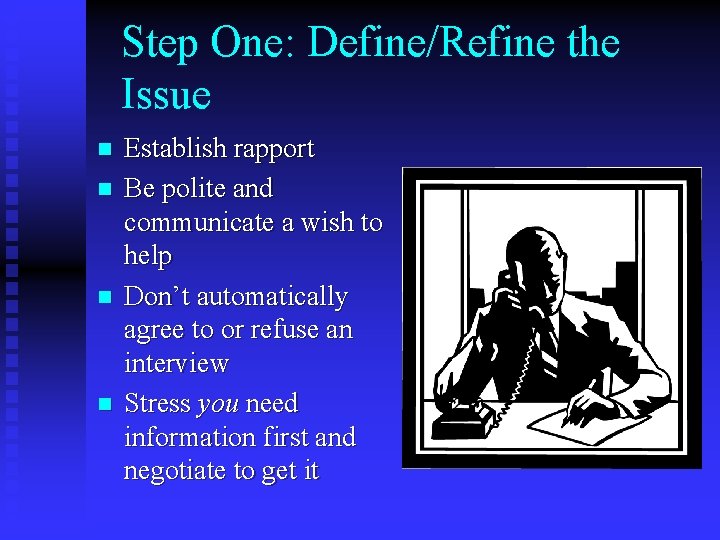
Step One: Define/Refine the Issue n n Establish rapport Be polite and communicate a wish to help Don’t automatically agree to or refuse an interview Stress you need information first and negotiate to get it
Step One: Define/ Refine the Issue n Attempt to Determine the Reporter’s Agenda by Asking Questions: u Reporter’s name & affiliation? u What is it about? u What particular aspect are you focusing on? u What’s your story or angle? u Can I ask how much you know about this issue? u Can I send (fax) some background? u When is your deadline and I’ll get back to you?
Background Information Versus “Press Releases” Definition of a Press Release: “Dropping a rose petal into the Grand Canyon and waiting to hear an echo. ” n Background information: Usually a tightly written fact sheet (outline or “bullet” format) which gives key background, facts, organizational policy, current status, etc. Not a press release! n
Step One: Define/Refine the Issue n n Determine your purpose/feasibility Research the answers u Consult subject matter experts u Formulate your own questions u Determine if new developments or issues exist
Step One: Define/Refine the Issue n Once the issue is clearly defined in your mind, ask yourself the most important question of all……. ”Am I really the one who should be doing this interview? ”
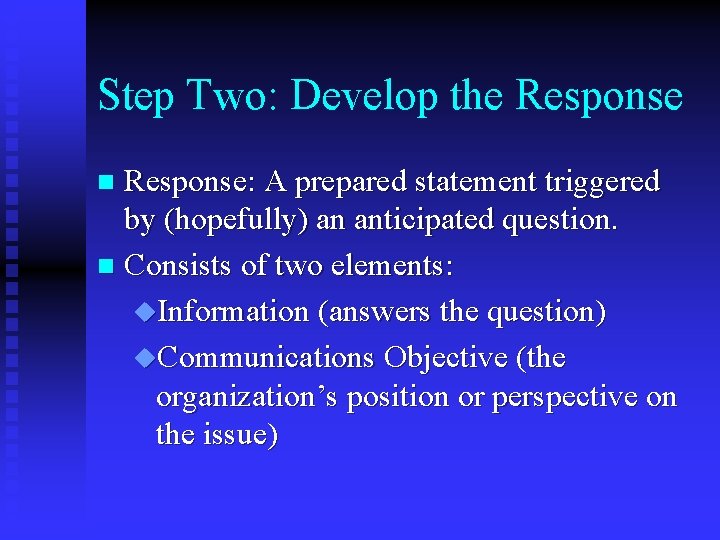
Step Two: Develop the Response: A prepared statement triggered by (hopefully) an anticipated question. n Consists of two elements: u. Information (answers the question) u. Communications Objective (the organization’s position or perspective on the issue) n
Step Two: Develop the Response n Communications Objectives (Messages) are the KEY to success. Without them, you are at the reporter’s mercy. The media claim they don’t like ‘em, but they always use ‘em!
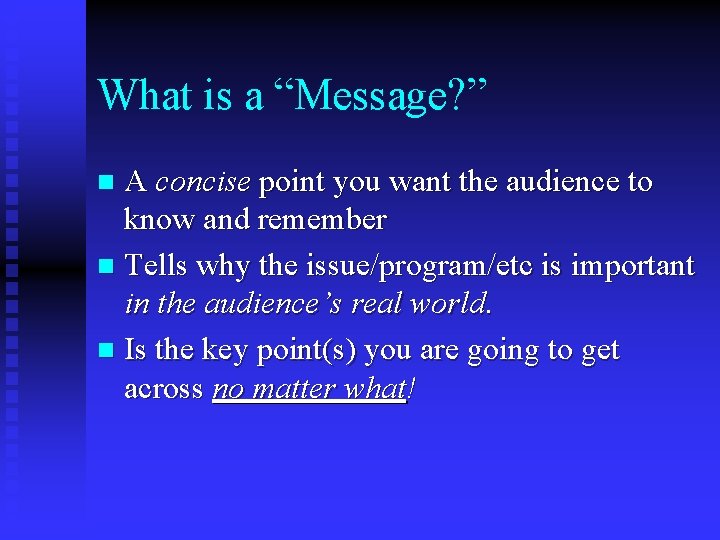
What is a “Message? ” A concise point you want the audience to know and remember n Tells why the issue/program/etc is important in the audience’s real world. n Is the key point(s) you are going to get across no matter what! n
What Does Being “Message Driven” Mean? Knowing what your messages are. n Being consistent in delivering them. n Assertively bringing them into the interview. n Displaying the empathy that shows you mean the message you deliver. n
Messages are most effective when framed in newsworthy terms. n n New & significant A spin-off of a trend or event Adds a new wrinkle to a current news story Gives a local tie to a national or regional issue
Messages - “The Art of the Quotable Quote. ” n n n Brief Stands on its own Uses common language & avoids jargon Colorful or metaphorical (if appropriate) Passionate or energetic “Ethos, Logos & Pathos” Aristotle
Message Length n Messages for broadcast media average between 5 and 20 seconds (normal “sound bite” = 8 sec. ) Messages for print rarely exceed 1 to 3 lines.
Create a Theme for Your Interview What is a theme? A word or word picture to frame your message(s) in a memorable way. n Reinforcing a theme throughout the interview keeps you and your messages focused. Ideally, a theme should dominate the interview and tie the messages together. n Examples: “Building the foundation”, “Back to the basics”, “A few good men” n
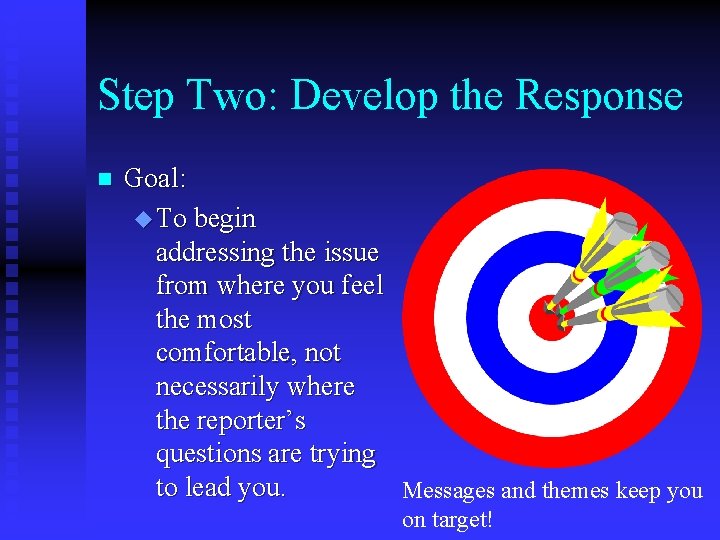
Step Two: Develop the Response n Goal: u To begin addressing the issue from where you feel the most comfortable, not necessarily where the reporter’s questions are trying to lead you. Messages and themes keep you on target!
Step Three: Brainstorm Potential Questions n ? n Think of everything you think you could be asked, to include the worst possible questions. Consider the rule of “ 5 x 5”
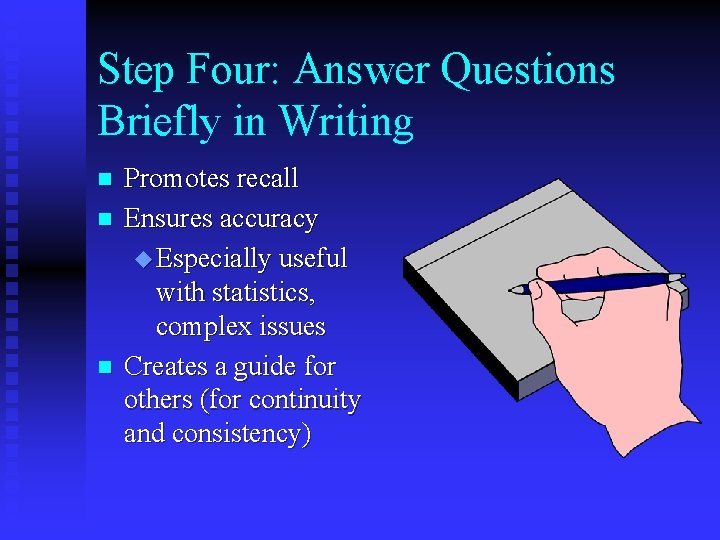
Step Four: Answer Questions Briefly in Writing n n n Promotes recall Ensures accuracy u Especially useful with statistics, complex issues Creates a guide for others (for continuity and consistency)
Step Five: (If Appropriate) Rehearse Out Loud n n n Murder Board: Staff role-plays the press & critiques performance Make sure you have staff ask the tough questions/give honest feedback Practice quotes/bites, but be careful not to sound “rehearsed”
Step Six: Establish the Ground Rules Call back on time n Reiterate the subject of the interview n Establish the areas not open for discussion n Establish interview length, location, day/time (choose interview site carefully) n
Enforcing Your “Bill of Rights” n In interviews of a spontaneous nature, you have the right…… u. To know who is interviewing you and who he/she represents u. To have total agreement by both parties of ground rules, no matter how hastily arranged u. To be treated courteously, even with tough questions USMC Media Training Guide
Enforcing Your “Bill of Rights” n Spontaneous interviews (continued). You have the right…. . u. Not to be physically threatened or impaired by lights too close or microphones shoved in your face u. To break off the interview after a “reasonable” time following the answers to important, main questions USMC Media Training Guide
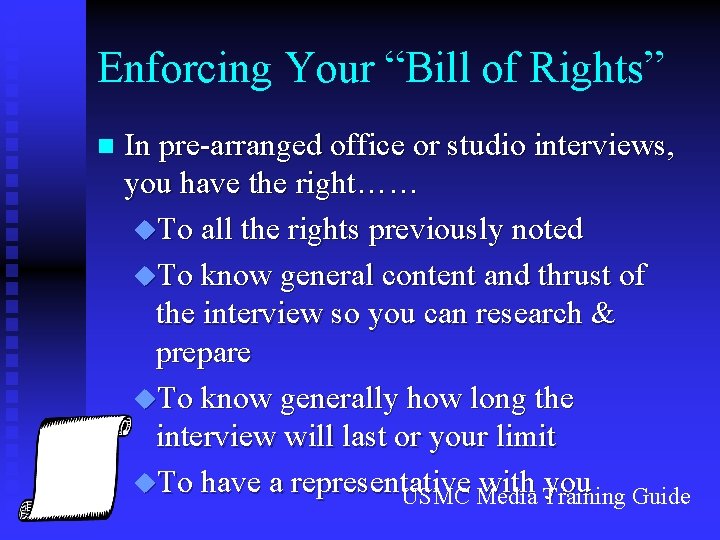
Enforcing Your “Bill of Rights” n In pre-arranged office or studio interviews, you have the right…… u. To all the rights previously noted u. To know general content and thrust of the interview so you can research & prepare u. To know generally how long the interview will last or your limit u. To have a representative with Training you Guide USMC Media
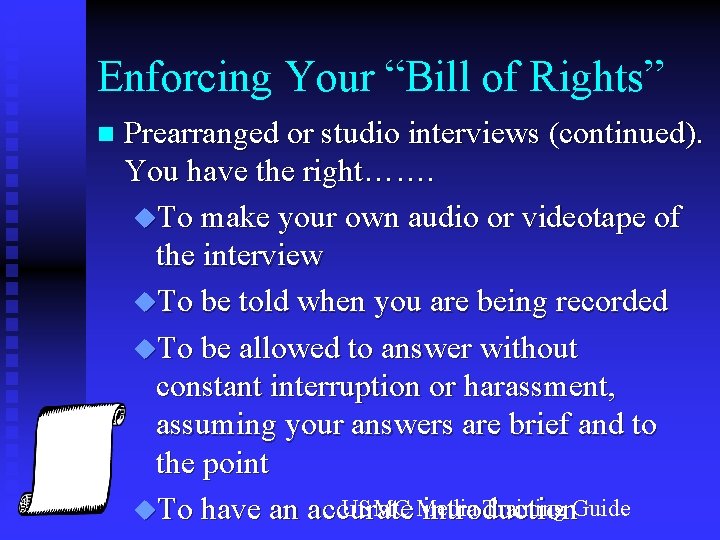
Enforcing Your “Bill of Rights” n Prearranged or studio interviews (continued). You have the right……. u. To make your own audio or videotape of the interview u. To be told when you are being recorded u. To be allowed to answer without constant interruption or harassment, assuming your answers are brief and to the point USMC Media Training Guide u. To have an accurate introduction
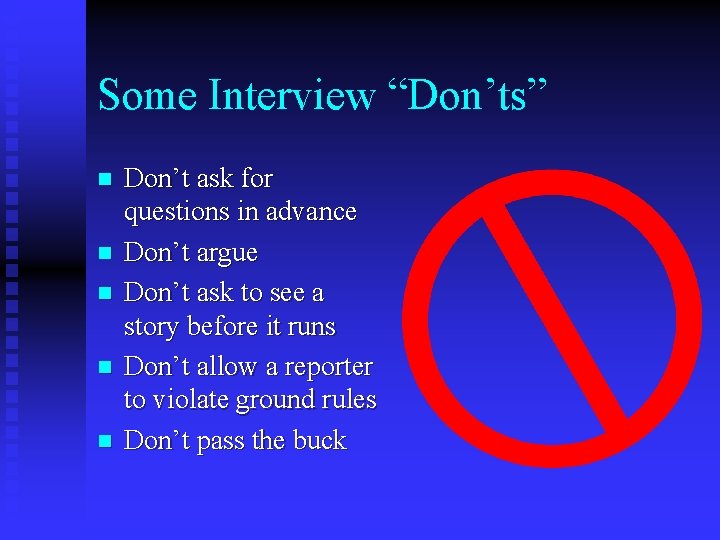
Some Interview “Don’ts” n n n Don’t ask for questions in advance Don’t argue Don’t ask to see a story before it runs Don’t allow a reporter to violate ground rules Don’t pass the buck
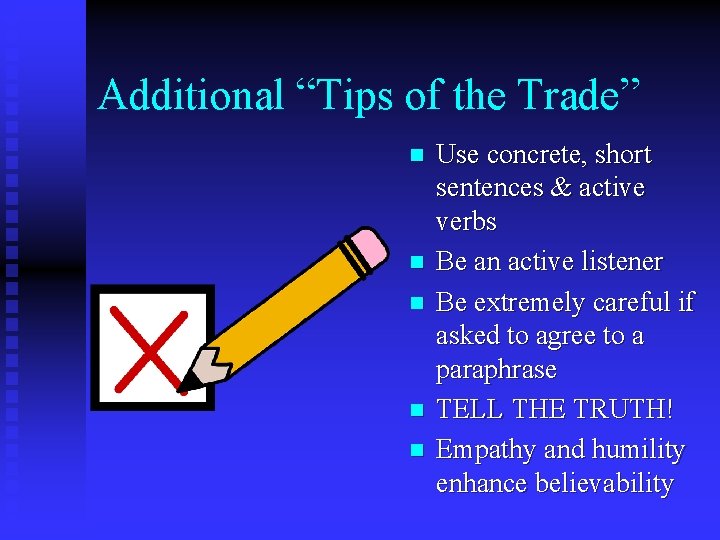
Additional “Tips of the Trade” n n n Use concrete, short sentences & active verbs Be an active listener Be extremely careful if asked to agree to a paraphrase TELL THE TRUTH! Empathy and humility enhance believability
Step Six: Establish The Ground Rules……A Final Thought n They’ve told their boss the interview is a “go” Once you get to this point, you have negotiated a good faith contract with the reporter. KEEP YOUR SIDE OF THE CONTRACT.
Step Seven: Conduct the Interview n n With Professionalism With Confidence With Control With Adequate Preparation
Techniques of Control n Packaging/Bundling u Quantify your info and tie it together giving the reporter verbal clues to follow u “We’ve got three new initiatives to solve the problem and they are…. ” n Hooking u Begs the question & baits the reporter to ask the question you want u “I think your audience may be interested in our two major concerns and initiatives…. ”
Techniques of Control n Bridging u Verbal maneuver to reform question in terms most favorable to you u Lead in Phrases: F“That’s one perspective…” F“What concerns me even more. . ” n Flagging u Body/hand/facial gestures, tone of voice, leaning forward to make a point, etc. u Why? Draws attention to what you are identifying as a key response.
Understanding the “On The Record/Off The Record” Maze
On The Record n Everything you say can be reported verbatim and you can be identified by name and position as the source of the information (NOTE: This is the preferred way to do business)
Off The Record n The reporter agrees to take information from a protected source without doing the story or identifying the informant in any way. (NOTE: This does not preclude the reporter from obtaining the information from other sources. )
On Background n n The reporter can use the information but not directly name the source. Good technique for educating a reporter
On Deep Background n n Cicero: “This is the last refuge of the weak. ” The reporter can use the information but cannot name the source or the agency NOTE: This is little more than a leak and, while used by the press, will not enhance one’s status with them.
On Categories of Release……. . . n As a matter of principle and basic policy, you should be prepared to live with everything you say to a reporter or don’t say it at all!
A Final Thought n n Who says they get to be in charge? “EXPECT BIAS, BUT DEMAND FAIRNESS” Systematic preparation protects you and your agency. It’s the key to interview success.