
Preparing for a DOL Audit What to Expect
- Slides: 31
Preparing for a DOL Audit What to Expect and How to Survive an EBSA Benefit Plan Investigation Chris Allesee, August 13, 2015 © Graydon Head & Ritchey LLP
When to Start NOW! ALWAYS BE AUDIT-READY § Due diligence § Stay abreast of fiduciary issues o http: //www. graydonhead. com/news/blogbenefits-insight § Make sure plan-related documents are readily available or easily accessible § Identify fiduciaries © Graydon Head & Ritchey LLP
Phases of an Audit § § § § © Graydon Head & Ritchey LLP Introduction and Appointment Letter Onsite Investigation Interviews Ingoing Investigation Closing or Compliance Letter Discussions and Resolution If Necessary: o Settlement o Litigation o Penalty Assessment
Scope § All ERISA-covered benefit plans are subject to DOL jurisdiction § ERISA § 504 - U. S. Department of Labor authorized to investigate plans for any or no reason, to request documents, and to discuss the investigation with affected participants § Current Focus: § Group Health Plans § Major Cases/Criminal Cases © Graydon Head & Ritchey LLP
Upside of an Audit § Free audit! § Clean bill of health from the DOL § Repeat audits of the same sponsor are rare § Corrections go to plan participants © Graydon Head & Ritchey LLP
Downside of an Audit § Time, energy, and expense § Likelihood of multiple plans being audited at the same time § Cost of corrections and potential excise tax § Potential litigation and penalties § Ineligible for DOL self-correction program © Graydon Head & Ritchey LLP
Why My Plan? § Indicators on Form 5500 § Participant Complaints § National Projects o Health Benefit Security Project o Fiduciary Service Provider Fees o ESOP o REACT § News Reports and Court Filings § Location § Random (SIP Project) © Graydon Head & Ritchey LLP
Phase 1: Introduction and Request Letter § The Call: o To inform you of the audit and arrange dates for onsite visit and document production o Contact ERISA counsel, but verify availability quickly and consider proposing alternate locations § The Letter: o Confirm the dates of the onsite visit o List of documents to be produced © Graydon Head & Ritchey LLP
Phase 1: Introduction and Request Letter § Make three important calls: o ERISA counsel o The investigator ØClarify the scope and dates for documents to produce ØSample sets ØProduce documents electronically ØDesk audit o Current and past service providers © Graydon Head & Ritchey LLP
Phase 1: Introduction and Request Letter After you receive the letter and before the onsite begins: § Review all documents to be produced § Work with ERISA counsel to identify potential issues and determine whether to take corrective action prior to the start of the onsite Ø DOL looks very favorably on proactive fiduciaries Ø May accept corrections, even when they may not be “perfect” § Designate a “point-person” for the investigation § Make copies and organize documents to coordinate with the request letter © Graydon Head & Ritchey LLP
Phase 2: Onsite Agenda: o Day 1 – Ø Introductions and preliminary questions Ø Discuss interview schedule Ø Review and catalog documents and request additional information o What you should do – Ø Introduce the key players Ø Get to know your investigator – build rapport Ø Provide a quiet place to work Ø Make point person accessible © Graydon Head & Ritchey LLP
Phase 2: Onsite o Days 2 and 3 – Ø Document review and request additional information Ø Interviews o What you should do – Ø Listen closely to requests Ø Push service providers to produce documents Ø Review all documents before producing them Ø Prep for interviews © Graydon Head & Ritchey LLP
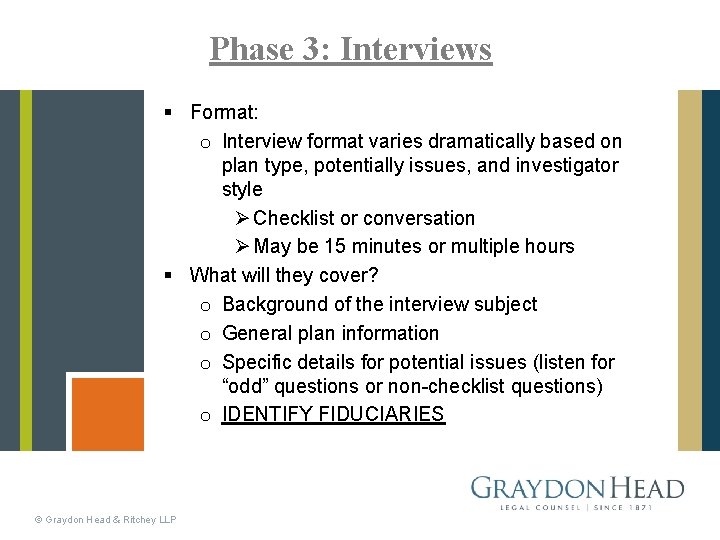
Phase 3: Interviews § Format: o Interview format varies dramatically based on plan type, potentially issues, and investigator style Ø Checklist or conversation Ø May be 15 minutes or multiple hours § What will they cover? o Background of the interview subject o General plan information o Specific details for potential issues (listen for “odd” questions or non-checklist questions) o IDENTIFY FIDUCIARIES © Graydon Head & Ritchey LLP
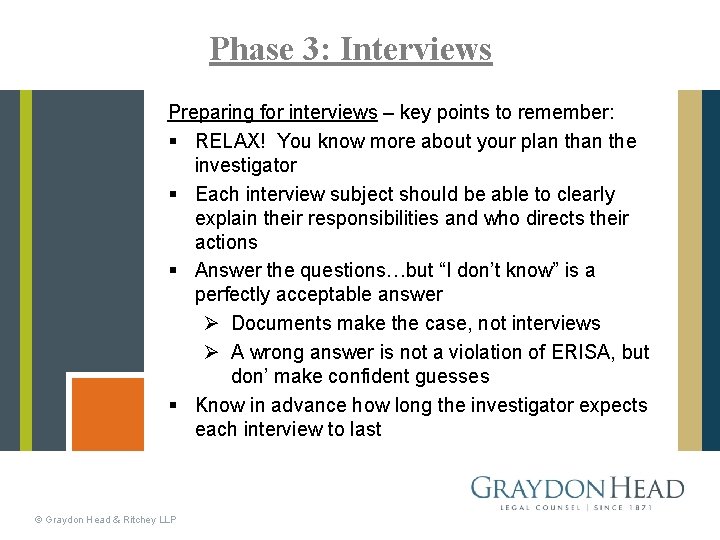
Phase 3: Interviews Preparing for interviews – key points to remember: § RELAX! You know more about your plan the investigator § Each interview subject should be able to clearly explain their responsibilities and who directs their actions § Answer the questions…but “I don’t know” is a perfectly acceptable answer Ø Documents make the case, not interviews Ø A wrong answer is not a violation of ERISA, but don’ make confident guesses § Know in advance how long the investigator expects each interview to last © Graydon Head & Ritchey LLP
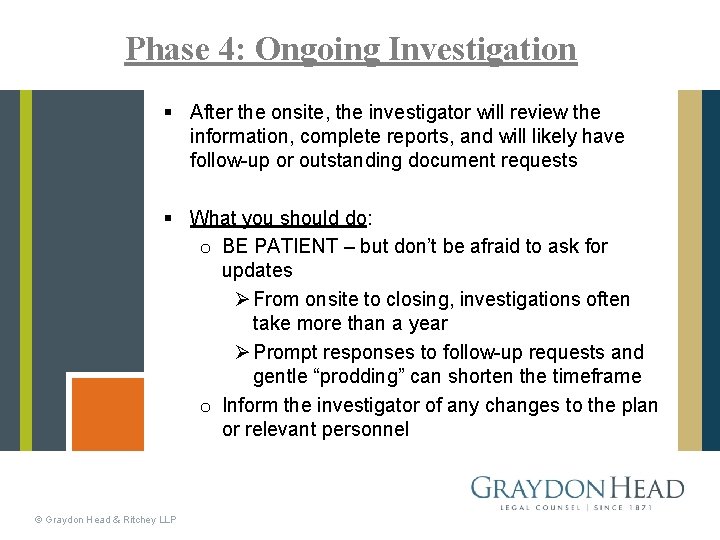
Phase 4: Ongoing Investigation § After the onsite, the investigator will review the information, complete reports, and will likely have follow-up or outstanding document requests § What you should do: o BE PATIENT – but don’t be afraid to ask for updates Ø From onsite to closing, investigations often take more than a year Ø Prompt responses to follow-up requests and gentle “prodding” can shorten the timeframe o Inform the investigator of any changes to the plan or relevant personnel © Graydon Head & Ritchey LLP
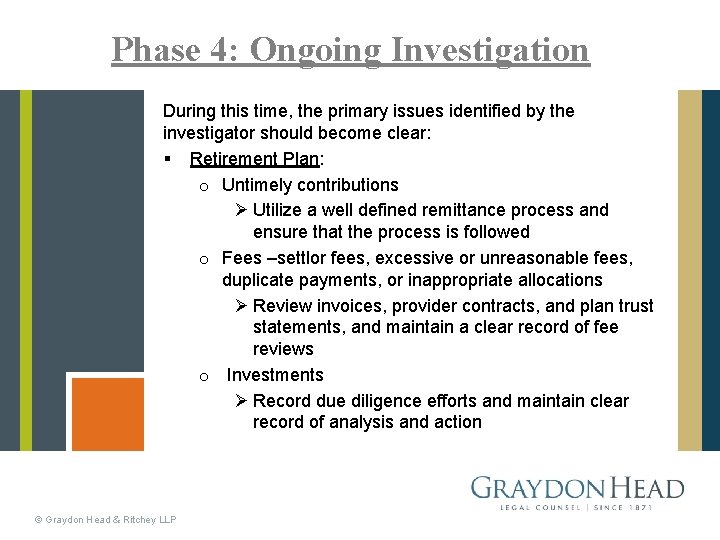
Phase 4: Ongoing Investigation During this time, the primary issues identified by the investigator should become clear: § Retirement Plan: o Untimely contributions Ø Utilize a well defined remittance process and ensure that the process is followed o Fees –settlor fees, excessive or unreasonable fees, duplicate payments, or inappropriate allocations Ø Review invoices, provider contracts, and plan trust statements, and maintain a clear record of fee reviews o Investments Ø Record due diligence efforts and maintain clear record of analysis and action © Graydon Head & Ritchey LLP
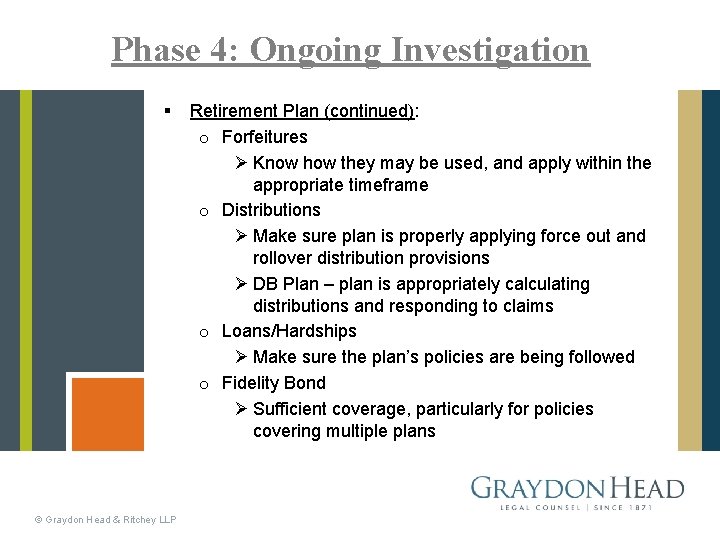
Phase 4: Ongoing Investigation § © Graydon Head & Ritchey LLP Retirement Plan (continued): o Forfeitures Ø Know how they may be used, and apply within the appropriate timeframe o Distributions Ø Make sure plan is properly applying force out and rollover distribution provisions Ø DB Plan – plan is appropriately calculating distributions and responding to claims o Loans/Hardships Ø Make sure the plan’s policies are being followed o Fidelity Bond Ø Sufficient coverage, particularly for policies covering multiple plans
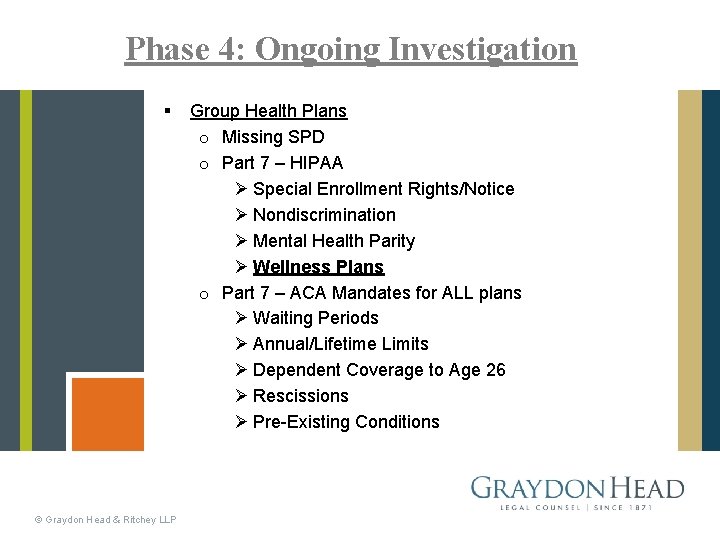
Phase 4: Ongoing Investigation § © Graydon Head & Ritchey LLP Group Health Plans o Missing SPD o Part 7 – HIPAA Ø Special Enrollment Rights/Notice Ø Nondiscrimination Ø Mental Health Parity Ø Wellness Plans o Part 7 – ACA Mandates for ALL plans Ø Waiting Periods Ø Annual/Lifetime Limits Ø Dependent Coverage to Age 26 Ø Rescissions Ø Pre-Existing Conditions
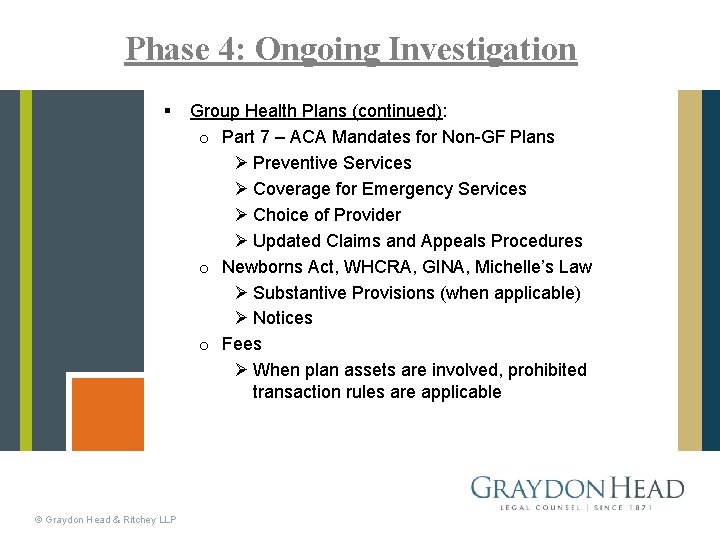
Phase 4: Ongoing Investigation § © Graydon Head & Ritchey LLP Group Health Plans (continued): o Part 7 – ACA Mandates for Non-GF Plans Ø Preventive Services Ø Coverage for Emergency Services Ø Choice of Provider Ø Updated Claims and Appeals Procedures o Newborns Act, WHCRA, GINA, Michelle’s Law Ø Substantive Provisions (when applicable) Ø Notices o Fees Ø When plan assets are involved, prohibited transaction rules are applicable
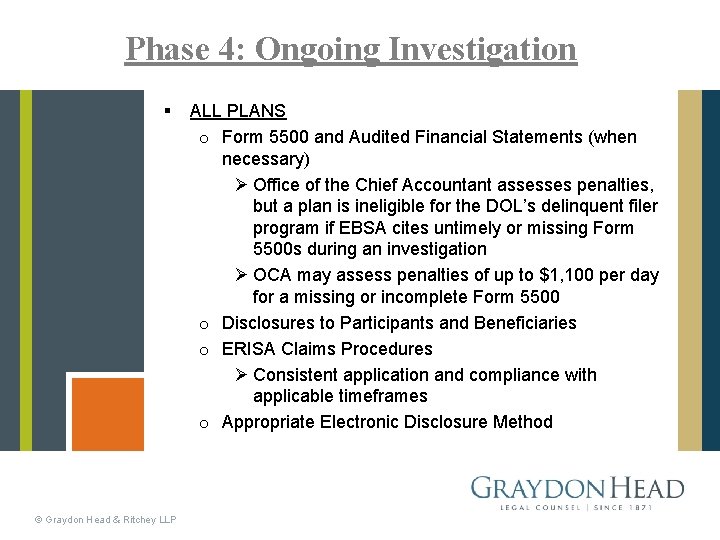
Phase 4: Ongoing Investigation § © Graydon Head & Ritchey LLP ALL PLANS o Form 5500 and Audited Financial Statements (when necessary) Ø Office of the Chief Accountant assesses penalties, but a plan is ineligible for the DOL’s delinquent filer program if EBSA cites untimely or missing Form 5500 s during an investigation Ø OCA may assess penalties of up to $1, 100 per day for a missing or incomplete Form 5500 o Disclosures to Participants and Beneficiaries o ERISA Claims Procedures Ø Consistent application and compliance with applicable timeframes o Appropriate Electronic Disclosure Method
Phase 5: Closing or Compliance Letter § Less than one-third of investigations cite no violations of ERISA Ø Letter will simply note the investigation is closed and thank you for your assistance § The other two-thirds receive a voluntary compliance letter (“VC Letter”) Ø Identifies alleged fiduciaries Ø Details factual findings of the investigation that DOL believes support a violation of ERISA Ø Asks for a response within 10 business days © Graydon Head & Ritchey LLP
Phase 5: Closing or Compliance Letter § Forward the VC Letter to ERISA counsel immediately o Most investigators will accept an informal notice of receipt of the letter and comment that it is under review as an initial response within 10 business days o Discuss an appropriate timeframe for a full response Ø Additional extensions may be allowed as long as there is substantive progress towards a resolution o Discuss the factual and legal findings with the investigator to frame your response © Graydon Head & Ritchey LLP
Phase 6: Discussions and Resolution § DOL’s Role: o Correcting a breach is a fiduciary decision o The DOL is not a fiduciary, and will only comment on the reasonableness of a corrective action § HOWEVER, resolving an issue through voluntary compliance is still a very interactive process: o After discussing the VC Letter with ERISA counsel, express factual or legal concerns with the investigator directly o If no concerns, ask the investigator for correction recommendations © Graydon Head & Ritchey LLP
Phase 6: Discussions and Resolution § Discuss with investigator: o Actual loss o Acceptable lost earnings calculation methods o Participant allocations o Procedural changes o Correction timeframe o Documents that will verify proof of correction NOTE that these are not negotiations, just discussions that help the fiduciary understand his or her obligations to the plan – negotiations imply a settlement, and settlements may result in penalties (ERISA § 502(l) for all plans and § 502(i) for welfare plans). © Graydon Head & Ritchey LLP
Phase 6: Discussions and Resolution § After discussing with investigator, promptly take corrective action and provide proof documents o Generally, DOL requires confirmation of receipt by the plan o Providing sufficient proof may not be easy and may take several attempts § Upon receipt of proof of a sufficient correction, the DOL will send a closing letter to the fiduciary o DOL will take no further action o Notes potential excise tax liability and mandatory referral of prohibited transactions to IRS o Notes referral to OCA (if citing Form 5500 violations) © Graydon Head & Ritchey LLP
Phase 6: Discussions and Resolution § Benefits of resolution through voluntary compliance o Quick o Cheap(er) o Penalties generally do not apply § § 502(l) and § 502(i) penalties only apply if there is a settlement or court order § Do NOT ask for signed confirmation of proposed corrective action in advance Ø Begins to look more like a settlement than a voluntary fiduciary action Ø 20% penalty under both sections © Graydon Head & Ritchey LLP
Phase 7: Settlement, Litigation, Penalties Overwhelming majority of cases do not require a formal settlement or litigation § Settlement: o Most common scenario is a fiduciary that has insufficient funds to make a full correction within a reasonable timeframe o Prohibited transaction exemption allows for repayment plans o Requires the fiduciary enter into a tolling agreement, if necessary o 502(l) penalty will apply © Graydon Head & Ritchey LLP
Phase 7: Settlement, Litigation, Penalties § Litigation Referrals o Most common scenarios are abandoned plans or consent decrees to reallocate a fiduciary’s personal account to affected participants o For disputed or unresolved issues: Ø Investigators generally warn in advance that a case will be forwarded to the Solicitor of Labor True litigated issues are very rare Ø VERY slow - Solicitor of Labor requires DOJ approval to file a complaint (up to 6 months) Ø Solicitor’s attorneys are likely to negotiate Ø 502(l) penalties will likely apply © Graydon Head & Ritchey LLP
Phase 7: Settlement, Litigation, Penalties § Penalty Assessment o DOL will mail letter citing “applicable recovery amount” and the amount of the penalty o Penalty generally allocated among liable fiduciaries based on amount paid o Good faith waiver or hardship waiver Ø Limited regional discretion to decrease penalty Ø Full waiver rarely approved o If not paid after waiver is denied, will be referred for collection © Graydon Head & Ritchey LLP
Conclusion § Always be audit ready § Be proactive and get ERISA counsel involved early § Be organized and responsive § Know your fiduciaries § Let the investigator do the heavy lifting: o Ask for clarification and updates o Ask for suggestions regarding corrections § It’s never too late to avoid litigation © Graydon Head & Ritchey LLP
Questions? § Thank you for your attention, and please feel free to call or email if you have any questions: o Chris Allesee – callesee@graydon. com o (513) 629 -2727 © Graydon Head & Ritchey LLP