
Prepared by Yussor noory Physical pharmacy college of
Prepared by Yussor noory Physical pharmacy college of Pharmacy Lab 1 Partition coefficient ( KD)
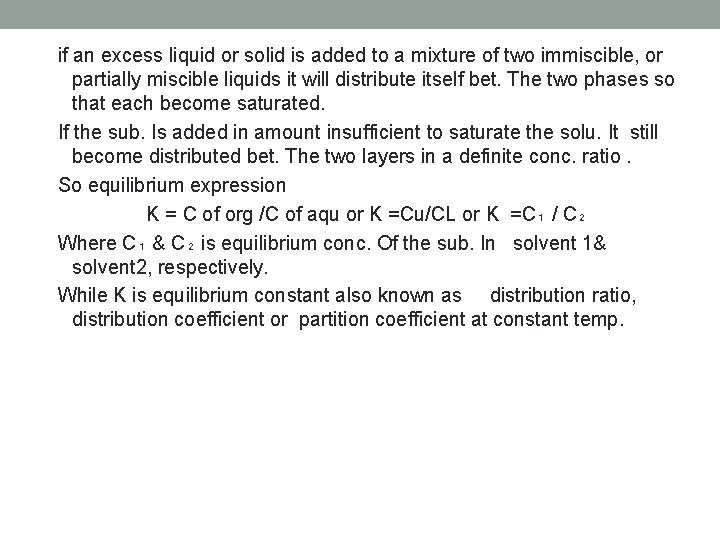
if an excess liquid or solid is added to a mixture of two immiscible, or partially miscible liquids it will distribute itself bet. The two phases so that each become saturated. If the sub. Is added in amount insufficient to saturate the solu. It still become distributed bet. The two layers in a definite conc. ratio. So equilibrium expression K = C of org /C of aqu or K =Cu/CL or K =C₁ / C₂ Where C₁ & C₂ is equilibrium conc. Of the sub. In solvent 1& solvent 2, respectively. While K is equilibrium constant also known as distribution ratio, distribution coefficient or partition coefficient at constant temp.
Importance of P. C. to the pharmacist: 1 -the preservation of oil / water system. 2 -absorption& distribution of drug through the body. 3 -In the extraction process to remove a particular solute From homogeneous system. 4 -In dosage formulation.
Experimental work : Determination the partition coefficient of iodine between water and chloroform.
Procedure: 1 - in dry Stoppered conical flask (iodine flask) put 10 ml of 1% iodine in chloroform (use burette). 2 - Add 25 ml D. W. to it. 3 -The flask is the thoroughly shaken from time to time 15 hour after equilibrium is established , allow to stand for complete phase separation, this need another 5 min an hour. 4 -10 ml of the sample are taken from the upper aqueous layer, care is taken to avoid touching the chloroforming layer. Then titrate against 0. 02 N sodium thiosulphate. the end point is the disappearance of light brownish color. 5 -5 ml are taken from the organic layer (lower layer). the inside wall of the pipette must be kept dry as it passes through aqueous phase by placing the finger tightly over the upper end of the pipette. Then titrate against 0. 1 N sodium thiosulphate. Before titration, add 5 ml of 10% pot. Iodide to facillate extraction of I 2 from the organic layer and it's titration with aqueous sodium thiosulphate. The end point is the disappearance of the brownish color.
Calculation: Iodine distributed between the aqueous phase and chloroformic phase. Aqueous phase: -the no. of ml of sodium thiosulphate (0. 02 N) consumed in the titration is equivalent to the amount of Iodine present. (Na 2 S 2 O 3) V 1 X C 1 = V 2 X C 2 (iodine) E. P X 0. 02 N =10 X N 2 =conc. Of iodine in water Chloroformic phase: -the no. of ml of sodium thiosulphate (0. 1 N) consumed in the titration is equivalent to the amount of Iodine present. (Na 2 S 2 O 3) V 1 X C 1 = V 2 X C 2 (iodine) E. P 2 X 0. 1 N = 5 X N 2 =conc. Of iodine in chloroform Conc. Of iodine in CHCl 3 Partition coefficient = -------------------Conc. Of iodine in water
- Slides: 6