
Prepared by Yussor noory Lab1 Physical pharmacy college
Prepared by Yussor noory Lab-1 - Physical pharmacy college of Pharmacy THE PHASE RULE AND DIFFERENT COMPONENTS
� phase rule : is a relationship for determining the least number required to define the state of the system. � -phase : -is homogeneous physically distinct portion of the system which is separated from other parts of the system by bounding surfaces � (e. g. water & its vapor is one component two phase system)
� Number of component : is the smallest number of constituents by which the phase of equilibrium system can be expressed as a chemical formula or equation.

Two component systems containing liquid phase � -as we know ethyl alcohol & water are miscible in all proportions , while water & mercury are completely immiscible regardless the amount of each. � Between these two extremes lie a whole range of system which exhibit a partial miscibility ( or immiscibility) such as water & phenol , as their miscibility affected by two factors conc. & temp.
� -to illustrate the effect of conc. & temp. we prepare the following conc. Of phenol in water by % weight as the total wt. is ( 10 gm) � 2%, 7%, 9%, 11% , 24%, 40%, 55%, 63%, 70%, &75% (w/w) � (e. g. 2% 0. 2 gm phenol + 9. 8 gm H₂O)
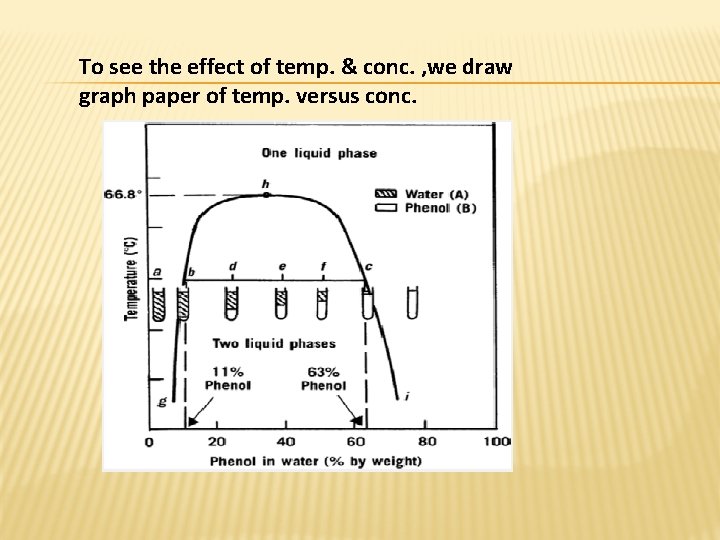
To see the effect of temp. & conc. , we draw graph paper of temp. versus conc.
binodal curve : - is the curve that separates two phase area from one phase area. � -tie line : - is the line drawn across the region of two phases (conjugate phases ) as each temp. has its own tie line. � -upper consolute temp. or critical solu. Temp. : - is the maximum temp. at which two phase region exists. � Water & phenol system it is 66. 8 as all combinations above this temp. is completely miscible & give one phase system. � -mass ratio: -is the relative amount by wt. of conjugate phase , it depends on the position in tie line & temp. �
-PROPERTIES OF THE TIE –LINE IN TWO COMPONENT SYSTEMS: � 1 -it is parallel to the base line � 2 -all systems prepared along the tie line at equilibrium separated into two conjugate phases of constant composition.
� For instance, consider a system containing 24% by weight of phenol and 76% by weight of water (point d in the diagram). At equilibrium two liquid phases have been presented in the tube. The upper one, A, has a composition of 11% phenol in water (point b on the diagram), whereas the lower layer, B, contains 63% phenol (point c on the diagram). The relative weights of the two phases can be calculated by the equation
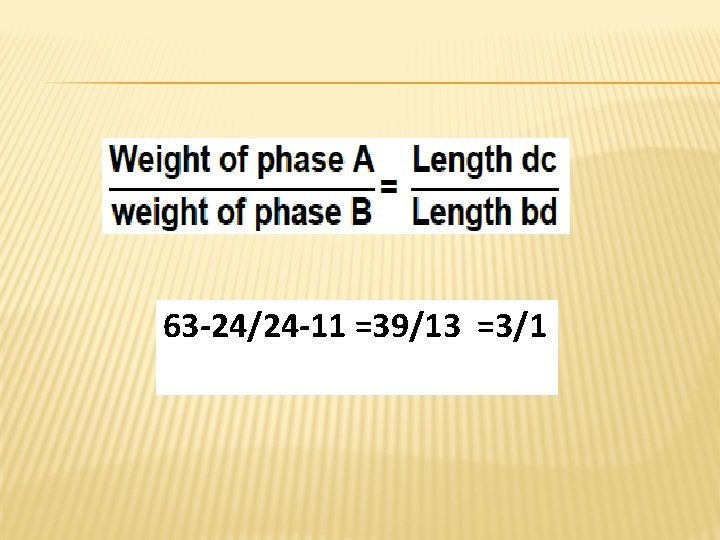
63 -24/24 -11 =39/13 =3/1
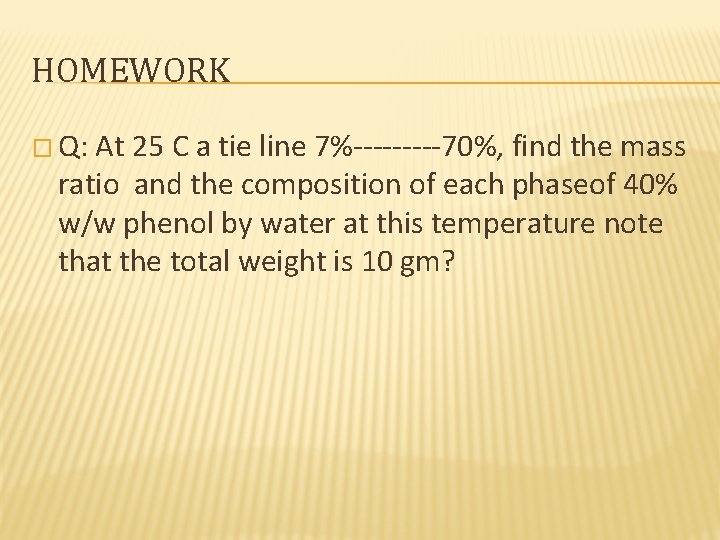
HOMEWORK � Q: At 25 C a tie line 7%-----70%, find the mass ratio and the composition of each phaseof 40% w/w phenol by water at this temperature note that the total weight is 10 gm?
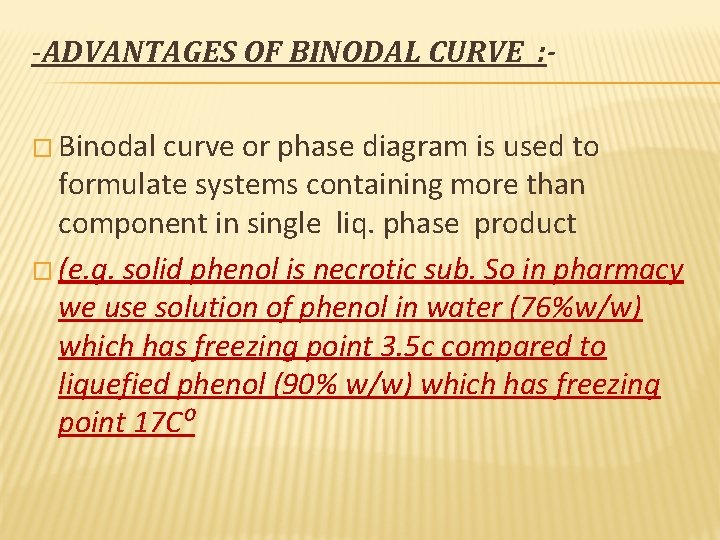
-ADVANTAGES OF BINODAL CURVE : � Binodal curve or phase diagram is used to formulate systems containing more than component in single liq. phase product � (e. g. solid phenol is necrotic sub. So in pharmacy we use solution of phenol in water (76%w/w) which has freezing point 3. 5 c compared to liquefied phenol (90% w/w) which has freezing point 17 C⁰
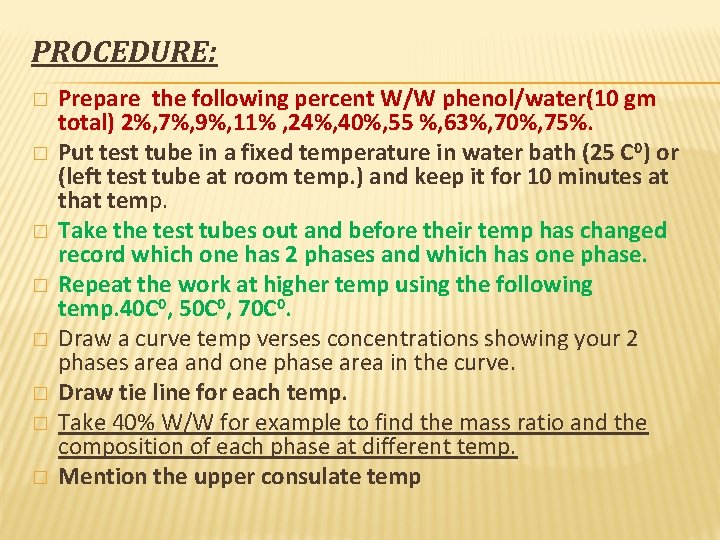
PROCEDURE: � � � � Prepare the following percent W/W phenol/water(10 gm total) 2%, 7%, 9%, 11% , 24%, 40%, 55 %, 63%, 70%, 75%. Put test tube in a fixed temperature in water bath (25 C 0) or (left test tube at room temp. ) and keep it for 10 minutes at that temp. Take the test tubes out and before their temp has changed record which one has 2 phases and which has one phase. Repeat the work at higher temp using the following temp. 40 C 0, 50 C 0, 70 C 0. Draw a curve temp verses concentrations showing your 2 phases area and one phase area in the curve. Draw tie line for each temp. Take 40% W/W for example to find the mass ratio and the composition of each phase at different temp. Mention the upper consulate temp
- Slides: 13