
Prepared by Noel Adams 2006 adamsntrinity vic edu
Prepared by Noel Adams, 2006: adamsn@trinity. vic. edu. au 1
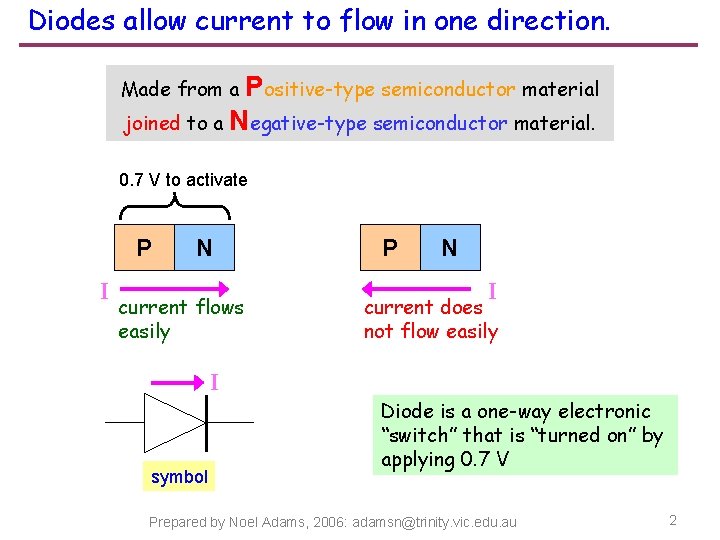
Diodes allow current to flow in one direction. Positive-type semiconductor material joined to a Negative-type semiconductor material. Made from a 0. 7 V to activate P I N current flows easily P N I current does not flow easily I symbol Diode is a one-way electronic “switch” that is “turned on” by applying 0. 7 V Prepared by Noel Adams, 2006: adamsn@trinity. vic. edu. au 2
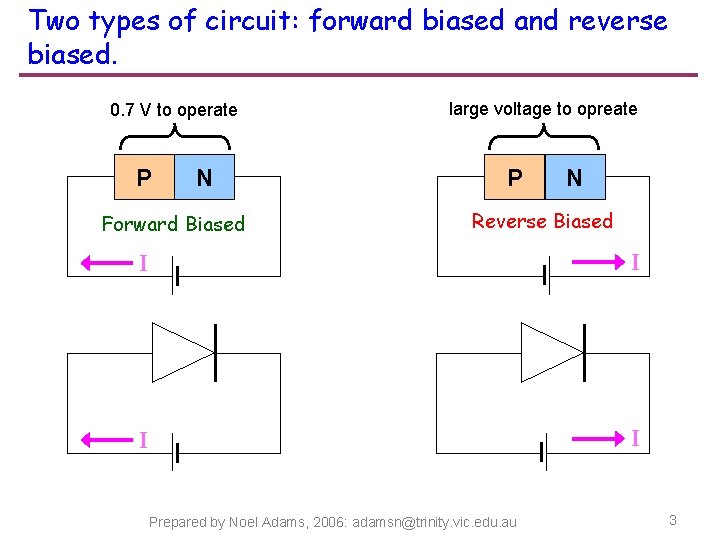
Two types of circuit: forward biased and reverse biased. 0. 7 V to operate P N Forward Biased large voltage to opreate P N Reverse Biased I I Prepared by Noel Adams, 2006: adamsn@trinity. vic. edu. au 3
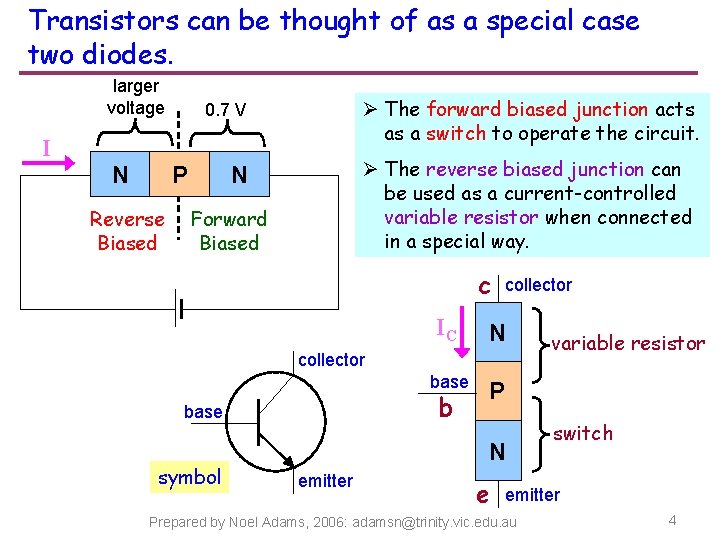
Transistors can be thought of as a special case two diodes. larger voltage I N P Reverse Biased Ø The forward biased junction acts as a switch to operate the circuit. 0. 7 V Ø The reverse biased junction can be used as a current-controlled variable resistor when connected in a special way. N Forward Biased c collector IC N base P collector b base symbol N emitter e variable resistor switch emitter Prepared by Noel Adams, 2006: adamsn@trinity. vic. edu. au 4
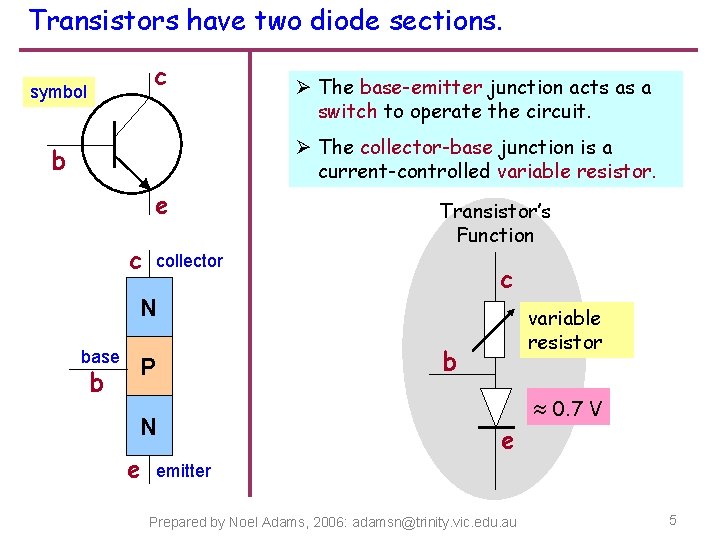
Transistors have two diode sections. c symbol Ø The base-emitter junction acts as a switch to operate the circuit. Ø The collector-base junction is a current-controlled variable resistor. b e c Transistor’s Function collector c N base P b N e variable resistor b e 0. 7 V emitter Prepared by Noel Adams, 2006: adamsn@trinity. vic. edu. au 5
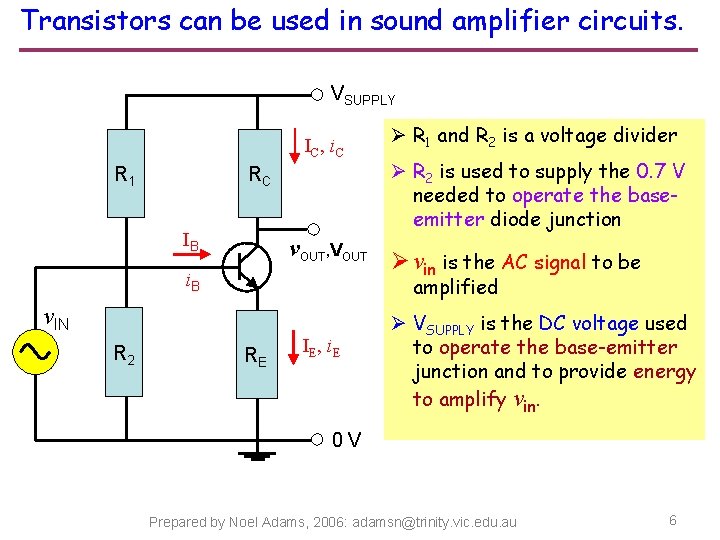
Transistors can be used in sound amplifier circuits. VSUPPLY IC, i. C R 1 RC IB v. OUT, VOUT i. B Ø R 2 is used to supply the 0. 7 V needed to operate the baseemitter diode junction Ø vin is the AC signal to be amplified v. IN R 2 Ø R 1 and R 2 is a voltage divider RE IE , i E Ø VSUPPLY is the DC voltage used to operate the base-emitter junction and to provide energy to amplify vin. 0 V Prepared by Noel Adams, 2006: adamsn@trinity. vic. edu. au 6
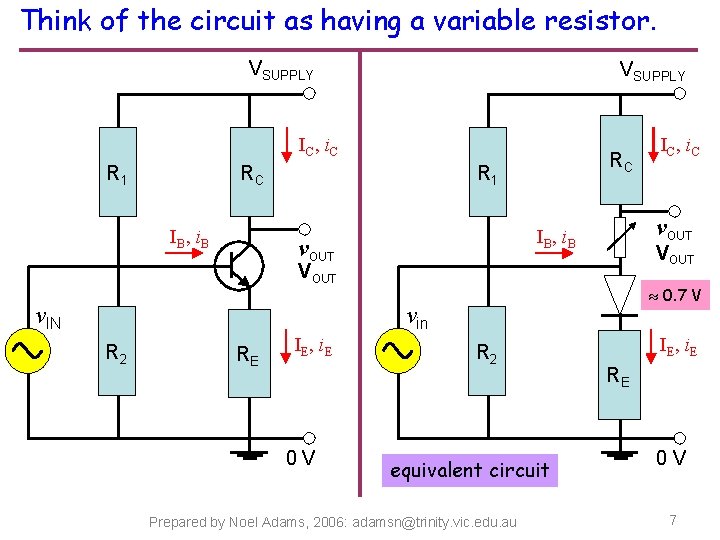
Think of the circuit as having a variable resistor. VSUPPLY IC, i. C R 1 RC IB, i. B RC R 1 v. OUT IB, i. B v. OUT VOUT v. IN 0. 7 V vin R 2 RE IE , i E 0 V IC, i. C R 2 equivalent circuit Prepared by Noel Adams, 2006: adamsn@trinity. vic. edu. au IE , i E RE 0 V 7
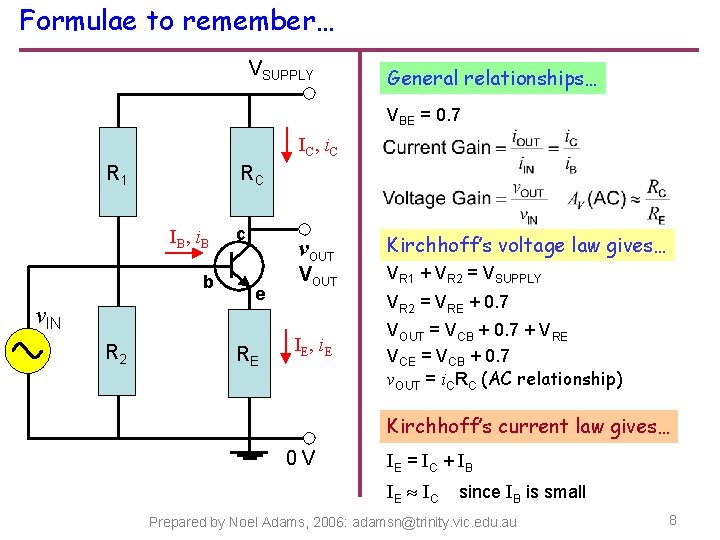
Formulae to remember… VSUPPLY General relationships… VBE = 0. 7 IC, i. C R 1 RC IB, i. B b v. IN R 2 c v. OUT e RE VOUT Kirchhoff’s voltage law gives… VR 1 + VR 2 = VSUPPLY VR 2 = VRE + 0. 7 IE , i E VOUT = VCB + 0. 7 + VRE VCE = VCB + 0. 7 v. OUT = i. CRC (AC relationship) Kirchhoff’s current law gives… 0 V IE = IC + IB IE IC since IB is small Prepared by Noel Adams, 2006: adamsn@trinity. vic. edu. au 8
- Slides: 8