
Prepare Income Statement and Balance Sheet According to
Prepare Income Statement and Balance Sheet According to Accrual Basis Principles of Cost Analysis and Management © Dale R. Geiger 2011 1
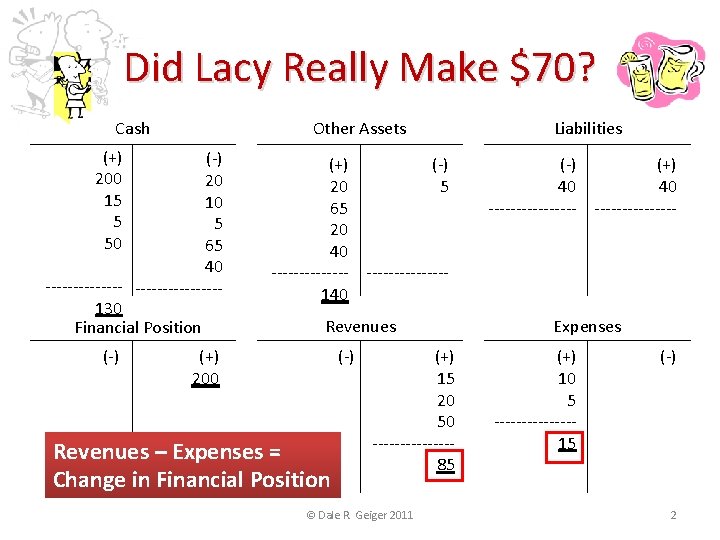
Did Lacy Really Make $70? Cash (+) 200 15 5 50 (-) 20 10 5 65 40 ---------------130 Financial Position (-) Other Assets Liabilities (+) (-) 20 5 65 20 40 --------------140 (-) (+) 40 40 -------- Revenues Expenses (+) 200 (-) Revenues – Expenses = Change in Financial Position (+) 15 20 50 -------85 © Dale R. Geiger 2011 (+) 10 5 -------15 (-) 2
Terminal Learning Objective • Task: Prepare Income Statement and Balance Sheet According to Accrual Basis • Condition: You are a cost advisor technician with access to all regulations/course handouts, and awareness of Operational Environment (OE)/Contemporary Operational Environment (COE) variables and actors. • Standard: with at least 80% accuracy: • • Explain purpose of adjusting transactions Describe types of adjusting transactions Record adjusting transactions in tabular format Identify and enter relevant report data (using macros provided in Excel template) to prepare income statement and balance sheet according to accrual basis © Dale R. Geiger 2011 3
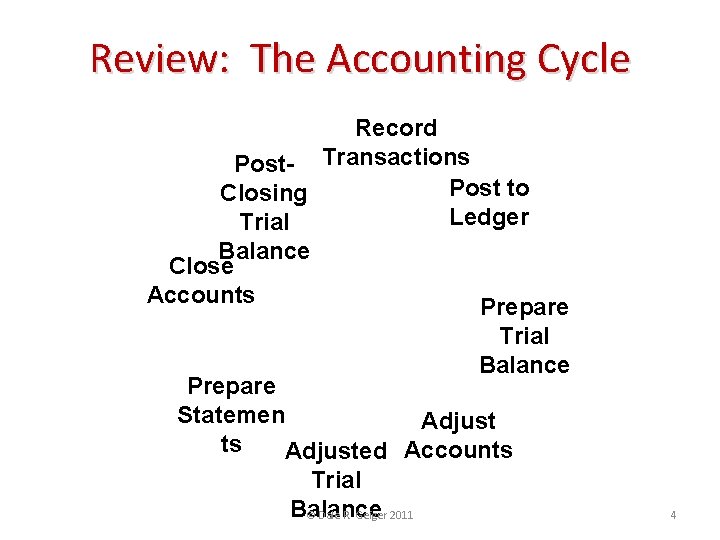
Review: The Accounting Cycle Record Post- Transactions Post to Closing Ledger Trial Balance Close Accounts Prepare Trial Balance Prepare Statemen Adjust ts Adjusted Accounts Trial Balance © Dale R. Geiger 2011 4
Why Adjust Accounts? • Allows financial statements to accurately represent financial position of the entity • Statement of Activities • Correctly report revenues and expenses for the period • Statement of Financial Position • Correctly state ending balances for assets, liabilities and financial position © Dale R. Geiger 2011 5
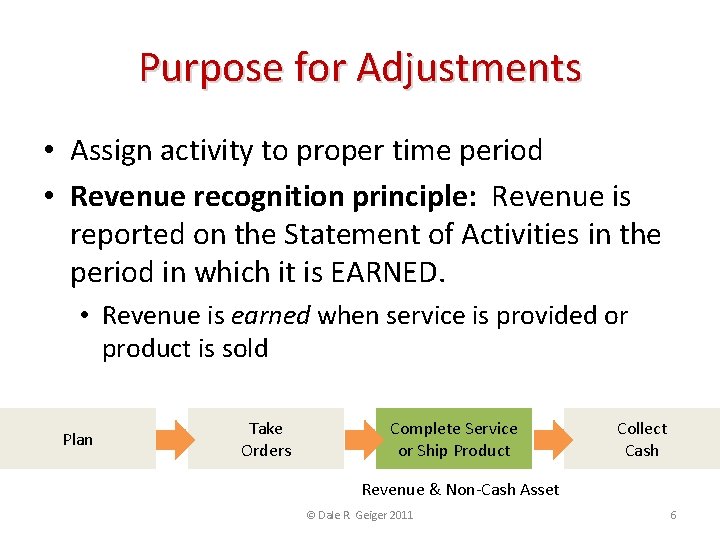
Purpose for Adjustments • Assign activity to proper time period • Revenue recognition principle: Revenue is reported on the Statement of Activities in the period in which it is EARNED. • Revenue is earned when service is provided or product is sold Plan Take Orders Complete Service or Ship Product Collect Cash Revenue & Non-Cash Asset © Dale R. Geiger 2011 6
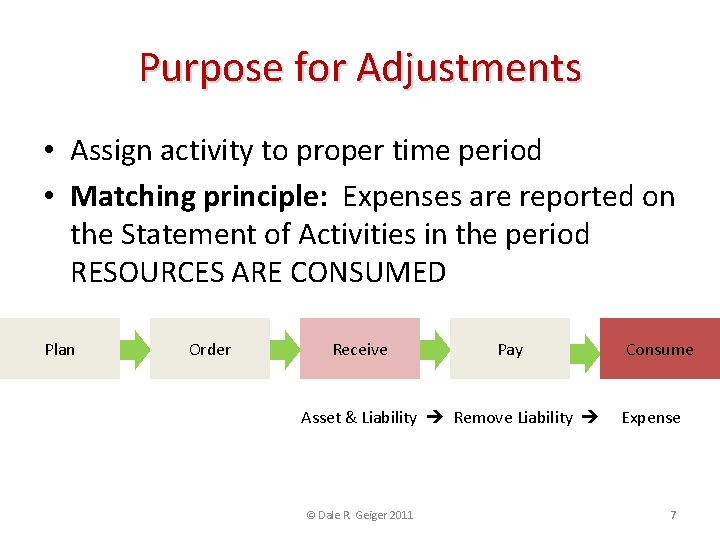
Purpose for Adjustments • Assign activity to proper time period • Matching principle: Expenses are reported on the Statement of Activities in the period RESOURCES ARE CONSUMED Plan Order Receive Pay Consume Asset & Liability Remove Liability Expense © Dale R. Geiger 2011 7
Learning Check • What is the accounting principle that defines when expenses should be reported? • In what period should revenues be reported? © Dale R. Geiger 2011 8
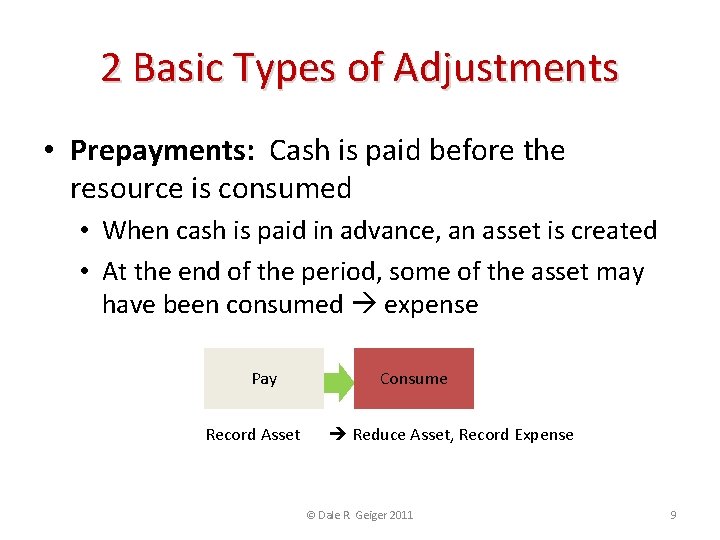
2 Basic Types of Adjustments • Prepayments: Cash is paid before the resource is consumed • When cash is paid in advance, an asset is created • At the end of the period, some of the asset may have been consumed expense Pay Consume Record Asset Reduce Asset, Record Expense © Dale R. Geiger 2011 9
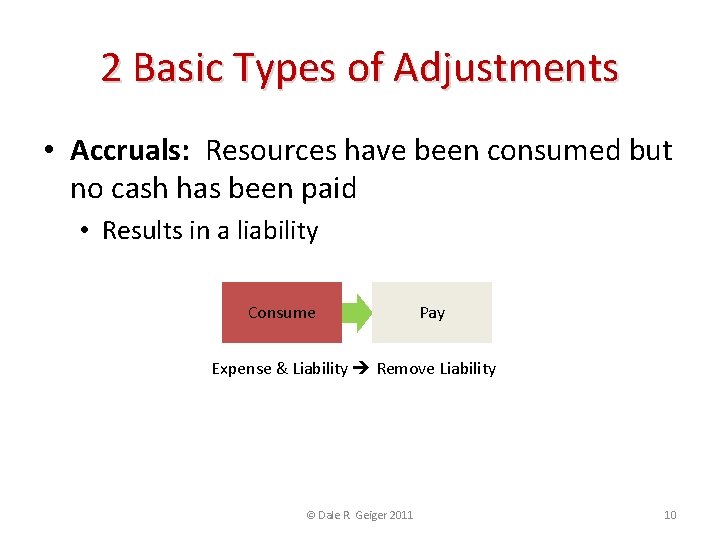
2 Basic Types of Adjustments • Accruals: Resources have been consumed but no cash has been paid • Results in a liability Consume Pay Expense & Liability Remove Liability © Dale R. Geiger 2011 10
Inventory and Cost of Goods Sold • Goods and materials that are manufactured or purchased for resale • Hold as assets on the Statement of Financial Position until sold • Record as expense “Cost of Goods Sold” on the Statement of Activities when sold © Dale R. Geiger 2011 11
Equipment and Depreciation • Depreciation is the accounting process of assigning a portion of equipment’s cost to the periods in which it is used • A portion of the benefit of owning the equipment has been received in the current period expense • The future benefit is reduced © Dale R. Geiger 2011 12
Rules for Adjustments • Each adjustment will affect ONE account from the Statement of Activities and ONE account from the Statement of Financial Position • Adjustments will NEVER affect the cash account © Dale R. Geiger 2011 13
Learning Check • Which type of adjustment is called for when resources are consumed before cash is paid? • Which account will never be affected by adjusting transactions? © Dale R. Geiger 2011 14
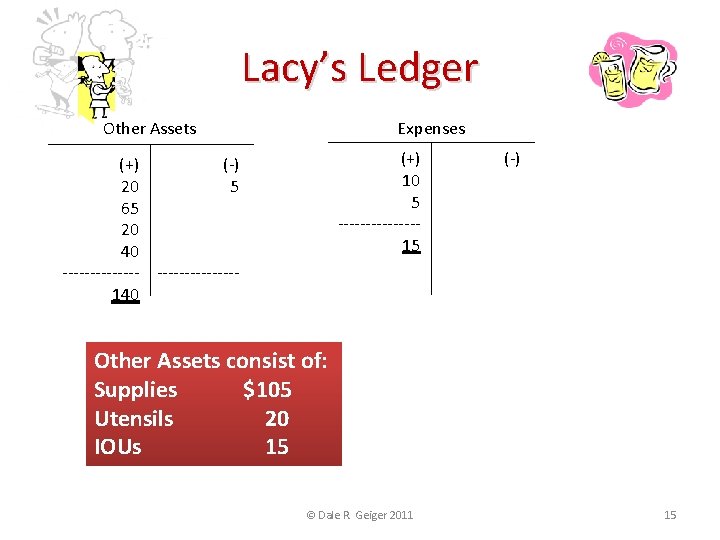
Lacy’s Ledger Other Assets Expenses (+) 10 5 -------15 (+) (-) 20 5 65 20 40 --------------140 (-) Other Assets consist of: Supplies $105 Utensils 20 IOUs 15 © Dale R. Geiger 2011 15
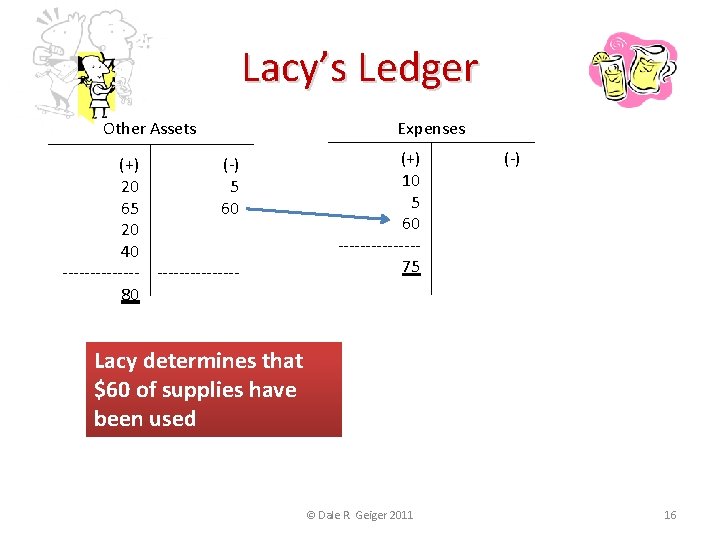
Lacy’s Ledger Other Assets Expenses (+) 10 5 60 -------75 (+) (-) 20 5 65 60 20 40 --------------80 (-) Lacy determines that $60 of supplies have been used © Dale R. Geiger 2011 16
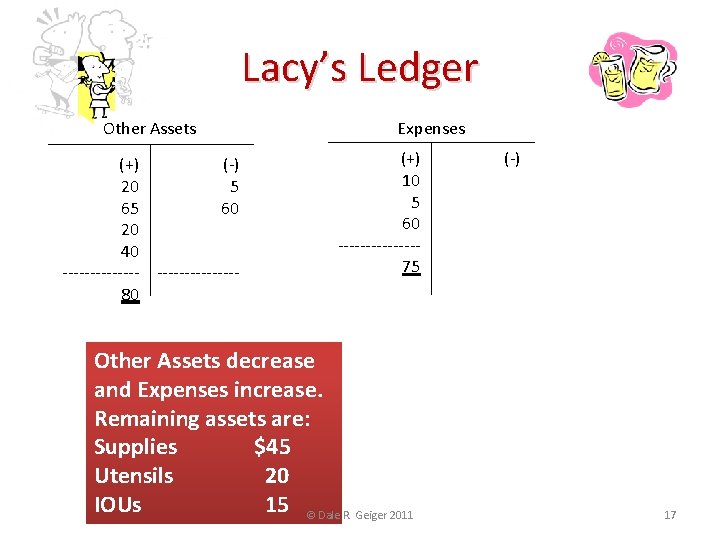
Lacy’s Ledger Other Assets (+) (-) 20 5 65 60 20 40 --------------80 Expenses (+) 10 5 60 -------75 Other Assets decrease and Expenses increase. Remaining assets are: Supplies $45 Utensils 20 IOUs 15 © Dale R. Geiger 2011 (-) 17
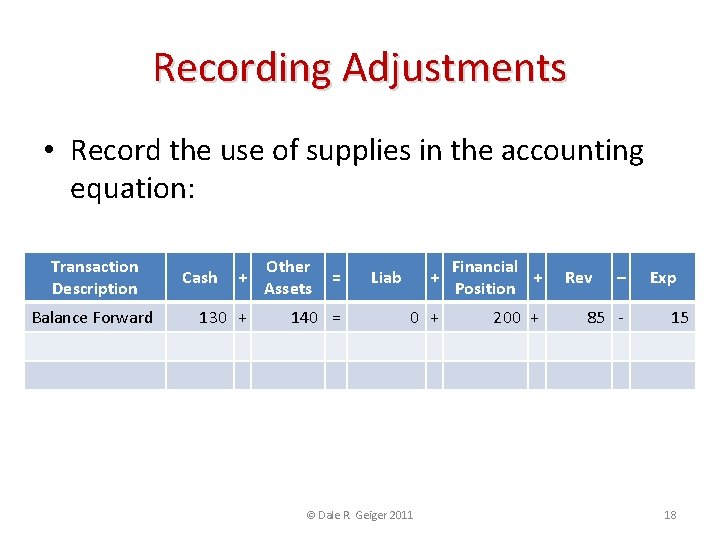
Recording Adjustments • Record the use of supplies in the accounting equation: Transaction Description Balance Forward + Other = Assets 130 + 140 = Cash + Financial + Position 0 + 200 + Liab © Dale R. Geiger 2011 Rev – 85 - Exp 15 18
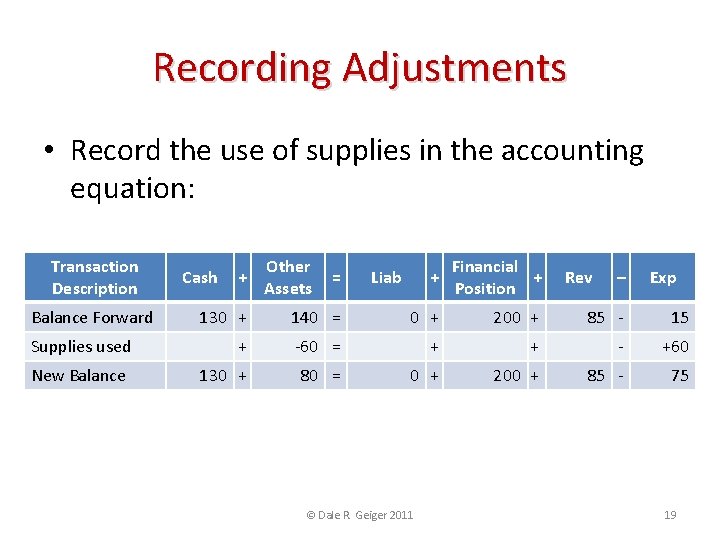
Recording Adjustments • Record the use of supplies in the accounting equation: Transaction Description + Other = Assets 130 + Supplies used New Balance Forward + Financial + Position 140 = 0 + 200 + 85 - 15 + -60 = + + - +60 130 + 80 = 0 + 200 + 85 - 75 Cash Liab © Dale R. Geiger 2011 Rev – Exp 19
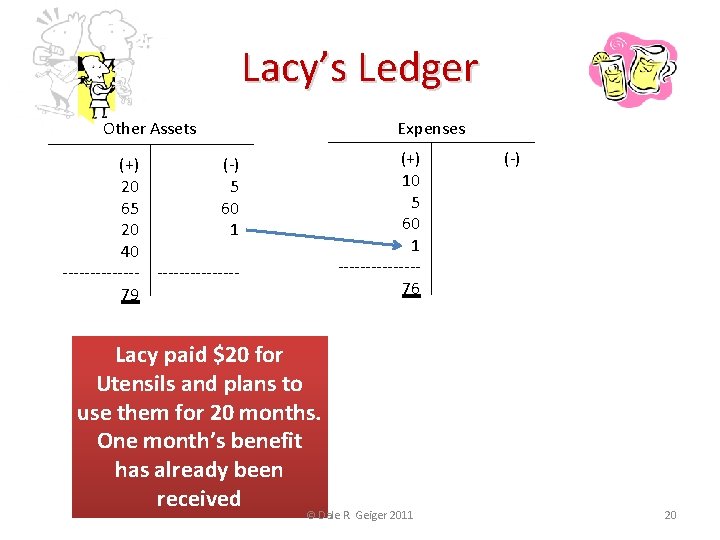
Lacy’s Ledger Other Assets Expenses (+) 10 5 60 1 -------76 (+) (-) 20 5 65 60 20 1 40 --------------79 Lacy paid $20 for Utensils and plans to use them for 20 months. One month’s benefit has already been received © Dale R. Geiger 2011 (-) 20
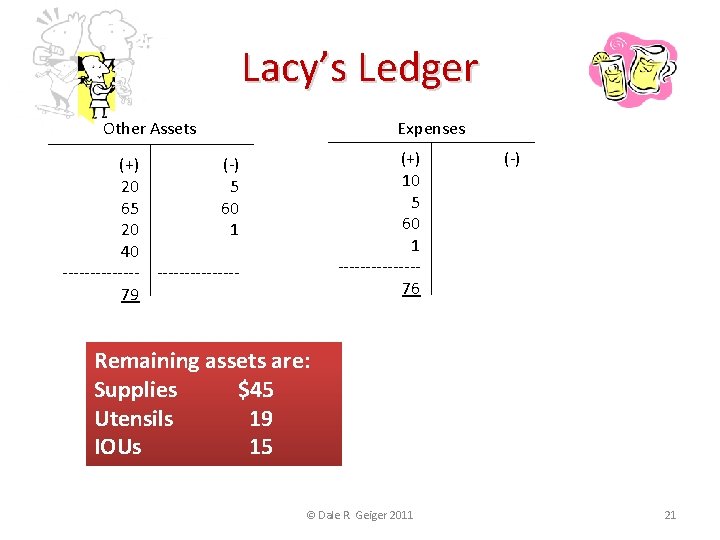
Lacy’s Ledger Other Assets Expenses (+) 10 5 60 1 -------76 (+) (-) 20 5 65 60 20 1 40 --------------79 (-) Remaining assets are: Supplies $45 Utensils 19 IOUs 15 © Dale R. Geiger 2011 21
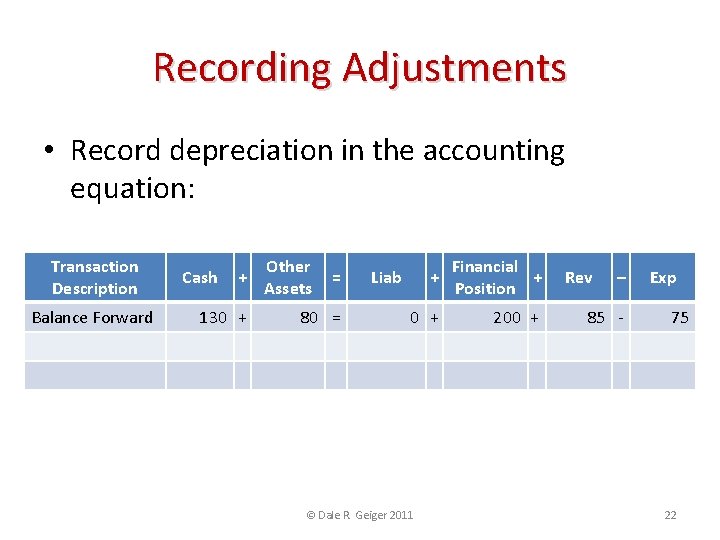
Recording Adjustments • Record depreciation in the accounting equation: Transaction Description Balance Forward + Other = Assets 130 + 80 = Cash + Financial + Position 0 + 200 + Liab © Dale R. Geiger 2011 Rev – 85 - Exp 75 22
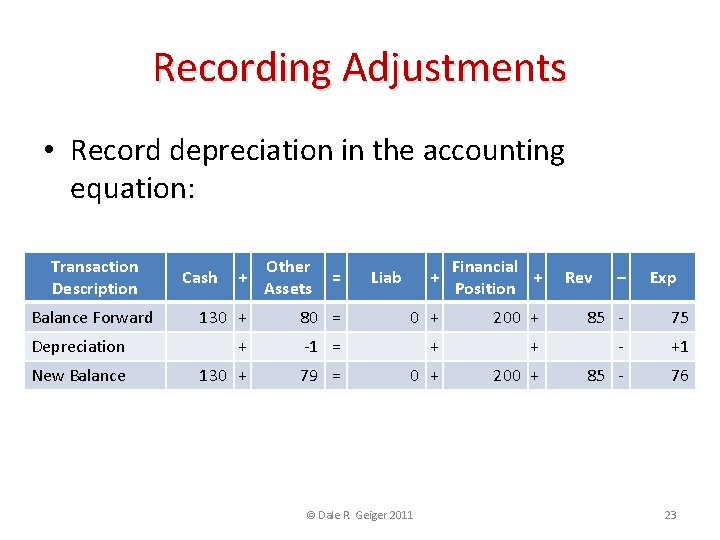
Recording Adjustments • Record depreciation in the accounting equation: Transaction Description + Other = Assets 130 + Depreciation New Balance Forward + Financial + Position 80 = 0 + 200 + 85 - 75 + -1 = + + - +1 130 + 79 = 0 + 200 + 85 - 76 Cash Liab © Dale R. Geiger 2011 Rev – Exp 23
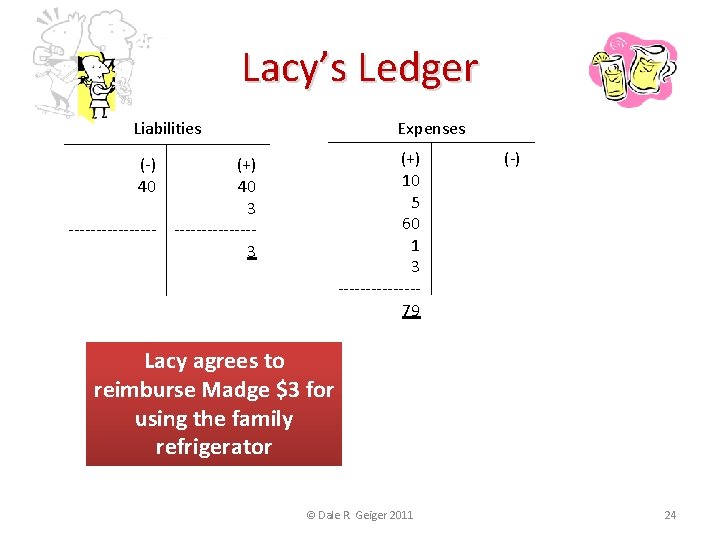
Lacy’s Ledger Liabilities (-) 40 (+) 40 3 --------3 Expenses (+) 10 5 60 1 3 -------79 (-) Lacy agrees to reimburse Madge $3 for using the family refrigerator © Dale R. Geiger 2011 24
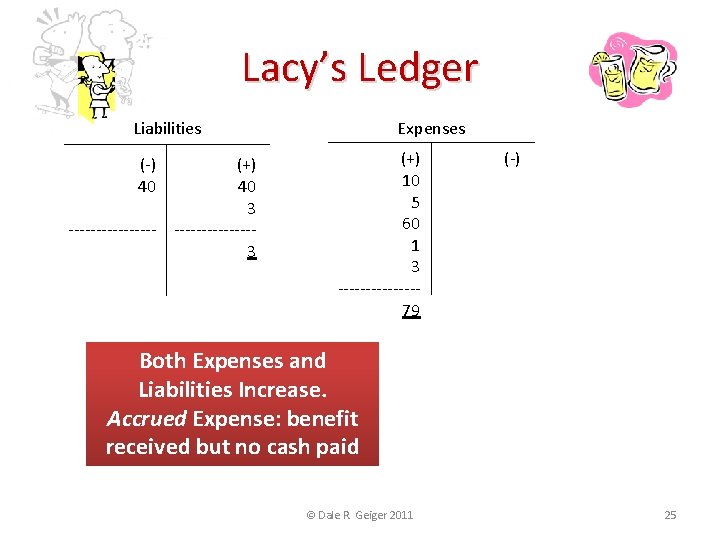
Lacy’s Ledger Liabilities (-) 40 (+) 40 3 --------3 Expenses (+) 10 5 60 1 3 -------79 (-) Both Expenses and Liabilities Increase. Accrued Expense: benefit received but no cash paid © Dale R. Geiger 2011 25
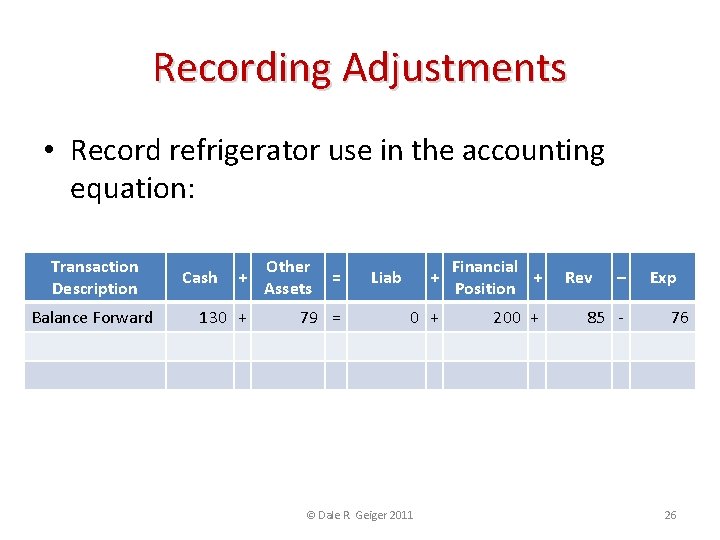
Recording Adjustments • Record refrigerator use in the accounting equation: Transaction Description Balance Forward + Other = Assets 130 + 79 = Cash + Financial + Position 0 + 200 + Liab © Dale R. Geiger 2011 Rev – 85 - Exp 76 26
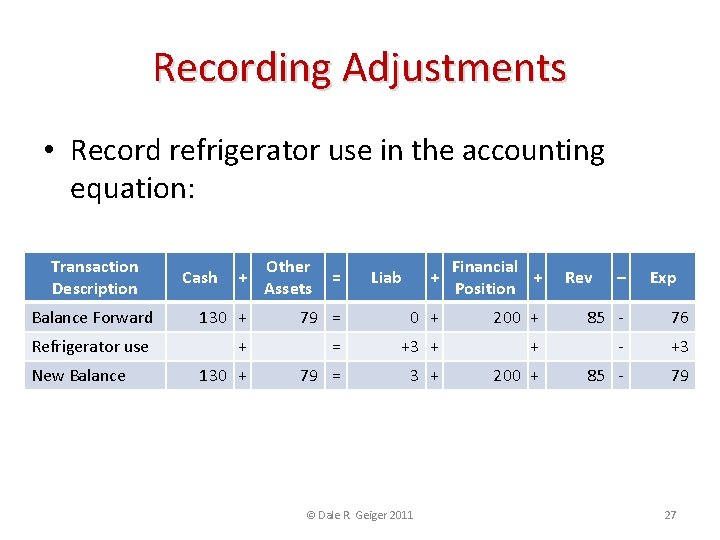
Recording Adjustments • Record refrigerator use in the accounting equation: Transaction Description + Other = Assets Balance Forward 130 + Refrigerator use New Balance + Financial + Position 79 = 0 + 200 + 85 - 76 + = +3 + + - +3 130 + 79 = 3 + 200 + 85 - 79 Cash Liab © Dale R. Geiger 2011 Rev – Exp 27
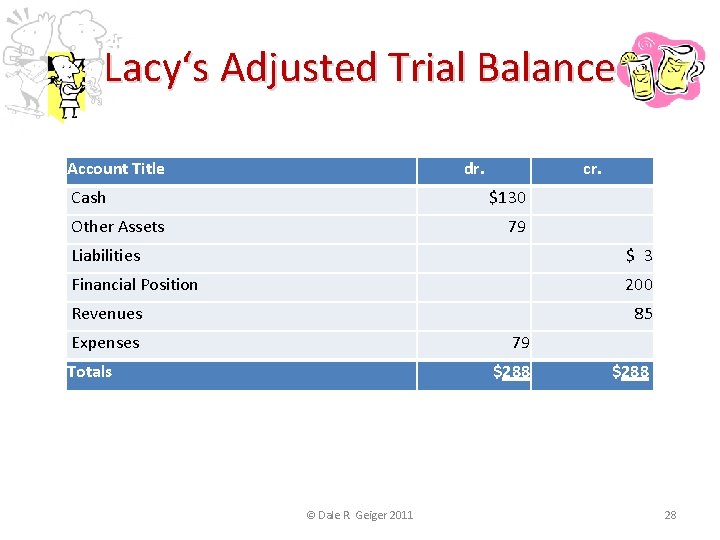
Lacy‘s Adjusted Trial Balance Account Title dr. Cash cr. $130 79 Liabilities $ 3 Financial Position 200 Revenues 85 Expenses 79 $288 Other Assets Totals © Dale R. Geiger 2011 28
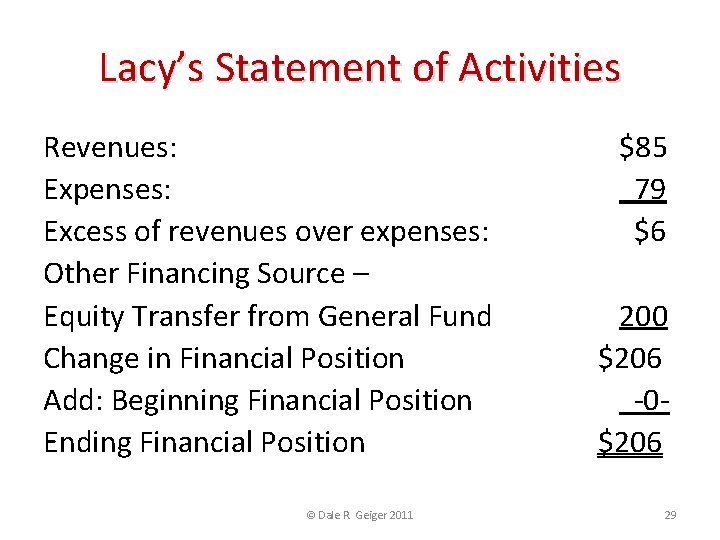
Lacy’s Statement of Activities Revenues: Expenses: Excess of revenues over expenses: Other Financing Source – Equity Transfer from General Fund Change in Financial Position Add: Beginning Financial Position Ending Financial Position © Dale R. Geiger 2011 $85 79 $6 200 $206 -0 $206 29
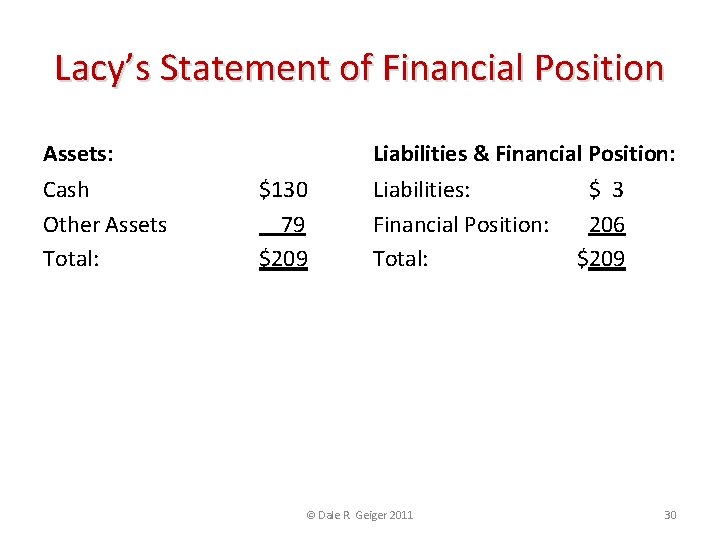
Lacy’s Statement of Financial Position Assets: Cash Other Assets Total: Liabilities & Financial Position: $130 79 $209 Liabilities: $ 3 Financial Position: 206 Total: $209 © Dale R. Geiger 2011 30
Learning Check • Which adjusting transaction resulted in a liability? • Which adjusting transaction(s) reduced assets? © Dale R. Geiger 2011 31
Practical Exercise © Dale R. Geiger 2011 32
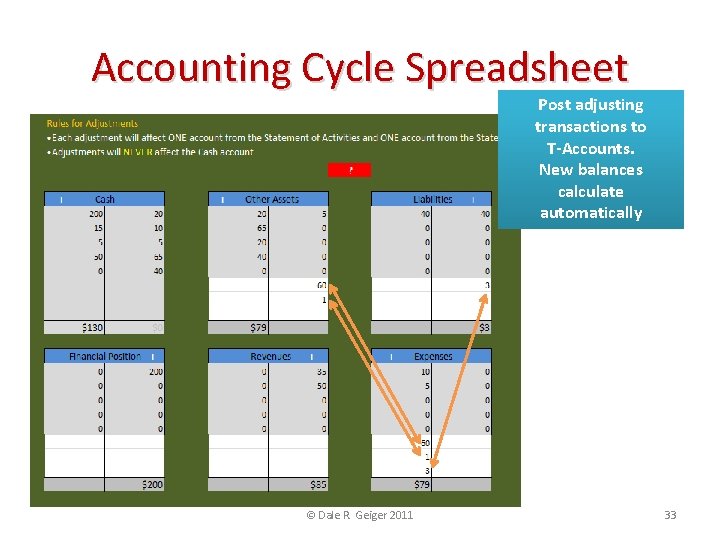
Accounting Cycle Spreadsheet Post adjusting transactions to T-Accounts. New balances calculate automatically © Dale R. Geiger 2011 33
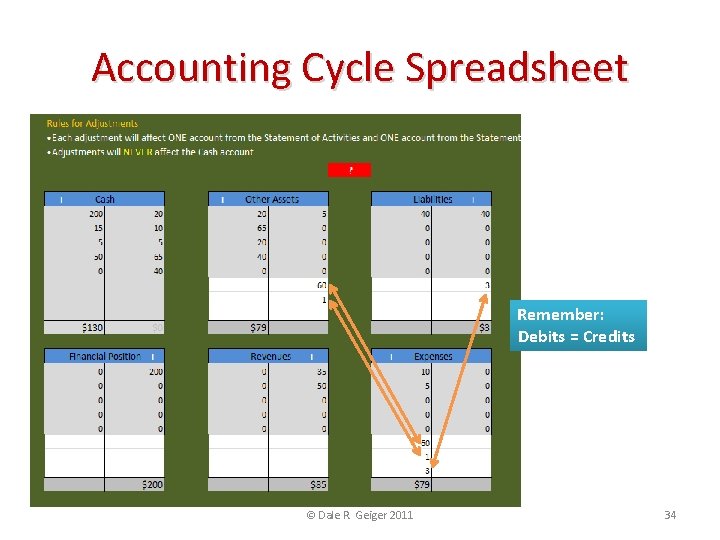
Accounting Cycle Spreadsheet Remember: Debits = Credits © Dale R. Geiger 2011 34
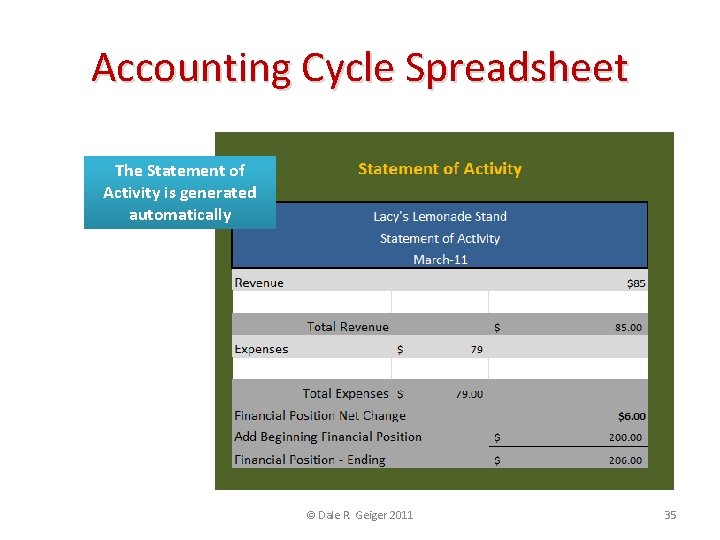
Accounting Cycle Spreadsheet The Statement of Activity is generated automatically © Dale R. Geiger 2011 35
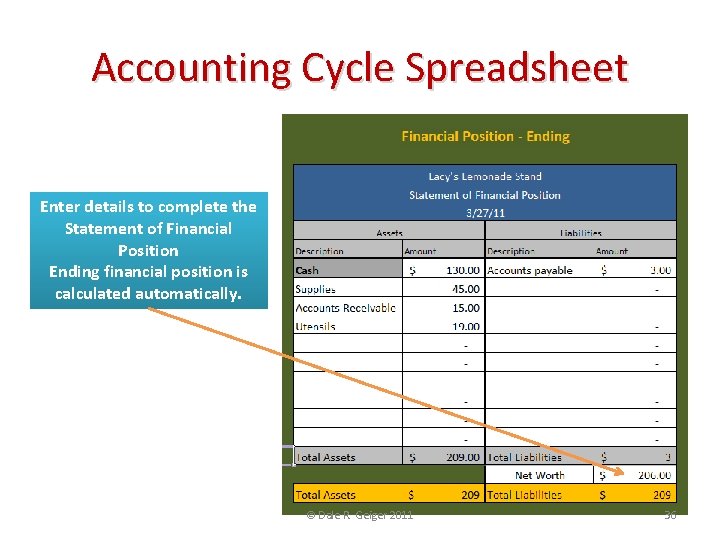
Accounting Cycle Spreadsheet Enter details to complete the Statement of Financial Position Ending financial position is calculated automatically. © Dale R. Geiger 2011 36
Practical Exercise © Dale R. Geiger 2011 37
- Slides: 37