
PREPARE FINANCIAL STATEMENTS D 1 HFI CL 8

- Slides: 79
PREPARE FINANCIAL STATEMENTS D 1. HFI. CL 8. 06 D 1 HFA. CL 7. 04 D 2. TFA. CL 7. 06 Slide 1
Introduction Prepare financial statements � Classroom schedule � Trainer contact details � Assessments � Resources: • Calculator, pen and paper Slide 2
Introduction Ice breaker: � What is your name? � Where do you live? � Why are you doing this course? � Where do you work? � What do you like most about your workplace? � Have you studied a module or unit similar to this before? Slide 3
The Accounting system � A Definition of Accounting: “The systematic recording, reporting and analysis of financial transactions of a business. ” � The Accounting System The people and the processes by which an organisation records, reports and analyses financial transactions Slide 4
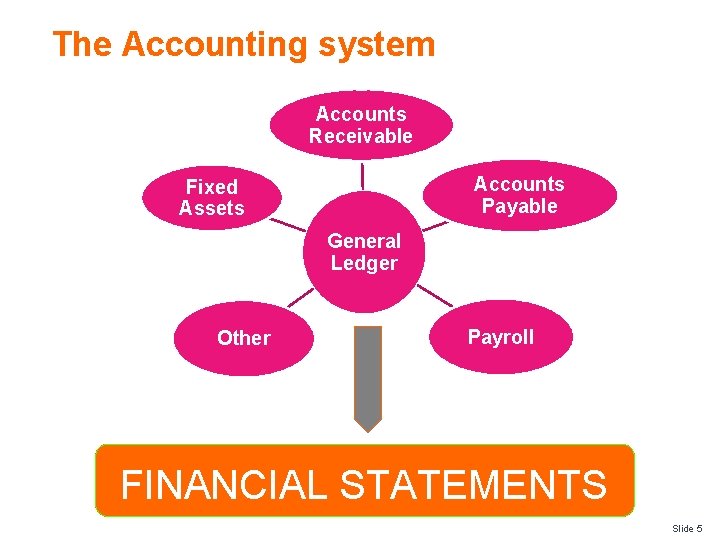
The Accounting system Accounts Receivable Accounts Payable Fixed Assets General Ledger Other Payroll FINANCIAL STATEMENTS Slide 5
Financial statements – theory � What are financial statements? • Financial transactions, activities and events • Summary � Why are financial statements prepared? • Financial performance and position • Growth and the future � Who prepares financial statements • Personnel involved Slide 6
Financial statements – theory Key characteristics of the tourism and hospitality industry � Sales volatility • Seasonal • Daily turnover � Product perishability • Food and beverage outlets • Accommodation venues Slide 7
Financial statements – theory Key characteristics (continued) � High fixed costs • Accommodation venues • Relationship to profit � Labour intensive activities • People business • Cost Slide 8
Financial Statements – theory Two categories of financial statements 1. Financial accounting 2. Management accounting Slide 9
Financial Statements – theory Financial accounting reports: � Terminology differences • Location • External and internal requirements � Profit and loss statement � Balance sheet � Statement of changes in equity � Statement of cash flows Slide 10
Financial Statements – theory Management accounting reports: � Profit and loss summary � Balance sheet � Revenue report � Bank reconciliation statement � Fixed asset register Slide 11
Financial Statements – theory How often are financial statements produced? � Arbitrary reporting periods of equal length � Ownership � Financial and management accounting reports Slide 12
Financial Statements – theory Financial accounting reports: � Regulatory requirements • Annually • Interim reports � Internal users • Threshold guidelines • Monitor, review and evaluate financial transactions • Support decision making Slide 13
Financial Statements – theory Management accounting reports: � Internal use only � Address key characteristics of the industry � Size and scope of organisation � Information required by interested parties Slide 14
Financial Statements – theory True and Fair View: � What does this mean? � Accounting standards � Implication for hospitality and tourism • Revenue • Assets • Costs Slide 15
Financial Statements – theory Considerations: � Disclosure • Factors • Relevant reports � Confidentiality • Work practices • Preparation of financial data • Distribution of reports Slide 16
Financial Statements – theory Considerations (continued): � Access to information • Outside the organisation • Statistical data for analysis • Market value or trading data Slide 17
Financial Statements – theory Assumptions underlying financial reports: � Jigsaw activity • Discuss and provide an explanation for the key assumptions given to your group. Use examples where you can • Create a class set of explanations and examples based on this activity Slide 18
Financial Statements – theory The format for financial reports: � Accounting standards and principles • GAAP • Local guidelines � Uniform system of accounts – USALI • Guided by activity • Location or region � External requirements Slide 19
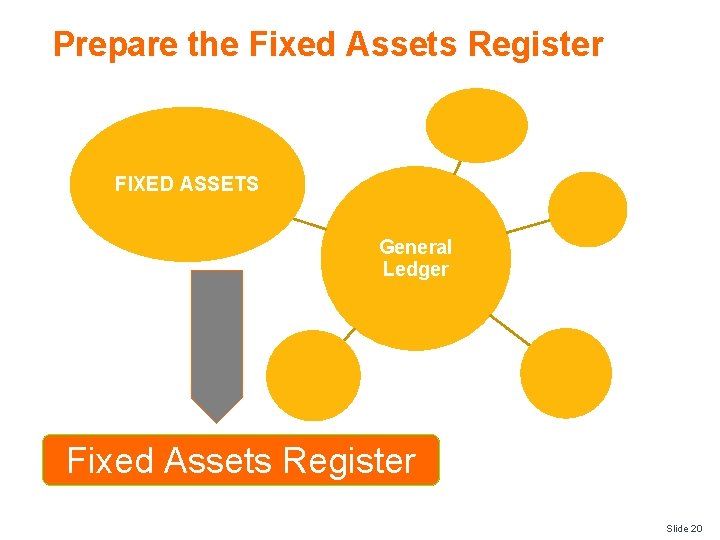
Prepare the Fixed Assets Register FIXED ASSETS General Ledger Fixed Assets Register Slide 20
Prepare the Fixed assets register Key concepts: � Relationship to revenue � Current and non-current assets • Examples from tourism and hospitality � Internal control to safeguard assets • Substantial investment � Cost principle Slide 21
Prepare the Fixed assets register What does a fixed asset register look like? � Activity • Create an example of a fixed asset register to share with the group for a hospitality or tourism organisation Slide 22
Prepare the Fixed assets register Format of a register should include: � Administrative details • Unique asset code • Description of the asset • Location of the asset • General ledger code • General ledger sub-category details Slide 23
Prepare the Fixed assets register Format of a register should include: � Purchase details • Date of purchase • Purchase price � Valuation details • Residual value • Useful life • Depreciation rate and method Slide 24
Prepare the Fixed assets register Format of a register should include: � Cumulative values • Accumulated depreciation • Book value or Net Book Value � Disposal details (where relevant) • Disposal date • Disposal price • General ledger adjustments Slide 25
Prepare the Fixed assets register Depreciation: � It may not be what you think… � Why is it calculated? � When is the calculation performed? � Remember there is no monetary exchange! Slide 26
Prepare the Fixed assets register Key terms and phrases: � Depreciation methods � Depreciation rate � Useful life � Residual or salvage value � Book value or Net book value � Accumulated depreciation Slide 27
Prepare the Fixed assets register Depreciation methods: Straight-line depreciation � � • Equal charge across life of the asset • Always calculates annual depreciation charge Method 1 – Depreciation rate • Purchase price X Depreciation rate = Annual depreciation charge Slide 28
Prepare the fixed assets register Depreciation methods: � Method 2 – Useful life Purchase price – residual value Useful life of the asset = Annual depreciation charge • Remember that residual value and useful life are estimates • CAUTION : ANNUAL CHARGE Slide 29
Prepare the Fixed assets register Depreciation methods: Reduced balance method � • Use asset more in earlier years • Always calculates annual depreciation charge Only one method but two steps � • Calculate Net book value • Calculate depreciation charge Slide 30
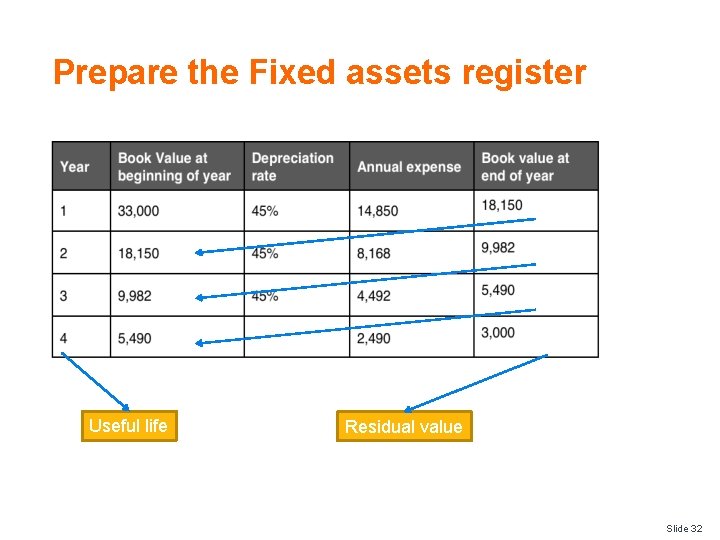
Prepare the Fixed assets register Reduced balance method: Calculate Net Book Value � • Book Value – Accumulated depreciation = Net Book Value • Previous period data used Depreciation charge � • Net Book Value X Depreciation rate = Annual Depreciation charge Slide 31
Prepare the Fixed assets register Useful life Residual value Slide 32
Prepare the Fixed assets register Maintaining the fixed assets register: � Why? • Accurate and timely information • Valuation � Integrity and security of data • Secure access • Authorised changes • Assets sighted Slide 33
Prepare the Fixed assets register Maintaining the fixed assets register: � Periodic updates • Financial reports • Physical count • Annual reviews � Purchases of fixed assets • Asset sighted • Asset categorised • Depreciation details Slide 34
Prepare the Fixed assets register Maintaining the fixed assets register: � Disposal of fixed assets • Authorisation • Valuations • Adjustments Slide 35
Prepare the Fixed assets register Produce the fixed assets register report: � Format • To meet internal requirements � Frequency • Reconcile to the general ledger • Significant updates • Other internal time requirements Slide 36
Prepare the Fixed assets register Produce the fixed assets register report: � Examples • Annual review • Record of changes • Depreciation schedule • Management decision making Slide 37
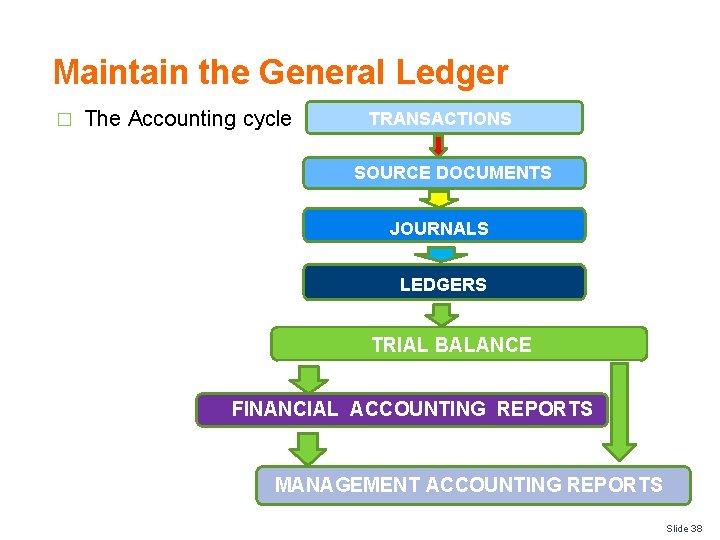
Maintain the General Ledger � The Accounting cycle TRANSACTIONS SOURCE DOCUMENTS JOURNALS LEDGERS TRIAL BALANCE FINANCIAL ACCOUNTING REPORTS MANAGEMENT ACCOUNTING REPORTS Slide 38
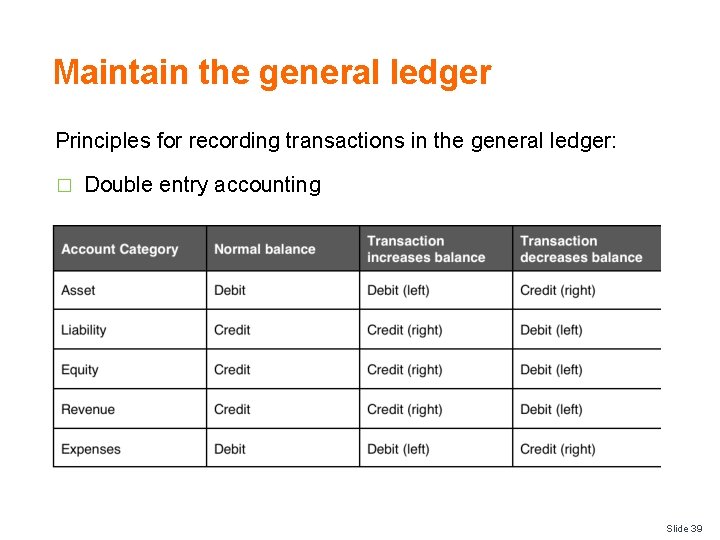
Maintain the general ledger Principles for recording transactions in the general ledger: � Double entry accounting Slide 39
Maintain the general ledger Principles for recording transactions in the general ledger: � Double entry accounting Slide 40
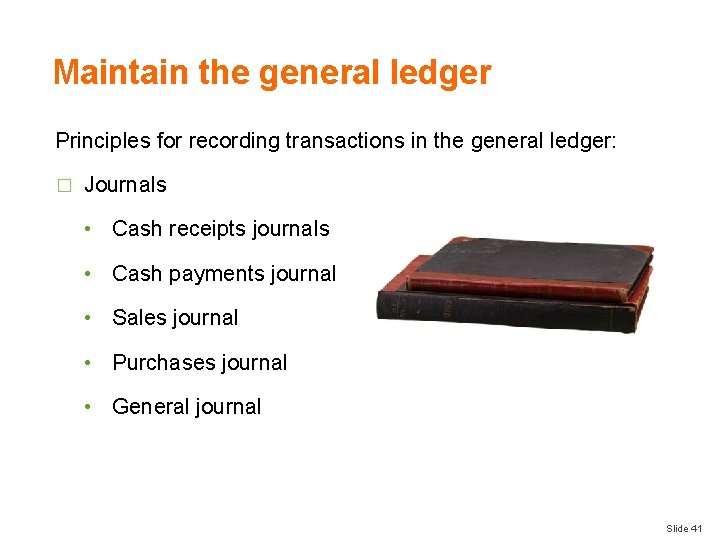
Maintain the general ledger Principles for recording transactions in the general ledger: � Journals • Cash receipts journals • Cash payments journal • Sales journal • Purchases journal • General journal Slide 41
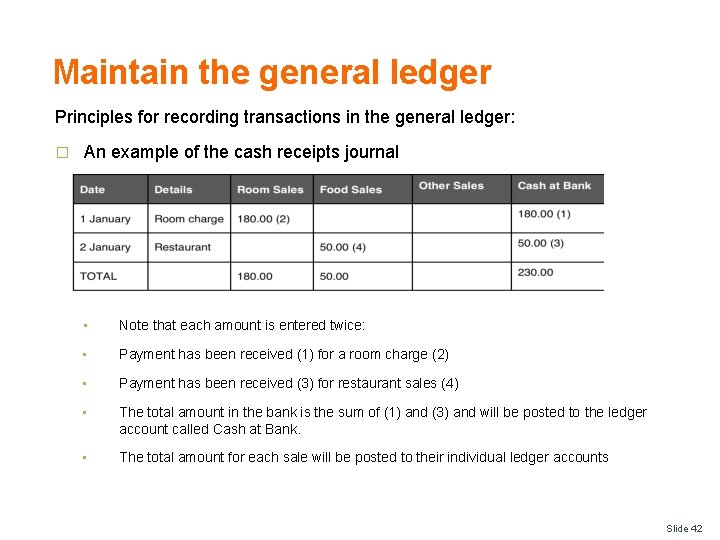
Maintain the general ledger Principles for recording transactions in the general ledger: � An example of the cash receipts journal • Note that each amount is entered twice: • Payment has been received (1) for a room charge (2) • Payment has been received (3) for restaurant sales (4) • The total amount in the bank is the sum of (1) and (3) and will be posted to the ledger account called Cash at Bank. • The total amount for each sale will be posted to their individual ledger accounts Slide 42
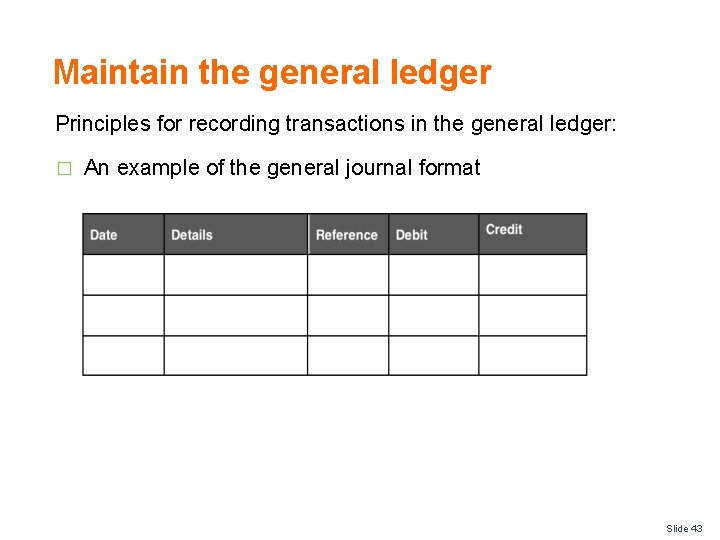
Maintain the general ledger Principles for recording transactions in the general ledger: � An example of the general journal format Slide 43
Maintain the general ledger Principles for recording transactions in the general ledger: � � Ledger accounts • Classified into revenue, expense, asset, liabilities and equity • Unique code • Current balance maintained Subsidiary ledger accounts • Different from journals • Reconciled to the main ledger account Slide 44
Maintain the general ledger Principles for recording transactions in the general ledger: � � External transactions • Source document recorded • Journal totals “posted” to the appropriate general ledger accounts • Subsidiary ledgers balanced, reconciled and details posted Internal transactions • General journal • Subsidiary ledgers Slide 45
Maintain the general ledger Activity Record the following transactions in the general journal for an accommodation venue: � 2, 500 cash received for room sales � Cash paid of 400 to staff for wages � Rent paid for one month of 1, 000 � 400 paid for advertising expenses Slide 46
Maintain the general ledger The trial balance: Activity � What is the trial balance? � Why is a trial balance prepared? � Format for the trial balance � When is the trial balance prepared? Slide 47
Maintain the general ledger Key concepts when preparing the trial balance: � Debits must equal Credits • BEWARE the computerised accounting system � Checklist for locating and adjusting errors � General journal records adjustments Slide 48
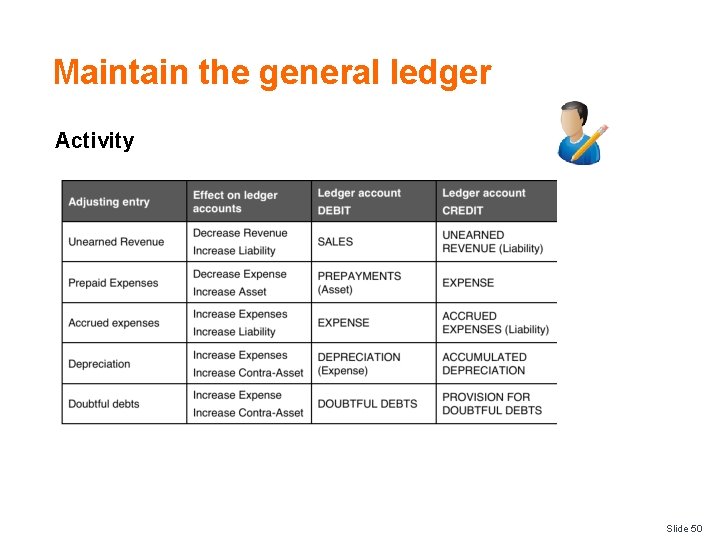
Maintain the general ledger Adjusting entries � What is an adjusting entry? � Tourism and hospitality examples � Accounting principles • Accrual assumption • Matching principle • Revenue recognition principle � General journal � Posted to the general ledger Slide 49
Maintain the general ledger Activity Slide 50
Maintain the general ledger Closing the general ledger: � The process � Financial accounting reports � Management accounting reports � Closing entries � Reversing entries Slide 51
Prepare the Bank Reconciliation Introduction: � Definition of cash � Safeguarding cash � • Revenue • Hospitality and tourism industry Internal controls • Collection and counting • Transfer • Storage Slide 52
Prepare the Bank Reconciliation The general ledger bank account: � What does it include? � How is it updated? • Cash journals • General journal � Increases and decreases to the cash balance • Debits and credits Slide 53
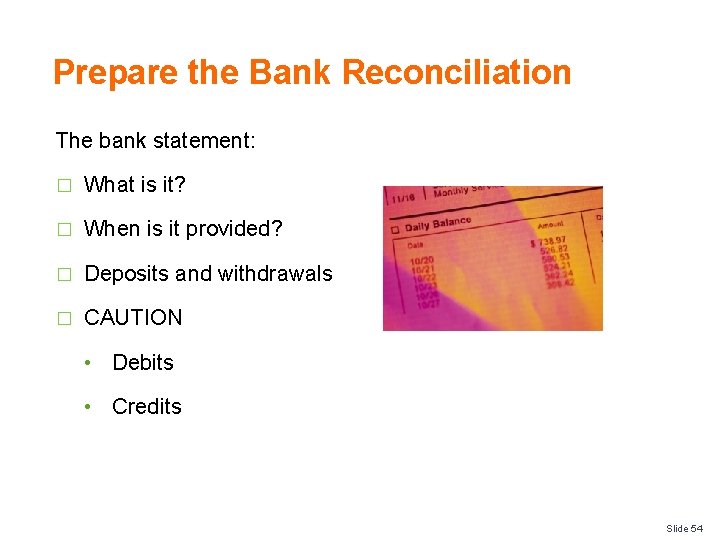
Prepare the Bank Reconciliation The bank statement: � What is it? � When is it provided? � Deposits and withdrawals � CAUTION • Debits • Credits Slide 54
Prepare the Bank Reconciliation The bank reconciliation: � Verifying the balances agree • General ledger bank account • Bank statement � Are there differences? • Timing • Errors • Dishonoured payments • Other Slide 55
Prepare the Bank Reconciliation The bank reconciliation: � Prepare your workspace • Secure • Documentation • Access to general ledger accounts • Access to computerised bank account if appropriate • Notes and workplace procedures Slide 56
Prepare the Bank Reconciliation The bank reconciliation: � Check outstanding items • Previous period � Compare deposit entries • Cash receipts journal = cash deposits in bank account • CAUTION - Individual and daily amounts • Mark entries that appear in both locations Slide 57
Prepare the Bank Reconciliation The bank reconciliation: � Investigate missing deposit entries • In accounting system, update as appropriate • In bank statement, timing difference • Bank error, only adjusted by bank � Differences • Recorded on the bank reconciliation statement Slide 58
Prepare the Bank Reconciliation The bank reconciliation: � Compare withdrawal entries • Cash payments journal = cash withdrawals from the bank account • Mark entries that appear in both locations • Generally, entries appear individually Slide 59
Prepare the Bank Reconciliation The bank reconciliation: � Investigate missing withdrawals • In accounting system, clerical errors • In bank statement, unpresented cheques • Items originated from bank, update accounting system • Bank error, only adjusted by bank � Differences • Recorded on the bank reconciliation statement Slide 60
Prepare the Bank Reconciliation The bank reconciliation: � Fees and charges • Identify • Update accounting system � Differences • Recorded on the bank reconciliation statement Slide 61
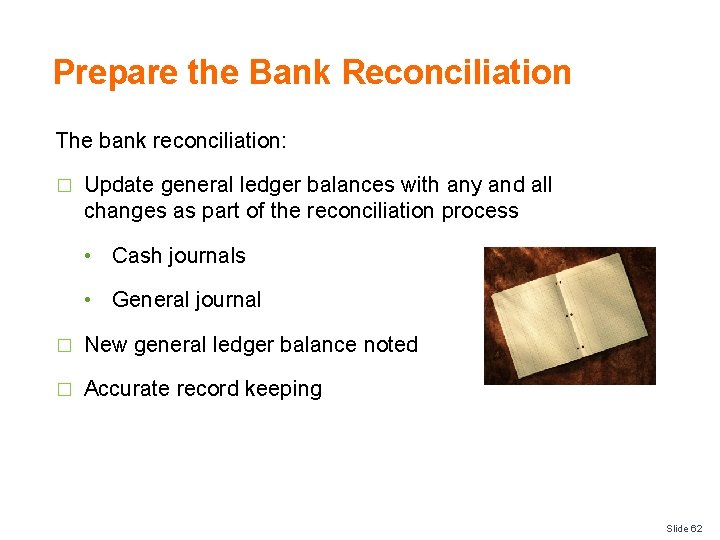
Prepare the Bank Reconciliation The bank reconciliation: � Update general ledger balances with any and all changes as part of the reconciliation process • Cash journals • General journal � New general ledger balance noted � Accurate record keeping Slide 62
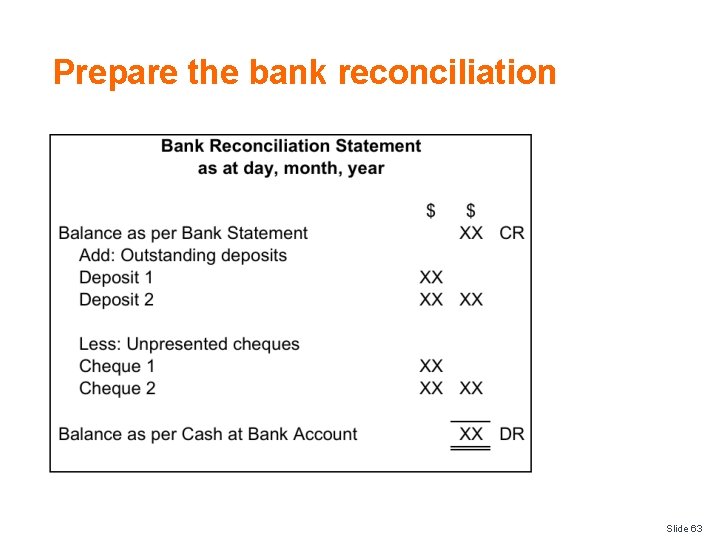
Prepare the bank reconciliation Slide 63
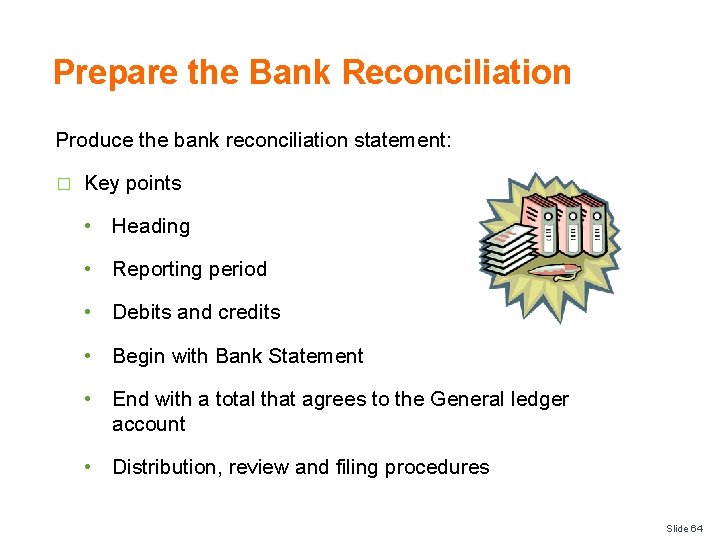
Prepare the Bank Reconciliation Produce the bank reconciliation statement: � Key points • Heading • Reporting period • Debits and credits • Begin with Bank Statement • End with a total that agrees to the General ledger account • Distribution, review and filing procedures Slide 64
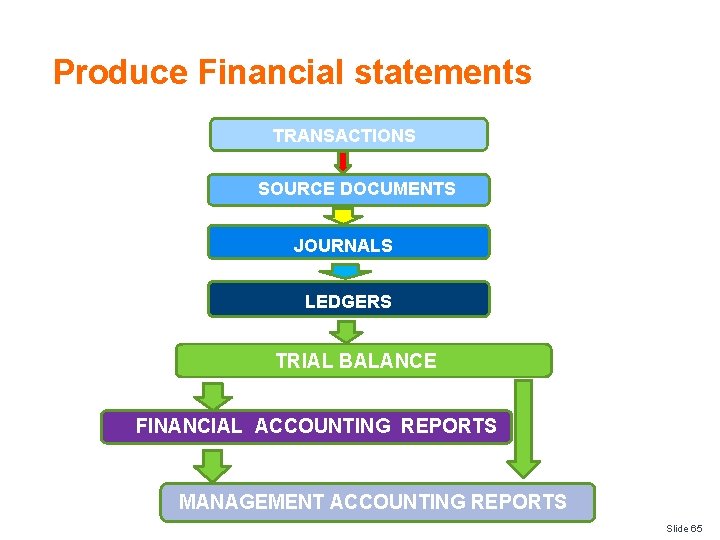
Produce Financial statements TRANSACTIONS SOURCE DOCUMENTS JOURNALS LEDGERS TRIAL BALANCE FINANCIAL ACCOUNTING REPORTS MANAGEMENT ACCOUNTING REPORTS Slide 65
Produce Financial statements Compile all necessary information: � Final adjusted trial balance • Worksheet � Budgets and forecasts � Previous period financial statements � Financial and operational ratios � External data � Activity Slide 66
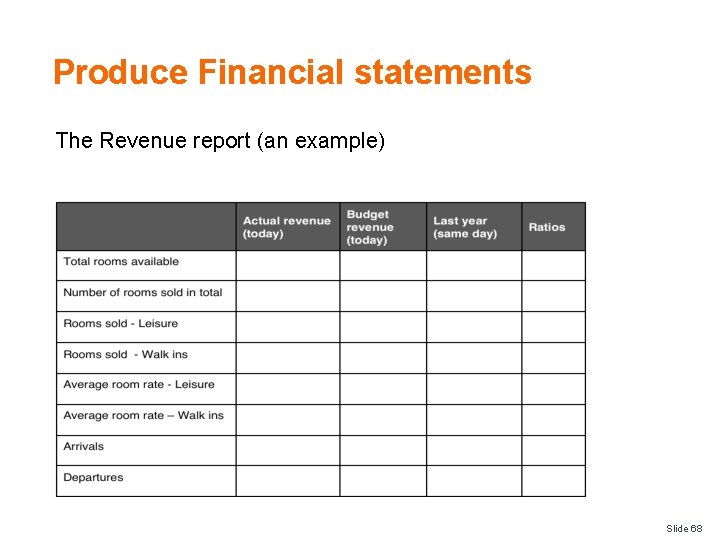
Produce Financial statements The Revenue report � Purpose � Frequency � Format � Nature of the financial information • Sales • Budget or forecast • Prior periods • Ratios Slide 67
Produce Financial statements The Revenue report (an example) Slide 68
Produce Financial statements The profit and loss statement: � Definition and purpose � Revenue less Expenses = Net Profit or Loss � Frequency � Format • Internal requirements (Management) • External requirements • Classification of categories (USALI) Slide 69
Produce Financial statements Preparing the profit and loss statement: � Headings � Sales accounts � Cost of sales or Cost of goods sold � Gross profit � Other expenses Slide 70
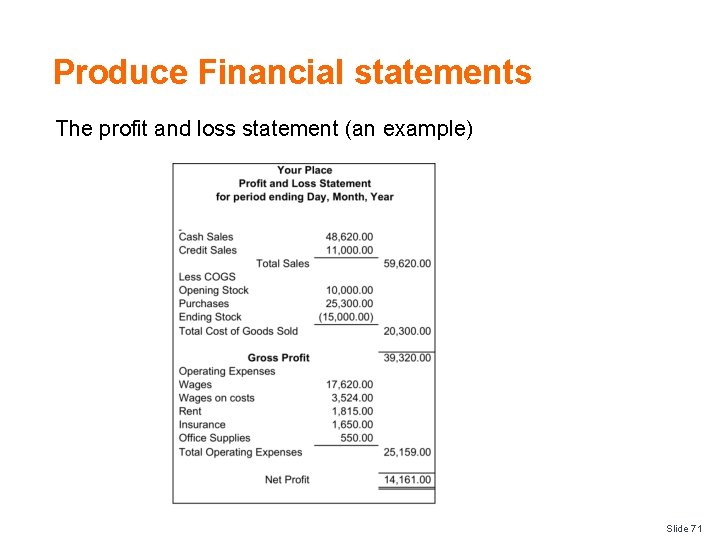
Produce Financial statements The profit and loss statement (an example) Slide 71
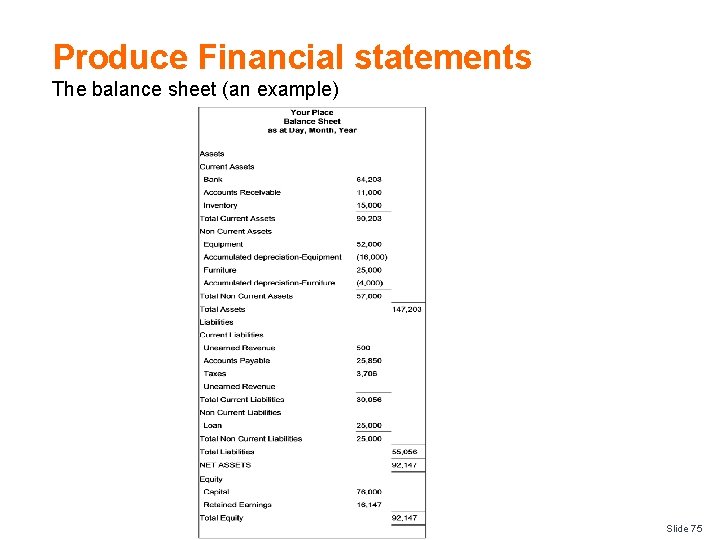
Produce Financial statements The Balance sheet: � Definition and purpose � The Accounting equation Assets – Liabilities = Equity � Frequency � Format • Account or Narrative Slide 72
Produce Financial statements The Balance sheet: � Assets and Liabilities • Current • Non-current � Equity • Capital • Retained Earnings Slide 73
Produce Financial statements Preparing the Balance sheet: � Headings � Account balances � Sub-category balances � Net Assets � Comparative data Slide 74
Produce Financial statements The balance sheet (an example) Slide 75
Produce Financial statements Other information: � Explanatory notes • Financial detail • Non-financial information • External requirements • Internal requirements Slide 76
Produce Financial statements The final steps: � Validate financial statements • Error free • Transcription of data � Update internal records • Closing entries • General ledger balances • Printing and archiving Slide 77
Produce Financial Statements The final steps (continued): � Distribution of financial statements • Confidentiality • Adhere to reporting deadlines � External distribution • Detailed requirements • Maintain confidentiality Slide 78
Produce Financial Statements The final steps (continued): � Internal distribution • Schedule to follow • Maintain confidentiality • Secure passwords Slide 79