
Preparatory activities to estimate surface ocean p H
- Slides: 24
Preparatory activities to estimate surface ocean p. H exploiting sea surface salinity satellite observations Roberto Sabia 1, Diego Fernández-Prieto 2, Jamie Shutler 3, Nicolas Reul 4, Peter Land 3 and Craig Donlon 2 Telespazio-Vega UK Ltd for European Space Agency (ESA), ESTEC, Noordwijk, the Netherlands. 1 European Space Agency (ESA), (ESRIN, Frascati, Italy)/(ESTEC, Noordwijk, the Netherlands). 2 3 Plymouth Marine Laboratory, Plymouth, United Kingdom. 4 IFREMER, Toulon, France. Ocean Salinity and Science Workshop Met Office, Exeter, UK,
Outline – Background: the OA context – Motivation and Objectives: satellite observations – Methodology and datasets – Total Alkalinity derivation – Surface ocean p. H derivation – Preliminary sensitivity/variability/error propagation studies – Remarks and perspectives
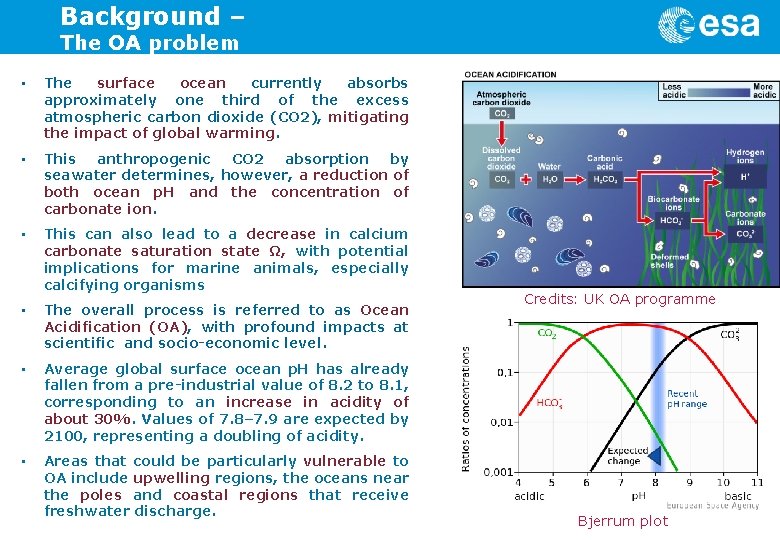
Background – The OA problem • The surface ocean currently absorbs approximately one third of the excess atmospheric carbon dioxide (CO 2), mitigating the impact of global warming. • This anthropogenic CO 2 absorption by seawater determines, however, a reduction of both ocean p. H and the concentration of carbonate ion. • This can also lead to a decrease in calcium carbonate saturation state Ω, with potential implications for marine animals, especially calcifying organisms • The overall process is referred to as Ocean Acidification (OA), with profound impacts at scientific and socio-economic level. • Average global surface ocean p. H has already fallen from a pre-industrial value of 8. 2 to 8. 1, corresponding to an increase in acidity of about 30%. Values of 7. 8– 7. 9 are expected by 2100, representing a doubling of acidity. • Areas that could be particularly vulnerable to OA include upwelling regions, the oceans near the poles and coastal regions that receive freshwater discharge. Credits: UK OA programme Bjerrum plot
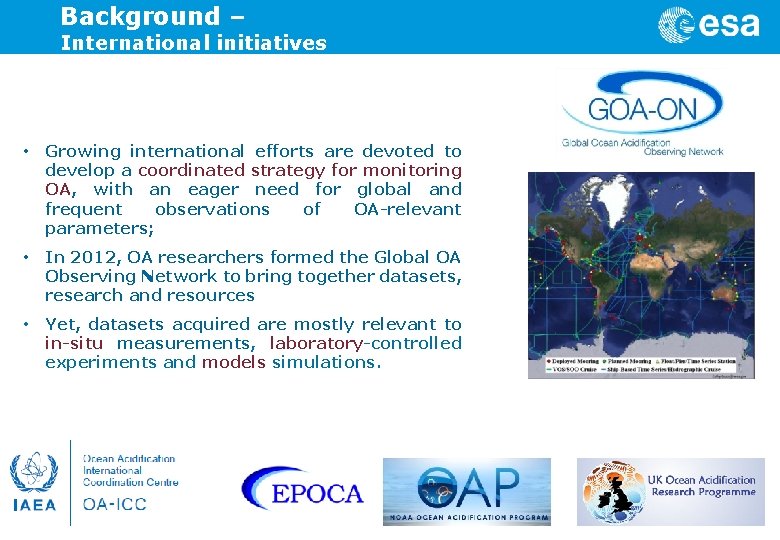
Background – International initiatives • Growing international efforts are devoted to develop a coordinated strategy for monitoring OA, with an eager need for global and frequent observations of OA-relevant parameters; • In 2012, OA researchers formed the Global OA Observing Network to bring together datasets, research and resources • Yet, datasets acquired are mostly relevant to in-situ measurements, laboratory-controlled experiments and models simulations.
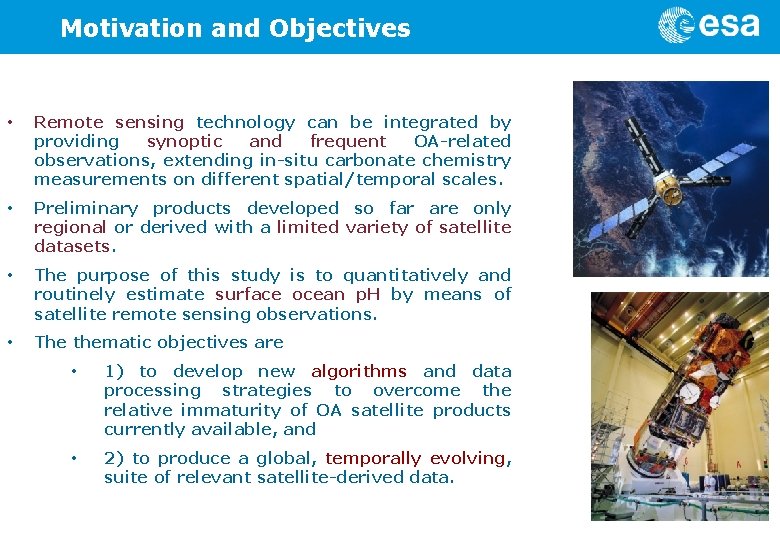
Motivation and Objectives • Remote sensing technology can be integrated by providing synoptic and frequent OA-related observations, extending in-situ carbonate chemistry measurements on different spatial/temporal scales. • Preliminary products developed so far are only regional or derived with a limited variety of satellite datasets. • The purpose of this study is to quantitatively and routinely estimate surface ocean p. H by means of satellite remote sensing observations. • The thematic objectives are • 1) to develop new algorithms and data processing strategies to overcome the relative immaturity of OA satellite products currently available, and • 2) to produce a global, temporally evolving, suite of relevant satellite-derived data.
STSE Pathfinders-OA Ocean Acidification using Earth observation • Pathfinders-OA is an 18 month ESA project to exploit Earth observation to research and monitor Ocean Acidification • Collect relevant datasets (in situ, EO and model) • Create a large database of EO-in situ matchups • Develop and validate algorithms to retrieve OA parameters from EO • Generate open source software tools and journal publications www. pathfinders-oceanacidification. org
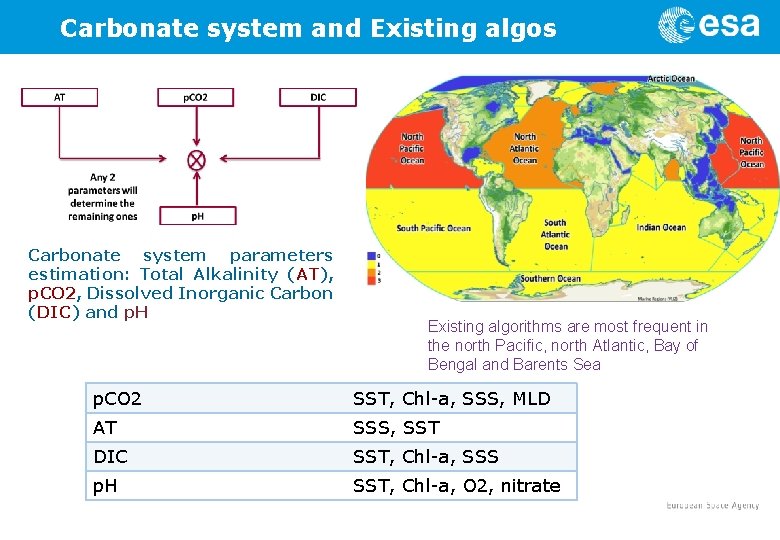
Carbonate system and Existing algos Carbonate system parameters estimation: Total Alkalinity (AT), p. CO 2, Dissolved Inorganic Carbon (DIC) and p. H Existing algorithms are most frequent in the north Pacific, north Atlantic, Bay of Bengal and Barents Sea p. CO 2 SST, Chl-a, SSS, MLD AT SSS, SST DIC SST, Chl-a, SSS p. H SST, Chl-a, O 2, nitrate
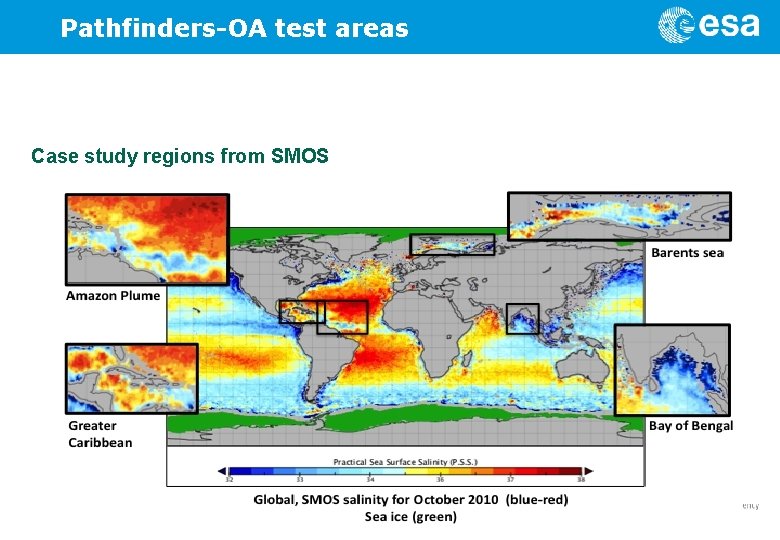
Pathfinders-OA test areas Case study regions from SMOS
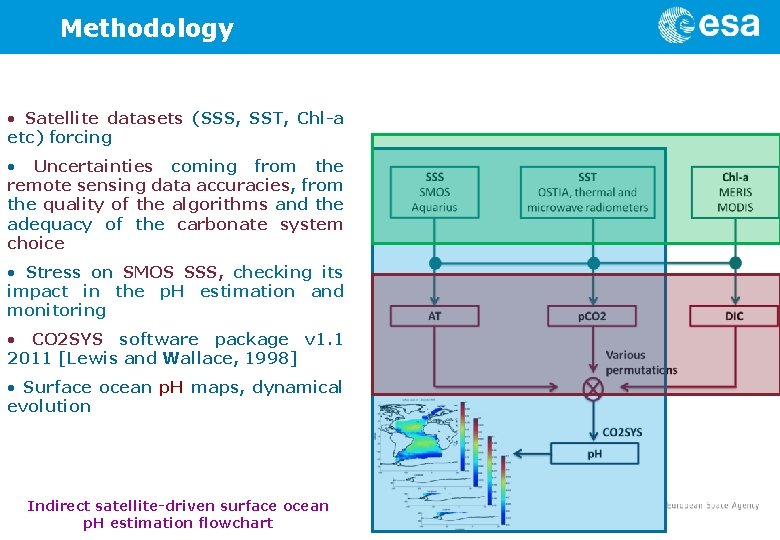
Methodology • Satellite datasets (SSS, SST, Chl-a etc) forcing • Uncertainties coming from the remote sensing data accuracies, from the quality of the algorithms and the adequacy of the carbonate system choice • Stress on SMOS SSS, checking its impact in the p. H estimation and monitoring • CO 2 SYS software package v 1. 1 2011 [Lewis and Wallace, 1998] • Surface ocean p. H maps, dynamical evolution Indirect satellite-driven surface ocean p. H estimation flowchart
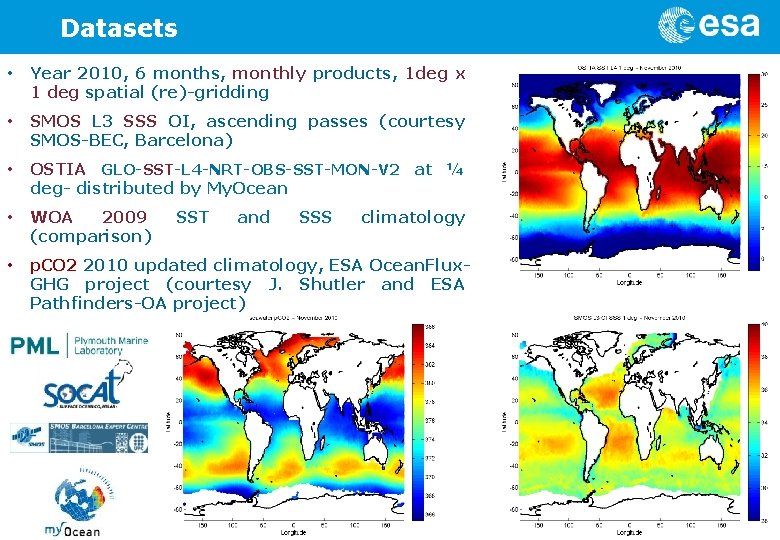
Datasets • Year 2010, 6 months, monthly products, 1 deg x 1 deg spatial (re)-gridding • SMOS L 3 SSS OI, ascending passes (courtesy SMOS-BEC, Barcelona) • OSTIA GLO-SST-L 4 -NRT-OBS-SST-MON-V 2 at ¼ deg- distributed by My. Ocean • WOA 2009 (comparison) • p. CO 2 2010 updated climatology, ESA Ocean. Flux. GHG project (courtesy J. Shutler and ESA Pathfinders-OA project) SST and SSS climatology
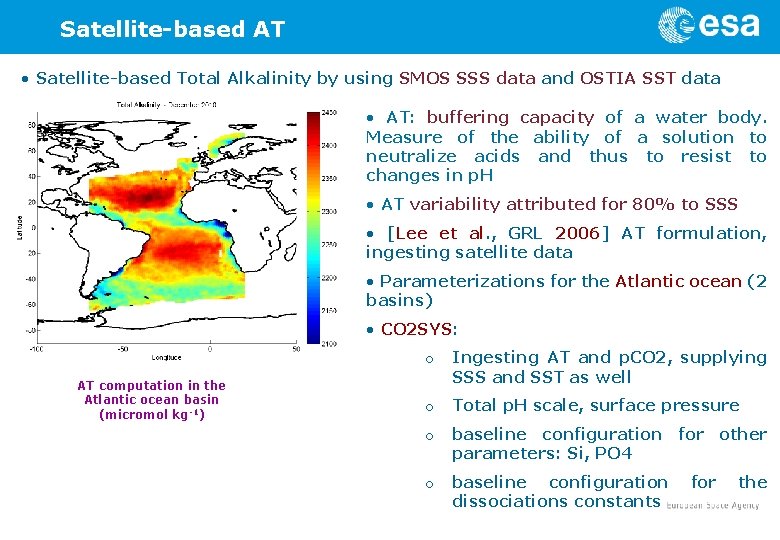
Satellite-based AT • Satellite-based Total Alkalinity by using SMOS SSS data and OSTIA SST data • AT: buffering capacity of a water body. Measure of the ability of a solution to neutralize acids and thus to resist to changes in p. H • AT variability attributed for 80% to SSS • [Lee et al. , GRL 2006] AT formulation, ingesting satellite data • Parameterizations for the Atlantic ocean (2 basins) • CO 2 SYS: AT computation in the Atlantic ocean basin (micromol kg-1) o Ingesting AT and p. CO 2, supplying SSS and SST as well o Total p. H scale, surface pressure o baseline configuration for other parameters: Si, PO 4 o baseline configuration dissociations constants for the
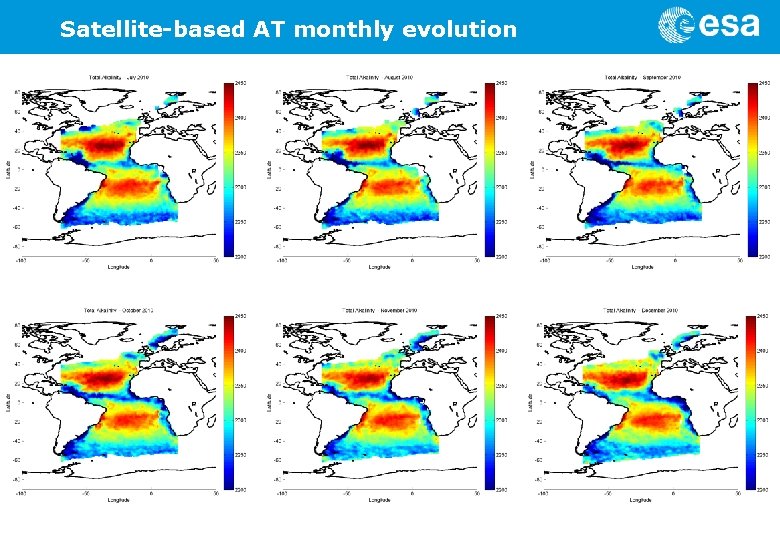
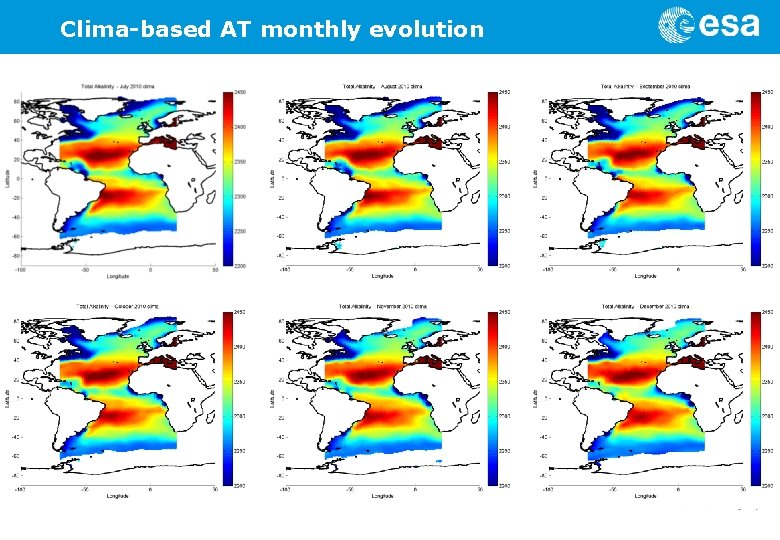
Satellite-based AT monthly evolution
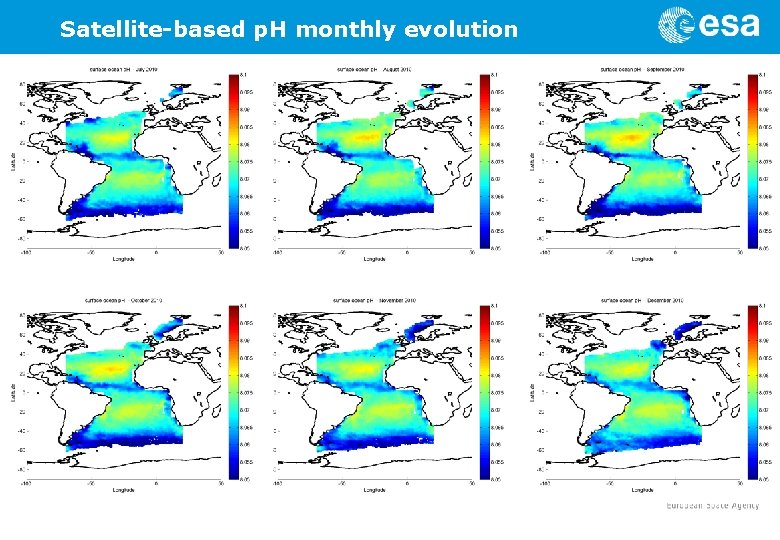
Satellite-based p. H monthly evolution
Clima-based AT monthly evolution
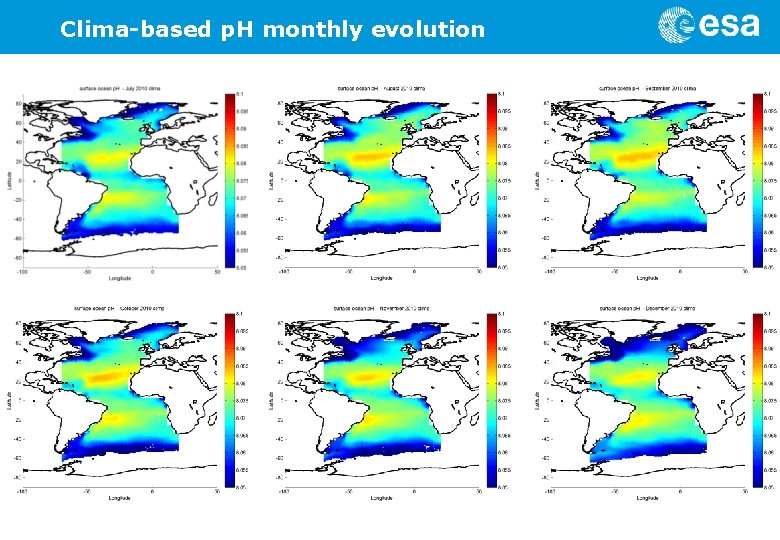
Clima-based p. H monthly evolution
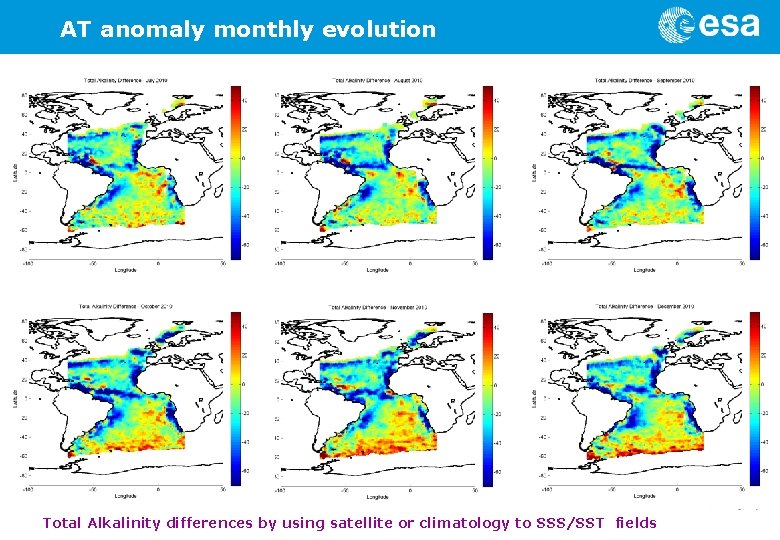
AT anomaly monthly evolution Total Alkalinity differences by using satellite or climatology to SSS/SST fields
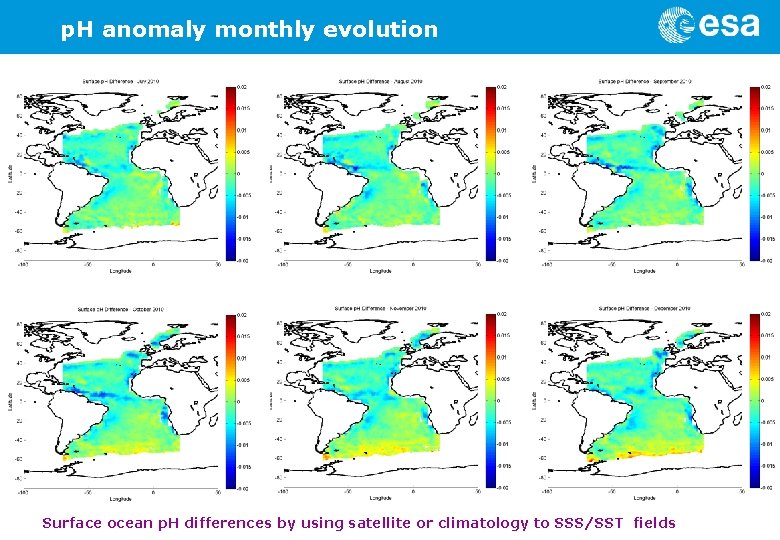
p. H anomaly monthly evolution Surface ocean p. H differences by using satellite or climatology to SSS/SST fields
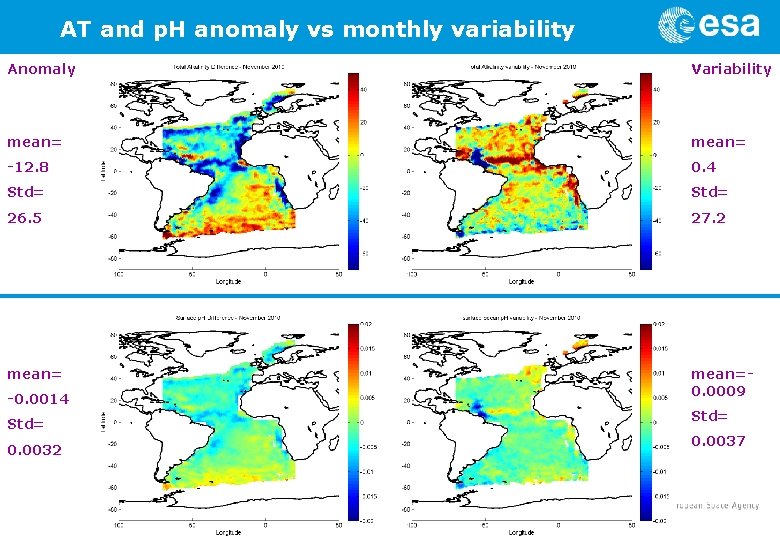
AT and p. H anomaly vs monthly variability Anomaly Variability mean= -12. 8 0. 4 Std= 26. 5 27. 2 mean=0. 0009 -0. 0014 Std= 0. 0032 Std= 0. 0037
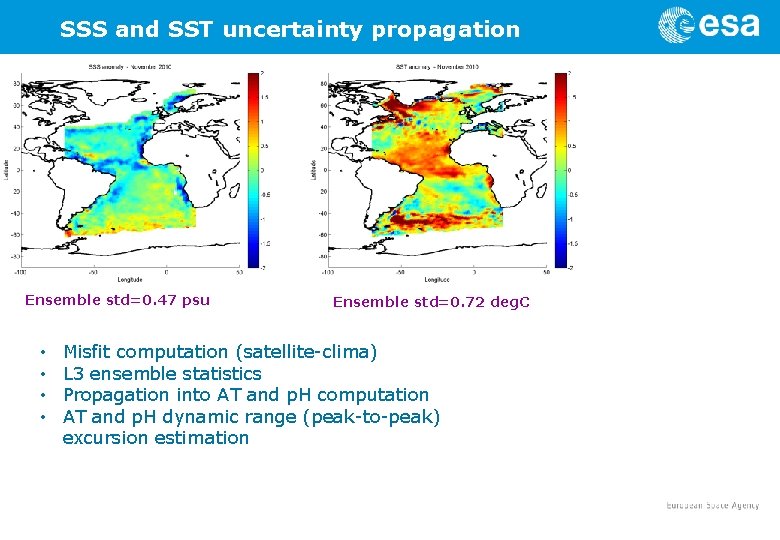
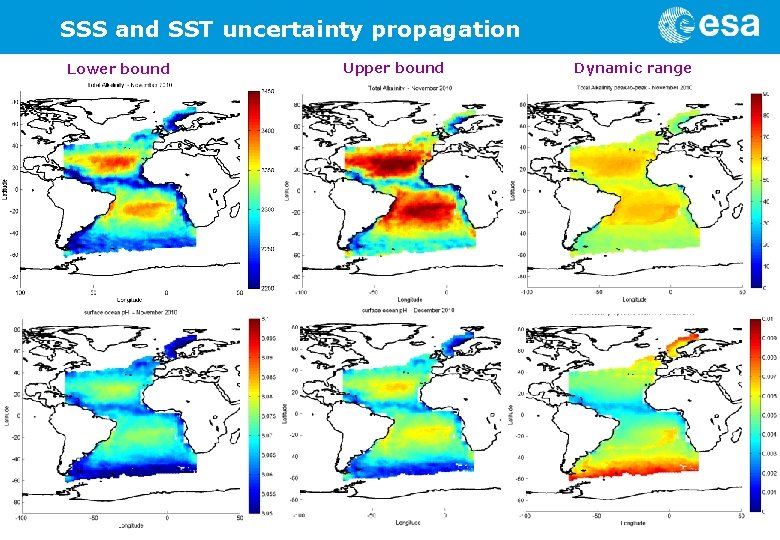
SSS and SST uncertainty propagation Ensemble std=0. 47 psu • • Ensemble std=0. 72 deg. C Misfit computation (satellite-clima) L 3 ensemble statistics Propagation into AT and p. H computation AT and p. H dynamic range (peak-to-peak) excursion estimation
SSS and SST uncertainty propagation Lower bound Upper bound Dynamic range
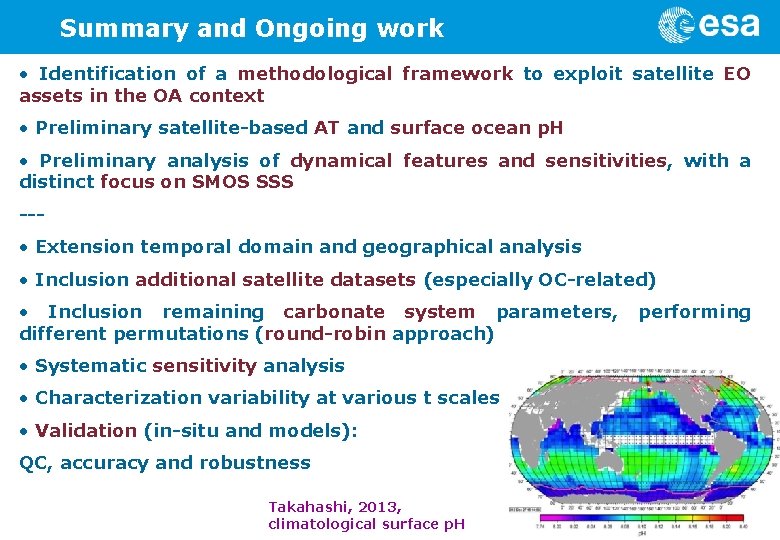
Summary and Ongoing work • Identification of a methodological framework to exploit satellite EO assets in the OA context • Preliminary satellite-based AT and surface ocean p. H • Preliminary analysis of dynamical features and sensitivities, with a distinct focus on SMOS SSS --- • Extension temporal domain and geographical analysis • Inclusion additional satellite datasets (especially OC-related) • Inclusion remaining carbonate system parameters, different permutations (round-robin approach) • Systematic sensitivity analysis • Characterization variability at various t scales • Validation (in-situ and models): QC, accuracy and robustness Takahashi, 2013, climatological surface p. H performing
Perspectives – Foster the advancement of the embryonic phase of OA-related remote sensing, inferring a novel value-added satellite product – Unify fragmented remote sensing efforts in terms of resolution and variety of datasets used, capitalizing on the recent addition of satellite SSS – Fine-tune algorithms to derive surface ocean p. H atlas, baseline to assess OA severity – Mid-term objective: quasi-operational derivation at different time scales surface ocean p. H – Outreach: bridging the gap between the satellite and the IMBER / SOLAS communities, benefiting from their cross-fertilization and feedback
SMOS-Mission Oceanographic Data Exploitation SMOS-MODE www. smos-mode. eu info@smos-mode. eu SMOS-MODE supports the network of SMOS ocean-related R&D Last meeting during 2 nd SMOS Science Conference (May 2015)
Thank you. Grazie