
PREPARATIONS FOR LOCAL GOVERNMENT ELECTIONS 2021 Briefing to
PREPARATIONS FOR LOCAL GOVERNMENT ELECTIONS 2021 Briefing to Kwa. Zulu-Natal Faith-Based Organisations Opening Remarks by Chairperson Glen Mashinini 1 02 December 2020
ACKNOWLEDGEMENTS • The Reverend Chundran Chetty, Centre Manager, Diakonia Council of Churches • Dr Douglas Dzivha, Chief Executive Office, Kwa. Zulu-Natal Christian Council • Other representatives of Faith-Based Organisations present today • Fellow colleagues from the Kwa. Zulu-Natal office of the Electoral Commission: • The Acting Provincial Electoral Officer Mrs. Ntombifuthi Masinga, • Provincial Outreach and Communications Office Team, Dr. Nonhla Hlongwane & Mr Thabani Ngwira 2
INTRODUCTION • Ladies and gentlemen • On behalf of the Electoral Commission thank you for this opportunity to brief you on our preparations for next year’s Local Government Elections • 2020 has been a year of great change, uncertainty and disruption to our lives • With this in mind the Commission is most appreciative of the opportunity to reconnect with our key partners even if it is virtually • Successful elections require the support, assistance and cooperation of a wide variety of stakeholders in all spheres of society including: • The national and provincial legislatures, municipal councils, government departments, business, labour, civil society, traditional leadership, religious-based organisations, NGOs, the media and many others 3
INTRODUCTION cont. • Today’s presentation will comprise two parts: • In the first part I will provide an overview of some of the critical issues we are facing as we prepare for next year’s Local Government Elections • I will also identify areas of potential cooperation and assistance for the Faithbased Organisations as has been our tradition in all previous elections • In the second part, our Acting Provincial Electoral Officer, Mrs Masinga will then provide technical details of our preparations for elections nationally and in Kwa. Zulu-Natal. 4
INTRODUCTION cont. • Contrary to general perceptions, Local Government Elections are much more intricate and complex than national and provincial elections • In national and provincial elections we run 10 simultaneous elections to elect 400 MPs and 430 MPLs • Yesterday the Municipal Demarcation Board handed over the final list of ward boundaries for next year’s Local Government Elections which will take place across 4 468 wards in • 8 metropolitan municipalities • 205 local municipalities • And 44 district municipalities • In the election, nearly 10 000 ward and PR councillors will be elected to these various municipal councils 5
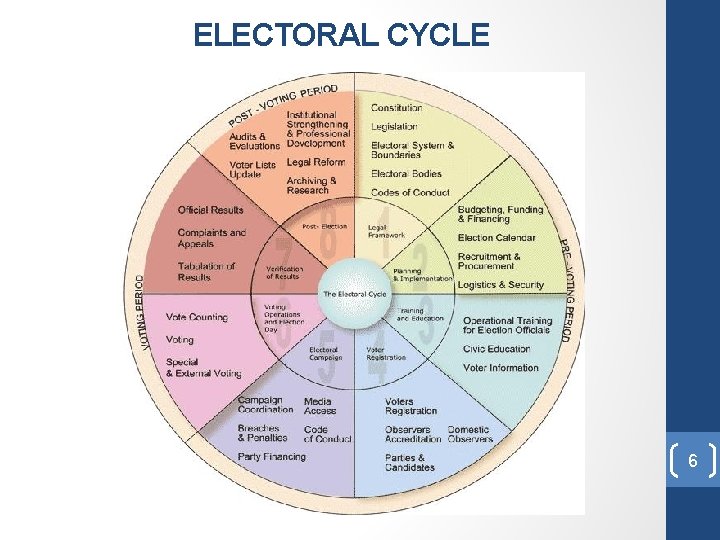
ELECTORAL CYCLE 6
THE ELECTORAL CYCLE • The Electoral Cycle is a planning tool which we and many election management bodies around the world use to plan for elections including to help identify and mitigate risks • The cycle comprises three phases: • The pre-election phase of planning and preparation in which we find ourselves now • The election phase during which voting and counting occurs and which culminates in the announcement of results • And finally the post-election phase in which we and our stakeholders evaluate performance and identify areas for future improvement • There are many factors which impact on the electoral cycle and its activities including the socio-economic and political context, the timing of elections, potential changes to electoral processes and new legislative amendments among others • Our Acting PEO will speak to some of these shortly but I would like to address some of the more strategic issues facing us as we move through the electoral cycle 7
SOCIO-ECONOMIC AND POLITICAL CONTEXT • Two key aspect of the current socioeconomic has the potential to directly and dramatically impact on our preparations and planning for LGE 2021. These are namely: 1. The significant deterioration of economic conditions which have had a devastating effect on the fiscus and its associated impact on available resources 2. And the impact of the COVID-19 pandemic on the lives and livelihoods of people around the world including here in South Africa. 8
LGE 2021 TIMELINE • The second factor affecting the Electoral Cycle is the timing of the election • Section 159 of the Constitution read with section 24(1) of the Local Government: Municipal Structures Act provides that a term of a municipal council is 5 years • Elections must take place within 90 days of expiry of the term • The current 5 -year term of municipal councils ends on 3 August 2021 • For the 2021 Local Government Elections that means the 90 day window starts on 4 August and ends on 1 November next year • The Minister of COGTA responsible for determination of the date after consultation with the Commission 9
MERGED ELECTIONS • A third factor is the proposal for the National and Provincial Elections to be merged with the Local Government Elections • Ultimately it is for Parliament to decide on such matters • Without going into details of this debate, in order to hold national, provincial and municipal elections on the same date it will require the term of office of either the national and provincial legislatures or the municipal councils to be shortened or lengthened • Following legal advice, the Commission is of the view that it would be far more advisable and Constitutionallysound for a term of office to be shortened rather than extended as the Constitution already allows for a shortened term of office • Consequently the Commission resolved that we shall schedule next year’s elections according to the prescribed Constitutional timelines 10
ELECTORAL REFORMS • Fourth is the ruling of the Constitutional Court June this year which found that the Electoral Act was unconstitutional in as far as it did not provide for independent candidates to contest national and provincial elections • This too is a policy matter which is receiving attention by the Portfolio Committee on Home Affairs in Parliament which has set up a task team to deal with this • The role of the Electoral Commission is providing technical assistance and advice • While this ruling has not directly impacted on plans for next year’s Local Government Elections, it is something the Commission is watching closely in the months ahead 11
PARTY FUNDING • The final factor is the funding of political parties • The Political Party Funding Act was assented to by the President last year • The Electoral Commission drafted and consulted on the regulations supporting the Act including receiving over 4 000 submissions and holding public hearings • In preparations for the implementation of the Act and regulations the Electoral Commission has begun to build its capacity in this area within resource constraints • We have also developed an online funding declaration system which represented political parties are currently being trained to use and to test • A final version of the regulations is awaiting the promulgation date by the President 12
KEY CHALLENGES FOR LGE • Let me now turn to some of the key challenges we face as we prepare to host South Africa’s fifth Local Government Elections 1. Heightened political contestation and litigation • As our democracy continues to mature and develop we are seeing ever-more robust contestation between more and more political parties • In the previous Local Government Elections we have seen the number of political parties contesting grow from 79 in 2000 to over 200 in 2016 • And the number of contesting candidates has grown over the same period from 30 000 to over 63 000 in 2016 • Alongside this rise has been an increase in scrutiny of each and every aspect of elections, which has also given rise to increased objections and litigation 13
KEY CHALLENGES FOR LGE 2. Declining voter registration and turnout • Voter registration and participation has been in decline in many developed democracies around the world in recent years • In South Africa while we continue to enjoy relatively high levels of registration and turnout for a county with a voluntary system we have seen a concerning downward trend especially among young voters • SA saw a 8% decline in turnout in NPE from 2014 to 2019 • Turnout of the past two municipal elections in 2011 and 2016 showed encouraging growth over previous elections – rising from 48 percent in 2006 to 57% in 2011 and 2016 • This is something we wish to maintain and further improve 14

KEY CHALLENGES FOR LGE 3. Demarcation disputes • While the Municipal Demarcation Board is not changing outer municipal boundaries, unresolved demarcation and boundary disputes tend to flare up ahead of Local Government Elections • These can pose risks to a number of aspects of the election process including voter registration, civic education, campaigning by parties and turnout and access to voting stations • The Electoral Commission believes that a political programme is required to address these issues before they pose threats to voter registration, participation and free political campaigning 15
KEY CHALLENGES FOR LGE 4. Social unrest • Incidents of social unrest – including service delivery protests – also pose risks to the smooth conduct of elections • Frequently these prevent access to communities and key areas which may hamper electoral preparations and the conducting of elections • These protests also often target municipal facilities where many of our local offices are located • Statistics from Municipal IQ show a steady rise in such protests over the past decade – with over 450 incidents reported in 2018 and 2019 • The high profile nature of municipal elections and its activities (voter registration, campaigning and voting) can be used by some communities to raise the profile of their grievances 16
KEY CHALLENGES FOR LGE 5. Political violence/ intra-party conflict • The process of candidate selection by political parties for local government has also emerged as a source of conflict and violence in some parts of our country • According to researcher Mary De Haas, around 90 municipal councillors, political party officials and senior municipal officials, have been murdered in Kwa. Zulu-Natal since 2015 • The Eastern Cape, Limpopo, Mpumalanga and North West have not recorded the same numbers of politically-linked attacks but have certainly not been immune to these tragic incidents • As we approach the Local Government Elections, the Electoral Commission appeals to all contestants, parties and voters to respect human life and the sanctity of the electoral process to ensure free, fair and peaceful elections 17
OPPORTUNITIES FOR COLLABORATION • As Faith-Based Organisations you play an important role in the electoral process • Among the key areas of cooperation on which we continue to rely on you include: 1. Encourage participation • Faith Based Organisations are a vital channel of communication to potential voters – we count on your honorable selves to encourage citizens to both register and to vote especially through the pastoral care letters that bolster our work as they are received differently by the church communities 2. Voting station venues • Places of worship are the second highest number of venues for voting stations after schools • We ask for your continued support and partnership in making your meeting venues available to us 18
OPPORTUNITIES FOR COLLABORATION 3. Conflict management • Religious Leaders have a very important role in creating an environment conducive to holding free and fair elections on the ground. • In KZN in particular, Faith-Based Organisations have been an integral part of the Commission’s conflict management, voter education and election observation machinery. • We have always called on the sector to help resolve conflicts which threaten the holding of free and fair elections. These have included, but are not limited to ward demarcation disputes, service delivery protests or inter/intraparty conflicts. • We hope that we can continue to rely on you and your organisations to assist us in conflict prevention and management 19
CONCLUSION • Distinguished guests • Local Government Elections are at the coal-face of interaction between our citizens and the people who represent them • The absence of constituencies in national and provincial elections means the first and closest point of contact which voters have with their elected representatives are municipal councillors • And most of our citizens receive many of their basic services including water, housing, electricity, waste management and a variety of other local infrastructure at a municipal level • If we are to further our democratic gains as a country we must all play our part in ensuring the success of these elections • We look forward to working with you over the coming year • I thank you 20
THANK YOU 21
- Slides: 21