
Preparation of the Elite Junior Middle Distance Runner





![Sprinters vs. Distance Runners [Rate vs. Economy]](https://slidetodoc.com/presentation_image_h/765e76004d0ed6ce28975d335ae85934/image-42.jpg "Sprinters vs. Distance Runners [Rate vs. Economy]")
![Glycolytic Workloads Speed Endurance 60 meters to [Ex. ] 2 sets of 5 150](https://slidetodoc.com/presentation_image_h/765e76004d0ed6ce28975d335ae85934/image-44.jpg "Glycolytic Workloads Speed Endurance 60 meters to [Ex. ] 2 sets of 5 150")


- Slides: 72
Preparation of the Elite Junior Middle Distance Runner Scott Christensen January 2011
Part 1: Athlete and event profiling for the middle distance events. Part 2: Training modalities for the 800 and 1600 meter events. Part 3: The multi-paced training scheme for the 800 and 1600 meter events. Part 4: Key workouts for each pace of the multi-paced training scheme.
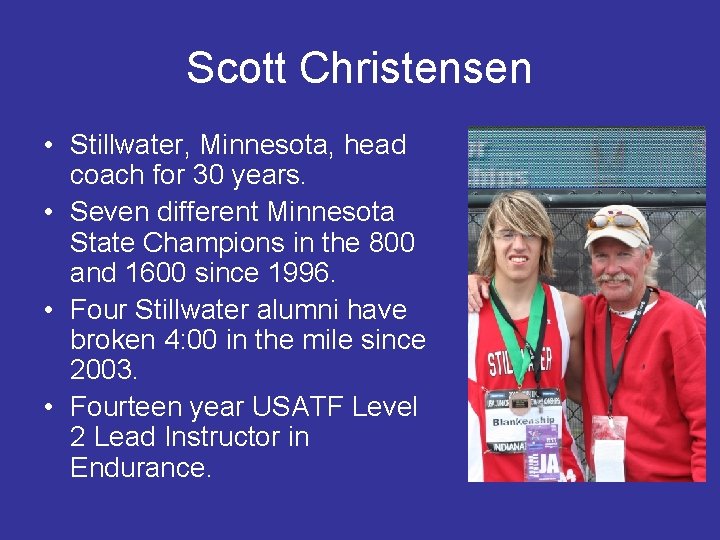
Scott Christensen • Stillwater, Minnesota, head coach for 30 years. • Seven different Minnesota State Champions in the 800 and 1600 since 1996. • Four Stillwater alumni have broken 4: 00 in the mile since 2003. • Fourteen year USATF Level 2 Lead Instructor in Endurance.
Part 1 Athlete and event profiling for the middle distance events.
“The 800 and 1500 meter events are physiologically very close, but very distant psychologically” Peter Coe.
Combined Zone Races All races from the 800 meters and longer have a significant aerobic and anaerobic component of energy contribution, and are called combined zone races. Combined zone races have a comfort zone and a critical zone. The critical zone is where the race is won or lost.
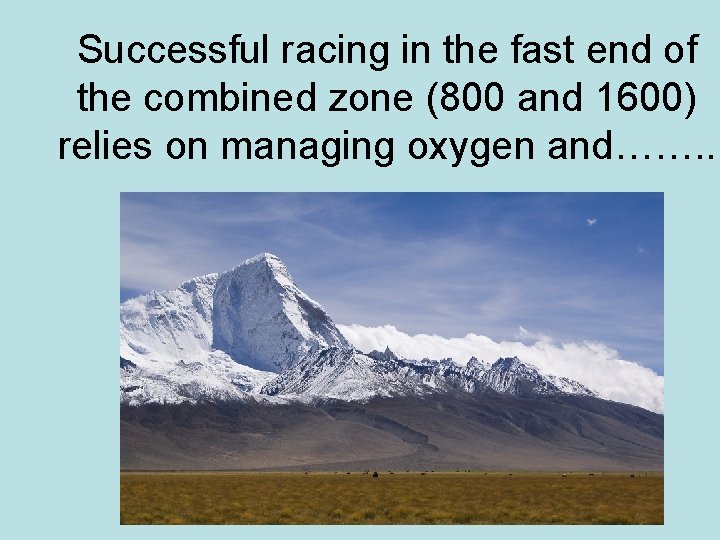
Successful racing in the fast end of the combined zone (800 and 1600) relies on managing oxygen and……. .
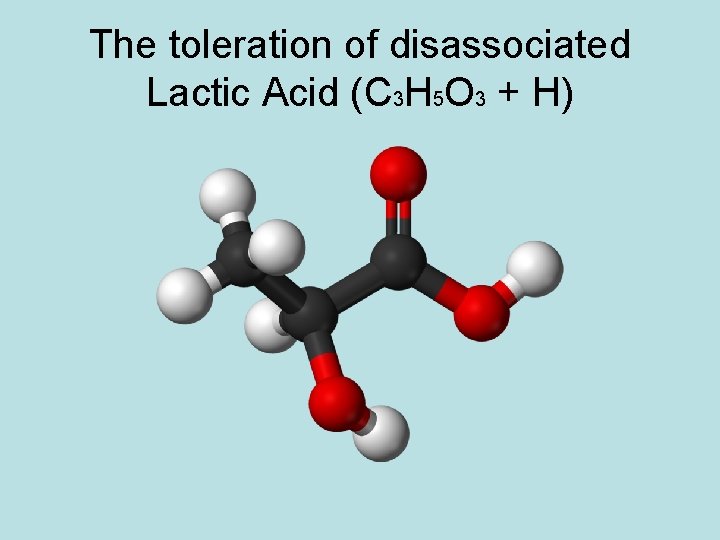
The toleration of disassociated Lactic Acid (C 3 H 5 O 3 + H)
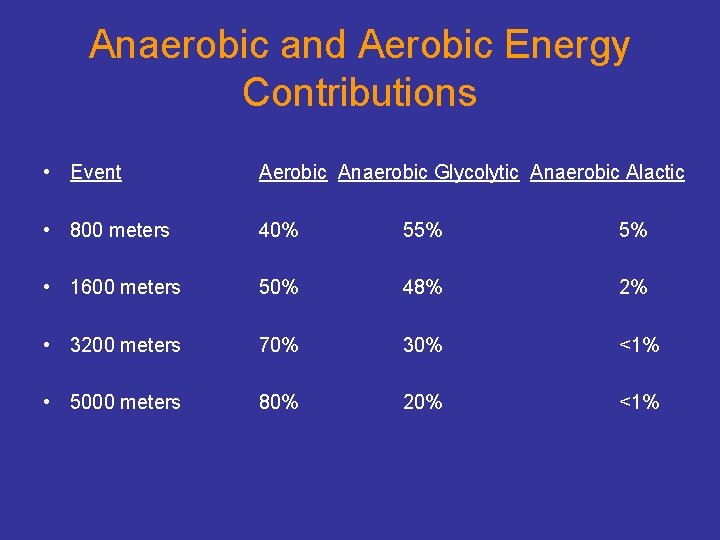
Anaerobic and Aerobic Energy Contributions • Event Aerobic Anaerobic Glycolytic Anaerobic Alactic • 800 meters 40% 55% 5% • 1600 meters 50% 48% 2% • 3200 meters 70% 30% <1% • 5000 meters 80% 20% <1%
Physiological Definition of “Elite” in Endurance Events • A genetic/trained physiological shift in an athlete to a greater contribution by the aerobic energy system at a combined zone race distance. • Example: 3000 meter race. • General Population = 70% aerobic/30% anaerobic • Paula Ratcliffe = 85% aerobic/15% anaerobic
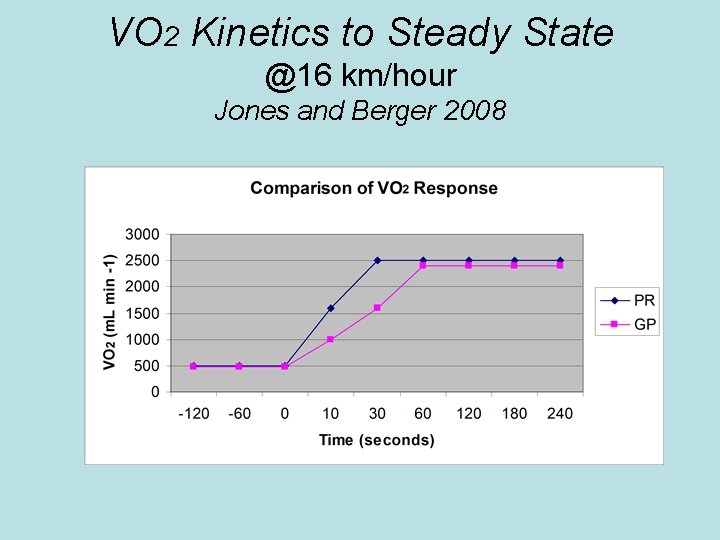
VO 2 Kinetics to Steady State @16 km/hour Jones and Berger 2008
It Is All About Preparation “ If given 8 hours to cut down an oak tree, I would spend the first 6 hours sharpening my axe. ” Abraham Lincoln
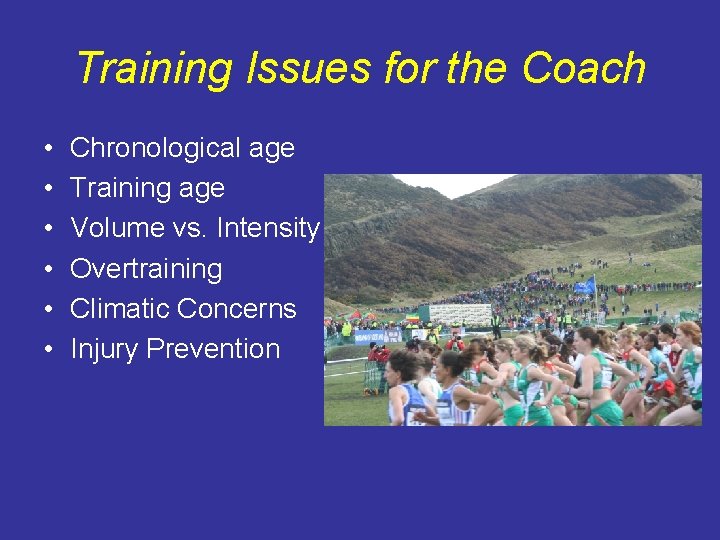
Training Issues for the Coach • • • Chronological age Training age Volume vs. Intensity Overtraining Climatic Concerns Injury Prevention
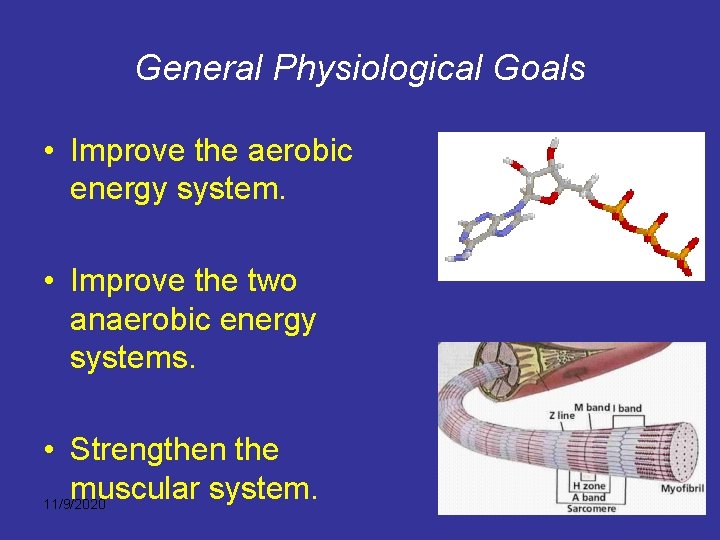
General Physiological Goals • Improve the aerobic energy system. • Improve the two anaerobic energy systems. • Strengthen the muscular system. 11/9/2020 14
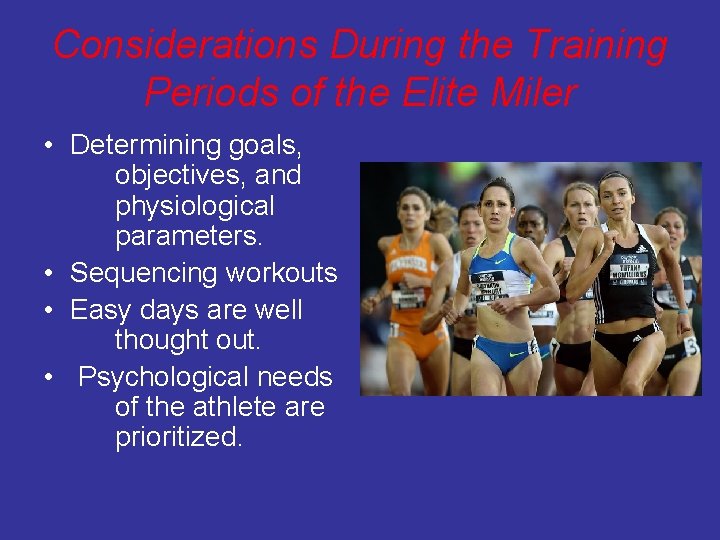
Considerations During the Training Periods of the Elite Miler • Determining goals, objectives, and physiological parameters. • Sequencing workouts • Easy days are well thought out. • Psychological needs of the athlete are prioritized.
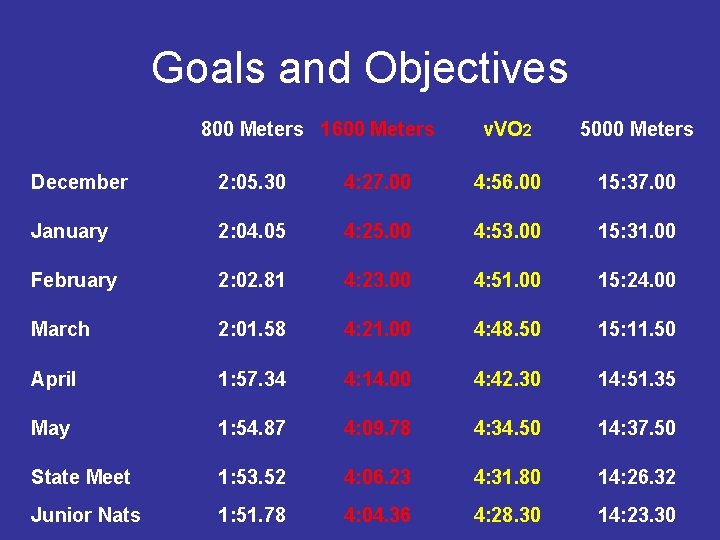
Goals and Objectives 800 Meters 1600 Meters v. VO 2 5000 Meters December 2: 05. 30 4: 27. 00 4: 56. 00 15: 37. 00 January 2: 04. 05 4: 25. 00 4: 53. 00 15: 31. 00 February 2: 02. 81 4: 23. 00 4: 51. 00 15: 24. 00 March 2: 01. 58 4: 21. 00 4: 48. 50 15: 11. 50 April 1: 57. 34 4: 14. 00 4: 42. 30 14: 51. 35 May 1: 54. 87 4: 09. 78 4: 34. 50 14: 37. 50 State Meet 1: 53. 52 4: 06. 23 4: 31. 80 14: 26. 32 Junior Nats 1: 51. 78 4: 04. 36 4: 28. 30 14: 23. 30
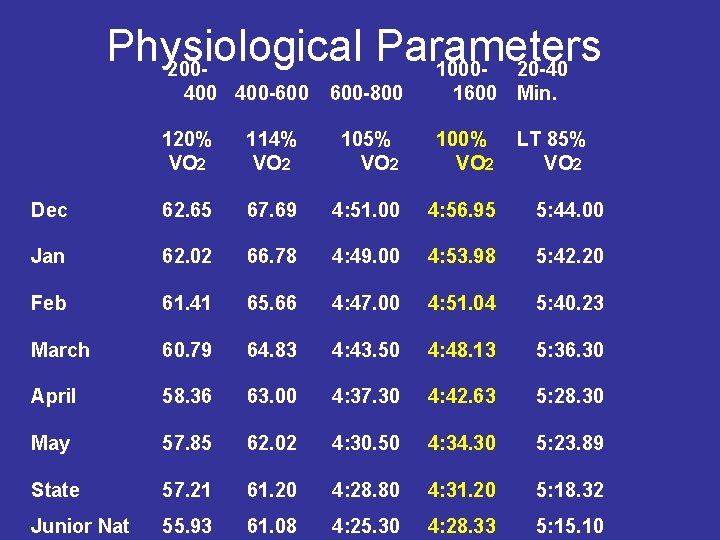
Physiological Parameters 2001000 - 20 -40 400 -600 600 -800 1600 Min. 120% VO 2 114% VO 2 105% VO 2 100% VO 2 LT 85% VO 2 Dec 62. 65 67. 69 4: 51. 00 4: 56. 95 5: 44. 00 Jan 62. 02 66. 78 4: 49. 00 4: 53. 98 5: 42. 20 Feb 61. 41 65. 66 4: 47. 00 4: 51. 04 5: 40. 23 March 60. 79 64. 83 4: 43. 50 4: 48. 13 5: 36. 30 April 58. 36 63. 00 4: 37. 30 4: 42. 63 5: 28. 30 May 57. 85 62. 02 4: 30. 50 4: 34. 30 5: 23. 89 State 57. 21 61. 20 4: 28. 80 4: 31. 20 5: 18. 32 Junior Nat 55. 93 61. 08 4: 25. 30 4: 28. 33 5: 15. 10
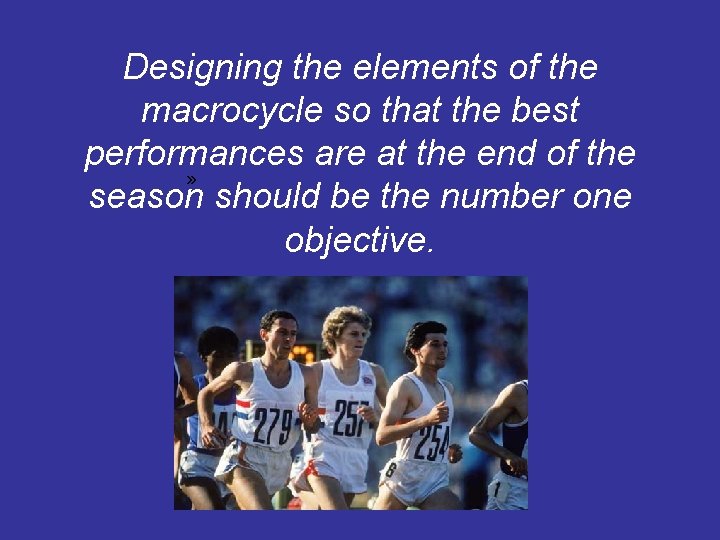
Designing the elements of the macrocycle so that the best performances are at the end of the » season should be the number one objective.
Specific Periods Within the 800 and 1600 Meter Macrocycle • The Preparation Period focuses on the athlete as an endurance runner. • The Competition Period focuses on the athlete as a miler. • The Transition Period allows the athlete to prepare for the next stage of development.
Biomotor Fatigue • Weakness or weariness resulting from exertion or prolonged stress. • Can be short-term or chronic. • A limiter of athletic performance.
Sources of Fatigue • The accumulation of by-products; e. g. , hydrogen ions in the muscle cells & blood. • The depletion of substances; e. g. , depletion of glycogen in the muscle cell. • Changes in metabolic function from acidity or changes in core body temperature; e. g. , enzyme disturbances. • A limitation at the neuromuscular junctions of the nervous system, e. g. , sodium-potassium pump. • Disturbed coordination regulation through overdemands on the neuro-hormonal system.
Part 2 Training modalities for the 800 and 1600 meter runs.
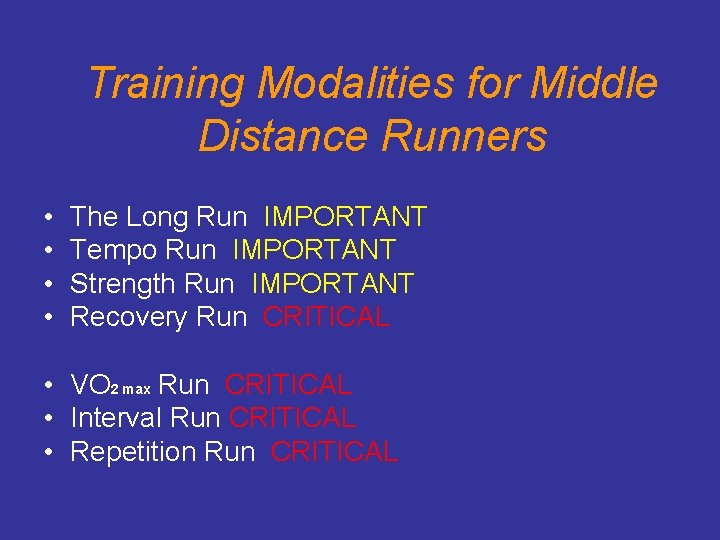
Training Modalities for Middle Distance Runners • • The Long Run IMPORTANT Tempo Run IMPORTANT Strength Run IMPORTANT Recovery Run CRITICAL • VO 2 max Run CRITICAL • Interval Run CRITICAL • Repetition Run CRITICAL
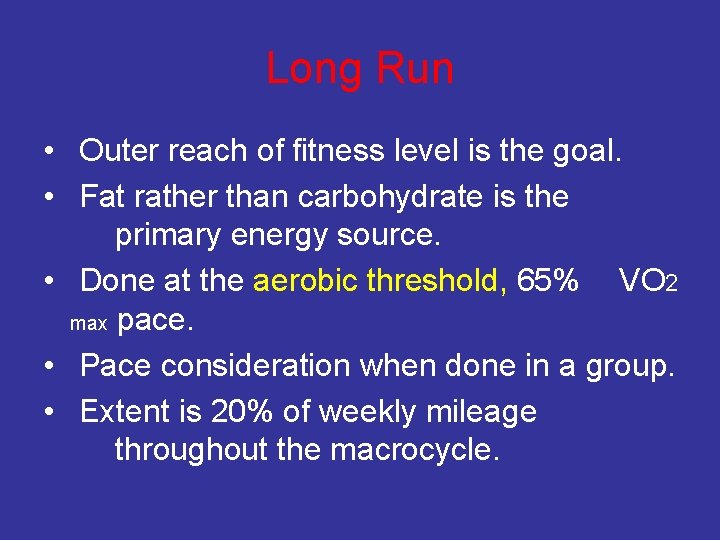
Long Run • Outer reach of fitness level is the goal. • Fat rather than carbohydrate is the primary energy source. • Done at the aerobic threshold, 65% VO 2 max pace. • Pace consideration when done in a group. • Extent is 20% of weekly mileage throughout the macrocycle.
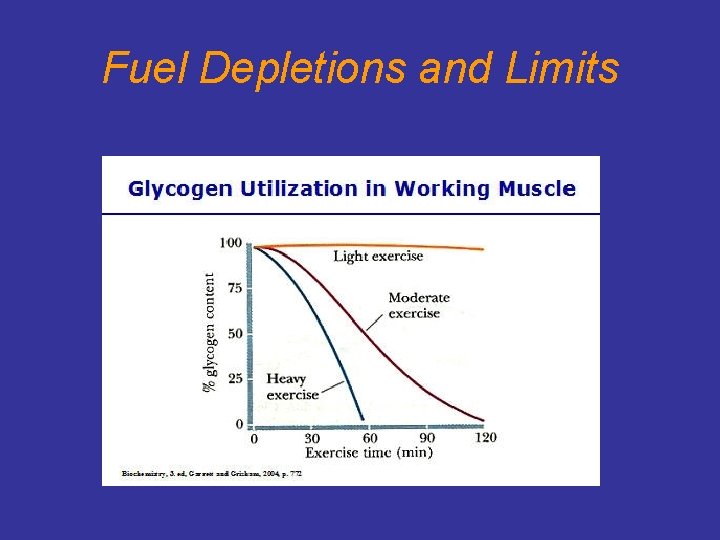
Fuel Depletions and Limits
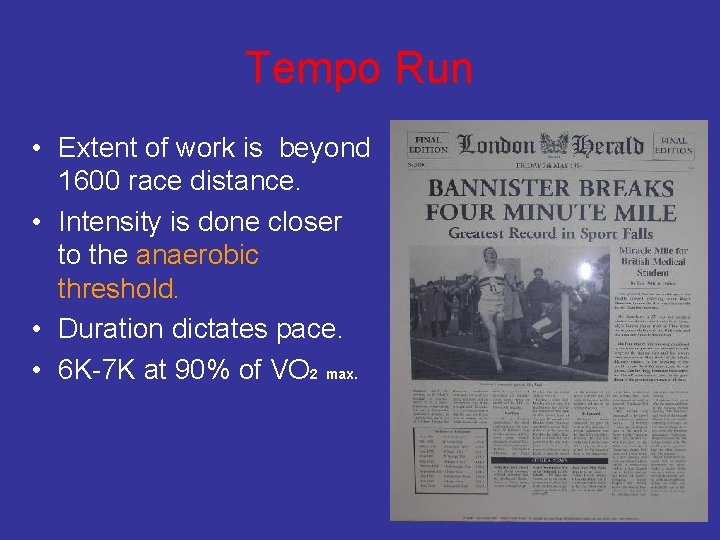
Tempo Run • Extent of work is beyond 1600 race distance. • Intensity is done closer to the anaerobic threshold. • Duration dictates pace. • 6 K-7 K at 90% of VO 2 max.
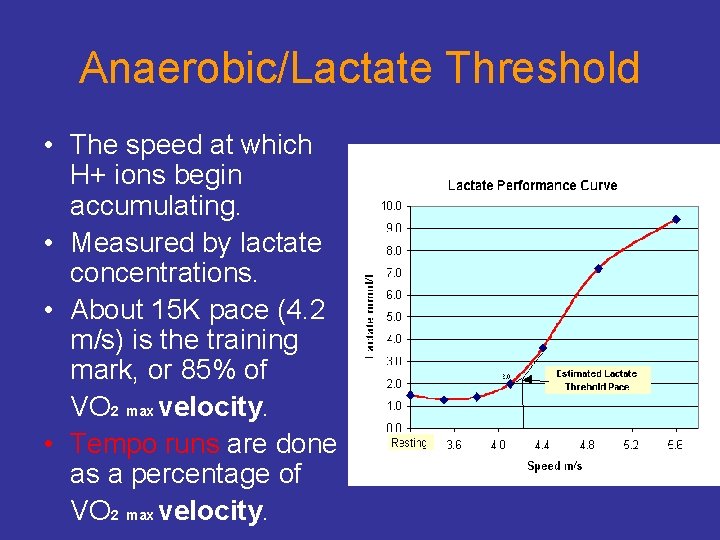
Anaerobic/Lactate Threshold • The speed at which H+ ions begin accumulating. • Measured by lactate concentrations. • About 15 K pace (4. 2 m/s) is the training mark, or 85% of VO 2 max velocity. • Tempo runs are done as a percentage of VO 2 max velocity.
Strength Run • Greater resistance to force is the goal. • Any running is strength work. • • • Hills are the main target workout. Hills are done in 4 microcycle blocks of time. 35 -45 second bouts of work. 4 minute jog of incomplete recovery. Sets of 6 -8.
Recovery Run • Recovery has many aspects and may simply be adding base mileage at the aerobic threshold pace. Shorter in distance than the long run. • Energy system recovery and muscle repair are the biggest concerns. • 20 min run at minimum.
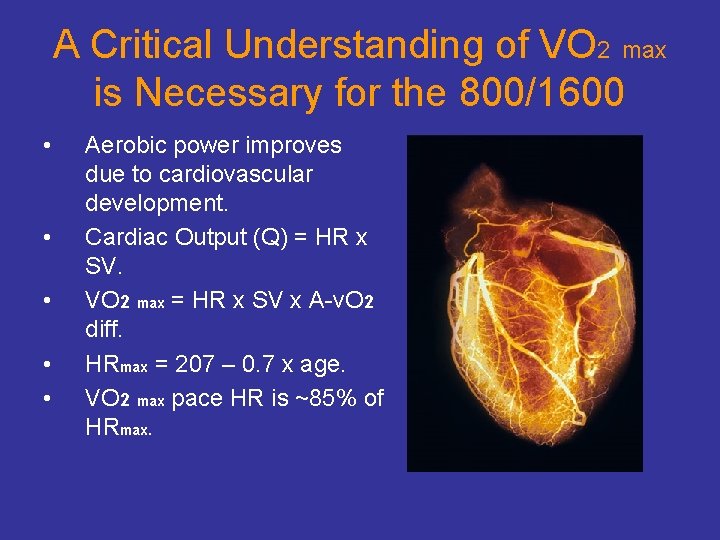
A Critical Understanding of VO 2 max is Necessary for the 800/1600 • • • Aerobic power improves due to cardiovascular development. Cardiac Output (Q) = HR x SV. VO 2 max = HR x SV x A-v. O 2 diff. HRmax = 207 – 0. 7 x age. VO 2 max pace HR is ~85% of HRmax.
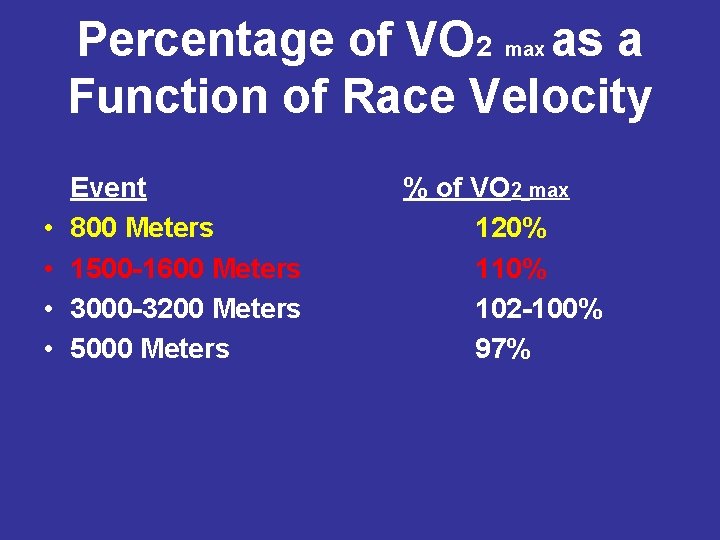
Percentage of VO 2 max as a Function of Race Velocity • • Event 800 Meters 1500 -1600 Meters 3000 -3200 Meters 5000 Meters % of VO 2 max 120% 110% 102 -100% 97%
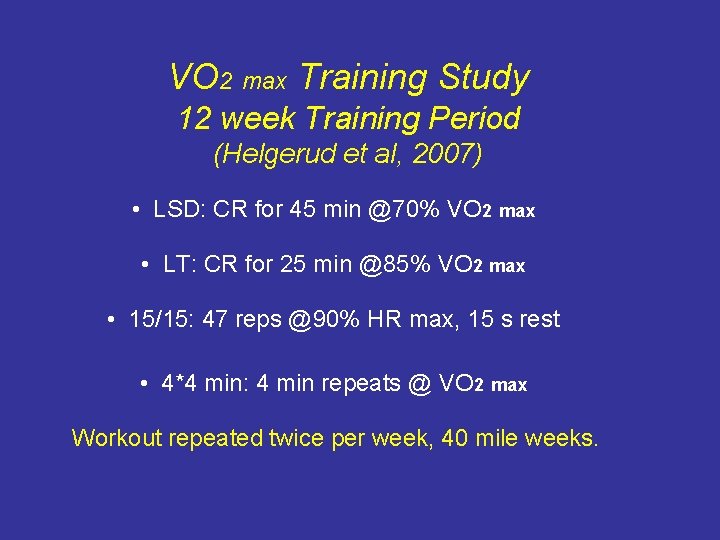
VO 2 max Training Study 12 week Training Period (Helgerud et al, 2007) • LSD: CR for 45 min @70% VO 2 max • LT: CR for 25 min @85% VO 2 max • 15/15: 47 reps @90% HR max, 15 s rest • 4*4 min: 4 min repeats @ VO 2 max Workout repeated twice per week, 40 mile weeks.
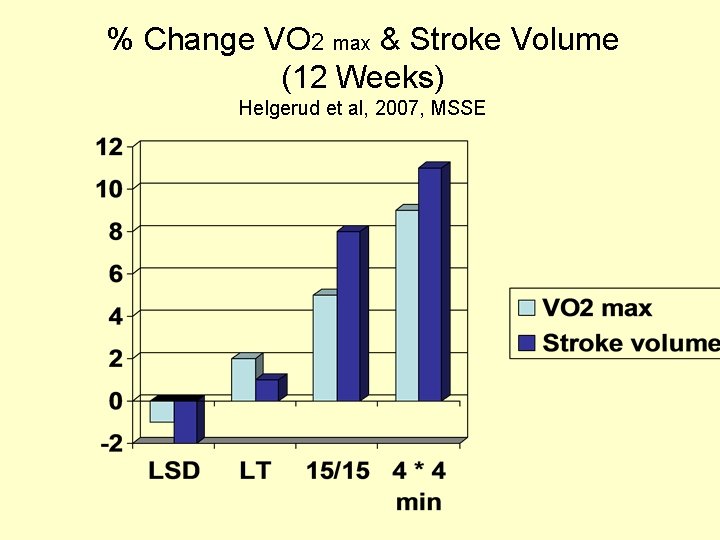
% Change VO 2 max & Stroke Volume (12 Weeks) Helgerud et al, 2007, MSSE
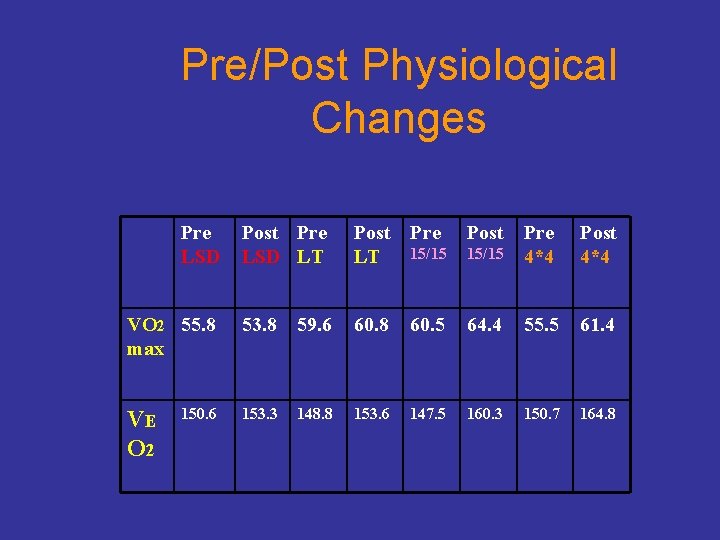
Pre/Post Physiological Changes Pre LSD Post Pre LSD LT Post Pre LT 15/15 Post VO 2 55. 8 max 53. 8 59. 6 60. 8 150. 6 153. 3 148. 8 153. 6 VE O 2 15/15 Pre 4*4 Post 4*4 60. 5 64. 4 55. 5 61. 4 147. 5 160. 3 150. 7 164. 8
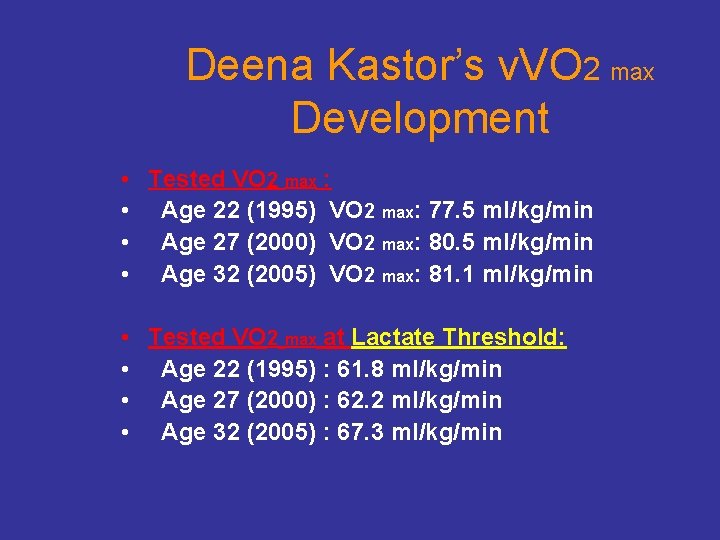
Deena Kastor’s v. VO 2 max Development • Tested VO 2 max : • Age 22 (1995) VO 2 max: 77. 5 ml/kg/min • Age 27 (2000) VO 2 max: 80. 5 ml/kg/min • Age 32 (2005) VO 2 max: 81. 1 ml/kg/min • Tested VO 2 max at Lactate Threshold: • Age 22 (1995) : 61. 8 ml/kg/min • Age 27 (2000) : 62. 2 ml/kg/min • Age 32 (2005) : 67. 3 ml/kg/min
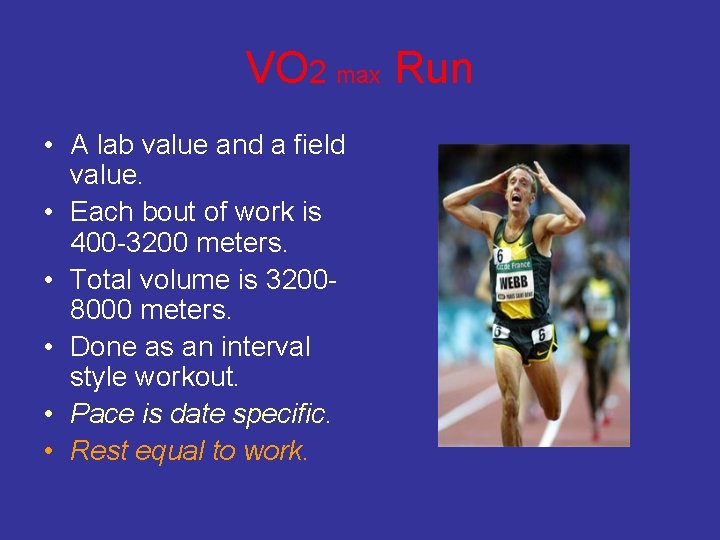
VO 2 max Run • A lab value and a field value. • Each bout of work is 400 -3200 meters. • Total volume is 32008000 meters. • Done as an interval style workout. • Pace is date specific. • Rest equal to work.
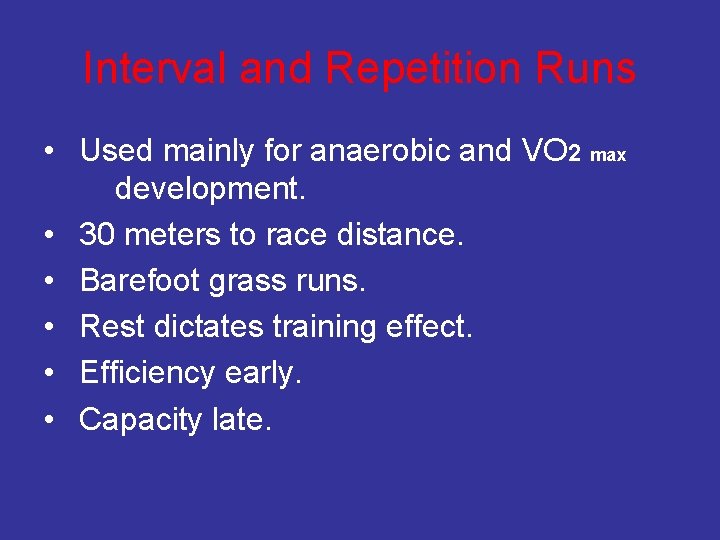
Interval and Repetition Runs • Used mainly for anaerobic and VO 2 max development. • 30 meters to race distance. • Barefoot grass runs. • Rest dictates training effect. • Efficiency early. • Capacity late.
Part 3 The multi-paced training scheme for the 800 and 1600 meter events.
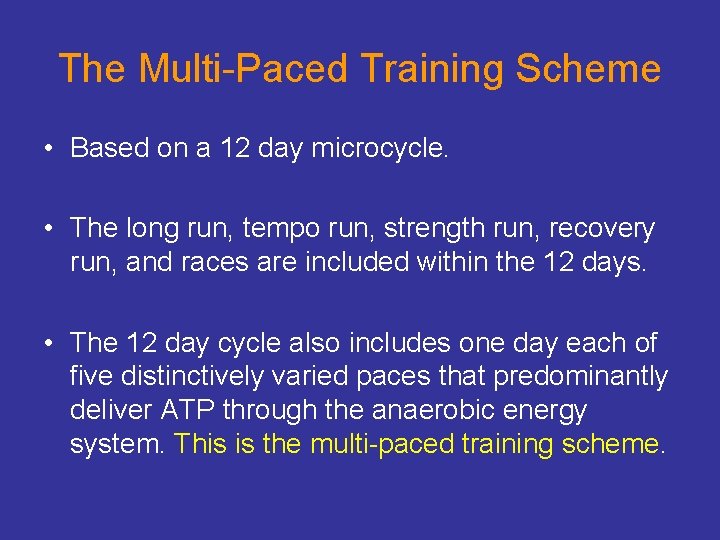
The Multi-Paced Training Scheme • Based on a 12 day microcycle. • The long run, tempo run, strength run, recovery run, and races are included within the 12 days. • The 12 day cycle also includes one day each of five distinctively varied paces that predominantly deliver ATP through the anaerobic energy system. This is the multi-paced training scheme.
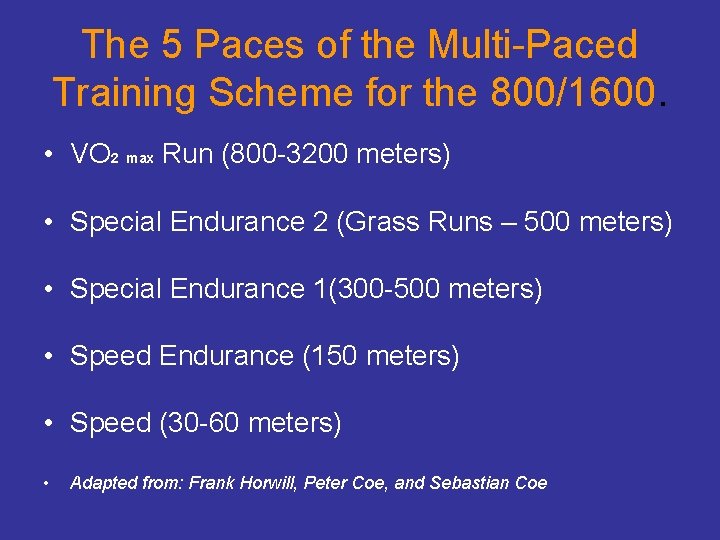
The 5 Paces of the Multi-Paced Training Scheme for the 800/1600. • VO 2 max Run (800 -3200 meters) • Special Endurance 2 (Grass Runs – 500 meters) • Special Endurance 1(300 -500 meters) • Speed Endurance (150 meters) • Speed (30 -60 meters) • Adapted from: Frank Horwill, Peter Coe, and Sebastian Coe
Sprinters vs. Distance Runners [Rate vs. Economy]
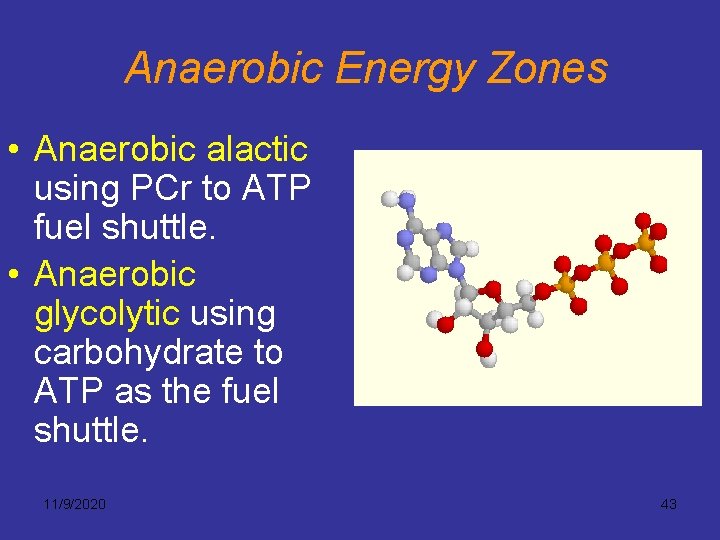
Anaerobic Energy Zones • Anaerobic alactic using PCr to ATP fuel shuttle. • Anaerobic glycolytic using carbohydrate to ATP as the fuel shuttle. 11/9/2020 43
Glycolytic Workloads Speed Endurance 60 meters to [Ex. ] 2 sets of 5 150 meters @ reps of 110 97% max effort meters. Special Endurance 1 150 meters to [Ex. ] 2 sets of 3 300 meters @ reps of 300 95% max effort meters Special Endurance 2 300 meters to [Ex. ]1 set of 4 600 meters @ reps of 500 92% max effort meters
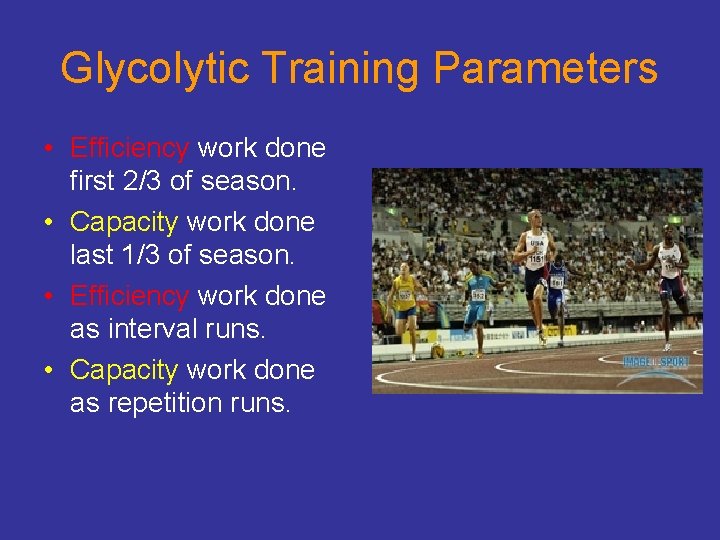
Glycolytic Training Parameters • Efficiency work done first 2/3 of season. • Capacity work done last 1/3 of season. • Efficiency work done as interval runs. • Capacity work done as repetition runs.
Glycolytic Workouts • Choose between Speed Endurance, Special Endurance 1, or Special Endurance 2. • Decide the extent. • Decide the intensity. • Decide the reps and sets. • Decide the total volume.
Improvements in Ground Contact Time “If a distance runner can lessen their ground contact time by. 02 seconds per stride, with all else being equal, there should be a ~5 second improvement in 1600 meter performance. This can be accomplished by strengthening the muscles of the foot. ” Ralph Mann Ph. D.
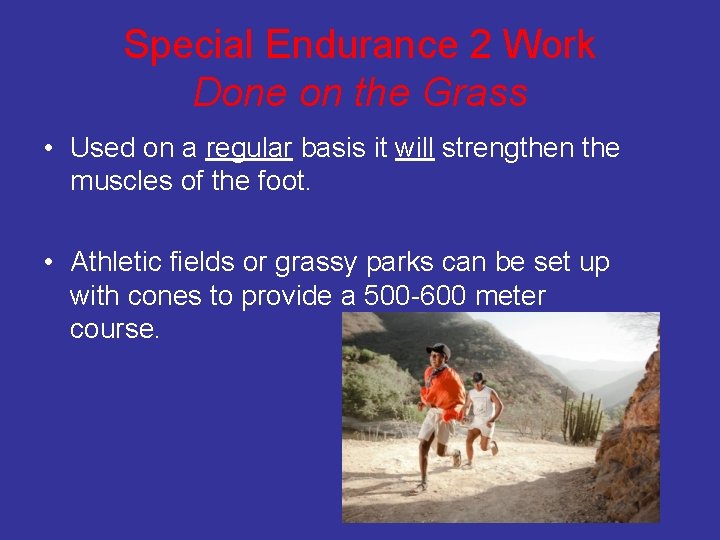
Special Endurance 2 Work Done on the Grass • Used on a regular basis it will strengthen the muscles of the foot. • Athletic fields or grassy parks can be set up with cones to provide a 500 -600 meter course.
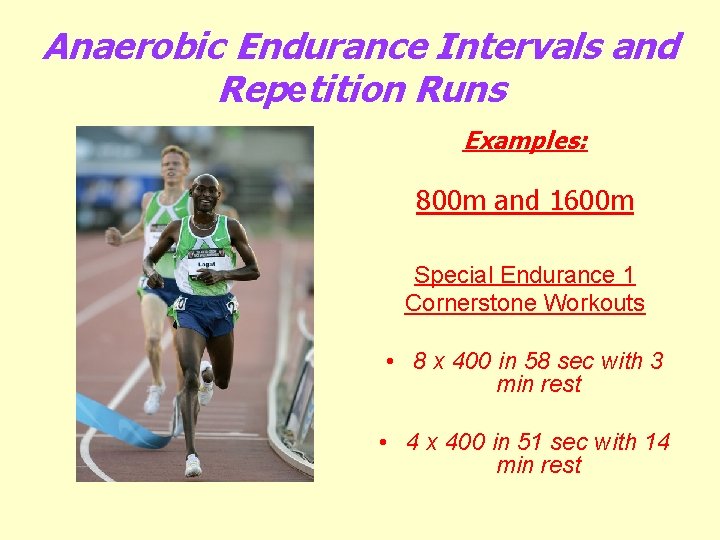
Anaerobic Endurance Intervals and Repetition Runs Examples: 800 m and 1600 m Special Endurance 1 Cornerstone Workouts • 8 x 400 in 58 sec with 3 min rest • 4 x 400 in 51 sec with 14 min rest
Speed Endurance • 60 -150 meters on the track. • The essence of “fast” running. • For the 800/1600 concentrate on 150 meters. • Because it is 100% effort, control of the rest interval dictates effect,
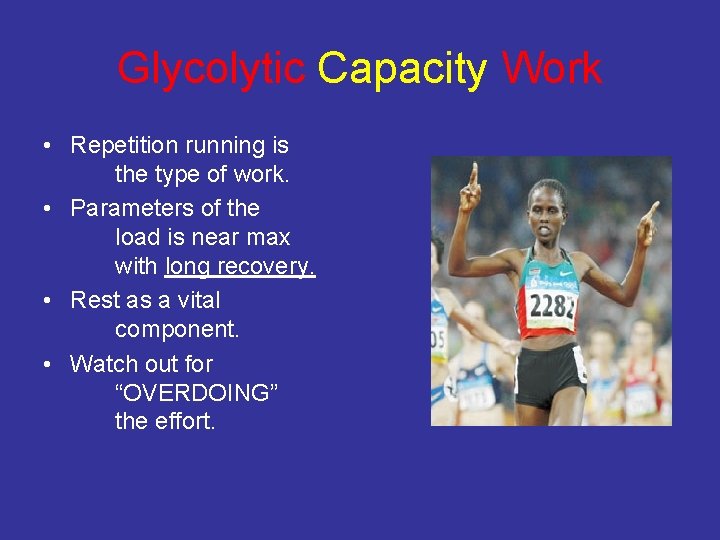
Glycolytic Capacity Work • Repetition running is the type of work. • Parameters of the load is near max with long recovery. • Rest as a vital component. • Watch out for “OVERDOING” the effort.
Alactic Energy Zone • • No hydrogen ion build up. 7 - 9 seconds in duration. Limited by fuel reserve. Fuel restored at sub-maximal velocity “on the fly”. • Used for max speed development. 11/9/2020 52
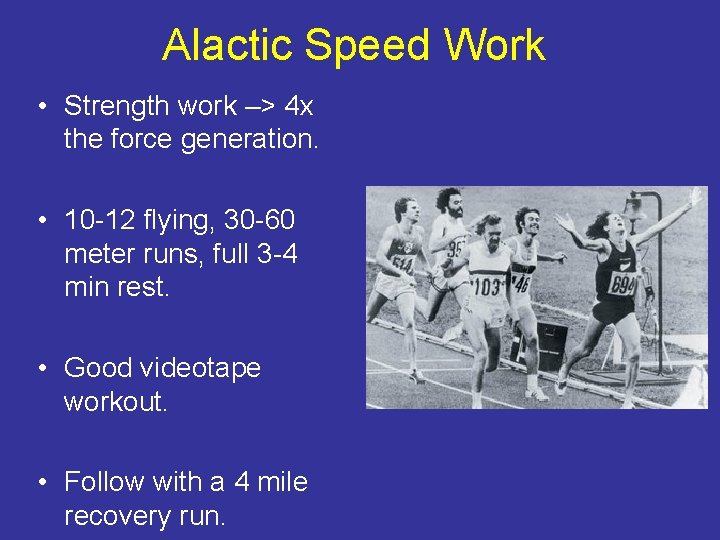
Alactic Speed Work • Strength work –> 4 x the force generation. • 10 -12 flying, 30 -60 meter runs, full 3 -4 min rest. • Good videotape workout. • Follow with a 4 mile recovery run.
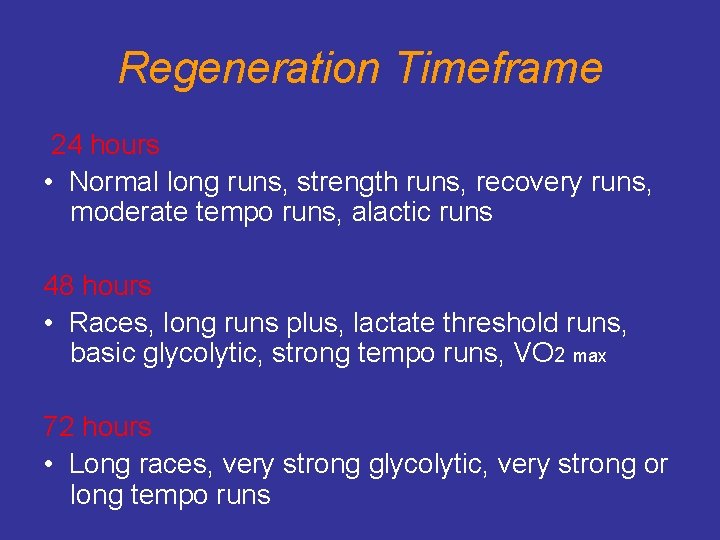
Regeneration Timeframe 24 hours • Normal long runs, strength runs, recovery runs, moderate tempo runs, alactic runs 48 hours • Races, long runs plus, lactate threshold runs, basic glycolytic, strong tempo runs, VO 2 max 72 hours • Long races, very strong glycolytic, very strong or long tempo runs
Training Effects • Some physiological effects after 24 hours. • Full physiological effects after 20 days. • Periodize and sequence your workouts so they fit the race schedule. • The body is very resilient when at a high fitness level. • Watch for muscle trauma caused by too much testosterone.
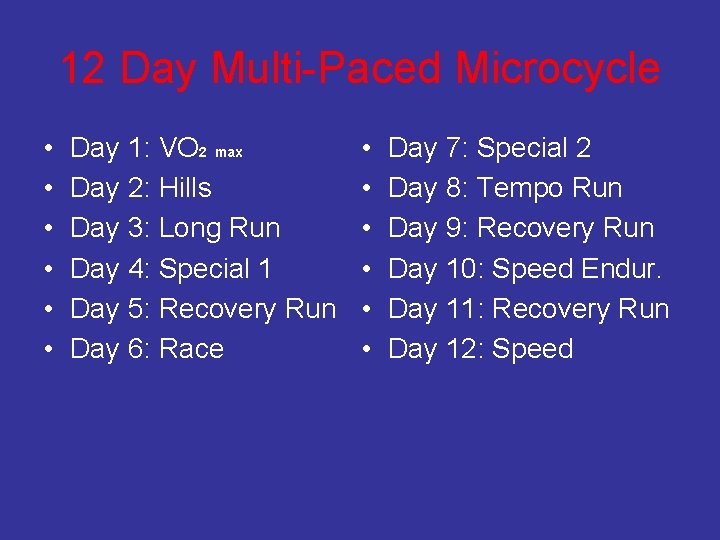
12 Day Multi-Paced Microcycle • • • Day 1: VO 2 max Day 2: Hills Day 3: Long Run Day 4: Special 1 Day 5: Recovery Run Day 6: Race • • • Day 7: Special 2 Day 8: Tempo Run Day 9: Recovery Run Day 10: Speed Endur. Day 11: Recovery Run Day 12: Speed
Part 4 Key workouts for each pace of the multi-paced training scheme.
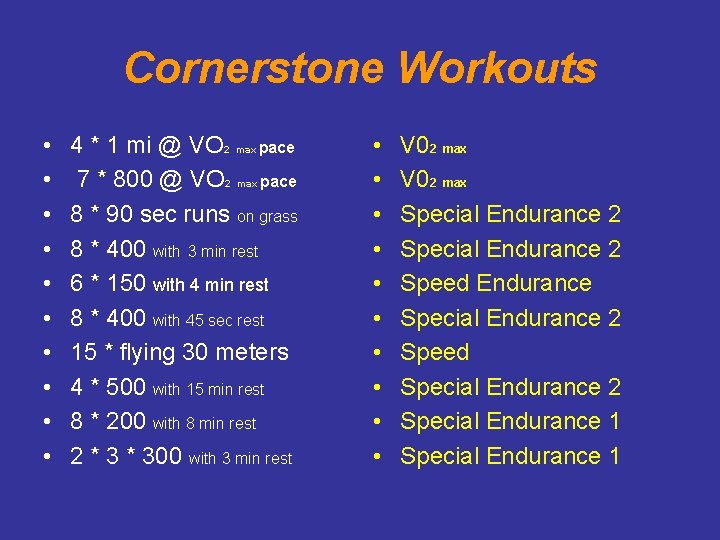
Cornerstone Workouts • • • 4 * 1 mi @ VO 2 max pace 7 * 800 @ VO 2 max pace 8 * 90 sec runs on grass 8 * 400 with 3 min rest 6 * 150 with 4 min rest 8 * 400 with 45 sec rest 15 * flying 30 meters 4 * 500 with 15 min rest 8 * 200 with 8 min rest 2 * 300 with 3 min rest • • • V 02 max Special Endurance 2 Speed Endurance Special Endurance 2 Speed Special Endurance 2 Special Endurance 1
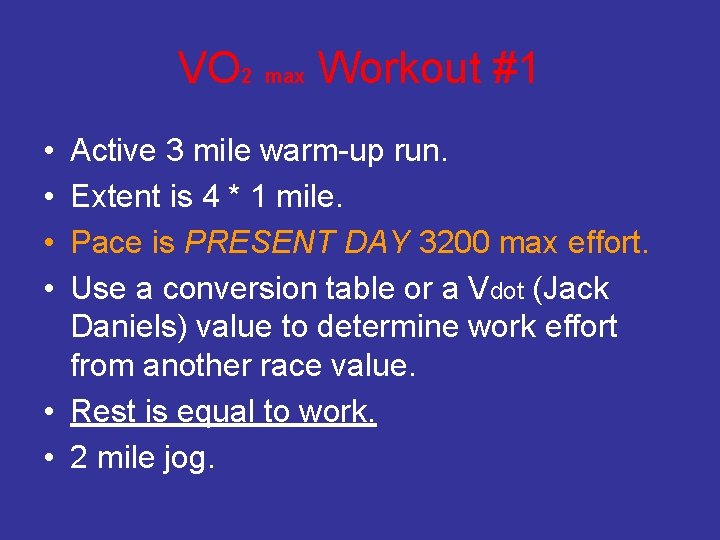
VO 2 max Workout #1 • • Active 3 mile warm-up run. Extent is 4 * 1 mile. Pace is PRESENT DAY 3200 max effort. Use a conversion table or a Vdot (Jack Daniels) value to determine work effort from another race value. • Rest is equal to work. • 2 mile jog.
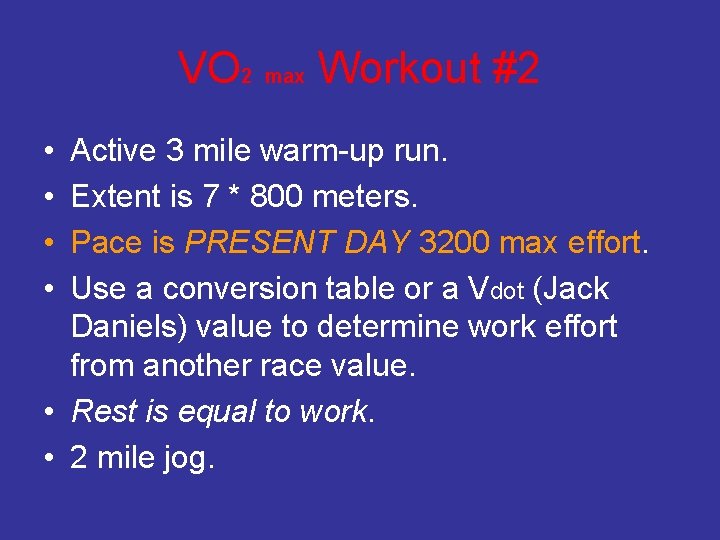
VO 2 max Workout #2 • • Active 3 mile warm-up run. Extent is 7 * 800 meters. Pace is PRESENT DAY 3200 max effort. Use a conversion table or a Vdot (Jack Daniels) value to determine work effort from another race value. • Rest is equal to work. • 2 mile jog.
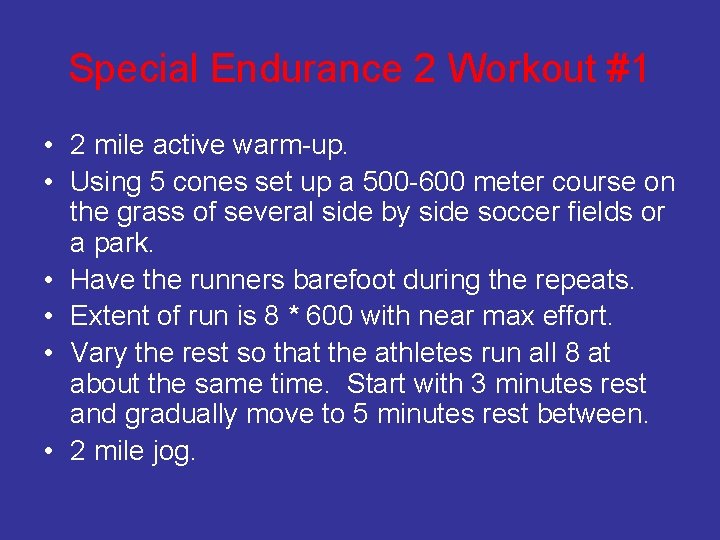
Special Endurance 2 Workout #1 • 2 mile active warm-up. • Using 5 cones set up a 500 -600 meter course on the grass of several side by side soccer fields or a park. • Have the runners barefoot during the repeats. • Extent of run is 8 * 600 with near max effort. • Vary the rest so that the athletes run all 8 at about the same time. Start with 3 minutes rest and gradually move to 5 minutes rest between. • 2 mile jog.
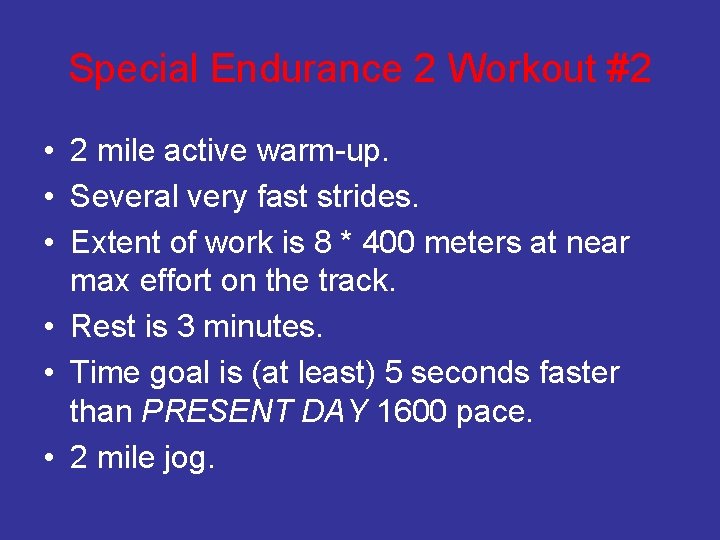
Special Endurance 2 Workout #2 • 2 mile active warm-up. • Several very fast strides. • Extent of work is 8 * 400 meters at near max effort on the track. • Rest is 3 minutes. • Time goal is (at least) 5 seconds faster than PRESENT DAY 1600 pace. • 2 mile jog.
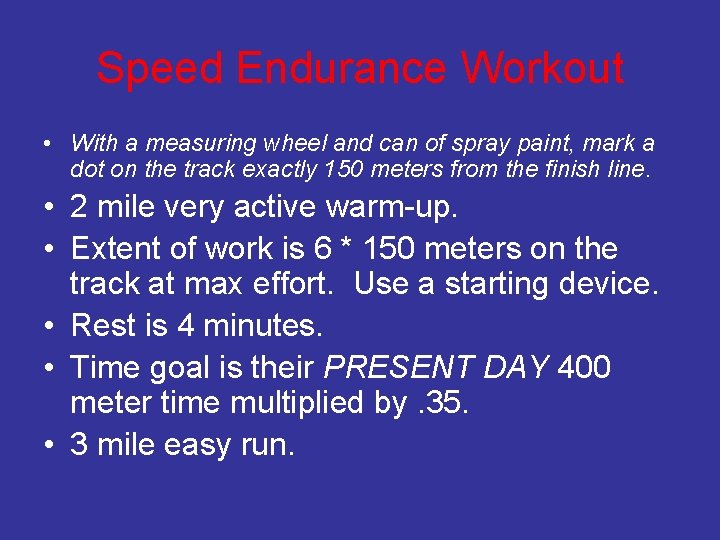
Speed Endurance Workout • With a measuring wheel and can of spray paint, mark a dot on the track exactly 150 meters from the finish line. • 2 mile very active warm-up. • Extent of work is 6 * 150 meters on the track at max effort. Use a starting device. • Rest is 4 minutes. • Time goal is their PRESENT DAY 400 meter time multiplied by. 35. • 3 mile easy run.
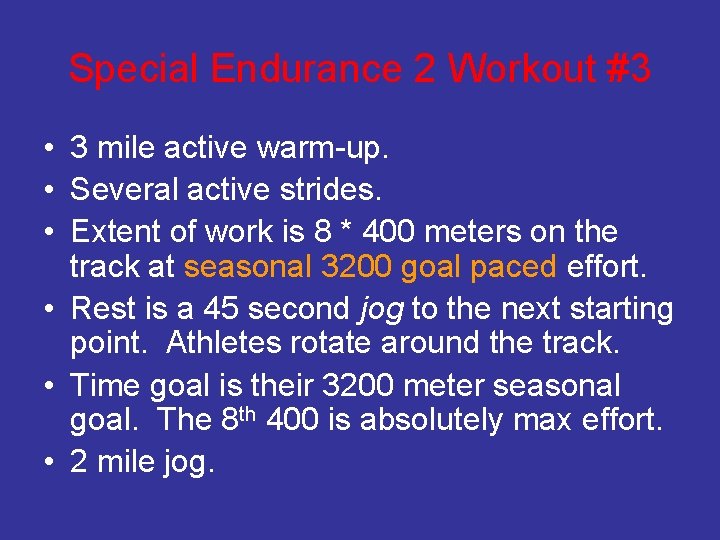
Special Endurance 2 Workout #3 • 3 mile active warm-up. • Several active strides. • Extent of work is 8 * 400 meters on the track at seasonal 3200 goal paced effort. • Rest is a 45 second jog to the next starting point. Athletes rotate around the track. • Time goal is their 3200 meter seasonal goal. The 8 th 400 is absolutely max effort. • 2 mile jog.
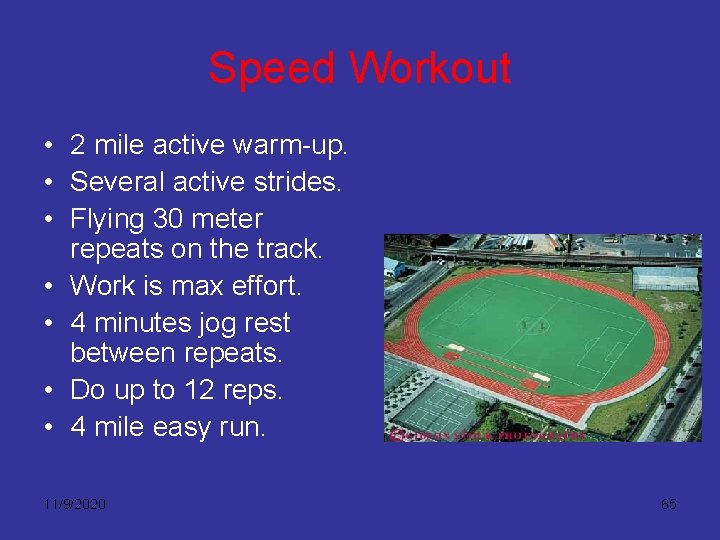
Speed Workout • 2 mile active warm-up. • Several active strides. • Flying 30 meter repeats on the track. • Work is max effort. • 4 minutes jog rest between repeats. • Do up to 12 reps. • 4 mile easy run. 11/9/2020 65
Special Endurance 2 Workout #4 • • • Capacity work done as repetition running. 2 mile active warm-up. Several active strides. Extent of work is 4 * 500 at max effort. Rest is near complete at 15 minutes. Time goal is PRESENT DAY 800 pace multiplied by. 59. • 1 mile jog.
Special Endurance 1 Workout #1 • 2 mile active warm-up. • Several very active strides. • Extent of work is 8 * 200 at near max effort on the track. • Rest is extensive at 8 minutes between repeats. • Time goal is PRESENT DAY 400 meter pace multiplied by. 47. • 2 mile jog.
Special Endurance 1 Workout #2 • 2 mile active warm-up. • Several very active strides. • Extent of work is 2 sets of 3 repeats of 300 meters on the track. • Rest is incomplete at 3 min between repeats and 5 minutes between the sets. • Time goal is seasonal 800 goal pace multiplied by. 35. • 2 mile jog. .
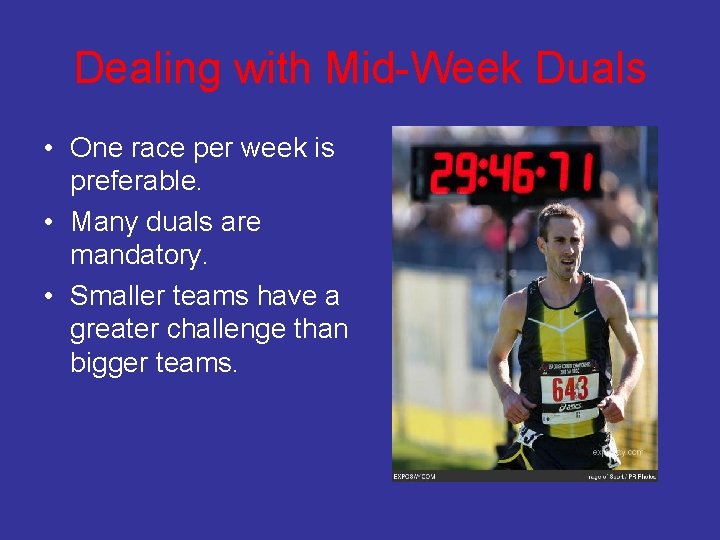
Dealing with Mid-Week Duals • One race per week is preferable. • Many duals are mandatory. • Smaller teams have a greater challenge than bigger teams.
Ups and Downs of Dual Meets • Using smaller meets for developing young athletes and emphasizing split time awareness is a plus. • Too many meets may lead to injuries, fatigue, chronic poor race performances and psychological stress, all minuses.
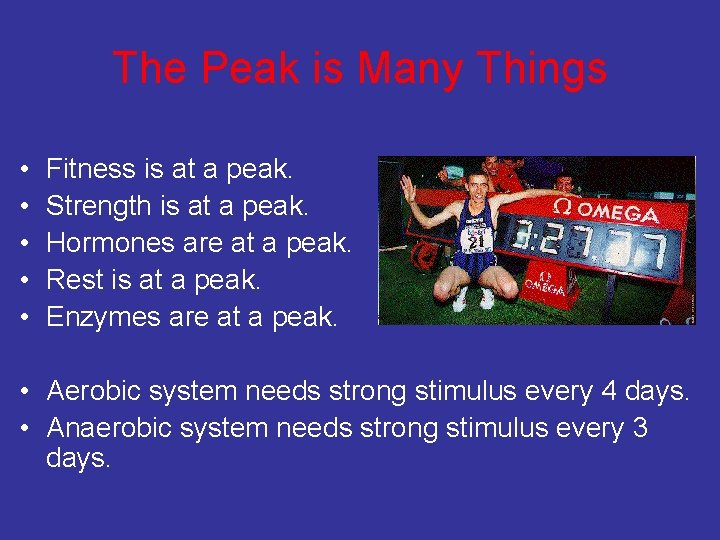
The Peak is Many Things • • • Fitness is at a peak. Strength is at a peak. Hormones are at a peak. Rest is at a peak. Enzymes are at a peak. • Aerobic system needs strong stimulus every 4 days. • Anaerobic system needs strong stimulus every 3 days.
More Endurance Information Available in the Following Book: The Complete Guide to Track and Field Conditioning for Endurance Events. By Scott Christensen Athletesacceleration. com/trackandfieldendurance. html