
Preparation of Technical Report By Dr Mouaaz Nahas

Preparation of Technical Report By: Dr. Mouaaz Nahas Seminars in Electrical Engineering 802304 Umm Al-Qura University Electrical Engineering Department
Agenda l l l l Technical Writing Activities Technical Report Structural Requirements Technical Report Parts (Elements) EE 802304 Report Structure and Presentation General Guidelines Checklist
Technical Writing l Technical Writing: is a form of communication that conveys information through writing. l Also known as Written Communication. l Preparation of technical report is part of Technical Writing.
Technical Writing Activities (Academic) l l l Coursework / Assignment Course Project Lab Report Senior Project Research Proposal Master’s Thesis Doctoral (Ph. D) Thesis Paper (Journal, Conference) Poster Article Book (or Chapters) Lessons (or Notes)
Technical Writing Activities (Industrial / Business) l l l l Field Report Progress Report Request for Proposal (RFP) Proposal Product Catalog Meeting Agenda / Minutes Whitepaper – (a business report that educates customers and helps them make decisions on product or technology)
Technical Report Structural Requirements 1) Content (Words & Information) – What you say in the report 2) Presentation (Appearance) – How the report looks like
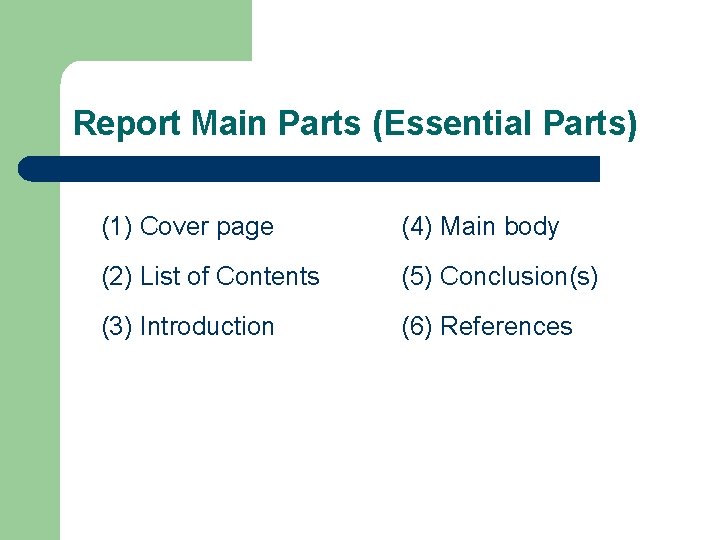
Report Main Parts (Essential Parts) (1) Cover page (4) Main body (2) List of Contents (5) Conclusion(s) (3) Introduction (6) References
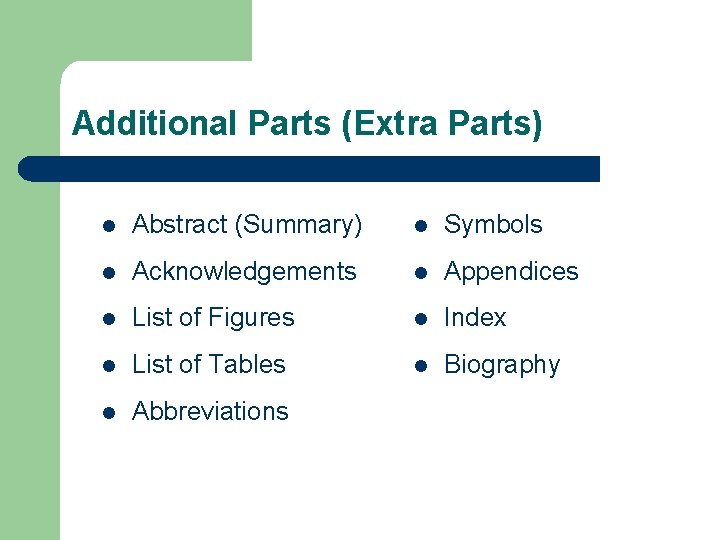
Additional Parts (Extra Parts) l Abstract (Summary) l Symbols l Acknowledgements l Appendices l List of Figures l Index l List of Tables l Biography l Abbreviations
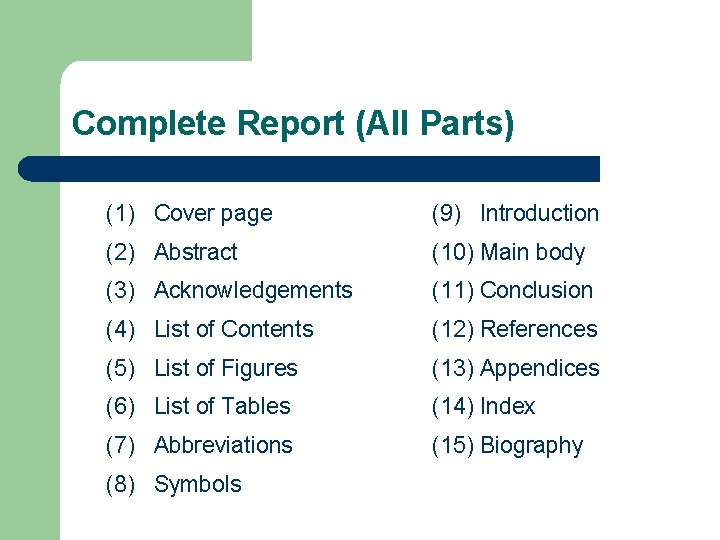
Complete Report (All Parts) (1) Cover page (9) Introduction (2) Abstract (10) Main body (3) Acknowledgements (11) Conclusion (4) List of Contents (12) References (5) List of Figures (13) Appendices (6) List of Tables (14) Index (7) Abbreviations (15) Biography (8) Symbols
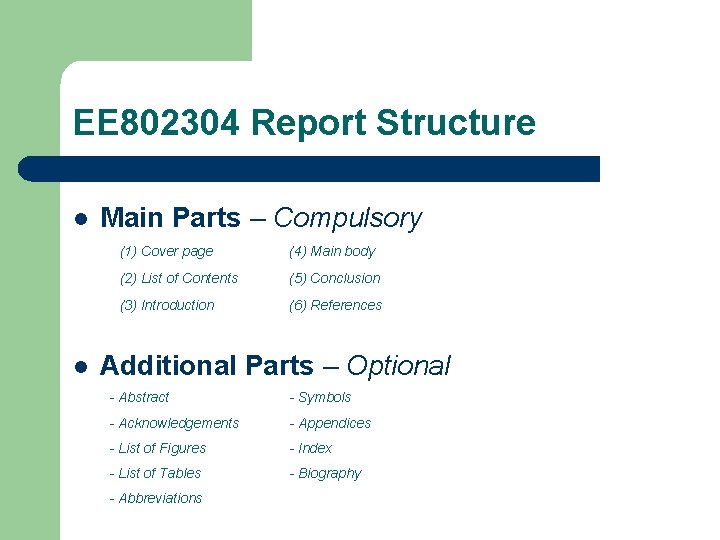
EE 802304 Report Structure l l Main Parts – Compulsory (1) Cover page (4) Main body (2) List of Contents (5) Conclusion (3) Introduction (6) References Additional Parts – Optional - Abstract - Symbols - Acknowledgements - Appendices - List of Figures - Index - List of Tables - Biography - Abbreviations
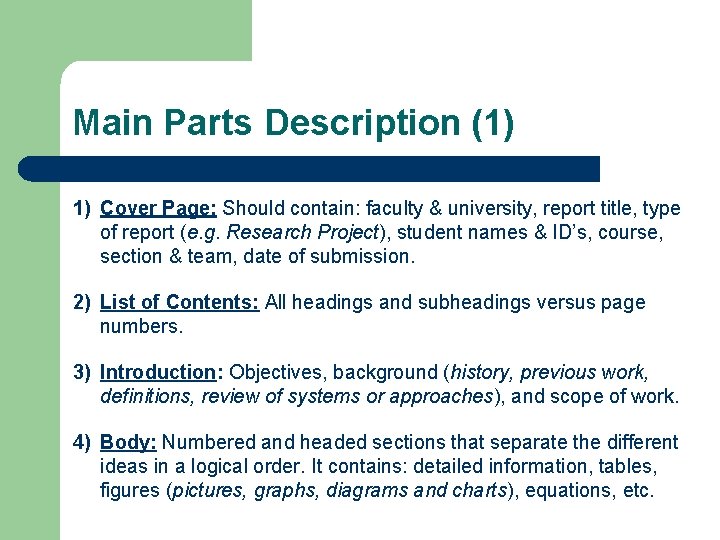
Main Parts Description (1) 1) Cover Page: Should contain: faculty & university, report title, type of report (e. g. Research Project), student names & ID’s, course, section & team, date of submission. 2) List of Contents: All headings and subheadings versus page numbers. 3) Introduction: Objectives, background (history, previous work, definitions, review of systems or approaches), and scope of work. 4) Body: Numbered and headed sections that separate the different ideas in a logical order. It contains: detailed information, tables, figures (pictures, graphs, diagrams and charts), equations, etc.
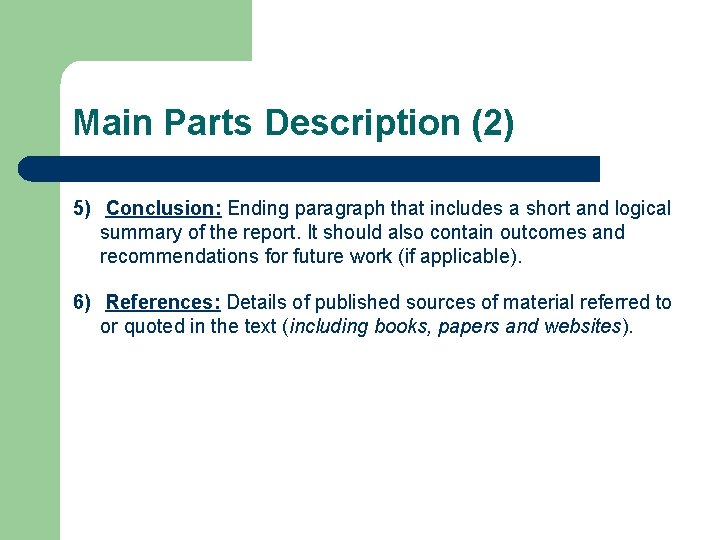
Main Parts Description (2) 5) Conclusion: Ending paragraph that includes a short and logical summary of the report. It should also contain outcomes and recommendations for future work (if applicable). 6) References: Details of published sources of material referred to or quoted in the text (including books, papers and websites).
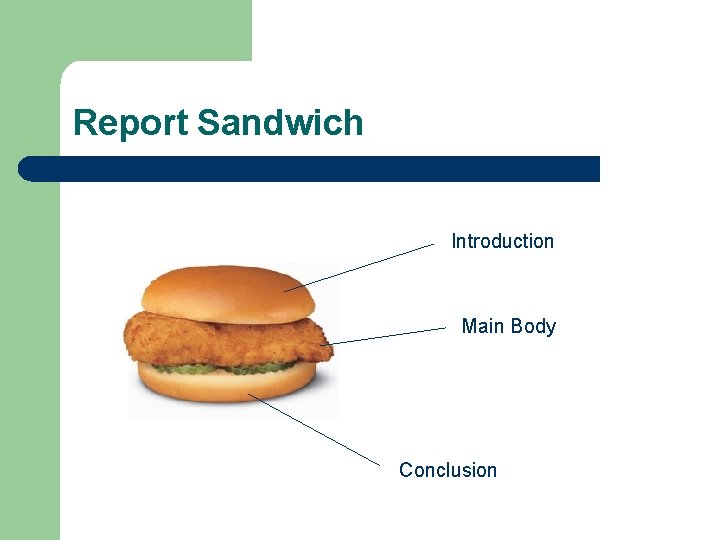
Report Sandwich Introduction Main Body Conclusion
Report Structure (Extra Parts) l Bibliography: Other published sources of material, including websites, not referred to in the text but useful for background or further reading. l Acknowledgements: List of people who helped you to do the research or prepare the report, including your proofreaders. l Appendices: Any further material which is essential for full understanding of your report (e. g. large scale diagrams, computer code, raw data, specifications) but not required by a casual reader.
Presentation of the Report l Script: The report must be printed single sided on white A 4 paper. Hand written or dot-matrix printed reports are not acceptable. l Font: Use 12 pt, Times New Roman font, for the main text. Headings can be written in Arial or other font with larger size (e. g. 14 pt). l Page Numbers: Start numbering from the introduction part. Number all pages consecutively starting at 1. l Binding: A single staple in the top left corner or 3 staples spaced down the left hand margin. For longer reports (e. g. graduation project report) binders may be used.

Headings and Subheadings 3 Transformers 3. 1 High Voltage 3. 2 Low Voltage 3. 2. 1 “Step-Down" 3. 2. 2 “Step-Up”
![Citation (referencing) For a book: Style: [1] Author Name(s), Title of Book, Publisher Place,](http://slidetodoc.com/presentation_image_h2/7e4d9503c7a7d2a3848c7a35d0210036/image-17.jpg "Citation (referencing) For a book: Style: [1] Author Name(s), Title of Book, Publisher Place,")
Citation (referencing) For a book: Style: [1] Author Name(s), Title of Book, Publisher Place, Year. Example: [1] I. P. Kaminow, T. Li, Optical fibre telecommunications IVB: systems and impairments, Academic Press, San Diego, London, 2002. For a journal paper: Style: [2] Author Name(s), “Title of Paper”, Name of Journal / Conference, Volume, pages (Year). Example: [2] V. W. S. Chan, K. L. Hall, E. Modiano, and K. A. Rauschenbach, “Architectures and technologies for high-speed optical data networks”. Journal of Lightwave Technology, 16, 2146 -2168 (1998). For a website: Style: [3] Site Name (Year), “Article Title/Page Title”, URL Address, [accessed Month Year]. Examples: [3] Wikipedia (2009), “Harvard referencing”, http: //en. wikipedia. org/wiki/Wikipedia: Harvard_referencing [accessed 2 Apr 2009].
Report Length (14 – 19 pages) (1) Cover page: 1 page (2) List of Contents: 1 page. (3) Introduction: 2 – 3 pages, including the Mind Map. (4) Main body: 7 – 9 (1 – 3 chapters). (5) Conclusion: 1 – 2 pages. (6) References: 1 – 2 pages (7 – 8 references, at least 3 books, others can be papers and / or website articles). (7) Report checklist
General Guidelines l l l l Use similar format for similar titles and similar subtitles. All tables and figures must have numbers and captions. Do not put any of them unless you mention it in the text. Tables should have titles on the top while figures have their titles at the bottom (use Fig. 1, Fig. 2, etc). Equations are numbered on the right hand side. Place tables, figures and equations as close as possible to the text in which they are mentioned. Very large tables, figures and detailed mathematics or software codes should go into appendices. Make sure you do not digress (deviate from the main topic).
Originality and plagiarism l Whenever you make use of other people's work, you must indicate this in the text with a number which refers to an item in the list of references. Any phrases, sentences or paragraphs which are copied unaltered (unchanged) must be enclosed in quotation marks (i. e. “ ”) and referenced by a number (i. e. [1]). Material which is reproduced with changes should not be in quotation marks but must still be referenced. It is not sufficient to list the sources of information at the end of the report; you must indicate the sources of information individually within the report using the reference numbering system. l Information that is not referenced is assumed to be either common knowledge or your own work or ideas; if it is not, then it is assumed to be plagiarized (i. e. you have knowingly copied someone else's words, facts or ideas without reference, passing them off as your own).
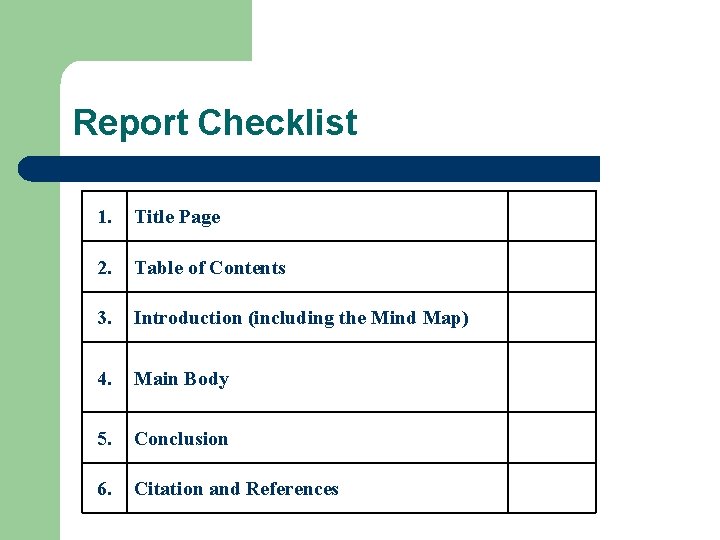
Report Checklist 1. Title Page 2. Table of Contents 3. Introduction (including the Mind Map) 4. Main Body 5. Conclusion 6. Citation and References

Thank You Any Questions?
- Slides: 22