
Preparation of Specimens for Metallographic Examination Exp 1
- Slides: 14
Preparation of Specimens for Metallographic Examination Exp. #1. 1
Objective To prepare the specimens surfaces to be examined by the microscope. To learn and to gain experience in the preparation of metallographic specimens. Exp. 4: Preparation of Specimens 11/24/2020 2
Introduction Metallography is basically the study of the structures and constitution of metals and alloys, using metallurgical microscopes and magnifications, so that the physical and mechanical properties of an alloy can be related to its observed microstructure. Such microscopic studies can provide an abundance of constitutional information about the specimen under investigation, including the size and shape of the grains (crystallites), the presence of micro defects (such as segregation, hair cracks, and nonmetallic inclusions), and the nature and distribution of secondary phases. The metallographic examination can be used in quality control and to predict and/or explain the mechanical properties. Exp. 4: Preparation of Specimens 11/24/2020 3
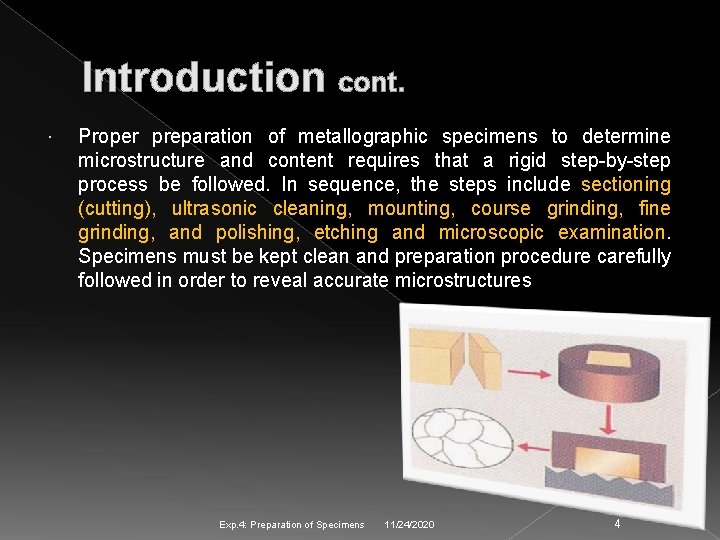
Introduction cont. Proper preparation of metallographic specimens to determine microstructure and content requires that a rigid step-by-step process be followed. In sequence, the steps include sectioning (cutting), ultrasonic cleaning, mounting, course grinding, fine grinding, and polishing, etching and microscopic examination. Specimens must be kept clean and preparation procedure carefully followed in order to reveal accurate microstructures Exp. 4: Preparation of Specimens 11/24/2020 4
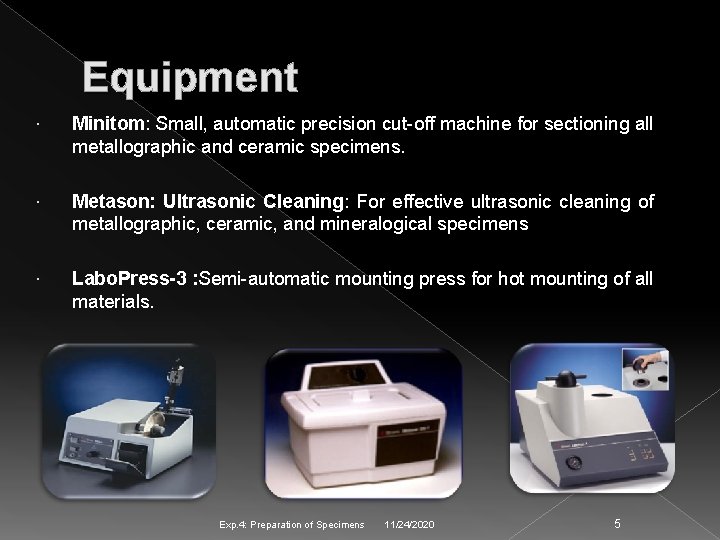
Equipment Minitom: Small, automatic precision cut-off machine for sectioning all metallographic and ceramic specimens. Metason: Ultrasonic Cleaning: For effective ultrasonic cleaning of metallographic, ceramic, and mineralogical specimens Labo. Press-3 : Semi-automatic mounting press for hot mounting of all materials. Exp. 4: Preparation of Specimens 11/24/2020 5
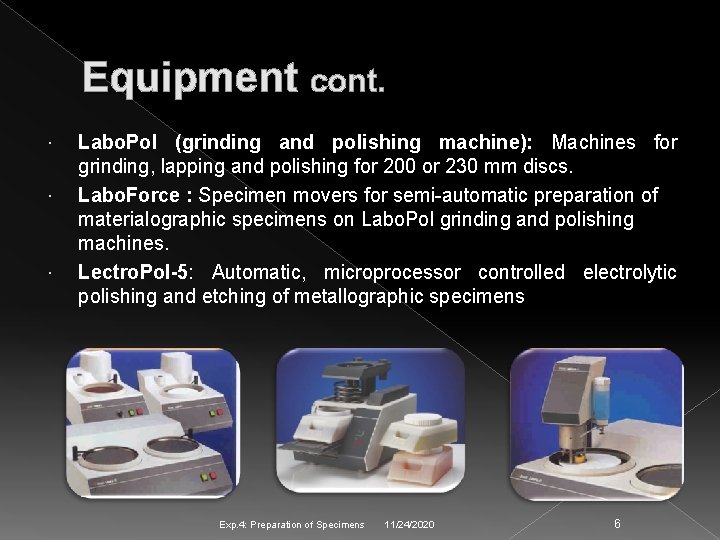
Equipment cont. Labo. Pol (grinding and polishing machine): Machines for grinding, lapping and polishing for 200 or 230 mm discs. Labo. Force : Specimen movers for semi-automatic preparation of materialographic specimens on Labo. Pol grinding and polishing machines. Lectro. Pol-5: Automatic, microprocessor controlled electrolytic polishing and etching of metallographic specimens Exp. 4: Preparation of Specimens 11/24/2020 6
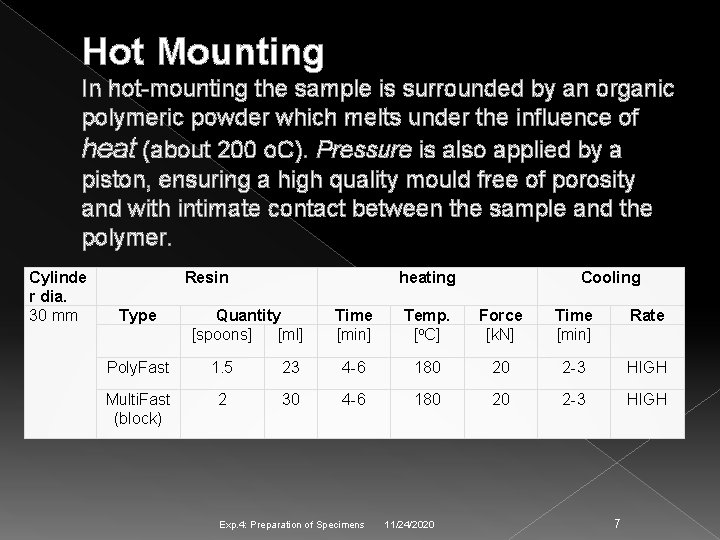
Hot Mounting In hot-mounting the sample is surrounded by an organic polymeric powder which melts under the influence of heat (about 200 o. C). Pressure is also applied by a piston, ensuring a high quality mould free of porosity and with intimate contact between the sample and the polymer. Cylinde r dia. 30 mm Resin Type heating Quantity [spoons] [ml] Cooling Time [min] Temp. [o. C] Force [k. N] Time [min] Rate Poly. Fast 1. 5 23 4 -6 180 20 2 -3 HIGH Multi. Fast (block) 2 30 4 -6 180 20 2 -3 HIGH Exp. 4: Preparation of Specimens 11/24/2020 7
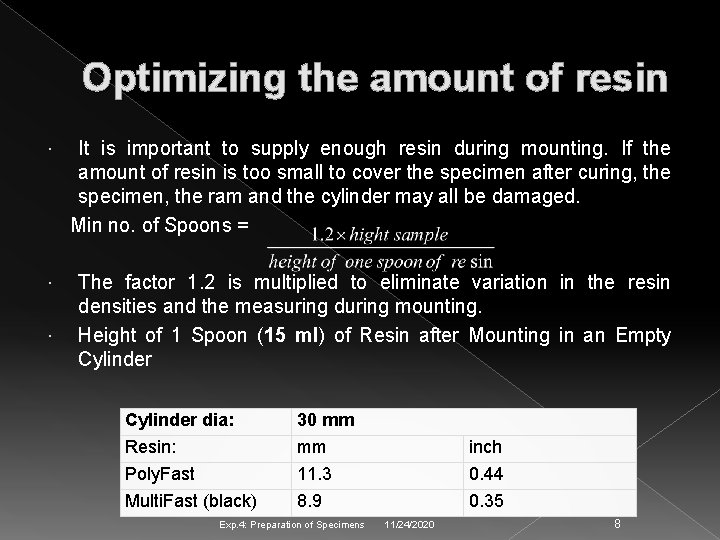
Optimizing the amount of resin It is important to supply enough resin during mounting. If the amount of resin is too small to cover the specimen after curing, the specimen, the ram and the cylinder may all be damaged. Min no. of Spoons = The factor 1. 2 is multiplied to eliminate variation in the resin densities and the measuring during mounting. Height of 1 Spoon (15 ml) of Resin after Mounting in an Empty Cylinder dia: Resin: Poly. Fast Multi. Fast (black) 30 mm mm 11. 3 8. 9 Exp. 4: Preparation of Specimens inch 0. 44 0. 35 11/24/2020 8
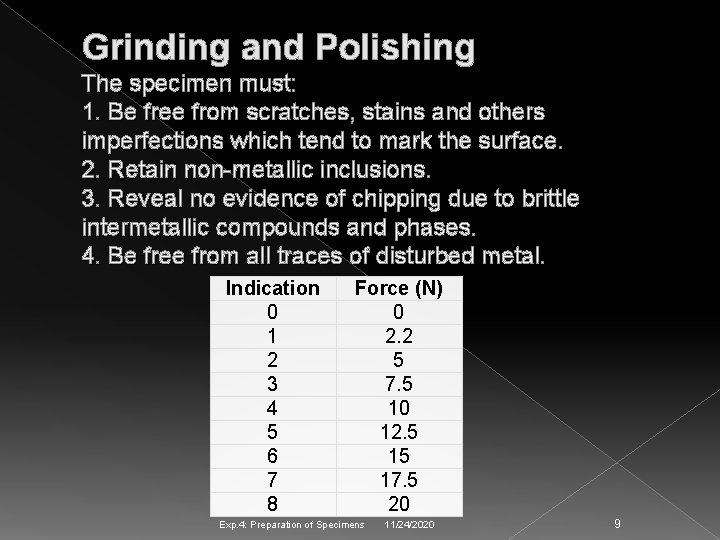
Grinding and Polishing The specimen must: 1. Be free from scratches, stains and others imperfections which tend to mark the surface. 2. Retain non-metallic inclusions. 3. Reveal no evidence of chipping due to brittle intermetallic compounds and phases. 4. Be free from all traces of disturbed metal. Indication 0 1 2 3 4 5 6 7 8 Force (N) 0 2. 2 5 7. 5 10 12. 5 15 17. 5 20 Exp. 4: Preparation of Specimens 11/24/2020 9
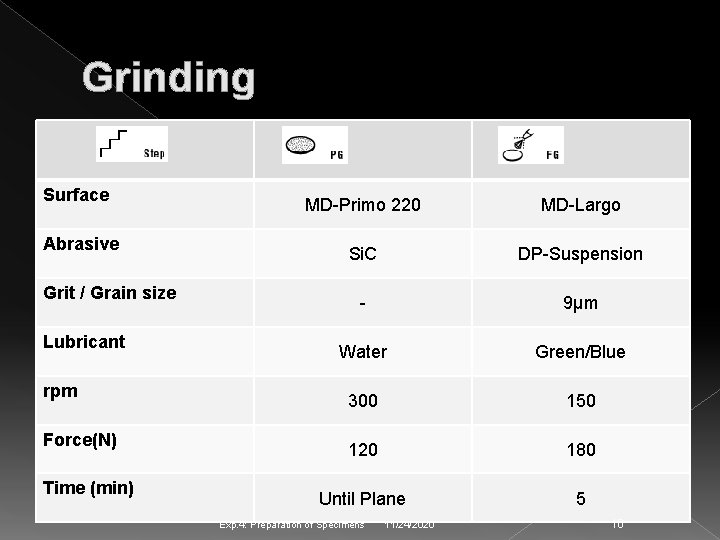
Grinding Surface Abrasive Grit / Grain size Lubricant rpm Force(N) Time (min) MD-Primo 220 MD-Largo Si. C DP-Suspension - 9µm Water Green/Blue 300 150 120 180 Until Plane 5 Exp. 4: Preparation of Specimens 11/24/2020 10
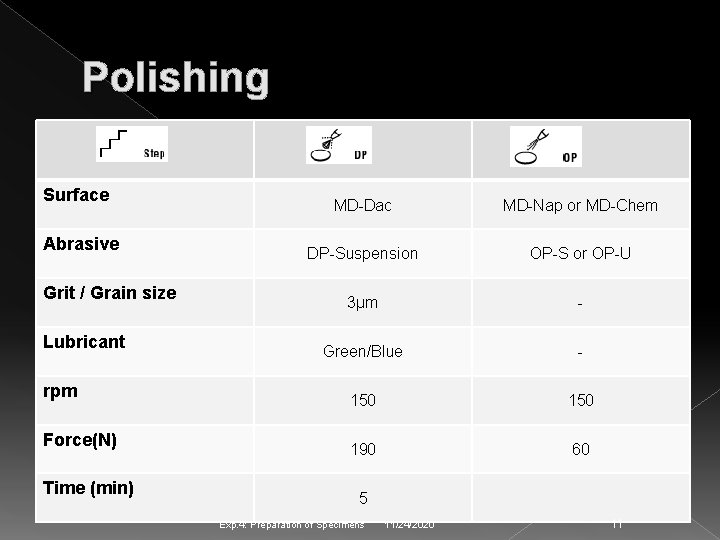
Polishing Surface Abrasive Grit / Grain size Lubricant rpm Force(N) Time (min) MD-Dac MD-Nap or MD-Chem DP-Suspension OP-S or OP-U 3µm - Green/Blue - 150 190 60 5 Exp. 4: Preparation of Specimens 11/24/2020 11
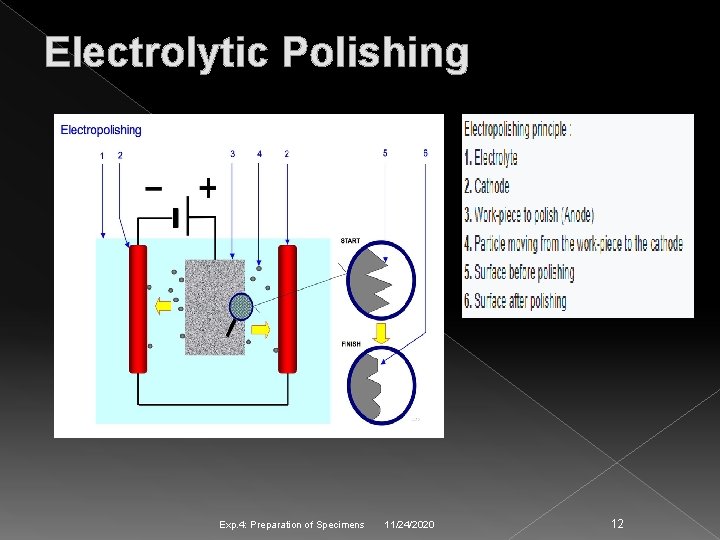
Electrolytic Polishing Exp. 4: Preparation of Specimens 11/24/2020 12
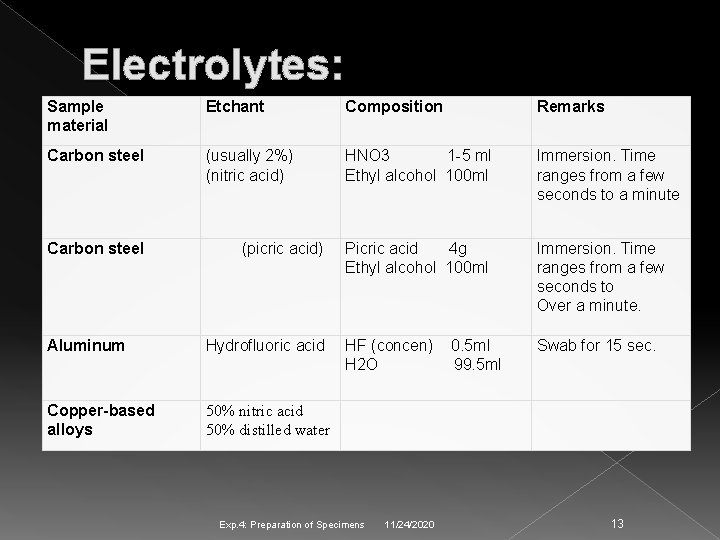
Electrolytes: Sample material Etchant Composition Remarks Carbon steel (usually 2%) (nitric acid) HNO 3 1 -5 ml Ethyl alcohol 100 ml Immersion. Time ranges from a few seconds to a minute Picric acid 4 g Ethyl alcohol 100 ml Immersion. Time ranges from a few seconds to Over a minute. HF (concen) 0. 5 ml H 2 O 99. 5 ml Swab for 15 sec. Carbon steel (picric acid) Aluminum Hydrofluoric acid Copper-based alloys 50% nitric acid 50% distilled water Exp. 4: Preparation of Specimens 11/24/2020 13
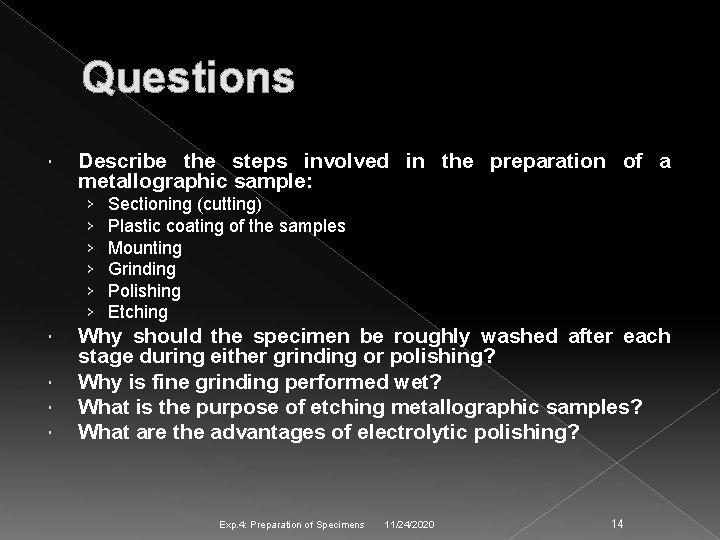
Questions Describe the steps involved in the preparation of a metallographic sample: › › › Sectioning (cutting) Plastic coating of the samples Mounting Grinding Polishing Etching Why should the specimen be roughly washed after each stage during either grinding or polishing? Why is fine grinding performed wet? What is the purpose of etching metallographic samples? What are the advantages of electrolytic polishing? Exp. 4: Preparation of Specimens 11/24/2020 14