
Preparation of Buffer Solutions by Different laboratory Ways
![Preparation of Buffer Solutions by Different laboratory Ways BCH 312 [PRACTICAL]](https://slidetodoc.com/presentation_image_h2/0a1f25f4656d78d3818314ed70cc03e7/image-1.jpg "Preparation of Buffer Solutions by Different laboratory Ways BCH 312 [PRACTICAL]")
Preparation of Buffer Solutions by Different laboratory Ways BCH 312 [PRACTICAL]
Objective: -To learn how to prepare a buffer by different laboratory ways.
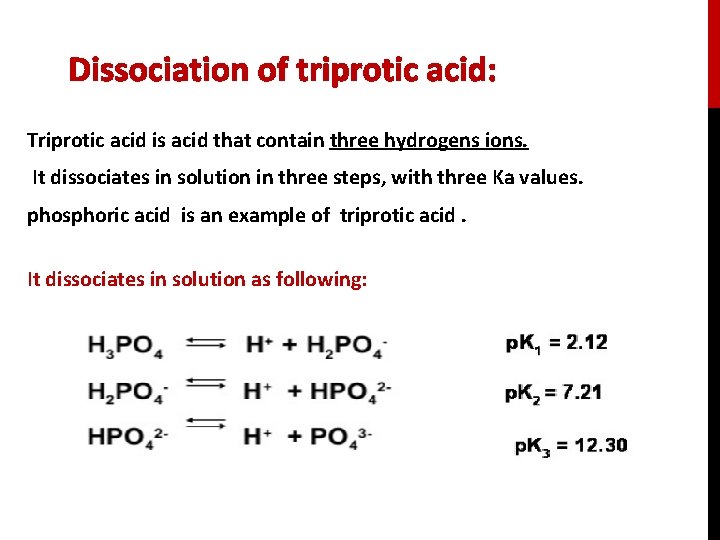
Dissociation of triprotic acid: Triprotic acid is acid that contain three hydrogens ions. It dissociates in solution in three steps, with three Ka values. phosphoric acid is an example of triprotic acid. It dissociates in solution as following:
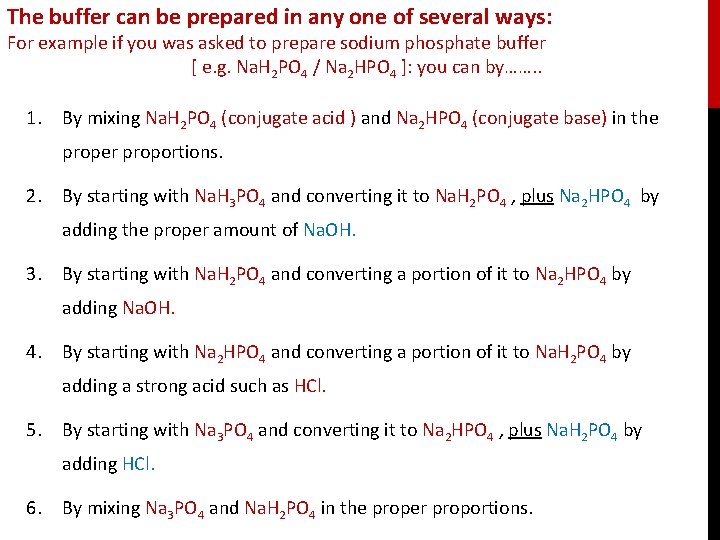
The buffer can be prepared in any one of several ways: For example if you was asked to prepare sodium phosphate buffer [ e. g. Na. H 2 PO 4 / Na 2 HPO 4 ]: you can by……. . 1. By mixing Na. H 2 PO 4 (conjugate acid ) and Na 2 HPO 4 (conjugate base) in the proper proportions. 2. By starting with Na. H 3 PO 4 and converting it to Na. H 2 PO 4 , plus Na 2 HPO 4 by adding the proper amount of Na. OH. 3. By starting with Na. H 2 PO 4 and converting a portion of it to Na 2 HPO 4 by adding Na. OH. 4. By starting with Na 2 HPO 4 and converting a portion of it to Na. H 2 PO 4 by adding a strong acid such as HCl. 5. By starting with Na 3 PO 4 and converting it to Na 2 HPO 4 , plus Na. H 2 PO 4 by adding HCl. 6. By mixing Na 3 PO 4 and Na. H 2 PO 4 in the proper proportions.

H 3 PO 4 HCl ‘donate H+’ H 2 PO 4 2 HPO 4 3 PO 4 Na. OH ‘accept H+’
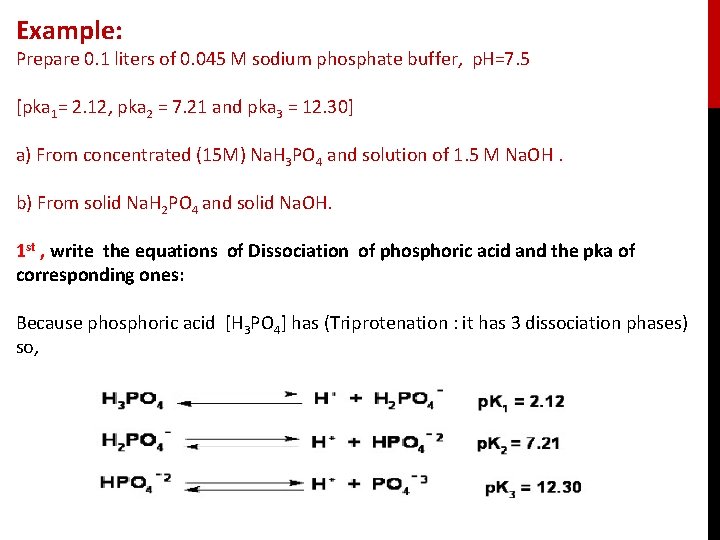
Example: Prepare 0. 1 liters of 0. 045 M sodium phosphate buffer, p. H=7. 5 [pka 1= 2. 12, pka 2 = 7. 21 and pka 3 = 12. 30] a) From concentrated (15 M) Na. H 3 PO 4 and solution of 1. 5 M Na. OH. b) From solid Na. H 2 PO 4 and solid Na. OH. 1 st , write the equations of Dissociation of phosphoric acid and the pka of corresponding ones: Because phosphoric acid [H 3 PO 4] has (Triprotenation : it has 3 dissociation phases) so,
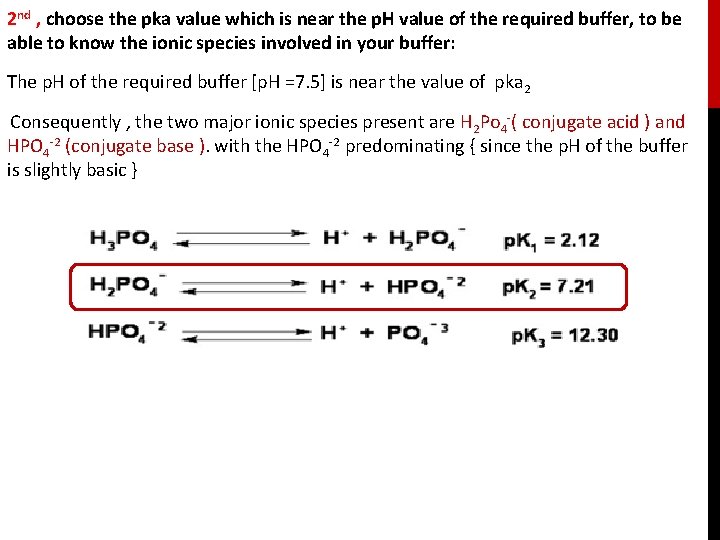
2 nd , choose the pka value which is near the p. H value of the required buffer, to be able to know the ionic species involved in your buffer: The p. H of the required buffer [p. H =7. 5] is near the value of pka 2 Consequently , the two major ionic species present are H 2 Po 4 -( conjugate acid ) and HPO 4 -2 (conjugate base ). with the HPO 4 -2 predominating { since the p. H of the buffer is slightly basic }
![Since the buffer concentration is 0. 045 M, so assume [A-] = y ,](http://slidetodoc.com/presentation_image_h2/0a1f25f4656d78d3818314ed70cc03e7/image-8.jpg "Since the buffer concentration is 0. 045 M, so assume [A-] = y ,")
Since the buffer concentration is 0. 045 M, so assume [A-] = y , [HA]= 0. 045 – y 3 rd , calculate No. of moles for the two ionic species in the buffer : PH =PKa 2 + log [ HPO 4 -2 ] / [H 2 PO 4 -] Assume [A-] = y , [HA]= 0. 045 - y 7. 5 = 7. 2 + log ( y / 0. 045 -y ) 7. 5 -7. 2 = log ( y / 0. 045 -y ) 0. 3= log( y / 0. 045 -y ) antilog for both sides: 2=( y / 0. 045 -y) y= 0. 09 - 2 y 3 y = 0. 09 y= 0. 9/3 = 0. 03 M conc. of [ HPO 4 -2 ] = [A-] = y So, conc. of [H 2 PO 4 -] =[HA] = 0. 045 – y = 0. 045 - 0. 03 = 0. 015 M - No. of moles of = HPO 4 -2 (A- ) = M x V = 0. 03 x 0. 1 = 0. 003 moles. - No. of moles of H 2 PO 4 - (HA)= M x V = 0. 015 x 0. 1 = 0. 0015 moles. Note that : [A-] = HPO 4 -2 [HA] = H 2 PO 4 -
[Note that Total no. of moles of phosphate buffer= M x V= 0. 045 x 0. 1 = 0. 0045 moles]. [Regardless of which method is used , the first step involves calculating number of moles and amounts of the two ionic species in the buffer]. Note: 1 - H 2 PO 4 - ( HA) = (Na. H 2 PO 4). 2 - HPO 4 -2 (A-) = (Na 2 HPO 4).
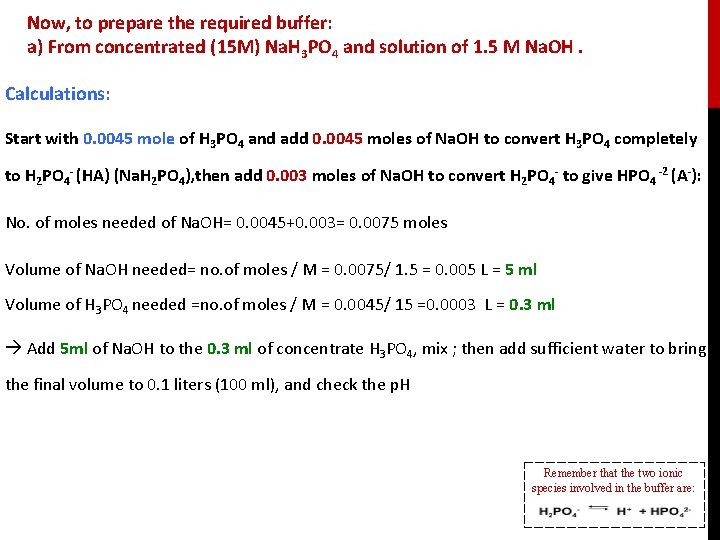
Now, to prepare the required buffer: a) From concentrated (15 M) Na. H 3 PO 4 and solution of 1. 5 M Na. OH. Calculations: Start with 0. 0045 mole of H 3 PO 4 and add 0. 0045 moles of Na. OH to convert H 3 PO 4 completely to H 2 PO 4 - (HA) (Na. H 2 PO 4), then add 0. 003 moles of Na. OH to convert H 2 PO 4 - to give HPO 4 -2 (A-): No. of moles needed of Na. OH= 0. 0045+0. 003= 0. 0075 moles Volume of Na. OH needed= no. of moles / M = 0. 0075/ 1. 5 = 0. 005 L = 5 ml Volume of H 3 PO 4 needed =no. of moles / M = 0. 0045/ 15 =0. 0003 L = 0. 3 ml Add 5 ml of Na. OH to the 0. 3 ml of concentrate H 3 PO 4, mix ; then add sufficient water to bring the final volume to 0. 1 liters (100 ml), and check the p. H Remember that the two ionic species involved in the buffer are:
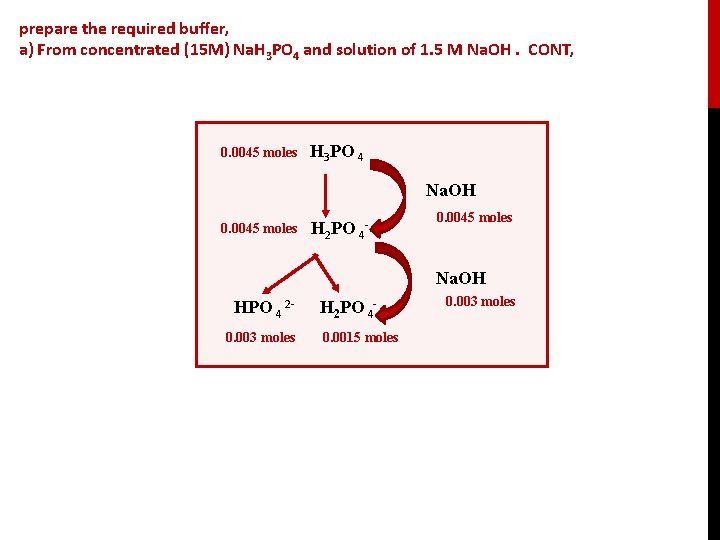
prepare the required buffer, a) From concentrated (15 M) Na. H 3 PO 4 and solution of 1. 5 M Na. OH. CONT, 0. 0045 moles H 3 PO 4 Na. OH 0. 0045 moles H 2 PO 4 - 0. 0045 moles Na. OH HPO 4 20. 003 moles H 2 PO 40. 0015 moles 0. 003 moles
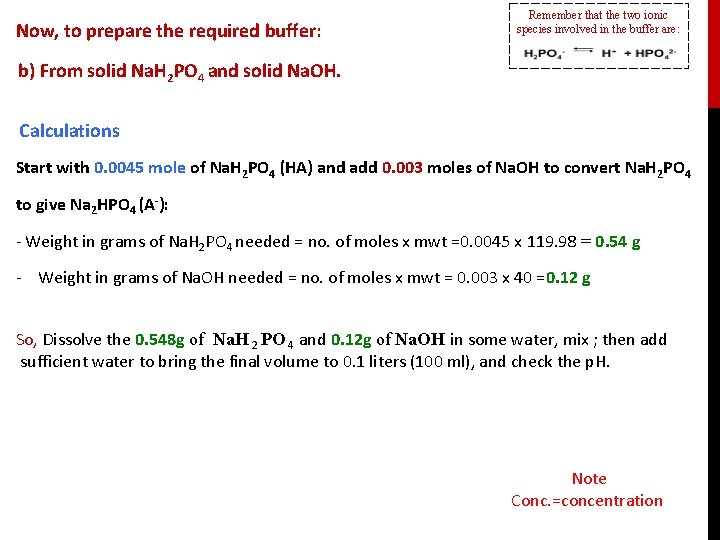
Now, to prepare the required buffer: Remember that the two ionic species involved in the buffer are: b) From solid Na. H 2 PO 4 and solid Na. OH. Calculations Start with 0. 0045 mole of Na. H 2 PO 4 (HA) and add 0. 003 moles of Na. OH to convert Na. H 2 PO 4 to give Na 2 HPO 4 (A-): - Weight in grams of Na. H 2 PO 4 needed = no. of moles x mwt =0. 0045 x 119. 98 = 0. 54 g - Weight in grams of Na. OH needed = no. of moles x mwt = 0. 003 x 40 =0. 12 g So, Dissolve the 0. 548 g of Na. H 2 PO 4 and 0. 12 g of Na. OH in some water, mix ; then add sufficient water to bring the final volume to 0. 1 liters (100 ml), and check the p. H. Note Conc. =concentration
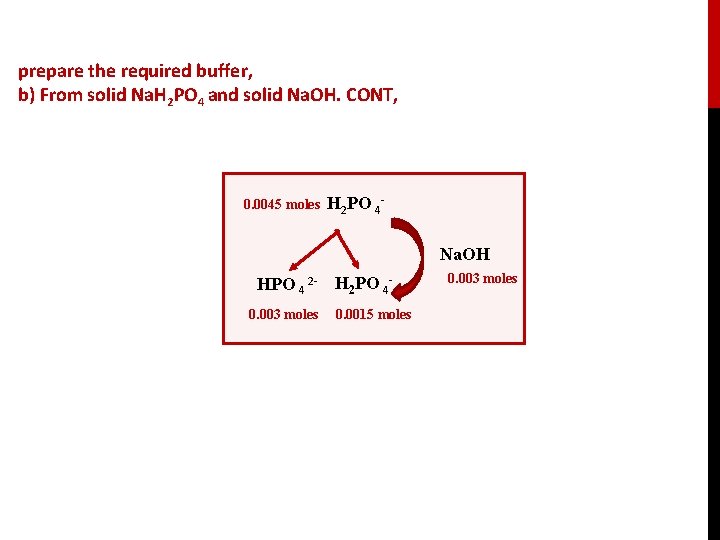
prepare the required buffer, b) From solid Na. H 2 PO 4 and solid Na. OH. CONT, 0. 0045 moles H 2 PO 4 Na. OH HPO 4 2 - H 2 PO 40. 003 moles 0. 0015 moles 0. 003 moles
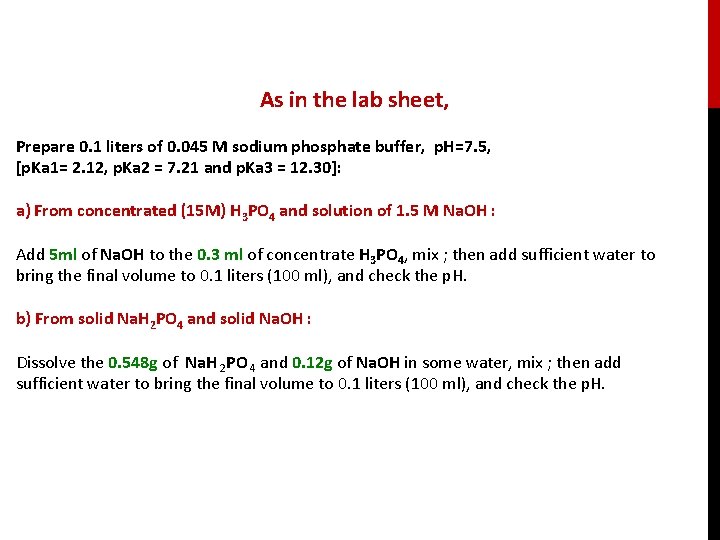
As in the lab sheet, Prepare 0. 1 liters of 0. 045 M sodium phosphate buffer, p. H=7. 5, [p. Ka 1= 2. 12, p. Ka 2 = 7. 21 and p. Ka 3 = 12. 30]: a) From concentrated (15 M) H 3 PO 4 and solution of 1. 5 M Na. OH : Add 5 ml of Na. OH to the 0. 3 ml of concentrate H 3 PO 4, mix ; then add sufficient water to bring the final volume to 0. 1 liters (100 ml), and check the p. H. b) From solid Na. H 2 PO 4 and solid Na. OH : Dissolve the 0. 548 g of Na. H 2 PO 4 and 0. 12 g of Na. OH in some water, mix ; then add sufficient water to bring the final volume to 0. 1 liters (100 ml), and check the p. H.
HOMEWORK: Prepare 0. 1 liters of 0. 045 M sodium phosphate buffer, p. H=7. 5, [pka 1= 2. 12, pka 2 = 7. 21 and pka 3 = 12. 30]: c) You are provided with solid Na 2 HPO 4 and 2 M HCl. d) You are provided with solid Na 3 PO 4 and 2 M HCl.
- Slides: 15