
Preparation of a BiologicallyBased Printable Hydrogel Patrick Curley
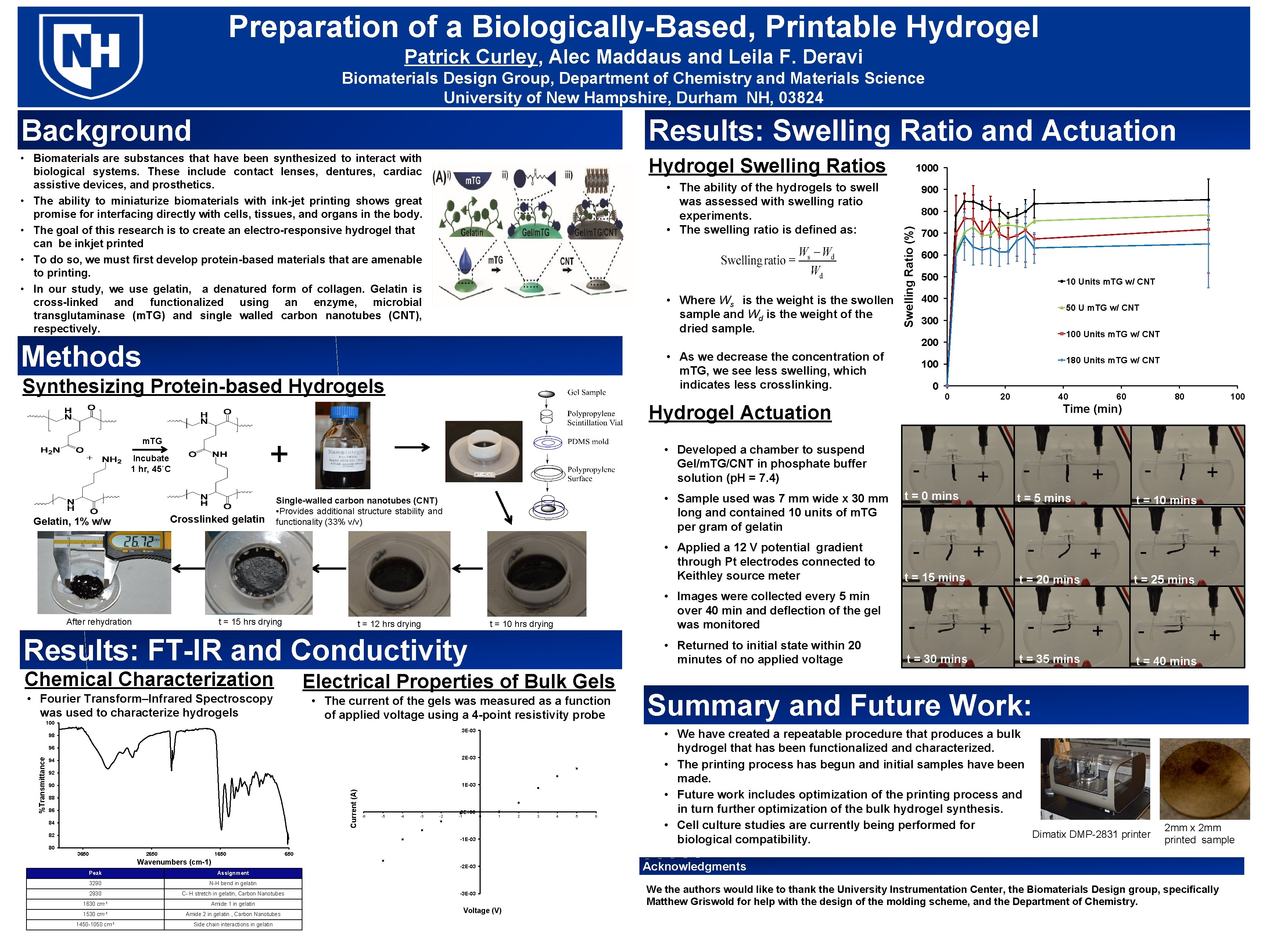
Preparation of a Biologically-Based, Printable Hydrogel Patrick Curley, Alec Maddaus and Leila F. Deravi Biomaterials Design Group, Department of Chemistry and Materials Science University of New Hampshire, Durham NH, 03824 Background Results: Swelling Ratio and Actuation • Biomaterials are substances that have been synthesized to interact with biological systems. These include contact lenses, dentures, cardiac assistive devices, and prosthetics. • The ability to miniaturize biomaterials with ink-jet printing shows great promise for interfacing directly with cells, tissues, and organs in the body. • The goal of this research is to create an electro-responsive hydrogel that can be inkjet printed • To do so, we must first develop protein-based materials that are amenable to printing. • In our study, we use gelatin, a denatured form of collagen. Gelatin is cross-linked and functionalized using an enzyme, microbial transglutaminase (m. TG) and single walled carbon nanotubes (CNT), respectively. Hydrogel Swelling Ratios • Where Ws is the weight is the swollen sample and Wd is the weight of the dried sample. 900 800 Swelling Ratio (%) • The ability of the hydrogels to swell was assessed with swelling ratio experiments. • The swelling ratio is defined as: 1000 700 600 500 10 Units m. TG w/ CNT 400 50 U m. TG w/ CNT 300 100 Units m. TG w/ CNT 200 Methods • As we decrease the concentration of m. TG, we see less swelling, which indicates less crosslinking. Synthesizing Protein-based Hydrogels 180 Units m. TG w/ CNT 100 0 0 20 40 Hydrogel Actuation + m. TG Incubate 1 hr, 45˚C Crosslinked gelatin Gelatin, 1% w/w • Developed a chamber to suspend Gel/m. TG/CNT in phosphate buffer solution (p. H = 7. 4) • Sample used was 7 mm wide x 30 mm long and contained 10 units of m. TG per gram of gelatin Single-walled carbon nanotubes (CNT) • Provides additional structure stability and functionality (33% v/v) • Applied a 12 V potential gradient through Pt electrodes connected to Keithley source meter After rehydration t = 15 hrs drying t = 12 hrs drying • Images were collected every 5 min over 40 min and deflection of the gel was monitored t = 10 hrs drying Results: FT-IR and Conductivity Chemical Characterization • Returned to initial state within 20 minutes of no applied voltage Electrical Properties of Bulk Gels • Fourier Transform–Infrared Spectroscopy was used to characterize hydrogels • The current of the gels was measured as a function of applied voltage using a 4 -point resistivity probe 100 3 E-03 98 2 E-03 94 92 1 E-03 90 Current (A) %Transmittance 96 88 86 84 82 -6 -5 -4 -3 -2 0 E+00 -1 0 1 -1 E-03 80 3650 2650 1650 Wavenumbers (cm-1) Assignment 3290 N-H bend in gelatin 2930 C- H stretch in gelatin, Carbon Nanotubes 1630 cm-1 Amide 1 in gelatin 1530 cm-1 Amide 2 in gelatin , Carbon Nanotubes 1450 -1050 cm-1 Side chain interactions in gelatin 3 4 5 6 80 100 Time (min) - + t = 0 mins - + t = 30 mins - t = 35 mins + t = 10 mins + t = 20 mins + - + t = 5 mins t = 15 mins - - - + t = 25 mins + - + t = 40 mins Summary and Future Work: • We have created a repeatable procedure that produces a bulk hydrogel that has been functionalized and characterized. • The printing process has begun and initial samples have been made. • Future work includes optimization of the printing process and in turn further optimization of the bulk hydrogel synthesis. • Cell culture studies are currently being performed for Dimatix DMP-2831 printer biological compatibility. 2 mm x 2 mm printed sample 650 -2 E-03 Peak 2 60 -3 E-03 Voltage (V) Acknowledgments We the authors would like to thank the University Instrumentation Center, the Biomaterials Design group, specifically Matthew Griswold for help with the design of the molding scheme, and the Department of Chemistry.
- Slides: 1