
PREPARATION AND SET UP OF YOUR ACCOUNTING SYSTEM

- Slides: 18
PREPARATION AND SET UP OF YOUR ACCOUNTING SYSTEM UNDER 280 E BY LC SOLUTIONS MICHIGAN PLLC
PREPARATION Planning and preparation are key! When planning for your business, don’t forgot to consider the accounting needs it will have. Too often business owners scramble at tax time to have any form of “accounting”! Michigan’s Medical Marihuana industry is complicated enough! Don’t let good accounting slip through the cracks or be put on the back burner! What steps can you take to be successful?
STEP 1: BE AWARE OF IRS § 280 E Enacted in 1982 by Congress IRS § 280 E: “No deduction or credit shall be allowed for any amount paid or incurred during the taxable year in carrying on any trade or business if such trade or business (or the activities which comprise such trade or business) consists of trafficking in controlled substances (within the meaning of schedule I and II of the Controlled Substances Act) which is prohibited by Federal law or the law of any State in which such trade or business is conducted. ” Because Marihuana is illegal federally § 280 E must be followed by businesses (and caregivers) for federal tax purposes. This does not mean all costs fall under 280 E!
STEP 1: BE AWARE OF IRS § 280 E Further explanation following in Congress’s report states: “All deductions and credits for amounts paid or incurred in the illegal trafficking in drugs listed in the Controlled Substances Act are disallowed. To preclude possible challenges on constitutional grounds, the adjustment to gross receipts with respect to effective costs of goods sold is not affected by this provision of the bill. " As a business owner operating under the MMFLA you should be aware of the following: That IRS § 280 effects your business Your business will be limited on certain expense deductions it can take for federal taxes Not all ”expenses” are disallowed – cost of goods sold are allowed as an adjustment (deduction) from gross revenue.
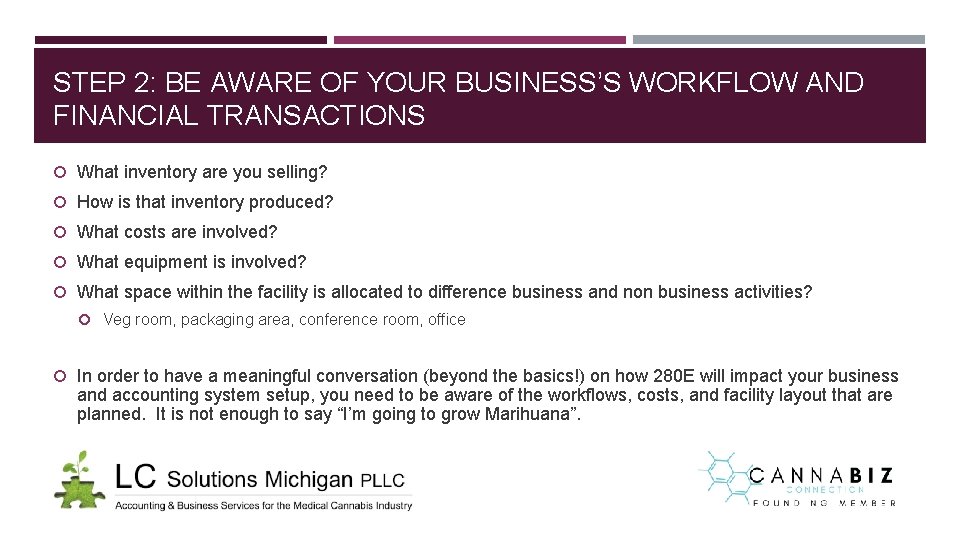
STEP 2: BE AWARE OF YOUR BUSINESS’S WORKFLOW AND FINANCIAL TRANSACTIONS What inventory are you selling? How is that inventory produced? What costs are involved? What equipment is involved? What space within the facility is allocated to difference business and non business activities? Veg room, packaging area, conference room, office In order to have a meaningful conversation (beyond the basics!) on how 280 E will impact your business and accounting system setup, you need to be aware of the workflows, costs, and facility layout that are planned. It is not enough to say “I’m going to grow Marihuana”.
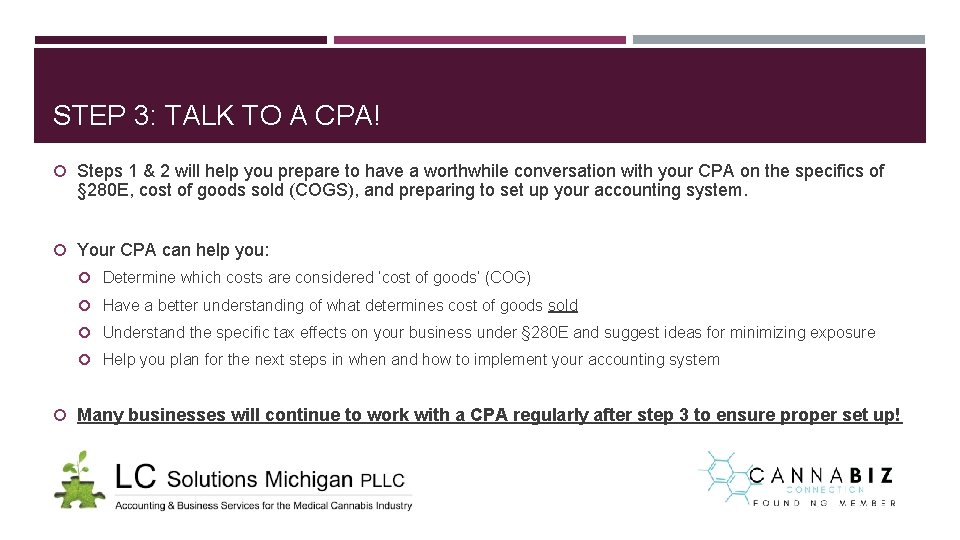
STEP 3: TALK TO A CPA! Steps 1 & 2 will help you prepare to have a worthwhile conversation with your CPA on the specifics of § 280 E, cost of goods sold (COGS), and preparing to set up your accounting system. Your CPA can help you: Determine which costs are considered ‘cost of goods’ (COG) Have a better understanding of what determines cost of goods sold Understand the specific tax effects on your business under § 280 E and suggest ideas for minimizing exposure Help you plan for the next steps in when and how to implement your accounting system Many businesses will continue to work with a CPA regularly after step 3 to ensure proper set up!
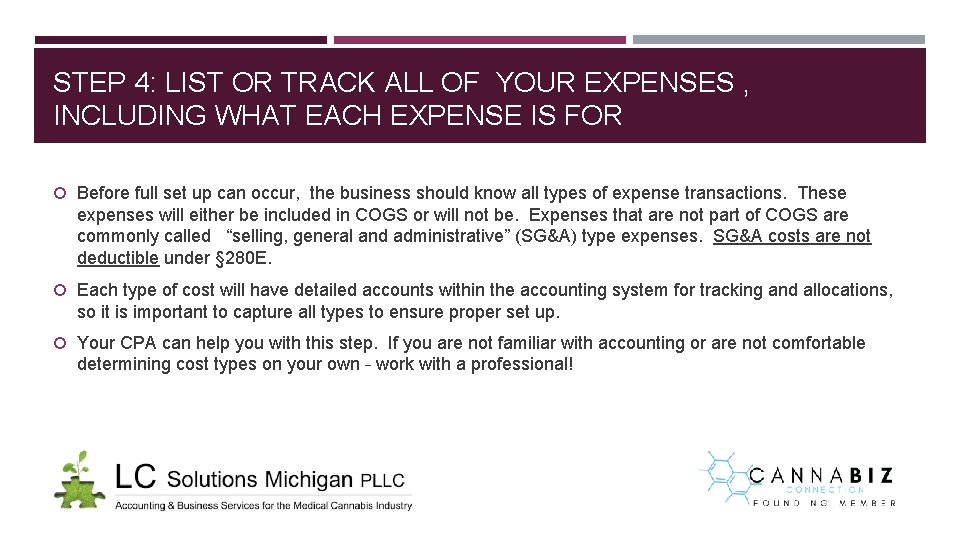
STEP 4: LIST OR TRACK ALL OF YOUR EXPENSES , INCLUDING WHAT EACH EXPENSE IS FOR Before full set up can occur, the business should know all types of expense transactions. These expenses will either be included in COGS or will not be. Expenses that are not part of COGS are commonly called “selling, general and administrative” (SG&A) type expenses. SG&A costs are not deductible under § 280 E. Each type of cost will have detailed accounts within the accounting system for tracking and allocations, so it is important to capture all types to ensure proper set up. Your CPA can help you with this step. If you are not familiar with accounting or are not comfortable determining cost types on your own – work with a professional!
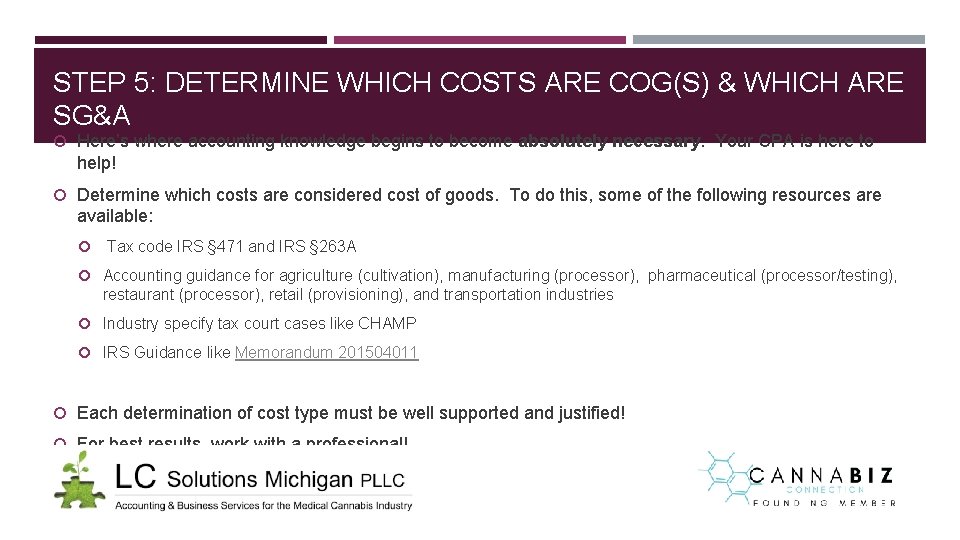
STEP 5: DETERMINE WHICH COSTS ARE COG(S) & WHICH ARE SG&A Here’s where accounting knowledge begins to become absolutely necessary. Your CPA is here to help! Determine which costs are considered cost of goods. To do this, some of the following resources are available: Tax code IRS § 471 and IRS § 263 A Accounting guidance for agriculture (cultivation), manufacturing (processor), pharmaceutical (processor/testing), restaurant (processor), retail (provisioning), and transportation industries Industry specify tax court cases like CHAMP IRS Guidance like Memorandum 201504011 Each determination of cost type must be well supported and justified! For best results, work with a professional!
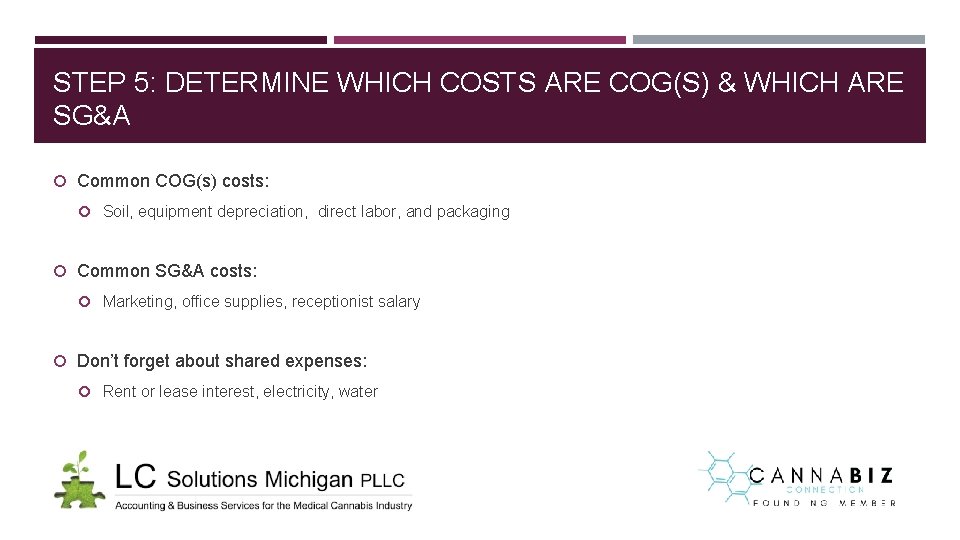
STEP 5: DETERMINE WHICH COSTS ARE COG(S) & WHICH ARE SG&A Common COG(s) costs: Soil, equipment depreciation, direct labor, and packaging Common SG&A costs: Marketing, office supplies, receptionist salary Don’t forget about shared expenses: Rent or lease interest, electricity, water
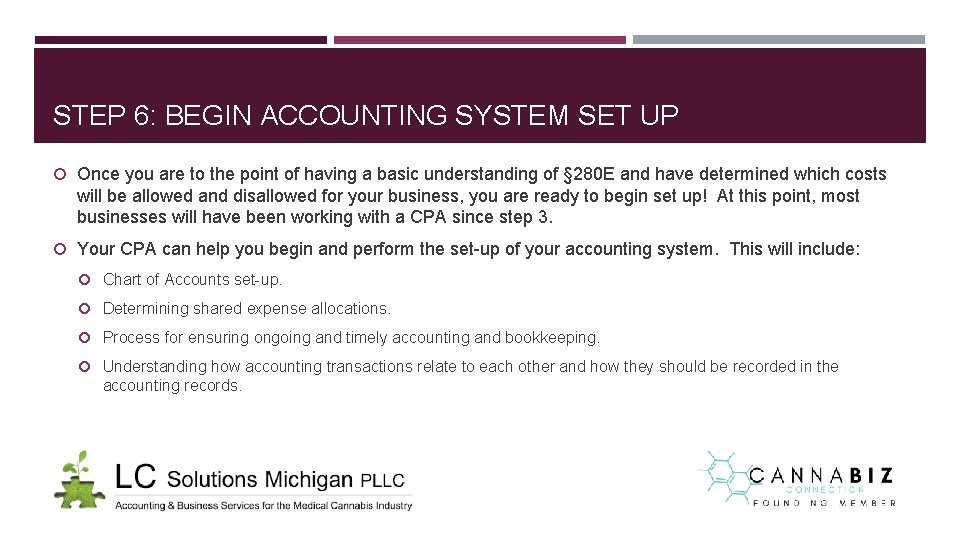
STEP 6: BEGIN ACCOUNTING SYSTEM SET UP Once you are to the point of having a basic understanding of § 280 E and have determined which costs will be allowed and disallowed for your business, you are ready to begin set up! At this point, most businesses will have been working with a CPA since step 3. Your CPA can help you begin and perform the set-up of your accounting system. This will include: Chart of Accounts set-up. Determining shared expense allocations. Process for ensuring ongoing and timely accounting and bookkeeping. Understanding how accounting transactions relate to each other and how they should be recorded in the accounting records.
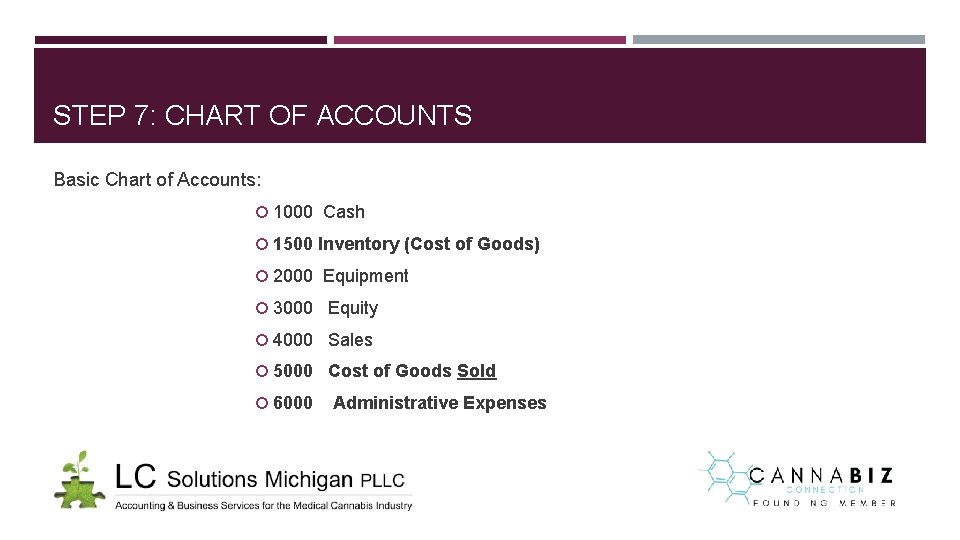
STEP 7: CHART OF ACCOUNTS Basic Chart of Accounts: 1000 Cash 1500 Inventory (Cost of Goods) 2000 Equipment 3000 Equity 4000 Sales 5000 Cost of Goods Sold 6000 Administrative Expenses
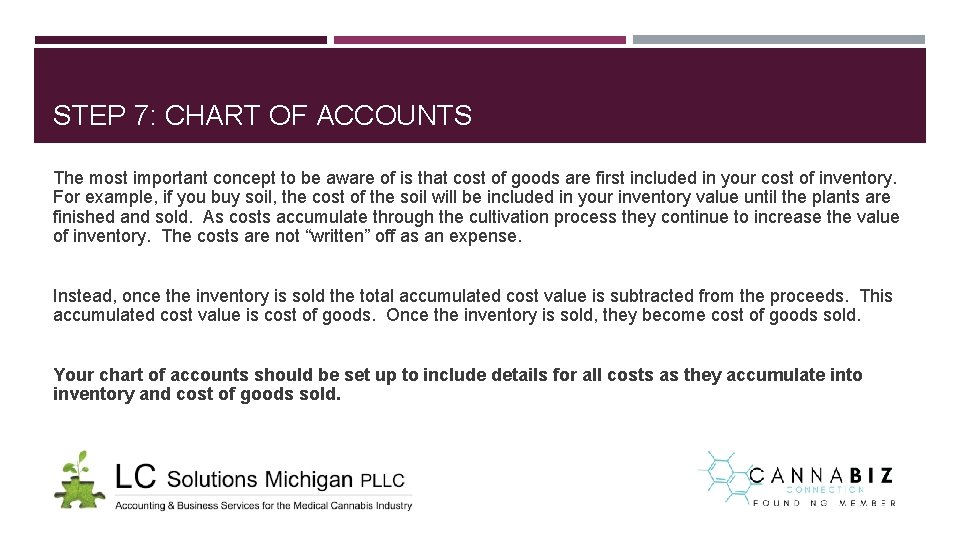
STEP 7: CHART OF ACCOUNTS The most important concept to be aware of is that cost of goods are first included in your cost of inventory. For example, if you buy soil, the cost of the soil will be included in your inventory value until the plants are finished and sold. As costs accumulate through the cultivation process they continue to increase the value of inventory. The costs are not “written” off as an expense. Instead, once the inventory is sold the total accumulated cost value is subtracted from the proceeds. This accumulated cost value is cost of goods. Once the inventory is sold, they become cost of goods sold. Your chart of accounts should be set up to include details for all costs as they accumulate into inventory and cost of goods sold.
STEP 8: DETERMINE SHARED EXPENSE ALLOCATIONS Shared expenses like rent or lease interest, electricity, certain employee wages, and overhead costs may be allocated separately to COGS and SG&A expenses! Your CPA can help you calculate allocation percentages based on building square footage or other more detailed allocation methods. Allocations will need to be applied each time a shared expense is recorded, so it is best to have a well documented process and support for allocations!
STEP 9: ENSURE ONGOING BOOKKEEPING PROCESSES After setting up your chart of accounts and determining shared expense allocations, next your business will need to ensure the system will be used and accurate bookkeeping and record keeping will take place! Work with a CPA to help determine processes for: Recording transactions Reconciling cash Maintaining fixed asset and lease schedules Keeping source document records (audit trail) Ensuring 280 E compliance
STEP 10: MAINTAIN 280 E COMPLIANCE Be prepared to be challenged by the IRS! Maintain your accounting system to continuously track and have support for all cost of goods sold adjustments allowed under § 280 E Ensure cost of goods inclusions and allocations are compliant and complete at all times. Continuously review costs for changes to their nature and type.
OTHER TIPS Get your seed to sale and/or point of sale system set up! Just because METRC isn’t ready yet, doesn’t mean these aren’t important for tracking inventory costs and sales data, along with helpful reporting that will be needed for your accounting records. Choose an accounting system that is easy to work with and has document retention features built in. Cloud accounting systems offer many benefits and features. Determine who will perform your ongoing bookkeeping and accounting schedule maintenance. DO NOT have someone do this who is not experienced in accounting! DO NOT wait until the last minute! Scrambling to get your accounting in order just in time for taxes is not a good idea. With your business operating under the MMFLA, do not cause extra complications for yourself by not keeping your accounting on track throughout the year! Work with a professional!
HOW WE CAN HELP 280 E consulting and planning Accounting system setup Ongoing bookkeeping and review Quick. Books Pro. Advisor services Email: kareyna@lcsolutionsmichigan. com CFO services Phone: 810 -793 -6702 Tax planning and preparations
THANK YOU!