
Preoperative Assessment and Preparation By Dr Rashad AlKashgari
Pre-operative Assessment and Preparation By Dr. Rashad Al-Kashgari Associate Professor of Surgery 2001
Pre-operative Assessment and Preparation l l Why ? How ? When ? What ?
Pre-operative Assessment and Preparation WHY ? l l Elective operation should be performed under optimal condition with full physical and psychological preparation of a fully informed patient. Emergency operation may have to be done in less than ideal circumstances.
Pre-operative Assessment and Preparation HOW ? l l l History Physical exam Investigation
Pre-operative Assessment and Preparation WHEN ? l l l Out patient visit Pre-operative ward round ER
Pre-operative Assessment and Preparation WHAT TO DO ? l l l . Six tasks To explain to the patient / relative the nature of the illness , implications of surgery and prognosis Identification of potential operative mortality and postoperative morbidity To assess the fitness for operation Identification of the risks of potential postoperative complications and prophylactic measures. Planning of operation and consent
Task one To explain to the patient / relative l l Nature of surgery Implication of surgery Alleviate fear/anxiety of the patient Prognosis
Task two Identification of potential operative mortality and morbidity l Look for the risk factors?
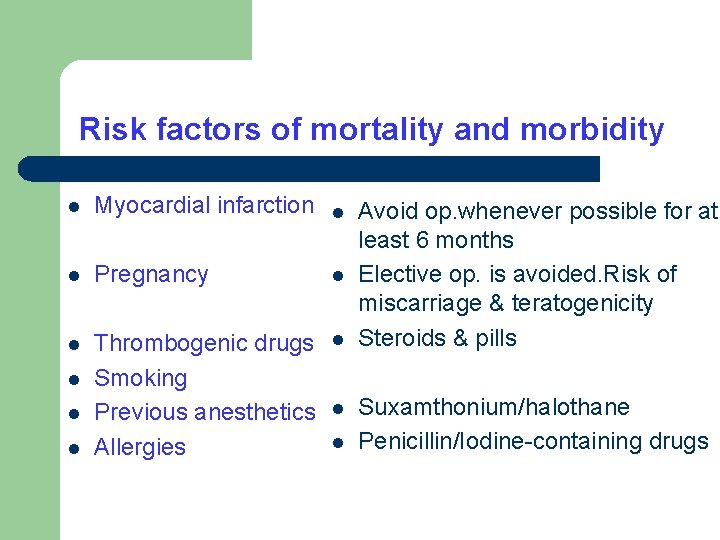
Risk factors of mortality and morbidity l Myocardial infarction l l Pregnancy l l Thrombogenic drugs Smoking Previous anesthetics Allergies l l l Avoid op. whenever possible for at least 6 months Elective op. is avoided. Risk of miscarriage & teratogenicity Steroids & pills Suxamthonium/halothane Penicillin/Iodine-containing drugs
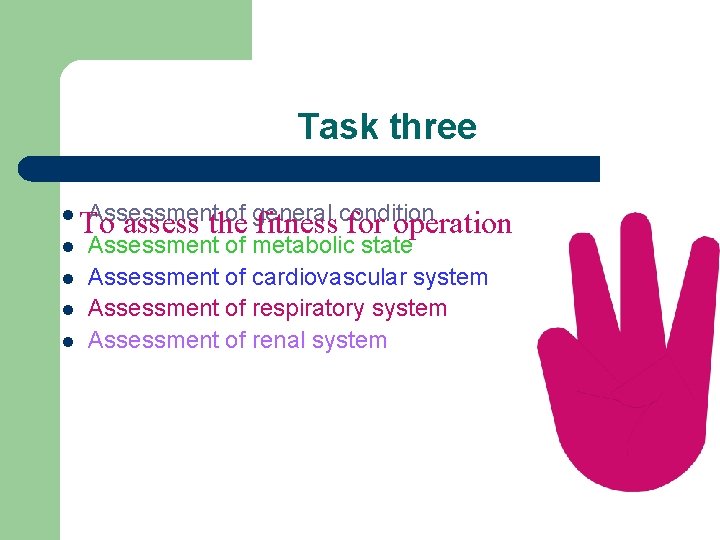
Task three l l l Assessment of general To assess the fitnesscondition for operation Assessment of metabolic state Assessment of cardiovascular system Assessment of respiratory system Assessment of renal system
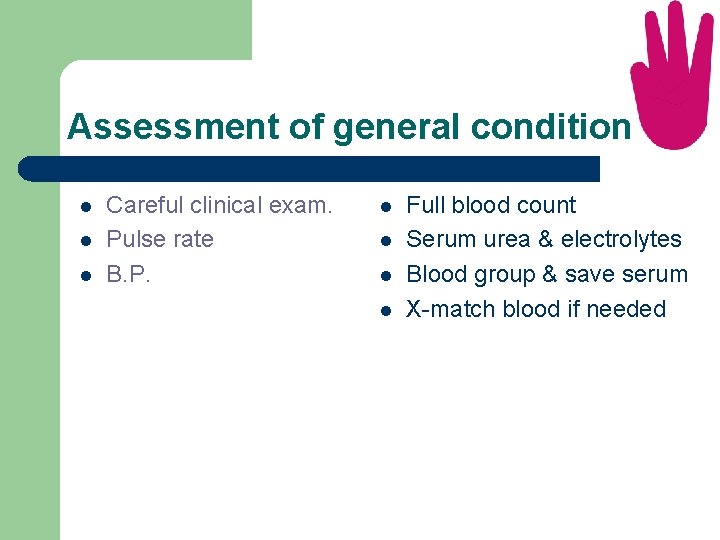
Assessment of general condition l l l Careful clinical exam. Pulse rate B. P. l l Full blood count Serum urea & electrolytes Blood group & save serum X-match blood if needed
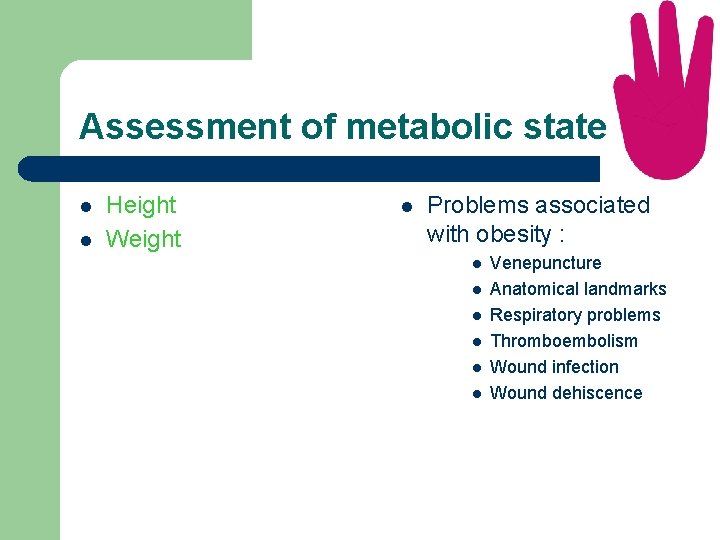
Assessment of metabolic state l l Height Weight l Problems associated with obesity : l l l Venepuncture Anatomical landmarks Respiratory problems Thromboembolism Wound infection Wound dehiscence
Assessment of cardiovascular system l Clinical exam of heart and vessels l l ECG Echocardiogram
Cardiovascular conditions l l l Increase risk of CVA/MI Hypertension Myocardial ischaemia l Avoid techniques /drugs which increase heart rate/diastolic B. P/perfusion gradient Cardiac arrhythmias l Discuss with cardiologist pre-op Valve disease/septal l Cover with antibiotics defect Hypovolemia l Restore blood volume pre-op
Assessment of respiratory system l Clinical exam of chest l l CXR Sputum for bacteriological exam Blood gases Pulmonary function tests: FEV 1 FVC
Respiratory conditions l Chronic bronchitis l Suffer HYPOXEMIA. DO blood gases High risk patients-consider only for urgent op . l Asthma l Brochiectasis l l Common cold l l At risk of post-op respiratory failure. Give bronchodilator. Best index: FEV 1/FVC X 100 Physiotherapy + Antibiotics (use local blocks instead of general anaesthesia) Cancel op. in acute phase
Assessment of renal system l Clinical examination l l Urinanalysis & microscopy Urine for microbiological examination Serum urea Serum creatinine
Renal disorders l Chronic retention
Task four Identification of risks of potential post operative complications and prophylaxis l l l Pulmonary collapse andl Pre-op breathing exercises infection Cardiac complications l Avoid excessive fluid post-op in all patients with cardiac ischemia or valvular disease l Major causes are hypovolemia, Acute renal failure sepsis, jaundice and characterized by: (oliguria, dilute urine , & mismatched blood urea conc. <300 mmol/l)
Task four (continue) Identification of risks of potential postoperative complications and prophylaxis (continue) l Venous Thrombosis l l l Wound infection l Avoid compression of legs during and after op. If necessary, use graded compression stocking / low dose heparin 5000 I. u Q. 12 hrs OR a single dose of LMW heparin Prophylactic antibiotics (Bactericidal best guess for offending organism, high doses, three doses. . when?
Task five Planning of the operation l l l The operation should be properly named after full explanation to the patient and the side of operation is marked in case of bilateral parts. He/she should consent for it. The duration of hospital stay, convalescense and time off work should be indicated.
CONSENT l l Explain to the patient in simple non medical language what is going to be done. Alleviate his/her fears. Do not deceive the patient. Reassure the patient
Task six Pre-operative orders l l Keep NPO (Nil per Oral) from ? ? : 00 hrs Medications l l l Essential Prophylaxis Prepare area for surgery l l Cleaning Shave Enema Etc
- Slides: 23