
PRENATAL THREE STAGES OF PREGNANCY Child Development Mr

- Slides: 14
PRENATAL: THREE STAGES OF PREGNANCY Child Development Mr. Pardi
Conception ■ Once every 28 days an _____ (an _________) is released by one of a woman’s two ovaries. ■ This is part of a woman’s menstrual cycle and is called ____________. ■ At the same time, a hormone is released to prepare the uterus in the event that the ovum is _____________. ■ The uterus is the organ in a woman’s body in which a baby develops during _________________.
Conception Cont. ■ When an ovum (egg cell) is released from the ovary, it moves through the ________________. ■ The Fallopian tube is what ___________________________________. ■ This process takes ________________. ■ During ovulation, the inner lining of the uterus grows and thickens and if the ovum is not fertilized, the lining
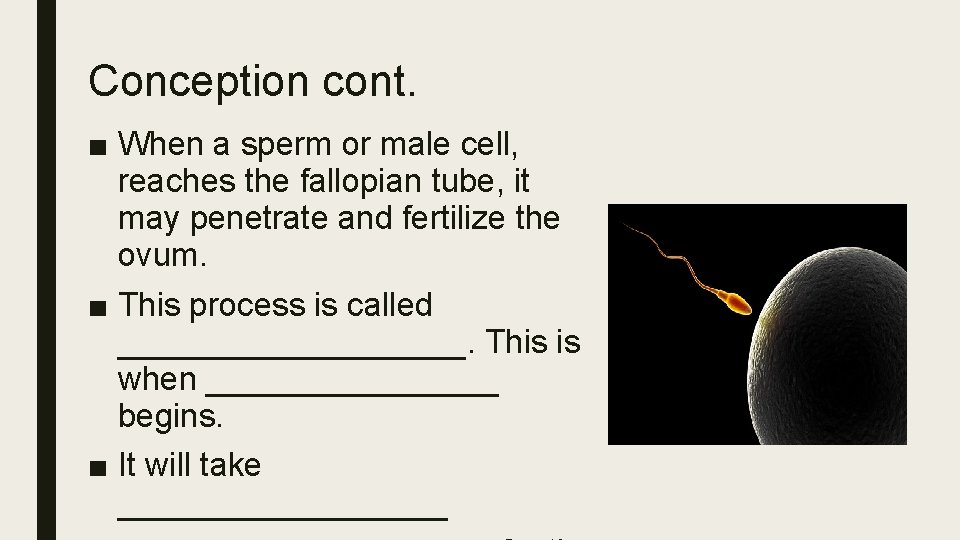
Conception cont. ■ When a sperm or male cell, reaches the fallopian tube, it may penetrate and fertilize the ovum. ■ This process is called __________. This is when ________ begins. ■ It will take _________
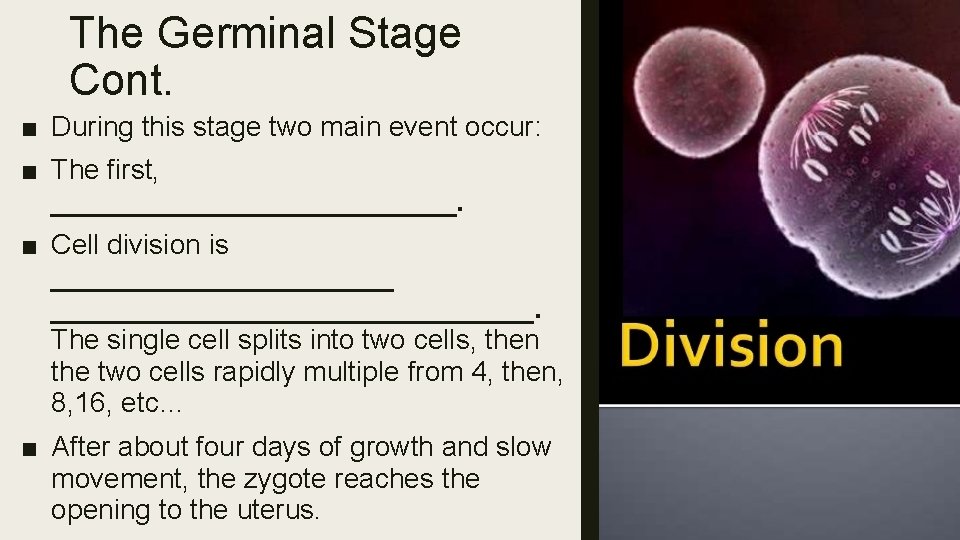
The Germinal Stage ■ The baby’s development during a pregnancy is called the _____________. ■ It is commonly grouped into three stages: _________, ______________, and __________. ■ The germinal stage is the _______ in a baby’s development. ■ It includes the formation of the _______ - the fertilized egg as a result of the male sperm and female egg. ■ This stage lasts only _____________but includes the key steps to establishing pregnancy.
The Germinal Stage Cont. ■ During this stage two main event occur: ■ The first, _____________. ■ Cell division is ___________________________. The single cell splits into two cells, then the two cells rapidly multiple from 4, then, 8, 16, etc… ■ After about four days of growth and slow movement, the zygote reaches the opening to the uterus.
The Germinal Stage Cont. ■ Implantation occurs once the lining of the uterus has thickened enough to provide ____________________________ ___. ■ The zygote usually ______________________ ____
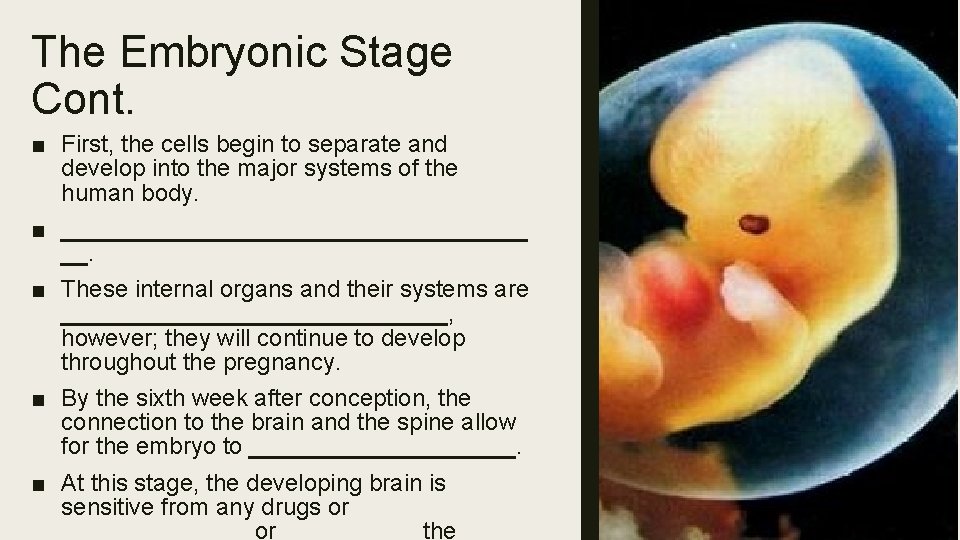
The Embryonic Stage ■ The Embryonic stage is ______________. ■ The embryo is what the developing baby is called from about _____________________________________________. ■ During this time the embryo grows rapidly and has several important changes.
The Embryonic Stage Cont. ■ First, the cells begin to separate and develop into the major systems of the human body. ■ __________________ __. ■ These internal organs and their systems are _______________, however; they will continue to develop throughout the pregnancy. ■ By the sixth week after conception, the connection to the brain and the spine allow for the embryo to __________. ■ At this stage, the developing brain is sensitive from any drugs or _______ or _____ the
The Embryonic Stage Cont. ■ During this stage the ______________forms. ■ The amniotic sac is a sac filled with ___________ that forms around the embryo. ■ The amniotic fluid is __________________. ■ It cushions the embryo from _______________________________________
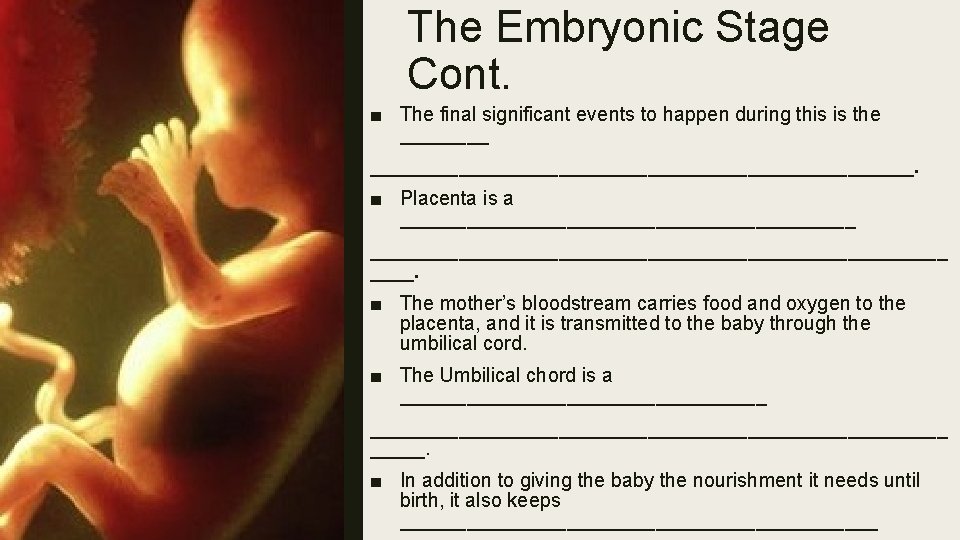
The Embryonic Stage Cont. ■ The final significant events to happen during this is the _____________________________. ■ Placenta is a _______________________________________________. ■ The mother’s bloodstream carries food and oxygen to the placenta, and it is transmitted to the baby through the umbilical cord. ■ The Umbilical chord is a ___________________________________________. ■ In addition to giving the baby the nourishment it needs until birth, it also keeps ______________________
The Fetal Stage ■ The third and final stage of development is the ________________. ■ It begins around the __________________________________. ■ At this point the developing baby is not longer called an embryo, but a ________________. ■ During this period 4 significant developments occur.
The Fetal Stage Cont. ■ Sometime during the fourth or fifth month the baby begins to _______________________ _ ________________________ ___. ■ These are the first fetal movements __________. ■ The doctor will generally ask the mother when she began feeling these movements to gauge the age of the fetus and to make sure it is developing normally. ■ This information will also be used to give an
The Fetal Stage Cont. ■ It is during this stage the fetus’s organs full develop, and by the ______________________________ ___. ■ The fetus also gains a lot of ______at this time, __________________________________ __. ■ At this point, the baby can ___________________________ ___