
Prenatal Development Infancy Unit 9 Developmental Psychology Modules
- Slides: 25
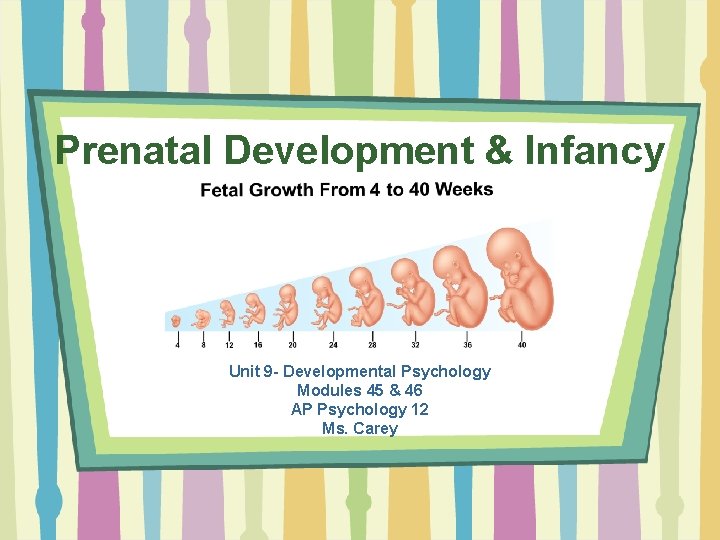
Prenatal Development & Infancy Unit 9 - Developmental Psychology Modules 45 & 46 AP Psychology 12 Ms. Carey
Module 45 - Prenatal Development & the Newborn p. 486 What three issues have engaged developmental psychologists? – 1) Nature vs. Nurture – 2) Continuity and Stages – 3) Stability vs. Change Developmental Psychologists study THREE main things at each stage of the life span: 1) Social Changes 2) Cognitive Changes 3) Physical Changes
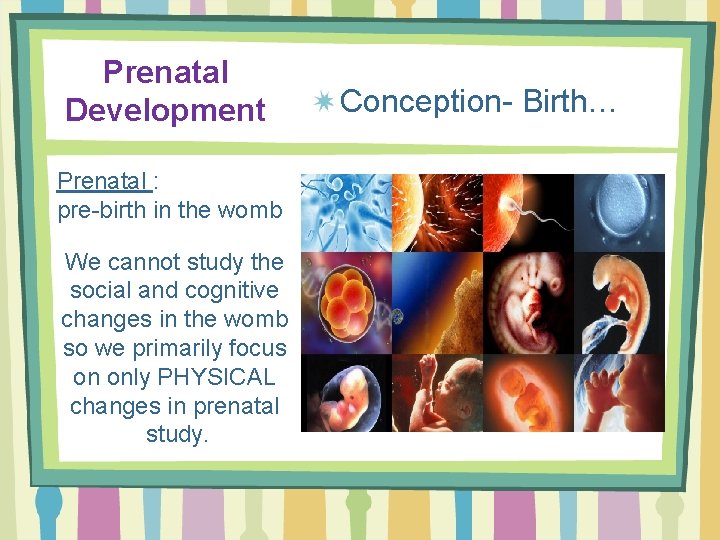
Prenatal Development Prenatal : pre-birth in the womb We cannot study the social and cognitive changes in the womb so we primarily focus on only PHYSICAL changes in prenatal study. Conception- Birth…
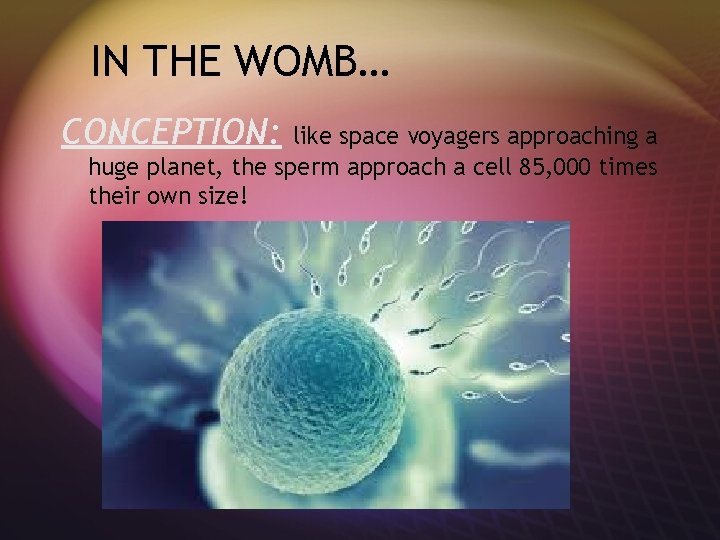
IN THE WOMB… CONCEPTION: like space voyagers approaching a huge planet, the sperm approach a cell 85, 000 times their own size!
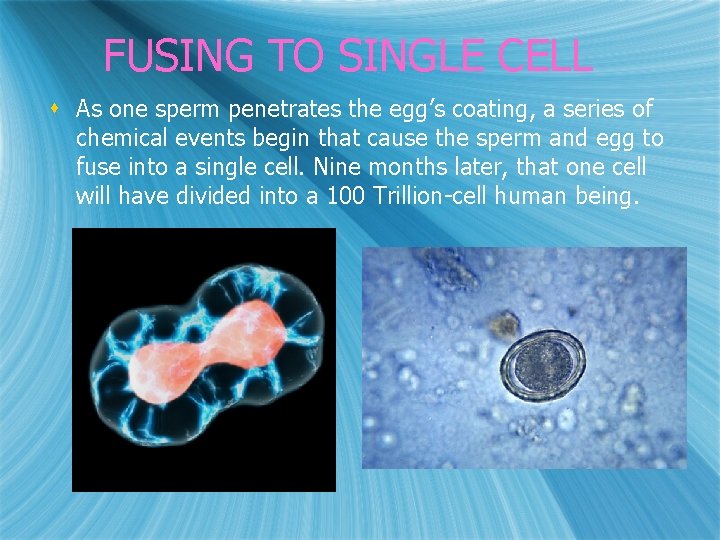
FUSING TO SINGLE CELL s As one sperm penetrates the egg’s coating, a series of chemical events begin that cause the sperm and egg to fuse into a single cell. Nine months later, that one cell will have divided into a 100 Trillion-cell human being.
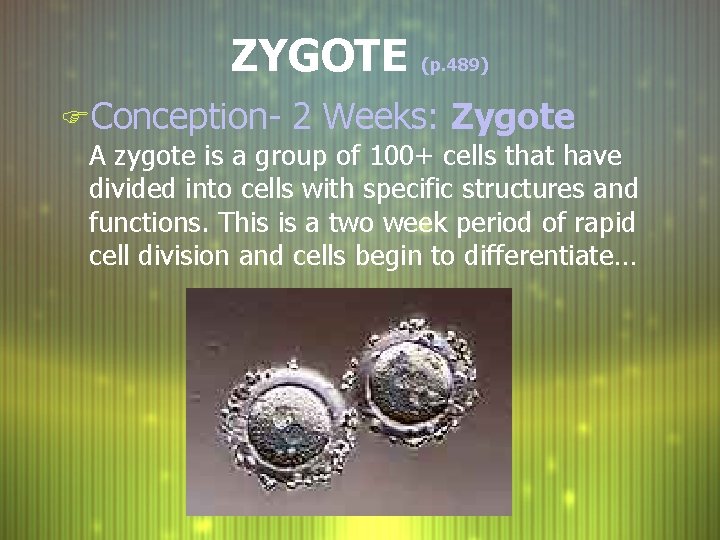
ZYGOTE (p. 489) FConception- 2 Weeks: Zygote A zygote is a group of 100+ cells that have divided into cells with specific structures and functions. This is a two week period of rapid cell division and cells begin to differentiate…
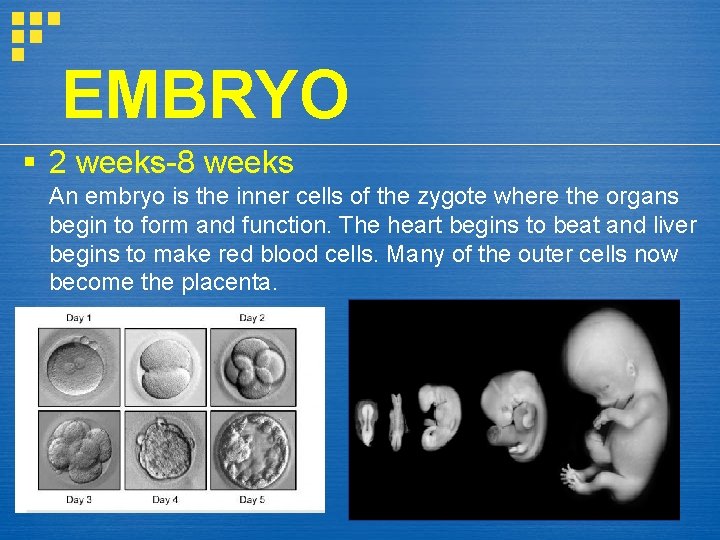
EMBRYO § 2 weeks-8 weeks An embryo is the inner cells of the zygote where the organs begin to form and function. The heart begins to beat and liver begins to make red blood cells. Many of the outer cells now become the placenta.
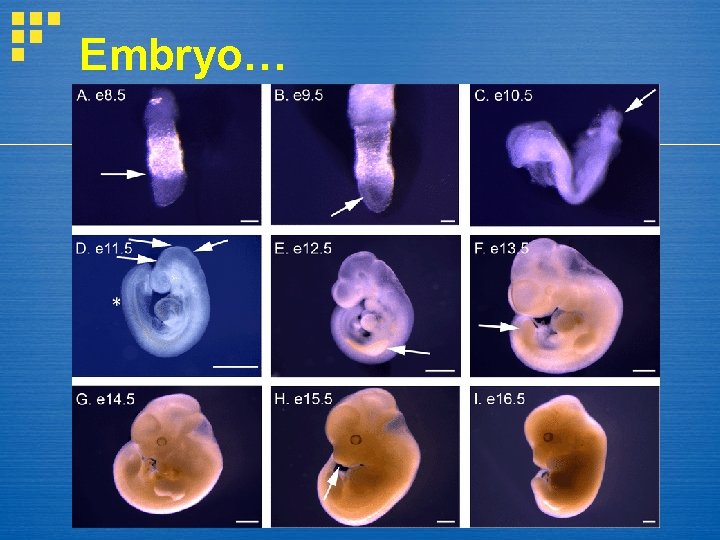
Embryo…
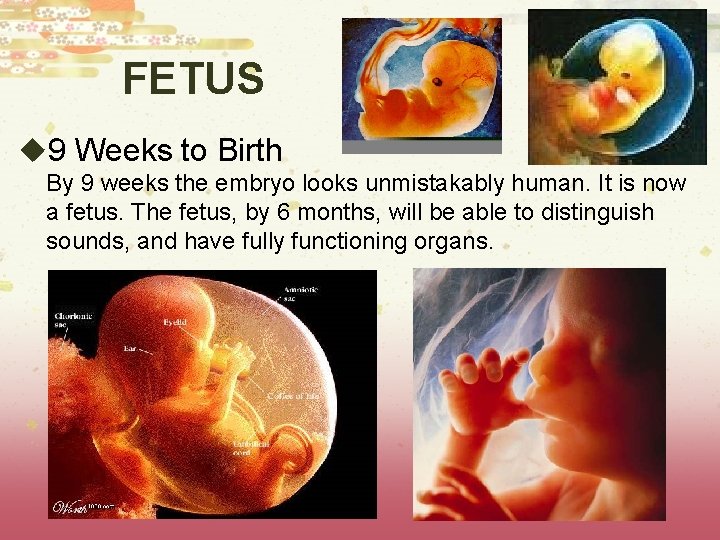
FETUS u 9 Weeks to Birth By 9 weeks the embryo looks unmistakably human. It is now a fetus. The fetus, by 6 months, will be able to distinguish sounds, and have fully functioning organs.
Prenatal Development Genetic & Environmental Factors u. TERATOGENS- agents such as chemicals, viruses, alcohol that can reach the embryo or fetus and cause harm. u. FAS (Fetal Alcohol Syndrome)- physical & cognitive abnormalities in children caused by a pregnant woman’s heavy drinking. In severe cases, signs include a small, out-ofproportion head & abnormal facial features.
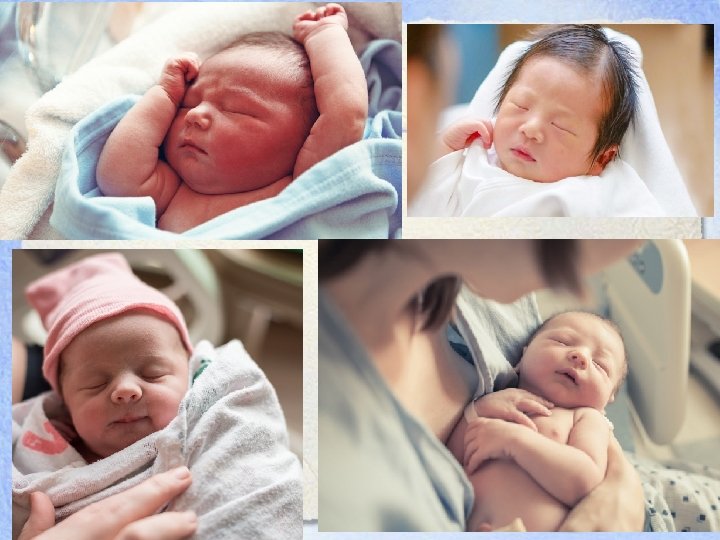
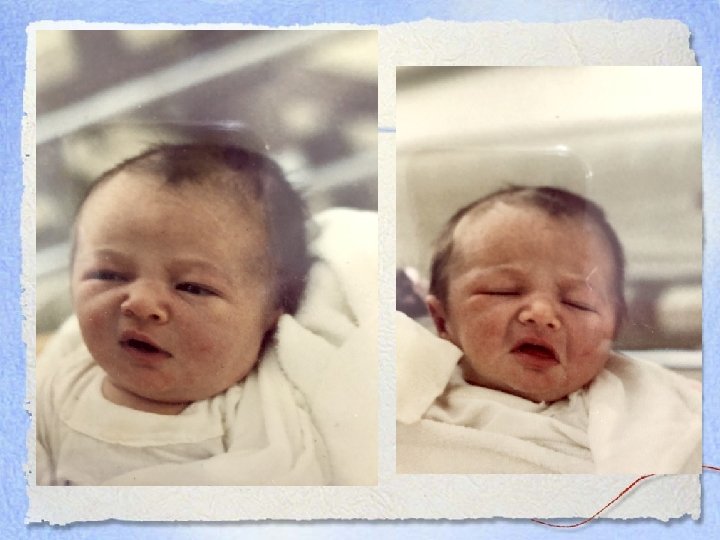
The Competent New Born (p. 491) • Babies are born with ‘apps preloaded” • Having survived prenatal hazards, they are born equipped with automatic reflex responses. For example if you touch a new born baby’s cheek, they turn towards the touch (rooting reflex) • Other adaptive responses include: – Sucking, startle reflex, and the strong grasping reflex. • Once the baby is born, a wild growth spurt of neural networks begin. In the first three months after birth, motor skills, hearing, vision, and communication skills are developed.
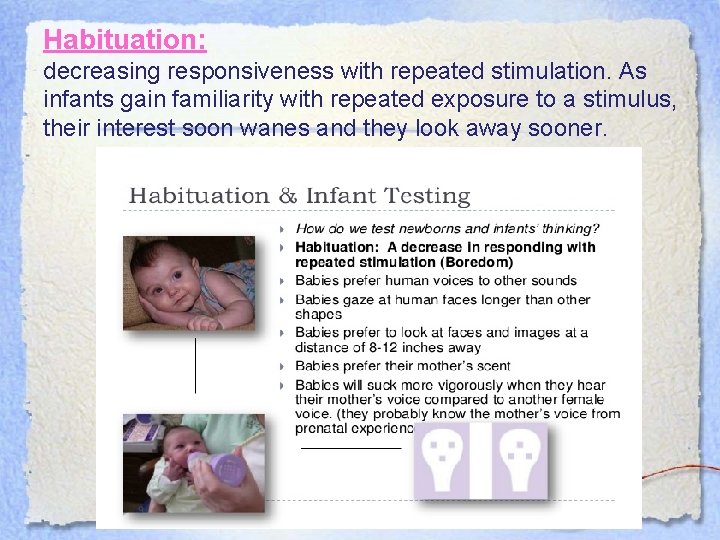
Habituation: decreasing responsiveness with repeated stimulation. As infants gain familiarity with repeated exposure to a stimulus, their interest soon wanes and they look away sooner.
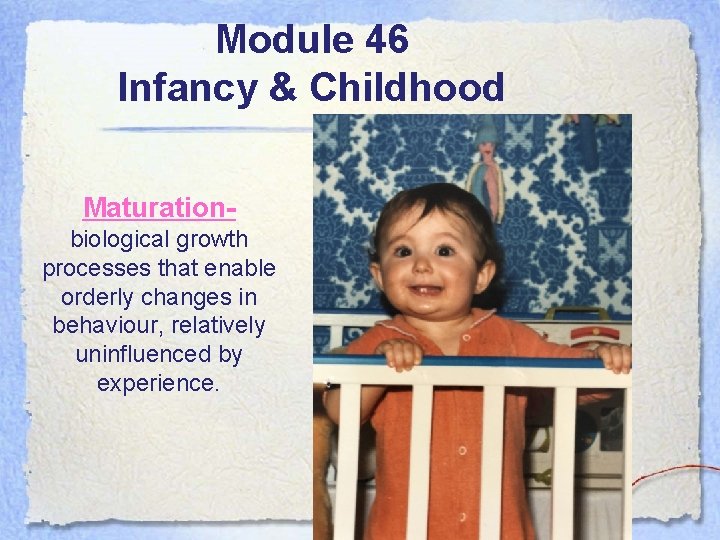
Module 46 Infancy & Childhood Maturationbiological growth processes that enable orderly changes in behaviour, relatively uninfluenced by experience.
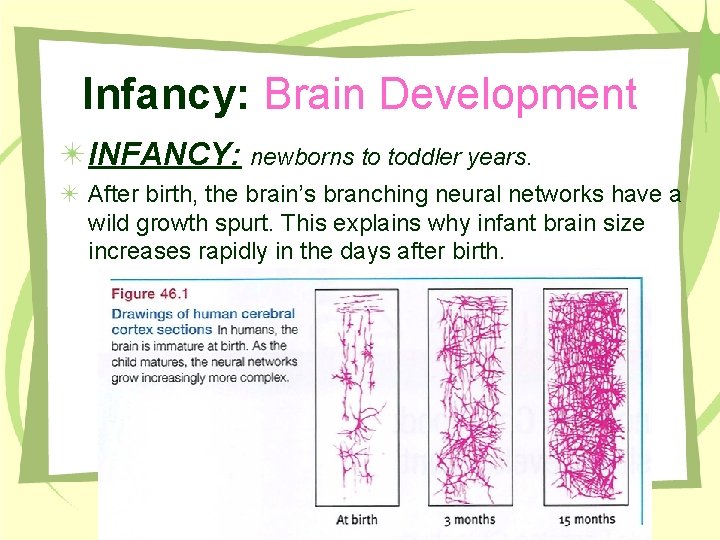
Infancy: Brain Development INFANCY: newborns to toddler years. After birth, the brain’s branching neural networks have a wild growth spurt. This explains why infant brain size increases rapidly in the days after birth.
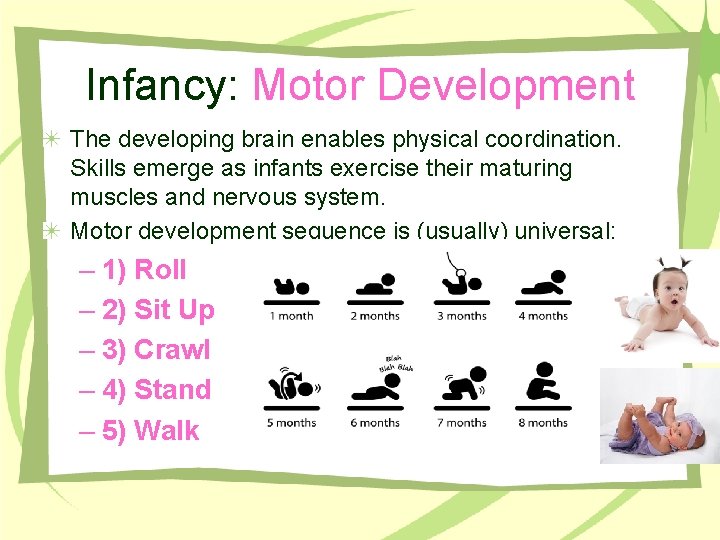
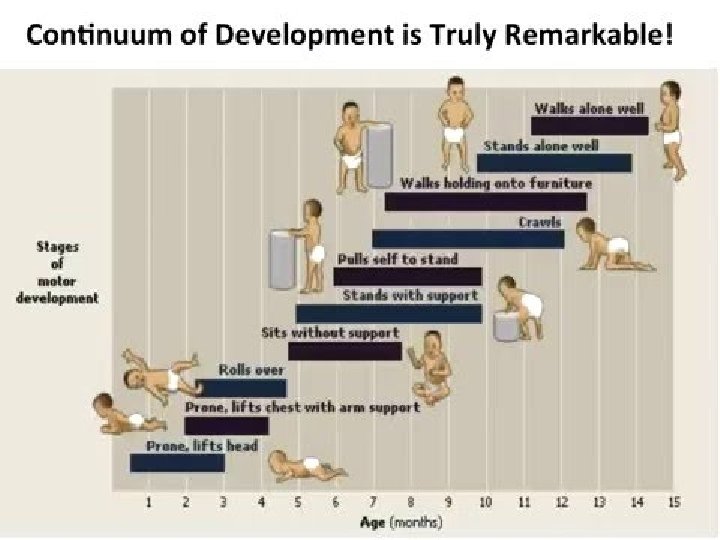
Infancy: Motor Development The developing brain enables physical coordination. Skills emerge as infants exercise their maturing muscles and nervous system. Motor development sequence is (usually) universal: – 1) Roll – 2) Sit Up – 3) Crawl – 4) Stand – 5) Walk
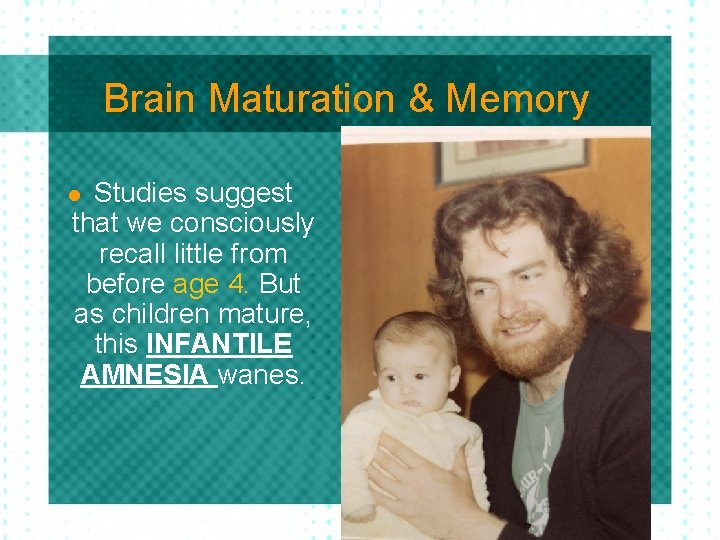
Brain Maturation & Memory Studies suggest that we consciously recall little from before age 4. But as children mature, this INFANTILE AMNESIA wanes. l
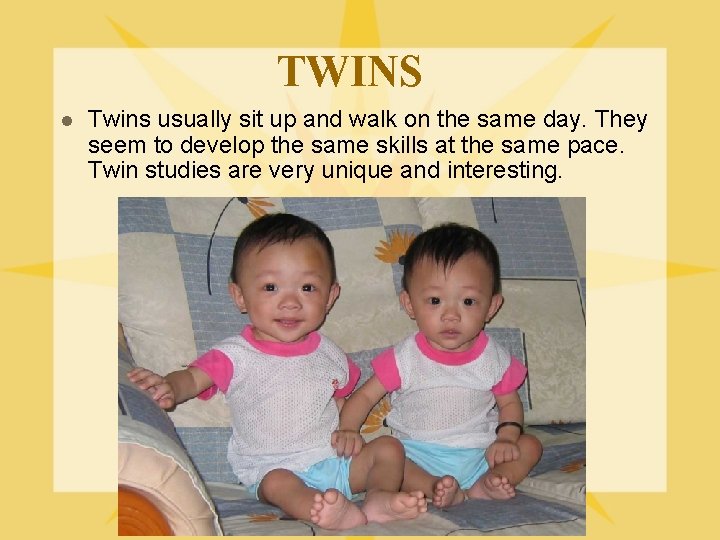
TWINS l Twins usually sit up and walk on the same day. They seem to develop the same skills at the same pace. Twin studies are very unique and interesting.
REVIEW • Physical Development in Infancy & Childhood: – Brain Development: within the brain, nerve cells form before birth. Sculpted by maturation and experience, their interconnections multiply rapidly after birth. – Maturation & Infant Memory: We lose conscious memories of experiences from our earliest years. Experiments do, however, show that infants can retain learning over time. – Motor Development: infant’s more complex physical skills- sitting, standing, walking- develop in a predictable sequence whose actual timing is a function of individual maturation rate and culture.