
Prenatal Detection of Severe Structural Congenital Heart Defects
- Slides: 8
Prenatal Detection of Severe Structural Congenital Heart Defects ACPC QNET Learning Session March 9, 2021 Kenan Stern, MD Mount Sinai Children’s Heart Center
Prenatal Detection of Severe Structural Congenital Heart Defects • Team (physicians and sonographers): – – – – – Joe Kreeger Anitha Parthiban Sowmya Balasubramanian Rick Michelfelder Chris Statile Ann Kavanaugh-Mc. Hugh Sarina Behera Katie Jo Stauffer Divya Suthar Kenan Stern
Prenatal Detection of Severe Structural Congenital Heart Defects • Benefits of prenatal detection: – Reduce neonatal morbidity and mortality – Affords the family the opportunity to make pregnancy related decisions such as termination. • Prenatal detection rates in the United States vary by lesion, but were 42% overall on a recent study, and slightly higher (50%) in neonates with CCHD. 5 Quartermain MD, et al. Pediatrics. 2015
Prenatal Detection of Severe Structural Congenital Heart Defects • Through use of this metric, centers will – be able to track rates of prenatal detection of severe structural CHD – identify targets for improvement, such as certain lesion types and barriers to effective prenatal screening. ***It is anticipated that interventions meant to improve prenatal detection will cross disciplines to include all those involved in the care of pregnant women and their fetuses.
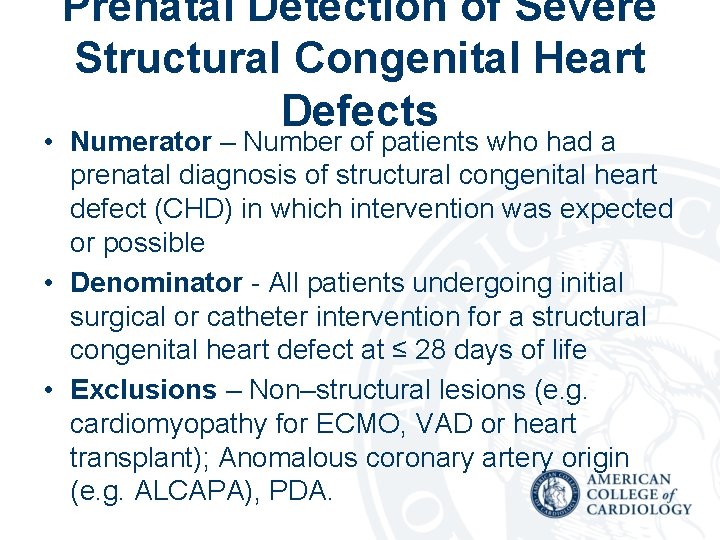
Prenatal Detection of Severe Structural Congenital Heart Defects • Numerator – Number of patients who had a prenatal diagnosis of structural congenital heart defect (CHD) in which intervention was expected or possible • Denominator - All patients undergoing initial surgical or catheter intervention for a structural congenital heart defect at ≤ 28 days of life • Exclusions – Non–structural lesions (e. g. cardiomyopathy for ECMO, VAD or heart transplant); Anomalous coronary artery origin (e. g. ALCAPA), PDA.
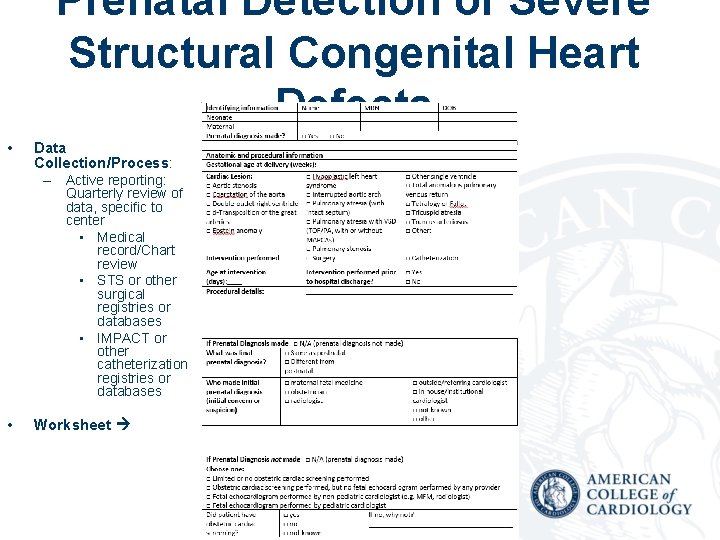
Prenatal Detection of Severe Structural Congenital Heart Defects • Data Collection/Process: – Active reporting: Quarterly review of data, specific to center • Medical record/Chart review • STS or other surgical registries or databases • IMPACT or other catheterization registries or databases • Worksheet
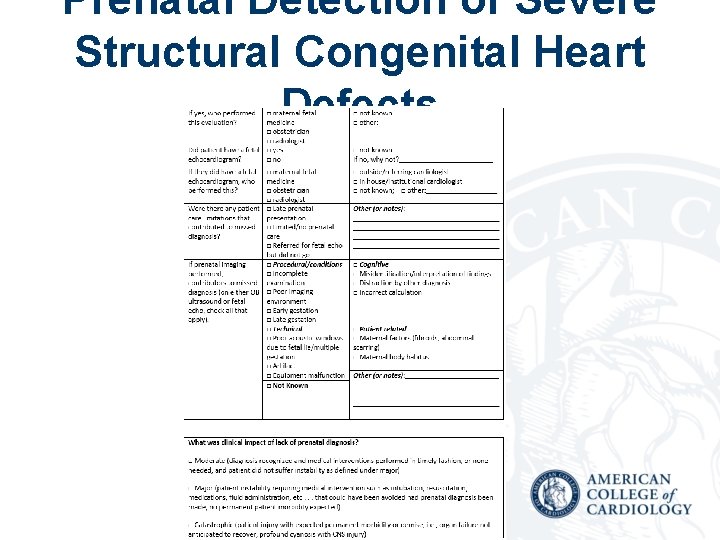
Prenatal Detection of Severe Structural Congenital Heart Defects
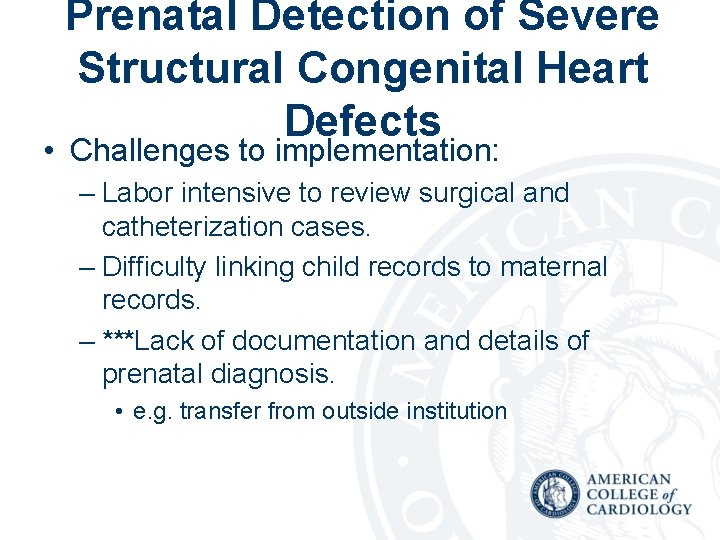
Prenatal Detection of Severe Structural Congenital Heart Defects • Challenges to implementation: – Labor intensive to review surgical and catheterization cases. – Difficulty linking child records to maternal records. – ***Lack of documentation and details of prenatal diagnosis. • e. g. transfer from outside institution