
Premolars There are four maxillary and four mandibular
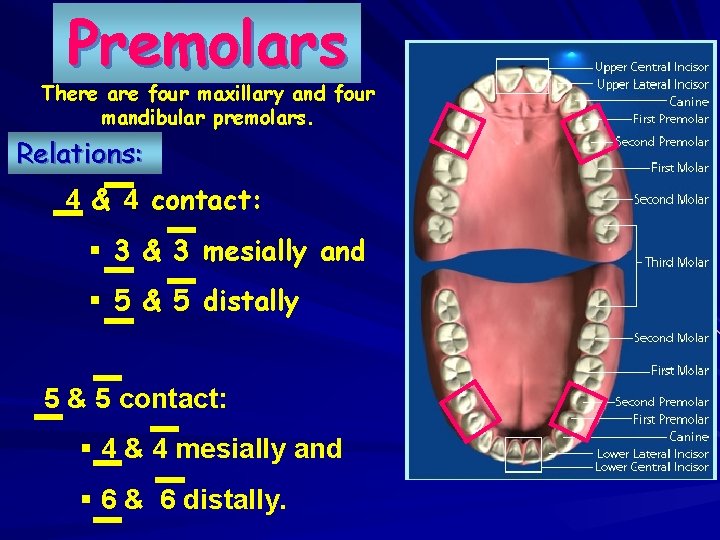
Premolars There are four maxillary and four mandibular premolars. Relations: 4 & 4 contact: § 3 & 3 mesially and § 5 & 5 distally 5 & 5 contact: § 4 & 4 mesially and § 6 & 6 distally.

General Features of Premolars They are transitional teeth located between the canine and molar teeth. By definition: Premolar teeth are permanent teeth distal to the canines, successors to deciduous molars. There are two premolars per quadrant and are identified as first and second premolars.

General Features of Premolars They have at least two cusps. § one large buccal cusp, § Smaller lingual cusp The lower second premolar maysometimes- have two lingual cusps. www. rxdentistry. blogspot. com
For easy teeth description: Follow the following points : Function: (grinding). Chronology: important developmental dates Number of lobes: (four lobes: 3 buccally and 1 lingually or five lobes 3 buccally and 2 lingually). Description of the different aspects: § Geometric shape of the crown. § Outlines of the crown and root. § Surface anatomy of the crown and root. § Pulp cavity.
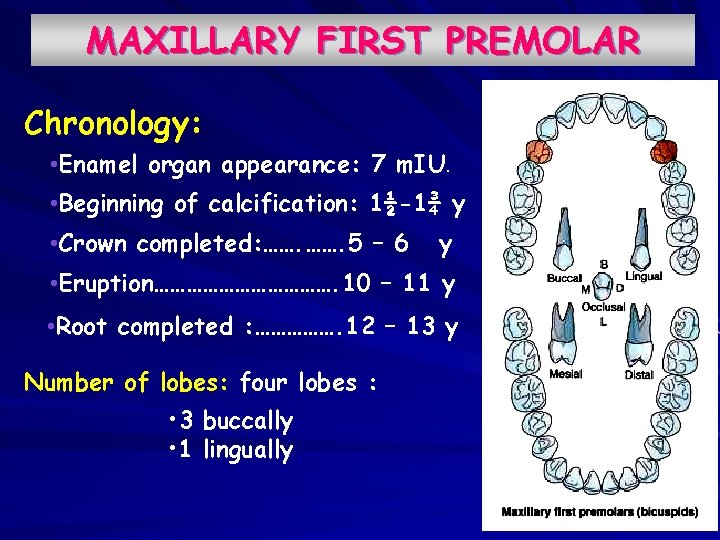
MAXILLARY FIRST PREMOLAR Chronology: • Enamel organ appearance: 7 m. IU. • Beginning of calcification: 1½-1¾ y • Crown completed: ……. 5 – 6 y • Eruption………………. 10 – 11 y • Root completed : ……………. 12 – 13 y Number of lobes: four lobes : • 3 buccally • 1 lingually
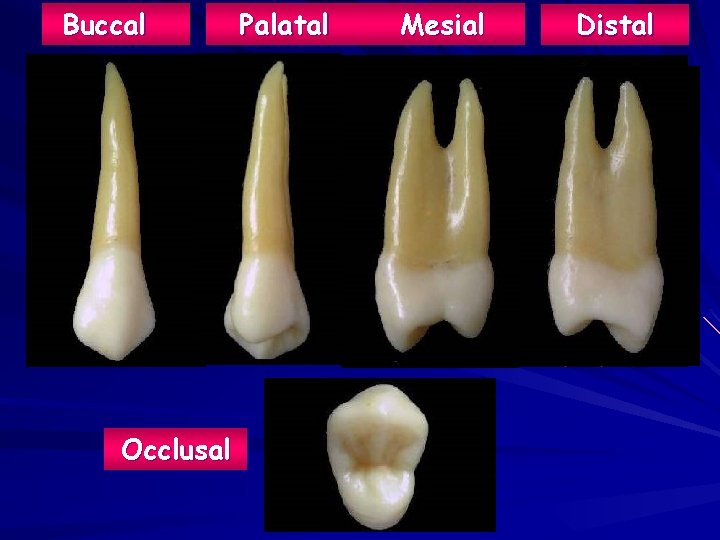
Buccal Palatal Mesial Occlusal www. rxdentistry. blogspot. com Distal
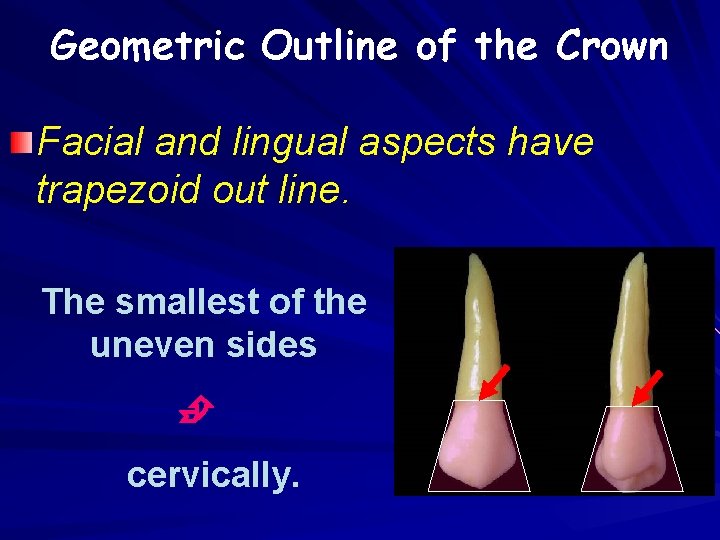
Geometric Outline of the Crown Facial and lingual aspects have trapezoid out line. The smallest of the uneven sides cervically.
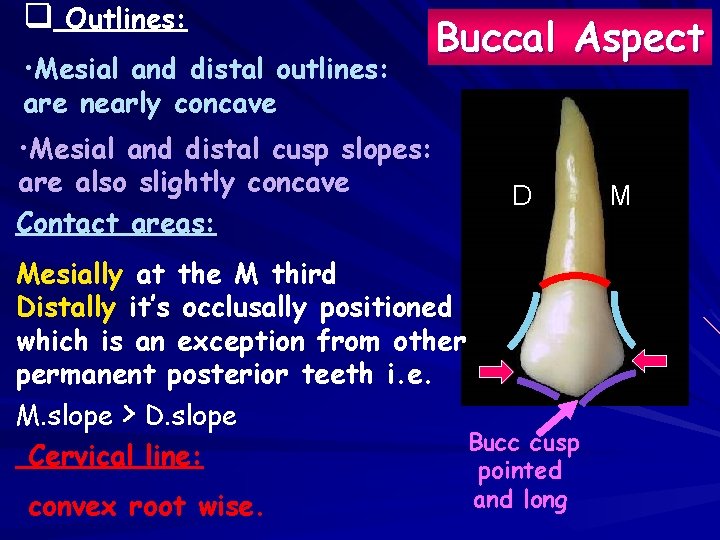
q Outlines: • Mesial and distal outlines: are nearly concave • Mesial and distal cusp slopes: are also slightly concave Contact areas: Buccal Aspect D Mesially at the M third Distally it’s occlusally positioned which is an exception from other permanent posterior teeth i. e. M. slope > D. slope Bucc cusp Cervical line: pointed convex root wise. and long M
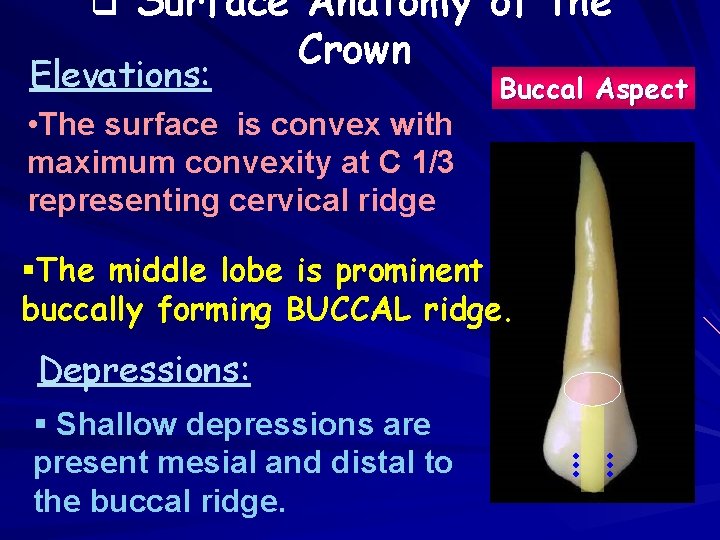
q Surface Anatomy of the Crown Elevations: • The surface is convex with maximum convexity at C 1/3 representing cervical ridge Buccal Aspect §The middle lobe is prominent buccally forming BUCCAL ridge. Depressions: § Shallow depressions are present mesial and distal to the buccal ridge.
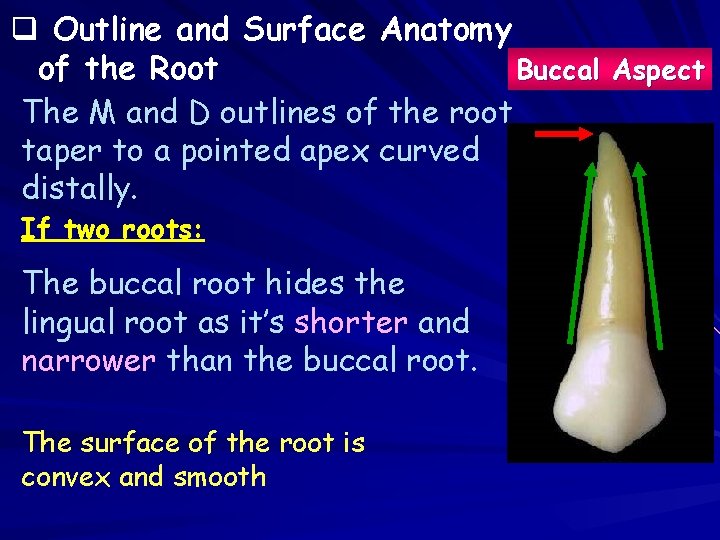
q Outline and Surface Anatomy of the Root Buccal Aspect The M and D outlines of the root taper to a pointed apex curved distally. If two roots: The buccal. root hides the lingual root as it’s shorter and narrower than the buccal root. The surface of the root is convex and smooth
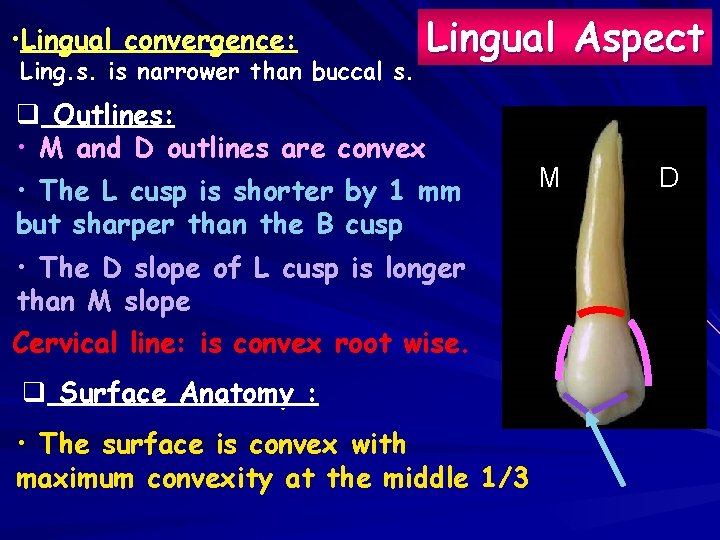
• Lingual convergence: Ling. s. is narrower than buccal s. Lingual Aspect q Outlines: • M and D outlines are convex • The L cusp is shorter by 1 mm but sharper than the B cusp • The D slope of L cusp is longer than M slope Cervical line: is convex root wise. q Surface Anatomy : • The surface is convex with maximum convexity at the middle 1/3 M D
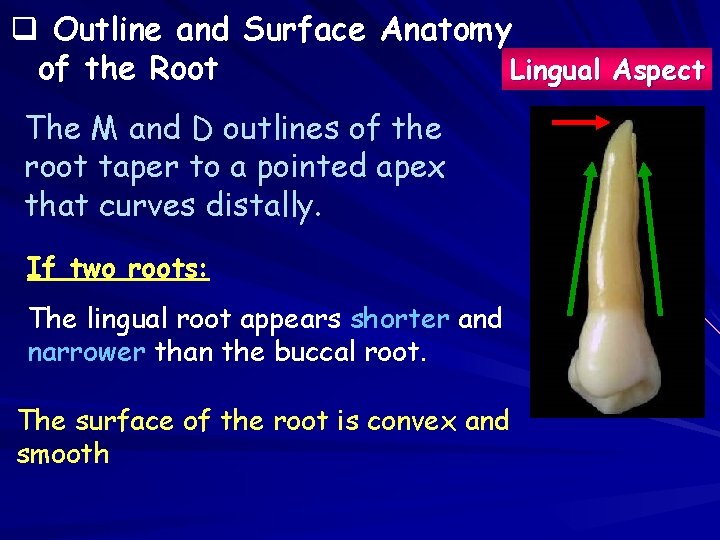
q Outline and Surface Anatomy of the Root Lingual Aspect The M and D outlines of the root taper to a pointed apex that curves distally. If two roots: The lingual root appears shorter and narrower than the buccal root. The surface of the root is convex and smooth
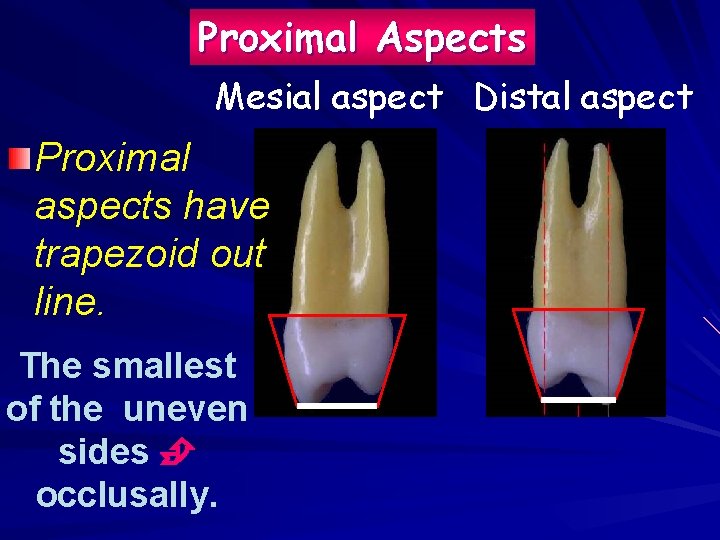
Proximal Aspects Mesial aspect Distal aspect Proximal aspects have trapezoid out line. The smallest of the uneven sides occlusally.
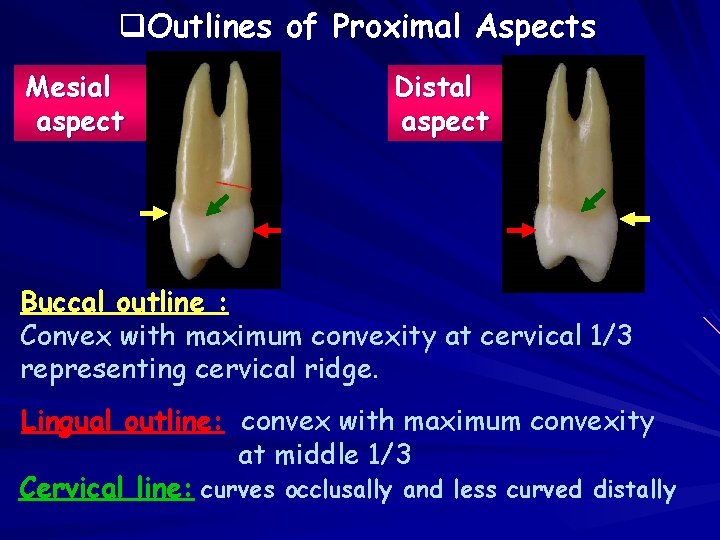
q. Outlines of Proximal Aspects Mesial aspect Distal aspect Buccal outline : Convex with maximum convexity at cervical 1/3 representing cervical ridge. Lingual outline: convex with maximum convexity at middle 1/3 Cervical line: curves occlusally and less curved distally
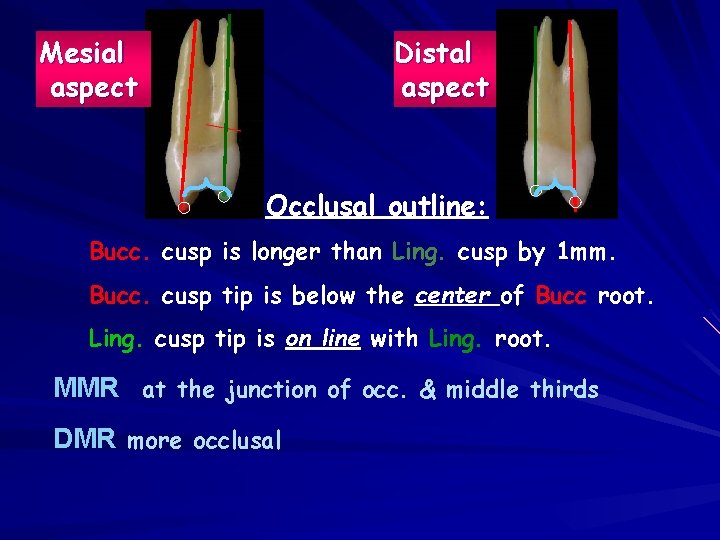
Distal aspect Mesial aspect Occlusal outline: Bucc. cusp is longer than Ling. cusp by 1 mm. Bucc. cusp tip is below the center of Bucc root. Ling. cusp tip is on line with Ling. root. MMR at the junction of occ. & middle thirds DMR more occlusal
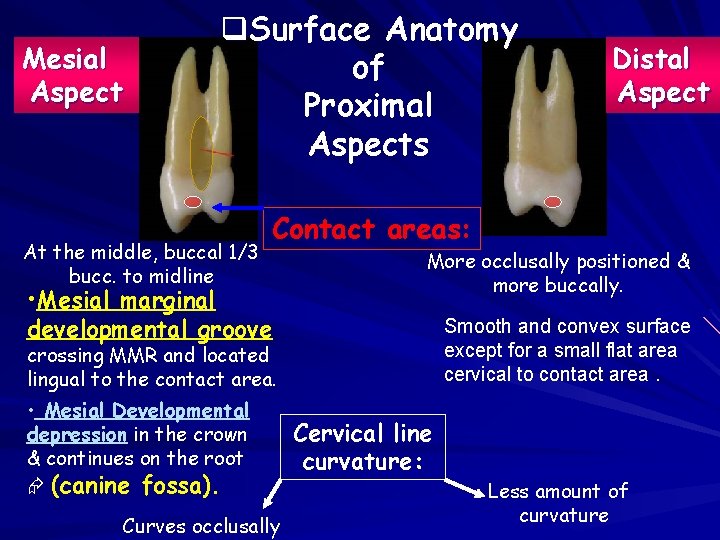
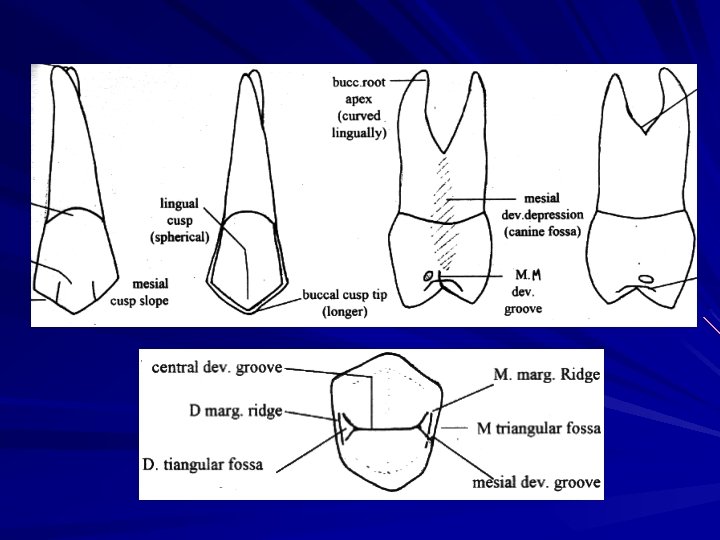
Mesial Aspect q. Surface Anatomy of Proximal Aspects At the middle, buccal 1/3 bucc. to midline Distal Aspect Contact areas: • Mesial marginal developmental groove More occlusally positioned & more buccally. Smooth and convex surface except for a small flat area cervical to contact area. crossing MMR and located lingual to the contact area. • Mesial Developmental depression in the crown & continues on the root (canine fossa). Curves occlusally Cervical line curvature: Less amount of curvature
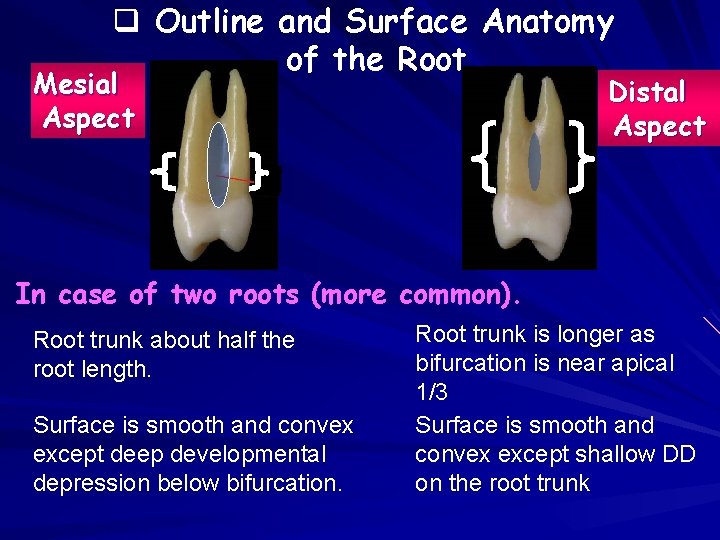
q Outline and Surface Anatomy of the Root Mesial Aspect Distal Aspect In case of two roots (more common). Root trunk about half the root length. Surface is smooth and convex except deep developmental depression below bifurcation. Root trunk is longer as bifurcation is near apical 1/3 Surface is smooth and convex except shallow DD on the root trunk
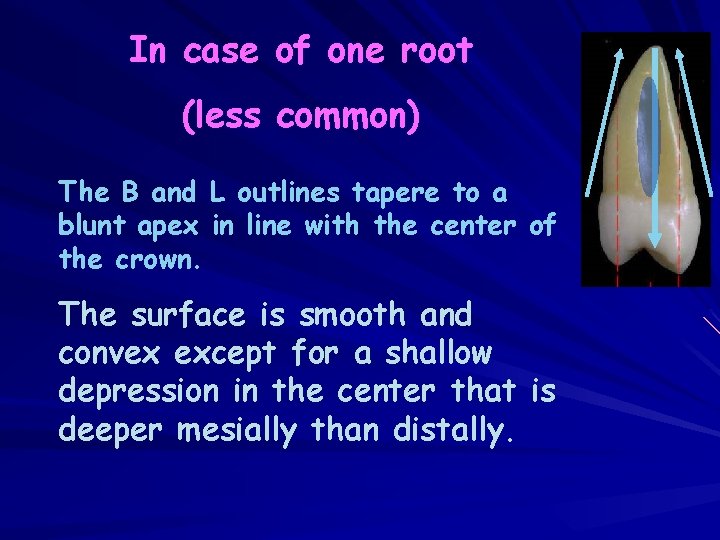
In case of one root (less common) The B and L outlines tapere to a blunt apex in line with the center of the crown. The surface is smooth and convex except for a shallow depression in the center that is deeper mesially than distally.
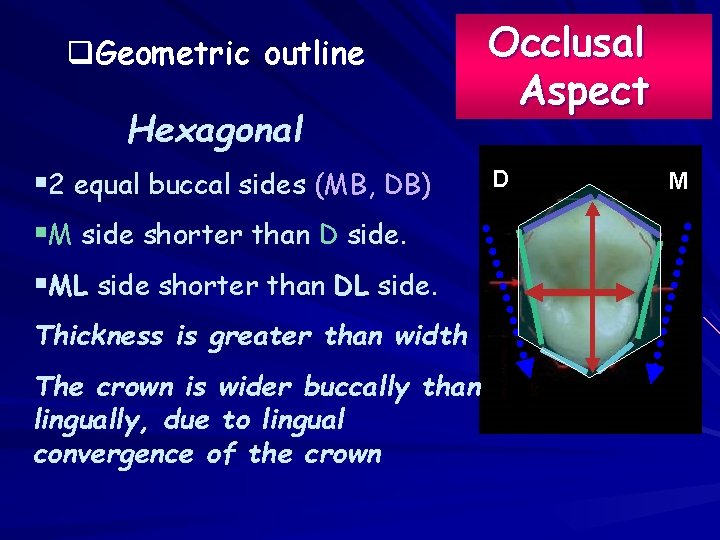
q. Geometric outline Hexagonal § 2 equal buccal sides (MB, DB) §M side shorter than D side. §ML side shorter than DL side. Thickness is greater than width The crown is wider buccally than lingually, due to lingual convergence of the crown Occlusal Aspect D M
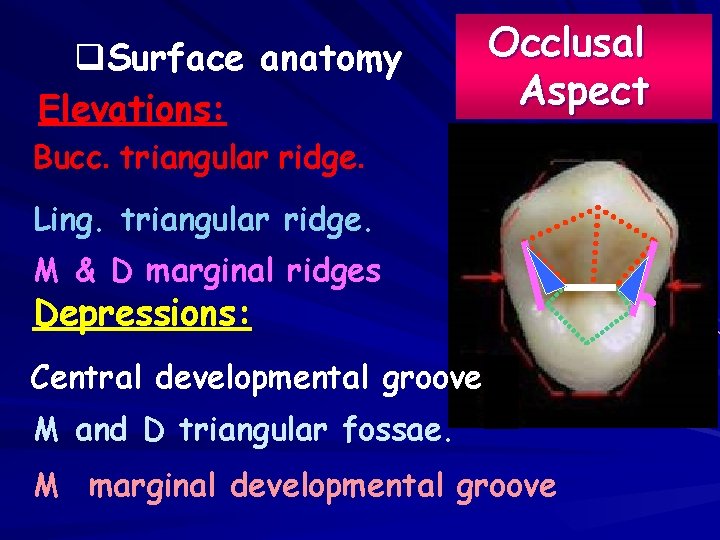
q. Surface anatomy Elevations: Occlusal Aspect Bucc. triangular ridge. Ling. triangular ridge. M & D marginal ridges Depressions: Central developmental groove M and D triangular fossae. M marginal developmental groove
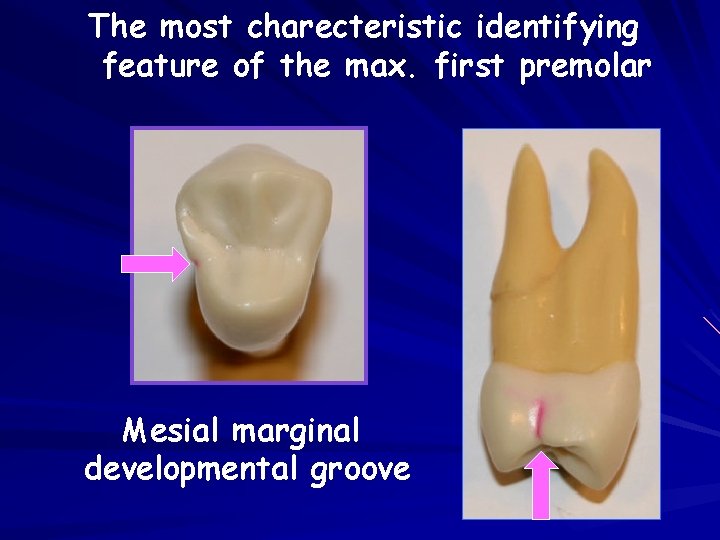
The most charecteristic identifying feature of the max. first premolar Mesial marginal developmental groove
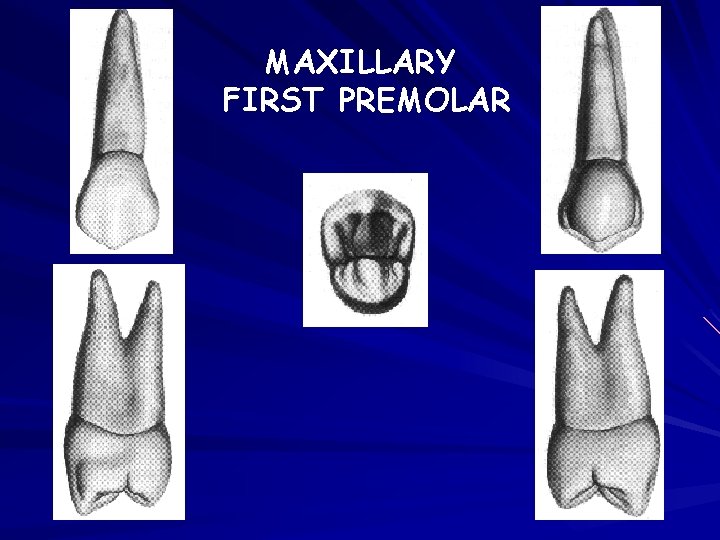
MAXILLARY FIRST PREMOLAR
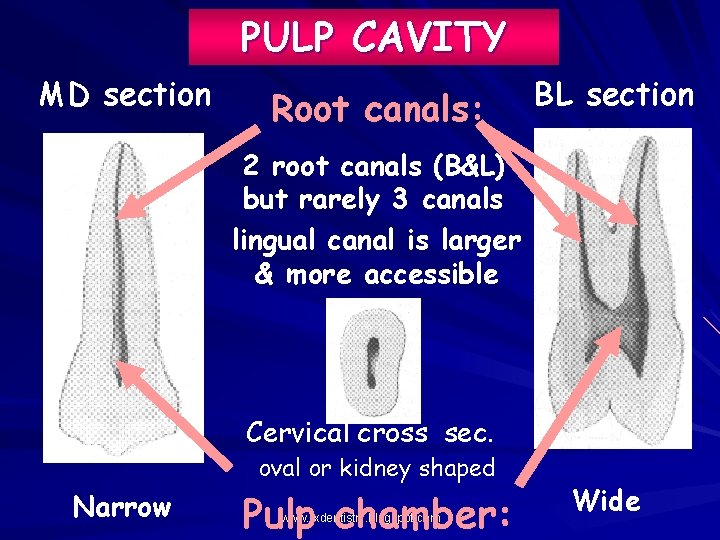
PULP CAVITY MD section Root canals: BL section 2 root canals (B&L) but rarely 3 canals lingual canal is larger & more accessible Cervical cross sec. oval or kidney shaped Narrow Pulp chamber: www. rxdentistry. blogspot. com Wide
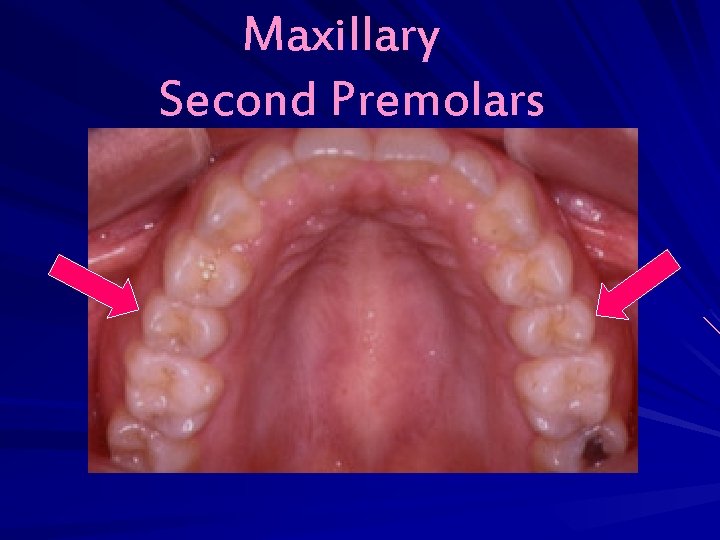
Maxillary Second Premolars
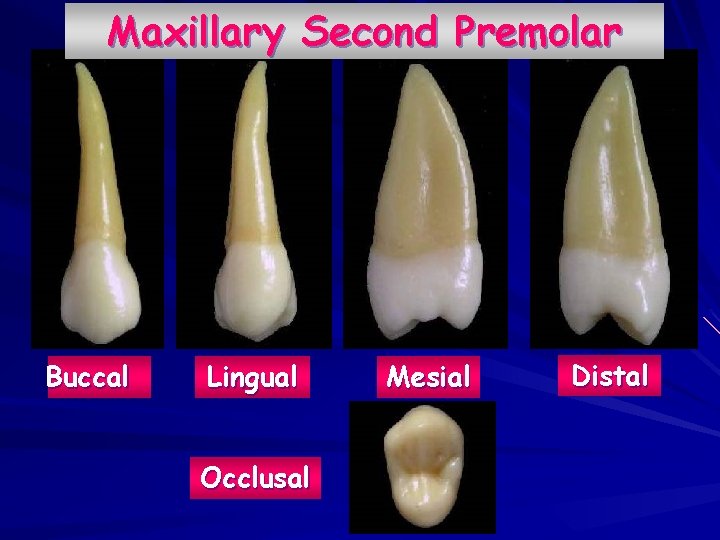
Maxillary Second Premolar Buccal Lingual Occlusal Mesial Distal
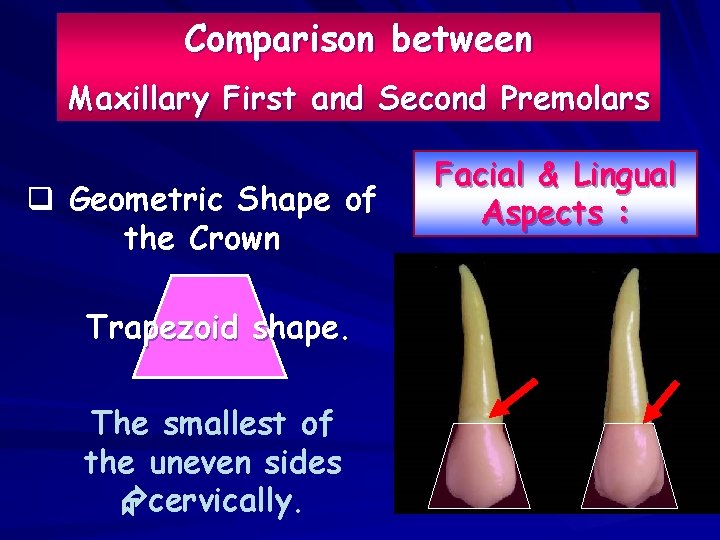
Comparison between Maxillary First and Second Premolars q Geometric Shape of the Crown Trapezoid shape. The smallest of the uneven sides cervically. Facial & Lingual Aspects :
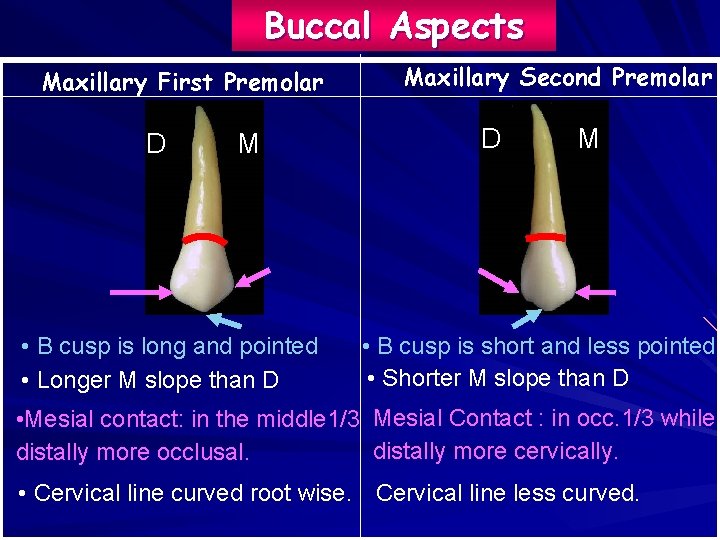
Buccal Aspects Maxillary First Premolar D M • B cusp is long and pointed • Longer M slope than D Maxillary Second Premolar D M • B cusp is short and less pointed • Shorter M slope than D • Mesial contact: in the middle 1/3 Mesial Contact : in occ. 1/3 while distally more cervically. distally more occlusal. • Cervical line curved root wise. Cervical line less curved.
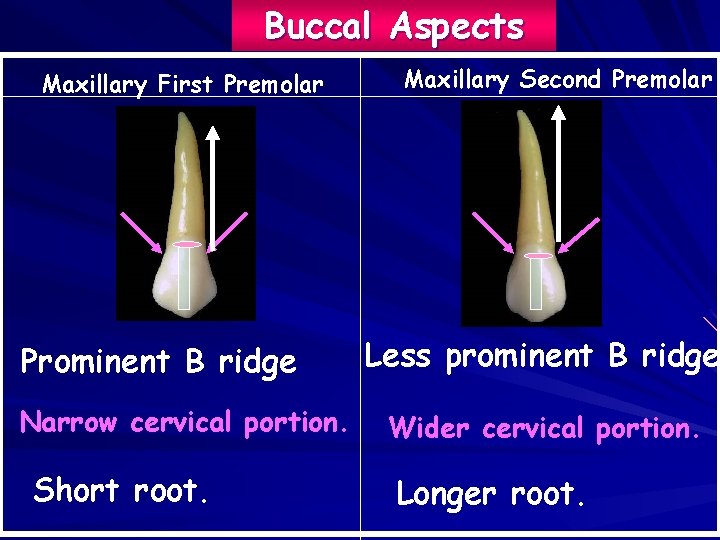
Buccal Aspects Maxillary First Premolar Prominent B ridge Narrow cervical portion. Short root. Maxillary Second Premolar Less prominent B ridge Wider cervical portion. Longer root.
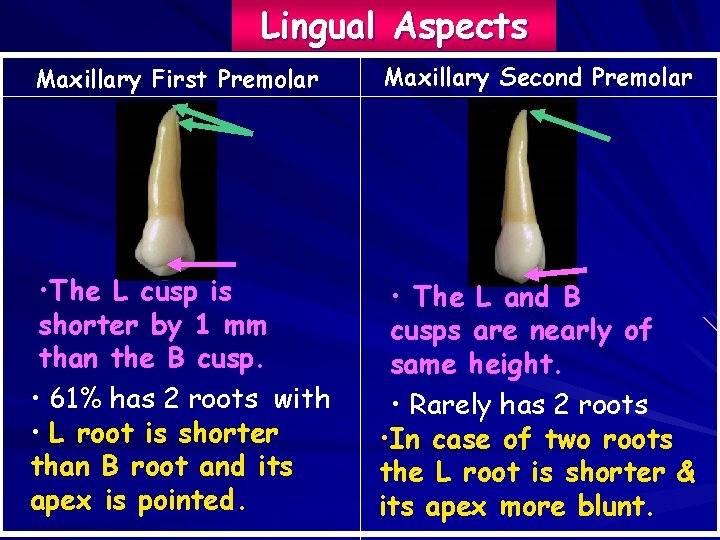
Lingual Aspects Maxillary First Premolar Maxillary Second Premolar • The L cusp is shorter by 1 mm than the B cusp. • 61% has 2 roots with • L root is shorter than B root and its apex is pointed. • The L and B cusps are nearly of same height. • Rarely has 2 roots • In case of two roots the L root is shorter & its apex more blunt.
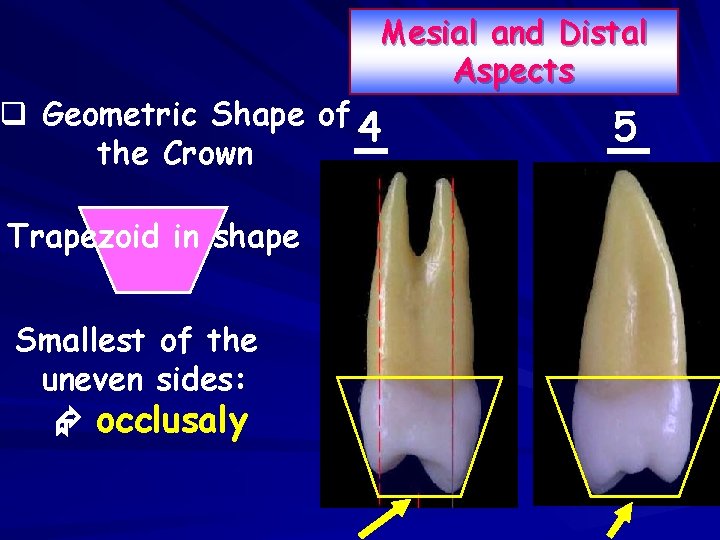
Mesial and Distal Aspects q Geometric Shape of 4 the Crown Trapezoid in shape Smallest of the uneven sides: occlusaly 5
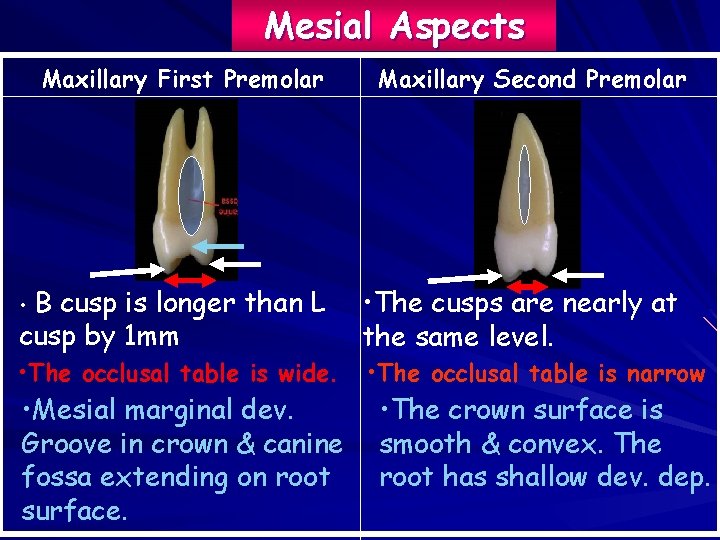
Mesial Aspects Maxillary First Premolar Maxillary Second Premolar B cusp is longer than L cusp by 1 mm • The cusps are nearly at the same level. • The occlusal table is wide. • The occlusal table is narrow • • Mesial marginal dev. Groove in crown & canine fossa extending on root surface. • The crown surface is smooth & convex. The root has shallow dev. dep.
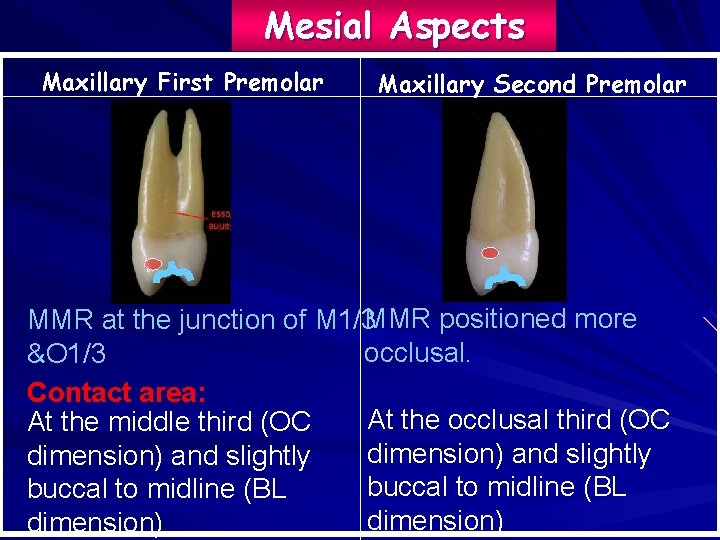
Mesial Aspects Maxillary First Premolar Maxillary Second Premolar MMR at the junction of M 1/3 MMR positioned more occlusal. &O 1/3 Contact area: At the occlusal third (OC At the middle third (OC dimension) and slightly buccal to midline (BL dimension)
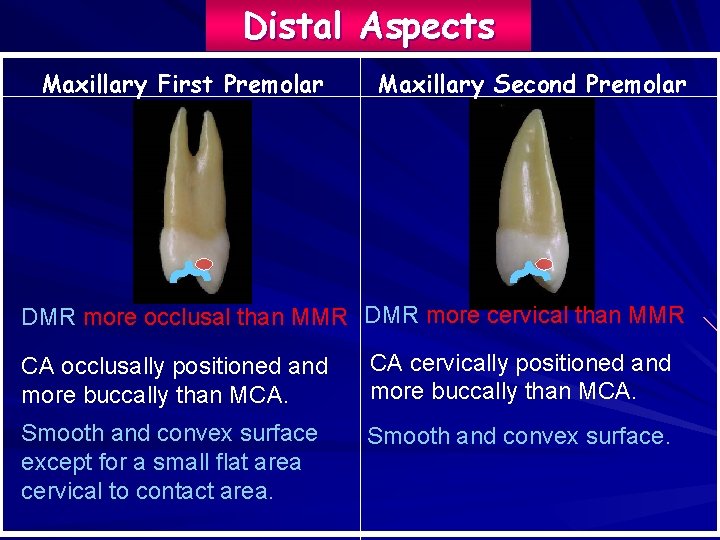
Distal Aspects Maxillary First Premolar Maxillary Second Premolar DMR more occlusal than MMR DMR more cervical than MMR CA occlusally positioned and more buccally than MCA. CA cervically positioned and more buccally than MCA. Smooth and convex surface except for a small flat area cervical to contact area. Smooth and convex surface.
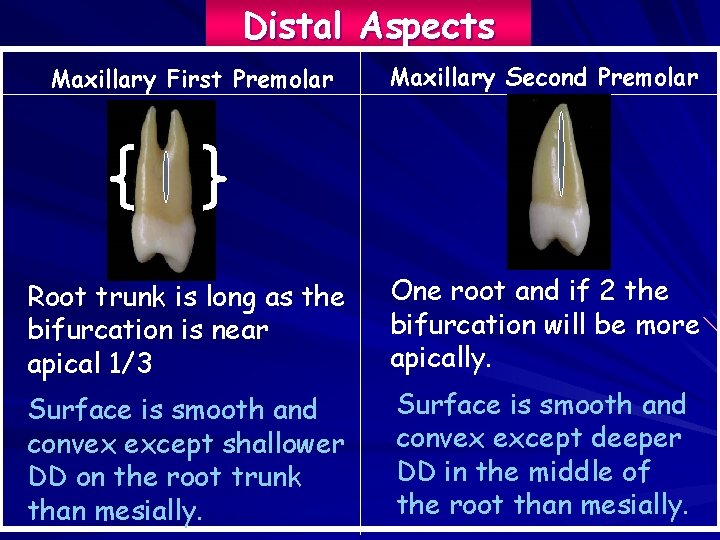
Distal Aspects Maxillary First Premolar Maxillary Second Premolar Root trunk is long as the bifurcation is near apical 1/3 One root and if 2 the bifurcation will be more apically. Surface is smooth and convex except shallower DD on the root trunk than mesially. Surface is smooth and convex except deeper DD in the middle of the root than mesially.
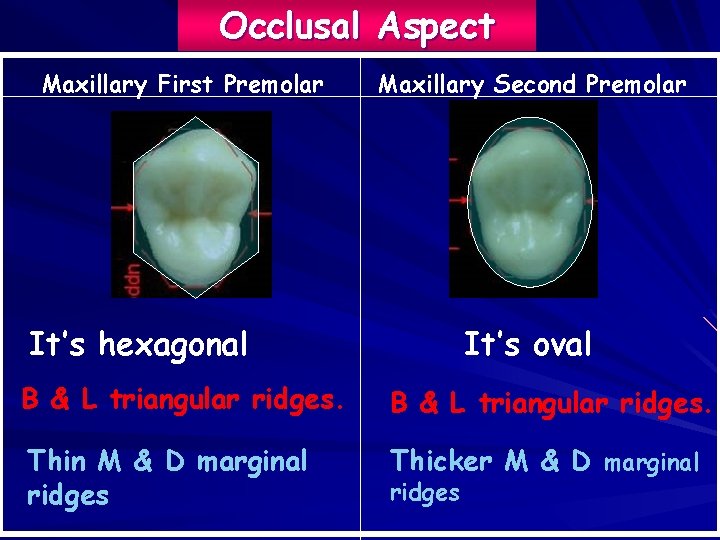
Occlusal Aspect Maxillary First Premolar Maxillary Second Premolar It’s hexagonal It’s oval B & L triangular ridges. Thin M & D marginal ridges Thicker M & D marginal ridges
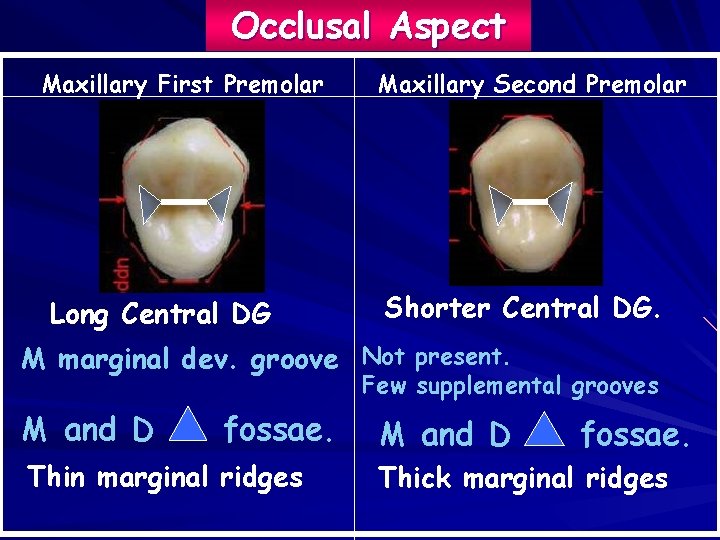
Occlusal Aspect Maxillary First Premolar Long Central DG Maxillary Second Premolar Shorter Central DG. M marginal dev. groove Not present. Few supplemental grooves M and D fossae. Thin marginal ridges M and D fossae. Thick marginal ridges
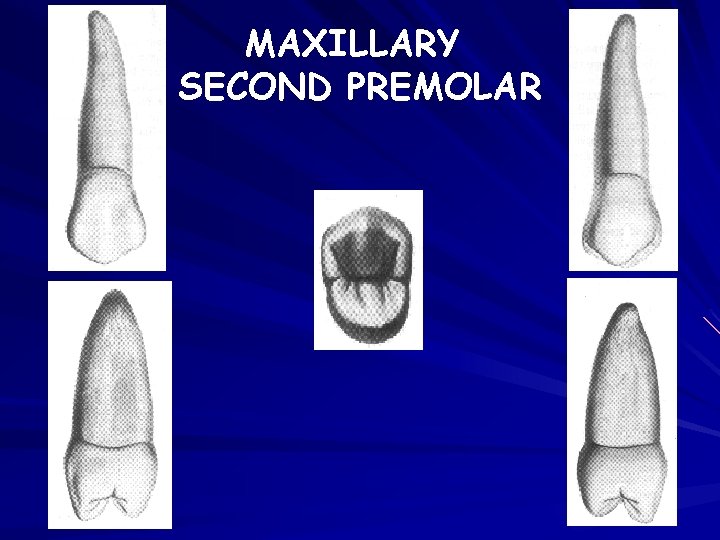
MAXILLARY SECOND PREMOLAR
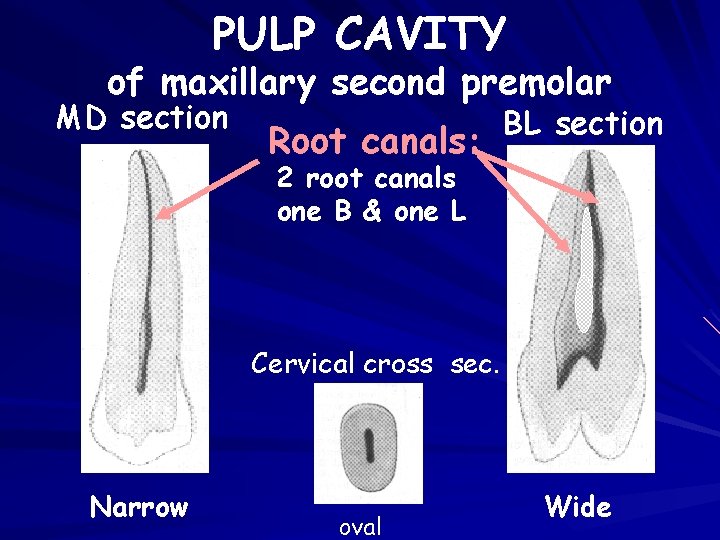
PULP CAVITY of maxillary second premolar MD section Root canals: BL section 2 root canals one B & one L Cervical cross sec. Narrow oval Wide


www. rxdentistry. blogspot. com
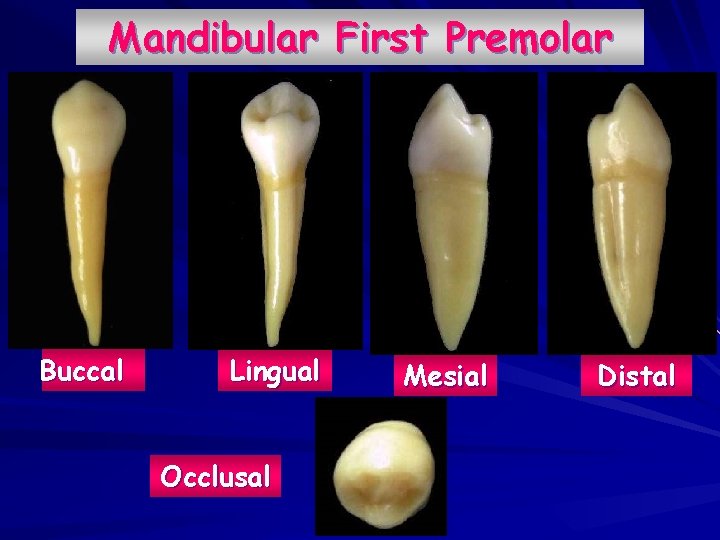
Mandibular First Premolar Buccal Lingual Occlusal Mesial Distal
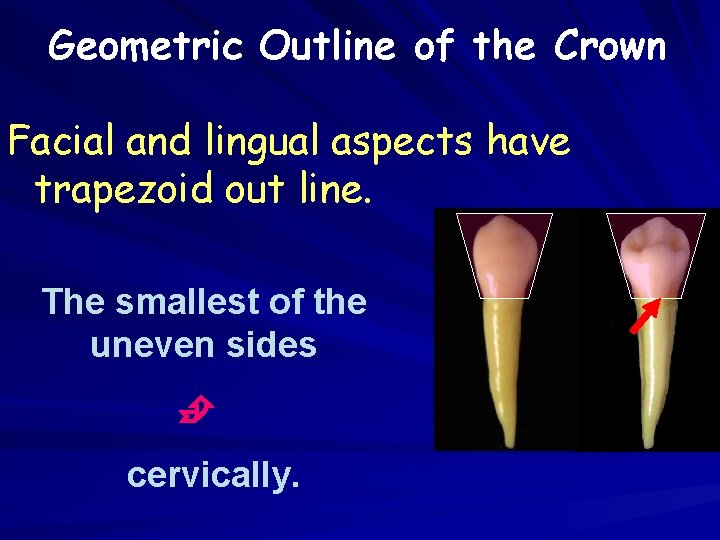
Geometric Outline of the Crown Facial and lingual aspects have trapezoid out line. The smallest of the uneven sides cervically.
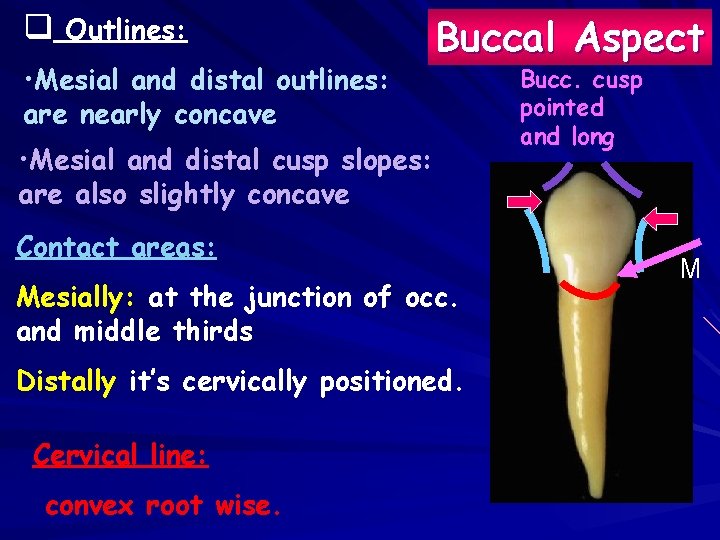
q Outlines: • Mesial and distal outlines: are nearly concave Buccal Aspect • Mesial and distal cusp slopes: are also slightly concave Contact areas: Mesially: at the junction of occ. and middle thirds Distally it’s cervically positioned. Cervical line: convex root wise. Bucc. cusp pointed and long M
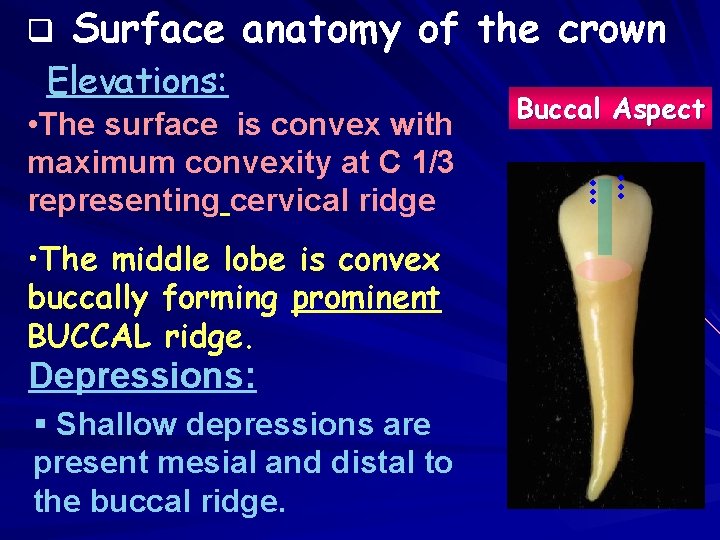
q Surface anatomy of the crown Elevations: • The surface is convex with maximum convexity at C 1/3 representing cervical ridge • The middle lobe is convex buccally forming prominent BUCCAL ridge. Depressions: § Shallow depressions are present mesial and distal to the buccal ridge. Buccal Aspect
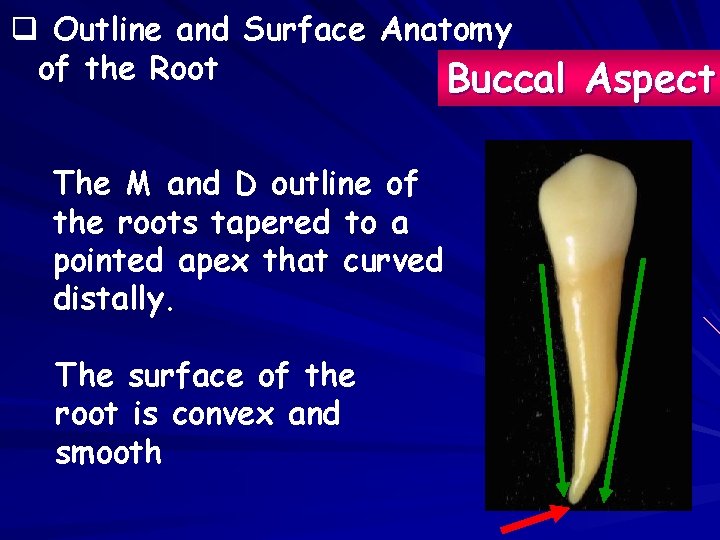
q Outline and Surface Anatomy of the Root Buccal The M and D outline of the roots tapered to a pointed apex that curved distally. The surface of the root is convex and smooth Aspect
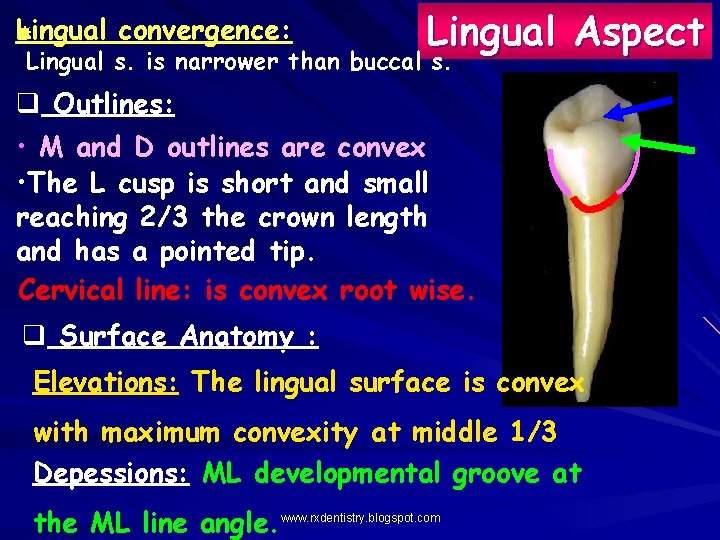
Lingual convergence: Lingual Aspect Lingual s. is narrower than buccal s. q Outlines: • M and D outlines are convex • The L cusp is short and small reaching 2/3 the crown length and has a pointed tip. Cervical line: is convex root wise. q Surface Anatomy : Elevations: The lingual surface is convex with maximum convexity at middle 1/3 Depessions: ML developmental groove at the ML line angle. www. rxdentistry. blogspot. com
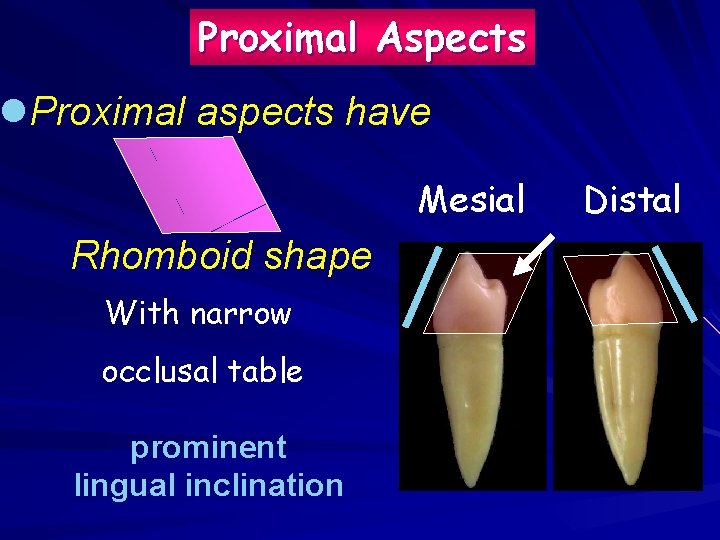
Proximal Aspects l. Proximal aspects have Mesial Rhomboid shape With narrow occlusal table prominent lingual inclination Distal
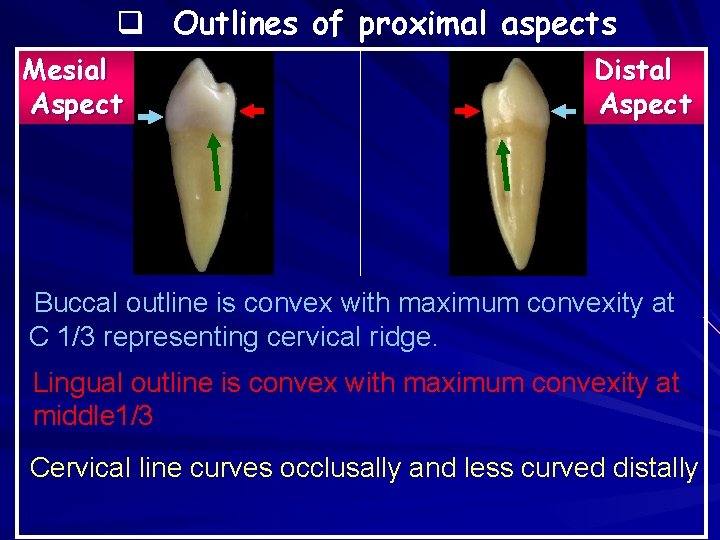
q Outlines of proximal aspects Mesial Aspect Distal Aspect Buccal outline is convex with maximum convexity at C 1/3 representing cervical ridge. Lingual outline is convex with maximum convexity at middle 1/3 Cervical line curves occlusally and less curved distally
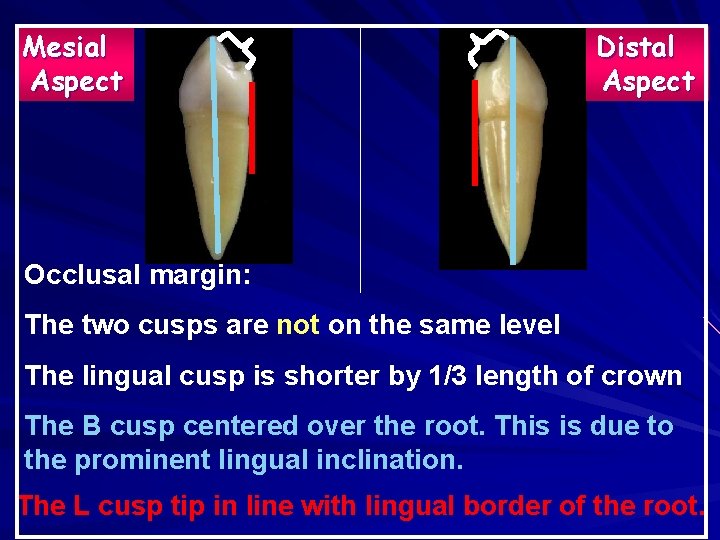
Mesial Aspect Distal Aspect Occlusal margin: The two cusps are not on the same level The lingual cusp is shorter by 1/3 length of crown The B cusp centered over the root. This is due to the prominent lingual inclination. The L cusp tip in line with lingual border of the root.
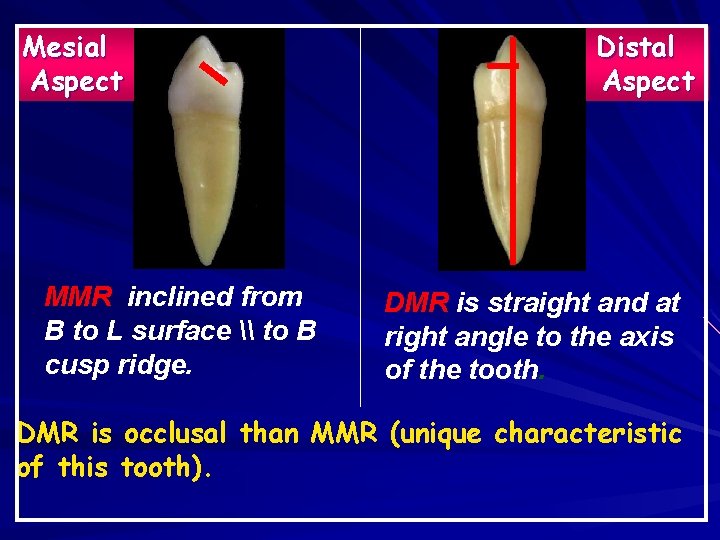
Mesial Aspect MMR inclined from B to L surface \ to B cusp ridge. Distal Aspect DMR is straight and at right angle to the axis of the tooth. DMR is occlusal than MMR (unique characteristic of this tooth).
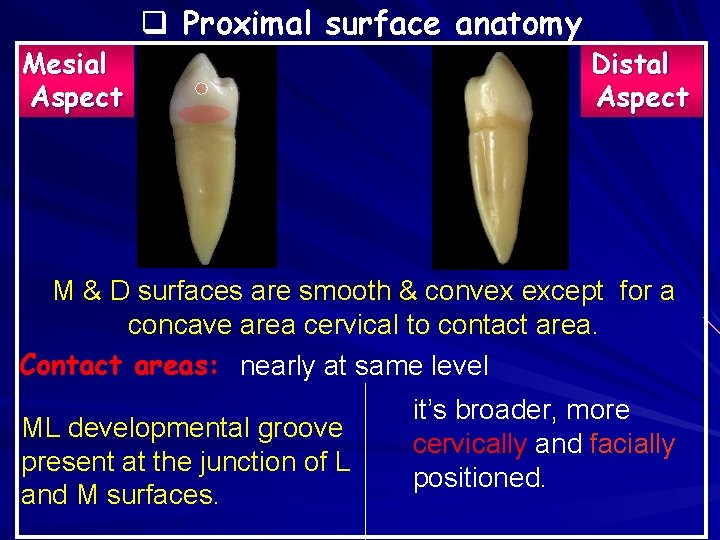
Mesial Aspect q Proximal surface anatomy Distal Aspect M & D surfaces are smooth & convex except for a concave area cervical to contact area. Contact areas: nearly at same level ML developmental groove present at the junction of L and M surfaces. it’s broader, more cervically and facially positioned.
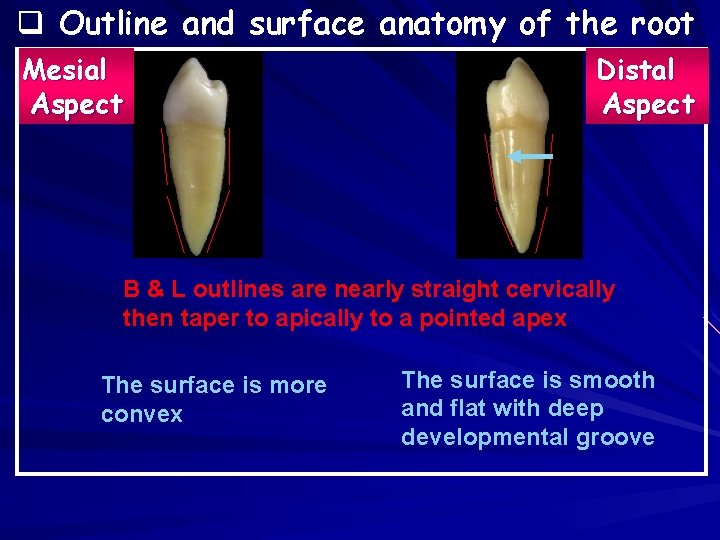
q Outline and surface anatomy of the root Mesial Aspect Distal Aspect B & L outlines are nearly straight cervically then taper to apically to a pointed apex The surface is more convex The surface is smooth and flat with deep developmental groove
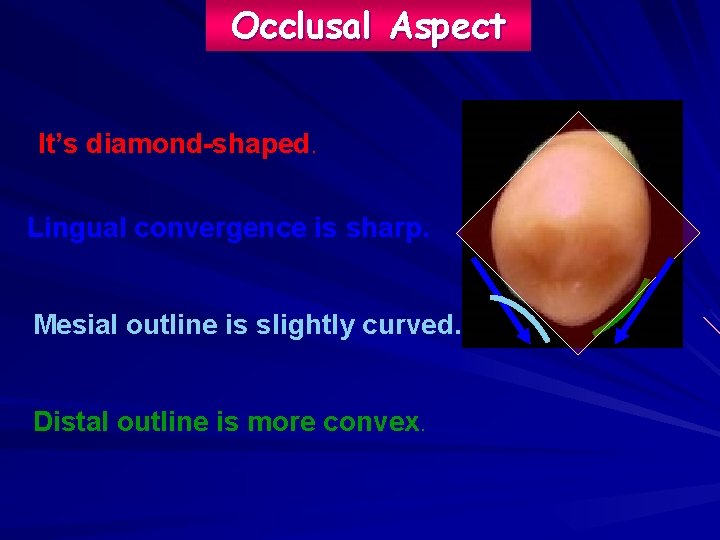
Occlusal Aspect It’s diamond-shaped. Lingual convergence is sharp. Mesial outline is slightly curved. Distal outline is more convex.
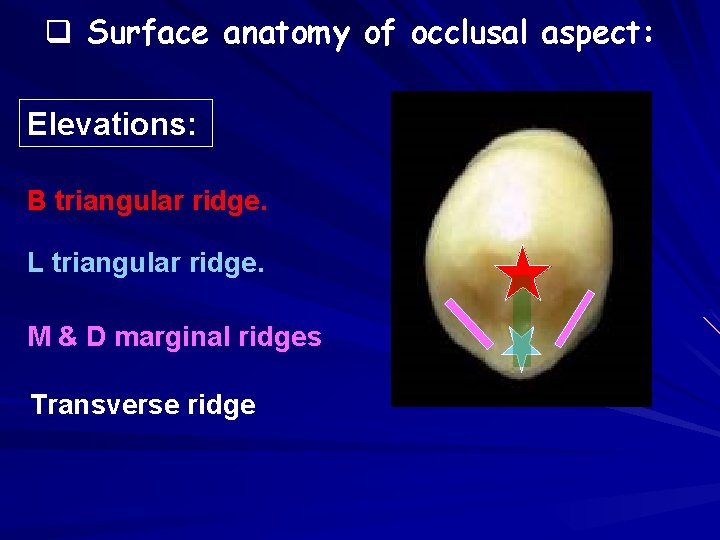
q Surface anatomy of occlusal aspect: Elevations: B triangular ridge. L triangular ridge. M & D marginal ridges Transverse ridge
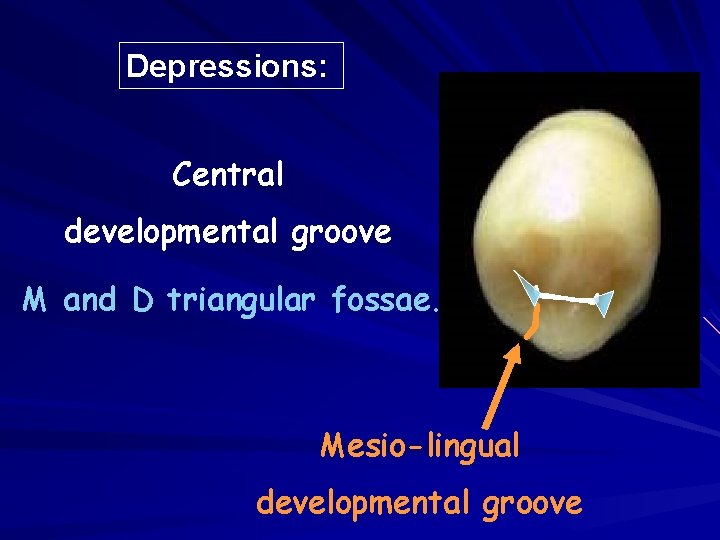
Depressions: Central developmental groove M and D triangular fossae. Mesio-lingual developmental groove
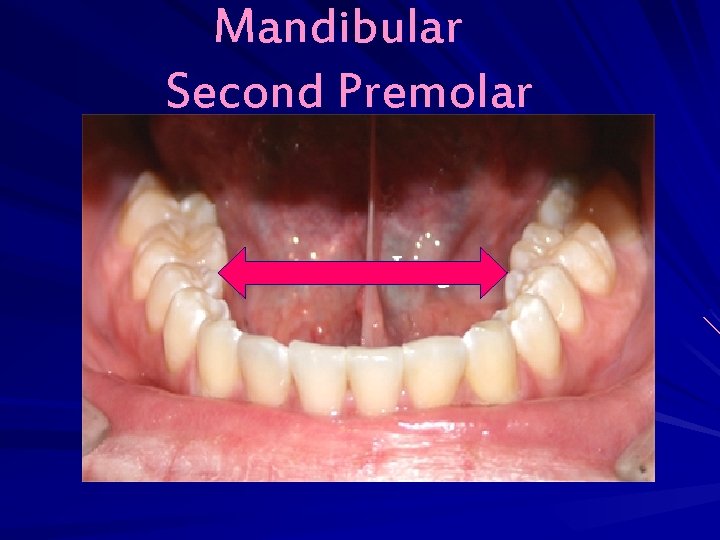
Mandibular Second Premolar
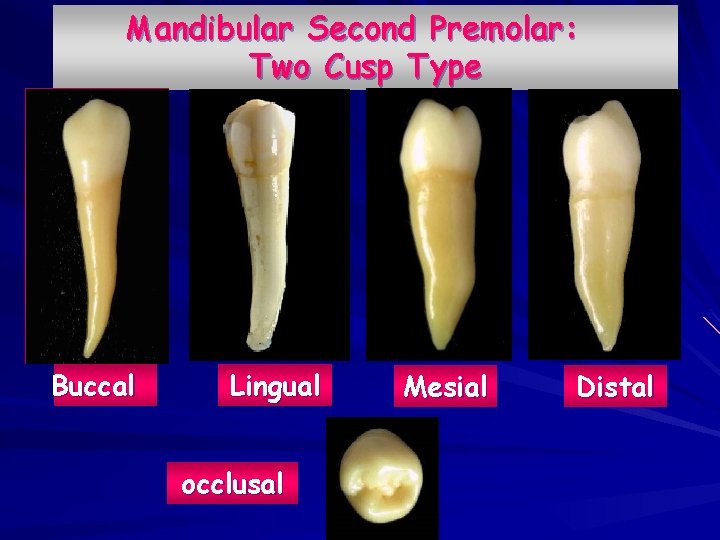
Mandibular Second Premolar: Two Cusp Type Buccal Lingual occlusal Mesial Distal
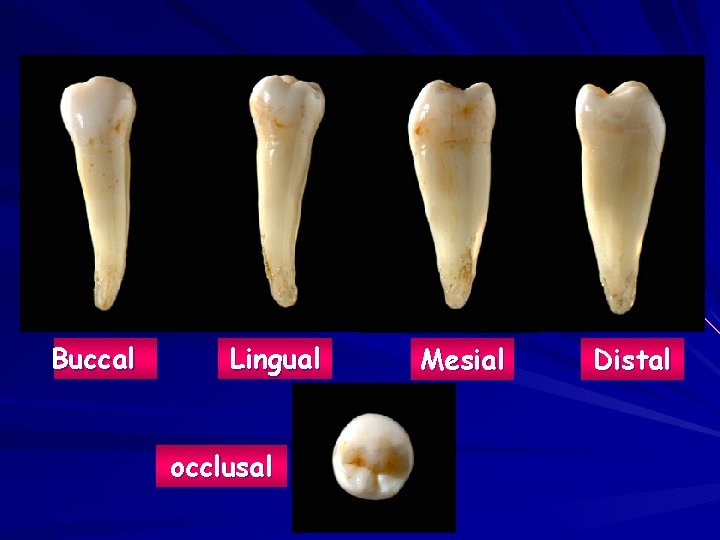
Buccal Lingual occlusal Mesial Distal
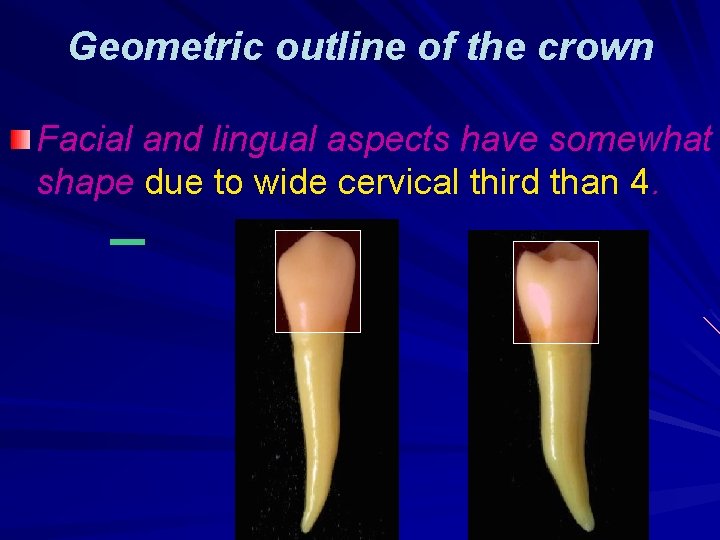
Geometric outline of the crown Facial and lingual aspects have somewhat shape due to wide cervical third than 4.
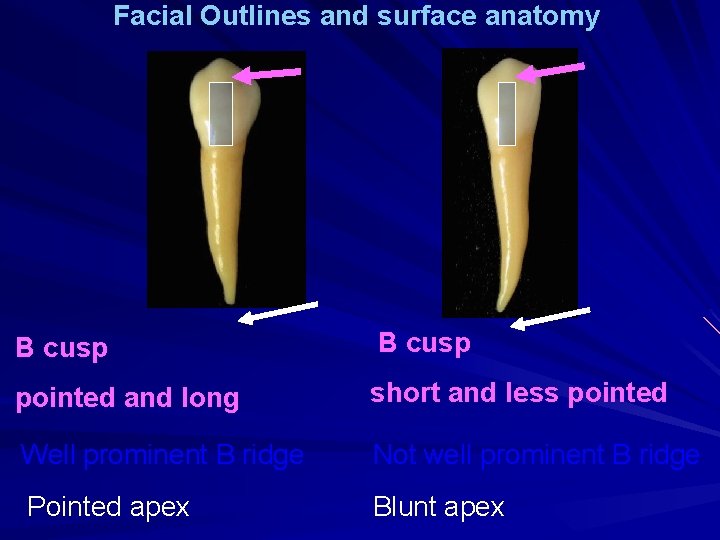
Facial Outlines and surface anatomy B cusp pointed and long short and less pointed Well prominent B ridge Not well prominent B ridge Pointed apex Blunt apex
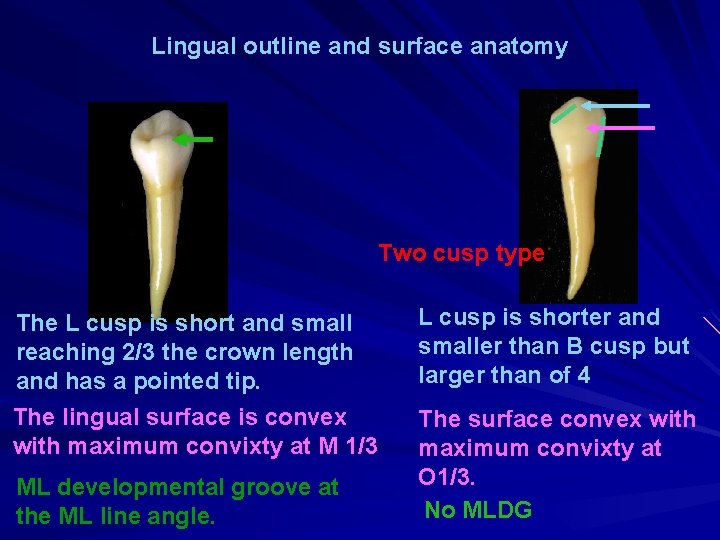
Lingual outline and surface anatomy Two cusp type The L cusp is short and small reaching 2/3 the crown length and has a pointed tip. L cusp is shorter and smaller than B cusp but larger than of 4 The lingual surface is convex with maximum convixty at M 1/3 The surface convex with maximum convixty at O 1/3. No MLDG ML developmental groove at the ML line angle.
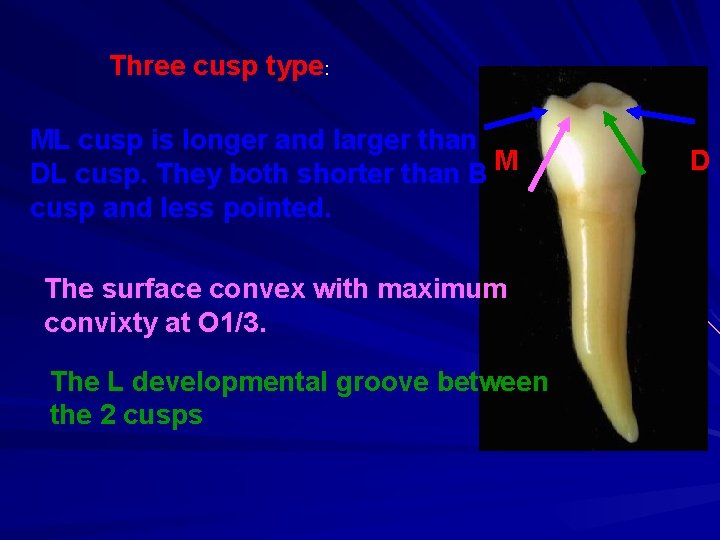
Three cusp type: ML cusp is longer and larger than DL cusp. They both shorter than B M cusp and less pointed. The surface convex with maximum convixty at O 1/3. The L developmental groove between the 2 cusps D
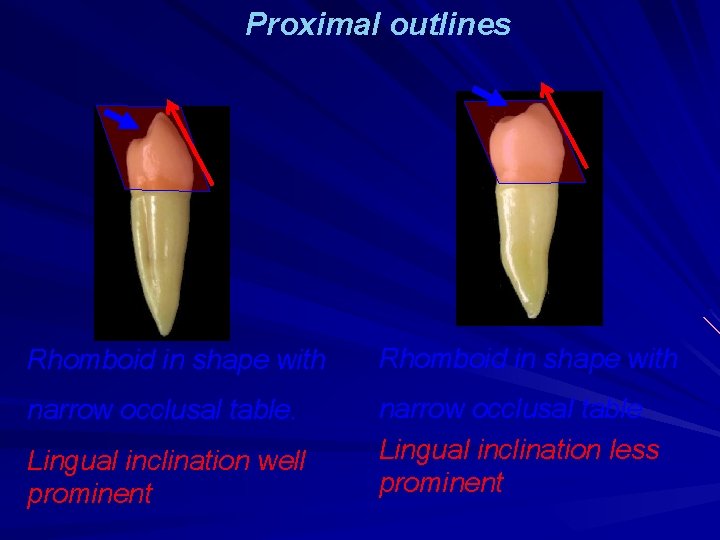
Proximal outlines Rhomboid in shape with narrow occlusal table. Lingual inclination less prominent Lingual inclination well prominent
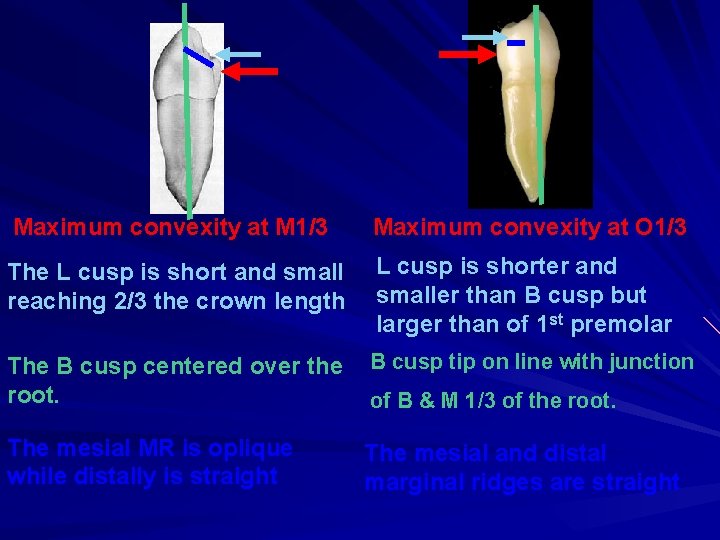
Maximum convexity at M 1/3 Maximum convexity at O 1/3 The L cusp is short and small reaching 2/3 the crown length L cusp is shorter and smaller than B cusp but larger than of 1 st premolar The B cusp centered over the root. B cusp tip on line with junction The mesial MR is oplique while distally is straight The mesial and distal marginal ridges are straight of B & M 1/3 of the root.
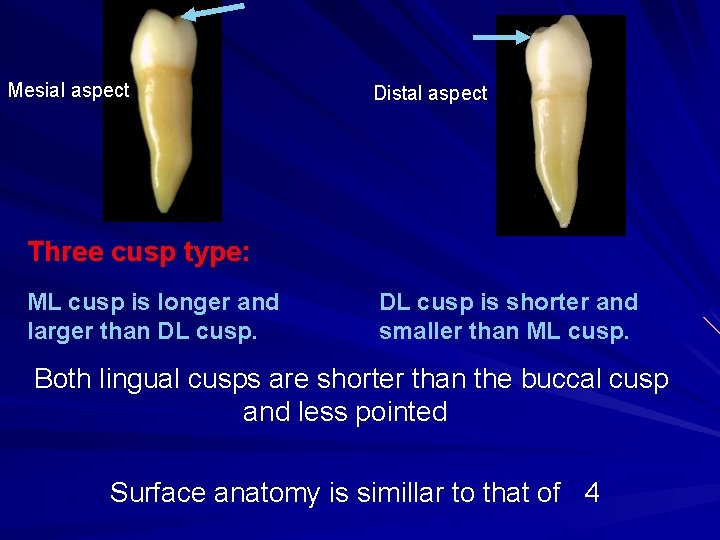
Mesial aspect Distal aspect Three cusp type: ML cusp is longer and larger than DL cusp is shorter and smaller than ML cusp. Both lingual cusps are shorter than the buccal cusp and less pointed Surface anatomy is simillar to that of 4
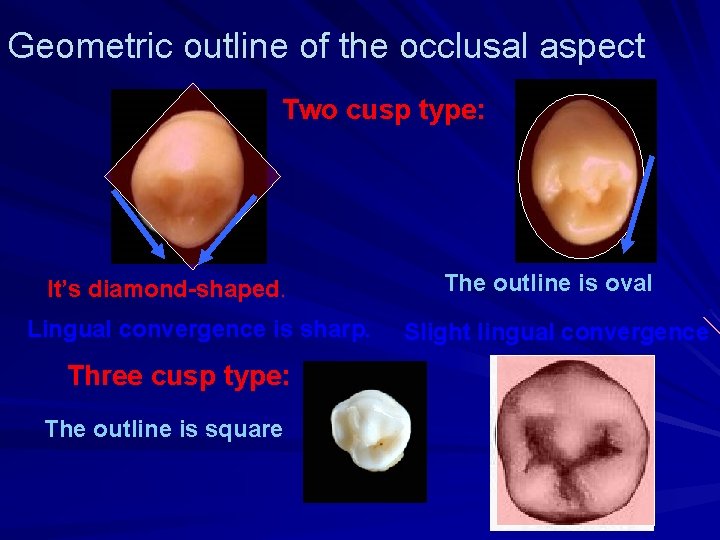
Geometric outline of the occlusal aspect Two cusp type: It’s diamond-shaped. Lingual convergence is sharp. Three cusp type: The outline is square The outline is oval Slight lingual convergence
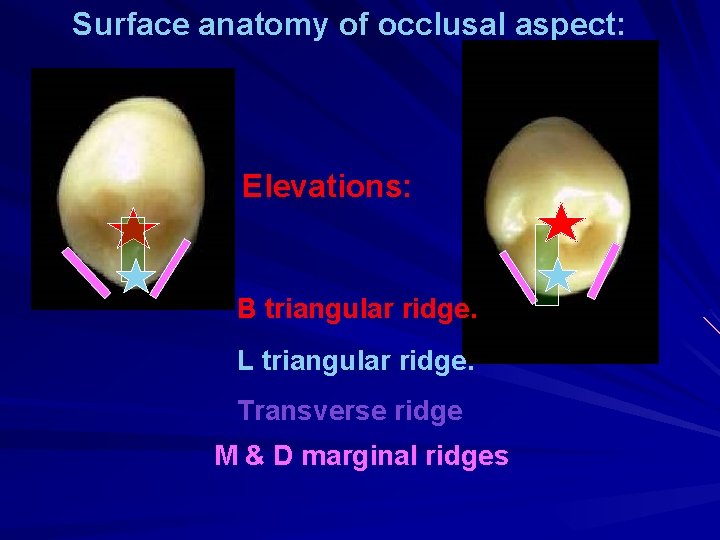
Surface anatomy of occlusal aspect: Elevations: B triangular ridge. L triangular ridge. Transverse ridge M & D marginal ridges
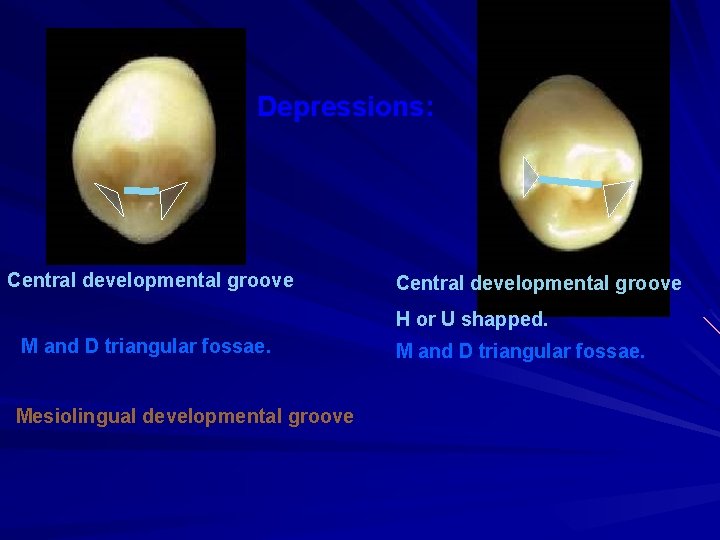
Depressions: Central developmental groove H or U shapped. M and D triangular fossae. Mesiolingual developmental groove M and D triangular fossae.
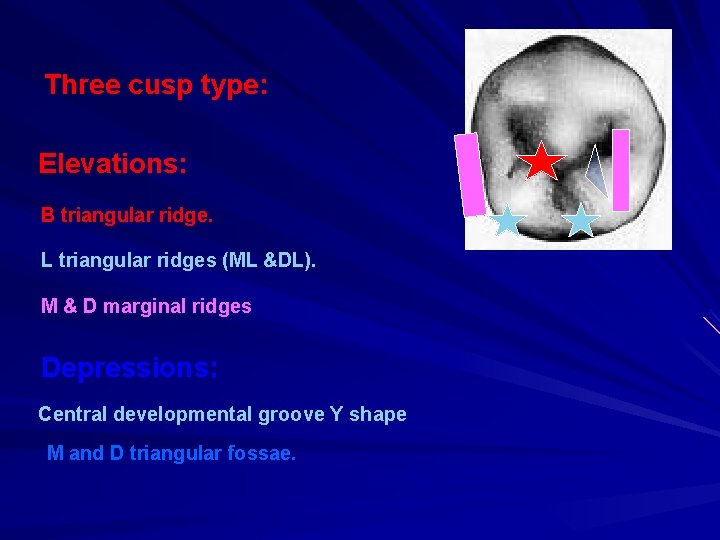
Three cusp type: Elevations: B triangular ridge. L triangular ridges (ML &DL). M & D marginal ridges Depressions: Central developmental groove Y shape M and D triangular fossae.
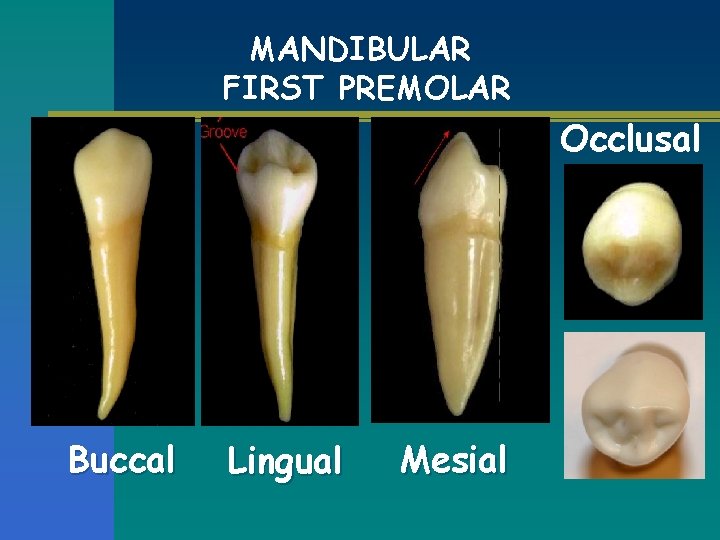
MANDIBULAR FIRST PREMOLAR Occlusal Buccal Lingual Mesial
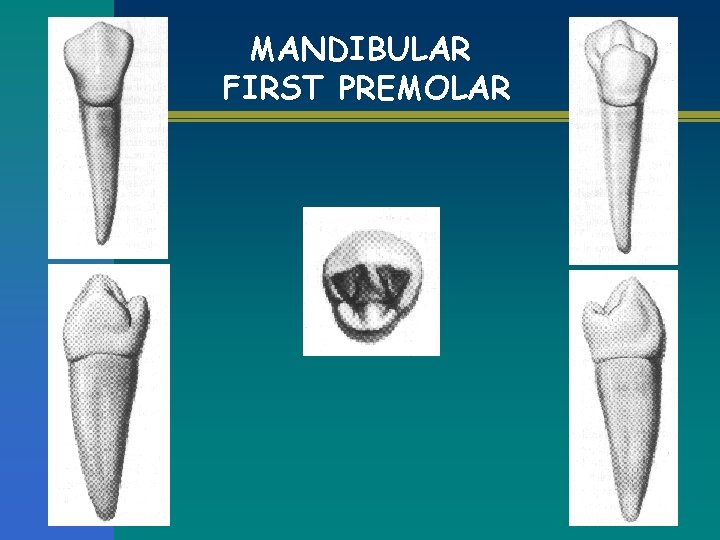
MANDIBULAR FIRST PREMOLAR
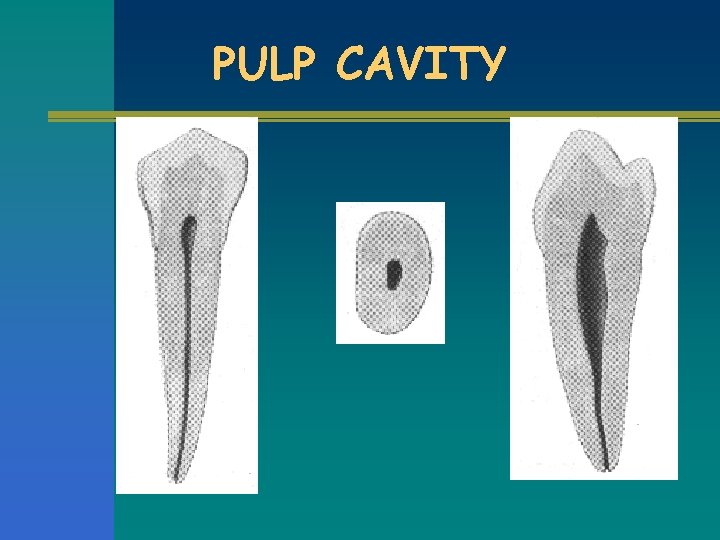
PULP CAVITY
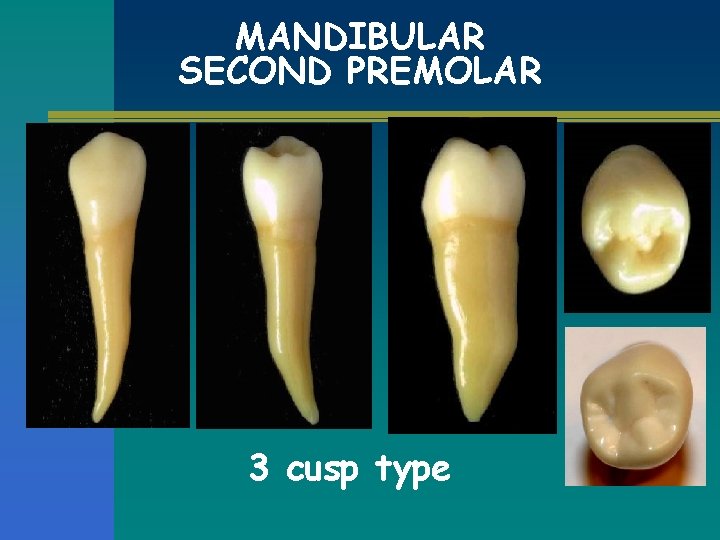
MANDIBULAR SECOND PREMOLAR 3 cusp type
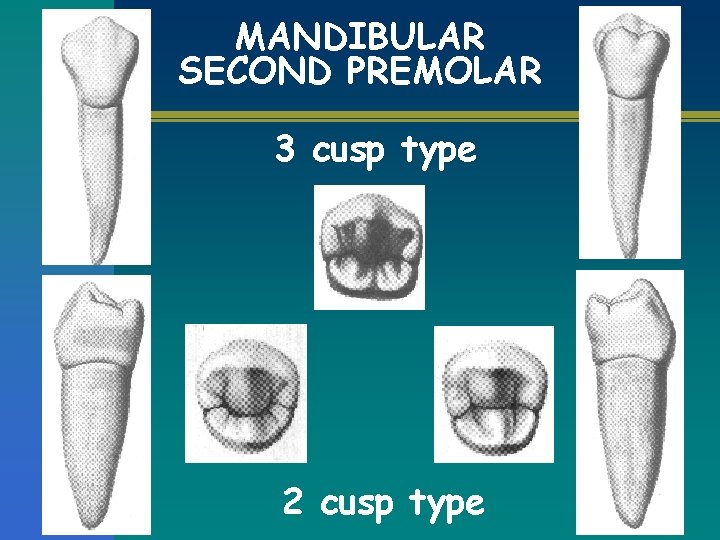
MANDIBULAR SECOND PREMOLAR 3 cusp type 2 cusp type
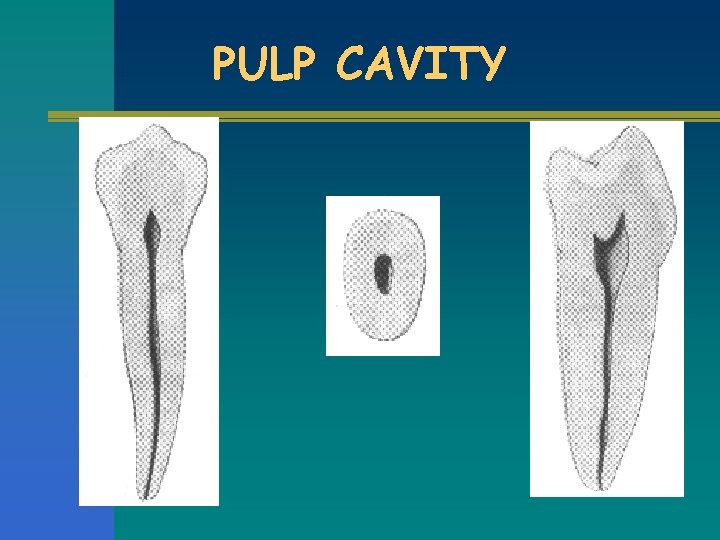
PULP CAVITY
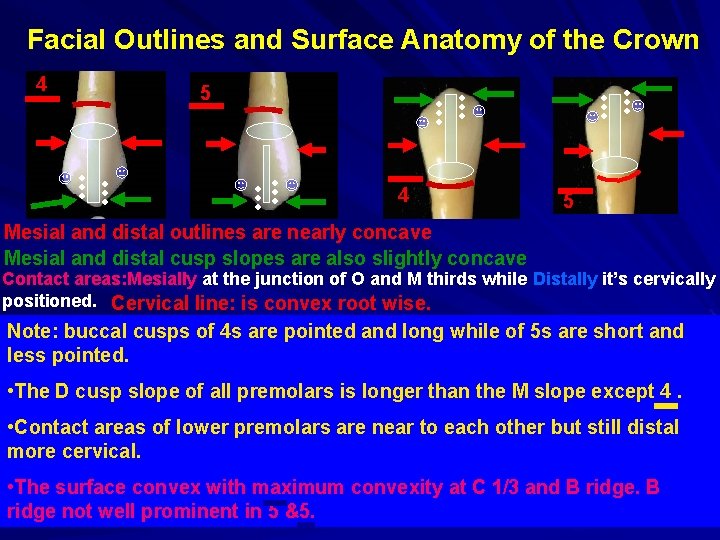
Facial Outlines and Surface Anatomy of the Crown 4 5 Mesial and distal outlines are nearly concave Mesial and distal cusp slopes are also slightly concave Contact areas: Mesially at the junction of O and M thirds while Distally it’s cervically positioned. Cervical line: is convex root wise. Note: buccal cusps of 4 s are pointed and long while of 5 s are short and less pointed. • The D cusp slope of all premolars is longer than the M slope except 4. • Contact areas of lower premolars are near to each other but still distal more cervical. • The surface convex with maximum convexity at C 1/3 and B ridge not well prominent in 5 www. rxdentistry. blogspot. com &5.
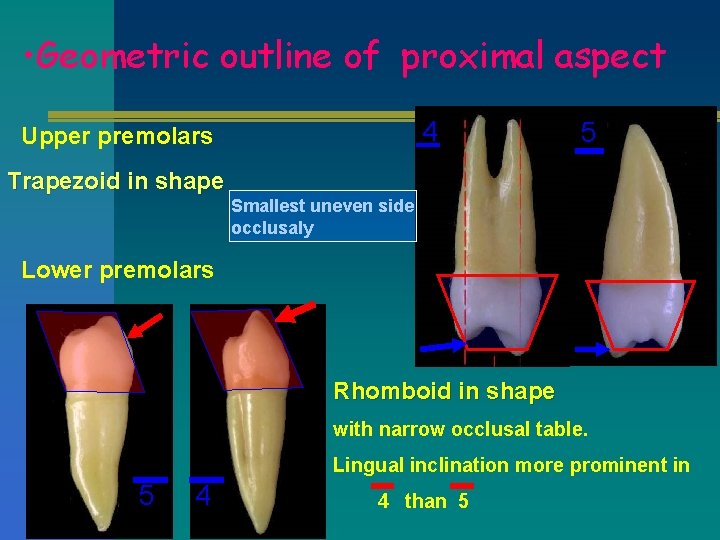
• Geometric outline of proximal aspect 4 Upper premolars 5 Trapezoid in shape Smallest uneven side occlusaly Lower premolars Rhomboid in shape with narrow occlusal table. Lingual inclination more prominent in 5 4 4 than 5
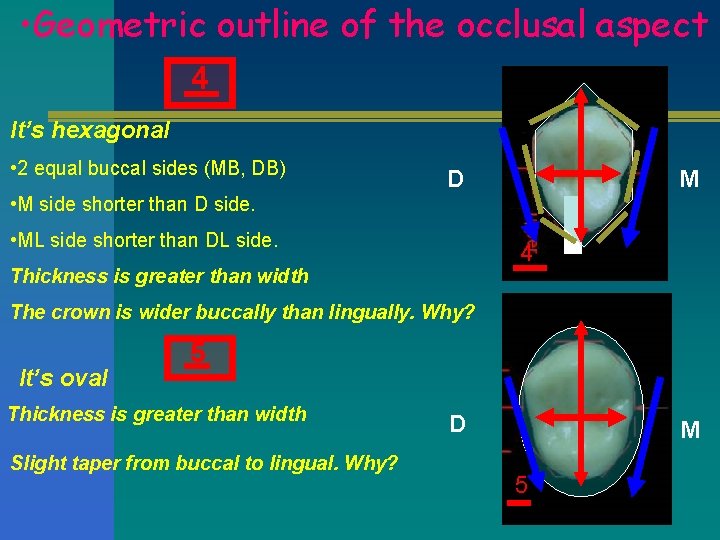
• Geometric outline of the occlusal aspect 4 It’s hexagonal • 2 equal buccal sides (MB, DB) • M side shorter than D side. D • ML side shorter than DL side. M 4 Thickness is greater than width The crown is wider buccally than lingually. Why? It’s oval 5 Thickness is greater than width Slight taper from buccal to lingual. Why? D M 5
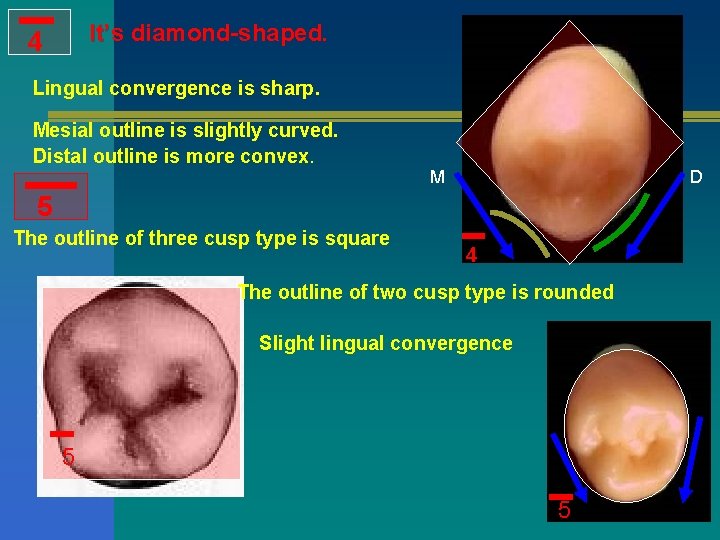
It’s diamond-shaped. 4 Lingual convergence is sharp. Mesial outline is slightly curved. Distal outline is more convex. M D 5 The outline of three cusp type is square 4 The outline of two cusp type is rounded Slight lingual convergence 5 5
- Slides: 80