
Preliminary Selection of Proposal for TRP 2008 2010


![TRP by Service Domain Target Actual [M€] 1 - Earth Observation 20. 0 27.](https://slidetodoc.com/presentation_image_h2/8cd27e6173a8a7e487441e45b8ea40e1/image-45.jpg "TRP by Service Domain Target Actual [M€] 1 - Earth Observation 20. 0 27.")
- Slides: 48
Preliminary Selection of Proposal for TRP 2008 -2010 CDTI Presentation - September 2007 1
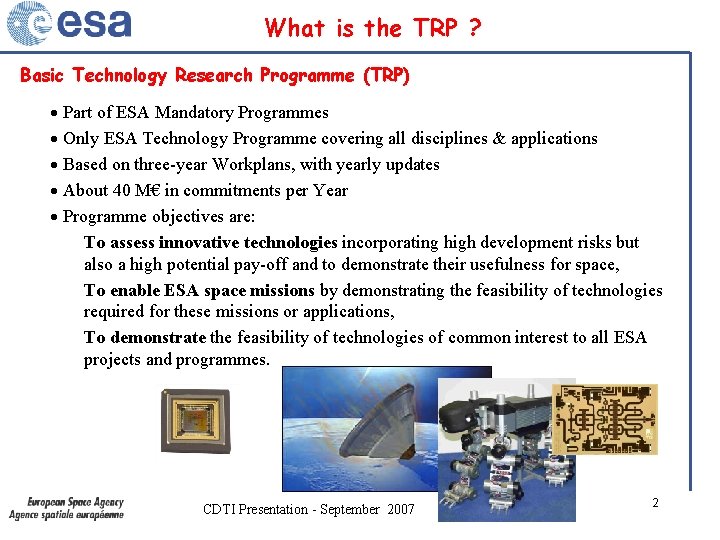
What is the TRP ? Basic Technology Research Programme (TRP) · Part of ESA Mandatory Programmes · Only ESA Technology Programme covering all disciplines & applications · Based on three-year Workplans, with yearly updates · About 40 M€ in commitments per Year · Programme objectives are: To assess innovative technologies incorporating high development risks but also a high potential pay-off and to demonstrate their usefulness for space, To enable ESA space missions by demonstrating the feasibility of technologies required for these missions or applications, To demonstrate the feasibility of technologies of common interest to all ESA projects and programmes. CDTI Presentation - September 2007 2
How is the TRP defined: E 2 E Process CDTI Presentation - September 2007 3
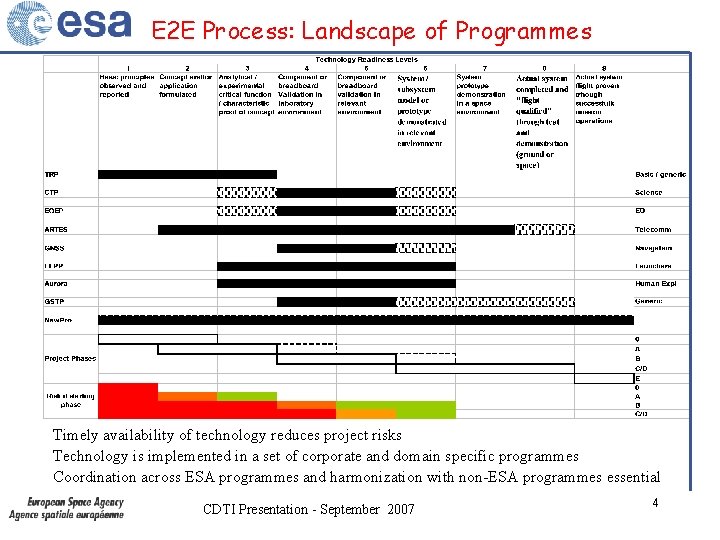
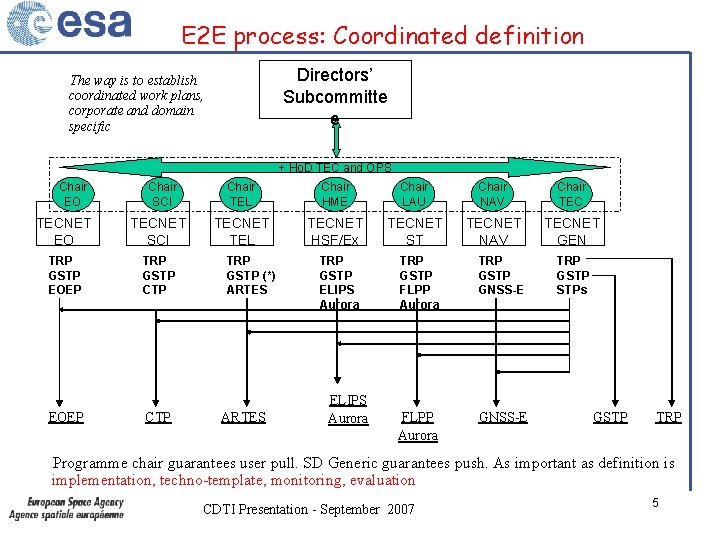
E 2 E Process: Landscape of Programmes Timely availability of technology reduces project risks Technology is implemented in a set of corporate and domain specific programmes Coordination across ESA programmes and harmonization with non-ESA programmes essential CDTI Presentation - September 2007 4
E 2 E process: Coordinated definition Directors’ Subcommitte e The way is to establish coordinated work plans, corporate and domain specific + Ho. D TEC and OPS Chair EO Chair SCI TECNET EO TECNET SCI TRP GSTP EOEP TRP GSTP CTP EOEP CTP Chair TEL Chair HME Chair LAU Chair NAV Chair TECNET TEL TECNET HSF/Ex TECNET ST TECNET NAV TECNET GEN TRP GSTP FLPP Aurora TRP GSTP GNSS-E FLPP Aurora GNSS-E TRP GSTP (*) ARTES TRP GSTP ELIPS Aurora TRP GSTP STPs GSTP TRP Programme chair guarantees user pull. SD Generic guarantees push. As important as definition is implementation, techno-template, monitoring, evaluation CDTI Presentation - September 2007 5
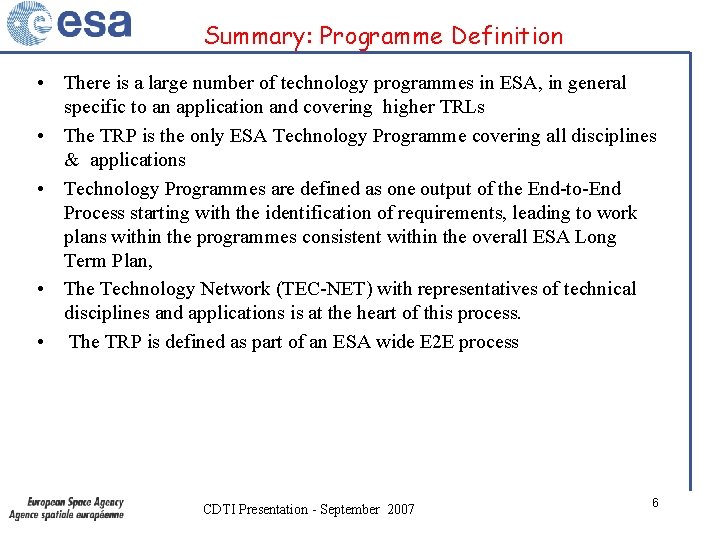
Summary: Programme Definition • There is a large number of technology programmes in ESA, in general specific to an application and covering higher TRLs • The TRP is the only ESA Technology Programme covering all disciplines & applications • Technology Programmes are defined as one output of the End-to-End Process starting with the identification of requirements, leading to work plans within the programmes consistent within the overall ESA Long Term Plan, • The Technology Network (TEC-NET) with representatives of technical disciplines and applications is at the heart of this process. • The TRP is defined as part of an ESA wide E 2 E process CDTI Presentation - September 2007 6
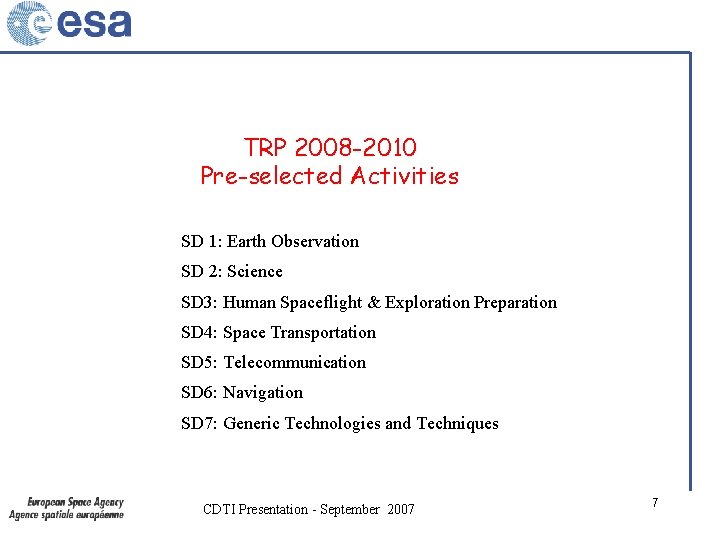
TRP 2008 -2010 Pre-selected Activities SD 1: Earth Observation SD 2: Science SD 3: Human Spaceflight & Exploration Preparation SD 4: Space Transportation SD 5: Telecommunication SD 6: Navigation SD 7: Generic Technologies and Techniques CDTI Presentation - September 2007 7
Service Domain 1: Earth Observation CDTI Presentation - September 2007 8
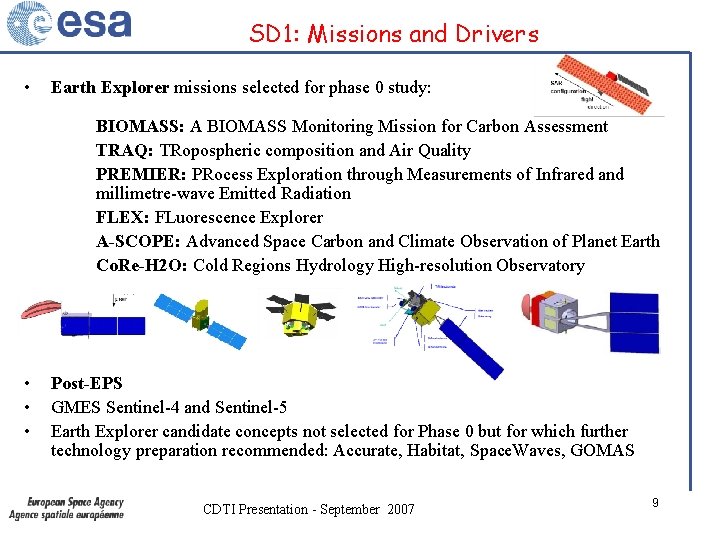
SD 1: Missions and Drivers • Earth Explorer missions selected for phase 0 study: BIOMASS: A BIOMASS Monitoring Mission for Carbon Assessment TRAQ: TRopospheric composition and Air Quality PREMIER: PRocess Exploration through Measurements of Infrared and millimetre-wave Emitted Radiation FLEX: FLuorescence Explorer A-SCOPE: Advanced Space Carbon and Climate Observation of Planet Earth Co. Re-H 2 O: Cold Regions Hydrology High-resolution Observatory • • • Post-EPS GMES Sentinel-4 and Sentinel-5 Earth Explorer candidate concepts not selected for Phase 0 but for which further technology preparation recommended: Accurate, Habitat, Space. Waves, GOMAS CDTI Presentation - September 2007 9
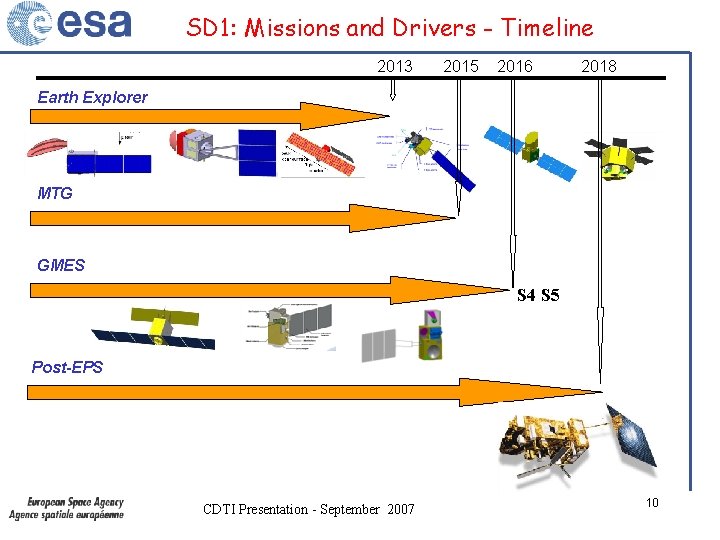
SD 1: Missions and Drivers - Timeline 2013 2015 2016 2018 Earth Explorer MTG GMES S 4 S 5 Post-EPS CDTI Presentation - September 2007 10
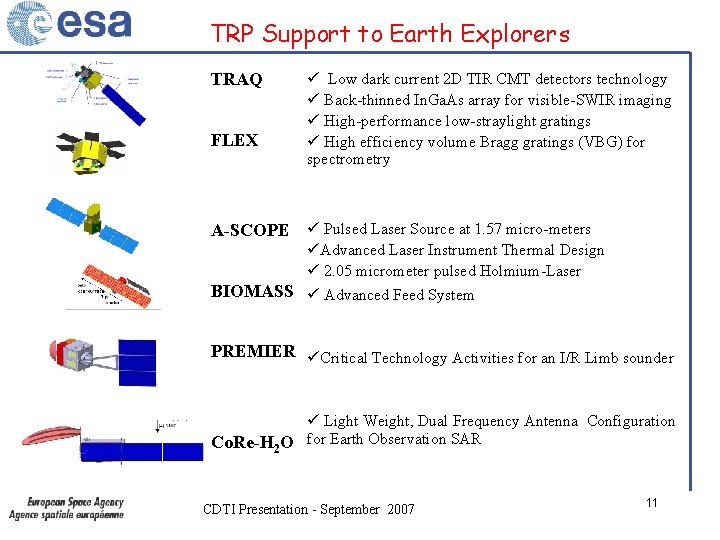
TRP Support to Earth Explorers TRAQ FLEX ü Low dark current 2 D TIR CMT detectors technology ü Back-thinned In. Ga. As array for visible-SWIR imaging ü High-performance low-straylight gratings ü High efficiency volume Bragg gratings (VBG) for spectrometry A-SCOPE ü Pulsed Laser Source at 1. 57 micro-meters üAdvanced Laser Instrument Thermal Design ü 2. 05 micrometer pulsed Holmium-Laser BIOMASS ü Advanced Feed System PREMIER üCritical Technology Activities for an I/R Limb sounder ü Light Weight, Dual Frequency Antenna Configuration Co. Re-H 2 O for Earth Observation SAR CDTI Presentation - September 2007 11
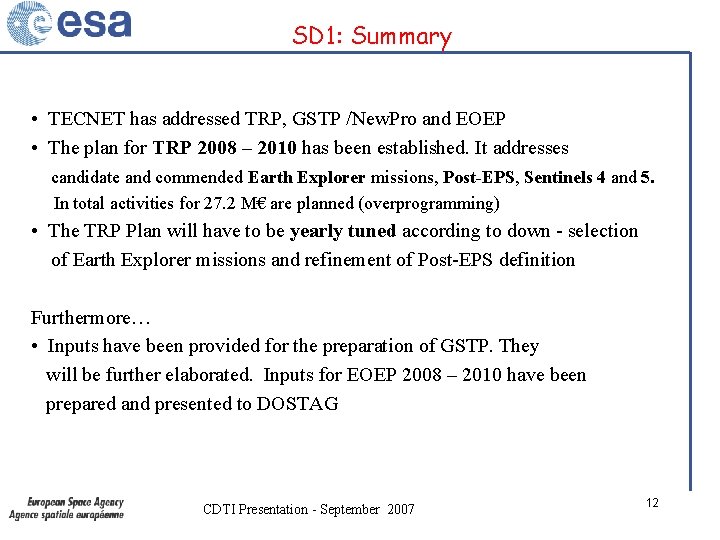
SD 1: Summary • TECNET has addressed TRP, GSTP /New. Pro and EOEP • The plan for TRP 2008 – 2010 has been established. It addresses candidate and commended Earth Explorer missions, Post-EPS, Sentinels 4 and 5. In total activities for 27. 2 M€ are planned (overprogramming) • The TRP Plan will have to be yearly tuned according to down - selection of Earth Explorer missions and refinement of Post-EPS definition Furthermore… • Inputs have been provided for the preparation of GSTP. They will be further elaborated. Inputs for EOEP 2008 – 2010 have been prepared and presented to DOSTAG CDTI Presentation - September 2007 12
Service Domain 2: Science CDTI Presentation - September 2007 13
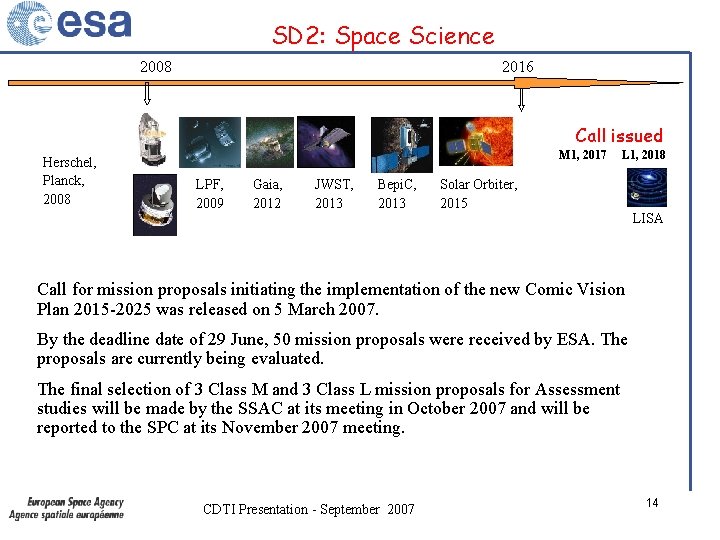
SD 2: Space Science 2008 2016 Call issued Herschel, Planck, 2008 M 1, 2017 LPF, 2009 Gaia, 2012 JWST, 2013 Bepi. C, 2013 L 1, 2018 Solar Orbiter, 2015 LISA Call for mission proposals initiating the implementation of the new Comic Vision Plan 2015 -2025 was released on 5 March 2007. By the deadline date of 29 June, 50 mission proposals were received by ESA. The proposals are currently being evaluated. The final selection of 3 Class M and 3 Class L mission proposals for Assessment studies will be made by the SSAC at its meeting in October 2007 and will be reported to the SPC at its November 2007 meeting. CDTI Presentation - September 2007 14
SD 2: Summary • A reserve has been allocated in the TRP 2008 – 2010 pending short-listing of candidates for next M and L class missions • Studies planned in CDF • Plans to be prepared in the beginning of 2008 for TRP/CTP/GSTP CDTI Presentation - September 2007 15
Service Domain 3: Human Space Flight & Exploration CDTI Presentation - September 2007 16
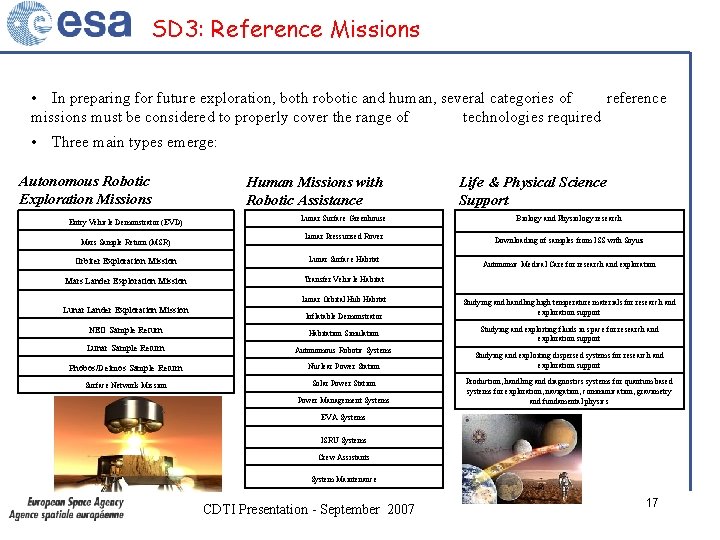
SD 3: Reference Missions • In preparing for future exploration, both robotic and human, several categories of reference missions must be considered to properly cover the range of technologies required • Three main types emerge: Autonomous Robotic Exploration Missions Entry Vehicle Demonstrator (EVD) Mars Sample Return (MSR) Human Missions with Robotic Assistance Lunar Surface Greenhouse Biology and Physiology research Lunar Pressurised Rover Downloading of samples from ISS with Soyuz Orbiter Exploration Mission Lunar Surface Habitat Mars Lander Exploration Mission Transfer Vehicle Habitat Lunar Orbital Hub Habitat Lunar Lander Exploration Mission Life & Physical Science Support Inflatable Demonstrator NEO Sample Return Habitation Simulation Lunar Sample Return Autonomous Robotic Systems Phobos/Deimos Sample Return Nuclear Power Station Surface Network Mission Solar Power Station Power Management Systems Autonomic Medical Care for research and exploration Studying and handling high temperature materials for research and exploration support Studying and exploiting fluids in space for research and exploration support Studying and exploiting dispersed systems for research and exploration support Production, handling and diagnostics systems for quantum based systems for exploration, navigation, communication, gravimetry and fundamental physics EVA Systems ISRU Systems Crew Assistants System Maintenance CDTI Presentation - September 2007 17
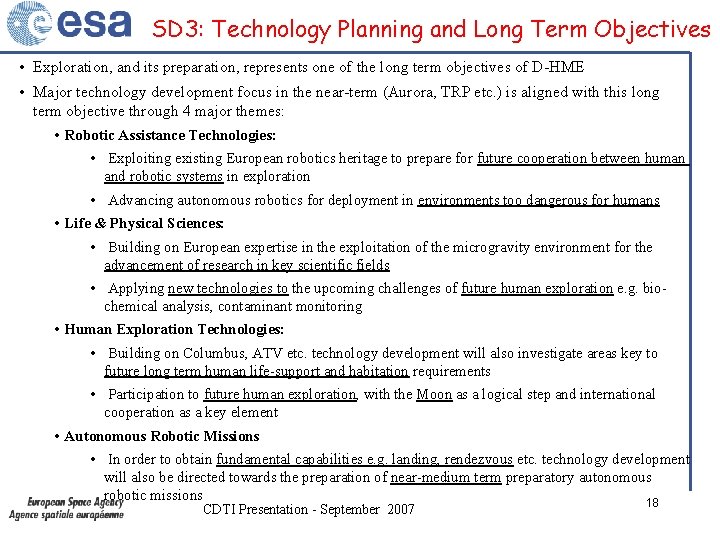
SD 3: Technology Planning and Long Term Objectives • Exploration, and its preparation, represents one of the long term objectives of D-HME • Major technology development focus in the near-term (Aurora, TRP etc. ) is aligned with this long term objective through 4 major themes: • Robotic Assistance Technologies: • Exploiting existing European robotics heritage to prepare for future cooperation between human and robotic systems in exploration • Advancing autonomous robotics for deployment in environments too dangerous for humans • Life & Physical Sciences: • Building on European expertise in the exploitation of the microgravity environment for the advancement of research in key scientific fields • Applying new technologies to the upcoming challenges of future human exploration e. g. biochemical analysis, contaminant monitoring • Human Exploration Technologies: • Building on Columbus, ATV etc. technology development will also investigate areas key to future long term human life-support and habitation requirements • Participation to future human exploration, with the Moon as a logical step and international cooperation as a key element • Autonomous Robotic Missions • In order to obtain fundamental capabilities e. g. landing, rendezvous etc. technology development will also be directed towards the preparation of near-medium term preparatory autonomous robotic missions 18 CDTI Presentation - September 2007
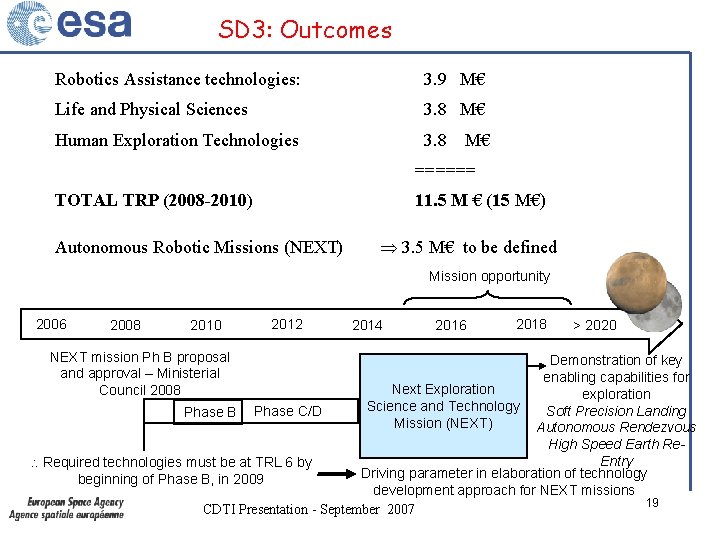
SD 3: Outcomes Robotics Assistance technologies: 3. 9 M€ Life and Physical Sciences 3. 8 M€ Human Exploration Technologies 3. 8 M€ ====== TOTAL TRP (2008 -2010) 11. 5 M € (15 M€) Autonomous Robotic Missions (NEXT) 3. 5 M€ to be defined Mission opportunity 2006 2008 2010 NEXT mission Ph B proposal and approval – Ministerial Council 2008 2012 2014 2016 2018 > 2020 Demonstration of key enabling capabilities for Next Exploration exploration Science and Technology Soft Precision Landing Phase B Phase C/D Mission (NEXT) Autonomous Rendezvous High Speed Earth Re. Entry Required technologies must be at TRL 6 by Driving parameter in elaboration of technology beginning of Phase B, in 2009 development approach for NEXT missions 19 CDTI Presentation - September 2007
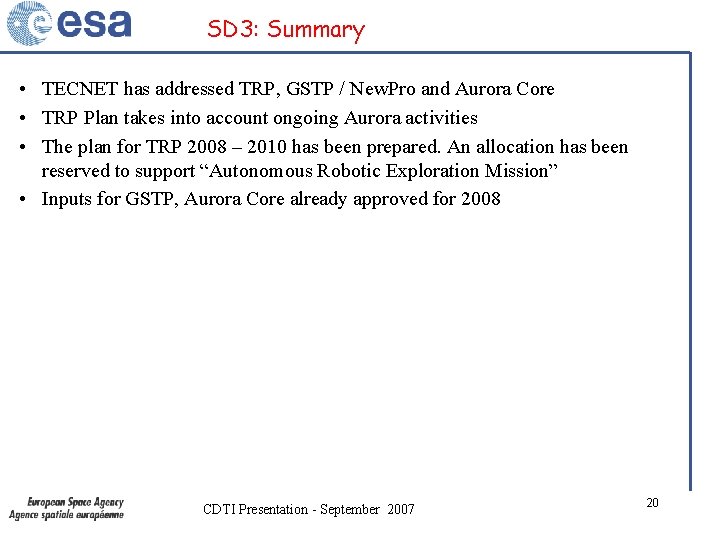
SD 3: Summary • TECNET has addressed TRP, GSTP / New. Pro and Aurora Core • TRP Plan takes into account ongoing Aurora activities • The plan for TRP 2008 – 2010 has been prepared. An allocation has been reserved to support “Autonomous Robotic Exploration Mission” • Inputs for GSTP, Aurora Core already approved for 2008 CDTI Presentation - September 2007 20
Service Domain 4 Space Transportation CDTI Presentation - September 2007 21
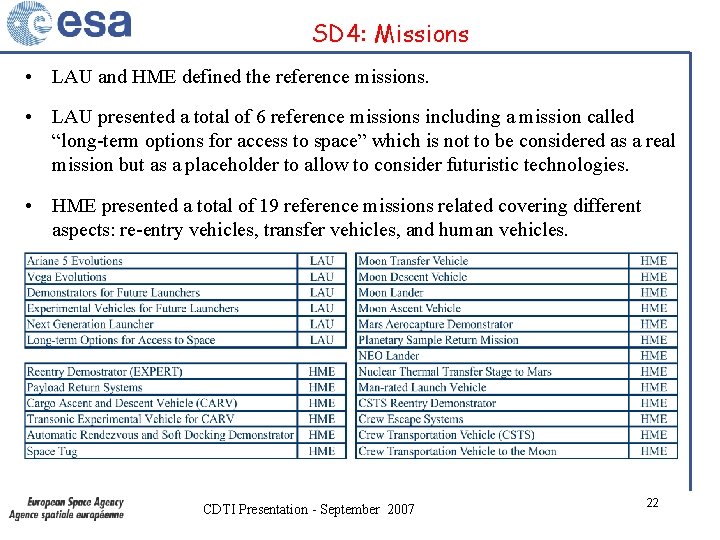
SD 4: Missions • LAU and HME defined the reference missions. • LAU presented a total of 6 reference missions including a mission called “long-term options for access to space” which is not to be considered as a real mission but as a placeholder to allow to consider futuristic technologies. • HME presented a total of 19 reference missions related covering different aspects: re-entry vehicles, transfer vehicles, and human vehicles. CDTI Presentation - September 2007 22
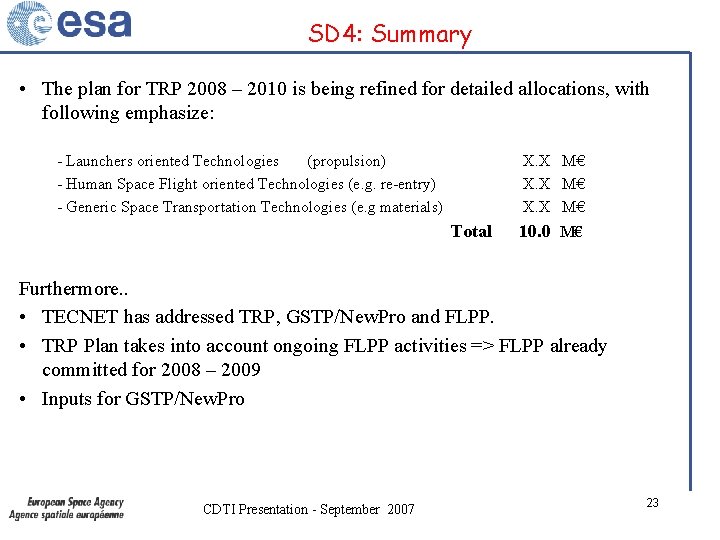
SD 4: Summary • The plan for TRP 2008 – 2010 is being refined for detailed allocations, with following emphasize: - Launchers oriented Technologies (propulsion) - Human Space Flight oriented Technologies (e. g. re-entry) - Generic Space Transportation Technologies (e. g materials) X. X M€ Total 10. 0 M€ Furthermore. . • TECNET has addressed TRP, GSTP/New. Pro and FLPP. • TRP Plan takes into account ongoing FLPP activities => FLPP already committed for 2008 – 2009 • Inputs for GSTP/New. Pro CDTI Presentation - September 2007 23
Service Domain 5 Telecommunication CDTI Presentation - September 2007 24
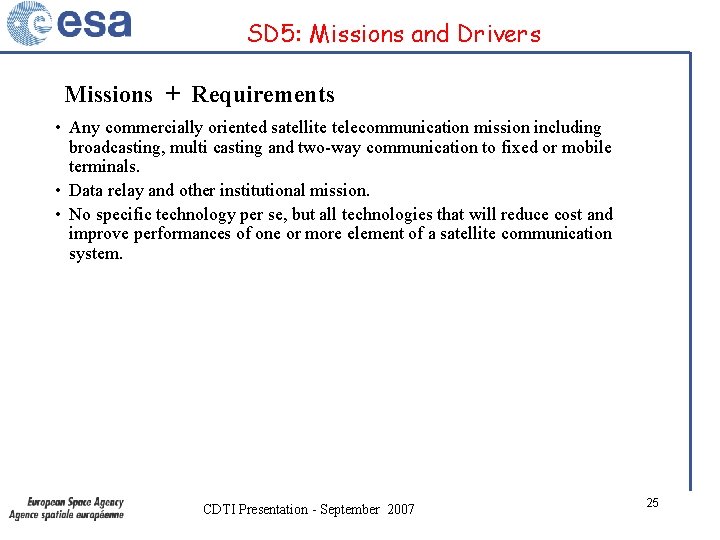
SD 5: Missions and Drivers Missions + Requirements • Any commercially oriented satellite telecommunication mission including broadcasting, multi casting and two-way communication to fixed or mobile terminals. • Data relay and other institutional mission. • No specific technology per se, but all technologies that will reduce cost and improve performances of one or more element of a satellite communication system. CDTI Presentation - September 2007 25
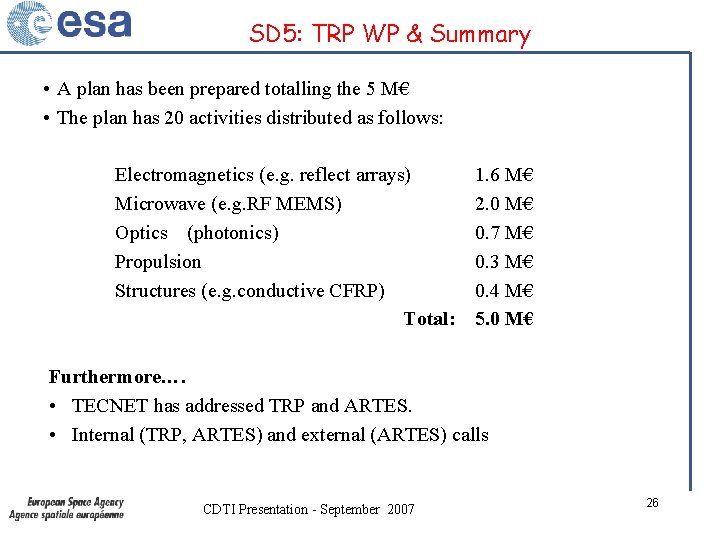
SD 5: TRP WP & Summary • A plan has been prepared totalling the 5 M€ • The plan has 20 activities distributed as follows: Electromagnetics (e. g. reflect arrays) Microwave (e. g. RF MEMS) Optics (photonics) Propulsion Structures (e. g. conductive CFRP) Total: 1. 6 M€ 2. 0 M€ 0. 7 M€ 0. 3 M€ 0. 4 M€ 5. 0 M€ Furthermore…. • TECNET has addressed TRP and ARTES. • Internal (TRP, ARTES) and external (ARTES) calls CDTI Presentation - September 2007 26
Service Domain 6: Navigation CDTI Presentation - September 2007 27
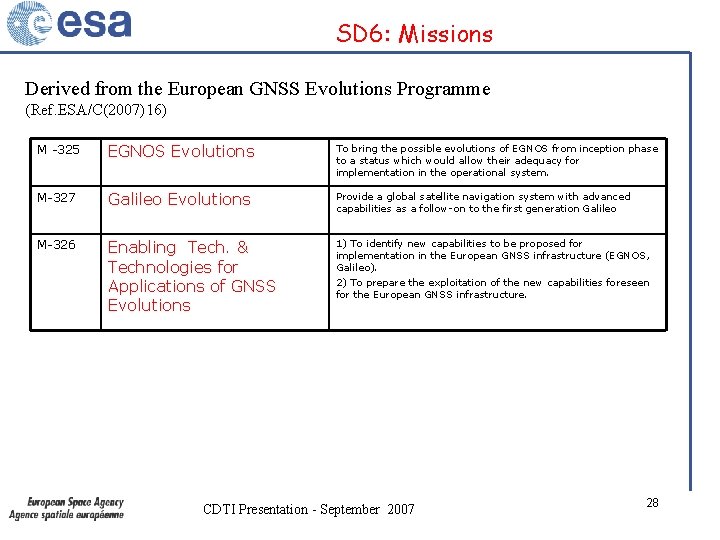
SD 6: Missions Derived from the European GNSS Evolutions Programme (Ref. ESA/C(2007)16) M -325 EGNOS Evolutions To bring the possible evolutions of EGNOS from inception phase to a status which would allow their adequacy for implementation in the operational system. M-327 Galileo Evolutions Provide a global satellite navigation system with advanced capabilities as a follow-on to the first generation Galileo M-326 Enabling Tech. & Technologies for Applications of GNSS Evolutions 1) To identify new capabilities to be proposed for implementation in the European GNSS infrastructure (EGNOS, Galileo). 2) To prepare the exploitation of the new capabilities foreseen for the European GNSS infrastructure. CDTI Presentation - September 2007 28
SD 6: TRP WP & Summary • TECNET has addressed TRP and GNSS Evolution. • Big uncertainty in evolution of all GNSS activities: EGNOS, Galileo, GNN Evolution => Staged approach => Only TRP 2008 prepared in detail : 2. 9 M€ • Reserve for 2009 – 2010 to be allocated when situation more clear CDTI Presentation - September 2007 29
Service Domain 7 : Generic Technologies CDTI Presentation - September 2007 30
Generic Technologies: Theme • The domain of Generic Technologies includes technology developments required by several service domains, e. g. Exploration, Earth Observation and Space Science as well as basic technologies. • Drivers are: - Programme driven multi-domain technology, e. g. platform technology - Technology potential enabling ambitious objectives in the long-term • Technology potential, should be organized so that it increases performance and reduces costs drastically, and assures European non-dependence. • Generic Technologies are summarized in ESTER (D 0) as Generic Missions: - Enabling ESA Missions - Industrial Competitiveness - Innovation - Non-dependence CDTI Presentation - September 2007 31
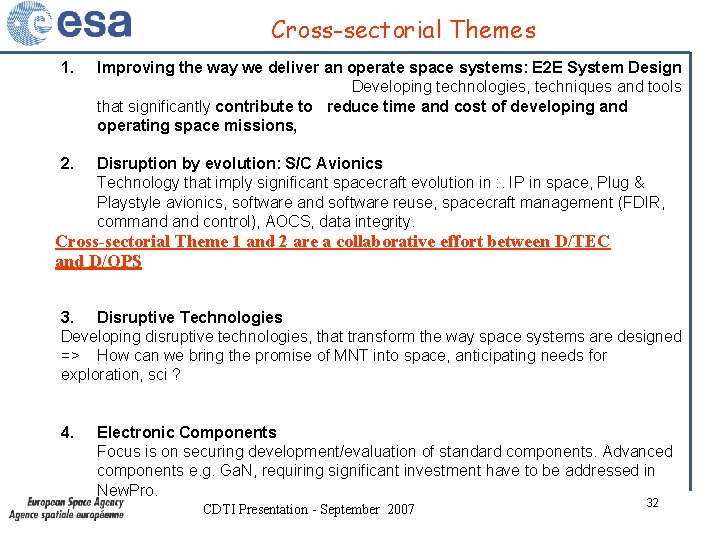
Cross-sectorial Themes 1. Improving the way we deliver an operate space systems: E 2 E System Design Developing technologies, techniques and tools that significantly contribute to reduce time and cost of developing and operating space missions, 2. Disruption by evolution: S/C Avionics Technology that imply significant spacecraft evolution in : . IP in space, Plug & Playstyle avionics, software and software reuse, spacecraft management (FDIR, command control), AOCS, data integrity. Cross-sectorial Theme 1 and 2 are a collaborative effort between D/TEC and D/OPS 3. Disruptive Technologies Developing disruptive technologies, that transform the way space systems are designed => How can we bring the promise of MNT into space, anticipating needs for exploration, sci ? 4. Electronic Components Focus is on securing development/evaluation of standard components. Advanced components e. g. Ga. N, requiring significant investment have to be addressed in New. Pro. CDTI Presentation - September 2007 32
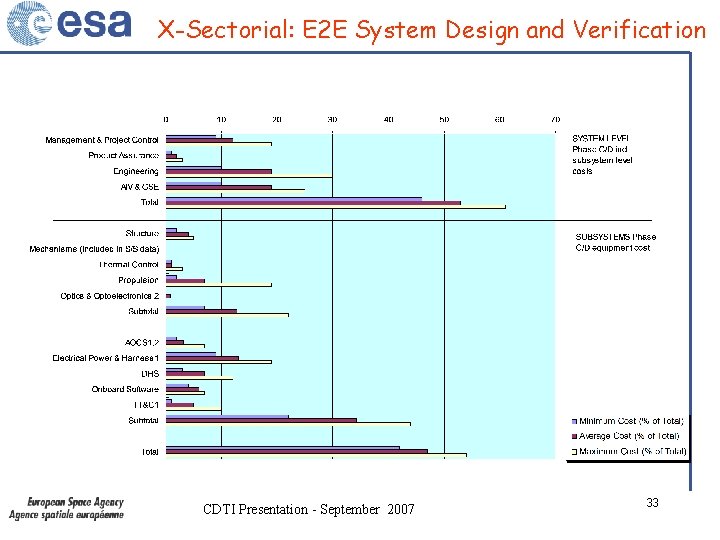
X-Sectorial: E 2 E System Design and Verification CDTI Presentation - September 2007 33
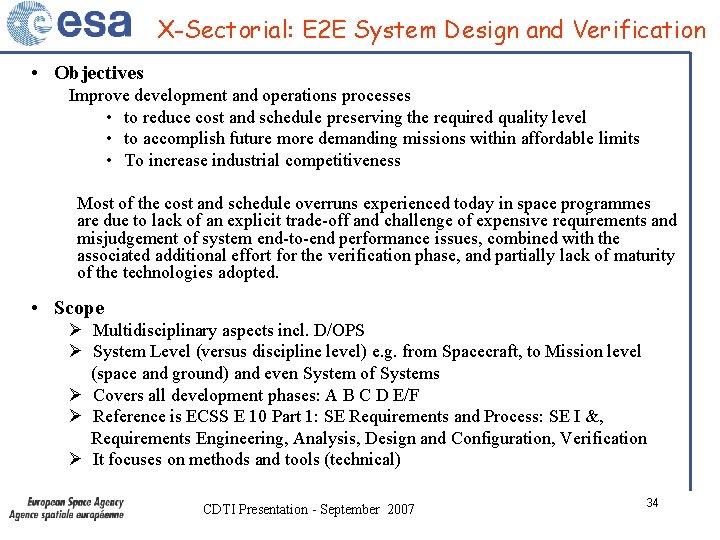
X-Sectorial: E 2 E System Design and Verification • Objectives Improve development and operations processes • to reduce cost and schedule preserving the required quality level • to accomplish future more demanding missions within affordable limits • To increase industrial competitiveness Most of the cost and schedule overruns experienced today in space programmes are due to lack of an explicit trade-off and challenge of expensive requirements and misjudgement of system end-to-end performance issues, combined with the associated additional effort for the verification phase, and partially lack of maturity of the technologies adopted. • Scope Ø Multidisciplinary aspects incl. D/OPS Ø System Level (versus discipline level) e. g. from Spacecraft, to Mission level (space and ground) and even System of Systems Ø Covers all development phases: A B C D E/F Ø Reference is ECSS E 10 Part 1: SE Requirements and Process: SE I &, Requirements Engineering, Analysis, Design and Configuration, Verification Ø It focuses on methods and tools (technical) CDTI Presentation - September 2007 34
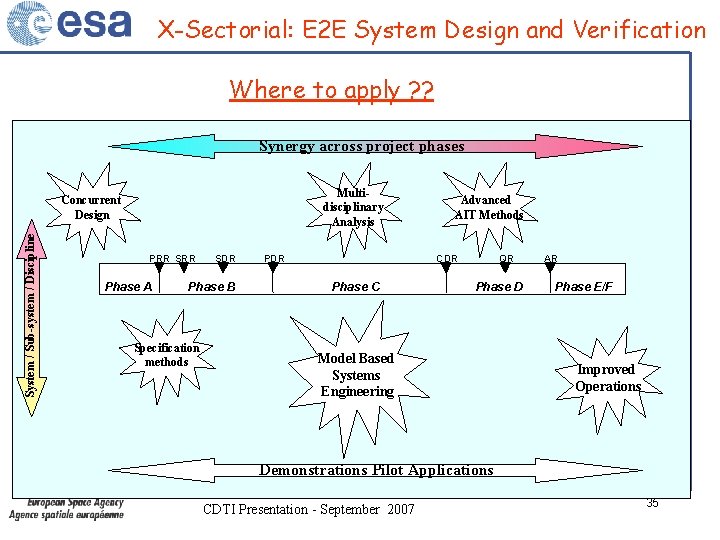
X-Sectorial: E 2 E System Design and Verification Where to apply ? ? Synergy across project phases Multidisciplinary Analysis System / Sub-system / Discipline Concurrent Design PRR SRR Phase A SDR Phase B Specification methods PDR Advanced AIT Methods CDR Phase C QR Phase D Model Based Systems Engineering AR Phase E/F Improved Operations Demonstrations Pilot Applications CDTI Presentation - September 2007 35
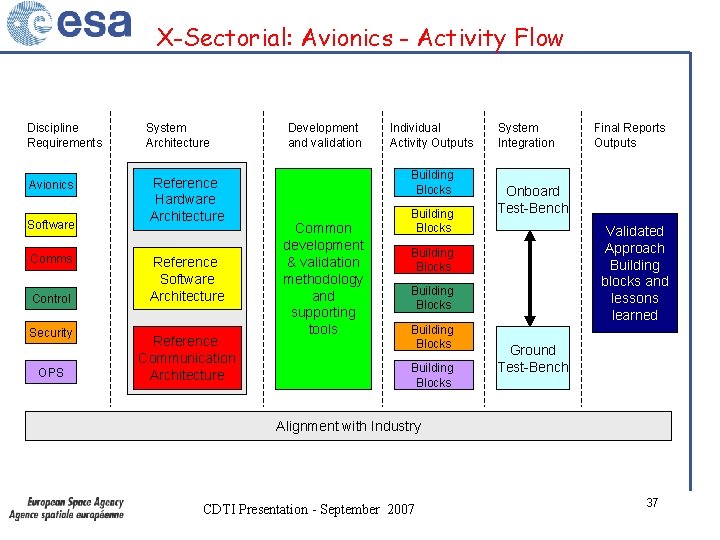
X-Sectorial: Avionics - Objectives Main Objective : Reduction of the development timeframe/cost for Avionics Data and Control Systems • Triggered by the NASA ‘ 6 day Spacecraft’ but tuned to realistic expectations for reducing the definition, design and validation of an Avionics Data and Control system: Ø Derivation of common architectures and pre-validated building blocks; use of common tools for development, validation and operations Ø Improved End-to-end view for protocols and tools, supported by inter-centre test-bedding Ø System level investigation of emerging requirements and techniques for Security, FDIR and Autonomy Ø Composition of a system from building blocks including generation of application SW and unit level validation (6 Months) CDTI Presentation - September 2007 36
X-Sectorial: Avionics - Activity Flow Discipline Requirements Avionics Software Comms Control Security OPS System Architecture Reference Hardware Architecture Reference Software Architecture Reference Communication Architecture Development and validation Individual Activity Outputs Building Blocks Common development & validation methodology and supporting tools Building Blocks System Integration Onboard Test-Bench Validated Approach Building blocks and lessons learned Building Blocks Final Reports Outputs Ground Test-Bench Alignment with Industry CDTI Presentation - September 2007 37
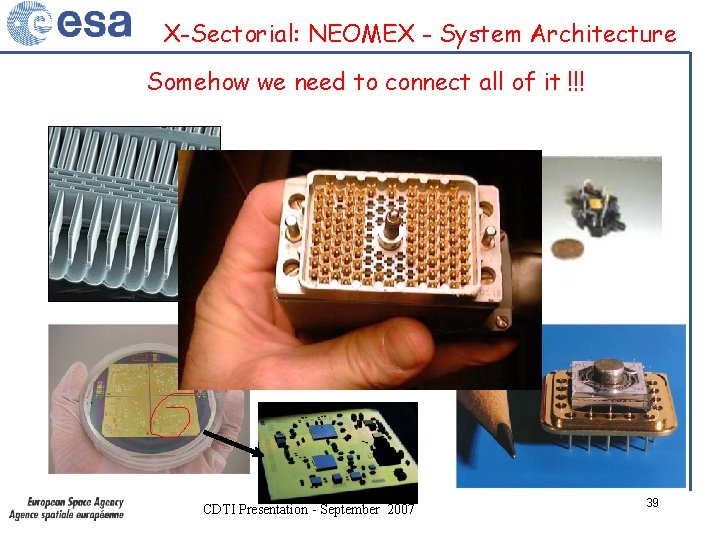
X-Sectorial: NEOMEX • Objective: To perform close-up scientific investigations on several sites on a Near Earth Object. • Constraints: Extreme mass-limitation, 5 kg platform, 2 -4 kg payload of 10 -15 W • Challenge: use microsystems integrated in a system to gain performance with respect to mass. NEOMEx will demonstrate all critical functions of a S/C in an integrated manner CDTI Presentation - September 2007 38
X-Sectorial: NEOMEX - System Architecture Somehow we need to connect all of it !!! CDTI Presentation - September 2007 39
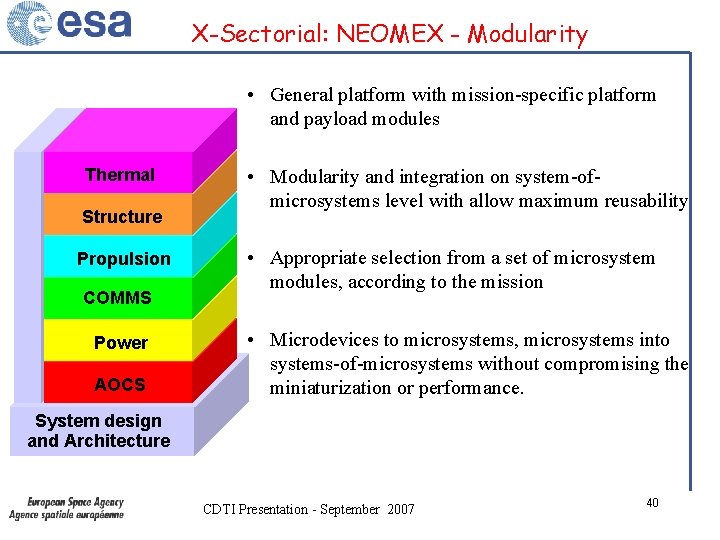
X-Sectorial: NEOMEX - Modularity • General platform with mission-specific platform and payload modules Thermal Structure Propulsion COMMS Power AOCS • Modularity and integration on system-ofmicrosystems level with allow maximum reusability • Appropriate selection from a set of microsystem modules, according to the mission • Microdevices to microsystems, microsystems into systems-of-microsystems without compromising the miniaturization or performance. System design and Architecture CDTI Presentation - September 2007 40
X-Sectorial: Electronic Components - Elements • Hybrid and Micropackaging Technologies Advancing the capabilities the industrial base for the ESA projects • Silicon based Component Issues: Technical usage and risk management Support studies for larger TRP activities • Radiation Effects Facilitating Radiation Testing under TRP/GSTP and other programmes Radiation Test implementation for studies, characterisation and evaluation • Passives Strengthen the European technology base on passives solutions for mission needs • RF/Microwave Strengthen the Ga. As industries, provide technologies/ solutions to the projects. Support to main Ga. N • Optoelectronics Provide generic solutions to generic problems: identify where there is scope to evaluate and qualify (traditionally a one off approach) • MNT Broad approach based on dossier priorities CDTI Presentation - September 2007 41
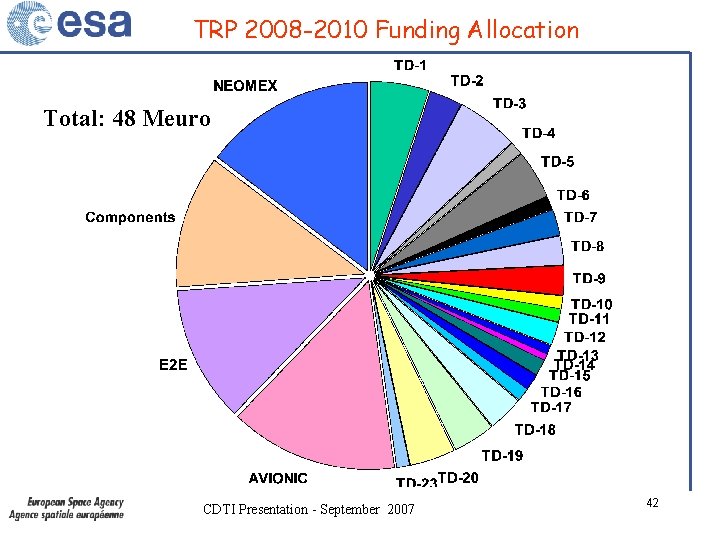
TRP 2008 -2010 Funding Allocation Total: 48 Meuro CDTI Presentation - September 2007 42
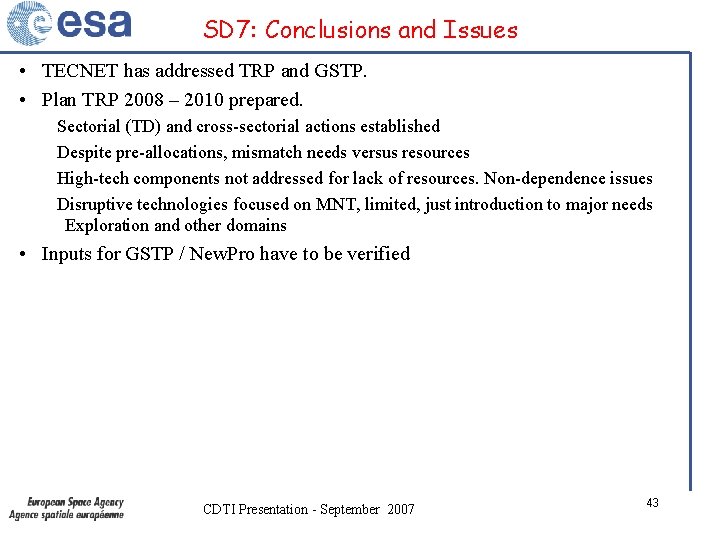
SD 7: Conclusions and Issues • TECNET has addressed TRP and GSTP. • Plan TRP 2008 – 2010 prepared. Sectorial (TD) and cross-sectorial actions established Despite pre-allocations, mismatch needs versus resources High-tech components not addressed for lack of resources. Non-dependence issues Disruptive technologies focused on MNT, limited, just introduction to major needs Exploration and other domains • Inputs for GSTP / New. Pro have to be verified CDTI Presentation - September 2007 43
TRPWorkplan Overview CDTI Presentation - September 2007 44
TRP by Service Domain Target Actual [M€] 1 - Earth Observation 20. 0 27. 21 2 - Science 20. 0 -2 3 - Human Spaceflight and Exploration Preparation 15. 0 11. 53 4 - Space Transportation 10. 0 X. X 4 5 - Telecommunications 5. 0 5. 3 6 - Navigation 5. 0 2. 95 7 - Generic Technology & Techniques 47. 0 47. 7 Total 120. 0 110. 8 Overprogramming to be aligned after downselection of Explorer Candidate Missions 2 TRP CTP will be defined beginning of 2008 3 3. 5 M€ are reserved for NEXT 4 Being Refined 5 Activities for 2008 only 1 CDTI Presentation - September 2007 45
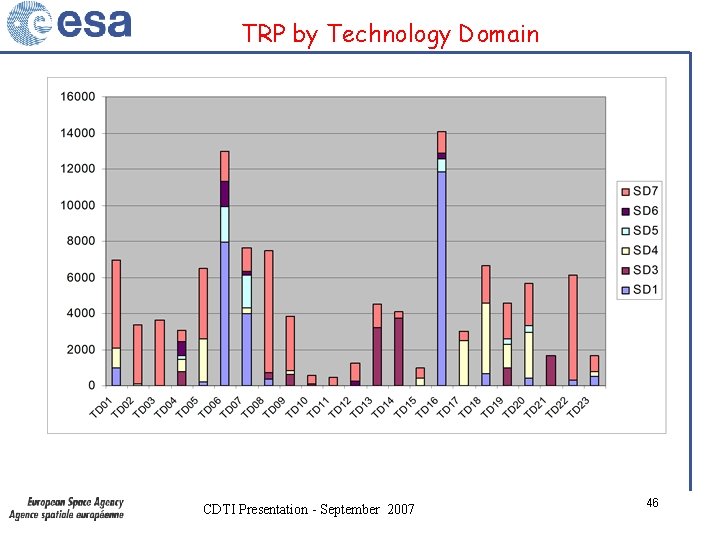
TRP by Technology Domain CDTI Presentation - September 2007 46
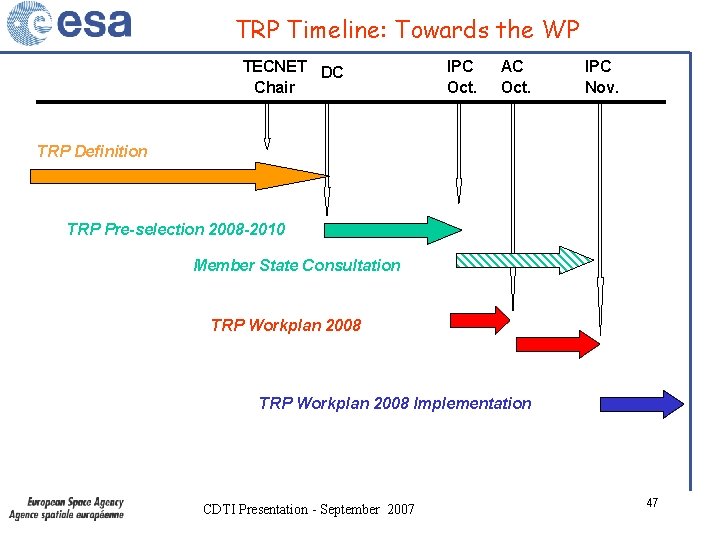
TRP Timeline: Towards the WP TECNET DC Chair IPC Oct. AC Oct. IPC Nov. TRP Definition TRP Pre-selection 2008 -2010 Member State Consultation TRP Workplan 2008 Implementation CDTI Presentation - September 2007 47
TRP Conclusions • • The plan 2008 – 2010 has been prepared with intervention of all stakeholders Budgetary Boundaries have been generally respected There is significant lack of resources in all domains There is in particular lack of resources for disruptive innovation, e. g. MNT, and advanced components, processors, FPGA, DSM, etc • The plan TRP 2008 – 2010 is ready for endorsement by IPC CDTI Presentation - September 2007 48