
Preliminary results from the cryogenic pulsed dc system
- Slides: 17
Preliminary results from the cryogenic pulsed dc system M. Jacewicz, J. Eriksson, R. Ruber FREIA Laboratory, Uppsala University and I. Profatilova, S. Calatroni, W. Wuensch CERN 1 High Gradient 2019, 10 -14/06/2019
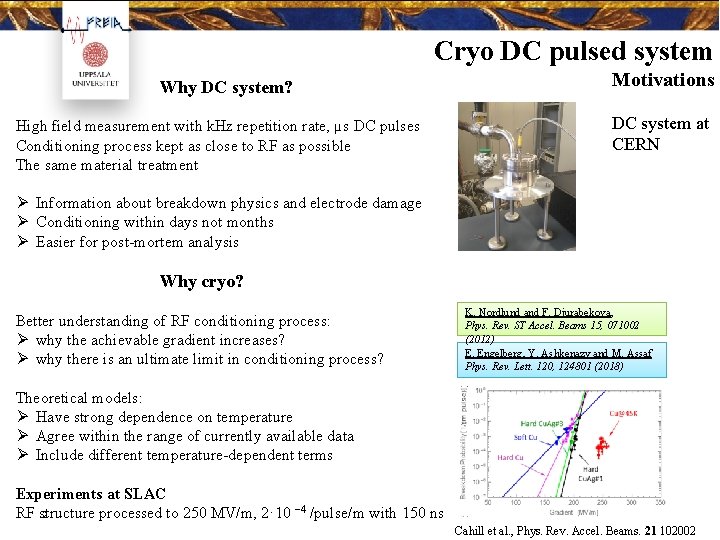
Cryo DC pulsed system Why DC system? High field measurement with k. Hz repetition rate, µs DC pulses Conditioning process kept as close to RF as possible The same material treatment Motivations DC system at CERN Ø Information about breakdown physics and electrode damage Ø Conditioning within days not months Ø Easier for post-mortem analysis Why cryo? Better understanding of RF conditioning process: Ø why the achievable gradient increases? Ø why there is an ultimate limit in conditioning process? K. Nordlund and F. Djurabekova, Phys. Rev. ST Accel. Beams 15, 071002 (2012) E. Engelberg, Y. Ashkenazy and M. Assaf Phys. Rev. Lett. 120, 124801 (2018) Theoretical models: Ø Have strong dependence on temperature Ø Agree within the range of currently available data Ø Include different temperature-dependent terms Experiments at SLAC RF structure processed to 250 MV/m, 2· 10 − 4 /pulse/m with 150 ns 2 Cahill et al. , Phys. Rev. Accel. Beams. 21 102002
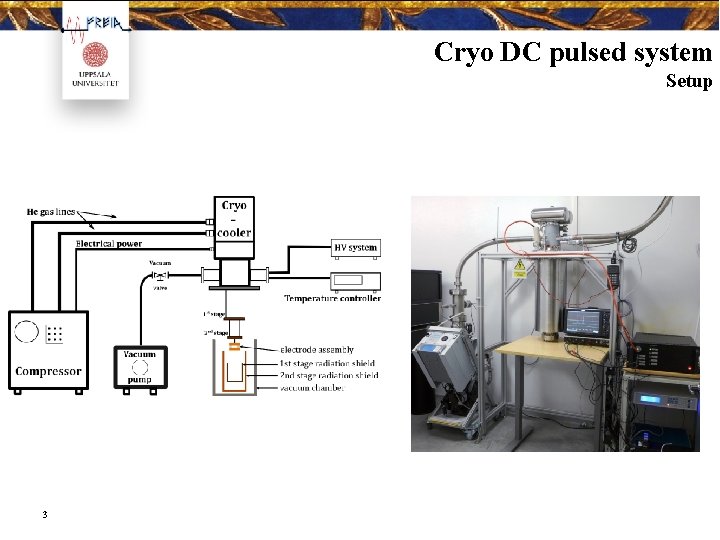
Cryo DC pulsed system Setup 3
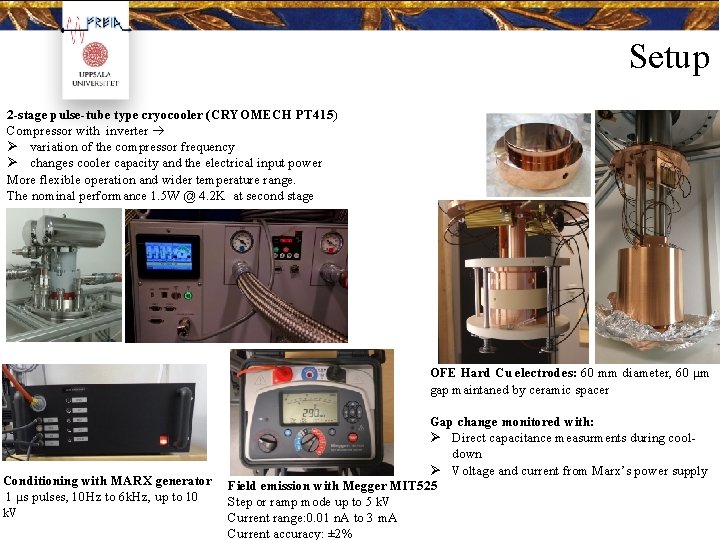
Setup 2 -stage pulse-tube type cryocooler (CRYOMECH PT 415) Compressor with inverter Ø variation of the compressor frequency Ø changes cooler capacity and the electrical input power More flexible operation and wider temperature range. The nominal performance 1. 5 W @ 4. 2 K at second stage OFE Hard Cu electrodes: 60 mm diameter, 60 μm gap maintaned by ceramic spacer Conditioning with MARX generator 1 μs pulses, 10 Hz to 6 k. Hz, up to 10 k. V Gap change monitored with: Ø Direct capacitance measurments during cooldown Ø Voltage and current from Marx’s power supply Field emission with Megger MIT 525 Step or ramp mode up to 5 k. V Current range: 0. 01 n. A to 3 m. A Current accuracy: ± 2%
Setup in operation since March, preliminary results
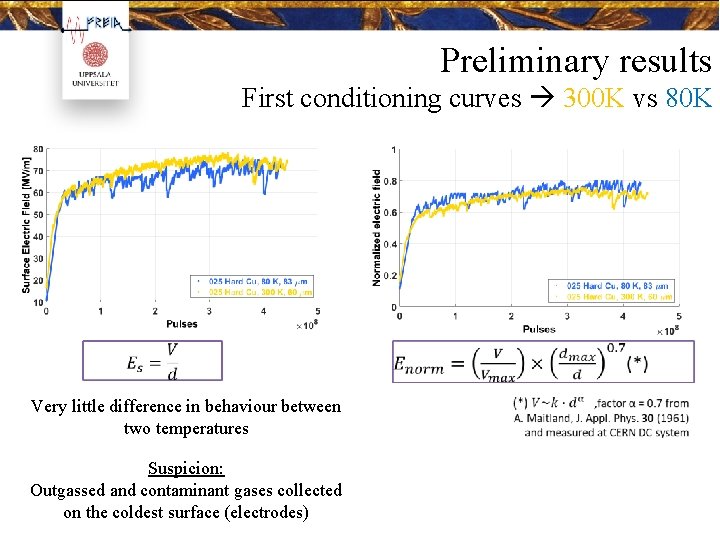
Preliminary results First conditioning curves 300 K vs 80 K Very little difference in behaviour between two temperatures Suspicion: Outgassed and contaminant gases collected on the coldest surface (electrodes)
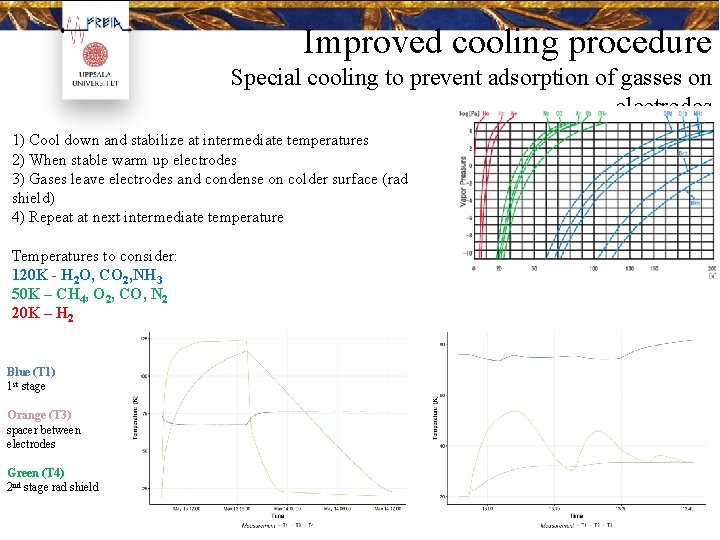
Improved cooling procedure Special cooling to prevent adsorption of gasses on electrodes 1) Cool down and stabilize at intermediate temperatures 2) When stable warm up electrodes 3) Gases leave electrodes and condense on colder surface (rad shield) 4) Repeat at next intermediate temperature Temperatures to consider: 120 K - H 2 O, CO 2, NH 3 50 K – CH 4, O 2, CO, N 2 20 K – H 2 Blue (T 1) 1 st stage Orange (T 3) spacer between electrodes Green (T 4) 2 nd stage rad shield
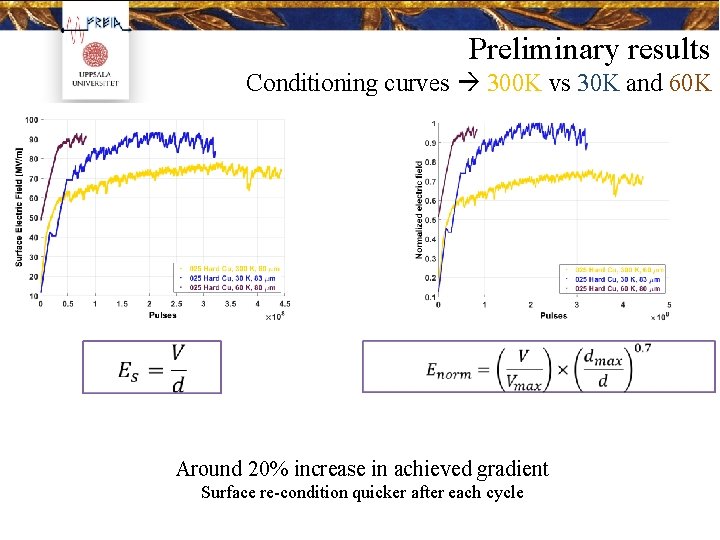
Preliminary results Conditioning curves 300 K vs 30 K and 60 K Around 20% increase in achieved gradient Surface re-condition quicker after each cycle
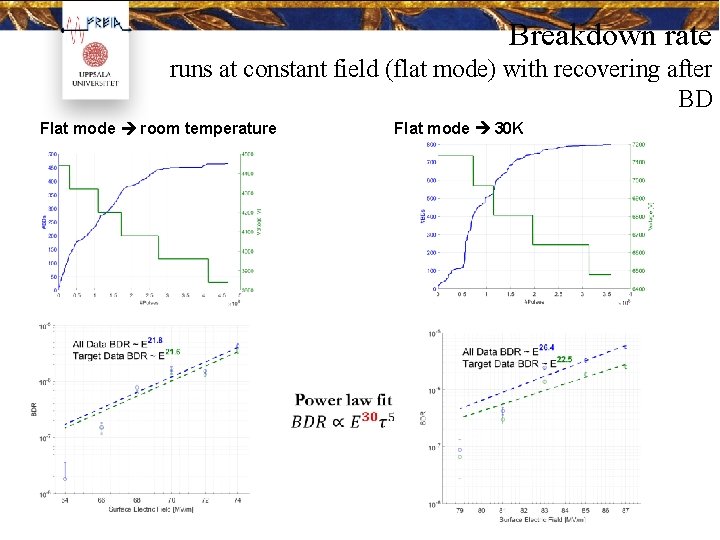
Breakdown rate runs at constant field (flat mode) with recovering after BD Flat mode 30 K Flat mode room temperature
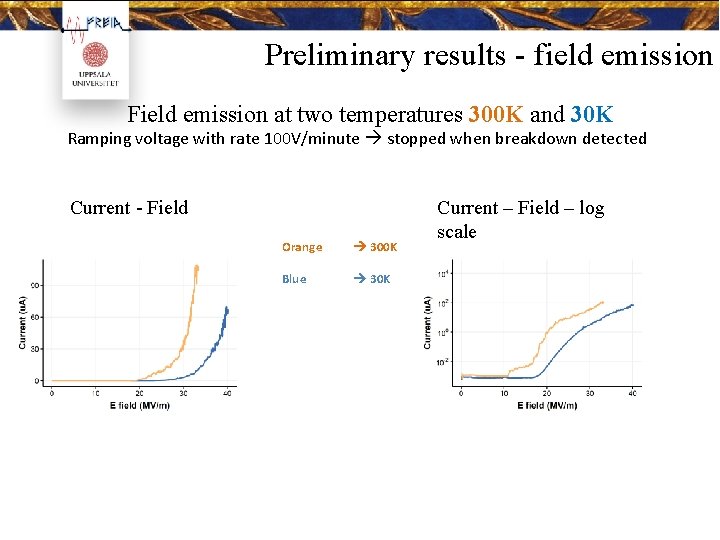
Preliminary results - field emission Field emission at two temperatures 300 K and 30 K Ramping voltage with rate 100 V/minute stopped when breakdown detected Current - Field Orange 300 K Blue 30 K Current – Field – log scale
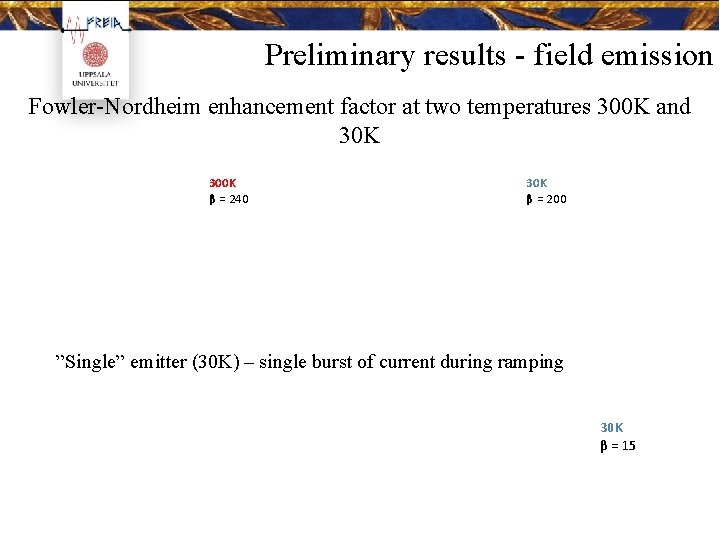
Preliminary results - field emission Fowler-Nordheim enhancement factor at two temperatures 300 K and 30 K 300 K β = 240 30 K β = 200 ”Single” emitter (30 K) – single burst of current during ramping 30 K β = 15
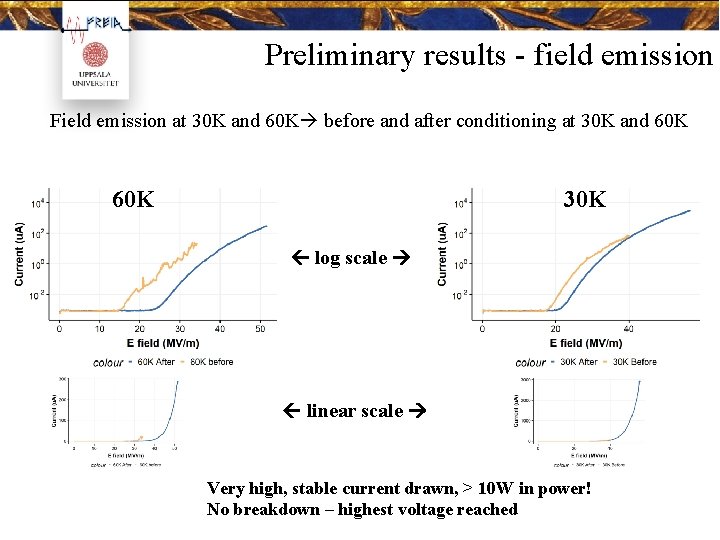
Preliminary results - field emission Field emission at 30 K and 60 K before and after conditioning at 30 K and 60 K 30 K log scale linear scale Very high, stable current drawn, > 10 W in power! No breakdown – highest voltage reached
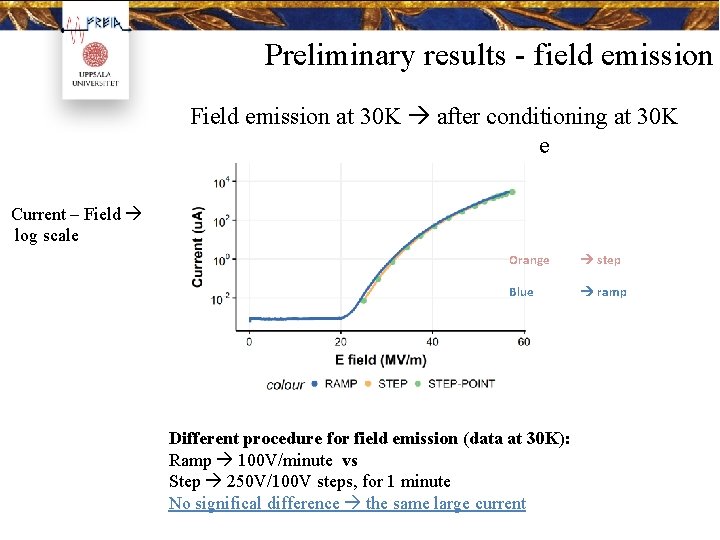
Preliminary results - field emission Field emission at 30 K after conditioning at 30 K Ramp vs step procedure Current – Field log scale Orange step Blue ramp Different procedure for field emission (data at 30 K): Ramp 100 V/minute vs Step 250 V/100 V steps, for 1 minute No significal difference the same large current
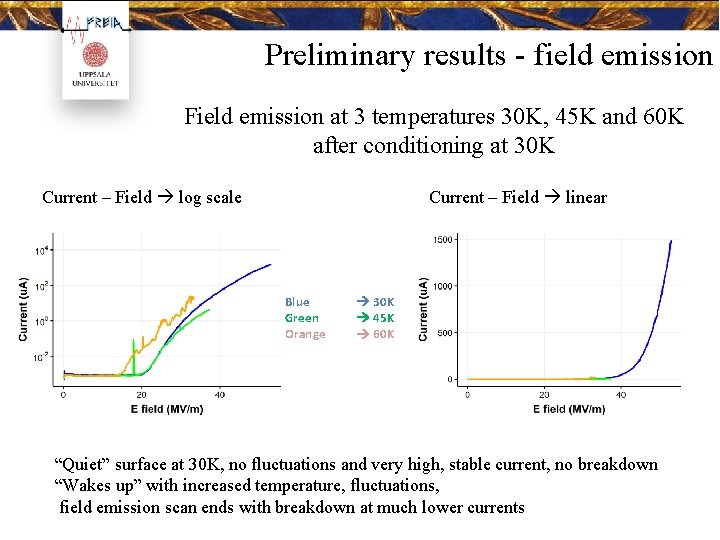
Preliminary results - field emission Field emission at 3 temperatures 30 K, 45 K and 60 K after conditioning at 30 K Current – Field log scale Current – Field linear scale Blue Green Orange 30 K 45 K 60 K “Quiet” surface at 30 K, no fluctuations and very high, stable current, no breakdown “Wakes up” with increased temperature, fluctuations, field emission scan ends with breakdown at much lower currents
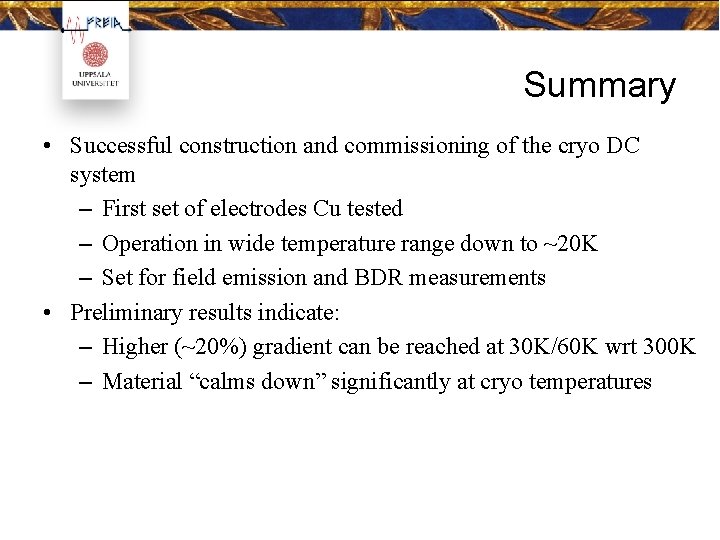
Summary • Successful construction and commissioning of the cryo DC system – First set of electrodes Cu tested – Operation in wide temperature range down to ~20 K – Set for field emission and BDR measurements • Preliminary results indicate: – Higher (~20%) gradient can be reached at 30 K/60 K wrt 300 K – Material “calms down” significantly at cryo temperatures
Thank You for attention!