
Preliminary Hazard Analysis of the ESS Cryomodules Nuno
- Slides: 25
Preliminary Hazard Analysis of the ESS Cryomodules Nuno Elias Cryogenics Engineering an Integration Support Division Safety review of Spokes and Elliptical Cryomodules, 9 th June 2016
Outline • • Introduction Hazards related to leaks Hazards Related to thermal events Hazards Related to Sub-system failure Hazards Related to Mechanical failure Hazards Related to Control and Command Hazards Related to Operator 2
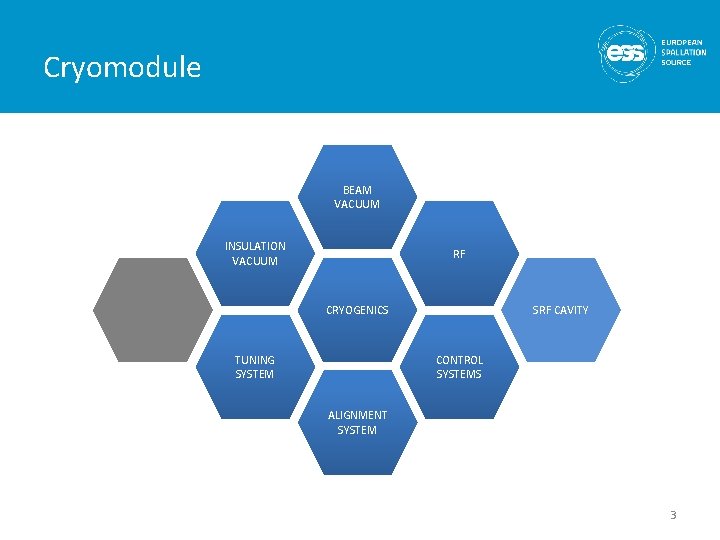
Cryomodule BEAM VACUUM INSULATION VACUUM RF SRF CAVITY CRYOGENICS TUNING SYSTEM CONTROL SYSTEMS ALIGNMENT SYSTEM 3
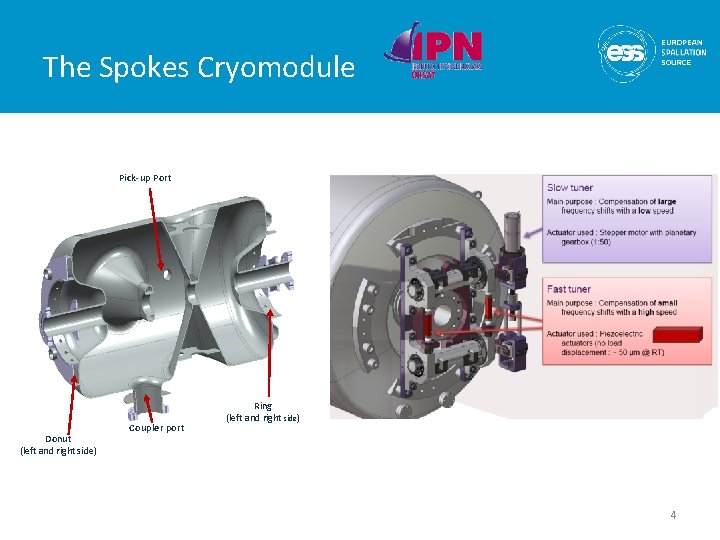
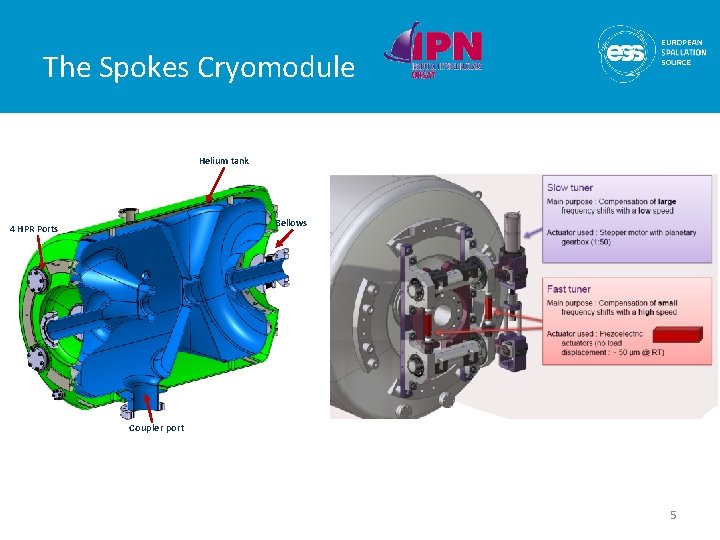
The Spokes Cryomodule Pick-up Port Donut (left and right side) Coupler port Ring (left and right side) 4
The Spokes Cryomodule Helium tank Bellows 4 HPR Ports Coupler port 5
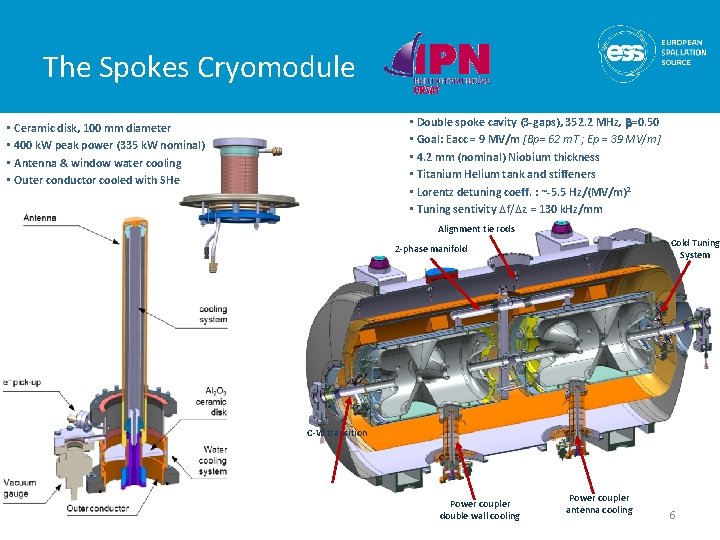
The Spokes Cryomodule • Double spoke cavity (3 -gaps), 352. 2 MHz, b=0. 50 • Goal: Eacc = 9 MV/m [Bp= 62 m. T ; Ep = 39 MV/m] • 4. 2 mm (nominal) Niobium thickness • Titanium Helium tank and stiffeners • Lorentz detuning coeff. : ~-5. 5 Hz/(MV/m)2 • Tuning sentivity Df/Dz = 130 k. Hz/mm • Ceramic disk, 100 mm diameter • 400 k. W peak power (335 k. W nominal) • Antenna & window water cooling • Outer conductor cooled with SHe Alignment tie rods Cold Tuning System 2 -phase manifold C-W transition Power coupler double wall cooling Power coupler antenna cooling 6
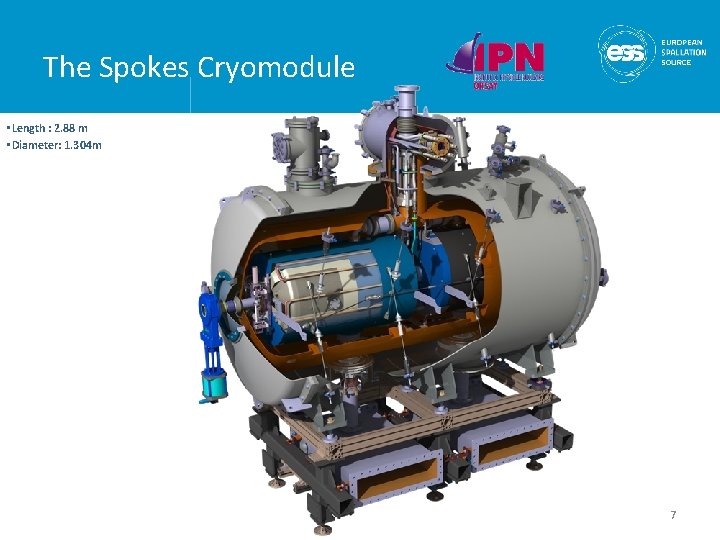
The Spokes Cryomodule • Length : 2. 88 m • Diameter: 1. 304 m 7
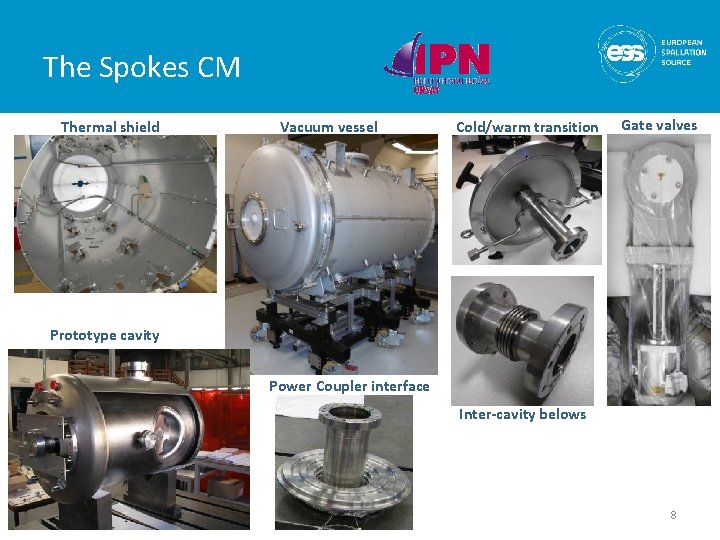
The Spokes CM Thermal shield Vacuum vessel Cold/warm transition Gate valves Prototype cavity Power Coupler interface Inter-cavity belows 8
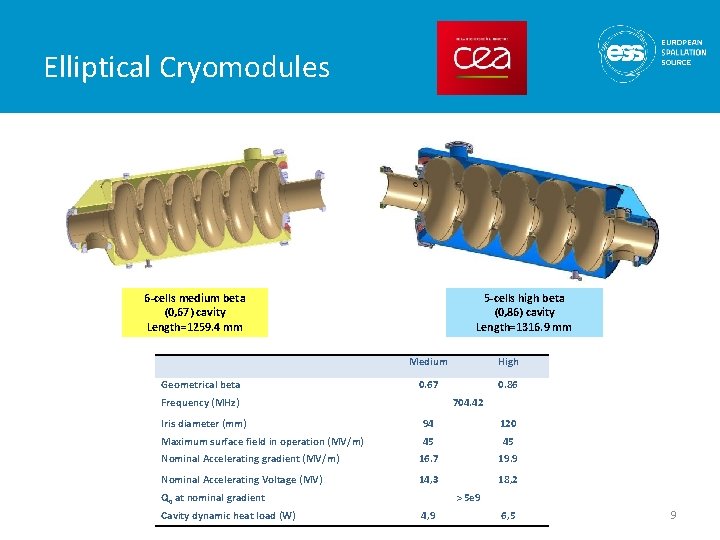
Elliptical Cryomodules 6 -cells medium beta (0, 67) cavity Length=1259. 4 mm Geometrical beta 5 -cells high beta (0, 86) cavity Length=1316. 9 mm Medium High 0. 67 0. 86 Frequency (MHz) 704. 42 Iris diameter (mm) 94 120 Maximum surface field in operation (MV/m) 45 45 Nominal Accelerating gradient (MV/m) 16. 7 19. 9 Nominal Accelerating Voltage (MV) 14, 3 18, 2 Q 0 at nominal gradient Cavity dynamic heat load (W) > 5 e 9 4, 9 6, 5 9
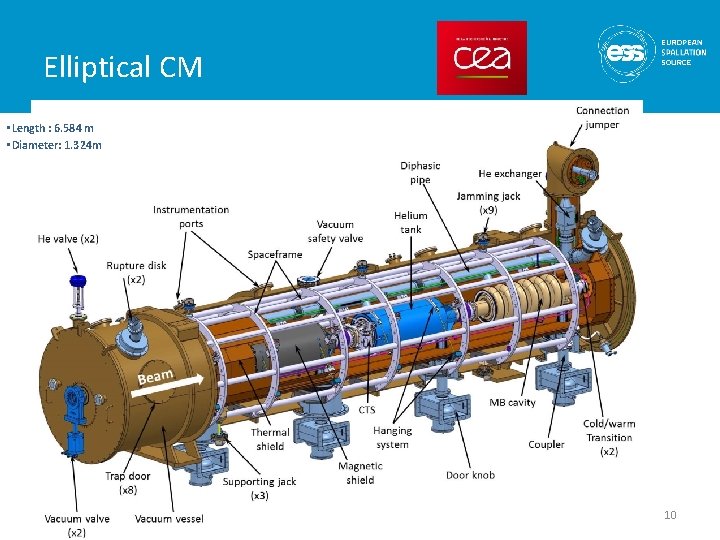
Elliptical CM • Length : 6. 584 m • Diameter: 1. 324 m 10
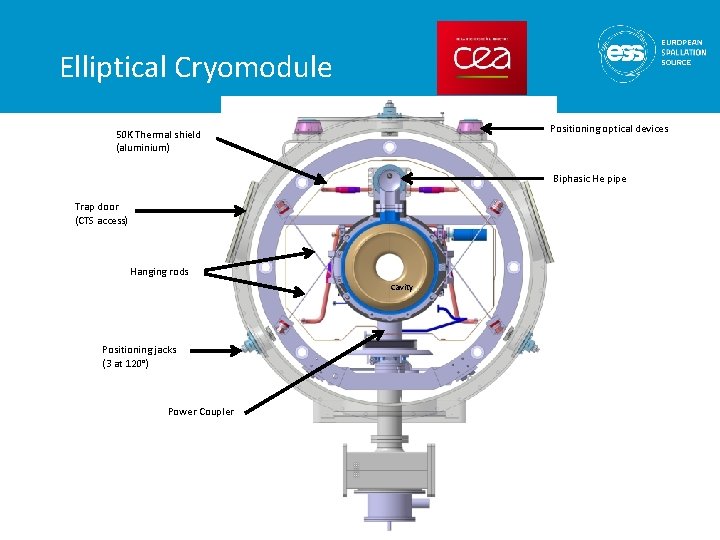
Elliptical Cryomodule Positioning optical devices 50 K Thermal shield (aluminium) Biphasic He pipe Trap door (CTS access) Hanging rods Cavity Positioning jacks (3 at 120°) Power Coupler
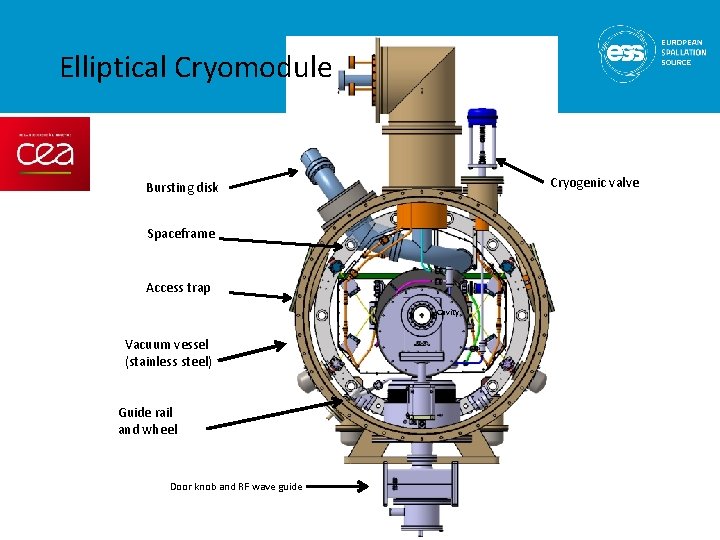
Elliptical Cryomodule Cryogenic valve Bursting disk Spaceframe Access trap Cavity Vacuum vessel (stainless steel) Guide rail and wheel Door knob and RF wave guide
Hazard Identification • Hazard: Potential threat – People – Equipment – Environment • Risk: Severity vs. Likelihood of occurrence (event) • Minimization of Risk (mitigation): - Measures to minimize occurrence and potential consequences - Measures in case event happens consequences are minimized. 13
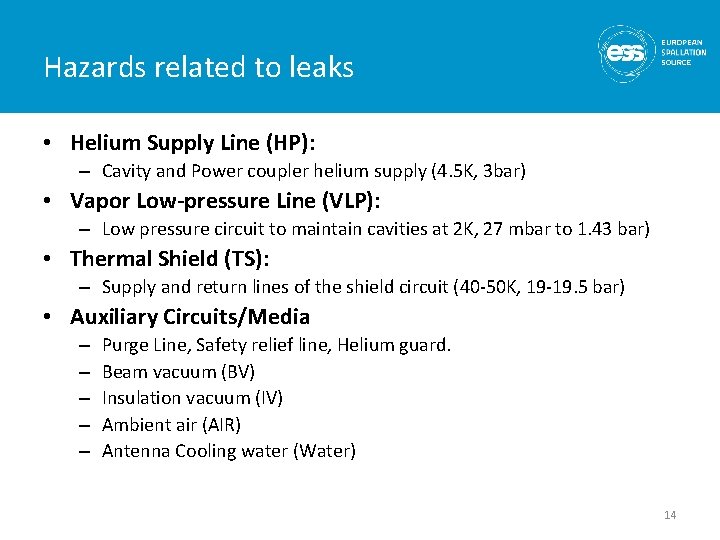
Hazards related to leaks • Helium Supply Line (HP): – Cavity and Power coupler helium supply (4. 5 K, 3 bar) • Vapor Low-pressure Line (VLP): – Low pressure circuit to maintain cavities at 2 K, 27 mbar to 1. 43 bar) • Thermal Shield (TS): – Supply and return lines of the shield circuit (40 -50 K, 19 -19. 5 bar) • Auxiliary Circuits/Media – – – Purge Line, Safety relief line, Helium guard. Beam vacuum (BV) Insulation vacuum (IV) Ambient air (AIR) Antenna Cooling water (Water) 14
Go to Document • Preliminary Hazard Analysis based on 2013 study: ESS 0051423_to be updated_NE_Hazid V 3_Protocol_WS 6_cryomodules_20130212. docx • Present Study focused in cryomodule operation: Hazard Analysis. pdf 15
Conclusions • A hazard analysis focused on the cryomodule operation is being produced – Various types of hazards have been studied. – Most critical scenarios have been identified and related to sudden beam vacuum loss. • Work is on-going, expected input from technical demonstrators tests will add valuable input. 16
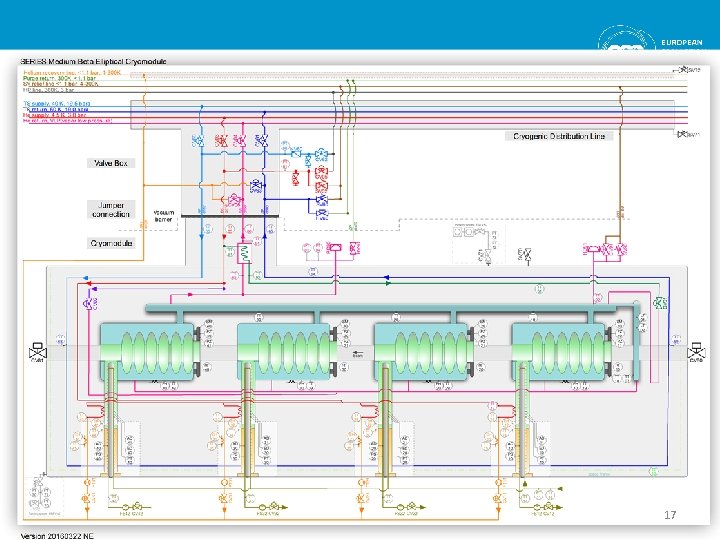
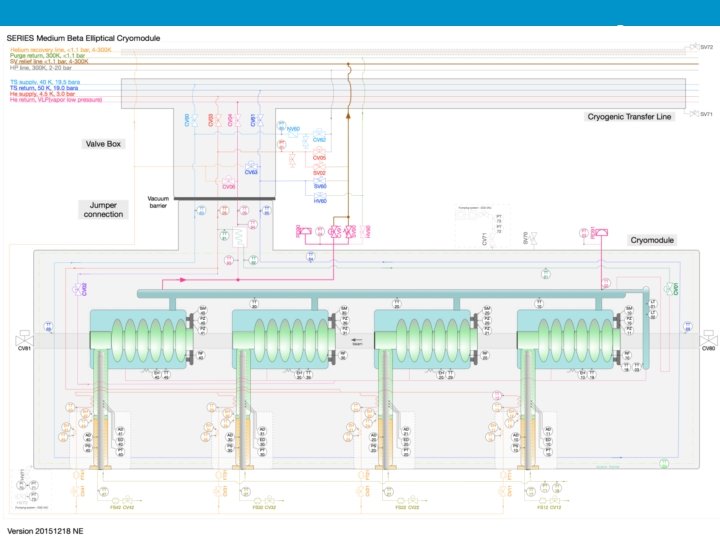
Cryomodule Flow and Instrumentation 17
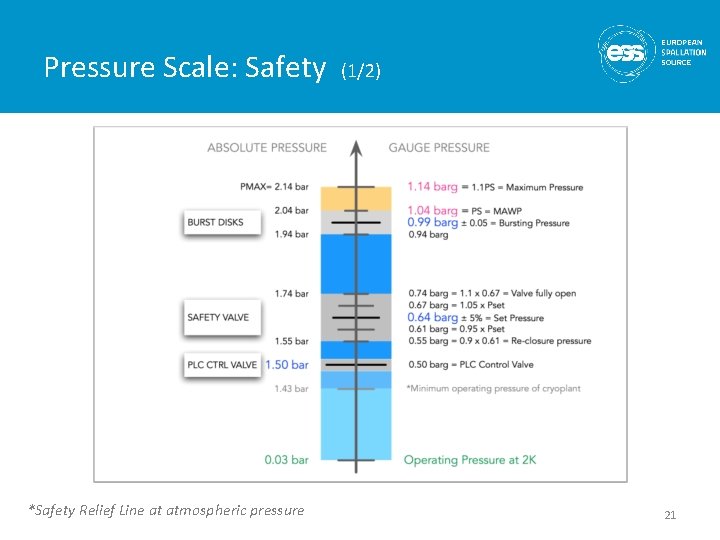
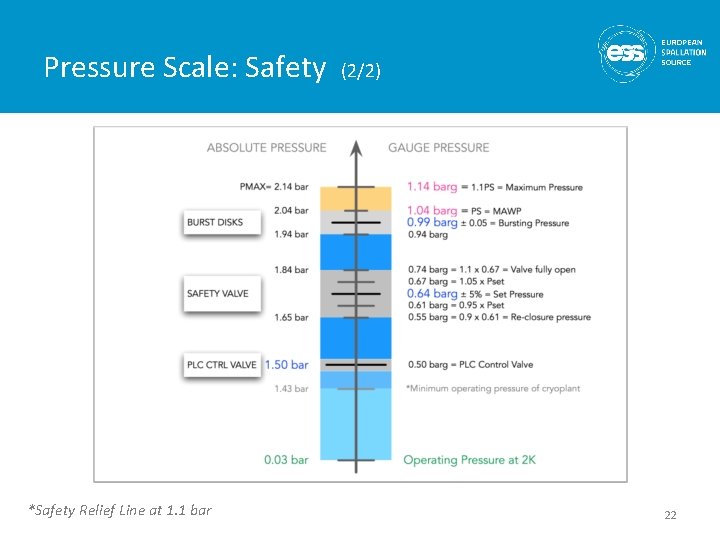
Pressure safety • Define the maximum allowable working pressure (PS) used for the design of the vessel and piping – The safety relief devices must be in place to prevent any event from pressurizing the vessel or piping above the MAWP. • Evaluate all pressure sources and possible mass flow rates • Size the vent line to the relief device – Temperature and pressure of flow stream – Evaluate pressure drop • Size the relief device • Size downstream ducting, in necessary 18
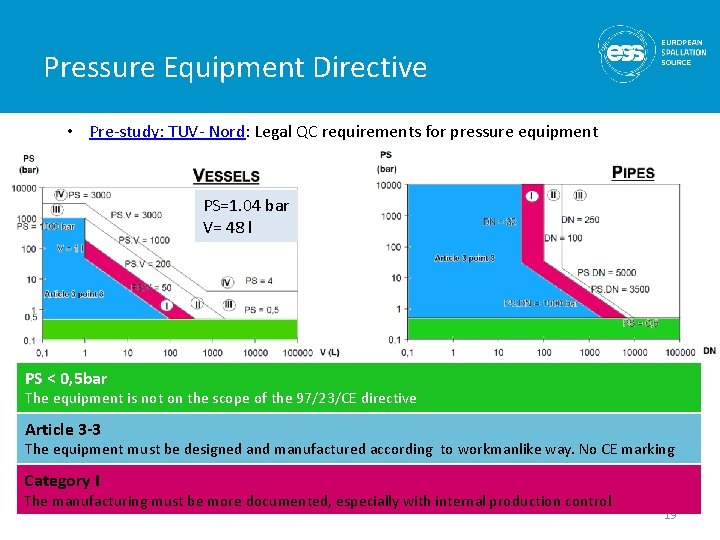
Pressure Equipment Directive • Pre-study: TUV- Nord: Legal QC requirements for pressure equipment PS=1. 04 bar V= 48 l PS < 0, 5 bar The equipment is not on the scope of the 97/23/CE directive Article 3 -3 The equipment must be designed and manufactured according to workmanlike way. No CE marking Category I The manufacturing must be more documented, especially with internal production control 19
20
Pressure Scale: Safety *Safety Relief Line at atmospheric pressure (1/2) 21
Pressure Scale: Safety *Safety Relief Line at 1. 1 bar (2/2) 22
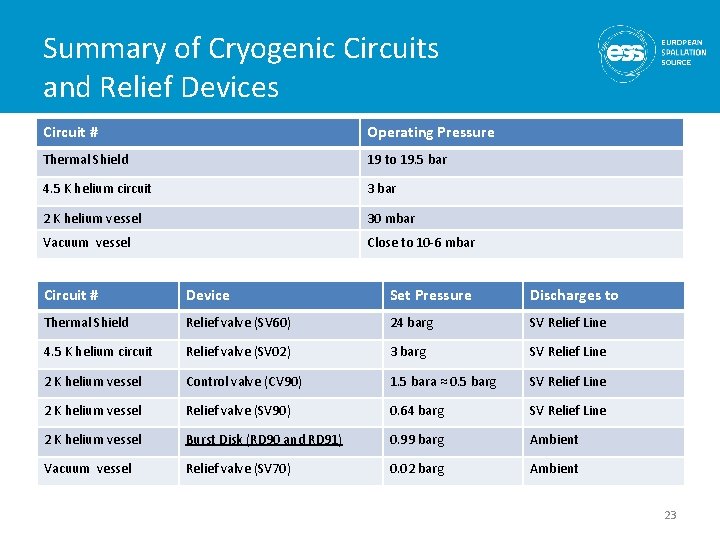
Summary of Cryogenic Circuits and Relief Devices Circuit # Operating Pressure Thermal Shield 19 to 19. 5 bar 4. 5 K helium circuit 3 bar 2 K helium vessel 30 mbar Vacuum vessel Close to 10 -6 mbar Circuit # Device Set Pressure Discharges to Thermal Shield Relief valve (SV 60) 24 barg SV Relief Line 4. 5 K helium circuit Relief valve (SV 02) 3 barg SV Relief Line 2 K helium vessel Control valve (CV 90) 1. 5 bara ≈ 0. 5 barg SV Relief Line 2 K helium vessel Relief valve (SV 90) 0. 64 barg SV Relief Line 2 K helium vessel Burst Disk (RD 90 and RD 91) 0. 99 barg Ambient Vacuum vessel Relief valve (SV 70) 0. 02 barg Ambient 23
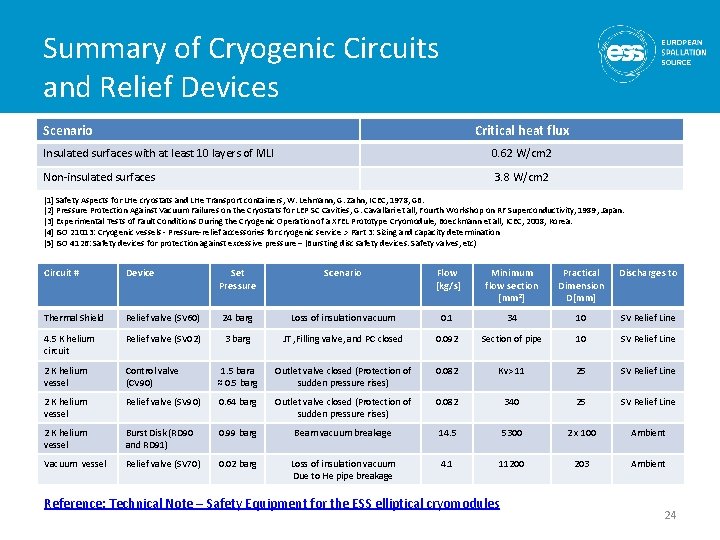
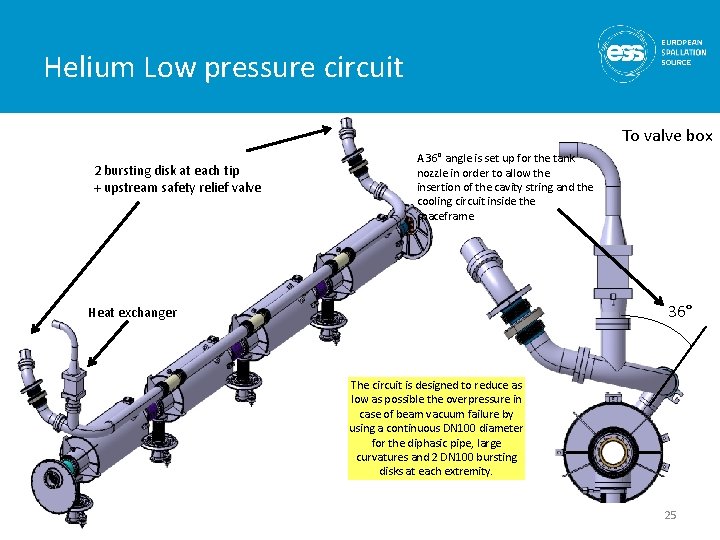
Summary of Cryogenic Circuits and Relief Devices Scenario Critical heat flux Insulated surfaces with at least 10 layers of MLI 0. 62 W/cm 2 Non-insulated surfaces 3. 8 W/cm 2 [1] Safety Aspects for LHe cryostats and LHe Transport containers, W. Lehmann, G. Zahn, ICEC, 1978, GB. [2] Pressure Protection Against Vacuum Failures on the Cryostats for LEP SC Cavities, G. Cavallari et all, Fourth Workshop on RF Superconductivity, 1989, Japan. [3] Experimental Tests of Fault Conditions During the Cryogenic Operation of a XFEL Prototype Cryomodule, Boeckmann et all, ICEC, 2008, Korea. [4] ISO 21013: Cryogenic vessels - Pressure-relief accessories for cryogenic service > Part 3: Sizing and capacity determination [5] ISO 4126: Safety devices for protection against excessive pressure – (Bursting disc safety devices. Safety valves, etc) Circuit # Device Set Pressure Scenario Flow [kg/s] Minimum flow section [mm 2] Practical Dimension D[mm] Discharges to Thermal Shield Relief valve (SV 60) 24 barg Loss of insulation vacuum 0. 1 34 10 SV Relief Line 4. 5 K helium circuit Relief valve (SV 02) 3 barg JT , Filling valve, and PC closed 0. 092 Section of pipe 10 SV Relief Line 2 K helium vessel Control valve (CV 90) 1. 5 bara ≈ 0. 5 barg Outlet valve closed (Protection of sudden pressure rises) 0. 082 Kv> 11 25 SV Relief Line 2 K helium vessel Relief valve (SV 90) 0. 64 barg Outlet valve closed (Protection of sudden pressure rises) 0. 082 340 25 SV Relief Line 2 K helium vessel Burst Disk (RD 90 and RD 91) 0. 99 barg Beam vacuum breakage 14. 5 5300 2 x 100 Ambient Vacuum vessel Relief valve (SV 70) 0. 02 barg Loss of insulation vacuum Due to He pipe breakage 4. 1 11200 203 Ambient Reference: Technical Note – Safety Equipment for the ESS elliptical cryomodules 24
Helium Low pressure circuit To valve box 2 bursting disk at each tip + upstream safety relief valve A 36° angle is set up for the tank nozzle in order to allow the insertion of the cavity string and the cooling circuit inside the spaceframe 36° Heat exchanger The circuit is designed to reduce as low as possible the overpressure in case of beam vacuum failure by using a continuous DN 100 diameter for the diphasic pipe, large curvatures and 2 DN 100 bursting disks at each extremity. 25