
Preliminary DTL studies at RAL Ciprian Plostinar CCLRC
- Slides: 17
Preliminary DTL studies at RAL Ciprian Plostinar CCLRC, ASTe. C, Intense Beams Group General HIPPI yearly meeting, Cosener’s House, Abingdon, UK
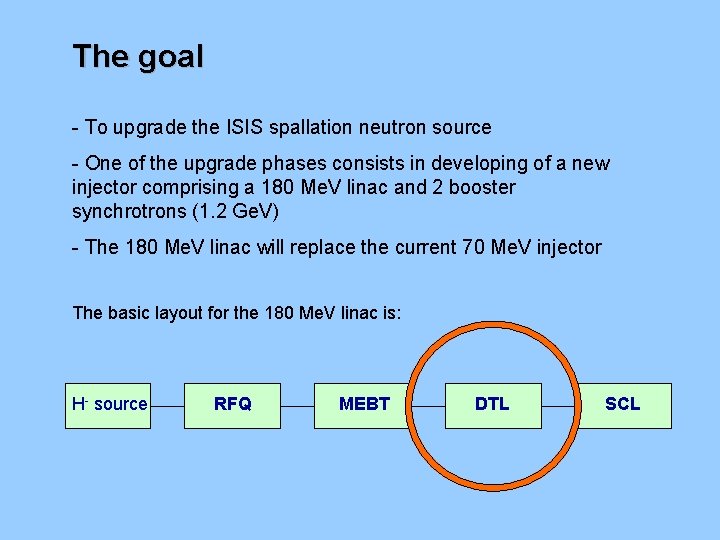
The goal - To upgrade the ISIS spallation neutron source - One of the upgrade phases consists in developing of a new injector comprising a 180 Me. V linac and 2 booster synchrotrons (1. 2 Ge. V) - The 180 Me. V linac will replace the current 70 Me. V injector The basic layout for the 180 Me. V linac is: H- source RFQ MEBT DTL SCL
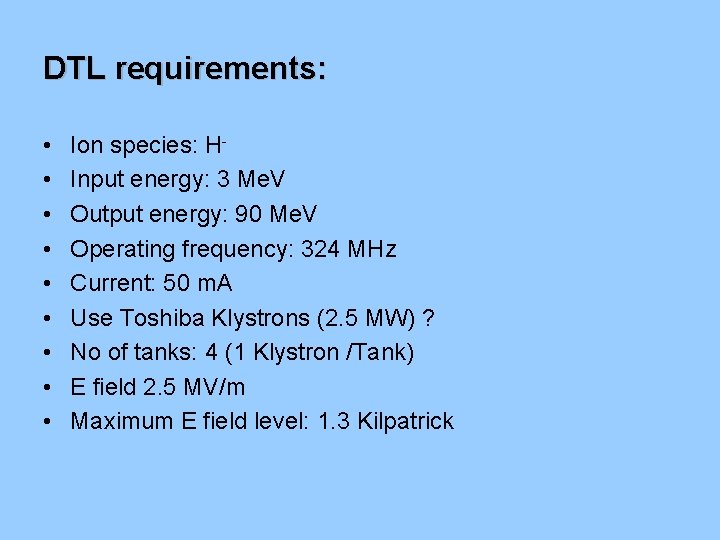
DTL requirements: • • • Ion species: HInput energy: 3 Me. V Output energy: 90 Me. V Operating frequency: 324 MHz Current: 50 m. A Use Toshiba Klystrons (2. 5 MW) ? No of tanks: 4 (1 Klystron /Tank) E field 2. 5 MV/m Maximum E field level: 1. 3 Kilpatrick
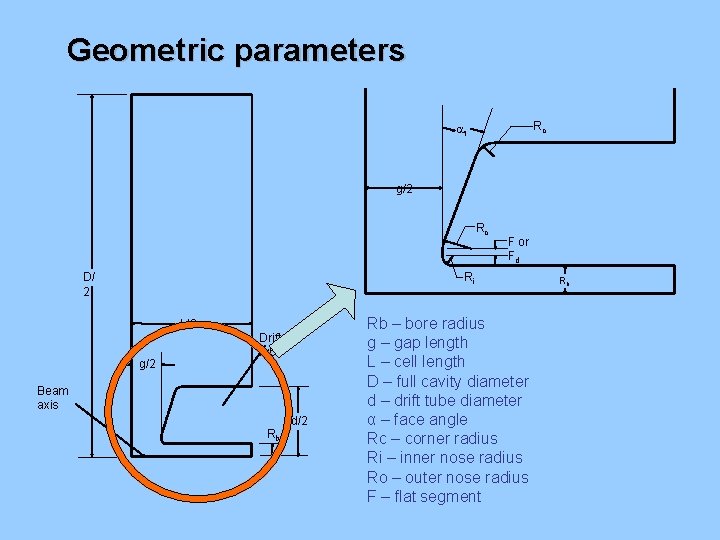
Geometric parameters Rc f g/2 Ro D/ 2 F or Fd Ri L/2 g/2 Drift tube Beam axis Rb d/2 Rb – bore radius g – gap length L – cell length D – full cavity diameter d – drift tube diameter α – face angle Rc – corner radius Ri – inner nose radius Ro – outer nose radius F – flat segment Rb
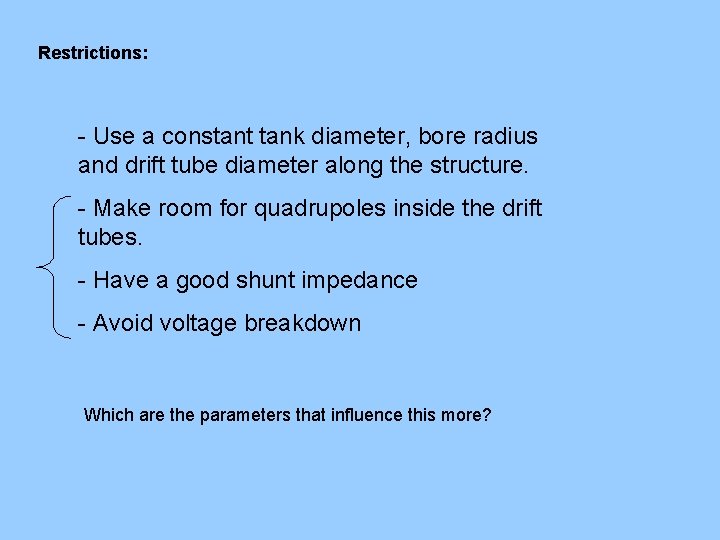
Restrictions: - Use a constant tank diameter, bore radius and drift tube diameter along the structure. - Make room for quadrupoles inside the drift tubes. - Have a good shunt impedance - Avoid voltage breakdown Which are the parameters that influence this more?
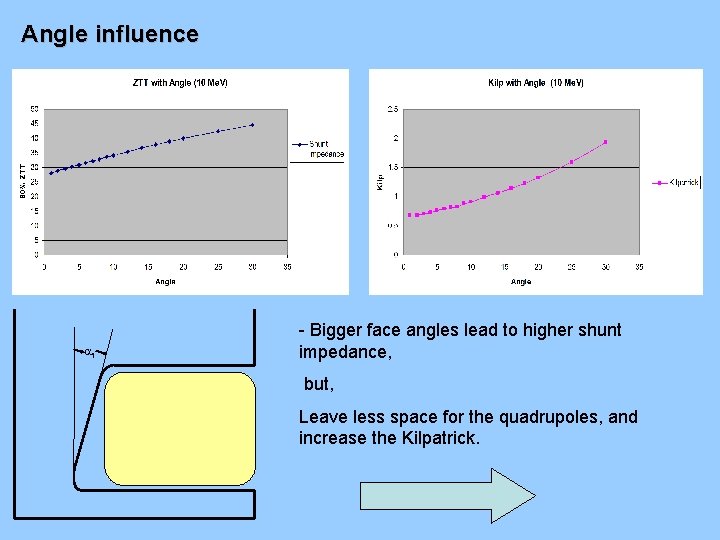
Angle influence f - Bigger face angles lead to higher shunt impedance, but, Leave less space for the quadrupoles, and increase the Kilpatrick.
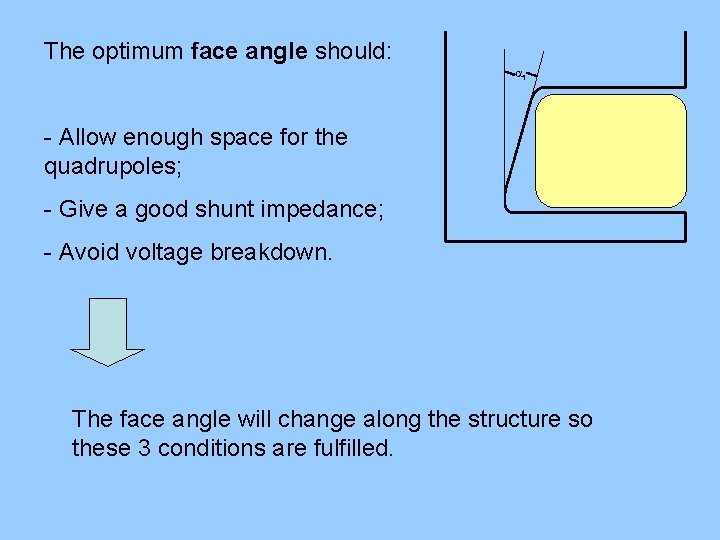
The optimum face angle should: f - Allow enough space for the quadrupoles; - Give a good shunt impedance; - Avoid voltage breakdown. The face angle will change along the structure so these 3 conditions are fulfilled.
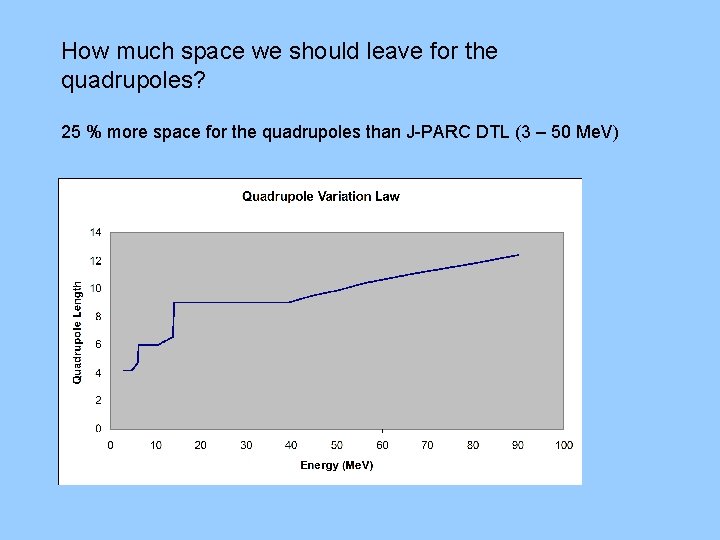
How much space we should leave for the quadrupoles? 25 % more space for the quadrupoles than J-PARC DTL (3 – 50 Me. V)
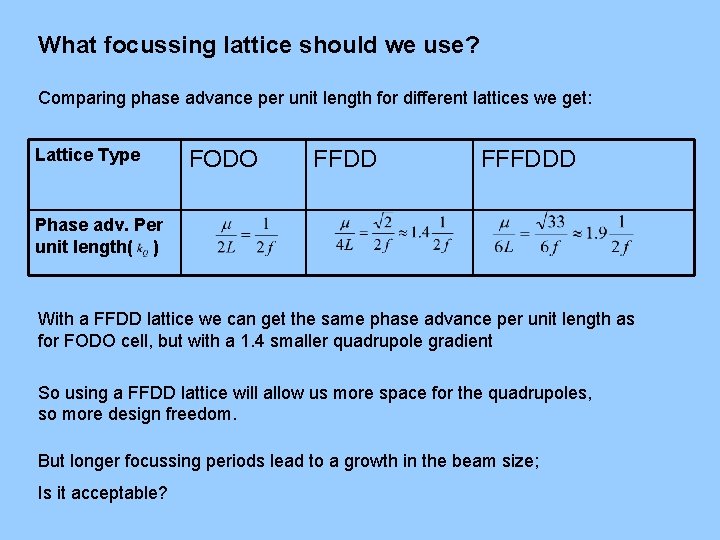
What focussing lattice should we use? Comparing phase advance per unit length for different lattices we get: Lattice Type FODO FFDD FFFDDD Phase adv. Per unit length( ) With a FFDD lattice we can get the same phase advance per unit length as for FODO cell, but with a 1. 4 smaller quadrupole gradient So using a FFDD lattice will allow us more space for the quadrupoles, so more design freedom. But longer focussing periods lead to a growth in the beam size; Is it acceptable?
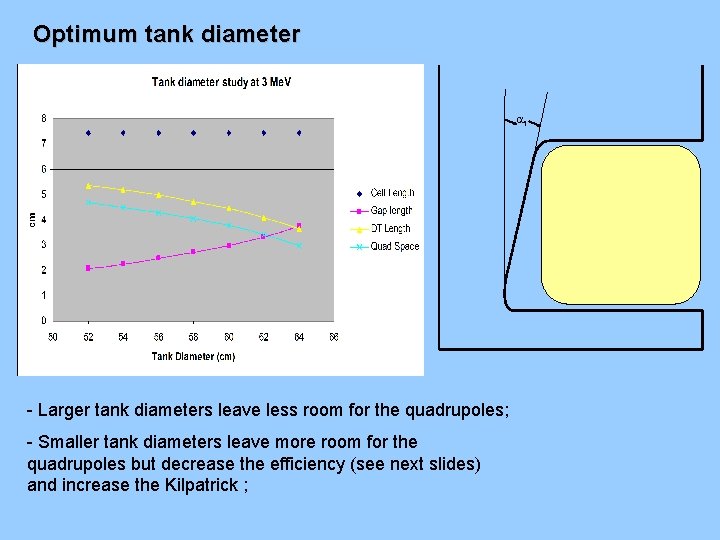
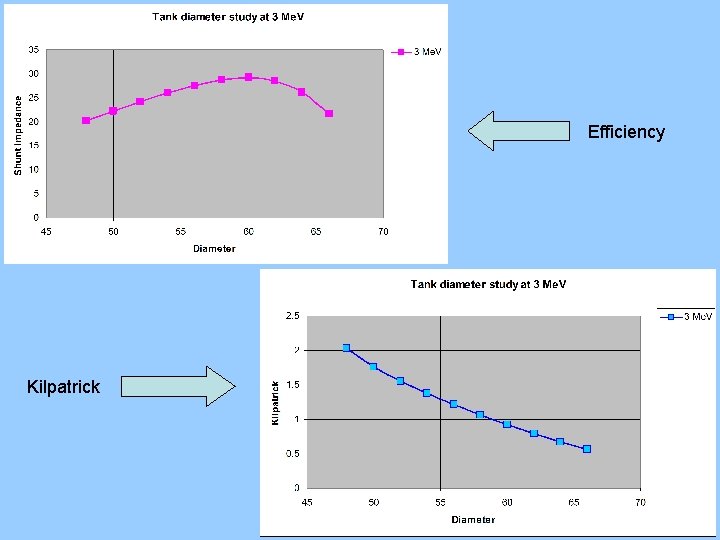
Optimum tank diameter f - Larger tank diameters leave less room for the quadrupoles; - Smaller tank diameters leave more room for the quadrupoles but decrease the efficiency (see next slides) and increase the Kilpatrick ;
Efficiency Kilpatrick
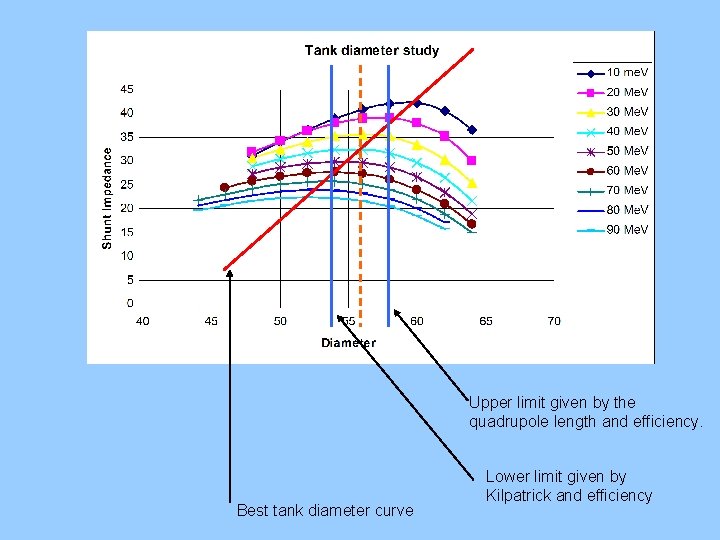
Upper limit given by the quadrupole length and efficiency. Best tank diameter curve Lower limit given by Kilpatrick and efficiency
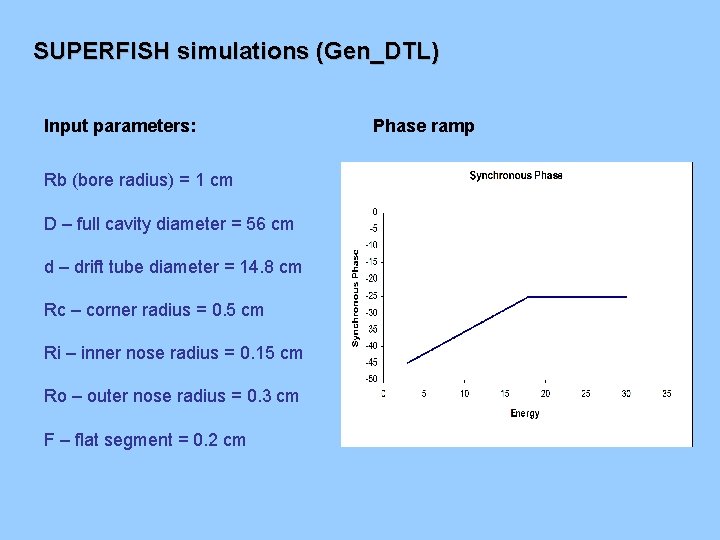
SUPERFISH simulations (Gen_DTL) Input parameters: Rb (bore radius) = 1 cm D – full cavity diameter = 56 cm d – drift tube diameter = 14. 8 cm Rc – corner radius = 0. 5 cm Ri – inner nose radius = 0. 15 cm Ro – outer nose radius = 0. 3 cm F – flat segment = 0. 2 cm Phase ramp
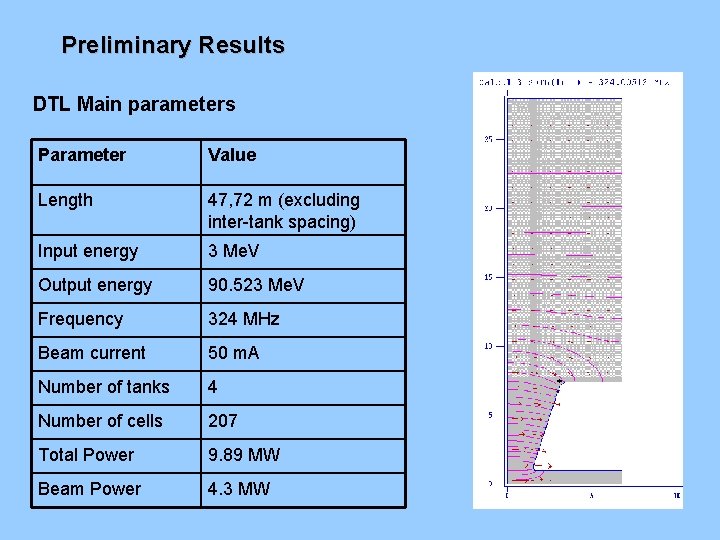
Preliminary Results DTL Main parameters Parameter Value Length 47, 72 m (excluding inter-tank spacing) Input energy 3 Me. V Output energy 90. 523 Me. V Frequency 324 MHz Beam current 50 m. A Number of tanks 4 Number of cells 207 Total Power 9. 89 MW Beam Power 4. 3 MW
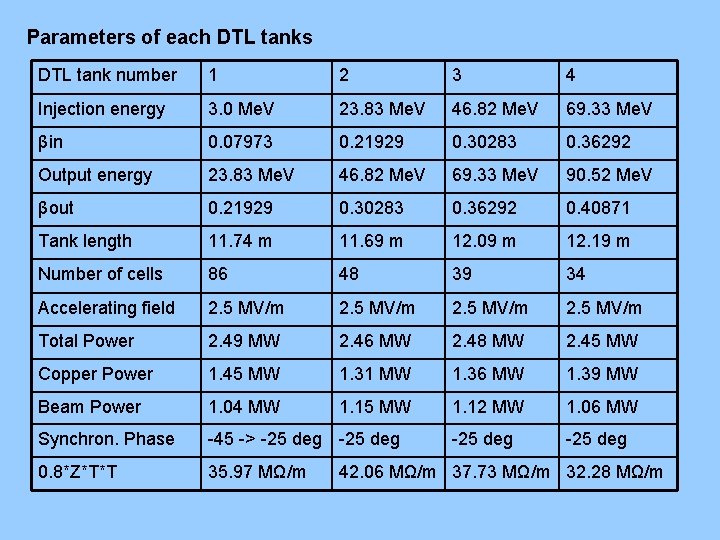
Parameters of each DTL tanks DTL tank number 1 2 3 4 Injection energy 3. 0 Me. V 23. 83 Me. V 46. 82 Me. V 69. 33 Me. V βin 0. 07973 0. 21929 0. 30283 0. 36292 Output energy 23. 83 Me. V 46. 82 Me. V 69. 33 Me. V 90. 52 Me. V βout 0. 21929 0. 30283 0. 36292 0. 40871 Tank length 11. 74 m 11. 69 m 12. 09 m 12. 19 m Number of cells 86 48 39 34 Accelerating field 2. 5 MV/m Total Power 2. 49 MW 2. 46 MW 2. 48 MW 2. 45 MW Copper Power 1. 45 MW 1. 31 MW 1. 36 MW 1. 39 MW Beam Power 1. 04 MW 1. 15 MW 1. 12 MW 1. 06 MW Synchron. Phase -45 -> -25 deg 0. 8*Z*T*T 35. 97 MΩ/m 42. 06 MΩ/m 37. 73 MΩ/m 32. 28 MΩ/m
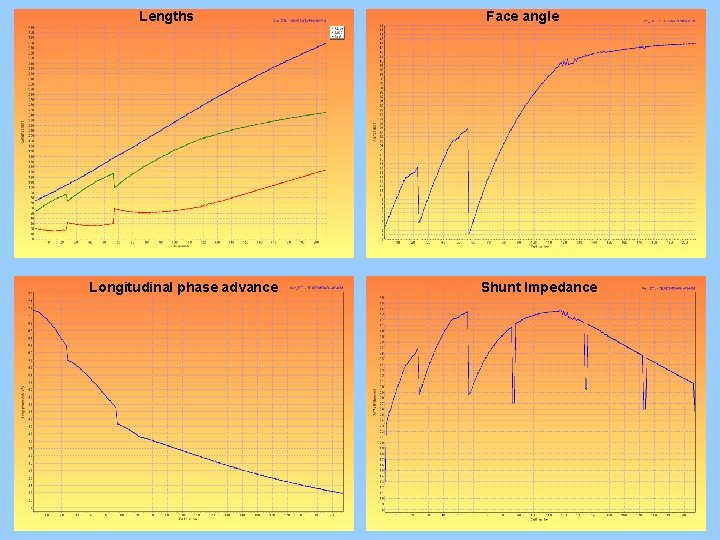
Lengths Longitudinal phase advance Face angle Shunt Impedance
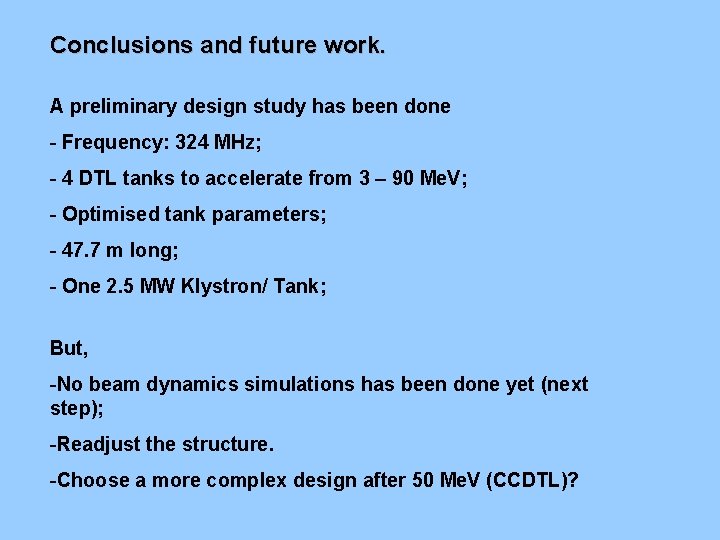
Conclusions and future work. A preliminary design study has been done - Frequency: 324 MHz; - 4 DTL tanks to accelerate from 3 – 90 Me. V; - Optimised tank parameters; - 47. 7 m long; - One 2. 5 MW Klystron/ Tank; But, -No beam dynamics simulations has been done yet (next step); -Readjust the structure. -Choose a more complex design after 50 Me. V (CCDTL)?