
Preliminaries Scientific Method Metric System Uncertainty Scientific method
- Slides: 41
Preliminaries Scientific Method Metric System Uncertainty
Scientific method • A way of solving problems • Observation – what is seen or measured • Hypothesis – educated guess of why things behave the way they do (possible explanation) • Experiment – designed to test hypothesis • …leads to new observations, • …and the cycle goes on…
Scientific method • Blah, blah… • Is this what scientists do? • There is real value to considering the scientific method – if you consider what scientists really do
Scientific method • They are curious about a problem (or their boss tells them to investigate a problem) • They gather basic background info (Wikipedia, Google) • They gather scientific background info (literature) • They perform experiments • They publish results (communicate)
Scientific method • Accuracy and precision affect experiments • Sometimes errors affect results • Random errors can mess up a trial (spilling some of a sample, dirty glassware…) – experiments are repeated to eliminate these errors • Systematic errors are harder to detect and will repeat in every trial (broken balance, contaminated stock solution)
Scientific method • Scientific method means that you have an idea that can be proven by experimentation • The results of your experiments must be reproducible by others • Reproducibility is precision – precision in data is represented by significant figures
Significant figures • Activity on sig. figs. • How many sig. figs. can you get from a laboratory measurement? • What purpose do significant figures serve? (Why do we use sig. figs. ? )
Metric System • Every measurement has two parts 1. Number 2. Scale (unit) • • • SI system (Systeme International) based on the metric system Prefix + base unit Prefix tells you the power of 10 to multiply by - decimal system -easy conversions
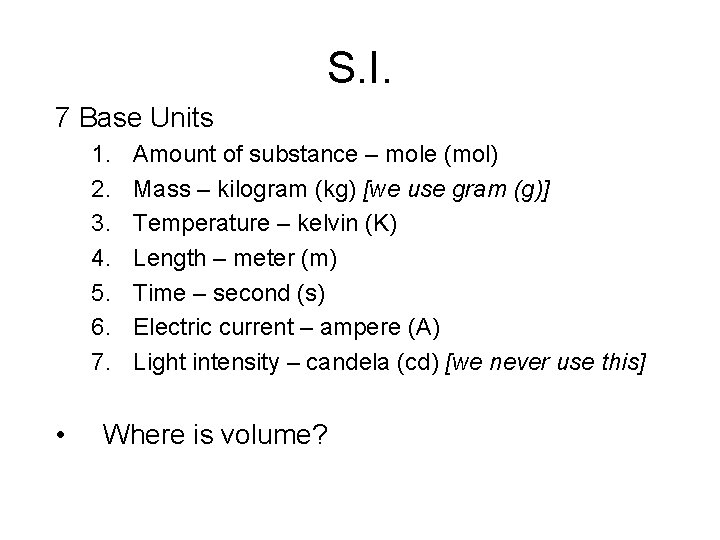
S. I. 7 Base Units 1. 2. 3. 4. 5. 6. 7. • Amount of substance – mole (mol) Mass – kilogram (kg) [we use gram (g)] Temperature – kelvin (K) Length – meter (m) Time – second (s) Electric current – ampere (A) Light intensity – candela (cd) [we never use this] Where is volume?
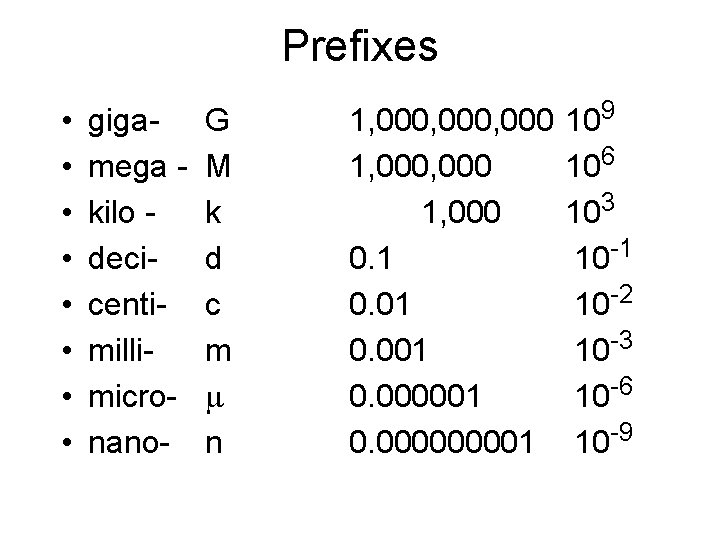
Prefixes • • gigamega kilo decicentimillimicronano- G M k d c m m n 1, 000, 000 1, 000 0. 1 0. 001 0. 000000001 109 106 103 10 -1 10 -2 10 -3 10 -6 10 -9
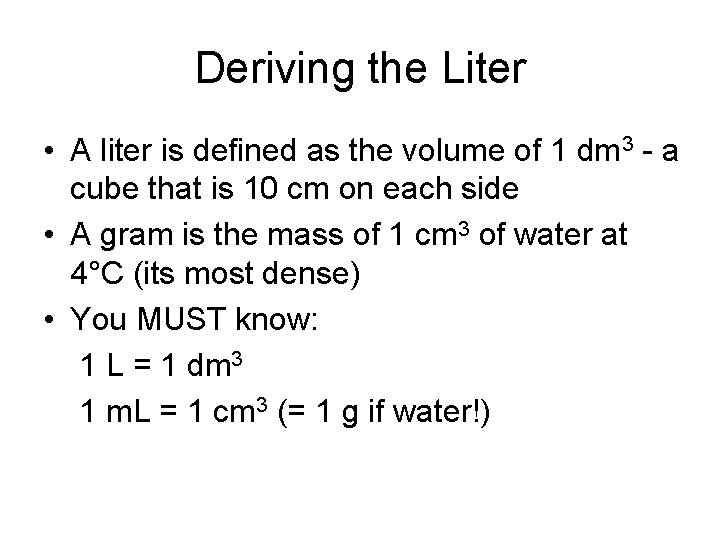
Deriving the Liter • A liter is defined as the volume of 1 dm 3 - a cube that is 10 cm on each side • A gram is the mass of 1 cm 3 of water at 4°C (its most dense) • You MUST know: 1 L = 1 dm 3 1 m. L = 1 cm 3 (= 1 g if water!)
Dimensional Analysis Using the units to solve problems
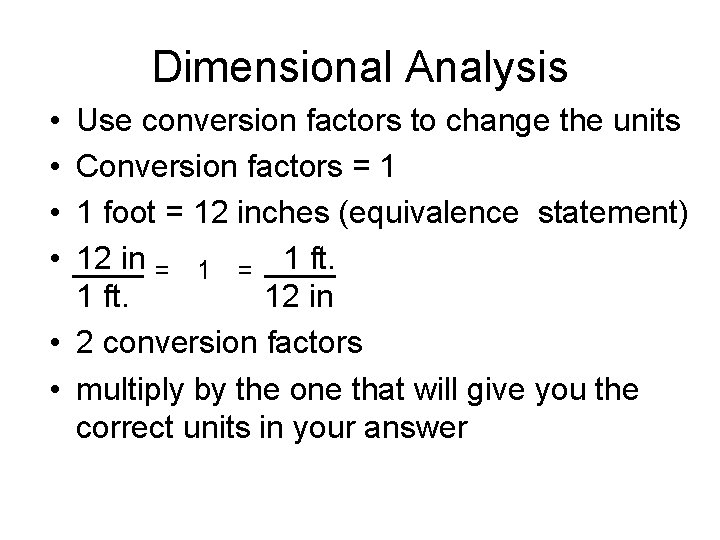
Dimensional Analysis • • Use conversion factors to change the units Conversion factors = 1 1 foot = 12 inches (equivalence statement) 12 in = 1 ft. 12 in • 2 conversion factors • multiply by the one that will give you the correct units in your answer
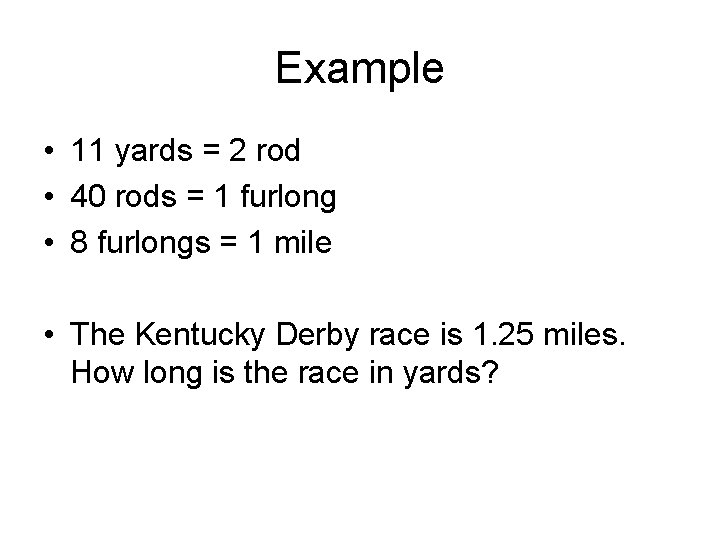
Example • 11 yards = 2 rod • 40 rods = 1 furlong • 8 furlongs = 1 mile • The Kentucky Derby race is 1. 25 miles. How long is the race in yards?
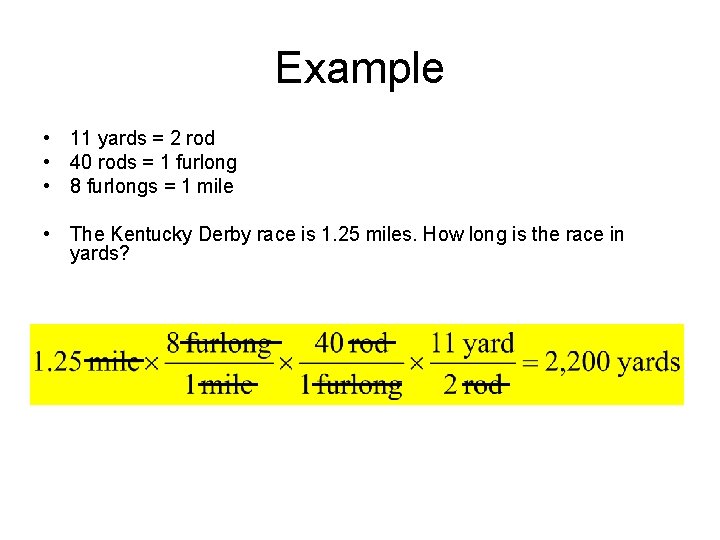
Example • 11 yards = 2 rod • 40 rods = 1 furlong • 8 furlongs = 1 mile • The Kentucky Derby race is 1. 25 miles. How long is the race in yards?
Metric/Dimensional analysis • Activity on the metric system • Activity on dimensional analysis
Mass and Weight • Mass is measure of resistance to change in motion • Weight is force of gravity • Sometimes used interchangeably • Mass can’t change, weight can
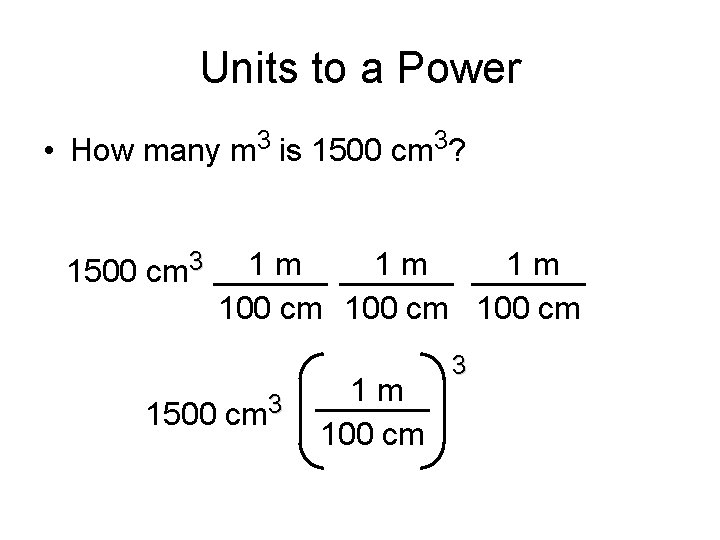
Units to a Power • How many m 3 is 1500 cm 3? 1500 cm 3 1500 1 m 1 m 1 m 100 cm cm 3 1 m 100 cm 3
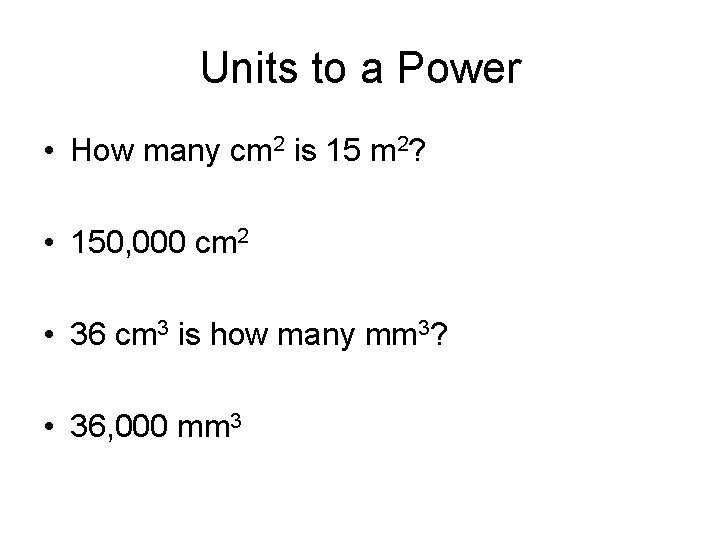
Units to a Power • How many cm 2 is 15 m 2? • 150, 000 cm 2 • 36 cm 3 is how many mm 3? • 36, 000 mm 3
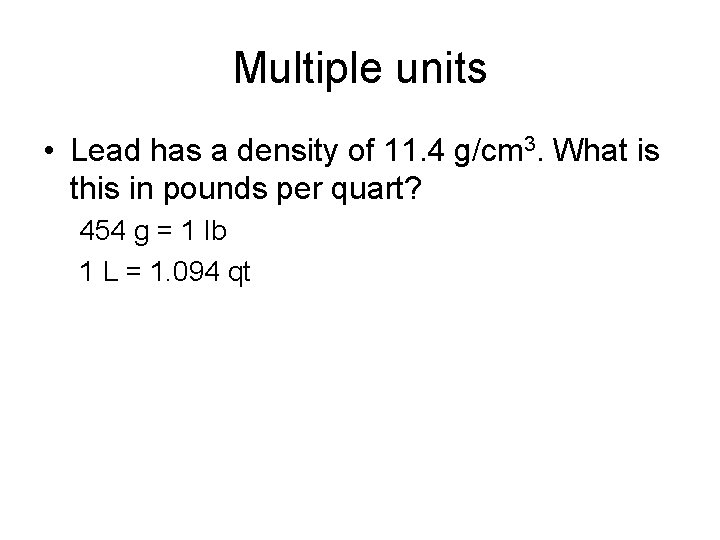
Multiple units • Lead has a density of 11. 4 g/cm 3. What is this in pounds per quart? 454 g = 1 lb 1 L = 1. 094 qt
Temperature and Density
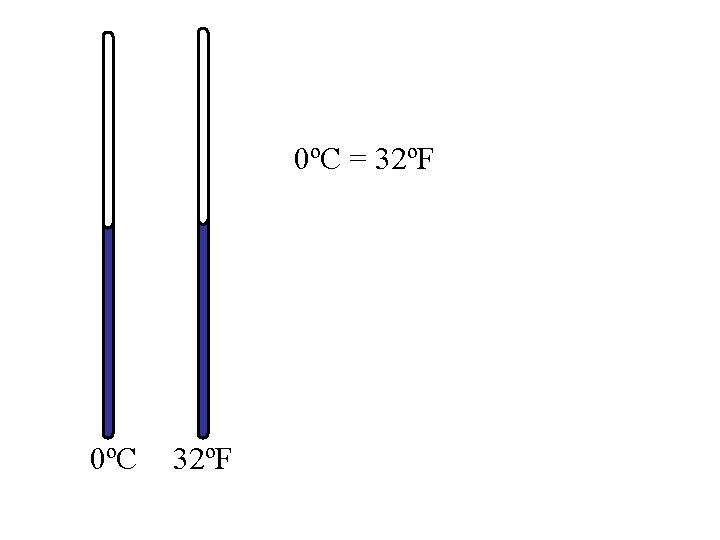
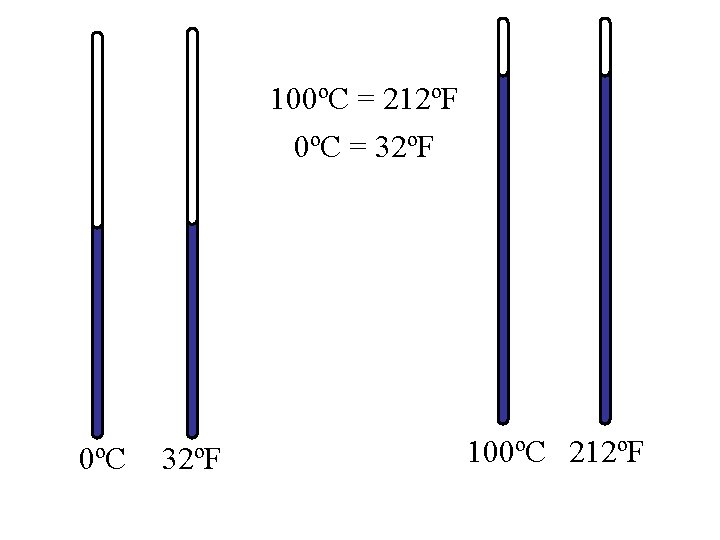
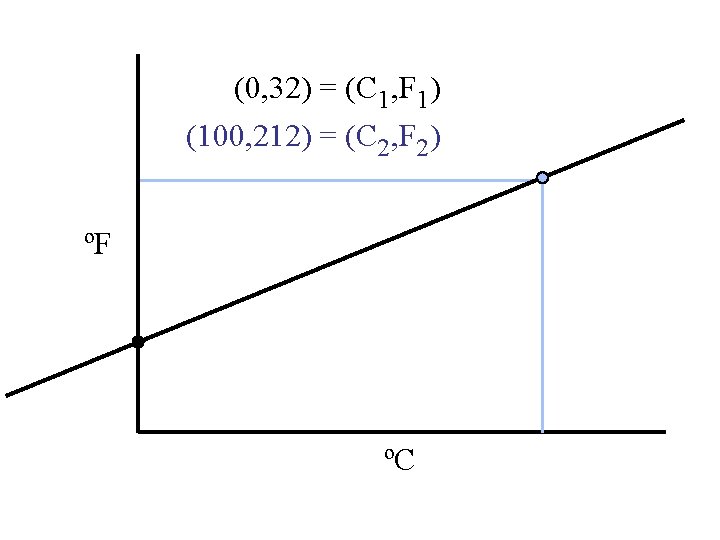
Temperature • A measure of the average kinetic energy • Different temperature scales, all are talking about the same height of mercury. • Derive a equation for converting ºF toºC
0ºC = 32ºF 0ºC 32ºF
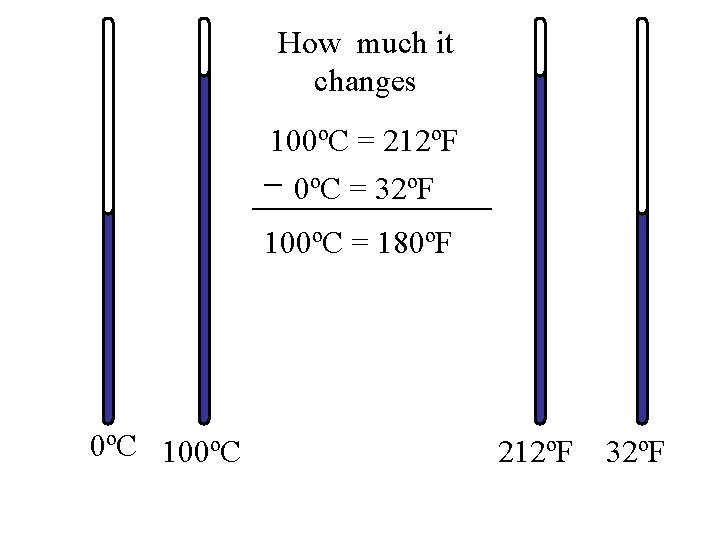
100ºC = 212ºF 0ºC = 32ºF 0ºC 32ºF 100ºC 212ºF
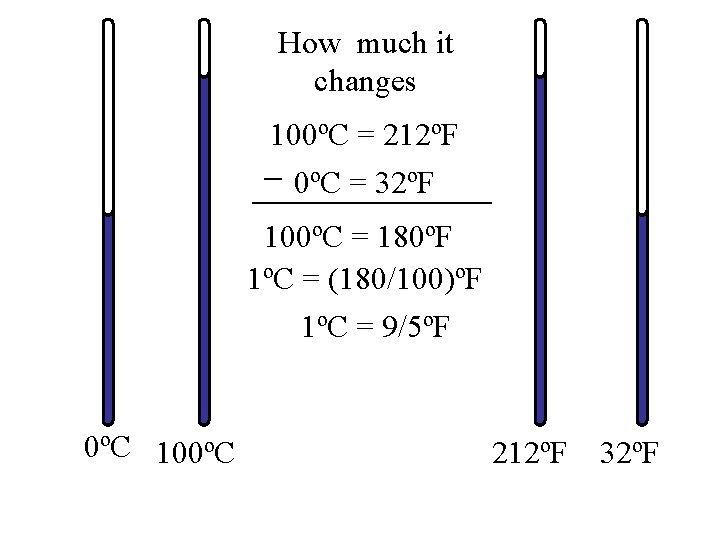
How much it changes 100ºC = 212ºF 0ºC = 32ºF 100ºC = 180ºF 0ºC 100ºC 212ºF 32ºF
How much it changes 100ºC = 212ºF 0ºC = 32ºF 100ºC = 180ºF 1ºC = (180/100)ºF 1ºC = 9/5ºF 0ºC 100ºC 212ºF 32ºF
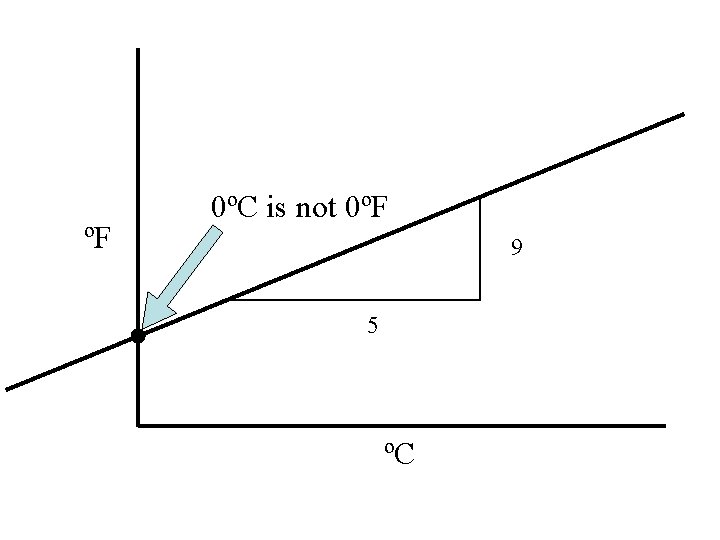
ºF 0ºC is not 0ºF 9 5 ºC
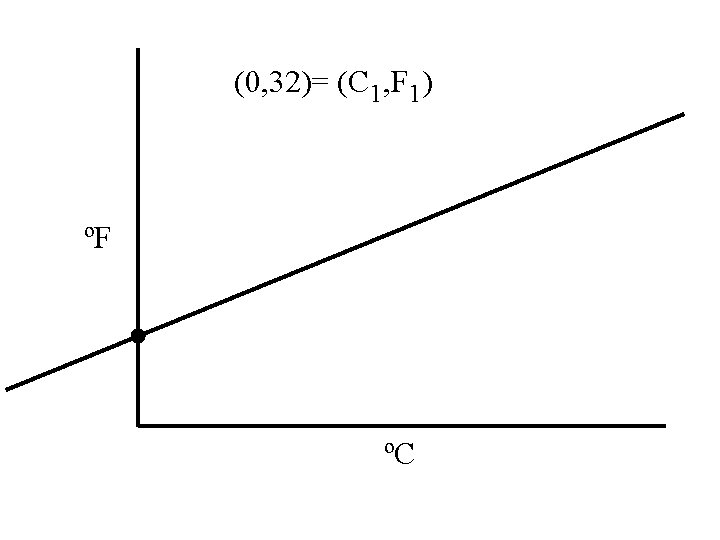
(0, 32)= (C 1, F 1) ºF ºC
(0, 32) = (C 1, F 1) (100, 212) = (C 2, F 2) ºF ºC
Density • • • Ratio of mass to volume D = m/V Useful for identifying a compound Useful for predicting weight An intrinsic property- does depend on what the material is
Density Problem • An empty container weighs 121. 3 g. Filled with carbon tetrachloride (density 1. 53 g/cm 3 ) the container weighs 283. 2 g. What is the volume of the container?
Physical Changes • A change that changes appearances, without changing the composition. • Chemical changes – a change where a new form of matter is formed. • Also called chemical reaction. • Not phase changes • Ice is still water.
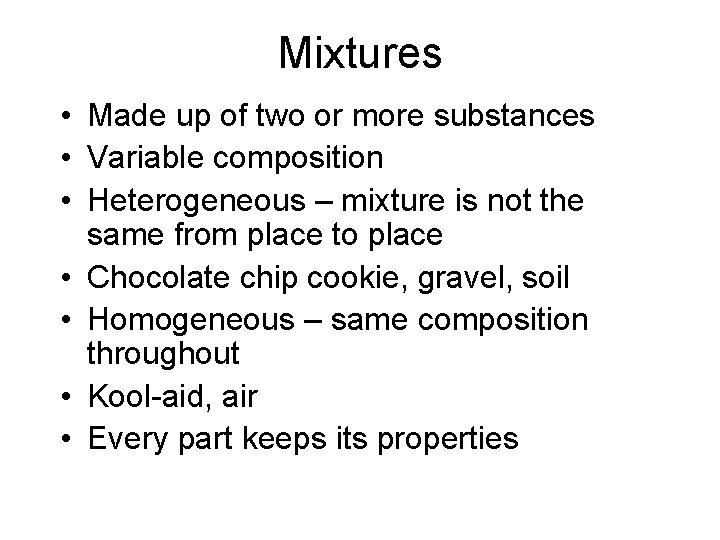
Mixtures • Made up of two or more substances • Variable composition • Heterogeneous – mixture is not the same from place to place • Chocolate chip cookie, gravel, soil • Homogeneous – same composition throughout • Kool-aid, air • Every part keeps its properties
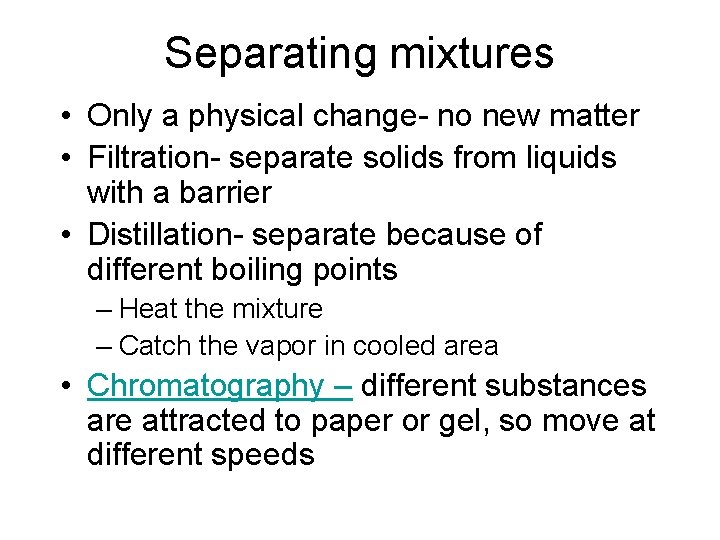
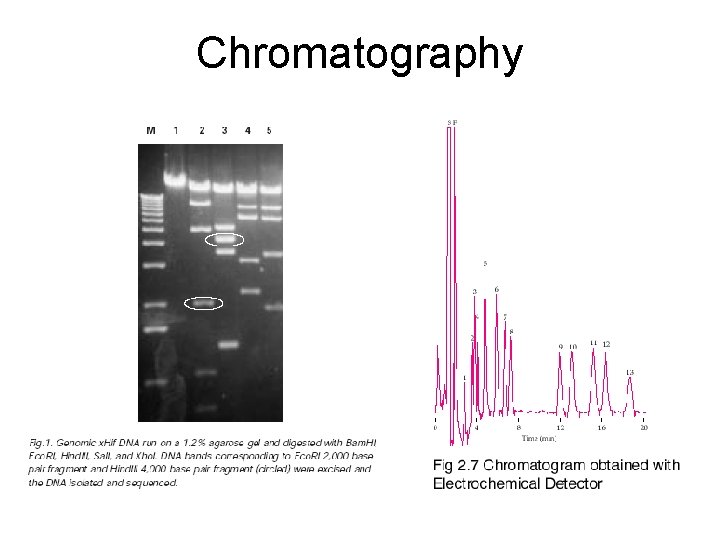
Separating mixtures • Only a physical change- no new matter • Filtration- separate solids from liquids with a barrier • Distillation- separate because of different boiling points – Heat the mixture – Catch the vapor in cooled area • Chromatography – different substances are attracted to paper or gel, so move at different speeds
Chromatography
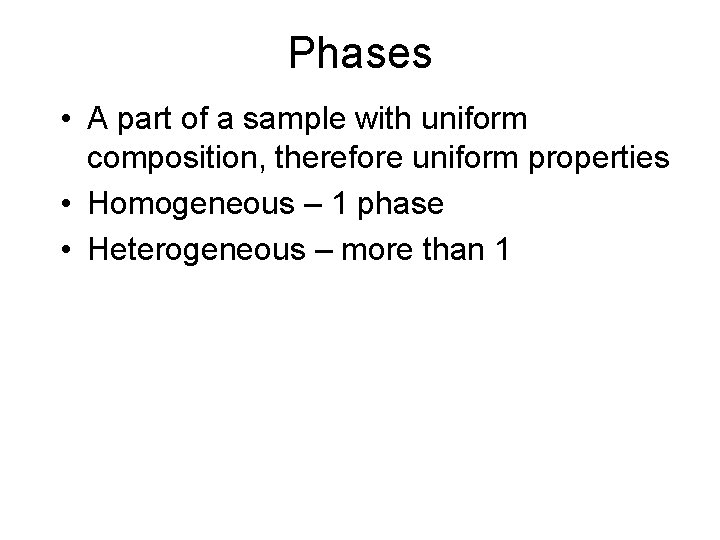
Phases • A part of a sample with uniform composition, therefore uniform properties • Homogeneous – 1 phase • Heterogeneous – more than 1
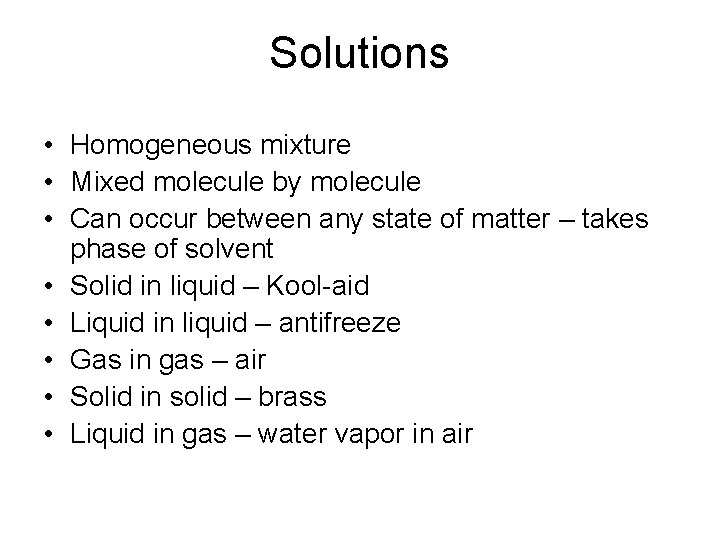
Solutions • Homogeneous mixture • Mixed molecule by molecule • Can occur between any state of matter – takes phase of solvent • Solid in liquid – Kool-aid • Liquid in liquid – antifreeze • Gas in gas – air • Solid in solid – brass • Liquid in gas – water vapor in air
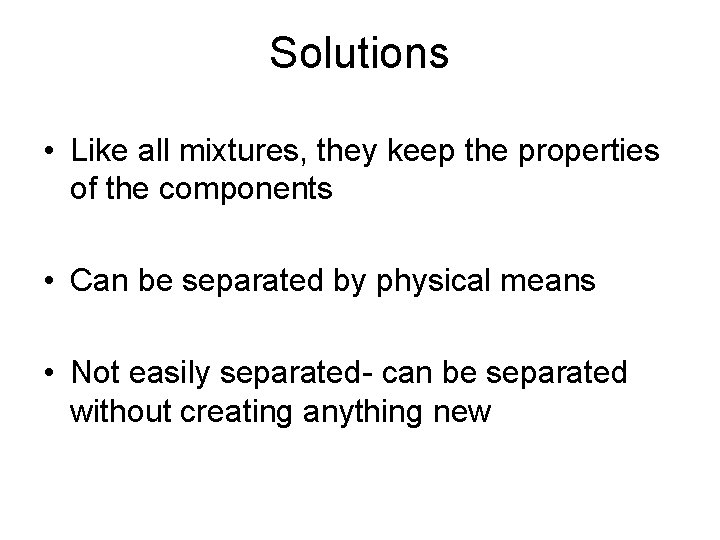
Solutions • Like all mixtures, they keep the properties of the components • Can be separated by physical means • Not easily separated- can be separated without creating anything new
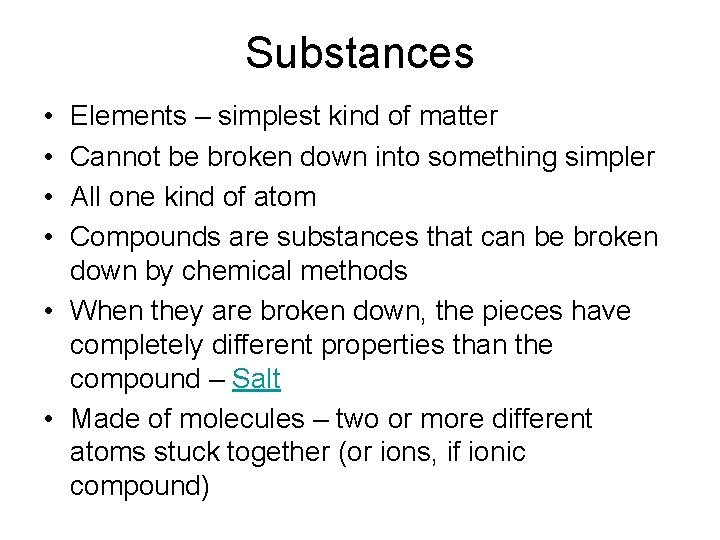
Substances • • Elements – simplest kind of matter Cannot be broken down into something simpler All one kind of atom Compounds are substances that can be broken down by chemical methods • When they are broken down, the pieces have completely different properties than the compound – Salt • Made of molecules – two or more different atoms stuck together (or ions, if ionic compound)
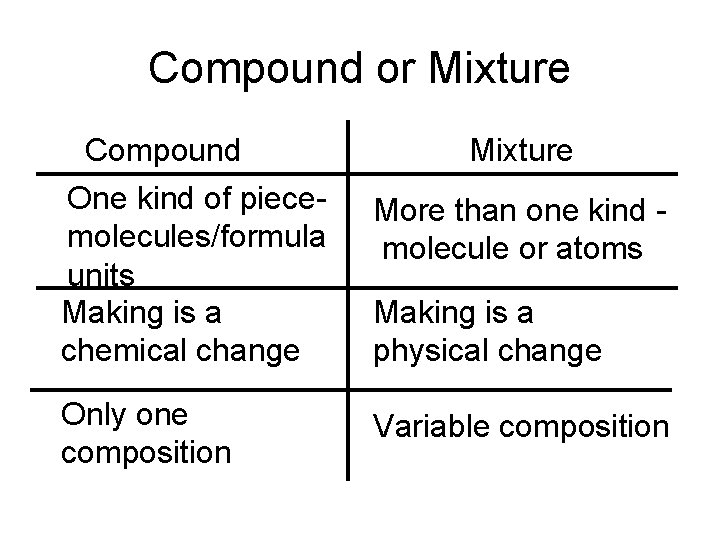
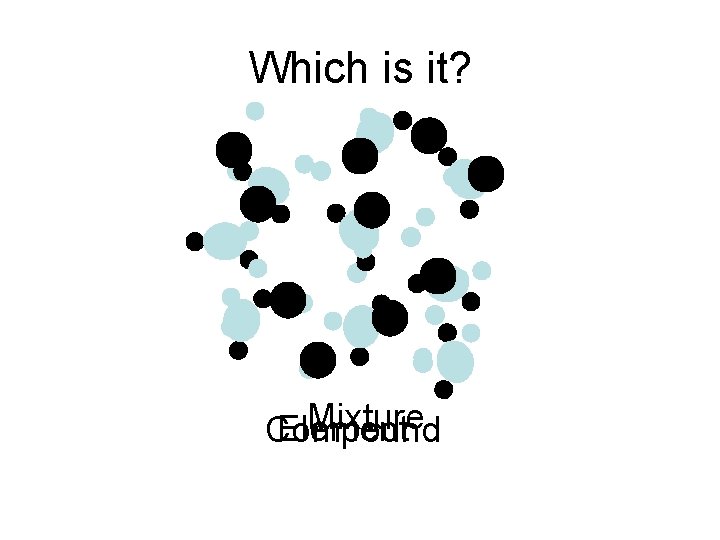
Compound or Mixture Compound One kind of piecemolecules/formula units Making is a chemical change Only one composition Mixture More than one kind molecule or atoms Making is a physical change Variable composition
Which is it? Mixture Element Compound