
Prehospital Patient Triage In Mass Casualty Incidents An
![Description of PLUS Categories Mechanism of Injury[1] Suggested Criteria[2] Penetrating Trauma Penetrating injuries to](https://slidetodoc.com/presentation_image_h/1a316f33448b36842dd97176df444826/image-14.jpg "Description of PLUS Categories Mechanism of Injury[1] Suggested Criteria[2] Penetrating Trauma Penetrating injuries to")
- Slides: 39
Prehospital Patient Triage In Mass Casualty Incidents: An Engineering Management Analysis And Strategy Recommendation Daniel J. Neal The George Washington University April 21, 2009 PLUS Follow-on Prehospital Casualty Triage Strategy for Mass Casualty Incidents
Presentation of this Research • “PLUS: A Prehospital Casualty Triage System” - 2008 Virginia EMS Symposium - Norfolk, Virginia (presentation). • “PLUS Prehospital Mass Casualty Triage: An Engineering Management Analysis and Strategy to Address Unusual Injury Mechanisms” - Disaster Medicine and Public Health Preparedness Journal – Submitted October 2008. (Peer-Reviewed Journal Submission). • “PLUS: Prehospital Casualty Triage System” - 5 th Annual Fire & Safety EXPO Korea - Daegu, South Korea (presentation). PLUS Follow-on Prehospital Casualty Triage Strategy for Mass Casualty Incidents 2
Objectives • Briefly overview the development of triage and present-day triage. • Outline the wide area of research opportunities in prehospital triage. • Review START Prehospital Casualty Triage and outline the need for additional criteria for casualties of varied (and latent) mechanisms of injury. • Describe the research questions and methodology. • Describe the results of the research. PLUS Follow-on Prehospital Casualty Triage Strategy for Mass Casualty Incidents 3
Definition of Triage • “The selection and categorization of the victims of a disaster with the view to appropriate treatment according to the degree of severity of illness or injury, and the availability of medical and transport facilities”. (Domres) • Derived from French word “trier”. • “Do the greatest good for the greatest number” or “match patient demand to medical resources. ” PLUS Follow-on Prehospital Casualty Triage Strategy for Mass Casualty Incidents 4
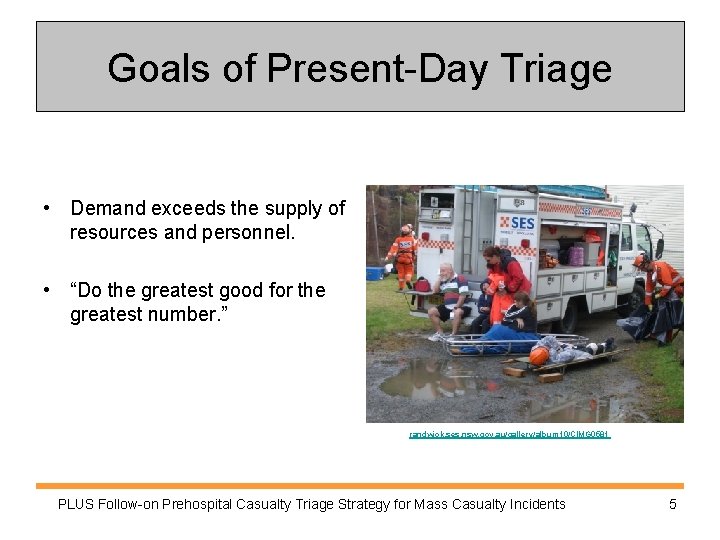
Goals of Present-Day Triage • Demand exceeds the supply of resources and personnel. • “Do the greatest good for the greatest number. ” randwick. ses. nsw. gov. au/gallery/album 10/CIMG 0581 PLUS Follow-on Prehospital Casualty Triage Strategy for Mass Casualty Incidents 5
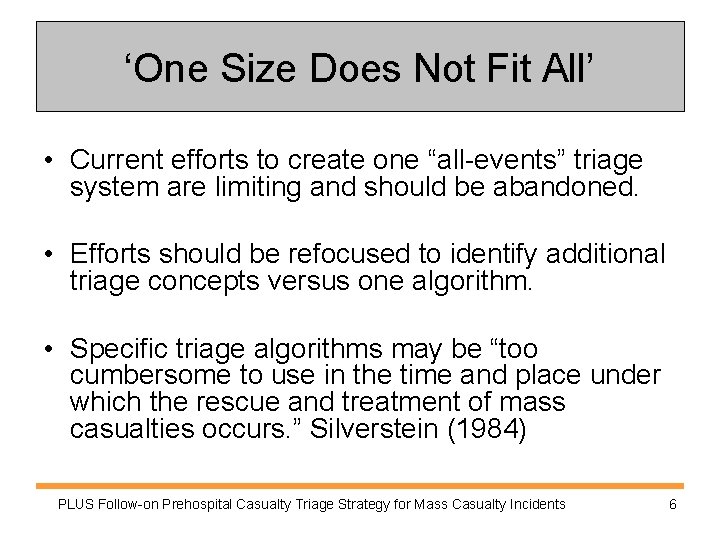
‘One Size Does Not Fit All’ • Current efforts to create one “all-events” triage system are limiting and should be abandoned. • Efforts should be refocused to identify additional triage concepts versus one algorithm. • Specific triage algorithms may be “too cumbersome to use in the time and place under which the rescue and treatment of mass casualties occurs. ” Silverstein (1984) PLUS Follow-on Prehospital Casualty Triage Strategy for Mass Casualty Incidents 6
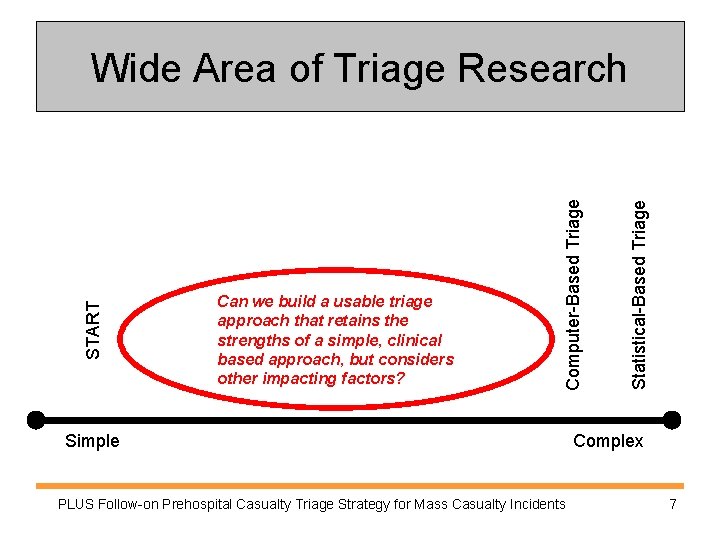
Simple PLUS Follow-on Prehospital Casualty Triage Strategy for Mass Casualty Incidents Statistical-Based Triage Can we build a usable triage approach that retains the strengths of a simple, clinical based approach, but considers other impacting factors? Computer-Based Triage START Wide Area of Triage Research Complex 7
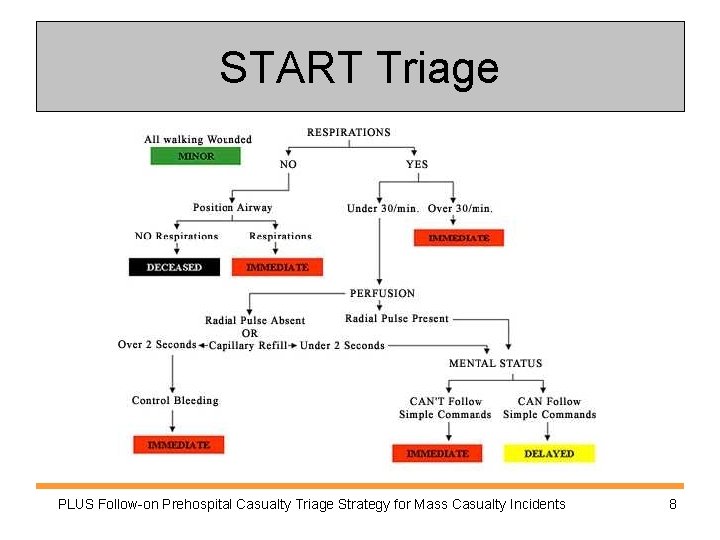
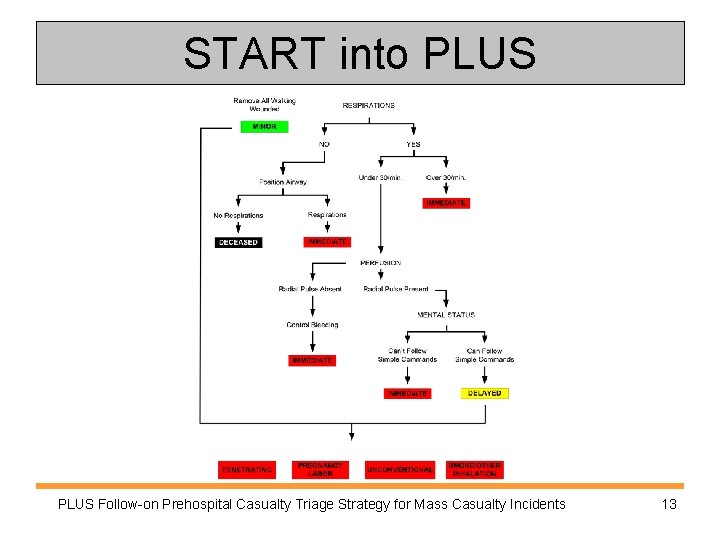
START Triage PLUS Follow-on Prehospital Casualty Triage Strategy for Mass Casualty Incidents 8
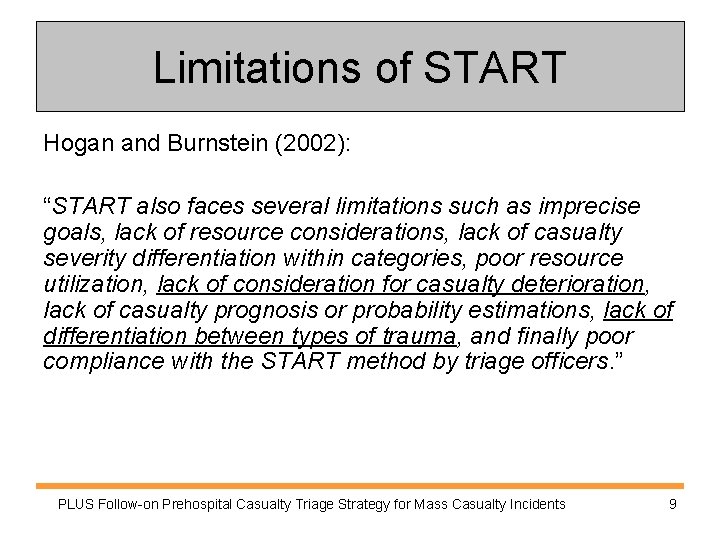
Limitations of START Hogan and Burnstein (2002): “START also faces several limitations such as imprecise goals, lack of resource considerations, lack of casualty severity differentiation within categories, poor resource utilization, lack of consideration for casualty deterioration, lack of casualty prognosis or probability estimations, lack of differentiation between types of trauma, and finally poor compliance with the START method by triage officers. ” PLUS Follow-on Prehospital Casualty Triage Strategy for Mass Casualty Incidents 9
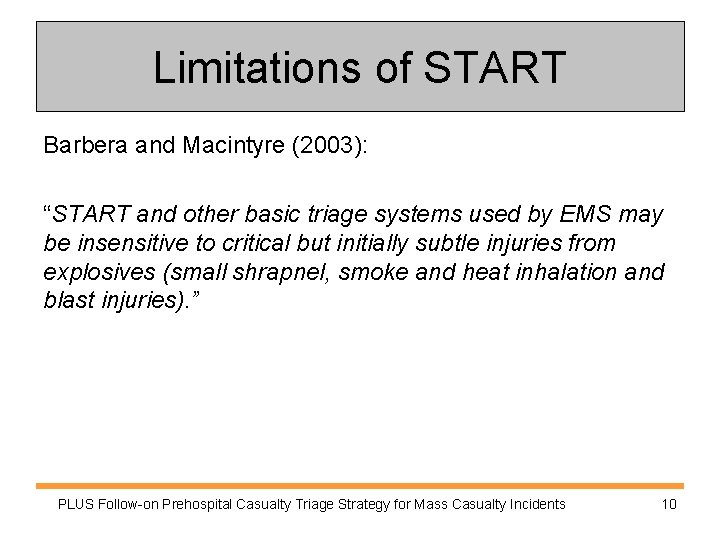
Limitations of START Barbera and Macintyre (2003): “START and other basic triage systems used by EMS may be insensitive to critical but initially subtle injuries from explosives (small shrapnel, smoke and heat inhalation and blast injuries). ” PLUS Follow-on Prehospital Casualty Triage Strategy for Mass Casualty Incidents 10
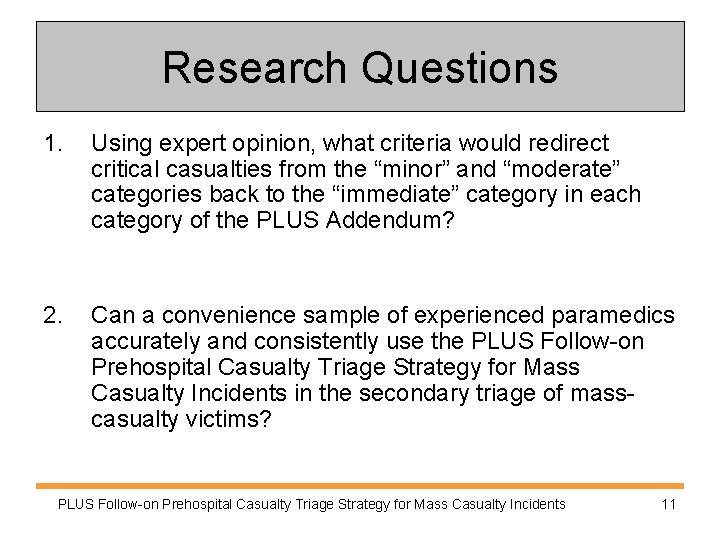
Research Questions 1. Using expert opinion, what criteria would redirect critical casualties from the “minor” and “moderate” categories back to the “immediate” category in each category of the PLUS Addendum? 2. Can a convenience sample of experienced paramedics accurately and consistently use the PLUS Follow-on Prehospital Casualty Triage Strategy for Mass Casualty Incidents in the secondary triage of masscasualty victims? PLUS Follow-on Prehospital Casualty Triage Strategy for Mass Casualty Incidents 11
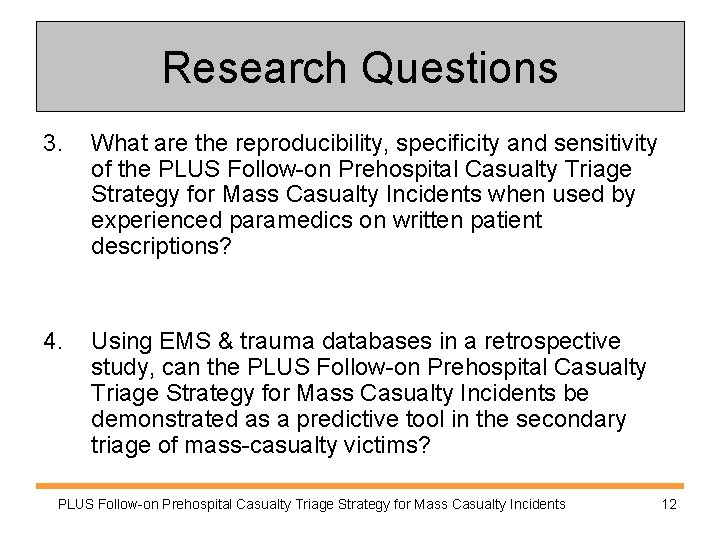
Research Questions 3. What are the reproducibility, specificity and sensitivity of the PLUS Follow-on Prehospital Casualty Triage Strategy for Mass Casualty Incidents when used by experienced paramedics on written patient descriptions? 4. Using EMS & trauma databases in a retrospective study, can the PLUS Follow-on Prehospital Casualty Triage Strategy for Mass Casualty Incidents be demonstrated as a predictive tool in the secondary triage of mass-casualty victims? PLUS Follow-on Prehospital Casualty Triage Strategy for Mass Casualty Incidents 12
START into PLUS Follow-on Prehospital Casualty Triage Strategy for Mass Casualty Incidents 13
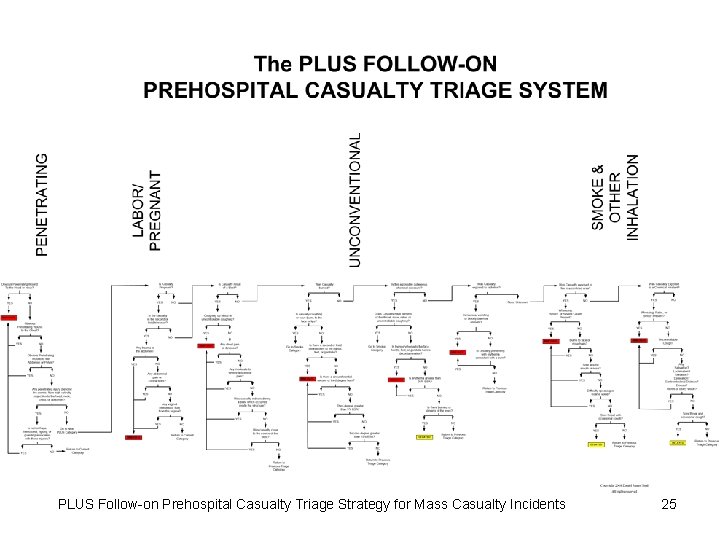
Description of PLUS Categories Mechanism of Injury[1] Suggested Criteria[2] Penetrating Trauma Penetrating injuries to the head, neck, chest, abdomen, or pelvis Penetrating injuries with suspected high mechanism Labor/Pregnant Casualties Pregnant casualties with injuries Casualties in active labor Unconventional Casualties Blast Injuries Burn Injuries Radiation Injuries Cutaneous Chemical Exposure Injuries Smoke and other inhalations Smoke Inhalation Other Chemical Inhalations [1] “Mechanism of Injury” is a description that depicts “the strength, direction, and nature of forces that cause injury to a patient. ” [2] Suggested Criteria: criteria identified from the literature and research sources that identified the extent and significance of a casualty’s injury. PLUS Follow-on Prehospital Casualty Triage Strategy for Mass Casualty Incidents 14
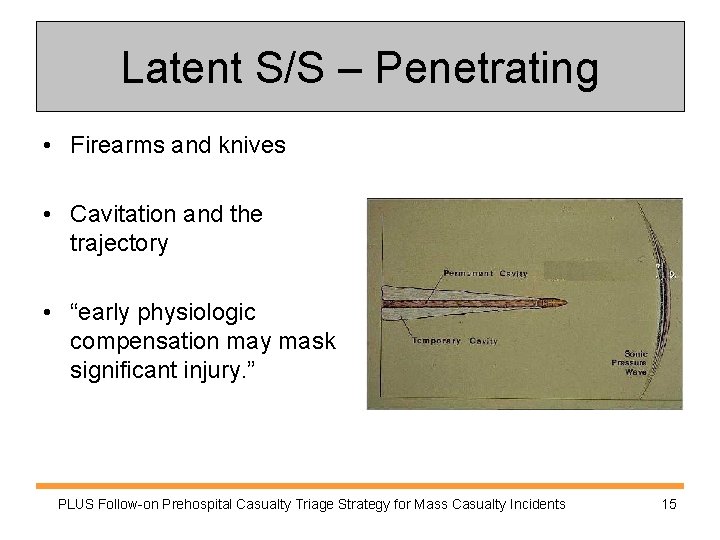
Latent S/S – Penetrating • Firearms and knives • Cavitation and the trajectory • “early physiologic compensation may mask significant injury. ” PLUS Follow-on Prehospital Casualty Triage Strategy for Mass Casualty Incidents 15
Latent S/S – Pregnant/Labor • Physiological changes. – Circulating blood volume increases by 50%. – Increasing heart rate. – Decreasing blood pressure. • “Bleeding can occur intraperitoneally, and the signs of rebound, guarding, and rigidity may not be present”. • “The most common cause of fetal death is maternal death. ” PLUS Follow-on Prehospital Casualty Triage Strategy for Mass Casualty Incidents 16
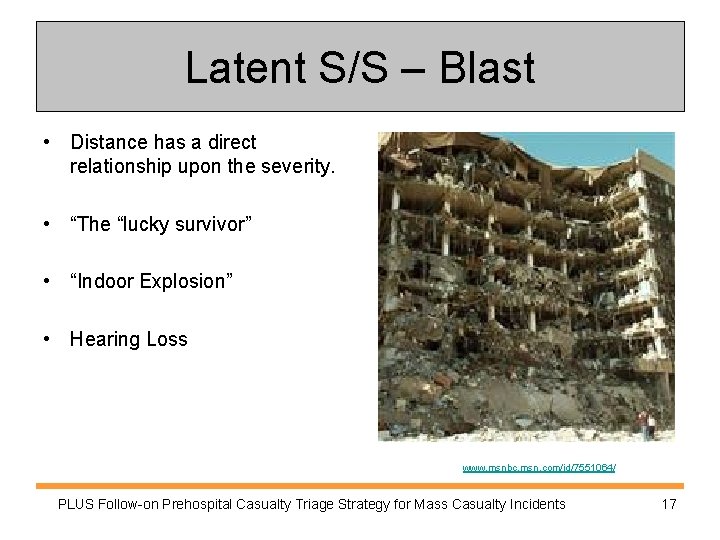
Latent S/S – Blast • Distance has a direct relationship upon the severity. • “The “lucky survivor” • “Indoor Explosion” • Hearing Loss www. msnbc. msn. com/id/7551064/ PLUS Follow-on Prehospital Casualty Triage Strategy for Mass Casualty Incidents 17
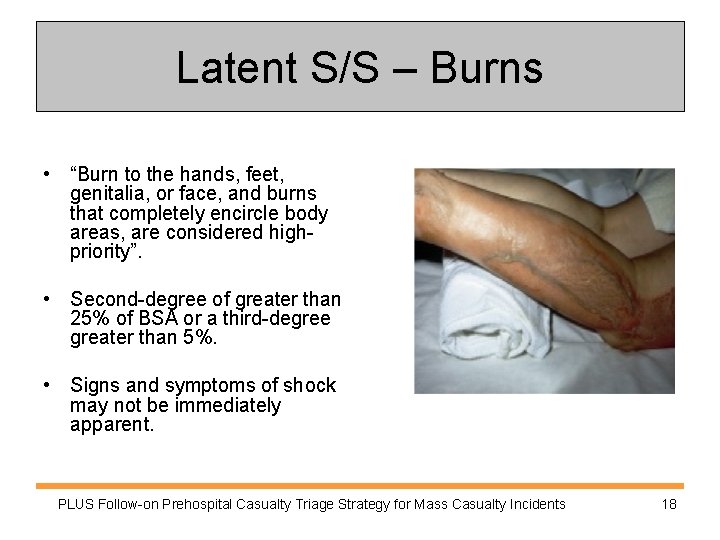
Latent S/S – Burns • “Burn to the hands, feet, genitalia, or face, and burns that completely encircle body areas, are considered highpriority”. • Second-degree of greater than 25% of BSA or a third-degree greater than 5%. • Signs and symptoms of shock may not be immediately apparent. PLUS Follow-on Prehospital Casualty Triage Strategy for Mass Casualty Incidents 18
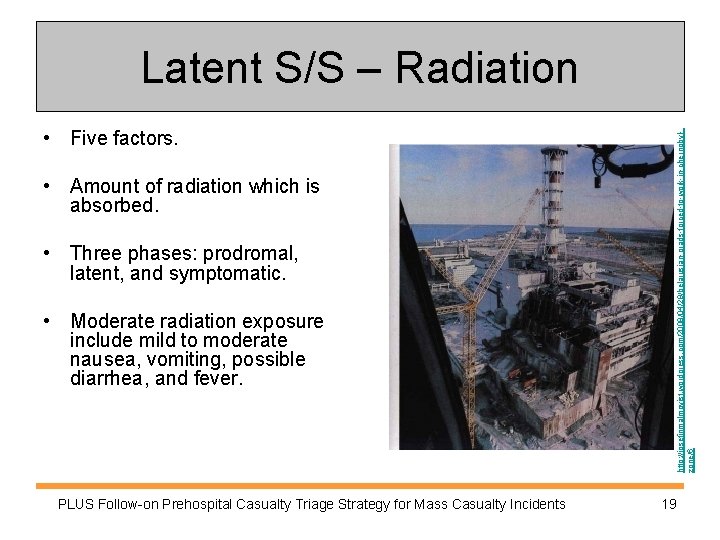
• Five factors. • Amount of radiation which is absorbed. • Three phases: prodromal, latent, and symptomatic. • Moderate radiation exposure include mild to moderate nausea, vomiting, possible diarrhea, and fever. PLUS Follow-on Prehospital Casualty Triage Strategy for Mass Casualty Incidents http: //josefinmalmqvist. wordpress. com/2008/04/29/belarusian-grads-forced-to-work-in-chernobylzone/6 Latent S/S – Radiation 19
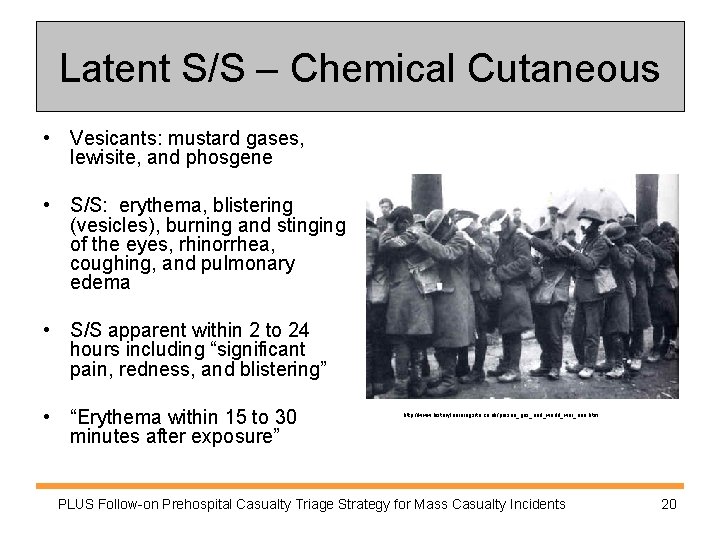
Latent S/S – Chemical Cutaneous • Vesicants: mustard gases, lewisite, and phosgene • S/S: erythema, blistering (vesicles), burning and stinging of the eyes, rhinorrhea, coughing, and pulmonary edema • S/S apparent within 2 to 24 hours including “significant pain, redness, and blistering” • “Erythema within 15 to 30 minutes after exposure” http: //www. historylearningsite. co. uk/poison_gas_and_world_war_one. htm PLUS Follow-on Prehospital Casualty Triage Strategy for Mass Casualty Incidents 20
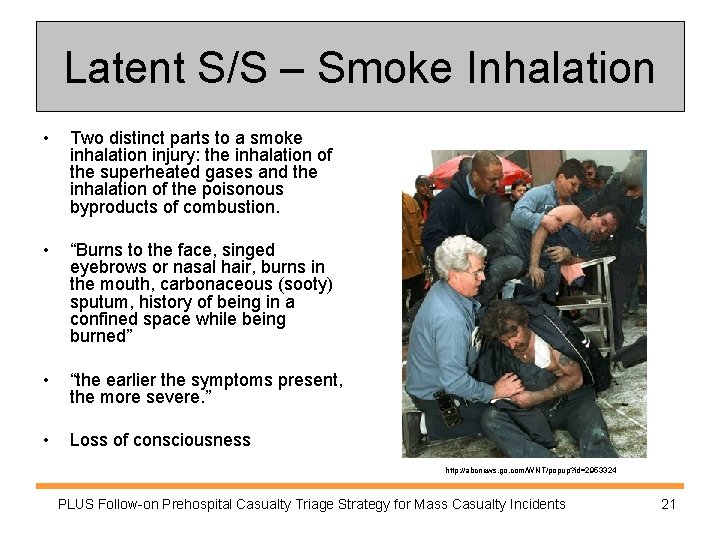
Latent S/S – Smoke Inhalation • Two distinct parts to a smoke inhalation injury: the inhalation of the superheated gases and the inhalation of the poisonous byproducts of combustion. • “Burns to the face, singed eyebrows or nasal hair, burns in the mouth, carbonaceous (sooty) sputum, history of being in a confined space while being burned” • “the earlier the symptoms present, the more severe. ” • Loss of consciousness http: //abcnews. go. com/WNT/popup? id=2953324 PLUS Follow-on Prehospital Casualty Triage Strategy for Mass Casualty Incidents 21
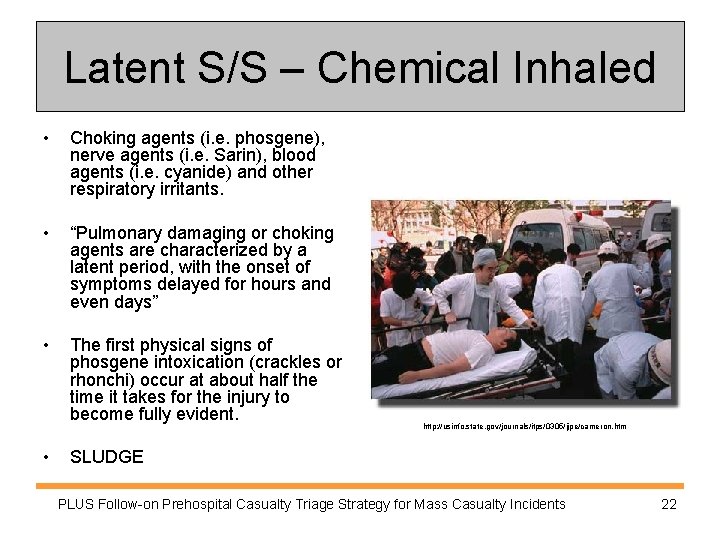
Latent S/S – Chemical Inhaled • Choking agents (i. e. phosgene), nerve agents (i. e. Sarin), blood agents (i. e. cyanide) and other respiratory irritants. • “Pulmonary damaging or choking agents are characterized by a latent period, with the onset of symptoms delayed for hours and even days” • The first physical signs of phosgene intoxication (crackles or rhonchi) occur at about half the time it takes for the injury to become fully evident. • http: //usinfo. state. gov/journals/itps/0305/ijpe/cameron. htm SLUDGE PLUS Follow-on Prehospital Casualty Triage Strategy for Mass Casualty Incidents 22
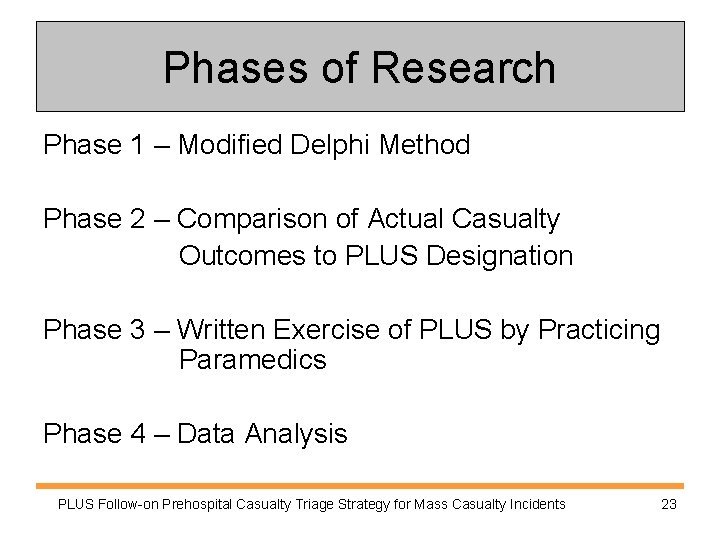
Phases of Research Phase 1 – Modified Delphi Method Phase 2 – Comparison of Actual Casualty Outcomes to PLUS Designation Phase 3 – Written Exercise of PLUS by Practicing Paramedics Phase 4 – Data Analysis PLUS Follow-on Prehospital Casualty Triage Strategy for Mass Casualty Incidents 23
Phase 1: Modified Delphi Method • Six (6) prehospital casualty care experts were selected using a convenience sample. • Conducted three (3) iterations to build consensus. • Identify (and/or support) criteria for “upgrade from minor or moderate to immediate” for each mechanism of injury. PLUS Follow-on Prehospital Casualty Triage Strategy for Mass Casualty Incidents 24
PLUS Follow-on Prehospital Casualty Triage Strategy for Mass Casualty Incidents 25
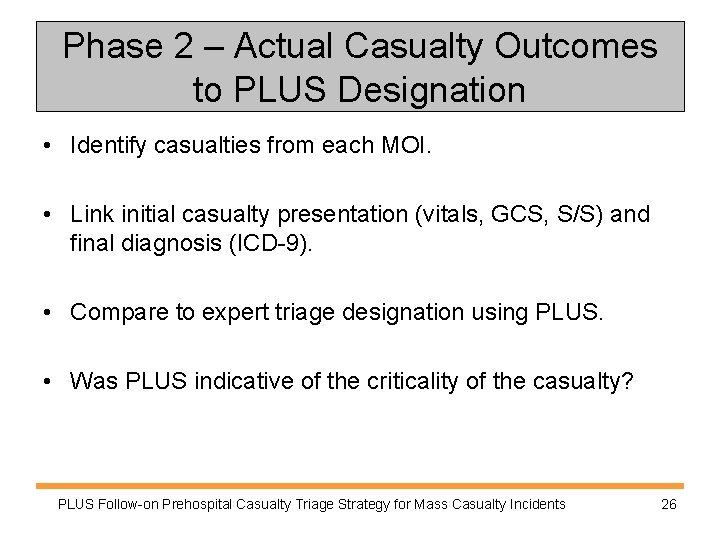
Phase 2 – Actual Casualty Outcomes to PLUS Designation • Identify casualties from each MOI. • Link initial casualty presentation (vitals, GCS, S/S) and final diagnosis (ICD-9). • Compare to expert triage designation using PLUS. • Was PLUS indicative of the criticality of the casualty? PLUS Follow-on Prehospital Casualty Triage Strategy for Mass Casualty Incidents 26
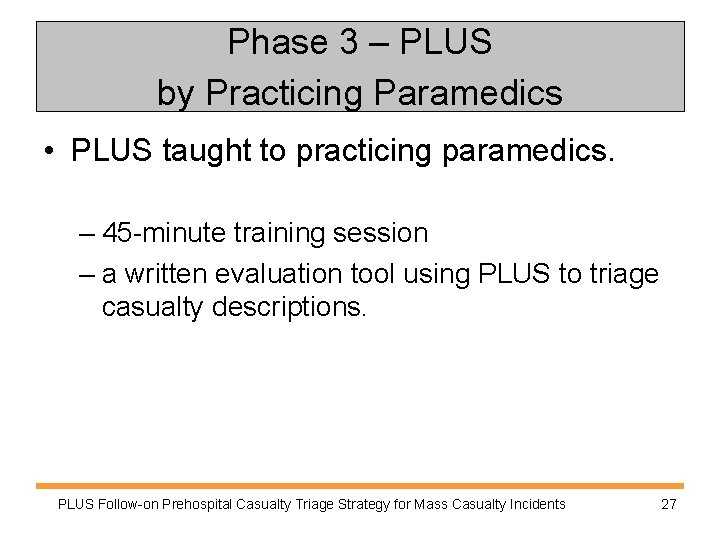
Phase 3 – PLUS by Practicing Paramedics • PLUS taught to practicing paramedics. – 45 -minute training session – a written evaluation tool using PLUS to triage casualty descriptions. PLUS Follow-on Prehospital Casualty Triage Strategy for Mass Casualty Incidents 27
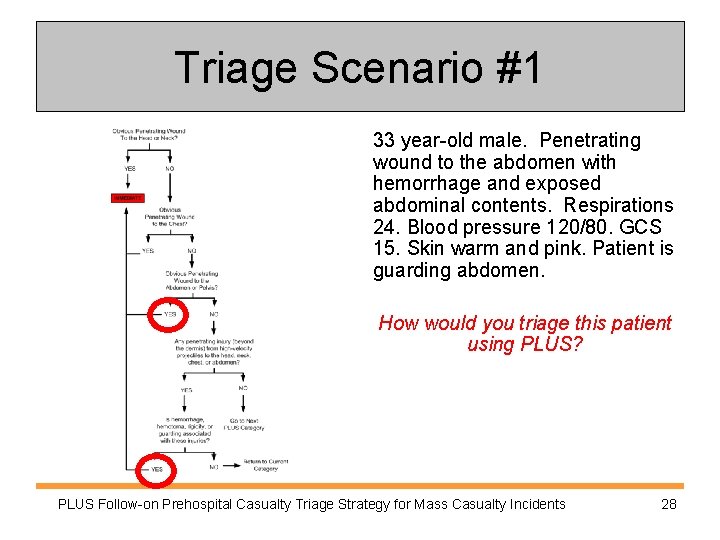
Triage Scenario #1 33 year-old male. Penetrating wound to the abdomen with hemorrhage and exposed abdominal contents. Respirations 24. Blood pressure 120/80. GCS 15. Skin warm and pink. Patient is guarding abdomen. How would you triage this patient using PLUS? PLUS Follow-on Prehospital Casualty Triage Strategy for Mass Casualty Incidents 28
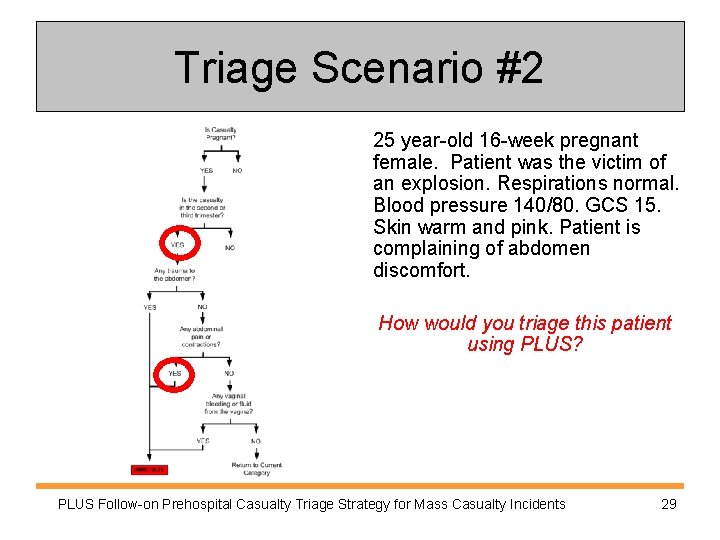
Triage Scenario #2 25 year-old 16 -week pregnant female. Patient was the victim of an explosion. Respirations normal. Blood pressure 140/80. GCS 15. Skin warm and pink. Patient is complaining of abdomen discomfort. How would you triage this patient using PLUS? PLUS Follow-on Prehospital Casualty Triage Strategy for Mass Casualty Incidents 29
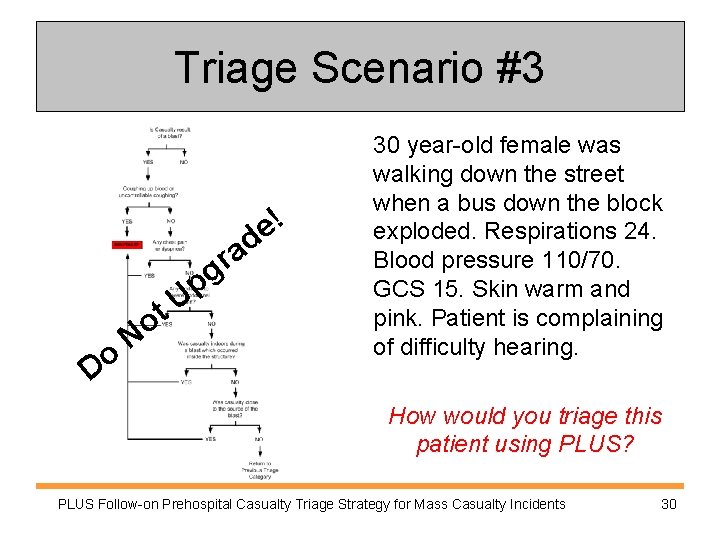
Triage Scenario #3 ! e d a r g p o D U t o N 30 year-old female was walking down the street when a bus down the block exploded. Respirations 24. Blood pressure 110/70. GCS 15. Skin warm and pink. Patient is complaining of difficulty hearing. How would you triage this patient using PLUS? PLUS Follow-on Prehospital Casualty Triage Strategy for Mass Casualty Incidents 30
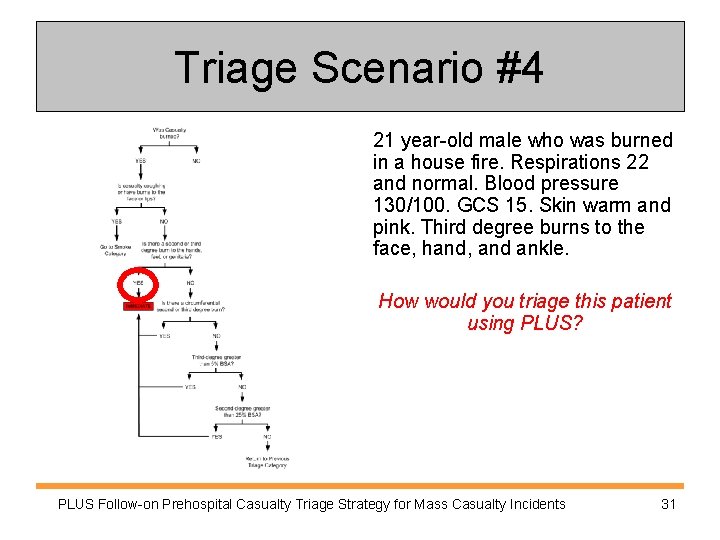
Triage Scenario #4 21 year-old male who was burned in a house fire. Respirations 22 and normal. Blood pressure 130/100. GCS 15. Skin warm and pink. Third degree burns to the face, hand, and ankle. How would you triage this patient using PLUS? PLUS Follow-on Prehospital Casualty Triage Strategy for Mass Casualty Incidents 31
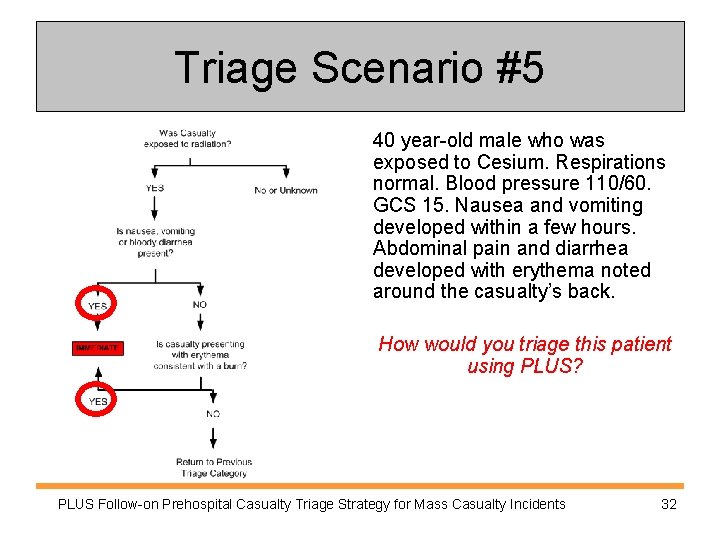
Triage Scenario #5 40 year-old male who was exposed to Cesium. Respirations normal. Blood pressure 110/60. GCS 15. Nausea and vomiting developed within a few hours. Abdominal pain and diarrhea developed with erythema noted around the casualty’s back. How would you triage this patient using PLUS? PLUS Follow-on Prehospital Casualty Triage Strategy for Mass Casualty Incidents 32
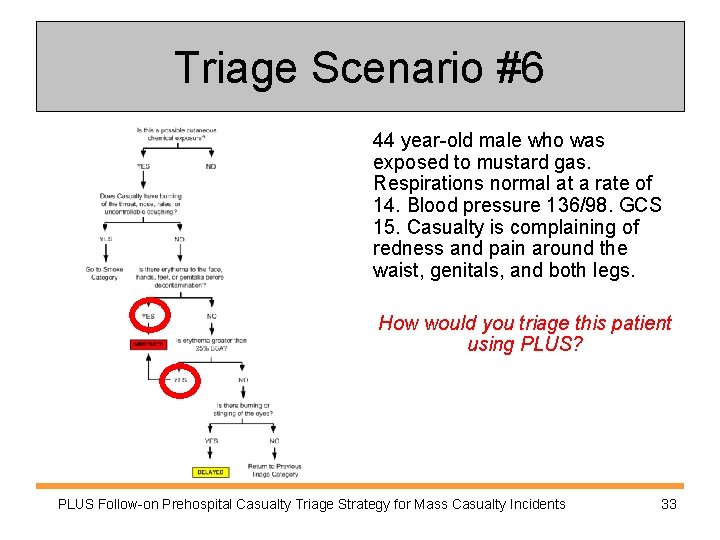
Triage Scenario #6 44 year-old male who was exposed to mustard gas. Respirations normal at a rate of 14. Blood pressure 136/98. GCS 15. Casualty is complaining of redness and pain around the waist, genitals, and both legs. How would you triage this patient using PLUS? PLUS Follow-on Prehospital Casualty Triage Strategy for Mass Casualty Incidents 33
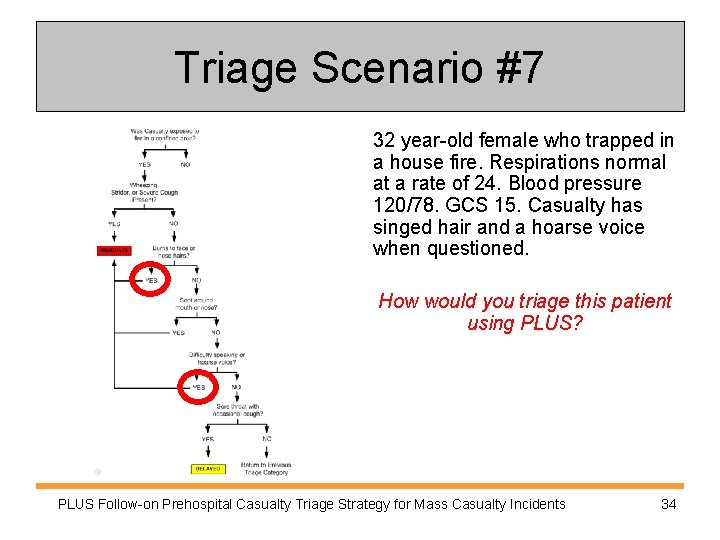
Triage Scenario #7 32 year-old female who trapped in a house fire. Respirations normal at a rate of 24. Blood pressure 120/78. GCS 15. Casualty has singed hair and a hoarse voice when questioned. How would you triage this patient using PLUS? PLUS Follow-on Prehospital Casualty Triage Strategy for Mass Casualty Incidents 34
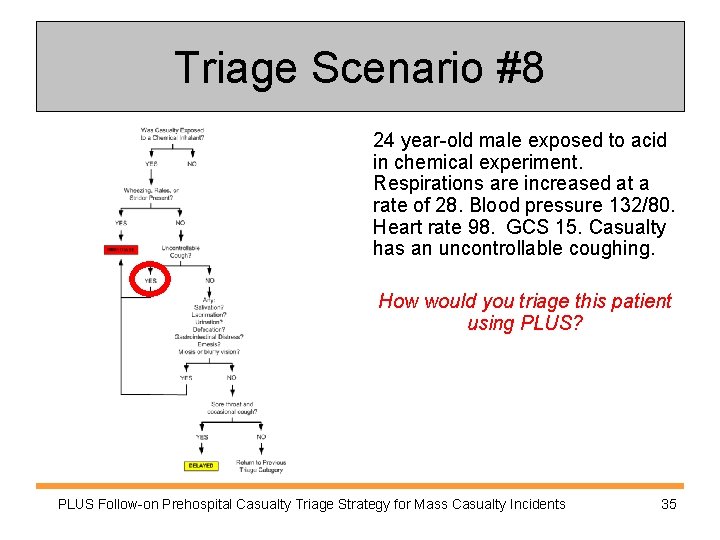
Triage Scenario #8 24 year-old male exposed to acid in chemical experiment. Respirations are increased at a rate of 28. Blood pressure 132/80. Heart rate 98. GCS 15. Casualty has an uncontrollable coughing. How would you triage this patient using PLUS? PLUS Follow-on Prehospital Casualty Triage Strategy for Mass Casualty Incidents 35
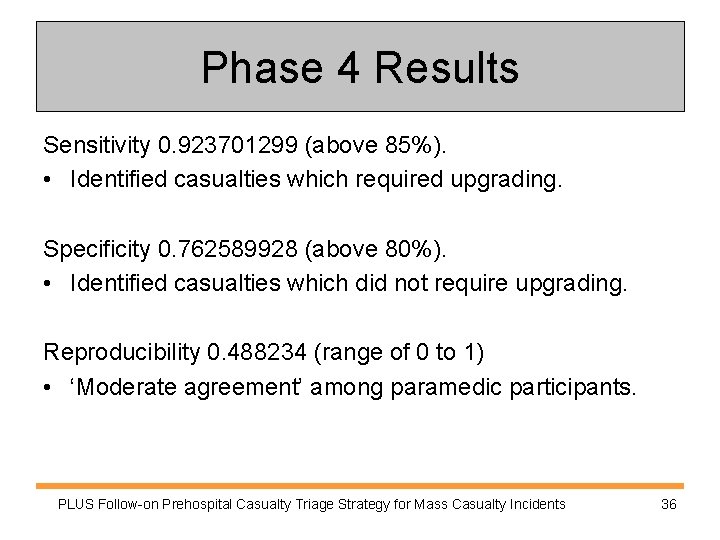
Phase 4 Results Sensitivity 0. 923701299 (above 85%). • Identified casualties which required upgrading. Specificity 0. 762589928 (above 80%). • Identified casualties which did not require upgrading. Reproducibility 0. 488234 (range of 0 to 1) • ‘Moderate agreement’ among paramedic participants. PLUS Follow-on Prehospital Casualty Triage Strategy for Mass Casualty Incidents 36
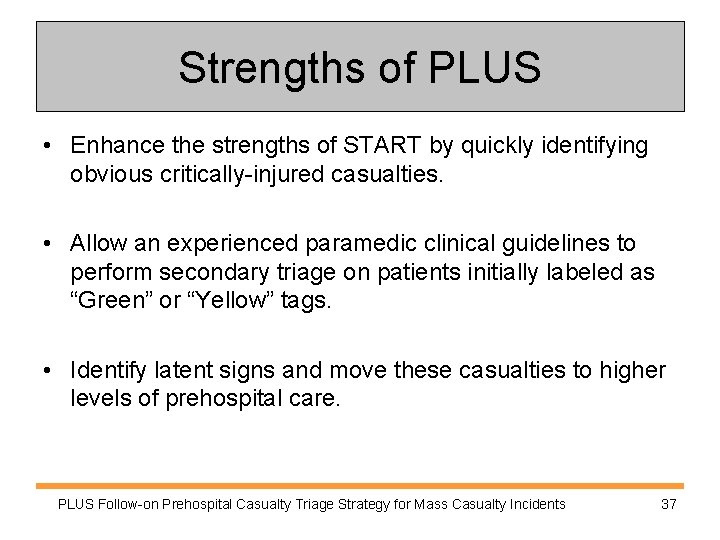
Strengths of PLUS • Enhance the strengths of START by quickly identifying obvious critically-injured casualties. • Allow an experienced paramedic clinical guidelines to perform secondary triage on patients initially labeled as “Green” or “Yellow” tags. • Identify latent signs and move these casualties to higher levels of prehospital care. PLUS Follow-on Prehospital Casualty Triage Strategy for Mass Casualty Incidents 37
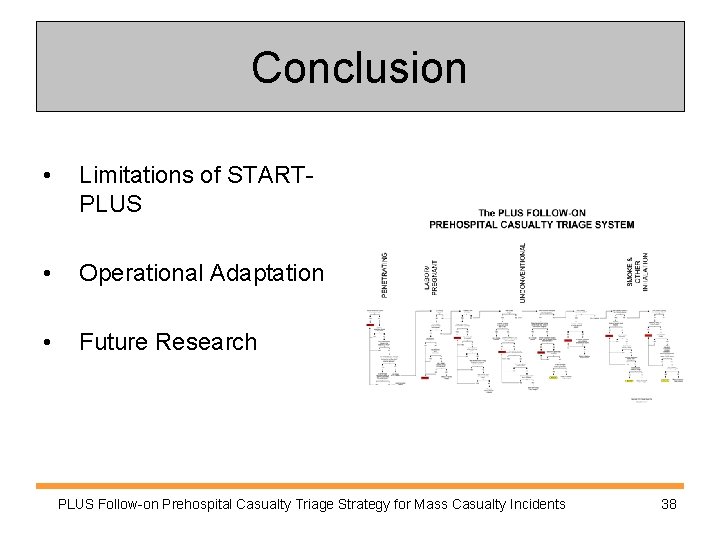
Conclusion • Limitations of STARTPLUS • Operational Adaptation • Future Research PLUS Follow-on Prehospital Casualty Triage Strategy for Mass Casualty Incidents 38
Discussion Daniel J. Neal danielneal@verizon. net PLUS Follow-on Prehospital Casualty Triage Strategy for Mass Casualty Incidents