
Prehospital Air Medical Plasma PAMPer Trial TACTIC at







- Slides: 28
Prehospital Air Medical Plasma (PAMPer) Trial TACTIC at AAST September 9 th
Hemorrhage Following Injury
Introduction • Over 25% of injured patients present with coagulopathy upon arrival to trauma center • Paying attention to or preventing coagulopathy early post injury improves outcome • Does prehospital plasma improve outcomes?
PAMPer • Multi-center, prospective, randomized, open label, interventional trial over 4 years focusing on patients with hemorrhagic shock who are transported via air medical transport to definitive care.
AIMs • Primary Aim #1: Determine whether prehospital infusion of AB plasma (2 units) as compared to standard air medical care results in a reduction in 30 day mortality • Secondary Aim #1: Lower 24 hour blood transfusion volume, lower incidence of MOF, NI, ALI and TRALI. • Secondary Aim #2: Reduction of blood component transfusion and resuscitation requirements over the first 24 hours post-injury. • Secondary Aim #3: Improved coagulation measurements (INR, PT/PTT) and TEG parameters. • Secondary Aim #4: Lower levels of early IL-6 cytokine expression, reduced thrombomodulin and increased protein C levels.
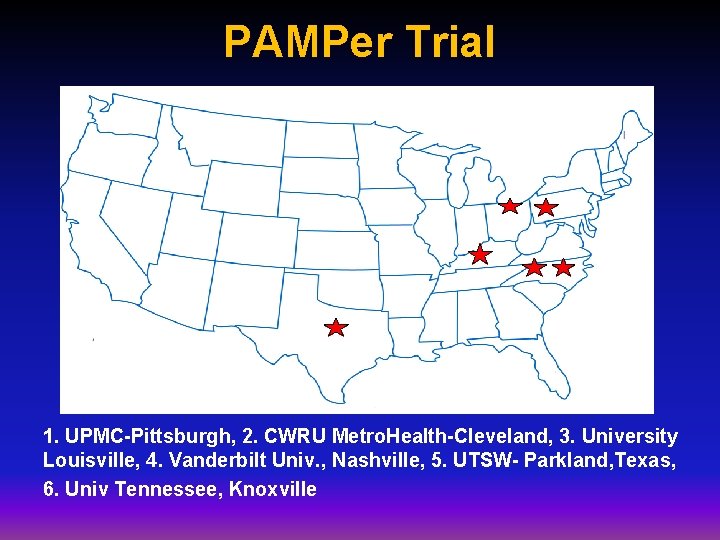
PAMPer Trial 1. UPMC-Pittsburgh, 2. CWRU Metro. Health-Cleveland, 3. University Louisville, 4. Vanderbilt Univ. , Nashville, 5. UTSW- Parkland, Texas, 6. Univ Tennessee, Knoxville
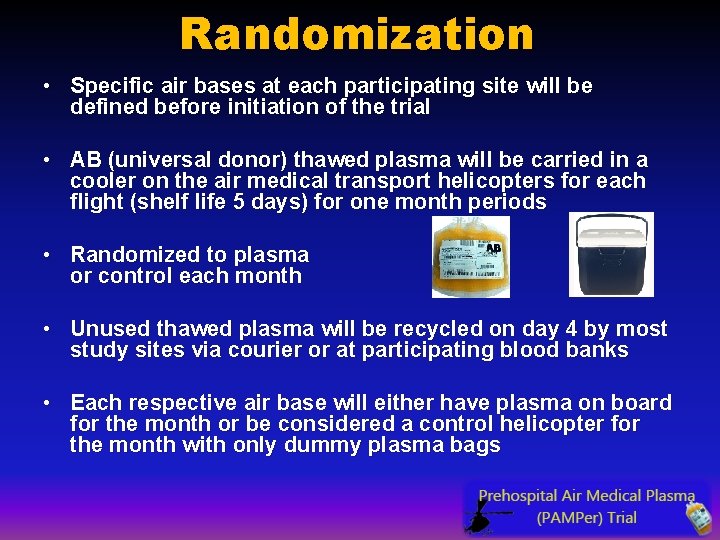
Randomization • Specific air bases at each participating site will be defined before initiation of the trial • AB (universal donor) thawed plasma will be carried in a cooler on the air medical transport helicopters for each flight (shelf life 5 days) for one month periods • Randomized to plasma or control each month • Unused thawed plasma will be recycled on day 4 by most study sites via courier or at participating blood banks • Each respective air base will either have plasma on board for the month or be considered a control helicopter for the month with only dummy plasma bags
Inclusion Criteria Requires #1 and #2 or #3 #1. Transporting from scene or referral hospital to PAMPer site AND #2. Systolic blood pressure below 90 mm. Hg and tachycardia > 108 BPM at scene, at the outside hospital with transport team present or during helicopter transport OR #3. Systolic blood pressure below 70 mm. Hg at scene or at outside hospital with transport team present or during helicopter transport
Intervention During plasma months: • 2 units of AB+ thawed plasma will be initiated en route during air medical transport after inclusion/exclusion criteria are met • Full intervention (2 units) will be given with continuation of infusion following arrival if not completed
Standard Operating Procedures Receives Intervention or Control Goal Directed Prehospital resuscitation SOP: Hypotension (SBP< 90))? YES Crystalloid Bolus or Blood Transfusion NO Maintenance crystalloid infusion only Continuation in -hospital resuscitation/care Trauma Center Arrival
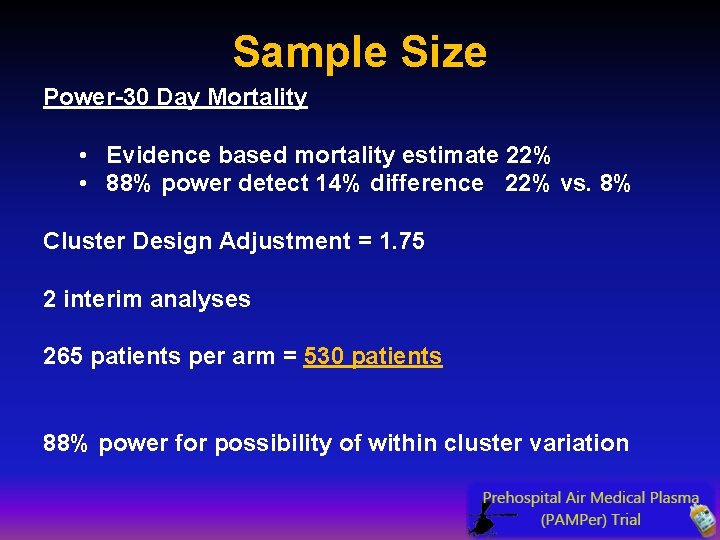
Sample Size Power-30 Day Mortality • Evidence based mortality estimate 22% • 88% power detect 14% difference 22% vs. 8% Cluster Design Adjustment = 1. 75 2 interim analyses 265 patients per arm = 530 patients 88% power for possibility of within cluster variation
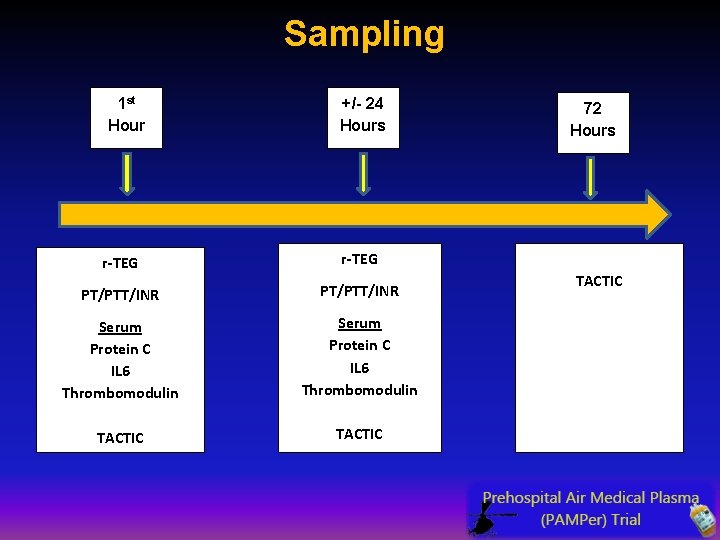
Sampling 1 st Hour +/- 24 Hours r-TEG PT/PTT/INR Serum Protein C IL 6 Thrombomodulin TACTIC 72 Hours TACTIC
Enrollment • Enrolled 21 patients • 3 Deaths – 1 Hemorrhagic shock – 1 Brain injury – 1 Combined
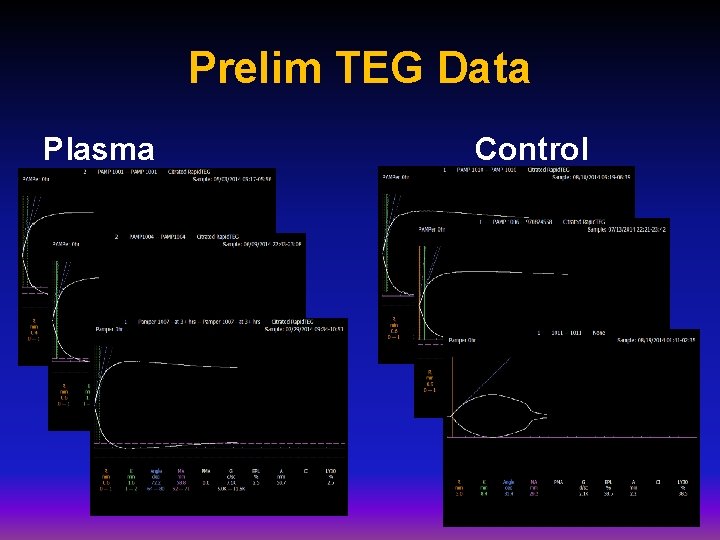
Prelim TEG Data Plasma Control
Questions ? ?
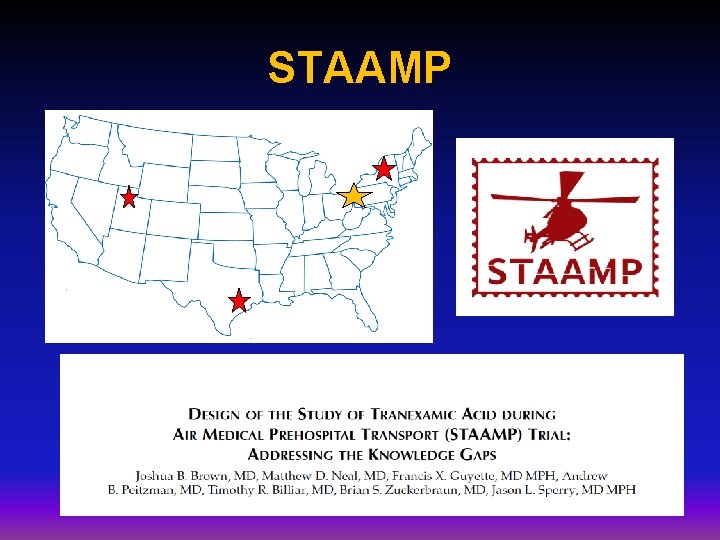
Study of Tranexamic Acid during Air Medical Prehospital Transport (STAAMP) Trial
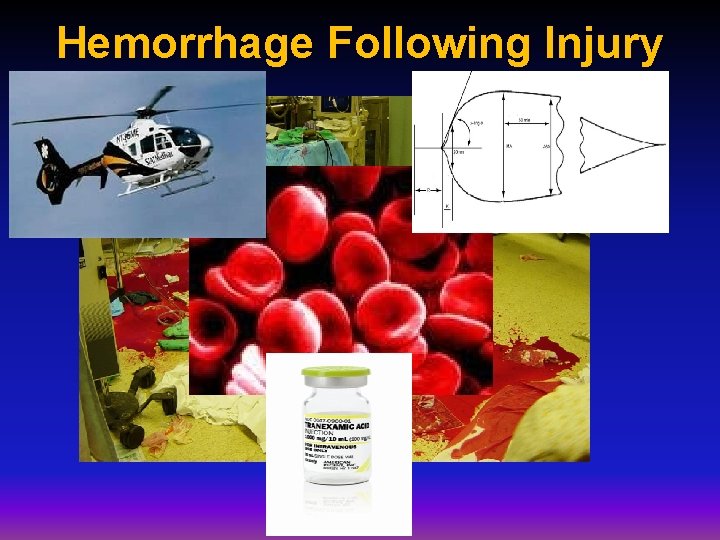
Hemorrhage Following Injury
Introduction • A recent single non-U. S. study suggests giving Tranexamic Acid (TXA) lowers mortality if given early after arrival to the hospital in patients at risk for bleeding post-injury • TXA is an Anti-fibrinolytic and Hyperfibrinolysis has been shown to be a risk factor for poor outcome and coagulopathy post-injury • Whether TXA safely lowers mortality in the US and how TXA lowers mortality post-injury if it does, remains unknown • Does prehospital TXA improve outcomes and by what mechanism?
STAAMP • Multi-center, prospective, randomized, blinded, controlled interventional trial over 3 years focusing on patients with concern for bleeding who are transported via air medical transport to definitive care.
STAAMP • Primary Aim#1: Determine whether prehospital tranexamic acid as compared to placebo results in a lower incidence of 30 day mortality • Secondary Aim#1: Lowers 24 hr motality, ALI, MOF, NI, early resuscitation and transfusion requirements. • Secondary Aim#2: Reduces hyperfibrinolysis, lowers the incidence of acute traumatic coagulopathy and improves early markers of coagulopathy. • Secondary Aim#3: To explore novel mechanisms by which prehospital TXA alters the inflammatory response independent of effects on hyperfibrinolysis; including analysis of platelet and leukocyte activation, plasmin levels and plasmin mediated complement activation and the early cytokine response to trauma. • Secondary Aim#4: Determine whether different dosing regimens of TXA upon arrival in the hospital are associated with improvements in hyperfibrinolysis, coagulopathy, clinical outcomes and the early inflammatory response.
STAAMP
Randomization • Specific air bases at each participating site will be defined before initiation of the trial • Predefined randomization in double blinded fashion will be prepared by pharmacy at the University Pittsburgh (IDS) • 10 cc of either TXA or sterile placebo will be mixed in provided 100 cc saline bag • Only TXA Intervention/Dose # will need to be recorded and provided to hospital research staff
Inclusion Criteria Requires #1 and #2 or #3 #1. Transporting from scene or referral hospital to STAAMP site within 2 hours of injury at risk of bleeding AND #2. Systolic blood pressure below 90 mm. Hg: • i. At scene of injury or during air medical transport • ii. Documented at referring hospital prior to air medical transport arrival OR #3. Tachycardia > 110 beats per minute: i. At scene of injury or during air medical transport • ii. Documented at referring hospital prior to air medical transport arrival
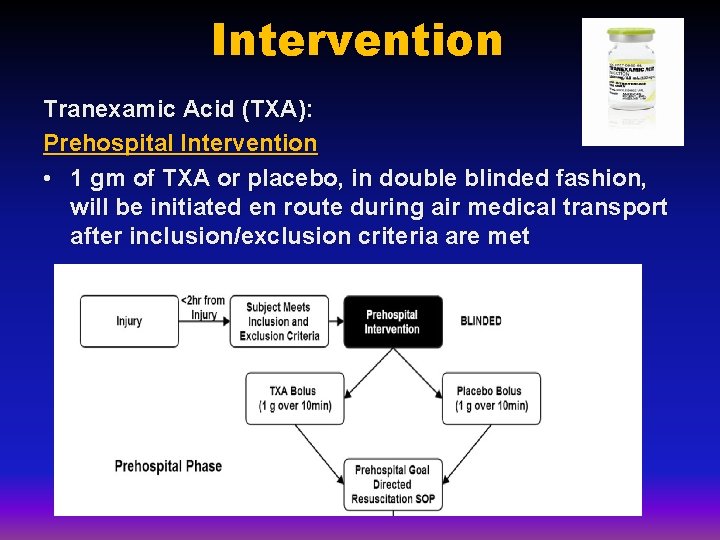
Intervention Tranexamic Acid (TXA): Prehospital Intervention • 1 gm of TXA or placebo, in double blinded fashion, will be initiated en route during air medical transport after inclusion/exclusion criteria are met
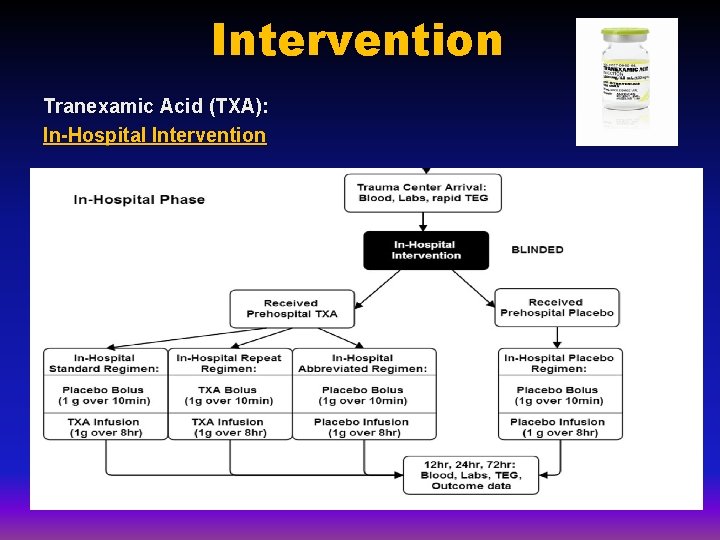
Intervention Tranexamic Acid (TXA): In-Hospital Intervention
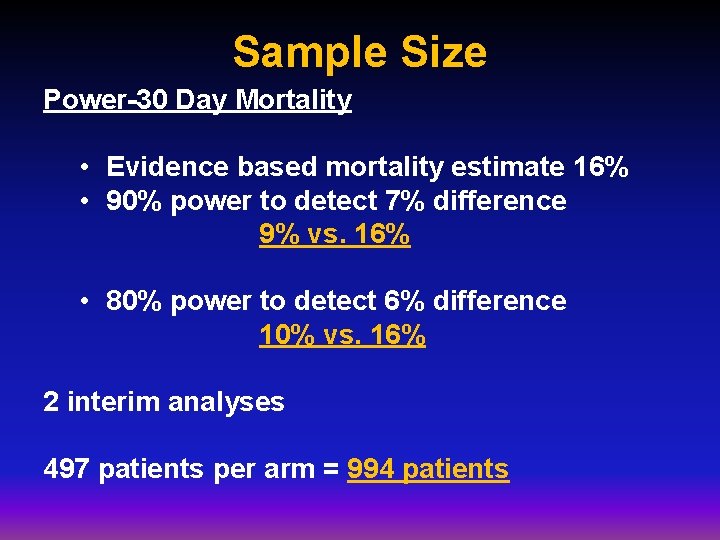
Sample Size Power-30 Day Mortality • Evidence based mortality estimate 16% • 90% power to detect 7% difference 9% vs. 16% • 80% power to detect 6% difference 10% vs. 16% 2 interim analyses 497 patients per arm = 994 patients
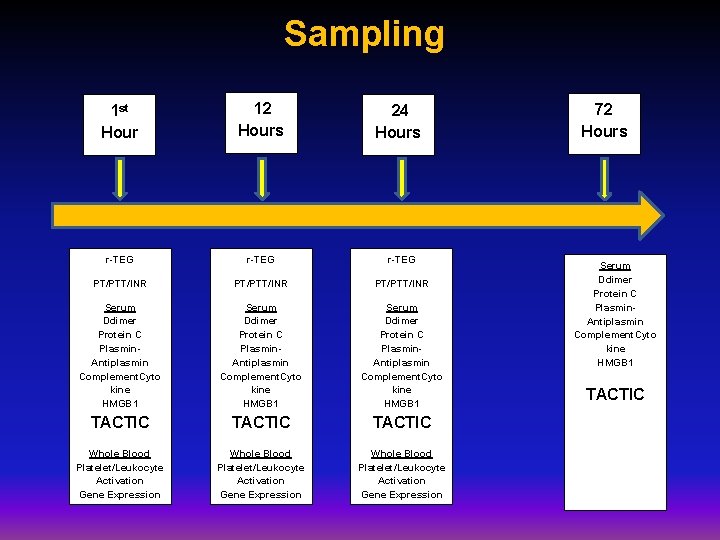
Sampling 1 st Hour 12 Hours r-TEG PT/PTT/INR Serum Ddimer Protein C Plasmin. Antiplasmin Complement. Cyto kine HMGB 1 TACTIC Whole Blood Platelet/Leukocyte Activation Gene Expression 24 Hours 72 Hours Serum Ddimer Protein C Plasmin. Antiplasmin Complement. Cyto kine HMGB 1 TACTIC
Questions ? ?