
PREGNANCY Objectives To be able to Identify with
PREGNANCY
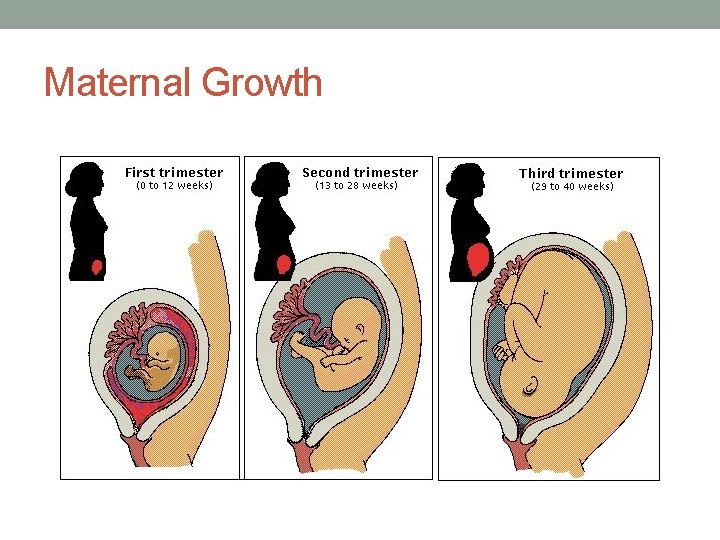
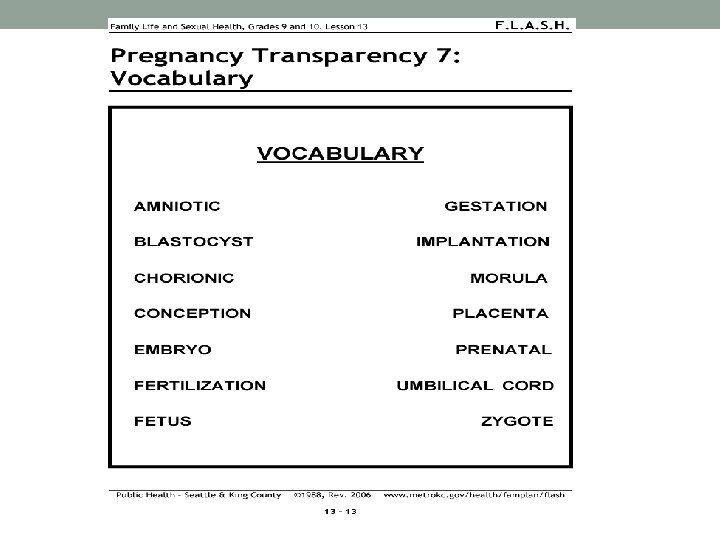
Objectives To be able to… • Identify, with 75% accuracy, the definitions of fourteen pregnancy- related terms. • Explain that the foundations of all organs and body systems are laid in the first trimester (three months) of pregnancy.

Homework Complete: • Individual Worksheet • Family Worksheet Due: Next Class
Today’s Lesson • Today’s lesson looks at the developing baby, from fertilization to birth. • By the end of the period: • most of you will know some new terminology • you’ll be able to explain the order in which the various parts develop. • We will examine pregnancy: • from the woman’s point of view. . . looking at what she can expect. • talking about how the parents(mother and father) can improve the chances the baby will be born healthy.
SPERMATOZOAN & OVUM
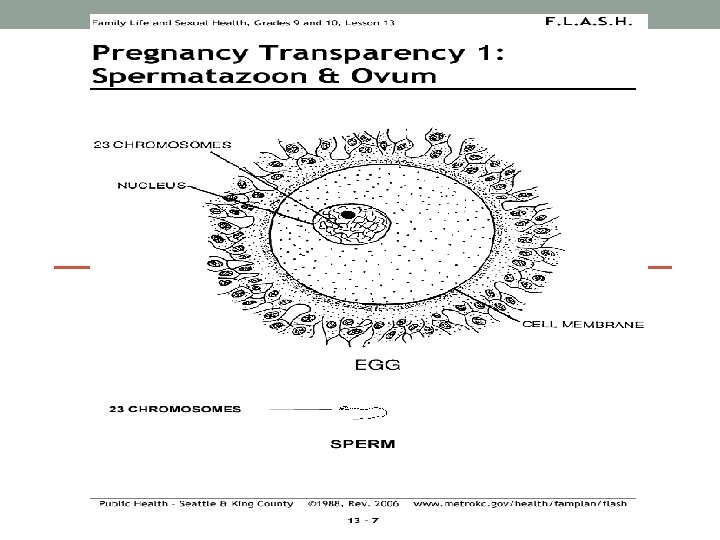
Spermatozoon & Ovum • The ovum, or egg cell: • the largest cell of the human body, about the size of a grain of sand. . . visible but only barely. • volume of the egg is about 85, 000 times the volume of a sperm. • The sperm: • much smaller. • resembles a tadpole. • head is about 1/10 as long as the whole sperm cell; • about three whole sperm cells could span the diameter of the egg.
Spermatozoon & Ovum • The human body is made of billions of cells. • The nucleus of each contains 23 pairs of chromosomes (46 separate ones). • Each of those chromosomes is a chain of genes; altogether, they contain between 50, 000 and 100, 000 genes. • Unlike other human cells, ova and sperm contain 23 individual chromosomes each, rather than 23 pairs.
FERTILIZATION
Fertilization • Usually, during sexual intercourse, hundreds of thousands of sperm are catapulted towards the cervix. • Traveling randomly • Many eventually die • Some quickly enter the uterus, with assistance from the cervical mucus, and travel toward the fallopian tubes. • If there is an ovum there (or if one is released within a few days) many sperm will try to penetrate its outer layers. • One may finally enter the ovum’s nucleus, forming a fertilized egg, or zygote. Fertilization is complete.
Fertilization • The new zygote contains a unique combination of genes: the blueprint for a new individual. • Appearance, health and even aspects of personality are determined by that genetic blueprint. http: //www. youtube. com/watch? v=h. Ag. Ok 3 lo. UY&feature=related
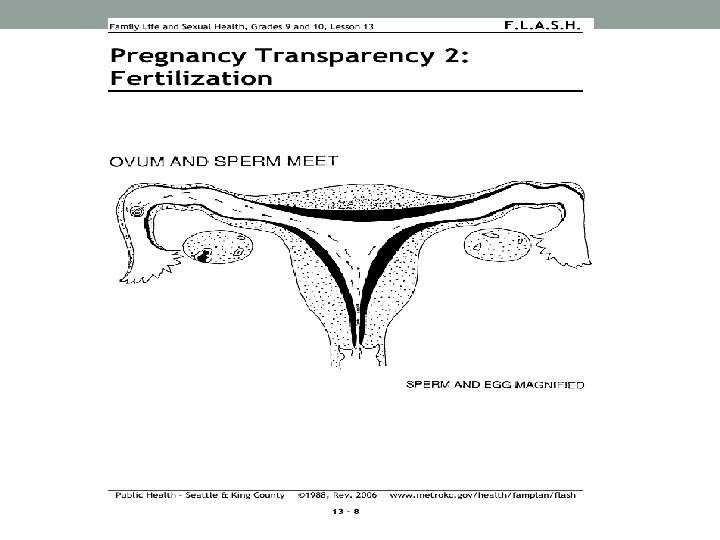

SEX DETERMINATION
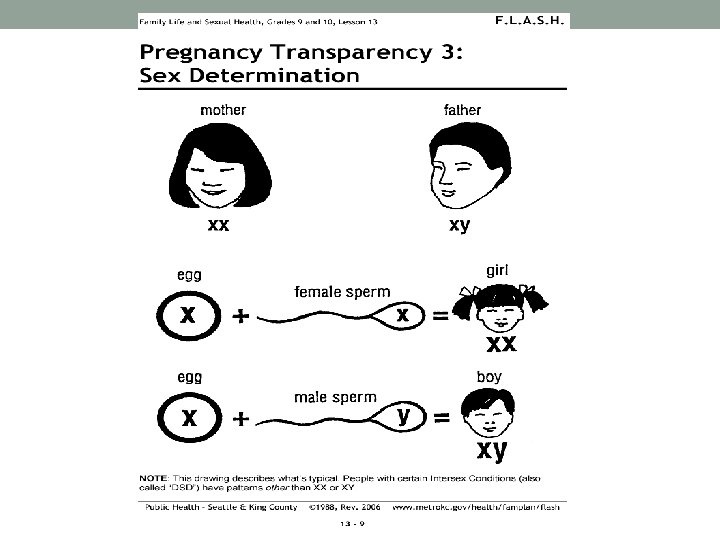
Sex Determination • Of each parent’s 23 pairs of chromosomes, one pair are the sex chromosomes. • The mother’s sex chromosomes are always a pair of X’s so when they part, to form 23 single chromosomes, each egg receives an X. • Men’s sex chromosomes, on the other hand, are always a pair consisting of one X and one Y. • So when the father’s chromosomes part to form spermatozoa, half the sperm receive an X and half receive a Y. • Thus, an X egg fertilized by an X sperm makes an XX baby: a girl. • An X egg (all eggs are X’s, remember) fertilized by a Y sperm makes an XY baby: a boy.

THE FIRST FEW DAYS
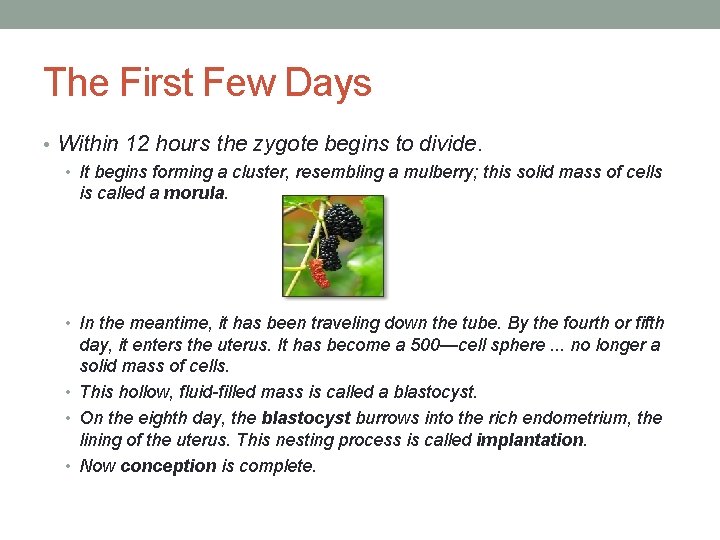
The First Few Days • Within 12 hours the zygote begins to divide. • It begins forming a cluster, resembling a mulberry; this solid mass of cells is called a morula. • In the meantime, it has been traveling down the tube. By the fourth or fifth day, it enters the uterus. It has become a 500—cell sphere. . . no longer a solid mass of cells. • This hollow, fluid-filled mass is called a blastocyst. • On the eighth day, the blastocyst burrows into the rich endometrium, the lining of the uterus. This nesting process is called implantation. • Now conception is complete.
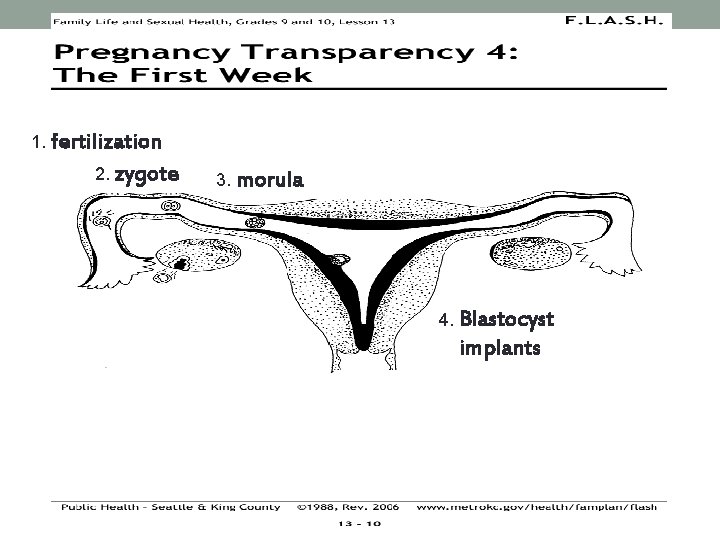
1. fertilization 2. zygote 3. morula 4. Blastocyst implants

CELLS SPECIALIZE
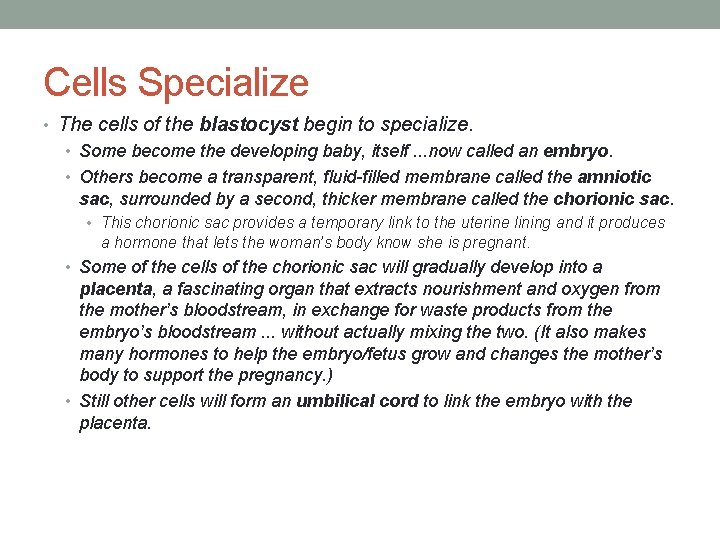
Cells Specialize • The cells of the blastocyst begin to specialize. • Some become the developing baby, itself. . . now called an embryo. • Others become a transparent, fluid-filled membrane called the amniotic sac, surrounded by a second, thicker membrane called the chorionic sac. • This chorionic sac provides a temporary link to the uterine lining and it produces a hormone that lets the woman’s body know she is pregnant. • Some of the cells of the chorionic sac will gradually develop into a placenta, a fascinating organ that extracts nourishment and oxygen from the mother’s bloodstream, in exchange for waste products from the embryo’s bloodstream. . . without actually mixing the two. (It also makes many hormones to help the embryo/fetus grow and changes the mother’s body to support the pregnancy. ) • Still other cells will form an umbilical cord to link the embryo with the placenta.
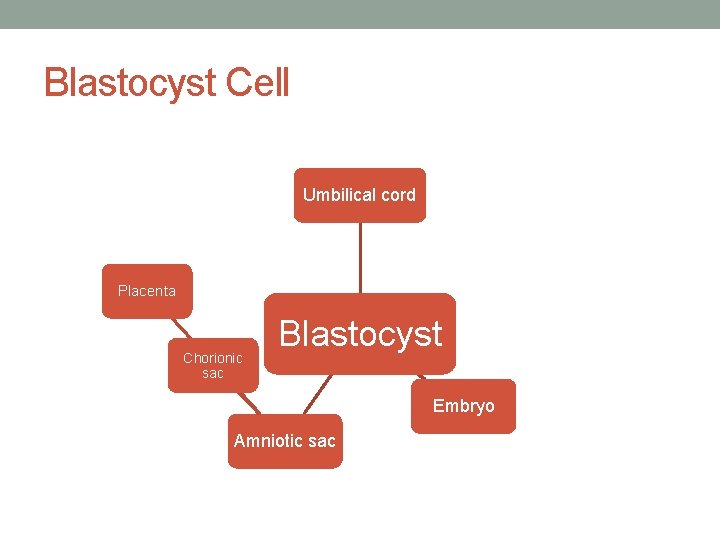
Blastocyst Cell Umbilical cord Placenta Chorionic sac Blastocyst Embryo Amniotic sac
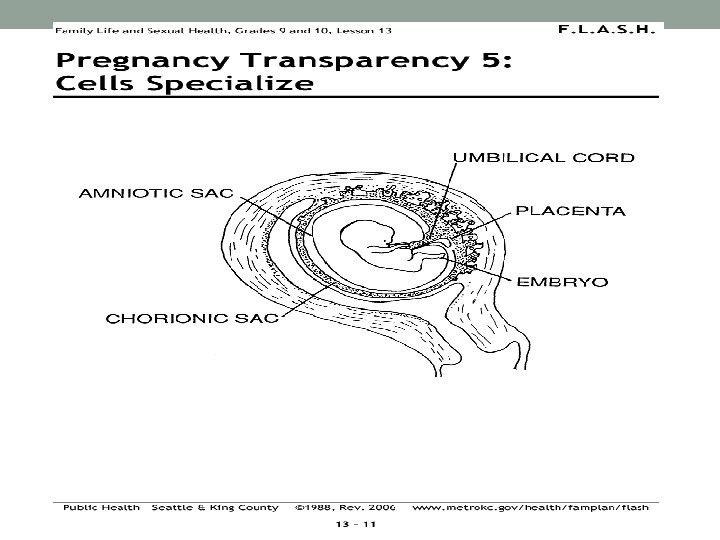
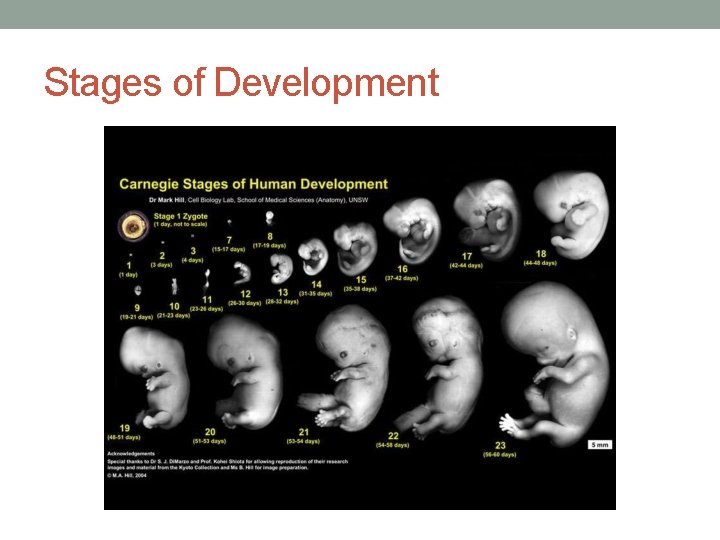
Cells Specialize • After 8 weeks, the embryo’s name changes. It is now a fetus. • After approximately 39 weeks(counting from fertilization), or about 9 months’ gestation, a full-term baby will be delivered. . . followed shortly by the placenta (which explains why it’s sometimes called the afterbirth).
Cells Specialize • This pre-natal (literally “before birth”) time varies considerably, with 75% of women delivering after 37 -41 weeks gestation. With expert premature-infant care, two out of three babies born in the twenty-seventh week survive. Babies born after seven months’ (30 weeks) gestation have a better than 85% chance of surviving; after eight months’ (34+weeks) gestation, they have a 97% chance. . . in industrialized countries like the United States.
Note on Abortions • Abortions are usually done by the twelfth week of pregnancy. They are available, in Washington State, up to twenty-four weeks’ gestation.
Stages of Development
Similariti es across Species
Maternal Growth
MULTIPLE BIRTHS
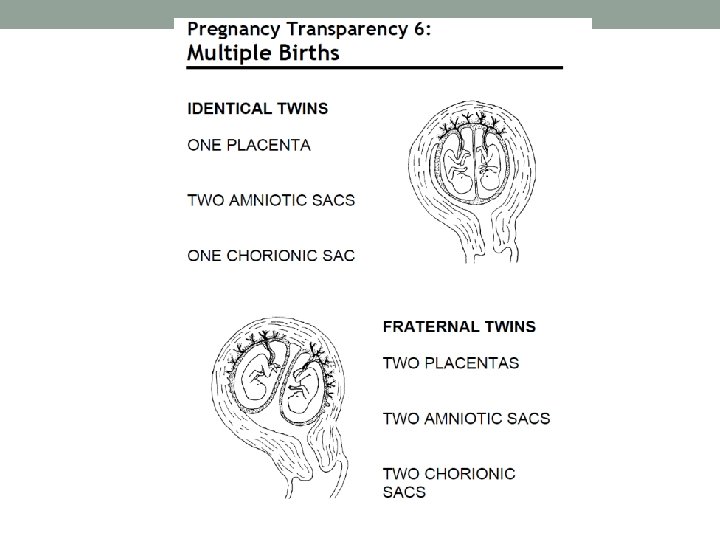
Multiple Births • Sometimes a single zygote, as it is dividing in the first week or so of development, separates into more than one blastocyst. • These developing babies have identical genetic material; they’ll be identical twins (triplets, etc. ) • They usually have separate amniotic sacs, but they will share a common chorionic sac and placenta.
Multiple Births • Other times —- this is more common — two or more ova will be released at about the same time. • Each will be fertilized by a different sperm, forming unique zygotes, each with unique genes: fraternal twins (triplets, etc. ). • They will have separate amniotic sacs and usually, though not always, separate chorions and placentas. • On rare occasion, triplets will be a combination…two identical siblings and a fraternal one. Approximate incidence of multiple births: twins, 1 in 31 births; triplets or higher, 1 in 652 births.

VOCABULARY

• http: //www. youtube. com/watch? v=Ejm 9 Kjn. MHV 4 • http: //www. youtube. com/watch? v=d. NOz. LYG 3 ep 8&feature =related • http: //www. youtube. com/watch? v=zw_d. Pnb. PRg. Y&feature =related
- Slides: 35