
PREGNANCY COMPLICATIONS SFC WARD Joint Special Operations Medical
- Slides: 88
PREGNANCY COMPLICATIONS SFC WARD Joint Special Operations Medical Training Center
Premature Labor • 10 - 15% of all pregnancies • 20 - 30% follow premature rupture of membranes • Maternal medical problems • Placental or fetal abnormalities • Assessment-regular contractions every 10 min X 30 min with cervical dilation • Prevention is key to management Joint Special Operations Medical Training Center
Abnormal Labor (Dystocia) • Passage through the pelvis • Presentation of passenger • Power of uterine contraction Joint Special Operations Medical Training Center
Pelvic Adequacy-basic shapes • • Gynecoid - easiest for delivery Platypelloid - wide hipped female Android - normal male shape Anthropoid - prevalent in blacks; difficult delivery Joint Special Operations Medical Training Center
Pelvic Adequacy • Small portals lead to dystocia Joint Special Operations Medical Training Center
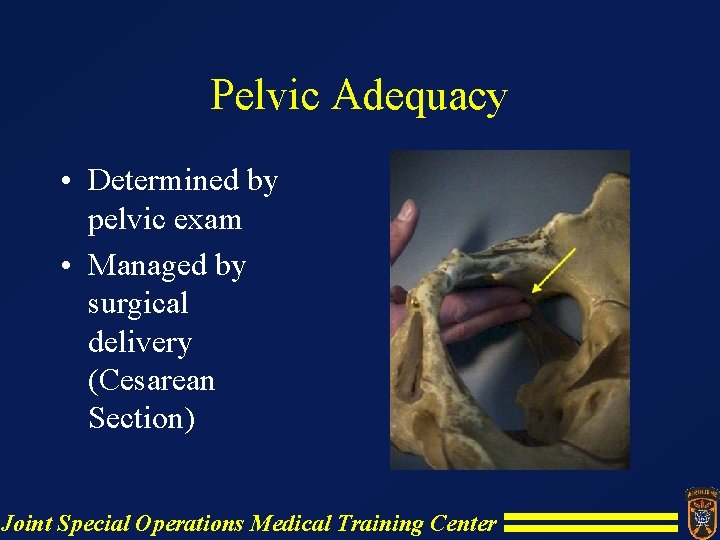
Pelvic Adequacy • Determined by pelvic exam • Managed by surgical delivery (Cesarean Section) Joint Special Operations Medical Training Center
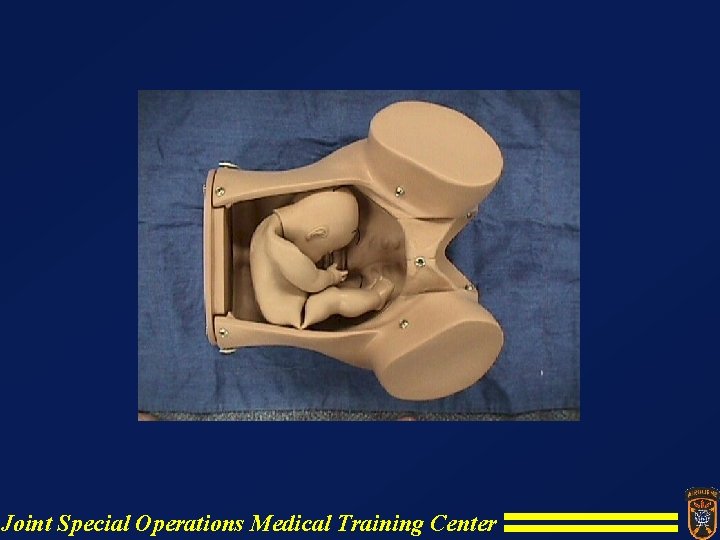
Abnormal Presentation • Occiput posterior - 4. 9% of births – 70% of time will rotate into OA • Transverse - fatal – Must be rotated manually or surgically delivered • Face - 1 in 500 births – Assess by vaginal exam – Carefully monitor cord position and fetal respiration Joint Special Operations Medical Training Center
Joint Special Operations Medical Training Center
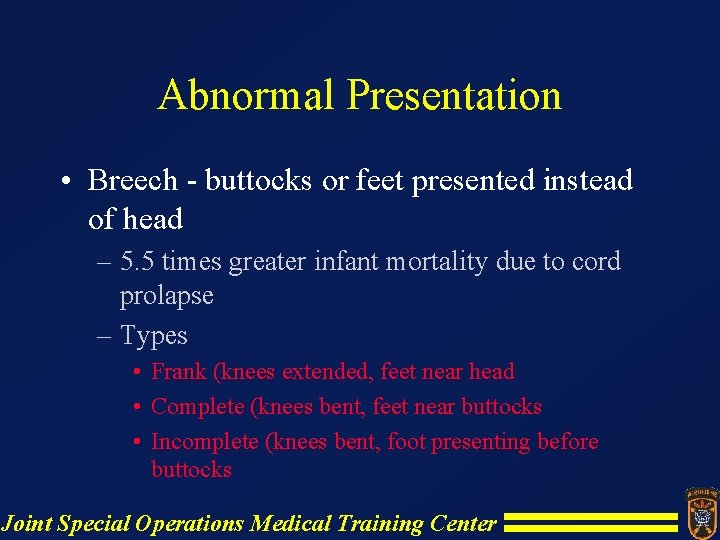
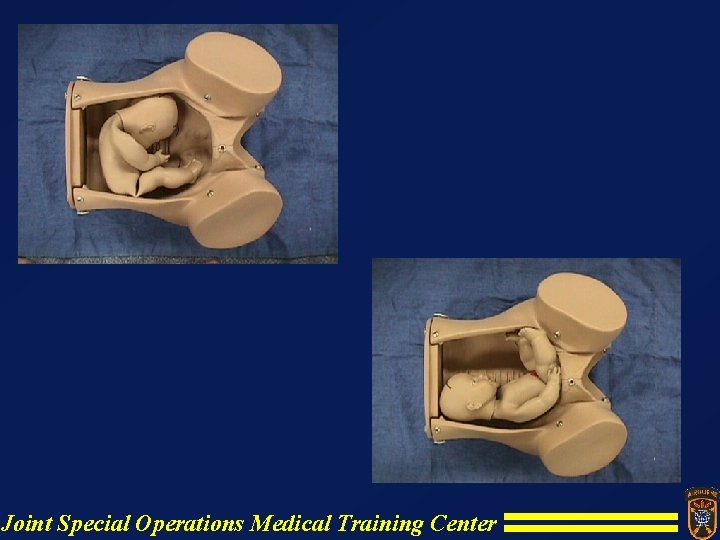
Abnormal Presentation • Breech - buttocks or feet presented instead of head – 5. 5 times greater infant mortality due to cord prolapse – Types • Frank (knees extended, feet near head • Complete (knees bent, feet near buttocks • Incomplete (knees bent, foot presenting before buttocks Joint Special Operations Medical Training Center
Joint Special Operations Medical Training Center
Breech Presentation • Assessed by vaginal/abdominal exam • Management: – Prevention is preferred. Attempt external version with extreme caution – Delivery is slow process of clearing one extremity at a time – Keep constantly aware of status of umbilical cord Joint Special Operations Medical Training Center
Abnormal Uterine Action • Inadequate contractions • Reassure patient, maintain fluids, have patient walk if possible, enema, nipple stimulation • If uterus is atonic try to correct with massage, Oxytocin IV under physician’s supervision Joint Special Operations Medical Training Center
Cord Accident • Prolapsed cord – Assessed by vaginal exam – Management: • Reposition fetus and cord if possible • Keep airway open • Meconium staining shows fetal distress Joint Special Operations Medical Training Center
Multiple Pregnancies • Normal delivery of one fetus followed by delivery of second no later than 20 minutes afterwards Joint Special Operations Medical Training Center
Uterine rupture • 1 in 1500 deliveries • Usually occurs during labor • Contributing factors are high parity, obstructed labor, intrauterine maneuvers, previous surgery, MVA with lap seat belt • Sudden lower abdominal pain and shock • Manage shock Joint Special Operations Medical Training Center
Vaginal and Perineal Lacerations • 1 st Degree – Slight laceration – No need for suturing Joint Special Operations Medical Training Center
Vaginal and Perineal Lacerations • 2 nd Degree – Into perineum without entering into anal sphincter or rectal mucosa – Mange with simple suture repair Joint Special Operations Medical Training Center
Vaginal and Perineal Lacerations • 3 rd Degree – Into anal sphincter and/or rectal mucosa – Mange with carefully placed sutures (layers) Joint Special Operations Medical Training Center
Uterine Inversion (prolapse) • Profuse bleeding after delivery • Abdominal pain • Uterus descended into vagina – Possibly as a result of traction placed on cord during 3 rd stage of labor • Manually reposition with fist or fingers • Carefully monitor for shock and blood loss Joint Special Operations Medical Training Center
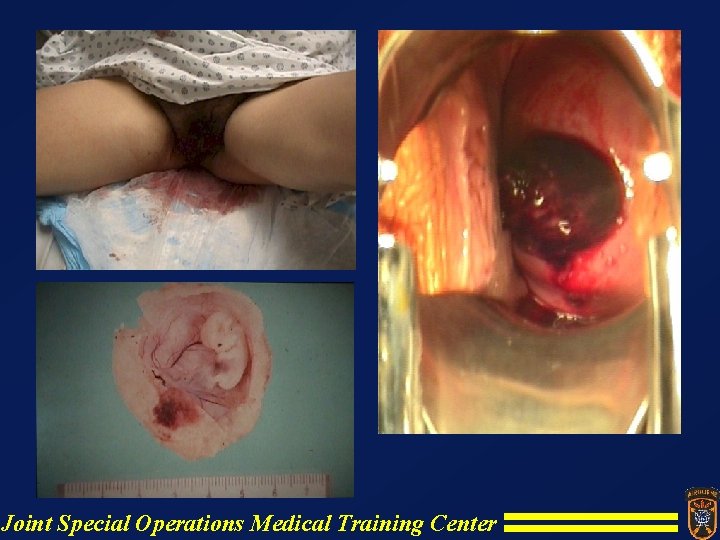
Abortion (Miscarriage)-Termination of pregnancy before viability • Incidence--15% of all pregnancies abort spontaneously. These abortions seem to be a natural rejection of mal-developing fetus; 85% occur in the first trimester and are related to fetal causes • Categories: threatened, inevitable, incomplete, or induced abortions Joint Special Operations Medical Training Center
Joint Special Operations Medical Training Center
Threatened Abortion--any vaginal bleeding in the first 20 weeks of pregnancy - 20 -30% of pregnant women have some bleeding in early months. Joint Special Operations Medical Training Center
Threatened Abortion--Signs and symptoms • Vaginal bleeding--varies from brownish to bright red, may occur repeatedly for many days • Mild cramps • Tenderness over the uterus, low back pain, sense of pelvic pressure Joint Special Operations Medical Training Center
Threatened Abortion--Signs and symptoms • Cervix closed or slightly dilated, no tissue loss • Symptoms subside or it becomes an inevitable abortion Joint Special Operations Medical Training Center
Threatened Abortion Management--conservative • Vaginal exam, make sure cervix is closed • Pad count, to monitor bleeding • Bed rest Joint Special Operations Medical Training Center
Inevitable Abortion-Intolerable pain or bleeding that threatens the mother's well being Joint Special Operations Medical Training Center
Inevitable Abortion-- Signs and symptoms • • Bleeding more profuse; threatens mother Cervix dilated Membrane rupture Painful uterine contractions Joint Special Operations Medical Training Center
Inevitable Abortion--Treatment • Embryo delivered • D & C after delivery Joint Special Operations Medical Training Center
Incomplete Abortion--some products of conception partially passed from uterine cavity Joint Special Operations Medical Training Center
Joint Special Operations Medical Training Center
Incomplete Abortion--Signs and symptoms • Vaginal bleeding--varies from brownish to bright red, may occur repeatedly for many days • Mild cramps • Tenderness over the uterus, low back pain, sense of pelvic pressure • Cervix closed or slightly dilated, no tissue loss Joint Special Operations Medical Training Center
Incomplete Abortion-Management • Complete the abortion promptly with suction • Monitor vital signs and amount of bleeding, treat symptomatically (IVs, blood, bedrest) • Psychological assistance/reduce anxiety • Pain meds PRN, vitamin and iron supplement • Watch for infection Joint Special Operations Medical Training Center
Complete Abortion--all products of conception are expelled Joint Special Operations Medical Training Center
Complete Abortion--Signs and symptoms • Same as incomplete except all POC are passed • Positive pregnancy test prior to abortion • Symptoms of pregnancy no longer exist (cervix closes, uterus contracts to normal size). Joint Special Operations Medical Training Center
Complete Abortion--Management • Bedrest for three days • Monitor vital signs and bleeding, replace blood PRN, keep pad count • Vitamin and iron supplements • D&C if bleeding continues • Follow up visit to ensure return to proper menstruation and no evidence of infection for approximately 6 weeks • Pain meds PRN Joint Special Operations Medical Training Center
Missed abortion--Fetus has died but has been retained in utero 4 weeks or longer Joint Special Operations Medical Training Center
Missed abortion--Signs and symptoms • Uterus fails to grow • Fetal heart sound is not heard at appropriate time with doppler • Fetal heart sound was present previously and now is absent • Ultrasound no longer shows cardiac activity Joint Special Operations Medical Training Center
Missed abortion--Treatment • If the fetus is not passed oxytoxin induction may be used • D&C may be used to remove fragments of the placenta Joint Special Operations Medical Training Center
Ectopic Pregnancies-implantation of fertilized egg in any site other than the uterine cavity Joint Special Operations Medical Training Center
Joint Special Operations Medical Training Center
Ectopic Pregnancies--Incidence • One in 150 pregnancies • Incidence is rising and higher in non whites • Increases with prior tubal diseases, ectopic pregnancies and induced abortions Joint Special Operations Medical Training Center
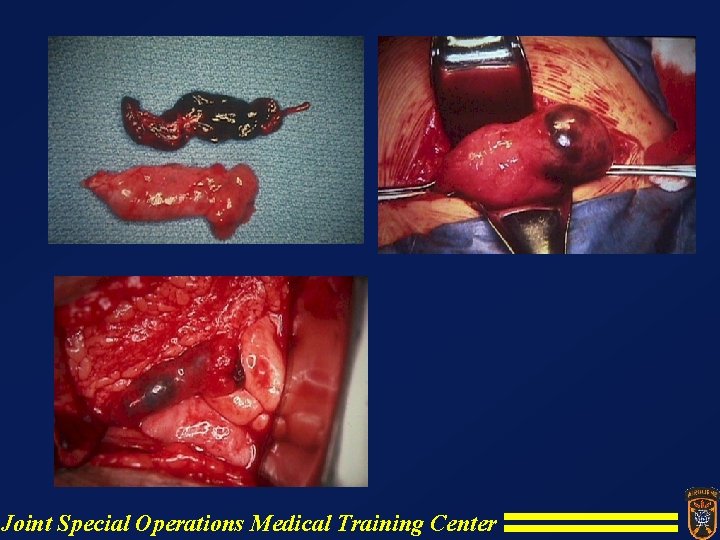
Ectopic Pregnancies • 95% occur in fallopian tube ("tubal pregnancy"), more than half are on the right side; ectopic pregnancy may also occur in ovary, abdomen, or cervix • Most common cause of maternal mortality in first trimester. Joint Special Operations Medical Training Center
Ectopic Pregnancies--Causes-delayed passage of eggs due to decreased lumen size • • • PID; chandelier sign Congenital deformities in mother Use of IUD (4 x greater in IUD users) Adhesions of the tube Anything leading to tubal sterilization. Joint Special Operations Medical Training Center
Ectopic Pregnancies--Signs and symptoms • Abdominal/pelvic pain early in pregnancy "tearing" type of pain. (Abdominal pain occurs in 90%) • Amenorrhea, spotty or irregular vaginal bleeding is present in 75% • Positive pregnancy test--50% • Abdominal tenderness • Pelvic exam may or may not reveal tender adnexal mass. Joint Special Operations Medical Training Center
Ectopic Pregnancies-Management • If left untreated usually results in death • Culdocentesis to confirm diagnosis-aspirate blood from cul-de-sac. (blood indicates intraperitoneal bleeding. ) • Surgery for definitive management--even if diagnosed before rupture Joint Special Operations Medical Training Center
Ectopic Pregnancies-Management • Principles guiding management include: – Preserve maternal life – Terminate the pregnancy with surgery – Supportive care of mother (blood, fluid, monitor vital signs, psychological support) Joint Special Operations Medical Training Center
Ectopic Pregnancies-Complications--catastrophic sequence • • Tubal rupture Severe internal hemorrhage Shock Death Joint Special Operations Medical Training Center
Differential assessment--history very important • • PID Spontaneous abortions--miscarriage Ruptured ovarian cyst Torsion of the ovarian cyst Appendicitis Pyelonephritis Pancreatitis Joint Special Operations Medical Training Center
Abruptio Placentae--premature separation of the normally implanted placenta after 20 weeks gestation Joint Special Operations Medical Training Center
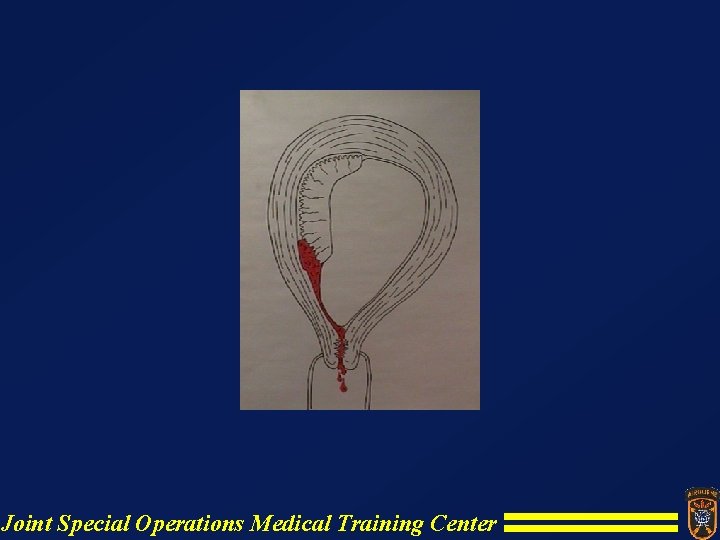
Abruptio Placentae • External hemorrhage--retroplacental bleeding occurs and the blood may pass behind the membranes and through the cervix • Internal hemorrhage--the placenta separates centrally and the blood accumulates under the placenta. Joint Special Operations Medical Training Center
Joint Special Operations Medical Training Center
Abruptio Placentae--Incidence • 1/90 pregnancies Joint Special Operations Medical Training Center
Abruptio Placentae-contributing factors • • • Hypertension Trauma Alcoholism Cocaine use Previous history of same problem. Joint Special Operations Medical Training Center
Abruptio Placentae--Signs and symptoms--depends on degree of separation • Concealed hemorrhage – Sharp pain – Change in vital signs--no external bleeding – Tender uterus--can progress to board-like – Evidence of fetal heart rate drop, fetal distress, or death • External: same signs and symptoms except bleeding occurs Joint Special Operations Medical Training Center
Abruptio Placentae-Management • NO VAGINAL EXAM if even suspect, as it may precipitate hemorrhage • IV fluids and oxygen • Type and crossmatch blood for possible transfusion • Prepare for possible immediate delivery of the fetus • Frequent fetal monitoring • Psychological support for the mother Joint Special Operations Medical Training Center
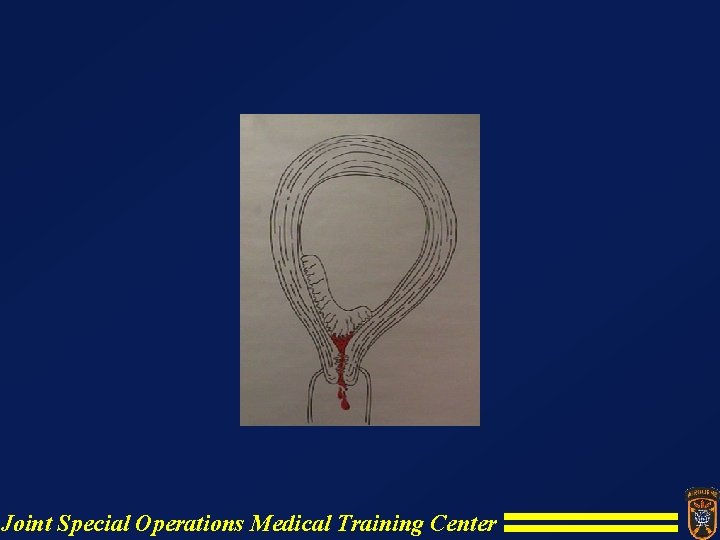
Placenta Previa--implantation of the placenta in the lower uterine segment such that at least a portion of a fully dilated cervix would be covered Joint Special Operations Medical Training Center
Joint Special Operations Medical Training Center
Placenta Previa • Incidence – One in two hundred pregnancies – Multiparous greater than primiparous – More common in patients with abnormalities of uterus (e. g. , fibroids) • Perinatal mortality is 20% Joint Special Operations Medical Training Center
Placenta Previa--Signs and symptoms • • Sudden painless vaginal bleeding Lower abdominal cramps are possible Uterus is soft Fetal exam is usually normal--depends on the amount of bleeding when it occurs • Usually not shocky as in abruptio placenta Joint Special Operations Medical Training Center
Placenta Previa-- Management • NO VAGINAL EXAM if suspect, as it may precipitate hemorrhage • IV fluids and oxygen • Type and crossmatch blood • Bed rest Joint Special Operations Medical Training Center
Placenta Previa-- Management • Monitor maternal and fetal V/S • Monitor amount of bleeding • Position for comfort and provide psychological support • When bleeding stops, the patient can ambulate Joint Special Operations Medical Training Center
Placenta Previa-- Management • Prepare for possible delivery of the fetus-dependent upon the fetus size and the amount of bleeding; once delivery is decided on, a C-section is usually preferred Joint Special Operations Medical Training Center
Toxemia of Pregnancy Preeclampsia--development of hypertension with proteinuria, edema, or both due to pregnancy between 20 weeks of pregnancy and first postpartum day Joint Special Operations Medical Training Center
Preeclampsia--Incidence • 5% of all pregnancies • Increased in primapara • Increased in women with hypertension or other vascular disorders. Joint Special Operations Medical Training Center
Preeclampsia--Signs and symptoms • Rise in BP over 140/90 or a 30/15 increase during pregnancy • Edema--face, hands and feet, peripheral that can cause possible headache, diplopia. It is important to note that edema persists even during bedrest. • Proteinuria 0. 3 g/liter in 24 hr sample • Weight exceeds normal for patient Joint Special Operations Medical Training Center
Preeclampsia--Management • Bedrest--preferably on the left side as this enhances tissue perfusion • Frequent weight and BP measurements; UA for protein • Correct dietary deficiencies; manage underlying medical conditions Joint Special Operations Medical Training Center
Preeclampsia--Management • Ensure proper fluid and electrolyte intake--encourage fluids but avoid high sodium fluids • Delivery of baby is the cure. Joint Special Operations Medical Training Center
Toxemia of Pregnancy Eclampsia--occurrence of one or more convulsions not attributed to other cerebral conditions in a patient with preeclampsia. Joint Special Operations Medical Training Center
Eclampsia --Signs and symptoms Same as preeclampsia with progression to seizures. Joint Special Operations Medical Training Center
Eclampsia • Perinatal mortality with eclampsia = 15% • Eclampsia develops in 1/200 preeclamptic patients and usually total if untreated. Joint Special Operations Medical Training Center
Eclampsia--Management • Oxygen and airway management • Monitor BP, pulse and respirations every 15 min. and urinary output and input recorded hourly. This should stabilize 46 hours when delivery must be accomplished. • Magnesium sulfate--used to prevent and treat convulsions Joint Special Operations Medical Training Center
Eclampsia--Management • Constant fetal monitoring • Quiet, dark environment • Hydration, balanced salt solution IV, usually 3 -4 liters over 24 hours • Delivery of baby is the cure. Monitor post delivery closely as eclampsia can occur up to a week postpartum. Joint Special Operations Medical Training Center
Common Medical Complications Which Affect Pregnancy • • • Diabetes Mellitus Anemia Urinary tract infections Constipation Medication use/abuse Infections Joint Special Operations Medical Training Center
Diabetes Mellitus--pregnancy increases need for glucose, Metabolic changes during pregnancy can increase diabetes mellitus signs and symptoms, and may cause problems. Joint Special Operations Medical Training Center
Diabetes Mellitus • In most third world countries, the majority of such women will be sterile. • Where signs of polyuria, polyphagia, and polydipsia appear--check the mother's blood glucose. • Insulin replacement is critical along with the management of weight and diet. Type II diabetics along with type I always require insulin. Joint Special Operations Medical Training Center
Complications associated with diabetes mellitus • Primary fetal hazard is anoxia as a result of maternal toxemia or ketoacidosis • Toxemia appears in 20% of the cases • Excessive weight gain, hydramnios, and fetal death are complications of the fetus • Preeclampsia is also a common occurrence • Pregnancy induced hypertension--25% • Premature labor. Joint Special Operations Medical Training Center
Anemia--follow the maternal hematocrit and give only crossmatched blood if absolutely needed, otherwise increase iron intake as RBC indicates. Joint Special Operations Medical Training Center
Urinary tract infections • Always evaluate urine in prenatal care-there is a higher incidence of premature births and perinatal mortality in pregnant women with an unmanaged UTI. Joint Special Operations Medical Training Center
Urinary tract infections • Asymptomatic bacteriuria indicates UTI-always manage despite being asymptomatic since 25% of these patients will develop acute pyelonephritis later in pregnancy. Joint Special Operations Medical Training Center
Urinary tract infections • Assessment by visualizing WBCs/RBCs in urine. • Almost always the result of gramnegative organisms--always gram-stain the urine to identify bacteria. • Nearly all will respond well to ampicillin Joint Special Operations Medical Training Center
Constipation--single most common problem in pregnancy • • Increase fiber in diet Add some mineral oil or stool softener Enema if unresolved Common reason for hemorrhoids--iron supplements compound the problem by increasing the firmness of the stool which causes constipation Joint Special Operations Medical Training Center
Medication use/abuse • Careful dispensing of any medication to childbearing women must be exercised • The use of drugs during the first trimester can result in teratogenic effects to the fetus; therefore, education plays the most important part Joint Special Operations Medical Training Center
Medication use/abuse • Each medication must be individually evaluated • Stop all use of tobacco, alcohol, hallucinogens • Review all pharmacologic substances before administering during pregnancy Joint Special Operations Medical Training Center
Immunizations • Only tetanus and rabies should be given whenever there is an indication • Smallpox and typhoid should only be given in the case of maternal exposure • Never give mumps, measles, rubella Joint Special Operations Medical Training Center
Infections • Malaria--manage mother with chloroquine • Vaginal infections--venereal diseases must be managed prior to delivery to avoid fetal contraction of the disease. • Some infections such as herpes merit delivery by C-section Joint Special Operations Medical Training Center
SUMMARY • • • Premature Labor Abnormal Labor Cord Accidents Tears Abortion Ectopic Pregnancy Abruptio Placentae Placenta Previa Toxemia Medical Conditions Joint Special Operations Medical Training Center
? Joint Special Operations Medical Training Center
Joint Special Operations Medical Training Center