
PreFlood Archaeology PreAdamic and Early Man Arnold C





- Slides: 48
Pre-Flood Archaeology Pre-Adamic and Early Man Arnold C Mendez Bible Study 10 -21 -17 Corpus Christi & Harlingen, TX 1
The Importance of Pre-Flood World Pre-Adamic and Early Man n n Indicates the true origin of mankind. Shows that man was created and did not evolve. Reveals that we are created in the image of God. Validates the Genesis account. 2
Pre-Flood Archaeology Bible Study Review n n n n We are “Old Earth” Creationists. Mankind is young and the earth is old. Genesis 1 is a recreation account. There is a gap in Genesis 1: 2. The Bible is a Catastrophic book. Fossils and large strata beds are indications of past water catastrophes. Strata can be laid down very quickly and it can be eroded very quickly. 3
Pre-Flood Archaeology Reviewcontinued n n n The earth has been through many past catastrophes (extinction events); the Pre. Adamic flood and Noah’s flood are just two we know about. The pre-Adamic world of dinosaurs came to an end with a catastrophe that left the earth covered in water. Scientists, like all people, are biased. 4
Major Points about the Pre. Adamic and Early Man n n Fossils of early man must be interpreted and dated. Anthropologists try to make the fossils fit the evolutionary record. The fossils of early man support the creation account in Genesis. Some speculation. 5
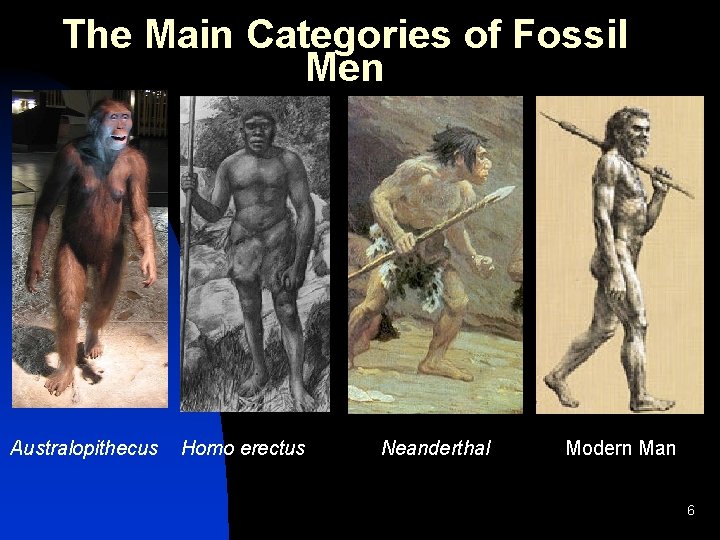
The Main Categories of Fossil Men Australopithecus Homo erectus Neanderthal Modern Man 6
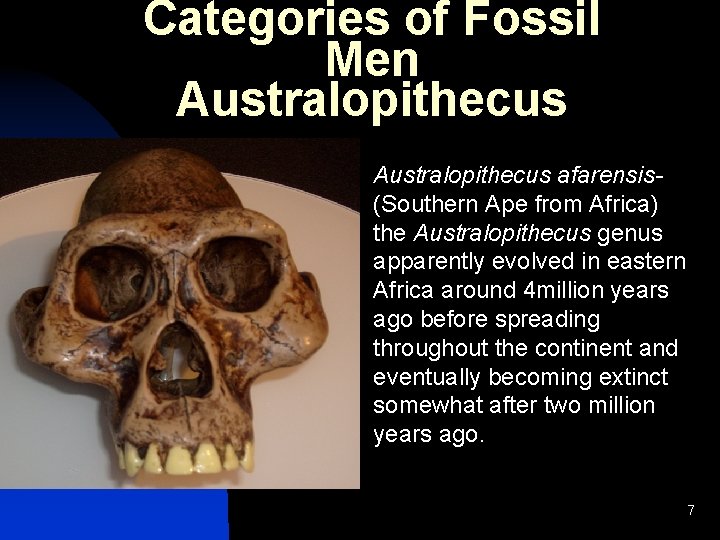
Categories of Fossil Men Australopithecus afarensis(Southern Ape from Africa) the Australopithecus genus apparently evolved in eastern Africa around 4 million years ago before spreading throughout the continent and eventually becoming extinct somewhat after two million years ago. 7
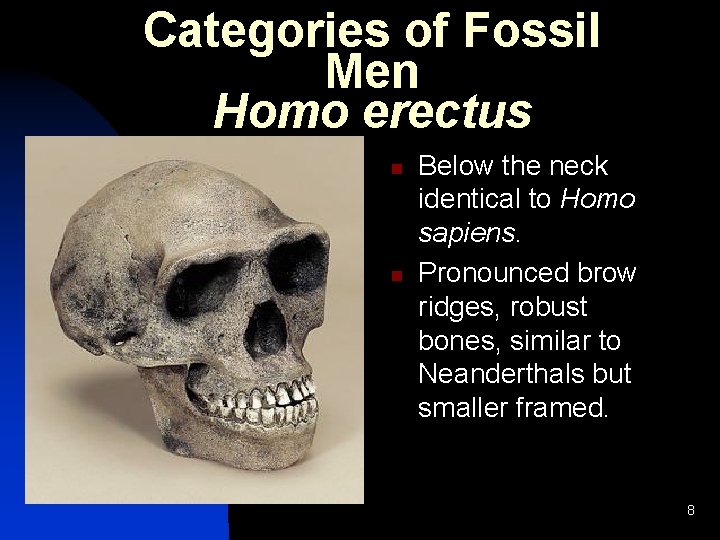
Categories of Fossil Men Homo erectus n n Below the neck identical to Homo sapiens. Pronounced brow ridges, robust bones, similar to Neanderthals but smaller framed. 8
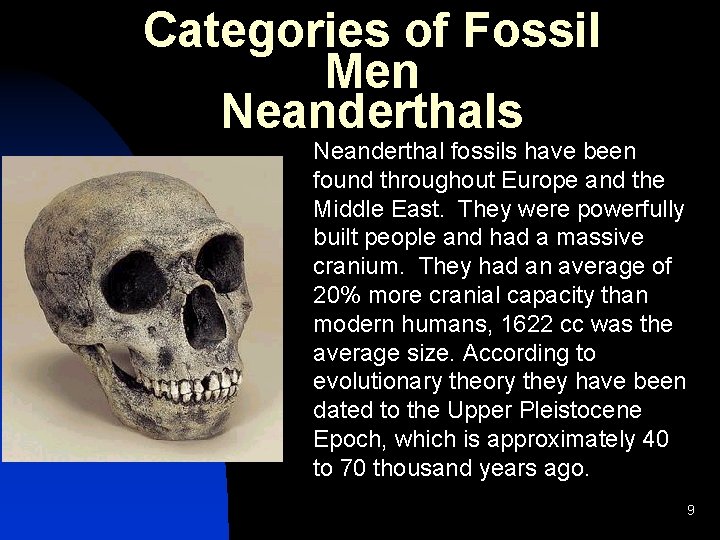
Categories of Fossil Men Neanderthals Neanderthal fossils have been found throughout Europe and the Middle East. They were powerfully built people and had a massive cranium. They had an average of 20% more cranial capacity than modern humans, 1622 cc was the average size. According to evolutionary theory they have been dated to the Upper Pleistocene Epoch, which is approximately 40 to 70 thousand years ago. 9
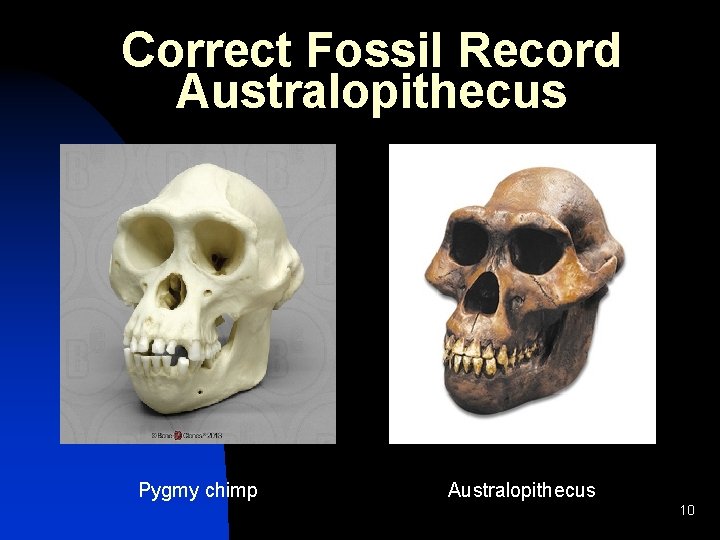
Correct Fossil Record Australopithecus Pygmy chimp Australopithecus 10
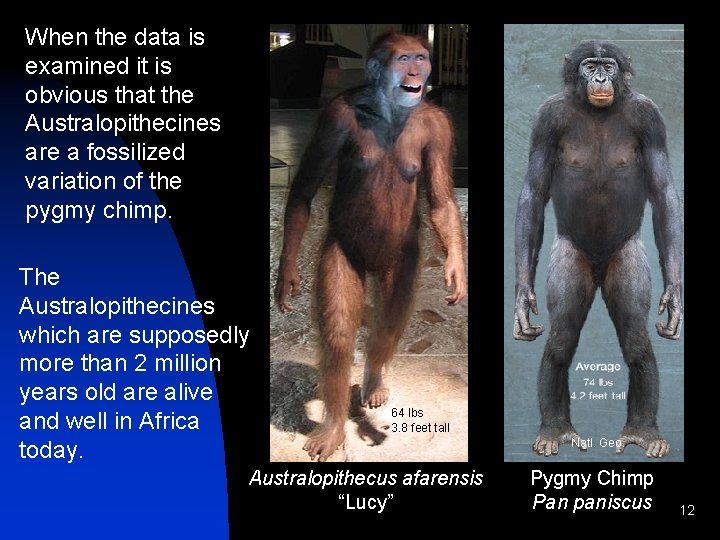
Comparison of Australopithecines and Pygmy Chimps n n n Both have the same skeletal structure. Both can walk upright. Both are the same height. Both weigh about the same. Both lived within 140 miles of each other. 11
When the data is examined it is obvious that the Australopithecines are a fossilized variation of the pygmy chimp. The Australopithecines which are supposedly more than 2 million years old are alive and well in Africa today. 64 lbs 3. 8 feet tall Australopithecus afarensis “Lucy” Natl. Geo. Pygmy Chimp Pan paniscus 12
Herbert W. Lucy's uncommon forebear. Science News. 123: 88 -92. (February 5, 1983). n "To make her point, [Adrienne] Zihlman compares the pygmy chimpanzee to 'Lucy, ' one of the oldest fossil hominids known, and finds the similarities striking. They are almost identical in body size, in stature and in brain size, she notes, and the major differences (the hip and the foot) represent the younger Lucy's adaptation to bipedal walking (Lucy, officially called Australopithecus afarensis, has been dated at 3. 6 million years, although that date has recently been challenged). " n "Susman also discovered that pygmy chimps have a unique style of locomotion. Like modern gorillas they tend to be knuckle-walkers on the ground, yet they seem to be natural bipeds, too, frequently walking upright both on the ground and in the trees. " 13
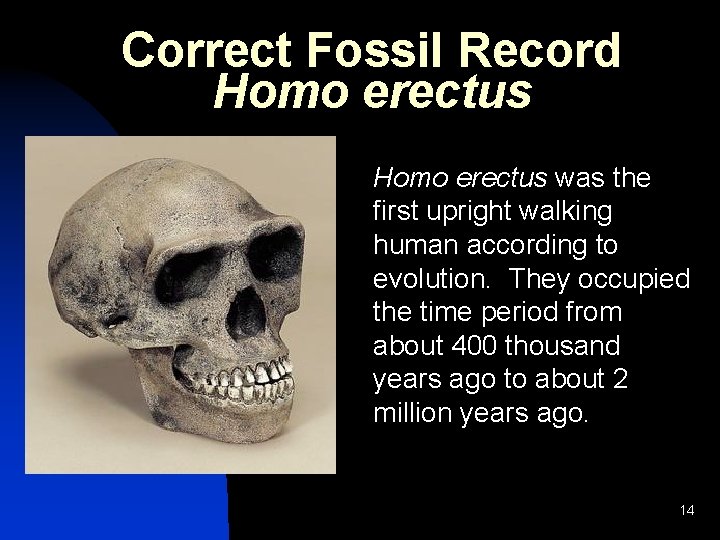
Correct Fossil Record Homo erectus was the first upright walking human according to evolution. They occupied the time period from about 400 thousand years ago to about 2 million years ago. 14
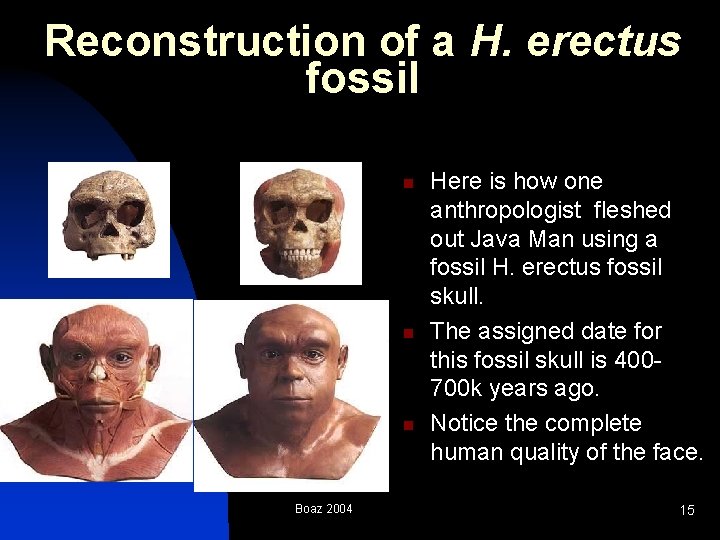
Reconstruction of a H. erectus fossil n n n Boaz 2004 Here is how one anthropologist fleshed out Java Man using a fossil H. erectus fossil skull. The assigned date for this fossil skull is 400700 k years ago. Notice the complete human quality of the face. 15
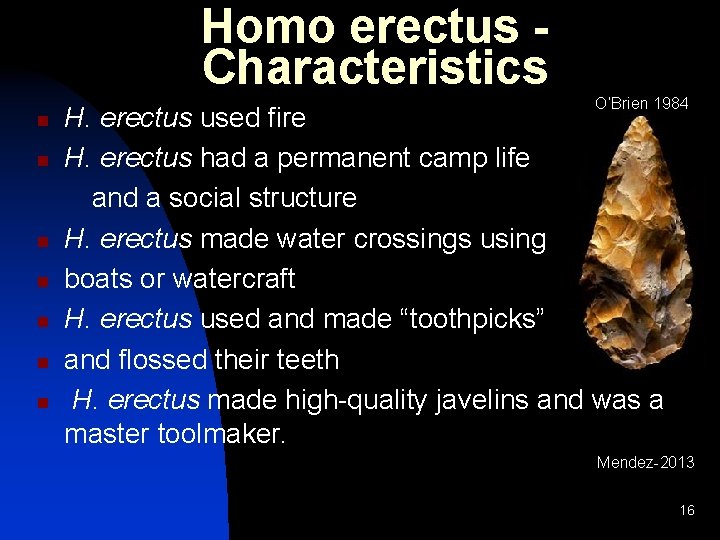
Homo erectus Characteristics O’Brien 1984 H. erectus used fire n H. erectus had a permanent camp life and a social structure n H. erectus made water crossings using n boats or watercraft n H. erectus used and made “toothpicks” n and flossed their teeth n H. erectus made high-quality javelins and was a master toolmaker. n Mendez-2013 16
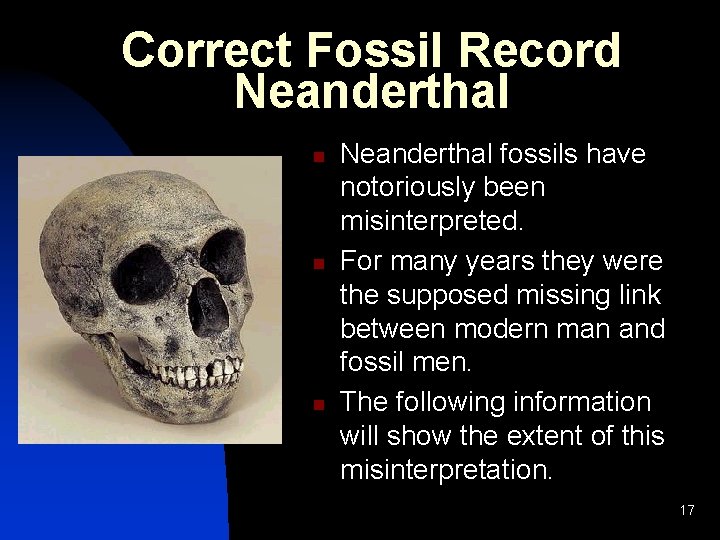
Correct Fossil Record Neanderthal n n n Neanderthal fossils have notoriously been misinterpreted. For many years they were the supposed missing link between modern man and fossil men. The following information will show the extent of this misinterpretation. 17
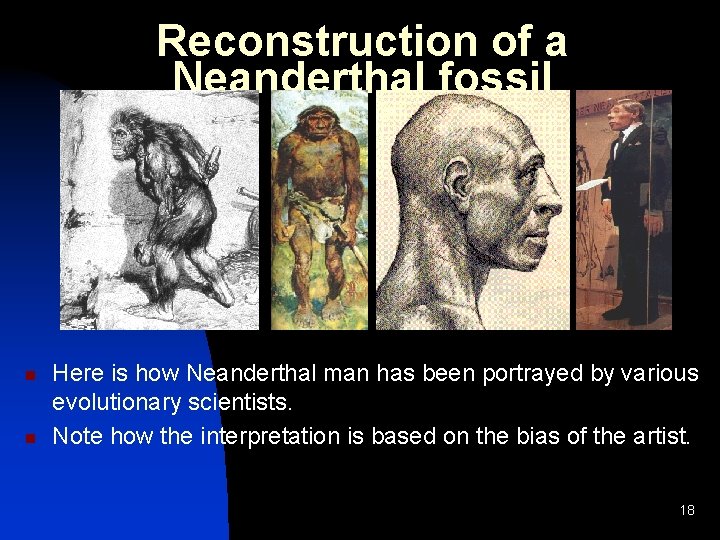
Reconstruction of a Neanderthal fossil n n Here is how Neanderthal man has been portrayed by various evolutionary scientists. Note how the interpretation is based on the bias of the artist. 18
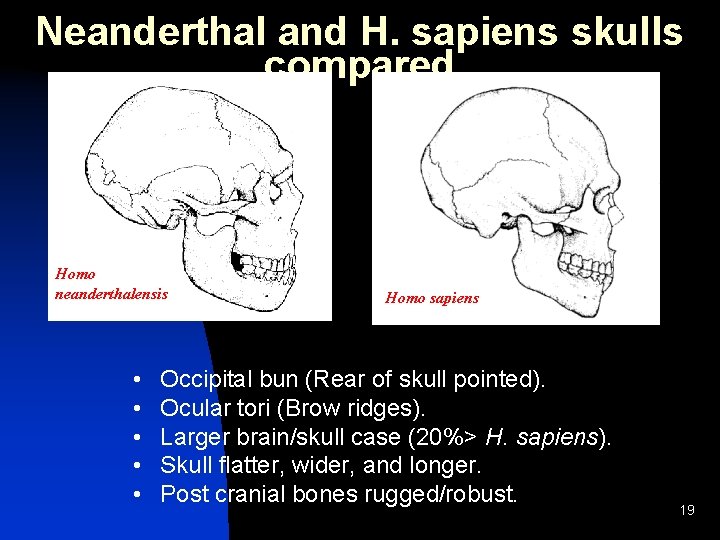
Neanderthal and H. sapiens skulls compared Homo neanderthalensis • • • Homo sapiens Occipital bun (Rear of skull pointed). Ocular tori (Brow ridges). Larger brain/skull case (20%> H. sapiens). Skull flatter, wider, and longer. Post cranial bones rugged/robust. 19
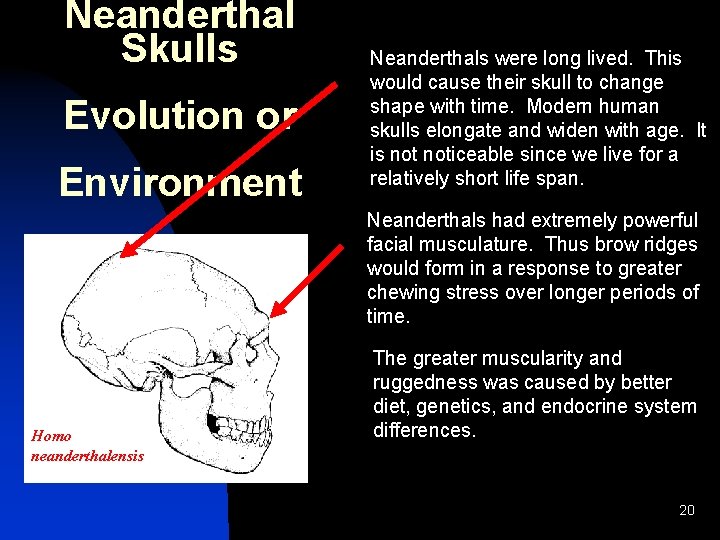
Neanderthal Skulls Evolution or Environment Neanderthals were long lived. This would cause their skull to change shape with time. Modern human skulls elongate and widen with age. It is noticeable since we live for a relatively short life span. Neanderthals had extremely powerful facial musculature. Thus brow ridges would form in a response to greater chewing stress over longer periods of time. Homo neanderthalensis The greater muscularity and ruggedness was caused by better diet, genetics, and endocrine system differences. 20
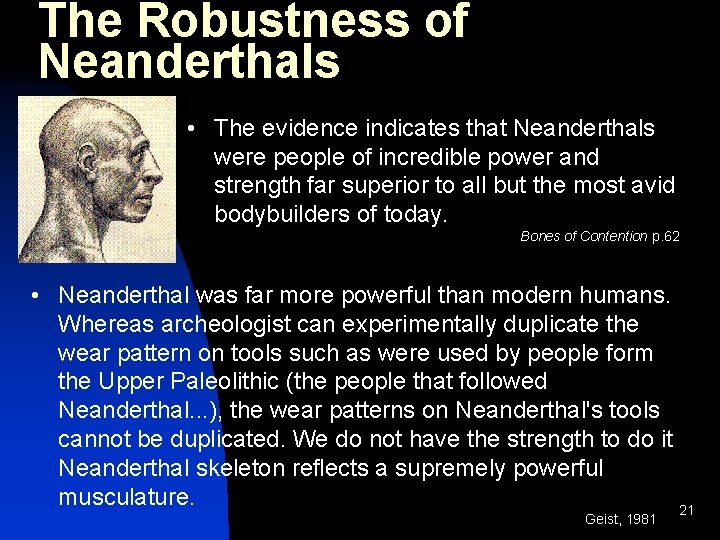
The Robustness of Neanderthals • The evidence indicates that Neanderthals were people of incredible power and strength far superior to all but the most avid bodybuilders of today. Bones of Contention p. 62 • Neanderthal was far more powerful than modern humans. Whereas archeologist can experimentally duplicate the wear pattern on tools such as were used by people form the Upper Paleolithic (the people that followed Neanderthal. . . ), the wear patterns on Neanderthal's tools cannot be duplicated. We do not have the strength to do it Neanderthal skeleton reflects a supremely powerful musculature. 21 Geist, 1981
Trinkaus E. The Neanderthals. Scientific American. 118 -33. December 1979 It is now clear that the Neanderthals had the same postural abilities, manual dexterity and range and character of movement that modern men do. They nonetheless differed from modern men in having massive limb bones… the skeletal robustness evidently reflects the Neanderthals' great muscular power. Everything indicates that for their height both Neanderthal man and Neanderthal women were bulkily built and heavily muscled…Many skeletal parts testify to this conclusion. The finger bones show similar attachments for the tendons of the powerful muscles that flexed the fingers. They also show an enlargement of the tuberosities that supported the pads at the fingertips. Both features indicate a much stronger grip than that of modern men…This kind of refined control, coupled with great power, also appears in a curious feature of the scapula, or shoulder blade. In Neanderthals a deeper groove characteristically appears on the back surface. This feature seems to reflect the strong development in Neanderthals of the teres minor muscle that runs from the scapula to the upper end of the humerus, or upper-arm bone. 22
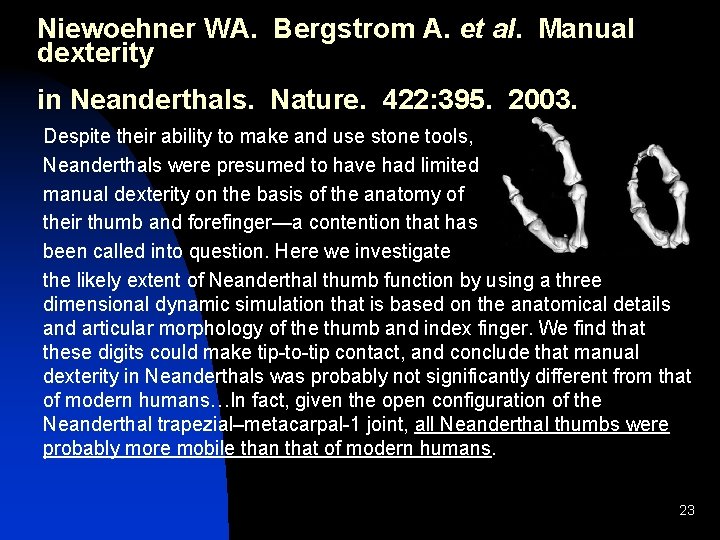
Niewoehner WA. Bergstrom A. et al. Manual dexterity in Neanderthals. Nature. 422: 395. 2003. Despite their ability to make and use stone tools, Neanderthals were presumed to have had limited manual dexterity on the basis of the anatomy of their thumb and forefinger—a contention that has been called into question. Here we investigate the likely extent of Neanderthal thumb function by using a three dimensional dynamic simulation that is based on the anatomical details and articular morphology of the thumb and index finger. We find that these digits could make tip-to-tip contact, and conclude that manual dexterity in Neanderthals was probably not significantly different from that of modern humans…In fact, given the open configuration of the Neanderthal trapezial–metacarpal-1 joint, all Neanderthal thumbs were probably more mobile than that of modern humans. 23
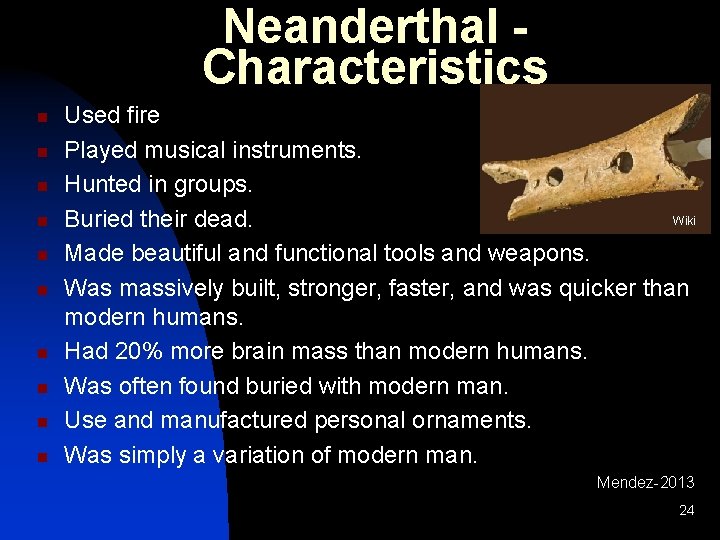
Neanderthal Characteristics n n n n n Used fire Played musical instruments. Hunted in groups. Wiki Buried their dead. Made beautiful and functional tools and weapons. Was massively built, stronger, faster, and was quicker than modern humans. Had 20% more brain mass than modern humans. Was often found buried with modern man. Use and manufactured personal ornaments. Was simply a variation of modern man. Mendez-2013 24
Fossil Record of Early Man is Important n Pre-Adamic fossil men are simply extinct apes. n Early Man lived a long time. n Early Man lived a violent life. n Early Man was buried in caves. n H. erectus, Neanderthal and modern man often overlapped in time and location. 25
Burial Practices of the Patriarchs n n n n Genesis 19: 30 Lot and his daughters. Genesis 23: 17 -20 Abraham’s burial plot. Genesis 49: 29 -32 Jacob, Isaac, Rebecca, Leah. John 11: 34 Lazarus Hebrews 11: 37 -38 Living in caves. 1 Kings 18: 4 Prophets in a cave. 1 Kings 19: 4 -9 Elijah in a cave. 26
Burial Practices of Neanderthals n The Neanderthal fossil evidence shows that the Neanderthal practice is in complete accord with the Genesis record. At least 350+ Neanderthal fossil individuals have been discovered so far at more than 80 sites in Europe, the Near East, and western Asia. Of these 350+ Neanderthal individuals, 186 of them (53 per cent) represent burials — all of them burials in caves or rock shelters. Further, it is obvious that caves were used as family burial grounds or cemeteries, as the following sites show: 27
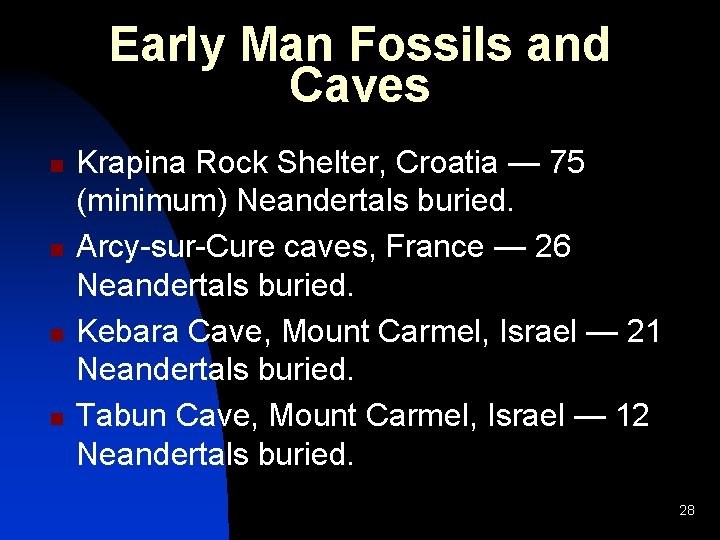
Early Man Fossils and Caves n n Krapina Rock Shelter, Croatia — 75 (minimum) Neandertals buried. Arcy-sur-Cure caves, France — 26 Neandertals buried. Kebara Cave, Mount Carmel, Israel — 21 Neandertals buried. Tabun Cave, Mount Carmel, Israel — 12 Neandertals buried. 28
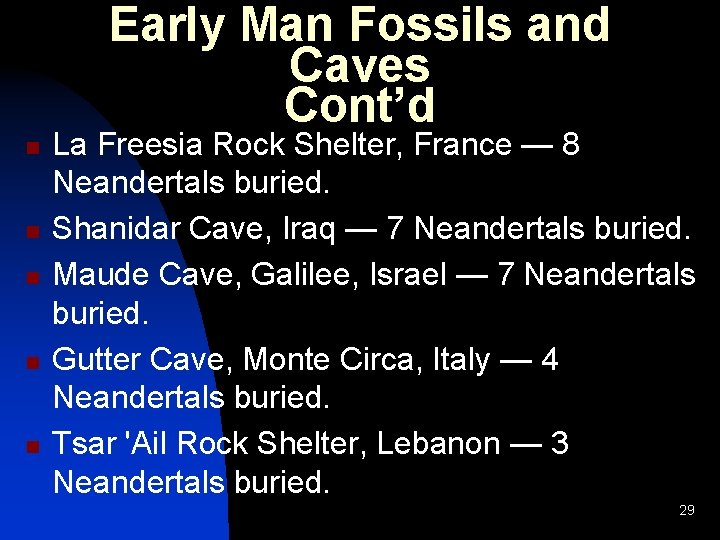
Early Man Fossils and Caves Cont’d n n n La Freesia Rock Shelter, France — 8 Neandertals buried. Shanidar Cave, Iraq — 7 Neandertals buried. Maude Cave, Galilee, Israel — 7 Neandertals buried. Gutter Cave, Monte Circa, Italy — 4 Neandertals buried. Tsar 'Ail Rock Shelter, Lebanon — 3 Neandertals buried. 29
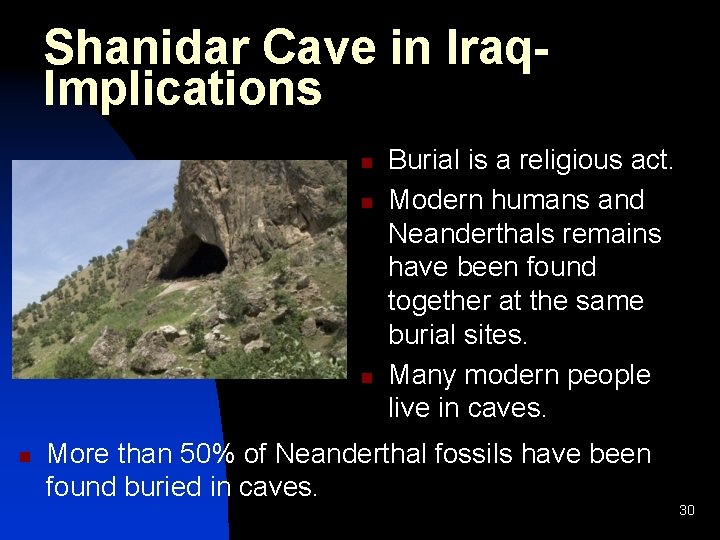
Shanidar Cave in Iraq. Implications n n Burial is a religious act. Modern humans and Neanderthals remains have been found together at the same burial sites. Many modern people live in caves. More than 50% of Neanderthal fossils have been found buried in caves. 30
The Violence of the Pre-Flood World n n Genesis 6: 5, 11, 13 The earth filled with violence. Genesis 6: 1 -3 God striving with mankind. 31
Trinkaus E. Zimmerman MR. Trauma among the Shanidar Neanderthals. American Journal of physical Anthropology. 57: 61 -76. 1982. Four of the adult Neandertals from Shanidar Cave, Iraq, Shanidar 1, 3, 4, and 5, show evidence of antemortem trauma. Shanidar 1 sustained injuries to the right frontal squama, the left lateral orbit, the right humerus and the right fifth metatarsal. Associated with this trauma are hypoplasia or atrophy of the right clavicle, scapula, and humerus, osteomyelitis of the right clavicles, degenerative joint disease at the right knee, ankle, and first tarsometatarsal joint, and remodeling of the left tibia. Shanidar 3 experienced trauma-related degenerative joint disease at the right talocrural and talocalcaneal joints and sustained a penetration wound across the left ninth rib. Shanidar 4 suffered a fracture of the right seventh or eight rib… Shanidar 5 had a scalp wound over the left frontal. A high frequency of antemortem trauma associated with the survival of the injured individuals appears to have been characteristic of the Neandertals. 32
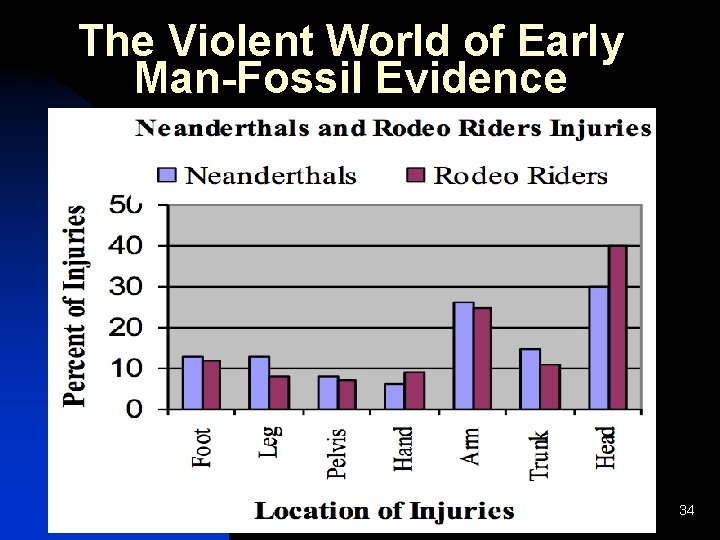
Gore R. The dawn of humans— neanderthals. National Geographic. 189: 1: 2 -35. 1996. So many Neandertal bones show traumatic breaks that one of Trinkaus's graduate student, Tomy Berger, decide to investigate the pattern. He analyzed the bones of 17 Neandertal who had suffered a total of 27 traumatic injuries. "I noticed that they were mostly injuries to the head and upper body—almost no lower limb injuries, " says Berger. 33
The Violent World of Early Man-Fossil Evidence 34
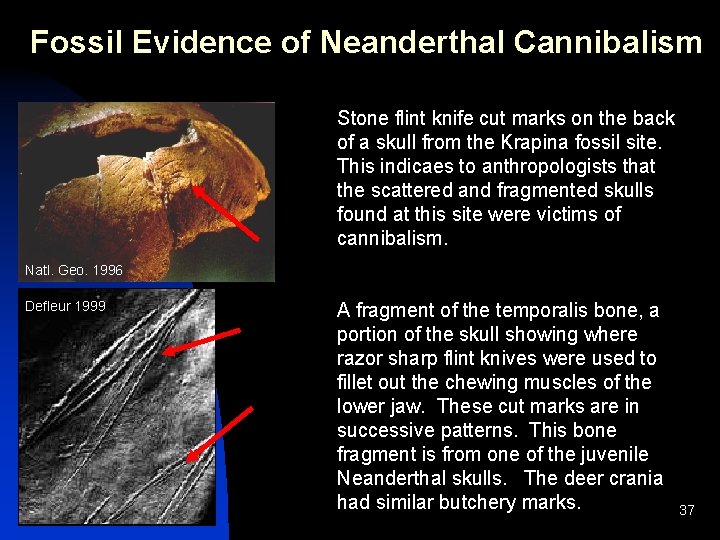
The Violence of Early Man. Cannibalism A French and American team digging at a Neanderthal site in France, Moula-Guercy cave, has unearthed grisly evidence of cannibalism. The Neanderthals at this site were expert hunters. They expertly butchered carcasses of deer, goats, and possibly even woolly rhinoceros. Using stone implements they dismembered and defleshed their kills. After the kills were butchered they then used stone hammers and anvils to break open the long appendage bones to get at the marrow. Many of the skulls were bashed open to remove the brains. The bones were then thrown into a skeletal trash heap. Evidence now shows that they did the same to their fellow Neanderthals. 35
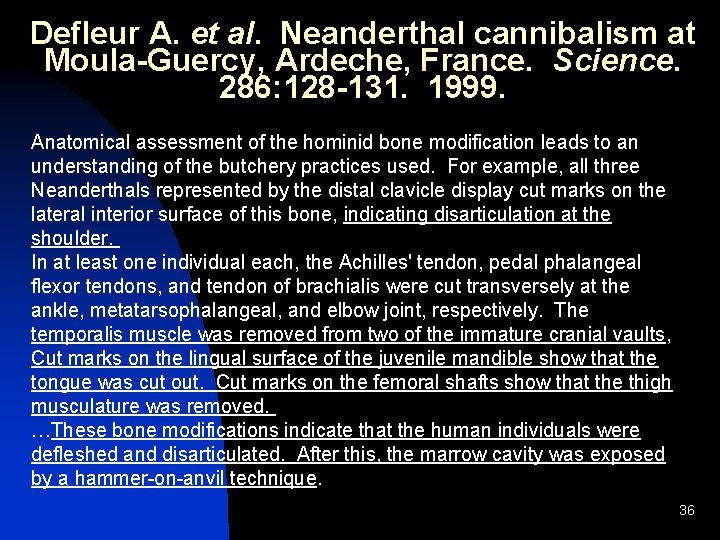
Defleur A. et al. Neanderthal cannibalism at Moula-Guercy, Ardeche, France. Science. 286: 128 -131. 1999. Anatomical assessment of the hominid bone modification leads to an understanding of the butchery practices used. For example, all three Neanderthals represented by the distal clavicle display cut marks on the lateral interior surface of this bone, indicating disarticulation at the shoulder. In at least one individual each, the Achilles' tendon, pedal phalangeal flexor tendons, and tendon of brachialis were cut transversely at the ankle, metatarsophalangeal, and elbow joint, respectively. The temporalis muscle was removed from two of the immature cranial vaults, Cut marks on the lingual surface of the juvenile mandible show that the tongue was cut out. Cut marks on the femoral shafts show that the thigh musculature was removed. …These bone modifications indicate that the human individuals were defleshed and disarticulated. After this, the marrow cavity was exposed by a hammer-on-anvil technique. 36
Fossil Evidence of Neanderthal Cannibalism Stone flint knife cut marks on the back of a skull from the Krapina fossil site. This indicaes to anthropologists that the scattered and fragmented skulls found at this site were victims of cannibalism. Natl. Geo. 1996 Defleur 1999 A fragment of the temporalis bone, a portion of the skull showing where razor sharp flint knives were used to fillet out the chewing muscles of the lower jaw. These cut marks are in successive patterns. This bone fragment is from one of the juvenile Neanderthal skulls. The deer crania had similar butchery marks. 37
The Longevity of Early Man n Genesis 5 Longevity before the flood. n Genesis 11 Longevity after the flood. 38
Anomalous Fossils of Early Man n n There are hundreds of examples of out of order fossils. These fossils falsify theory of the evolution of early man. Scientists overlook these fossil because of philosophical bias. The “Grandmother principle. ” We will look at two of these. 39
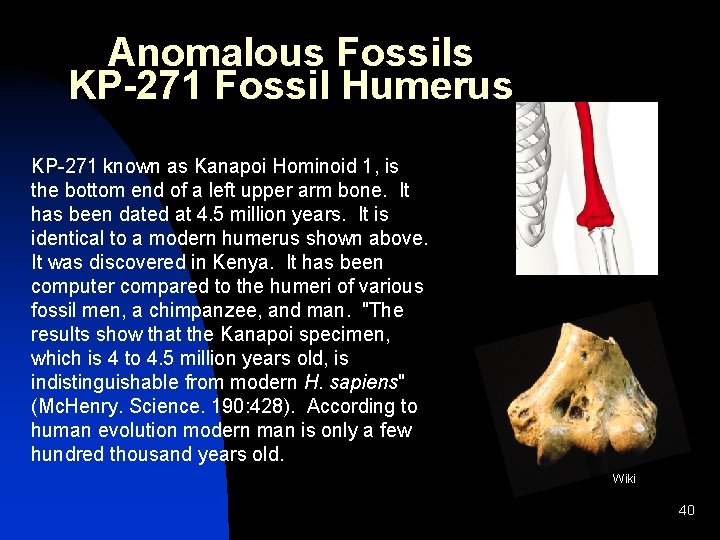
Anomalous Fossils KP-271 Fossil Humerus KP-271 known as Kanapoi Hominoid 1, is the bottom end of a left upper arm bone. It has been dated at 4. 5 million years. It is identical to a modern humerus shown above. It was discovered in Kenya. It has been computer compared to the humeri of various fossil men, a chimpanzee, and man. "The results show that the Kanapoi specimen, which is 4 to 4. 5 million years old, is indistinguishable from modern H. sapiens" (Mc. Henry. Science. 190: 428). According to human evolution modern man is only a few hundred thousand years old. Wiki 40
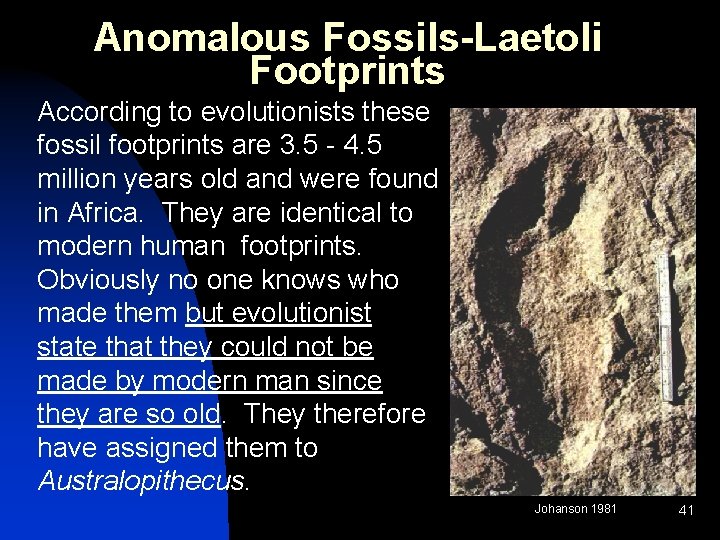
Anomalous Fossils-Laetoli Footprints According to evolutionists these fossil footprints are 3. 5 - 4. 5 million years old and were found in Africa. They are identical to modern human footprints. Obviously no one knows who made them but evolutionist state that they could not be made by modern man since they are so old. They therefore have assigned them to Australopithecus. Johanson 1981 41
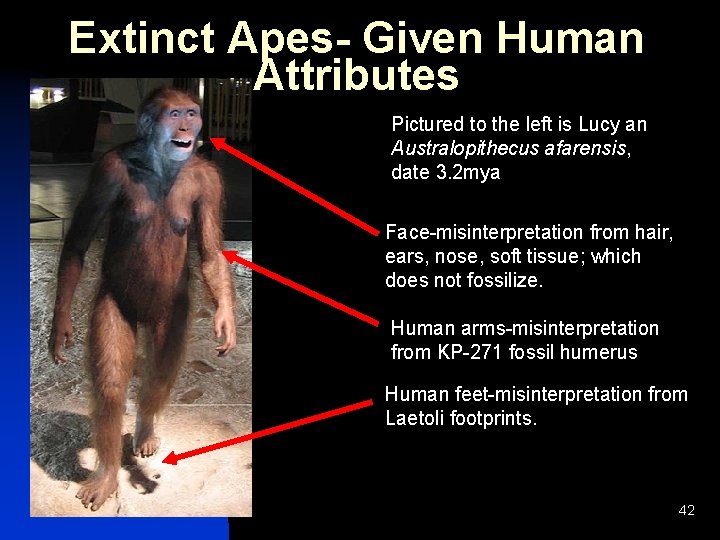
Extinct Apes- Given Human Attributes Pictured to the left is Lucy an Australopithecus afarensis, date 3. 2 mya Face-misinterpretation from hair, ears, nose, soft tissue; which does not fossilize. Human arms-misinterpretation from KP-271 fossil humerus Human feet-misinterpretation from Laetoli footprints. 42
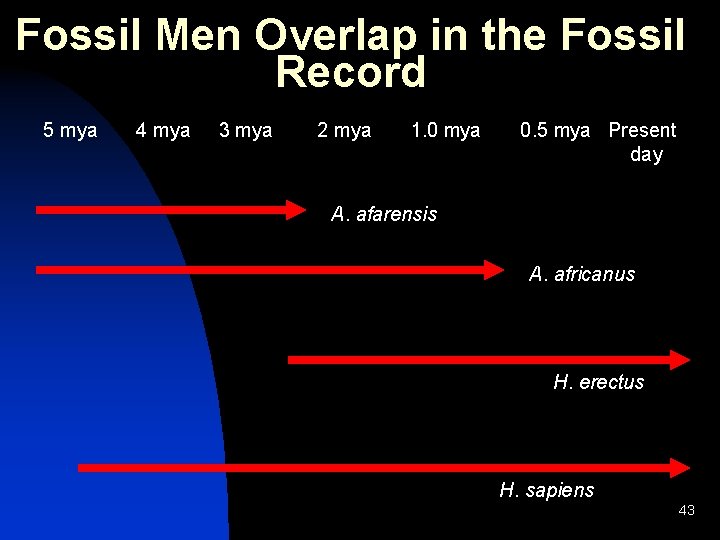
Fossil Men Overlap in the Fossil Record 5 mya 4 mya 3 mya 2 mya 1. 0 mya 0. 5 mya Present day A. afarensis A. africanus H. erectus H. sapiens 43
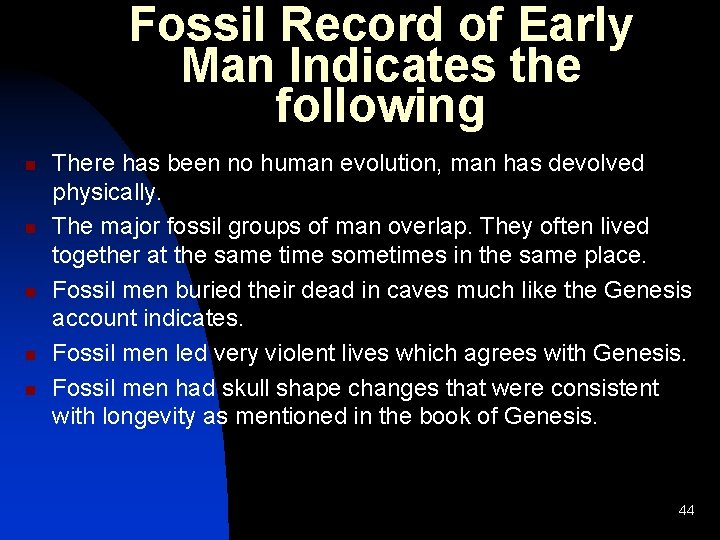
Fossil Record of Early Man Indicates the following n n n There has been no human evolution, man has devolved physically. The major fossil groups of man overlap. They often lived together at the same time sometimes in the same place. Fossil men buried their dead in caves much like the Genesis account indicates. Fossil men led very violent lives which agrees with Genesis. Fossil men had skull shape changes that were consistent with longevity as mentioned in the book of Genesis. 44
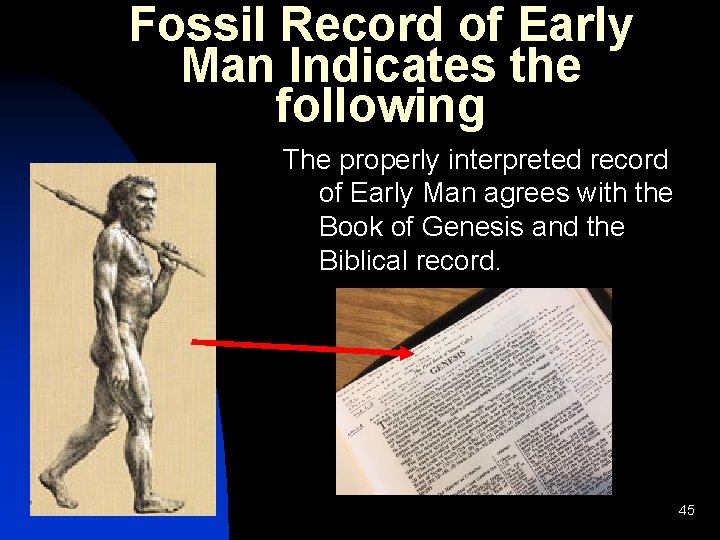
Fossil Record of Early Man Indicates the following The properly interpreted record of Early Man agrees with the Book of Genesis and the Biblical record. 45
Photo Credit and Copyright Notice n n n Unless otherwise noted the pictures and images are copyright free or from Wikipedia commons. This information is being distributed free of charge and is used for purposes of scholarly research, comment, criticism and teaching. Previously copyrighted materials, including articles, photos, etc. , in this presentation are copied and distributed under the "Fair Use" clause of the United States Copyright Act, Title 17, Chapter 1, Section 107 (1). This copyrighted material remains the exclusive property of the respective authors/owners. 46
Works Cited –Photo Credits Boaz NT. Ciochon RL. Headstrong Hominids. Natural History Magazine. Feb. 2004. (reconstruction by Hisao Baba. National Science Museum, Tokyo). Culotta E. Neanderthals were cannibals, bones show. Science. 286: 18. 1999. Defleur A. et al. Neanderthal cannibalism at Moula-Guercy, Ardeche, France. Science. 286: 128 -131. 1999. Gore R. The dawn of humans—neanderthals. National Geographic. 189: 1: 2 -35. 1996. Herbert W. Lucy's Uncommon Forebearer. Science News. 123: 88 -123. 1983. Johanson DC. Lucy the Beginnings of Humankind. Simon and Schuster. New York. 1981. Mc. Henry H. Fossils and the mosaic nature of human evolution. Science 190: 425 -431. 1975. Mc. Guire, Bill A Guide to the End of the World. pp. 159 -161. Oxford Univ. Press. 2002. Mendez AC The Dmanisi Skull: What Does it Reveal About Man’s Origins? Young Adult Blog. Church of God AWA. cogwa. org. Nov. 1, 2013. Mendez AC Noah’s Ark and Early Man Seminars. www. amendez. com 2017. O'Brien EM. What was the Acheulian handaxe. Natural History Magazine. July 1984. Trinkaus E. Zimmerman MR. Trauma among the Shanidar Neanderthals. American Journal of physical Anthropology. 57: 61 -76. 1982. 47
Question and Answers Pre-Flood Archaeology Pre-Adamic and Early Man Your Text Here Arnold C Mendez Bible Study 10 -21 -17 Corpus Christi & Harlingen, TX Rev. 2: 10 -17 48