
Prefetching Techniques for STTRAM based Lastlevel Cache in

Prefetching Techniques for STT-RAM based Last-level Cache in CMP Systems Mengjie Mao, Guangyu Sun, Yong Li, Kai Bu, Alex K. Jones, Yiran Chen Department of Electrical and Computer Engineering University of Pittsburgh
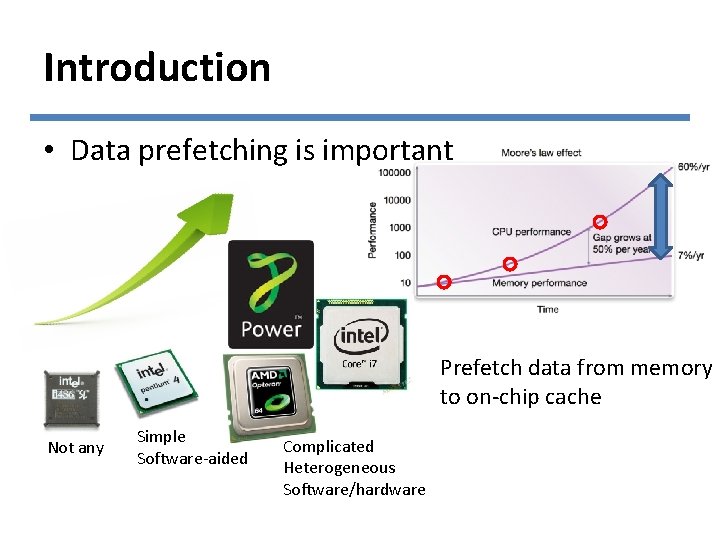
Introduction • Data prefetching is important Prefetch data from memory to on-chip cache Not any Simple Software-aided Complicated Heterogeneous Software/hardware
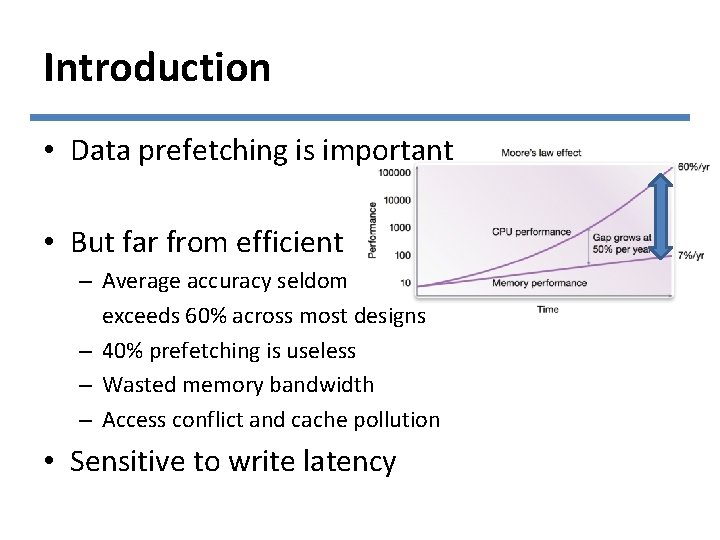
Introduction • Data prefetching is important • But far from efficient – Average accuracy seldom exceeds 60% across most designs – 40% prefetching is useless – Wasted memory bandwidth – Access conflict and cache pollution • Sensitive to write latency
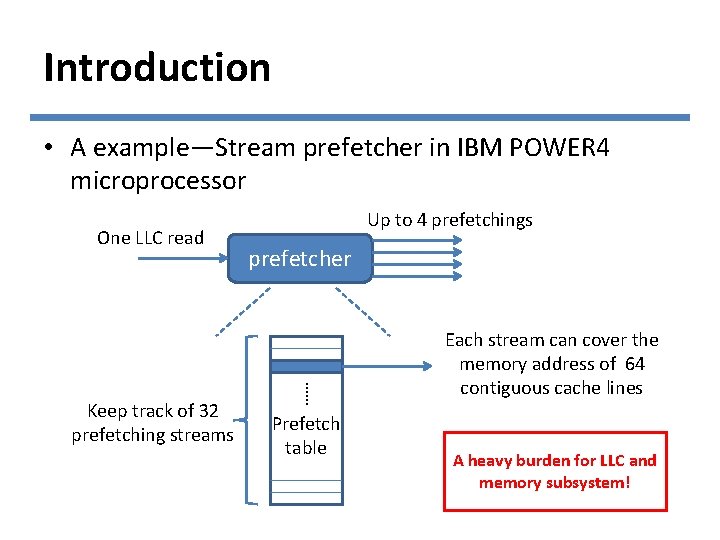
Introduction • A example—Stream prefetcher in IBM POWER 4 microprocessor One LLC read prefetcher …… Keep track of 32 prefetching streams Up to 4 prefetchings Prefetch table Each stream can cover the memory address of 64 contiguous cache lines A heavy burden for LLC and memory subsystem!
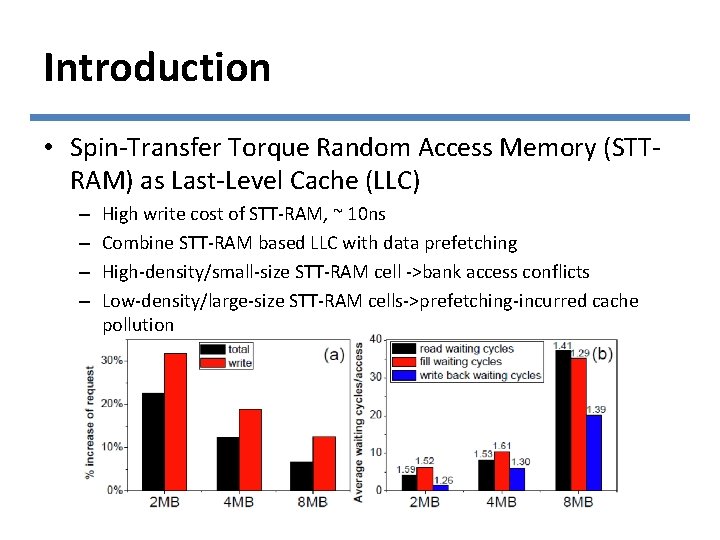
Introduction • Spin-Transfer Torque Random Access Memory (STTRAM) as Last-Level Cache (LLC) – – High write cost of STT-RAM, ~ 10 ns Combine STT-RAM based LLC with data prefetching High-density/small-size STT-RAM cell ->bank access conflicts Low-density/large-size STT-RAM cells->prefetching-incurred cache pollution
Introduction • Our work – Reduce the negative impact on system performance of CMPs with STT-RAM based LLC induced by data prefetching – Request Prioritization – Hybrid local-global prefetch control
Outline • Motivation • STT-RAM Basics • Methodology – Request prioritization – Hybrid local-global prefetch control • Result • Conclusion
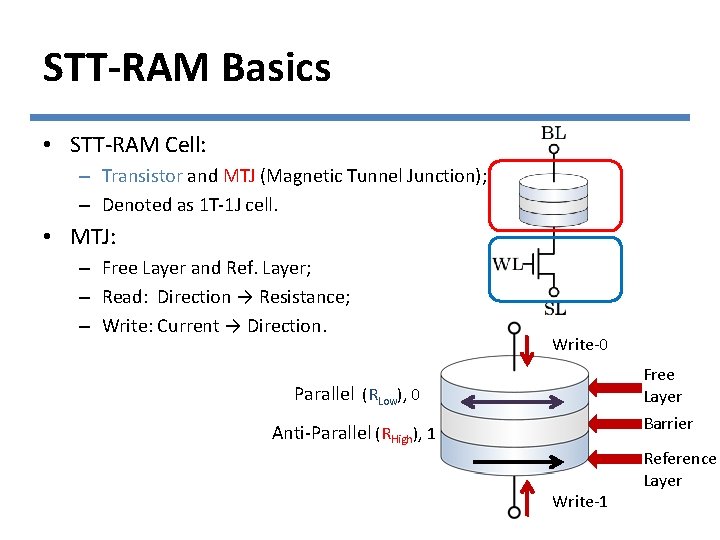
STT-RAM Basics • STT-RAM Cell: – Transistor and MTJ (Magnetic Tunnel Junction); – Denoted as 1 T-1 J cell. • MTJ: – Free Layer and Ref. Layer; – Read: Direction → Resistance; – Write: Current → Direction. Write-0 Free Layer Parallel (RLow), 0 Barrier Anti-Parallel (RHigh), 1 Write-1 Reference Layer
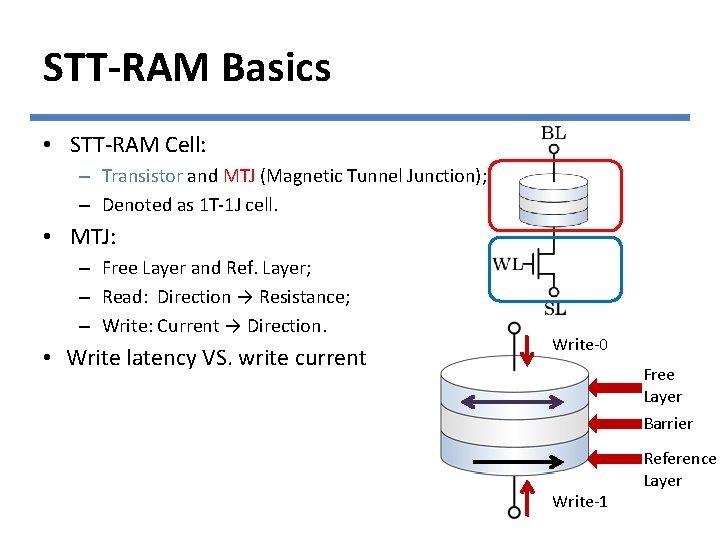
STT-RAM Basics • STT-RAM Cell: – Transistor and MTJ (Magnetic Tunnel Junction); – Denoted as 1 T-1 J cell. • MTJ: – Free Layer and Ref. Layer; – Read: Direction → Resistance; – Write: Current → Direction. • Write latency VS. write current Write-0 Free Layer Barrier Write-1 Reference Layer
Outline • Motivation • STT-RAM Basics • Methodology – Request Prioritization – Hybrid local-global prefetch control • Result • Conclusion
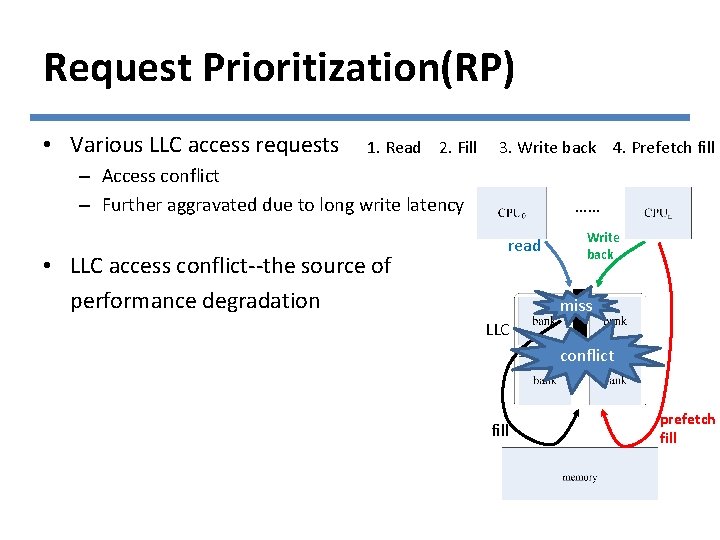
Request Prioritization(RP) • Various LLC access requests 1. Read 2. Fill 3. Write back 4. Prefetch fill – Access conflict – Further aggravated due to long write latency • LLC access conflict--the source of performance degradation …… read Write back miss LLC conflict fill prefetch fill
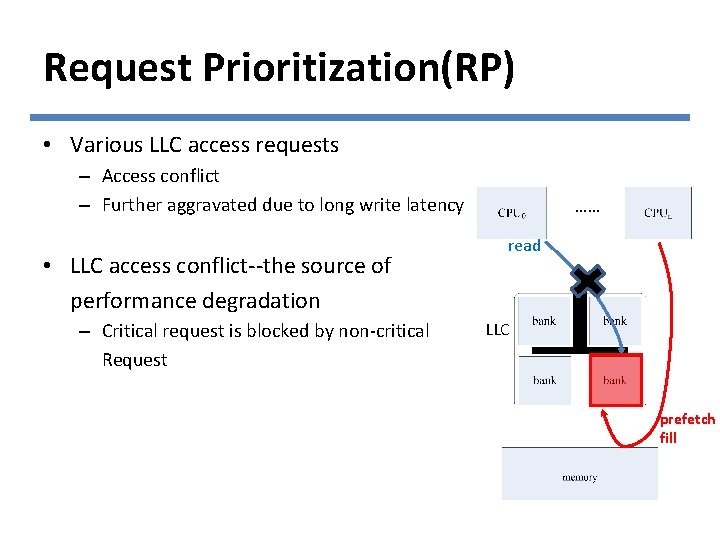
Request Prioritization(RP) • Various LLC access requests – Access conflict – Further aggravated due to long write latency • LLC access conflict--the source of performance degradation – Critical request is blocked by non-critical Request …… read LLC prefetch fill
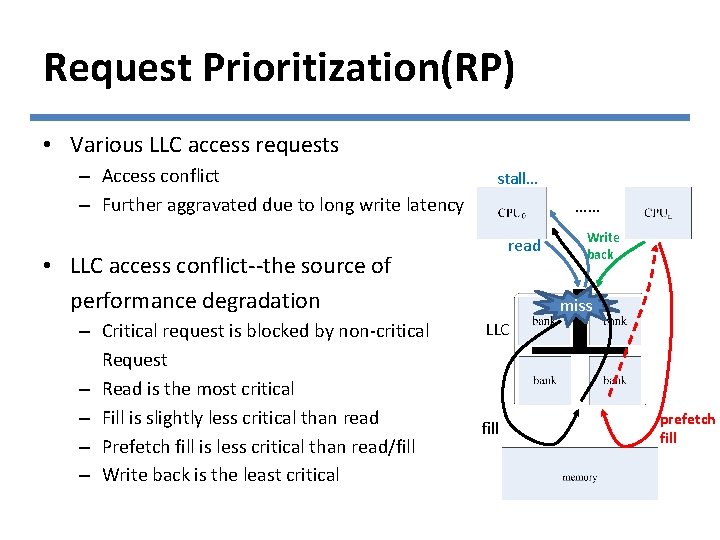
Request Prioritization(RP) • Various LLC access requests – Access conflict – Further aggravated due to long write latency stall… …… read • LLC access conflict--the source of performance degradation – Critical request is blocked by non-critical Request – Read is the most critical – Fill is slightly less critical than read – Prefetch fill is less critical than read/fill – Write back is the least critical Write back miss LLC fill prefetch fill
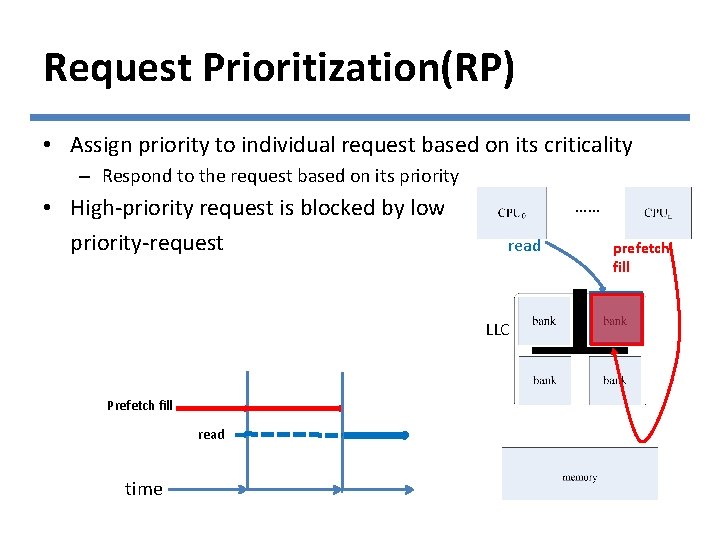
Request Prioritization(RP) • Assign priority to individual request based on its criticality – Respond to the request based on its priority • High-priority request is blocked by low priority-request …… read LLC Prefetch fill read time prefetch fill
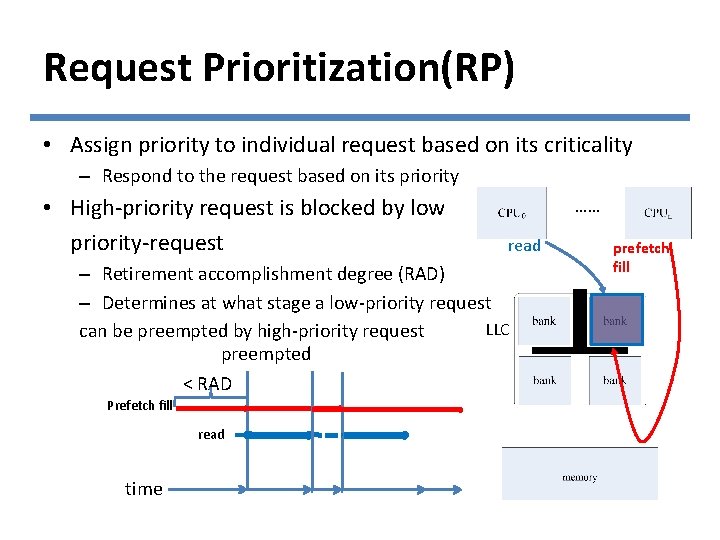
Request Prioritization(RP) • Assign priority to individual request based on its criticality – Respond to the request based on its priority • High-priority request is blocked by low priority-request …… read – Retirement accomplishment degree (RAD) – Determines at what stage a low-priority request LLC can be preempted by high-priority request preempted < RAD Prefetch fill read time prefetch fill
Outline • Motivation • STT-RAM Basics • Methodology – Request prioritization – Hybrid local-global prefetch control • Result • Conclusion
Hybrid Local-global Prefetch Control (HLGPC) • The prefetching efficiency is affected by the capacity (cell size) of STT-RAM based LLC – A large cell size alleviates bank conflict, by reducing the blocking time of write operations – Cache pollution incurred by prefetching also becomes severer due to the reduced total capacity • Prefetch control considering LLC access contention – Dynamically control the aggressiveness of the prefetchers – Tune the prefetch distance/prefetch degree
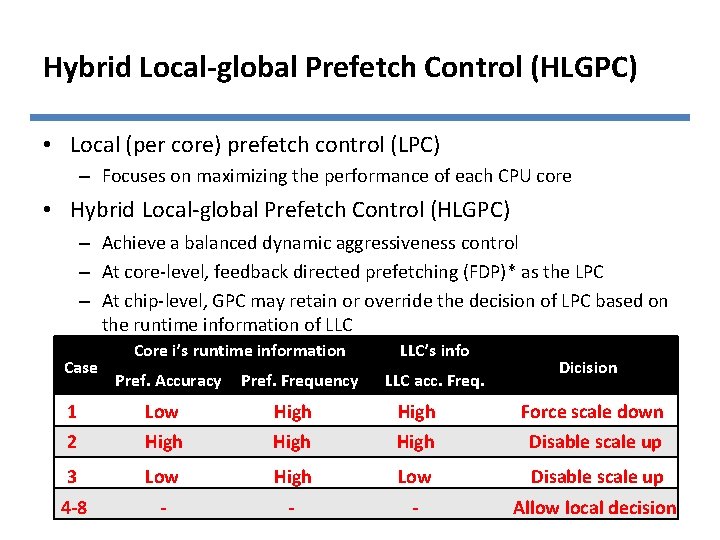
Hybrid Local-global Prefetch Control (HLGPC) • Local (per core) prefetch control (LPC) – Focuses on maximizing the performance of each CPU core • Hybrid Local-global Prefetch Control (HLGPC) – Achieve a balanced dynamic aggressiveness control – At core-level, feedback directed prefetching (FDP)* as the LPC – At chip-level, GPC may retain or override the decision of LPC based on the runtime information of LLC Case Core i’s runtime information Pref. Accuracy Pref. Frequency LLC’s info LLC acc. Freq. Dicision 1 2 Low High High Force scale down Disable scale up 3 Low High Low Disable scale up 4 -8 - - - Allow local decision
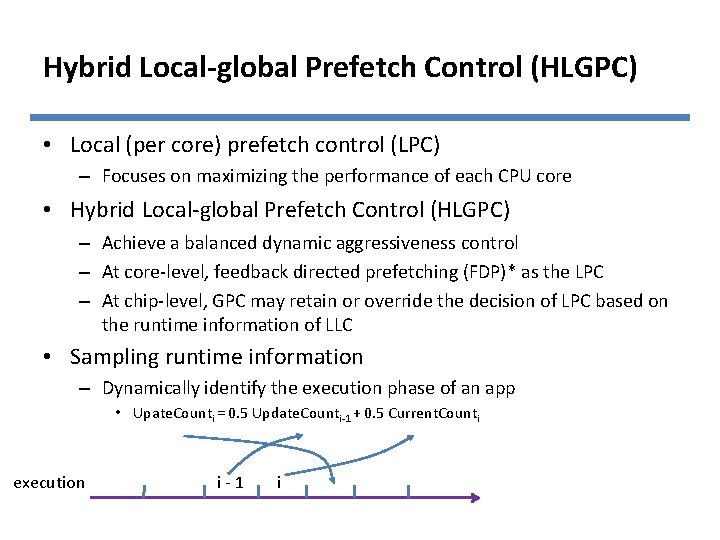
Hybrid Local-global Prefetch Control (HLGPC) • Local (per core) prefetch control (LPC) – Focuses on maximizing the performance of each CPU core • Hybrid Local-global Prefetch Control (HLGPC) – Achieve a balanced dynamic aggressiveness control – At core-level, feedback directed prefetching (FDP)* as the LPC – At chip-level, GPC may retain or override the decision of LPC based on the runtime information of LLC • Sampling runtime information – Dynamically identify the execution phase of an app • Upate. Counti = 0. 5 Update. Counti-1 + 0. 5 Current. Counti execution i-1 i
Outline • Motivation • STT-RAM Basics • Methodology – Request prioritization – Hybrid local-global prefetch control • Result • Conclusion
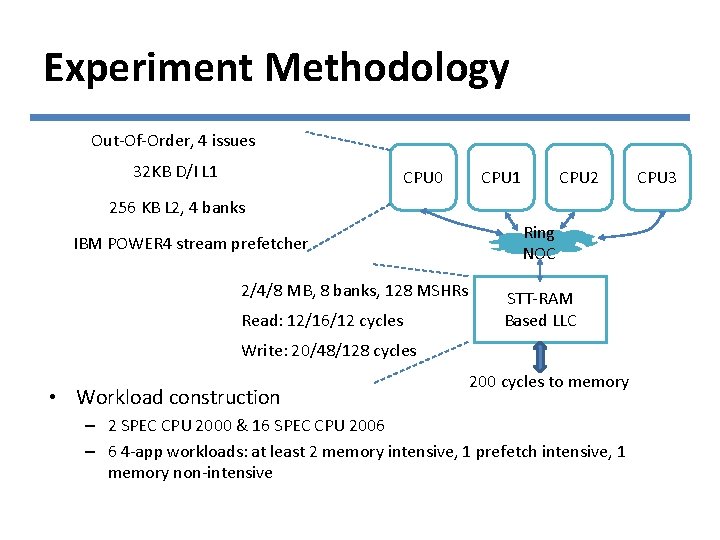
Experiment Methodology Out-Of-Order, 4 issues 32 KB D/I L 1 CPU 0 CPU 1 CPU 2 256 KB L 2, 4 banks IBM POWER 4 stream prefetcher 2/4/8 MB, 8 banks, 128 MSHRs Read: 12/16/12 cycles Ring NOC STT-RAM Based LLC Write: 20/48/128 cycles • Workload construction 200 cycles to memory – 2 SPEC CPU 2000 & 16 SPEC CPU 2006 – 6 4 -app workloads: at least 2 memory intensive, 1 prefetch intensive, 1 memory non-intensive CPU 3
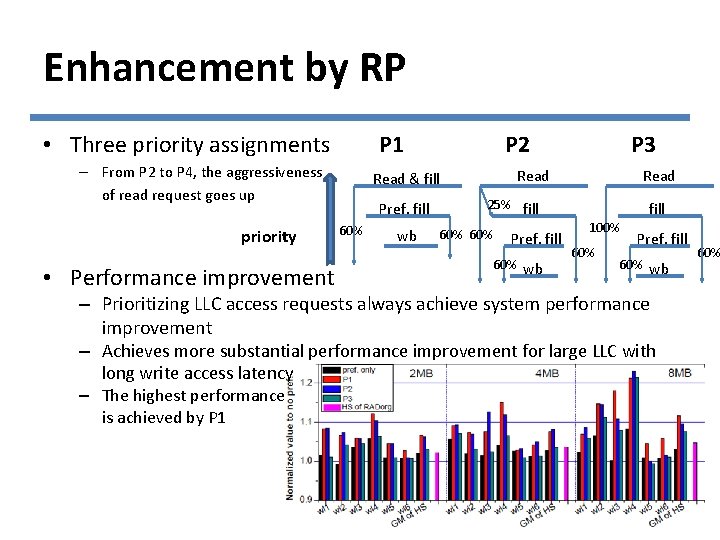
Enhancement by RP • Three priority assignments P 1 – From P 2 to P 4, the aggressiveness of read request goes up priority • Performance improvement P 2 Read & fill Pref. fill 60% wb P 3 Read 25% fill 60% Pref. fill 60% wb fill 100% 60% Pref. fill 60% wb – Prioritizing LLC access requests always achieve system performance improvement – Achieves more substantial performance improvement for large LLC with long write access latency – The highest performance is achieved by P 1 60%
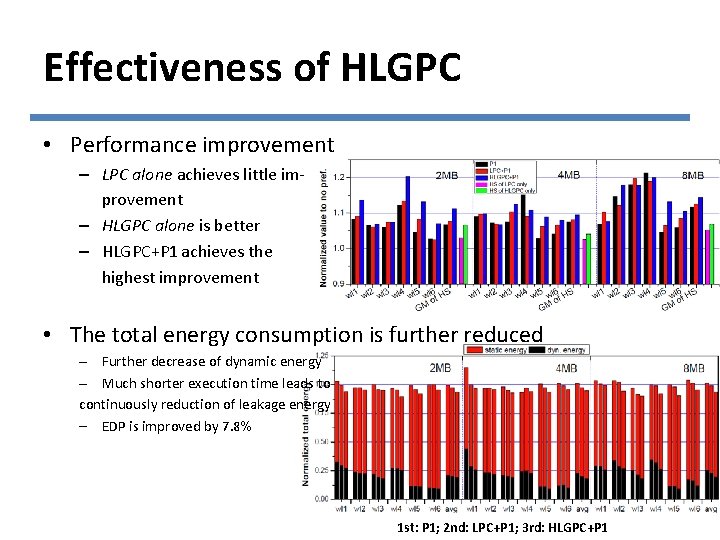
Effectiveness of HLGPC • Performance improvement – LPC alone achieves little improvement – HLGPC alone is better – HLGPC+P 1 achieves the highest improvement • The total energy consumption is further reduced – Further decrease of dynamic energy – Much shorter execution time leads to continuously reduction of leakage energy – EDP is improved by 7. 8% 1 st: P 1; 2 nd: LPC+P 1; 3 rd: HLGPC+P 1
Outline • Motivation • STT-RAM Basics • Methodology – Request prioritization – Hybrid local-global prefetch control • Result • Conclusion
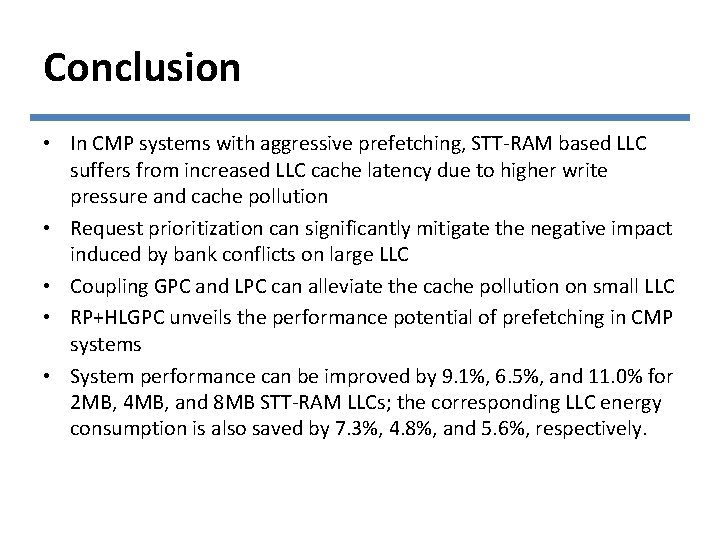
Conclusion • In CMP systems with aggressive prefetching, STT-RAM based LLC suffers from increased LLC cache latency due to higher write pressure and cache pollution • Request prioritization can significantly mitigate the negative impact induced by bank conflicts on large LLC • Coupling GPC and LPC can alleviate the cache pollution on small LLC • RP+HLGPC unveils the performance potential of prefetching in CMP systems • System performance can be improved by 9. 1%, 6. 5%, and 11. 0% for 2 MB, 4 MB, and 8 MB STT-RAM LLCs; the corresponding LLC energy consumption is also saved by 7. 3%, 4. 8%, and 5. 6%, respectively.

Q&A • Thank you
- Slides: 26