
Prefetching Ontime and When it Works Sequential Prefetcher
- Slides: 16
Prefetching On-time and When it Works Sequential Prefetcher With Adaptive Distance (SPAD) Ibrahim Burak Karsli (bkarsli@ele. uri. edu) Mustafa Cavus (mcavus@my. uri. edu) Resit Sendag (sendag@ele. uri. edu) Department of Electrical, Computer, and Biomedical Engineering University of Rhode Island
Outline § § Motivation Sequential Prefetcher with Adaptive Distance (SPAD) Hardware Budget Results
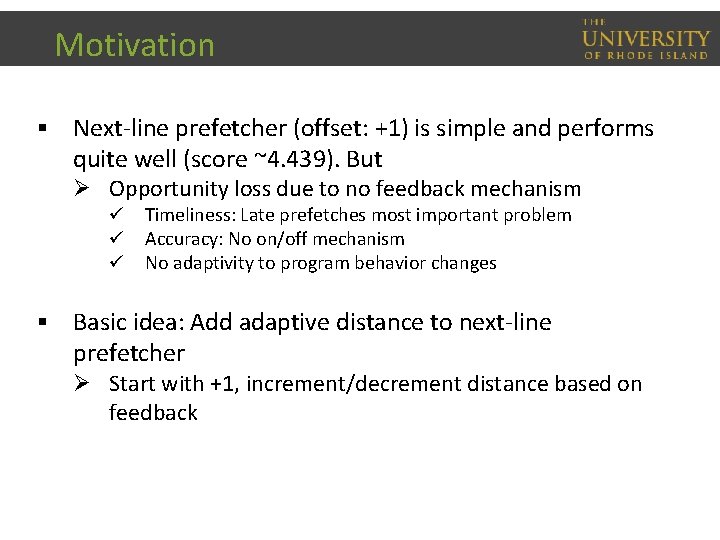
Motivation § Next-line prefetcher (offset: +1) is simple and performs quite well (score ~4. 439). But Ø Opportunity loss due to no feedback mechanism ü ü ü Timeliness: Late prefetches most important problem Accuracy: No on/off mechanism No adaptivity to program behavior changes § Basic idea: Add adaptive distance to next-line prefetcher Ø Start with +1, increment/decrement distance based on feedback
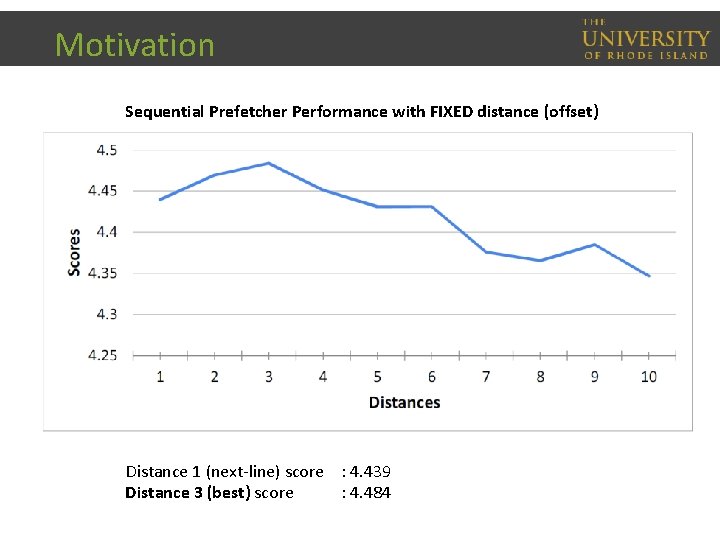
Motivation Sequential Prefetcher Performance with FIXED distance (offset) Distance 1 (next-line) score : 4. 439 Distance 3 (best) score : 4. 484
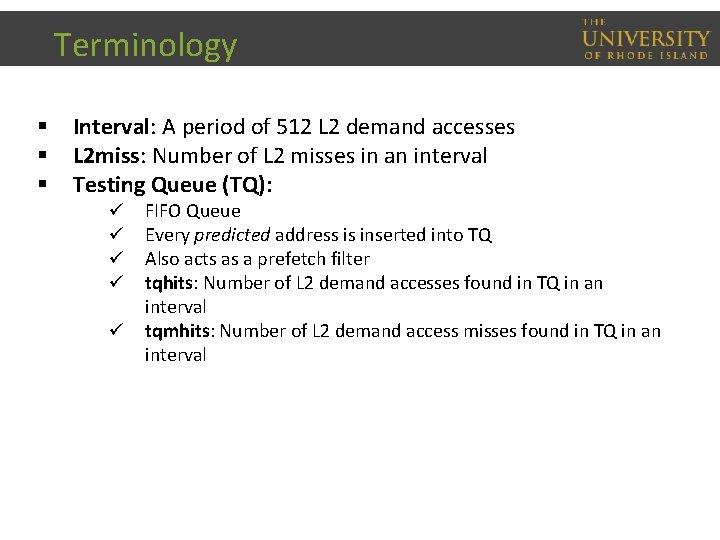
Terminology § § § Interval: A period of 512 L 2 demand accesses L 2 miss: Number of L 2 misses in an interval Testing Queue (TQ): ü ü ü FIFO Queue Every predicted address is inserted into TQ Also acts as a prefetch filter tqhits: Number of L 2 demand accesses found in TQ in an interval tqmhits: Number of L 2 demand access misses found in TQ in an interval
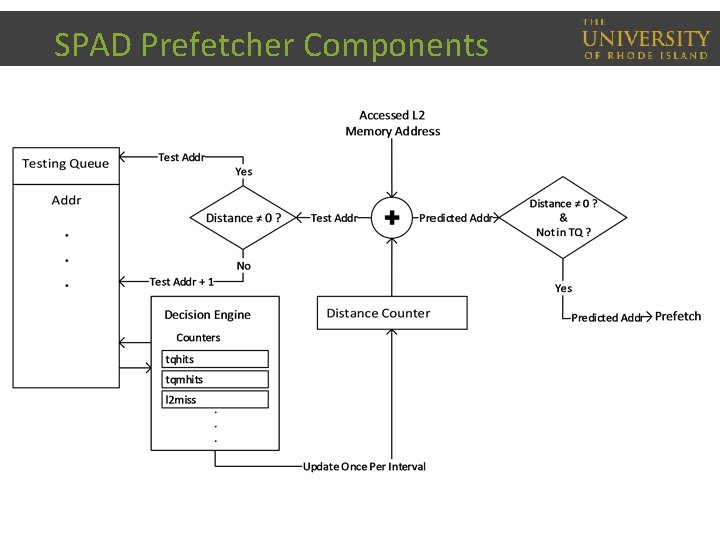
SPAD Prefetcher Components
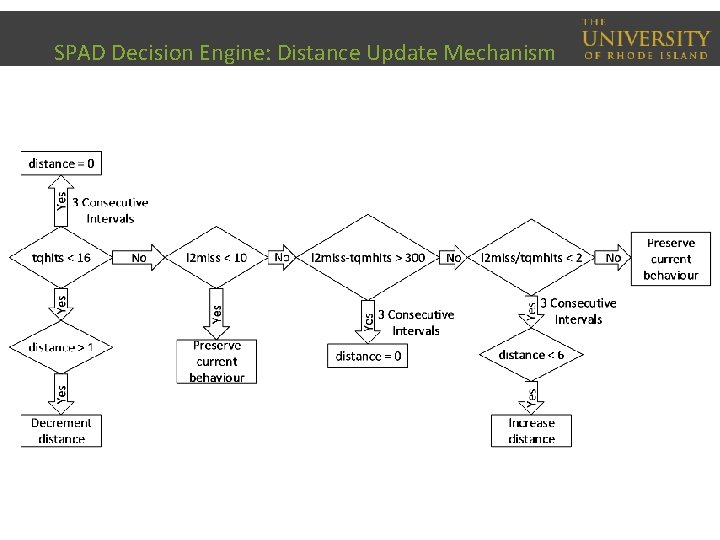
SPAD Decision Engine: Distance Update Mechanism
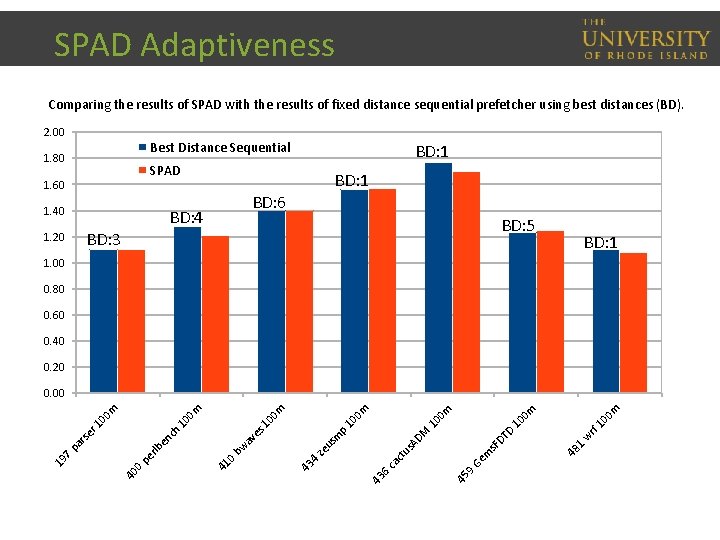
SPAD Adaptiveness Comparing the results of SPAD with the results of fixed distance sequential prefetcher using best distances (BD). 2. 00 Best Distance Sequential 1. 80 SPAD 1. 60 1. 40 1. 20 BD: 1 BD: 6 BD: 4 BD: 5 BD: 3 BD: 1 1. 00 0. 80 0. 60 0. 40 0. 20 0 m 10 0 m rf. 10 48 1. w D. DT m s. F 45 9. Ge us ct ca 6. 43 43 4. ze us m AD M p. . 1 0 10 0 m 0 m m 00 av es. 1 bw 0. 41 en 0. pe rlb 40 19 7. pa rs er ch . 1 0 0 m 0 m 0. 00
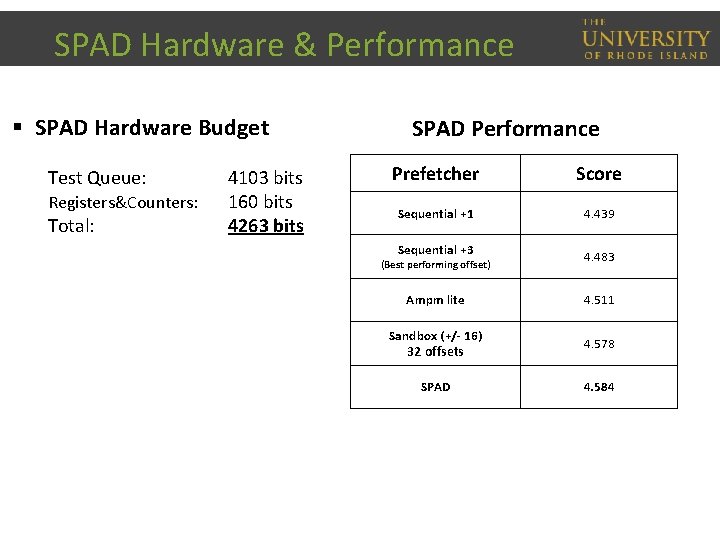
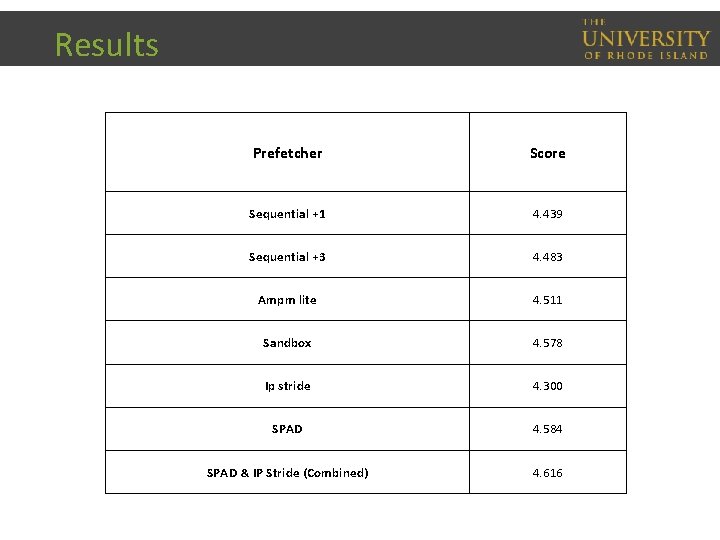
SPAD Hardware & Performance § SPAD Hardware Budget Test Queue: Registers&Counters: Total: 4103 bits 160 bits 4263 bits SPAD Performance Prefetcher Score Sequential +1 4. 439 Sequential +3 4. 483 Ampm lite 4. 511 Sandbox (+/- 16) 32 offsets 4. 578 SPAD 4. 584 (Best performing offset)
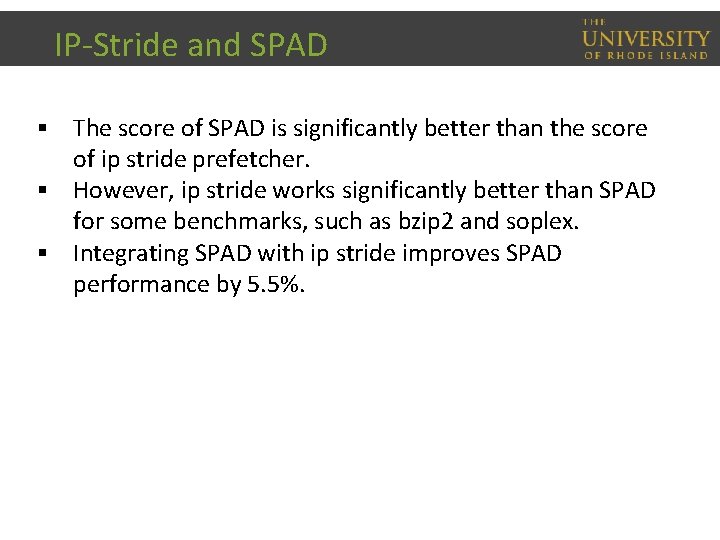
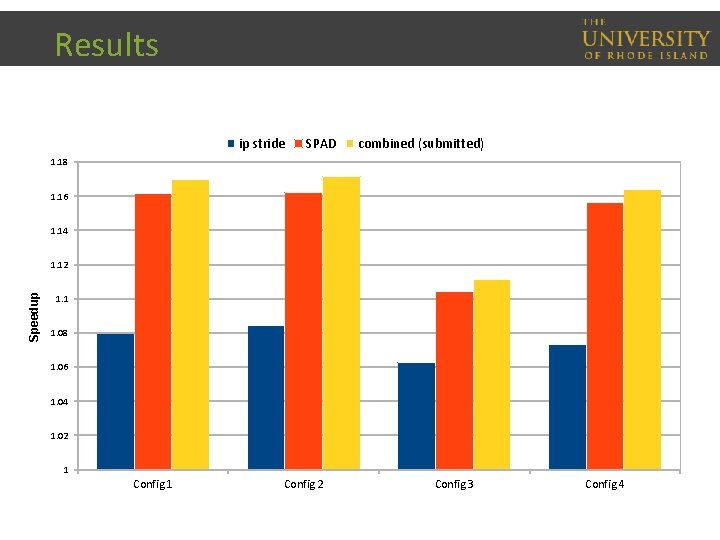
IP-Stride and SPAD § The score of SPAD is significantly better than the score of ip stride prefetcher. § However, ip stride works significantly better than SPAD for some benchmarks, such as bzip 2 and soplex. § Integrating SPAD with ip stride improves SPAD performance by 5. 5%.
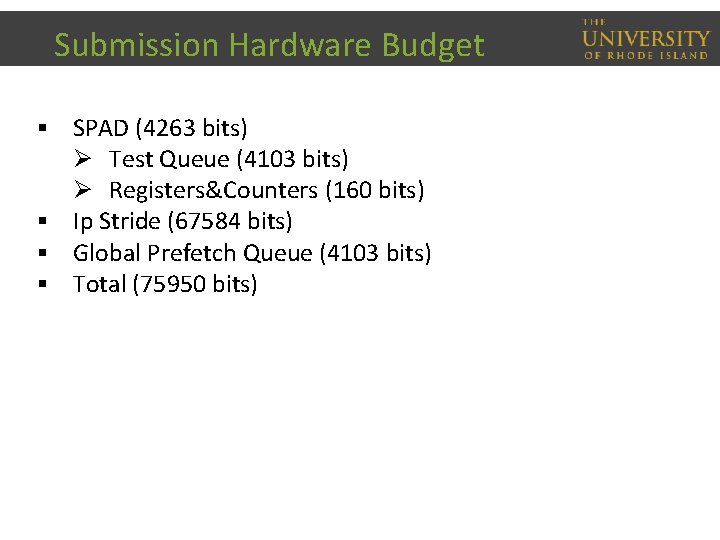
Submission Hardware Budget § SPAD (4263 bits) Ø Test Queue (4103 bits) Ø Registers&Counters (160 bits) § Ip Stride (67584 bits) § Global Prefetch Queue (4103 bits) § Total (75950 bits)
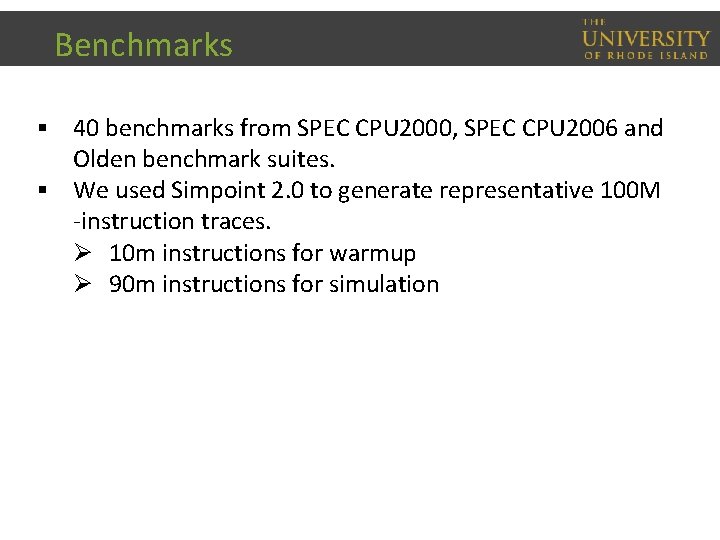
Benchmarks § 40 benchmarks from SPEC CPU 2000, SPEC CPU 2006 and Olden benchmark suites. § We used Simpoint 2. 0 to generate representative 100 M -instruction traces. Ø 10 m instructions for warmup Ø 90 m instructions for simulation
Results ip stride SPAD combined (submitted) 1. 18 1. 16 1. 14 Speedup 1. 12 1. 1 1. 08 1. 06 1. 04 1. 02 1 Config 2 Config 3 Config 4
Results Prefetcher Score Sequential +1 4. 439 Sequential +3 4. 483 Ampm lite 4. 511 Sandbox 4. 578 Ip stride 4. 300 SPAD 4. 584 SPAD & IP Stride (Combined) 4. 616
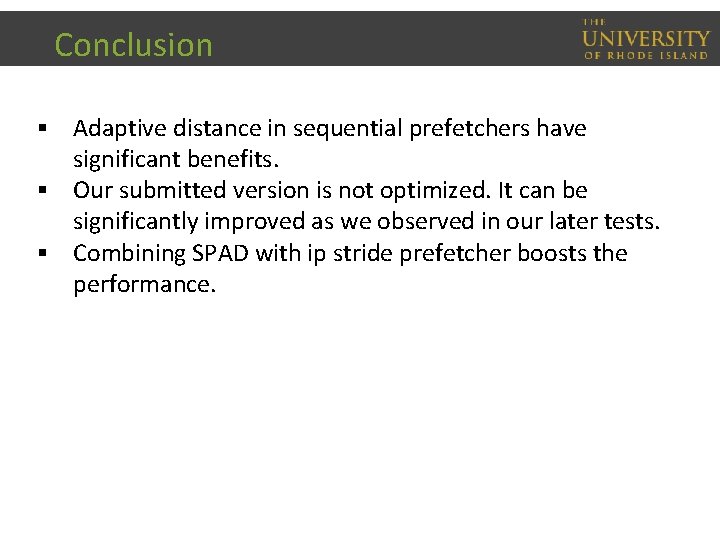
Conclusion § Adaptive distance in sequential prefetchers have significant benefits. § Our submitted version is not optimized. It can be significantly improved as we observed in our later tests. § Combining SPAD with ip stride prefetcher boosts the performance.
Thank You Questions?