
PreEndorsement Advisor Meeting Energy Water Infrastructure Instruments 8
- Slides: 55
Pre-Endorsement Advisor Meeting Energy, Water & Infrastructure Instruments 8 September 2020
Meeting Objective Convene Lab Members to: 1. Review the results of the Phase 3 Analysis 2. Recommend further analysis and lines of inquiry, noting improvements needed before 24 Sep Endorsement 3. Express initial interest in supporting instruments towards their implementation 1
Agenda • Welcome and introductions (Dr. Barbara Buchner) - 10’ • Presentation and Discussions • Energy Access stream: Green. Street Africa – 25’ • Sustainable Cities stream: Sub-National Climate Fund Initiative – 25’ • Nature-Based Solutions stream: Monetizing Water Savings – 25’ • Southern Africa Program: Climate Adaptation Notes – 25’ • Closing remarks (Dr. Barbara Buchner) – 10’ 2
Virtual Endorsement Meeting: Thursday 24 September 2020 Goal • Endorse final designs • Signal instruments are ready to be introduced to the market as official Lab investment vehicles Format • Short presentations of Lab instruments • Endorsement and potential support announcements • Roundtable to set strategy for 2021 Lab cycle and beyond Participants: Global Lab Principals and Advisors, Regional Panel Members, Lab Observers, Lab Analysts (meeting closed to proponents) 3
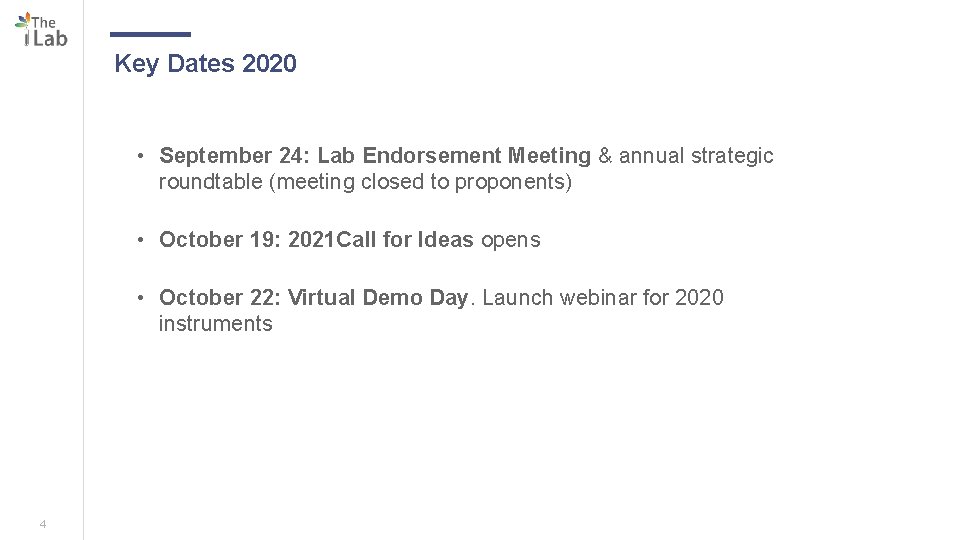
Key Dates 2020 • September 24: Lab Endorsement Meeting & annual strategic roundtable (meeting closed to proponents) • October 19: 2021 Call for Ideas opens • October 22: Virtual Demo Day. Launch webinar for 2020 instruments 4
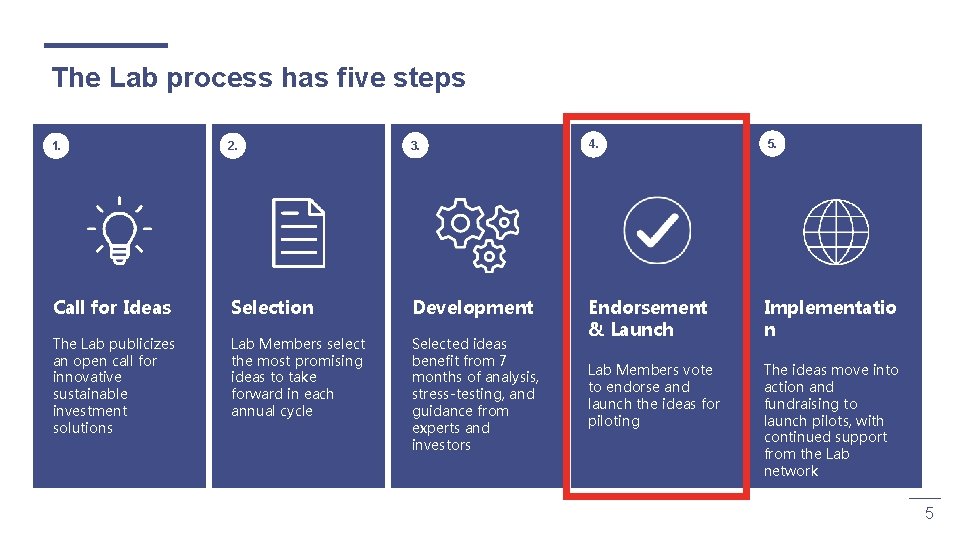
The Lab process has five steps 1. 2. 3. 4. 5. Call for Ideas Selection Development The Lab publicizes an open call for innovative sustainable investment solutions Lab Members select the most promising ideas to take forward in each annual cycle Selected ideas benefit from 7 months of analysis, stress-testing, and guidance from experts and investors Endorsement & Launch Implementatio n Lab Members vote to endorse and launch the ideas for piloting The ideas move into action and fundraising to launch pilots, with continued support from the Lab network 5
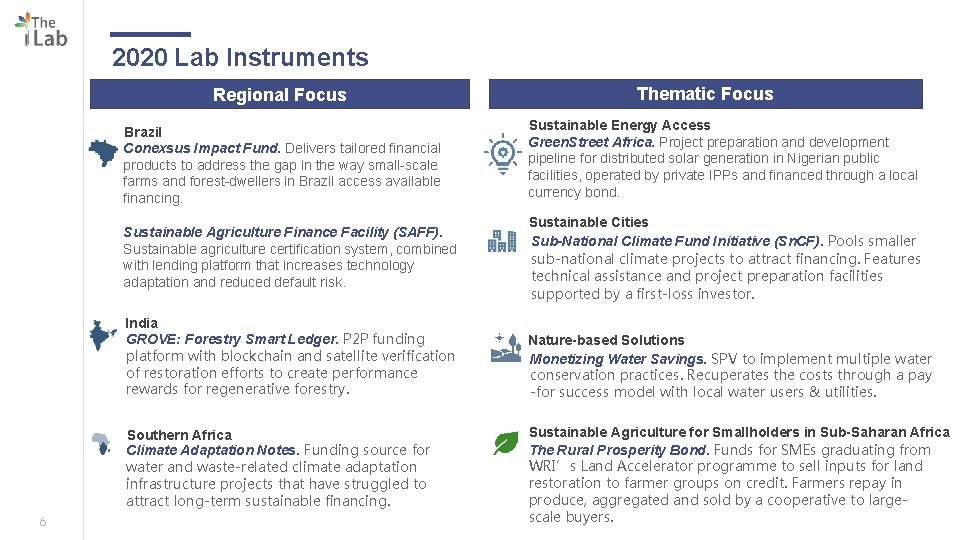
2020 Lab Instruments Regional Focus Brazil Conexsus Impact Fund. Delivers tailored financial products to address the gap in the way small-scale farms and forest-dwellers in Brazil access available financing. Sustainable Energy Access Green. Street Africa. Project preparation and development pipeline for distributed solar generation in Nigerian public facilities, operated by private IPPs and financed through a local currency bond. Sustainable Agriculture Finance Facility (SAFF). Sustainable agriculture certification system, combined with lending platform that increases technology adaptation and reduced default risk. Sustainable Cities Sub-National Climate Fund Initiative (Sn. CF). Pools smaller sub-national climate projects to attract financing. Features technical assistance and project preparation facilities supported by a first-loss investor. India GROVE: Forestry Smart Ledger. P 2 P funding platform with blockchain and satellite verification of restoration efforts to create performance rewards for regenerative forestry. Southern Africa Climate Adaptation Notes. Funding source for water and waste-related climate adaptation infrastructure projects that have struggled to attract long-term sustainable financing. 6 Thematic Focus Nature-based Solutions Monetizing Water Savings. SPV to implement multiple water conservation practices. Recuperates the costs through a pay -for success model with local water users & utilities. Sustainable Agriculture for Smallholders in Sub-Saharan Africa The Rural Prosperity Bond. Funds for SMEs graduating from WRI’s Land Accelerator programme to sell inputs for land restoration to farmer groups on credit. Farmers repay in produce, aggregated and sold by a cooperative to largescale buyers.
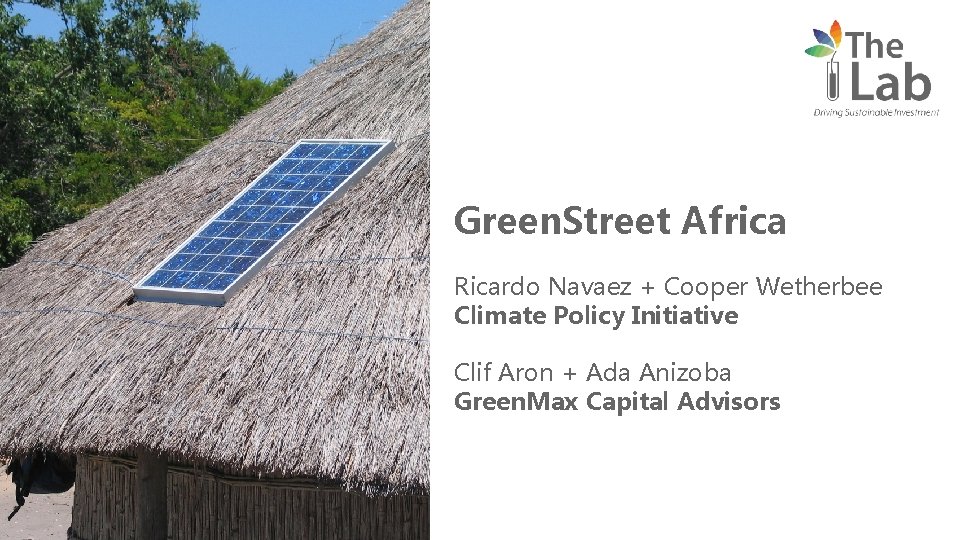
Green. Street Africa Ricardo Navaez + Cooper Wetherbee Climate Policy Initiative Clif Aron + Ada Anizoba Green. Max Capital Advisors
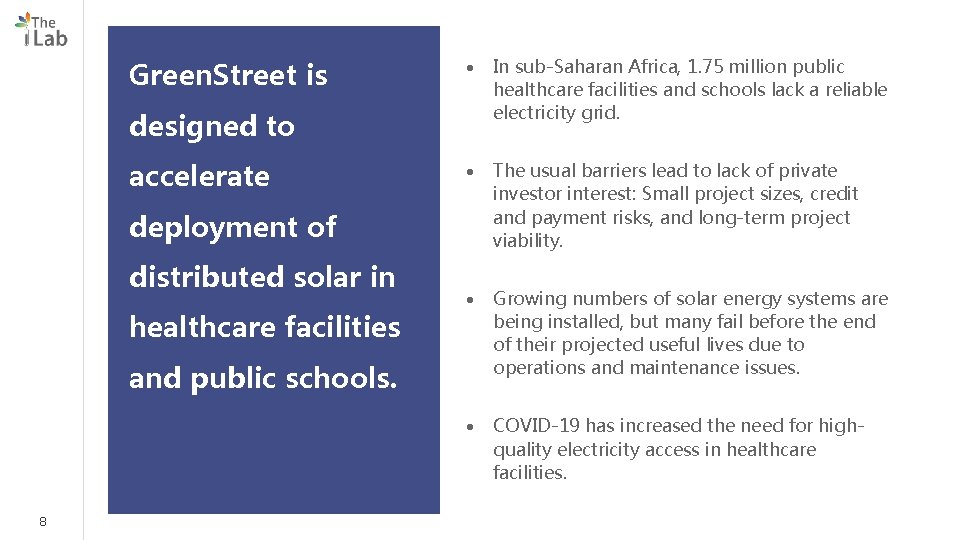
Green. Street is In sub-Saharan Africa, 1. 75 million public healthcare facilities and schools lack a reliable electricity grid. The usual barriers lead to lack of private investor interest: Small project sizes, credit and payment risks, and long-term project viability. Growing numbers of solar energy systems are being installed, but many fail before the end of their projected useful lives due to operations and maintenance issues. COVID-19 has increased the need for highquality electricity access in healthcare facilities. designed to accelerate deployment of distributed solar in healthcare facilities and public schools. 8
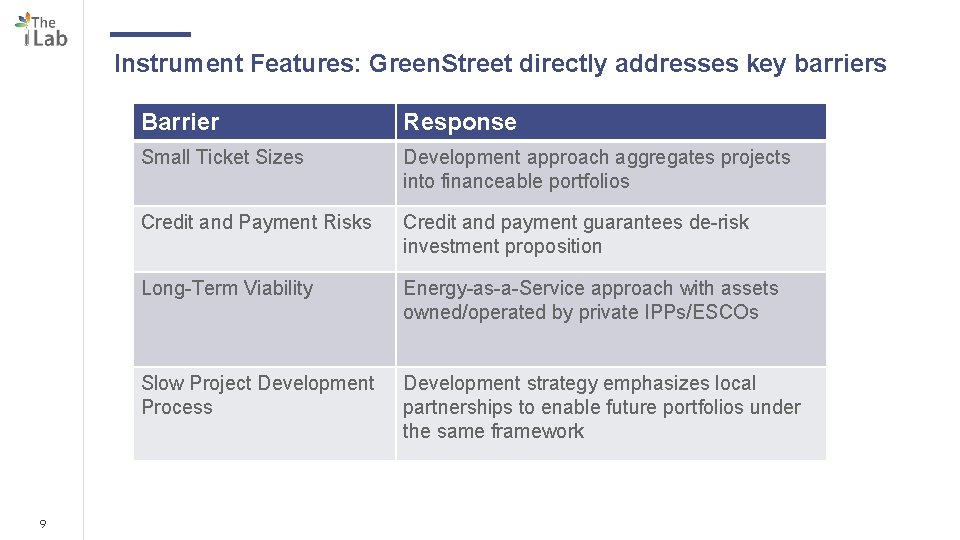
Instrument Features: Green. Street directly addresses key barriers 9 Barrier Response Small Ticket Sizes Development approach aggregates projects into financeable portfolios Credit and Payment Risks Credit and payment guarantees de-risk investment proposition Long-Term Viability Energy-as-a-Service approach with assets owned/operated by private IPPs/ESCOs Slow Project Development Process Development strategy emphasizes local partnerships to enable future portfolios under the same framework
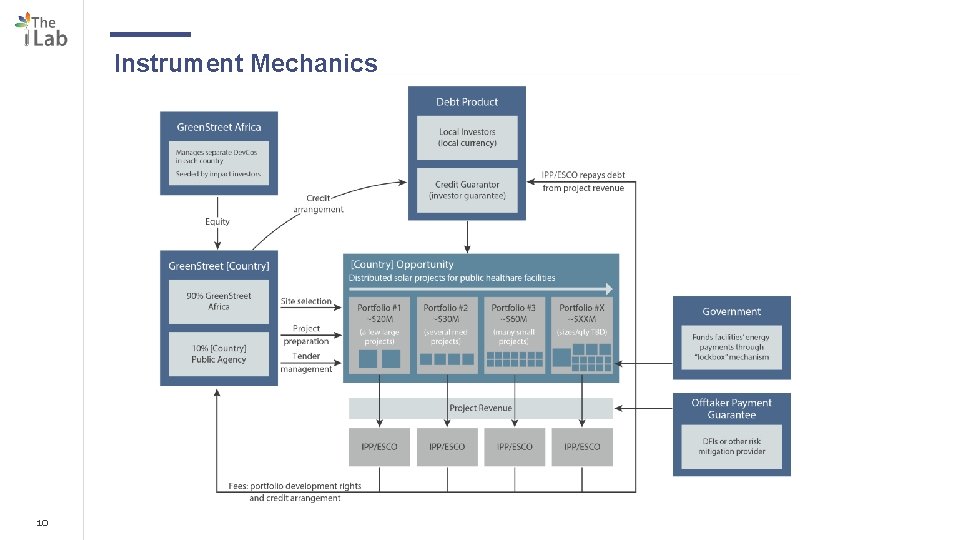
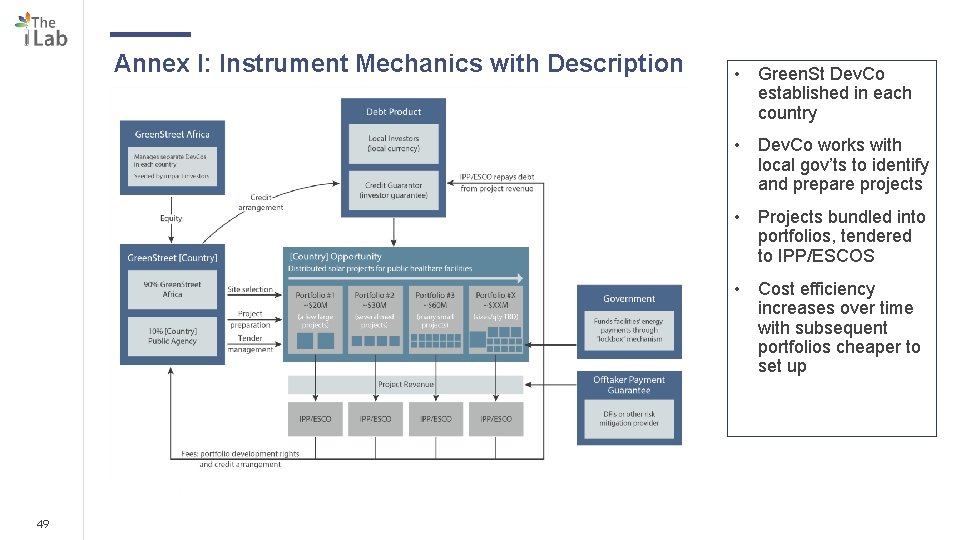
Instrument Mechanics 10
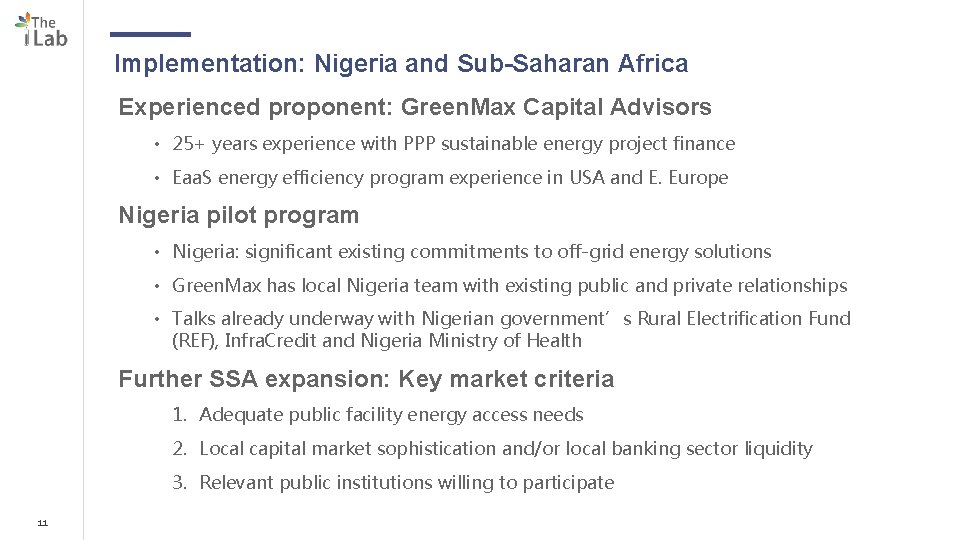
Implementation: Nigeria and Sub-Saharan Africa Experienced proponent: Green. Max Capital Advisors • 25+ years experience with PPP sustainable energy project finance • Eaa. S energy efficiency program experience in USA and E. Europe Nigeria pilot program • Nigeria: significant existing commitments to off-grid energy solutions • Green. Max has local Nigeria team with existing public and private relationships • Talks already underway with Nigerian government’s Rural Electrification Fund (REF), Infra. Credit and Nigeria Ministry of Health Further SSA expansion: Key market criteria 1. Adequate public facility energy access needs 2. Local capital market sophistication and/or local banking sector liquidity 3. Relevant public institutions willing to participate 11
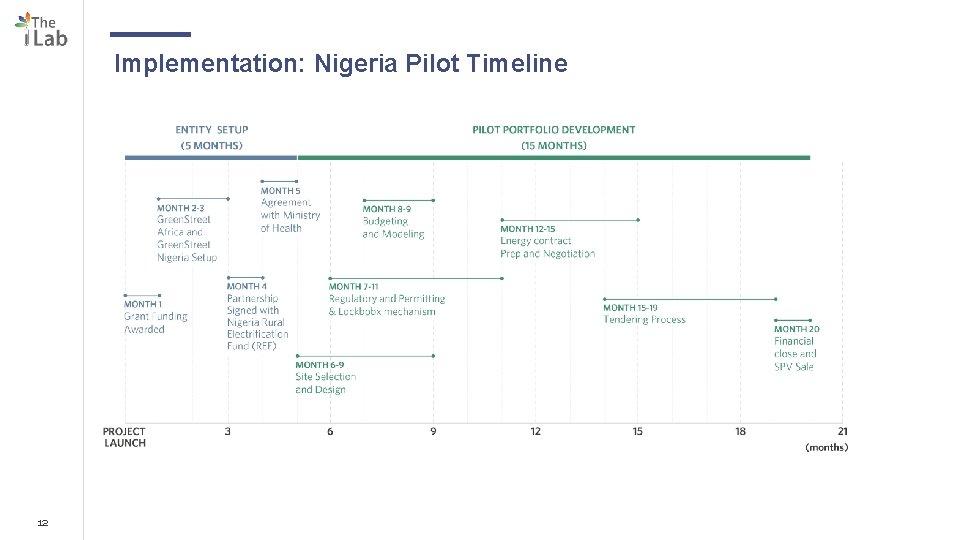
Implementation: Nigeria Pilot Timeline 12
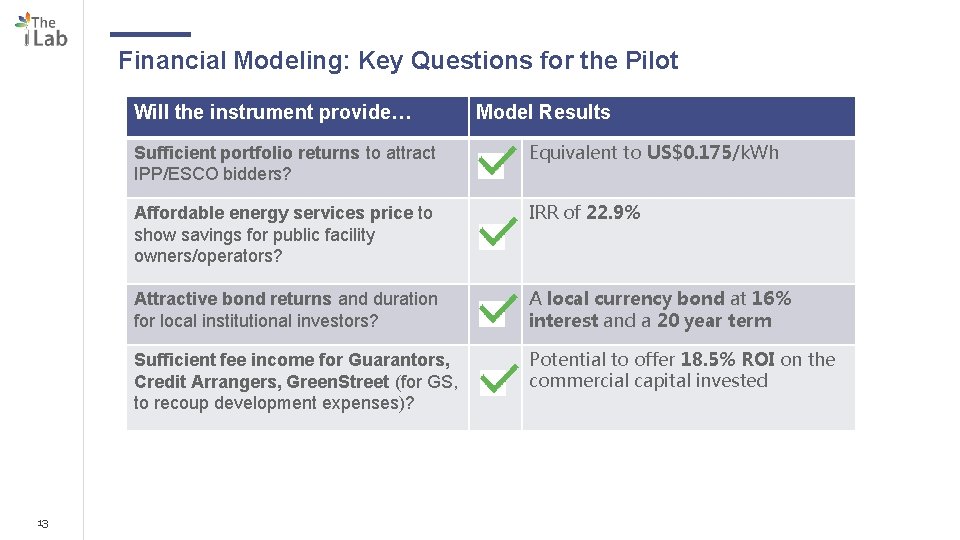
Financial Modeling: Key Questions for the Pilot Will the instrument provide… 13 Model Results Sufficient portfolio returns to attract IPP/ESCO bidders? Equivalent to US$0. 175/k. Wh Affordable energy services price to show savings for public facility owners/operators? IRR of 22. 9% Attractive bond returns and duration for local institutional investors? A local currency bond at 16% interest and a 20 year term Sufficient fee income for Guarantors, Credit Arrangers, Green. Street (for GS, to recoup development expenses)? Potential to offer 18. 5% ROI on the commercial capital invested
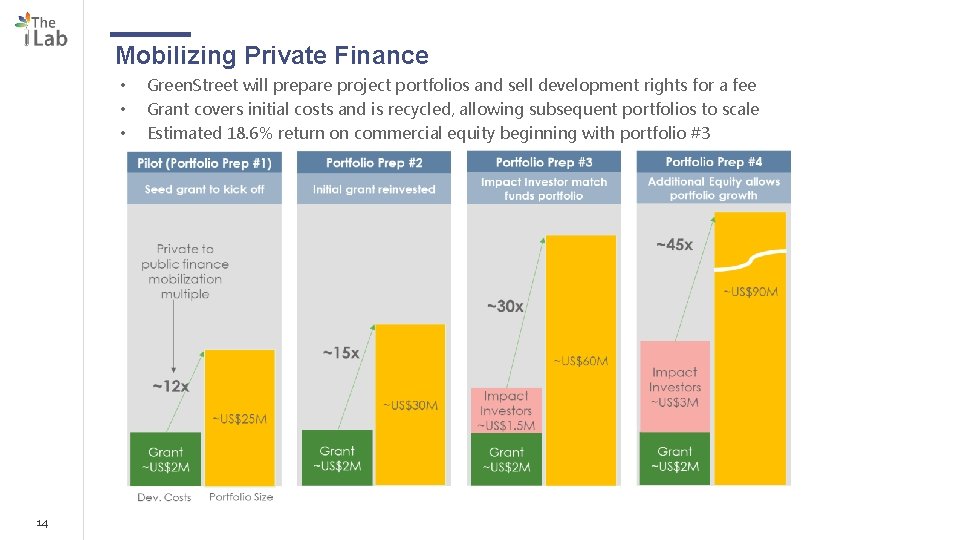
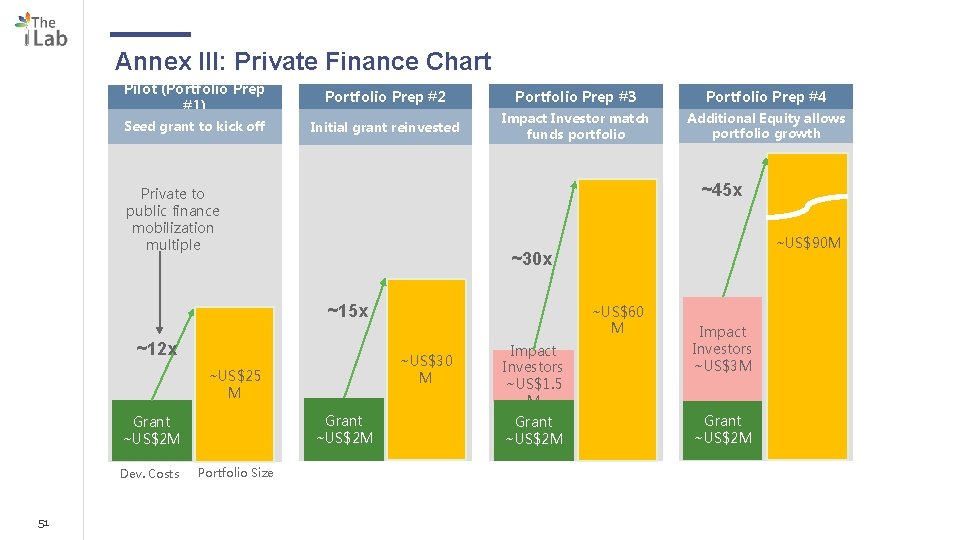
Mobilizing Private Finance • • • 14 Green. Street will prepare project portfolios and sell development rights for a fee Grant covers initial costs and is recycled, allowing subsequent portfolios to scale Estimated 18. 6% return on commercial equity beginning with portfolio #3
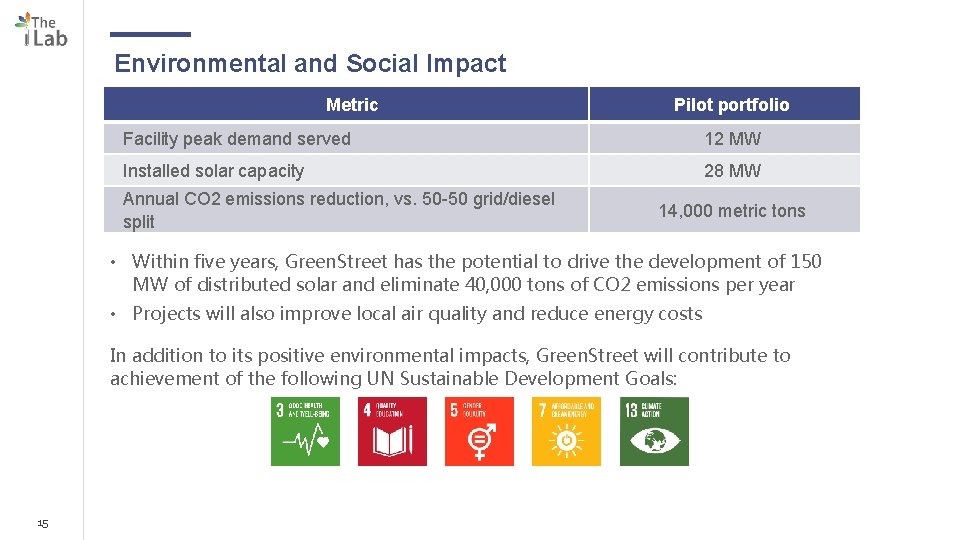
Environmental and Social Impact Metric Pilot portfolio Facility peak demand served 12 MW Installed solar capacity 28 MW Annual CO 2 emissions reduction, vs. 50 -50 grid/diesel split 14, 000 metric tons • Within five years, Green. Street has the potential to drive the development of 150 MW of distributed solar and eliminate 40, 000 tons of CO 2 emissions per year • Projects will also improve local air quality and reduce energy costs In addition to its positive environmental impacts, Green. Street will contribute to achievement of the following UN Sustainable Development Goals: 15
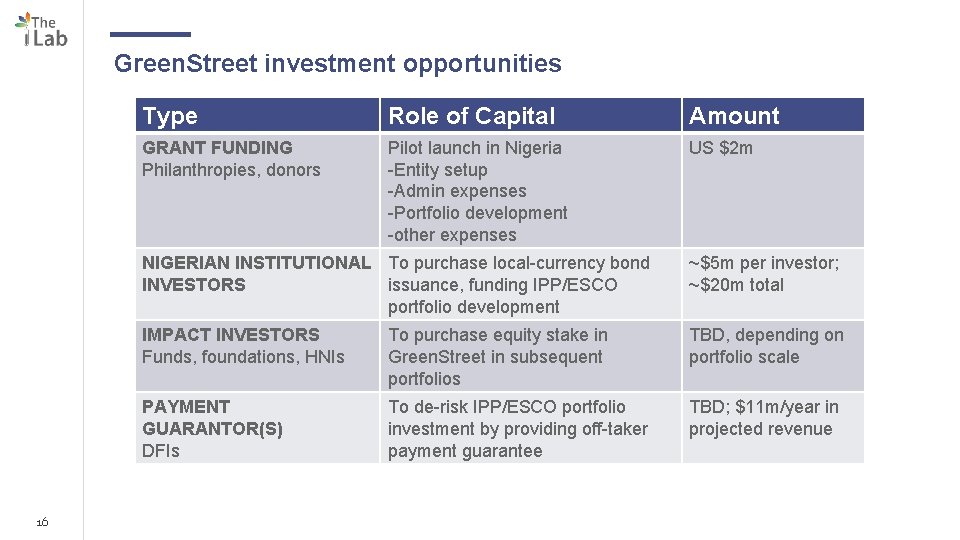
Green. Street investment opportunities 16 Type Role of Capital Amount GRANT FUNDING Philanthropies, donors Pilot launch in Nigeria -Entity setup -Admin expenses -Portfolio development -other expenses US $2 m NIGERIAN INSTITUTIONAL To purchase local-currency bond INVESTORS issuance, funding IPP/ESCO Ticket Size portfolio development ~$5 m per investor; ~$20 m total IMPACT INVESTORS Funds, foundations, HNIs To purchase equity stake in Green. Street in subsequent portfolios TBD, depending on portfolio scale PAYMENT GUARANTOR(S) DFIs To de-risk IPP/ESCO portfolio investment by providing off-taker payment guarantee TBD; $11 m/year in projected revenue
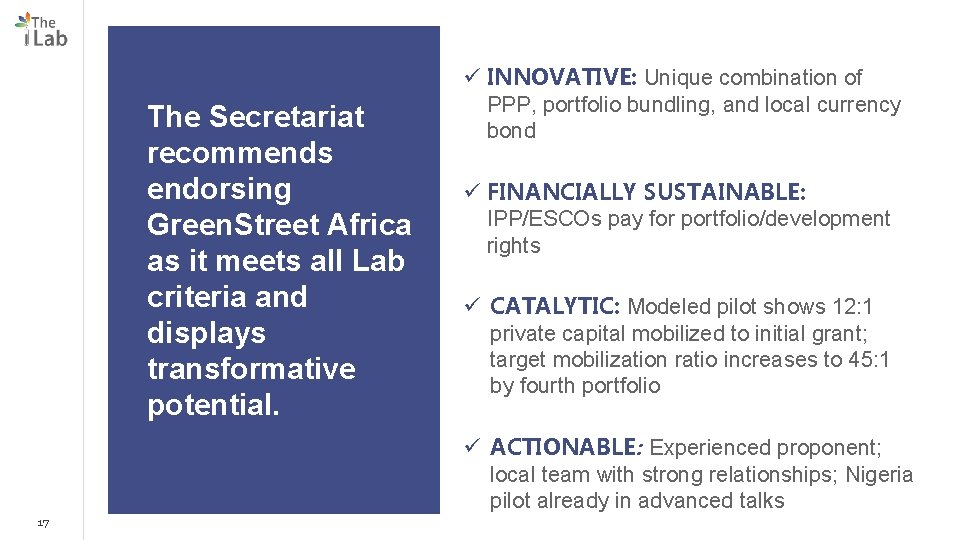
The Secretariat recommends endorsing Green. Street Africa as it meets all Lab criteria and displays transformative potential. ü INNOVATIVE: Unique combination of PPP, portfolio bundling, and local currency bond ü FINANCIALLY SUSTAINABLE: IPP/ESCOs pay for portfolio/development rights ü CATALYTIC: Modeled pilot shows 12: 1 private capital mobilized to initial grant; target mobilization ratio increases to 45: 1 by fourth portfolio ü ACTIONABLE: Experienced proponent; local team with strong relationships; Nigeria pilot already in advanced talks 17
Sub-National Climate Fund Initiative Hélène Van Caenegem Climate Policy Initiative David Albertani R 20 – Regions of Climate Action
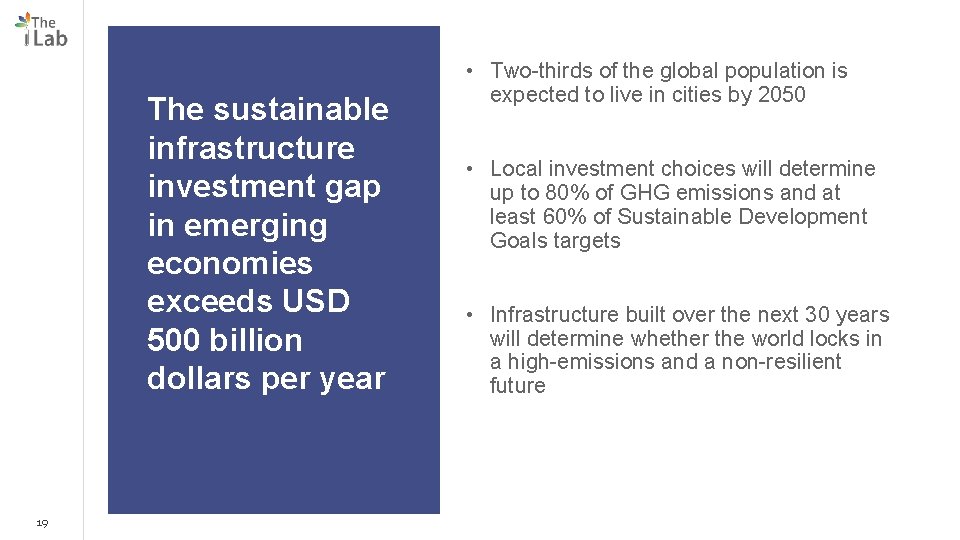
The sustainable infrastructure investment gap in emerging economies exceeds USD 500 billion dollars per year 19 • Two-thirds of the global population is expected to live in cities by 2050 • Local investment choices will determine up to 80% of GHG emissions and at least 60% of Sustainable Development Goals targets • Infrastructure built over the next 30 years will determine whether the world locks in a high-emissions and a non-resilient future
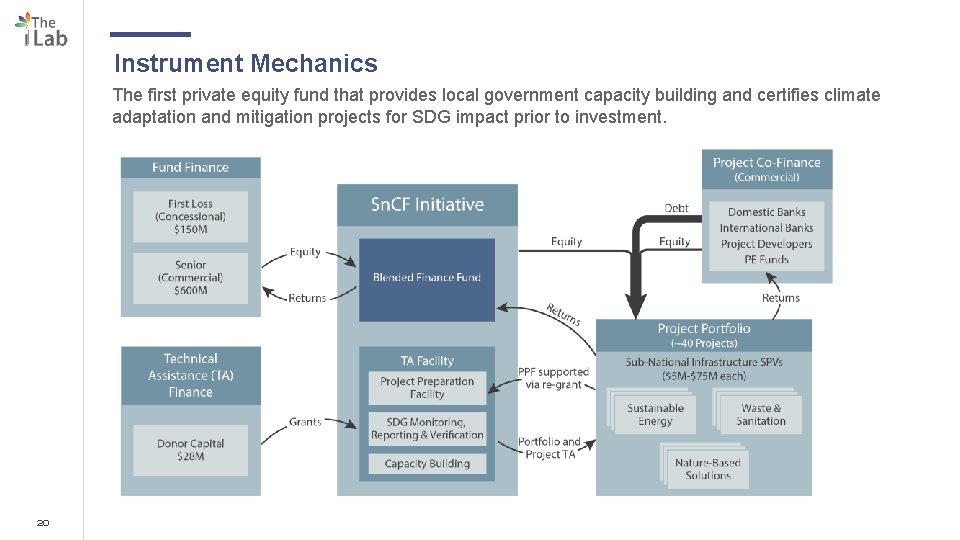
Instrument Mechanics The first private equity fund that provides local government capacity building and certifies climate adaptation and mitigation projects for SDG impact prior to investment. 20
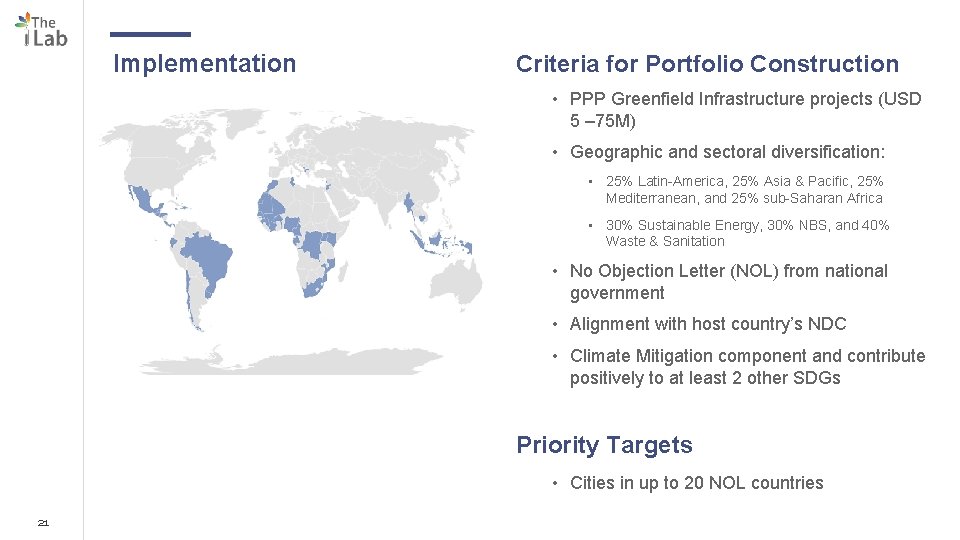
Implementation Criteria for Portfolio Construction • PPP Greenfield Infrastructure projects (USD 5 – 75 M) • Geographic and sectoral diversification: • 25% Latin-America, 25% Asia & Pacific, 25% Mediterranean, and 25% sub-Saharan Africa • 30% Sustainable Energy, 30% NBS, and 40% Waste & Sanitation • No Objection Letter (NOL) from national government • Alignment with host country’s NDC • Climate Mitigation component and contribute positively to at least 2 other SDGs Priority Targets • Cities in up to 20 NOL countries 21
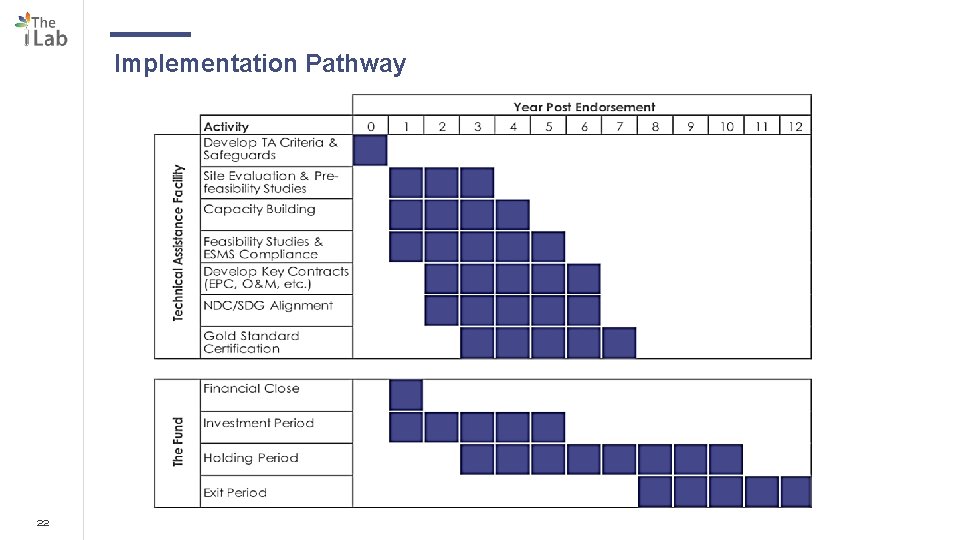
Implementation Pathway 22
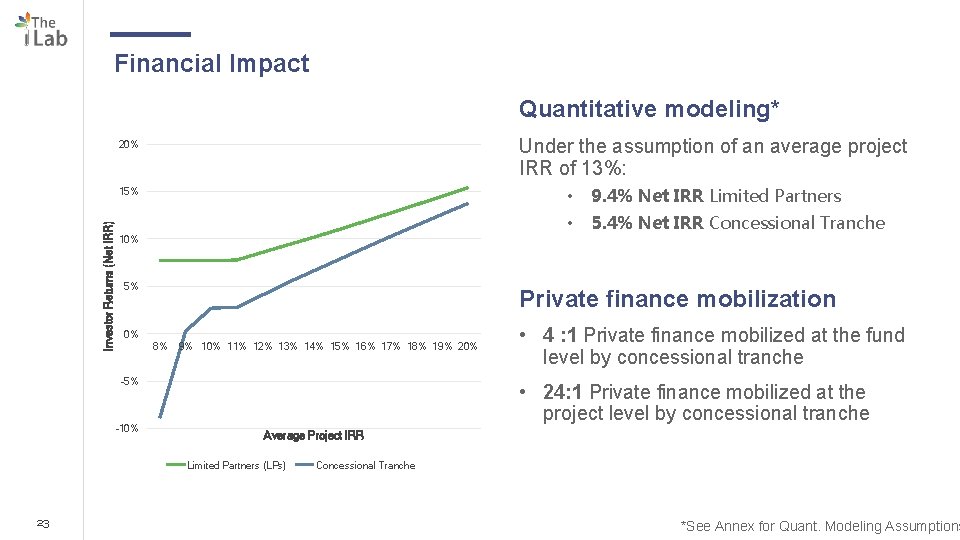
Financial Impact Quantitative modeling* Under the assumption of an average project IRR of 13%: 20% Investor Returns (Net IRR) 15% 9. 4% Net IRR Limited Partners • 5. 4% Net IRR Concessional Tranche 10% 5% Private finance mobilization 0% 8% 9% 10% 11% 12% 13% 14% 15% 16% 17% 18% 19% 20% -5% -10% • 4 : 1 Private finance mobilized at the fund level by concessional tranche • 24: 1 Private finance mobilized at the project level by concessional tranche Average Project IRR Limited Partners (LPs) 23 • Concessional Tranche *See Annex for Quant. Modeling Assumptions
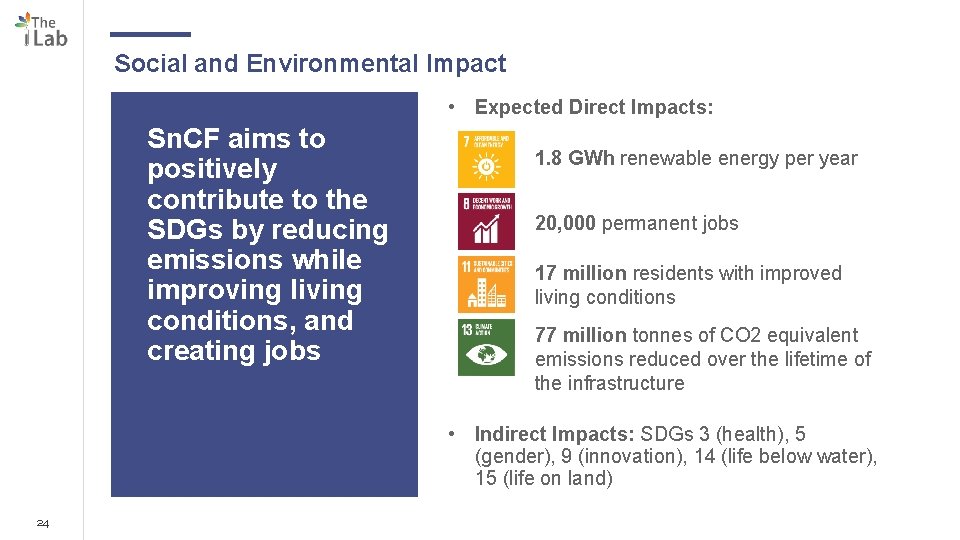
Social and Environmental Impact • Expected Direct Impacts: Sn. CF aims to positively contribute to the SDGs by reducing emissions while improving living conditions, and creating jobs 1. 8 GWh renewable energy per year 20, 000 permanent jobs 17 million residents with improved living conditions 77 million tonnes of CO 2 equivalent emissions reduced over the lifetime of the infrastructure • Indirect Impacts: SDGs 3 (health), 5 (gender), 9 (innovation), 14 (life below water), 15 (life on land) 24
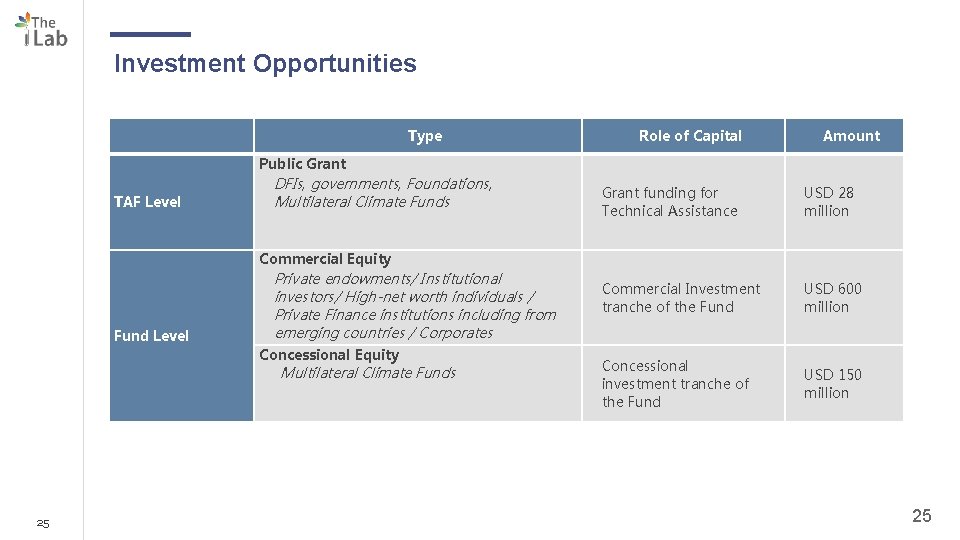
Investment Opportunities Type Role of Capital Amount Public Grant TAF Level DFIs, governments, Foundations, Multilateral Climate Funds Grant funding for Technical Assistance USD 28 million Commercial Investment tranche of the Fund USD 600 million Concessional investment tranche of the Fund USD 150 million Commercial Equity Fund Level 25 Private endowments/ Institutional investors/ High-net worth individuals / Private Finance institutions including from emerging countries / Corporates Concessional Equity Multilateral Climate Funds 25
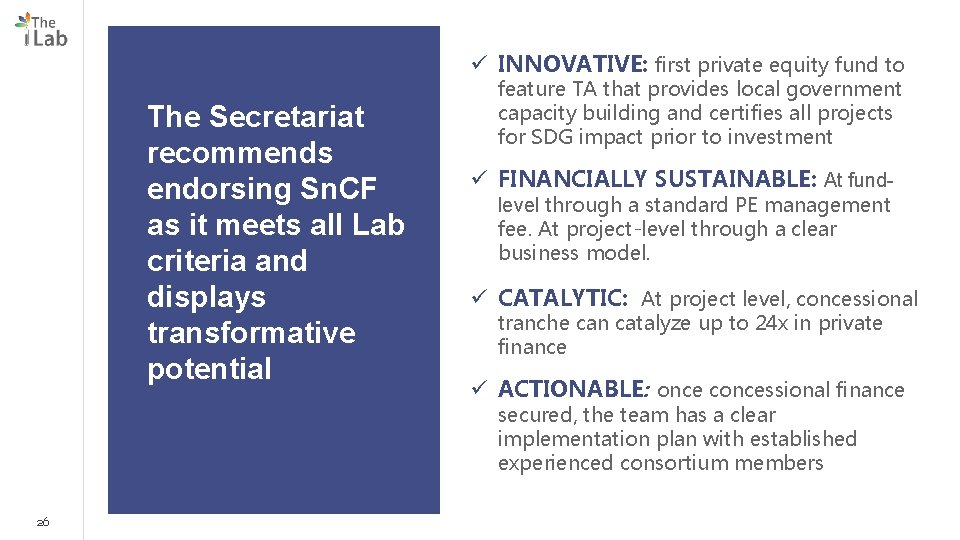
ü INNOVATIVE: first private equity fund to The Secretariat recommends endorsing Sn. CF as it meets all Lab criteria and displays transformative potential feature TA that provides local government capacity building and certifies all projects for SDG impact prior to investment ü FINANCIALLY SUSTAINABLE: At fundlevel through a standard PE management fee. At project-level through a clear business model. ü CATALYTIC: At project level, concessional tranche can catalyze up to 24 x in private finance ü ACTIONABLE: once concessional finance secured, the team has a clear implementation plan with established experienced consortium members 26
Monetizing Water Savings Fede Mazza + Matthew Solomon Climate Policy Initiative Gabriela Morales World Resources Institute David Moreno FEMSA Foundation
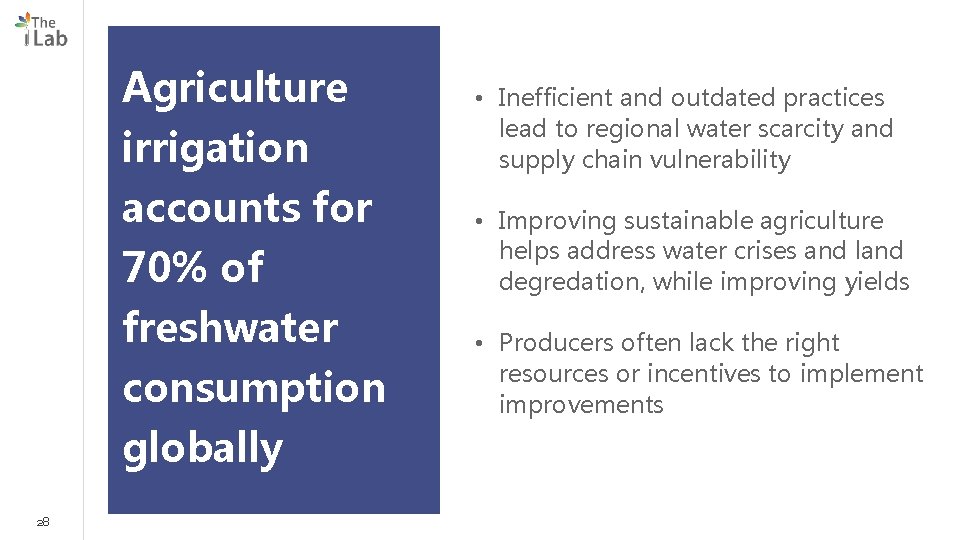
Agriculture irrigation accounts for 70% of freshwater consumption globally 28 • Inefficient and outdated practices lead to regional water scarcity and supply chain vulnerability • Improving sustainable agriculture helps address water crises and land degredation, while improving yields • Producers often lack the right resources or incentives to implement improvements
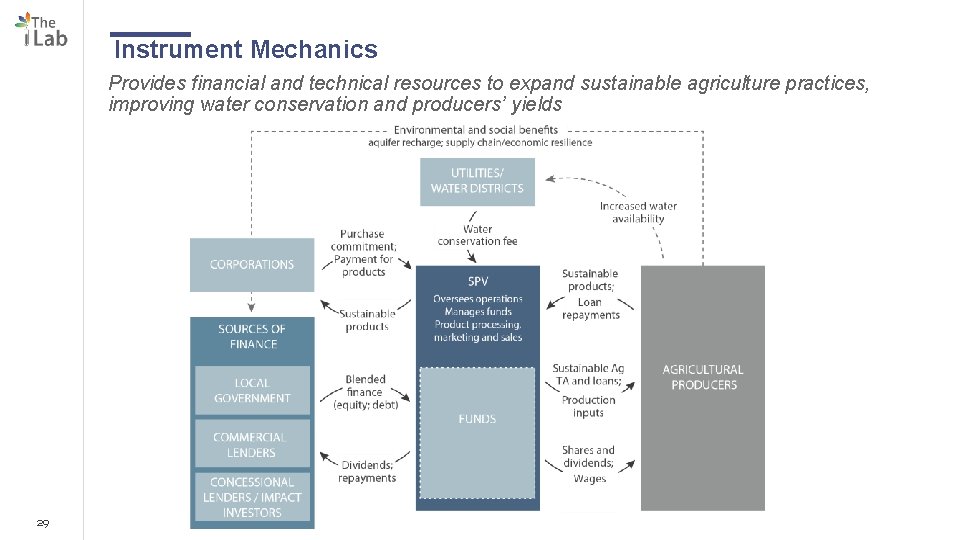
Instrument Mechanics Provides financial and technical resources to expand sustainable agriculture practices, improving water conservation and producers’ yields 29
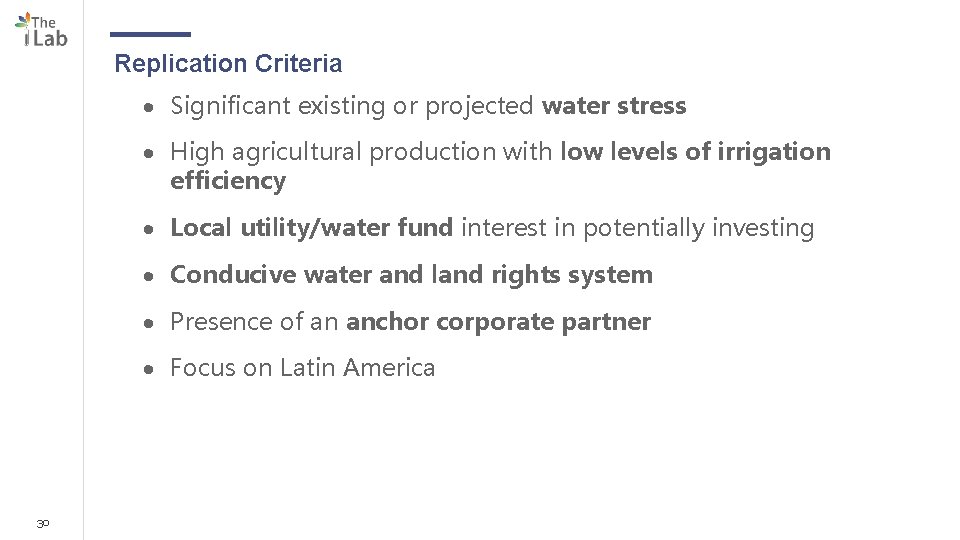
Replication Criteria Significant existing or projected water stress High agricultural production with low levels of irrigation efficiency Local utility/water fund interest in potentially investing Conducive water and land rights system Presence of an anchor corporate partner Focus on Latin America 30
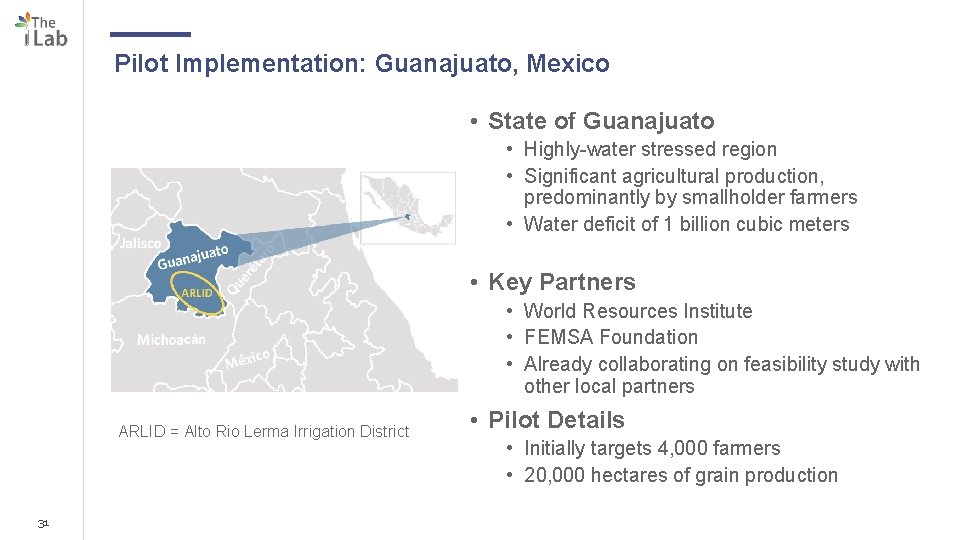
Pilot Implementation: Guanajuato, Mexico • State of Guanajuato • Highly-water stressed region • Significant agricultural production, predominantly by smallholder farmers • Water deficit of 1 billion cubic meters • Key Partners • World Resources Institute • FEMSA Foundation • Already collaborating on feasibility study with other local partners ARLID = Alto Rio Lerma Irrigation District 31 • Pilot Details • Initially targets 4, 000 farmers • 20, 000 hectares of grain production
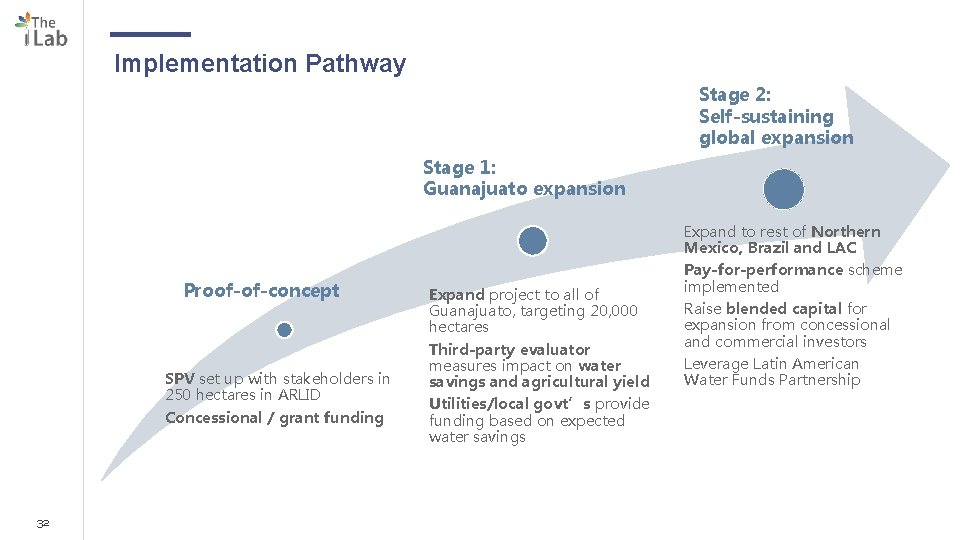
Implementation Pathway Stage 2: Self-sustaining global expansion Stage 1: Guanajuato expansion Proof-of-concept SPV set up with stakeholders in 250 hectares in ARLID Concessional / grant funding 32 Expand project to all of Guanajuato, targeting 20, 000 hectares Third-party evaluator measures impact on water savings and agricultural yield Utilities/local govt’s provide funding based on expected water savings Expand to rest of Northern Mexico, Brazil and LAC Pay-for-performance scheme implemented Raise blended capital for expansion from concessional and commercial investors Leverage Latin American Water Funds Partnership
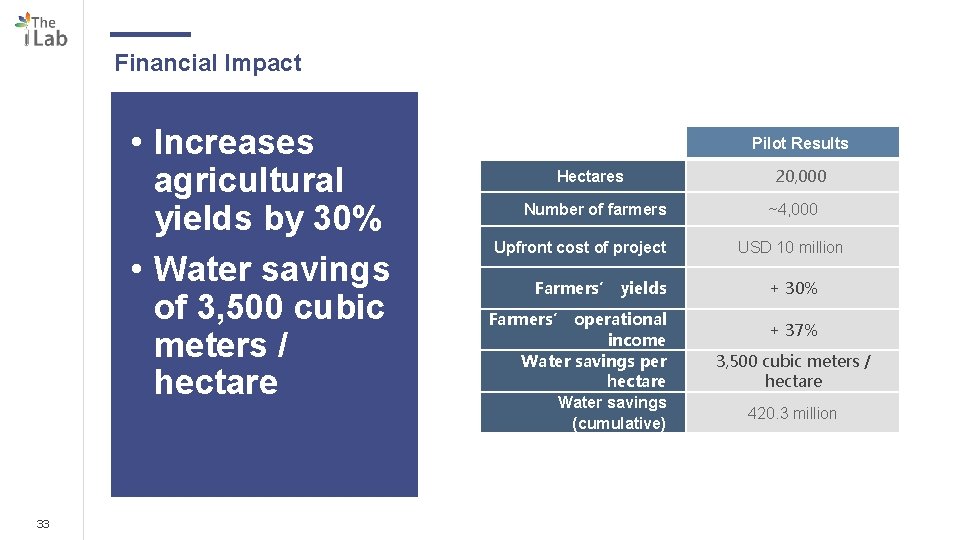
Financial Impact • Increases agricultural yields by 30% • Water savings of 3, 500 cubic meters / hectare 33 Pilot Results Hectares Number of farmers Upfront cost of project Farmers’ yields Farmers’ operational income Water savings per hectare Water savings (cumulative) 20, 000 ~4, 000 USD 10 million + 30% + 37% 3, 500 cubic meters / hectare 420. 3 million
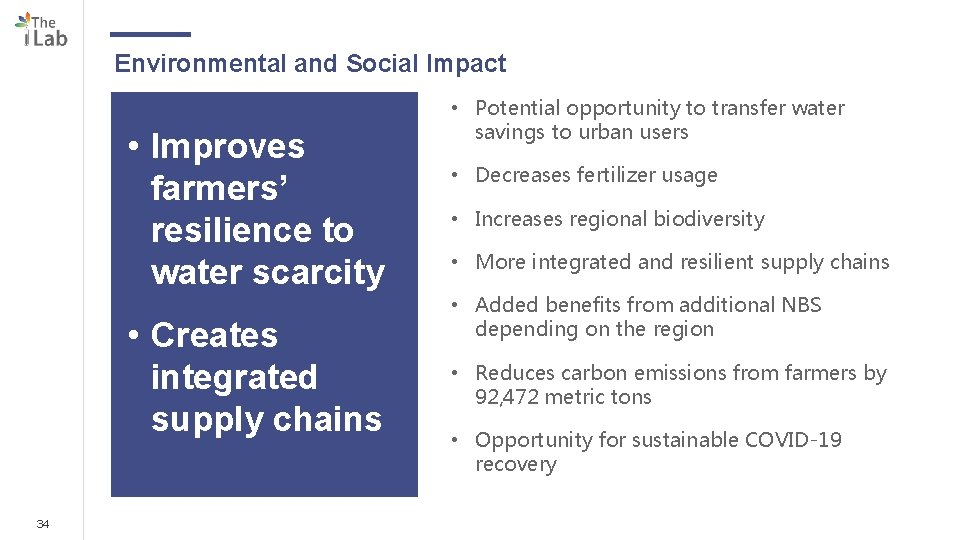
Environmental and Social Impact • Improves farmers’ resilience to water scarcity • Creates integrated supply chains 34 • Potential opportunity to transfer water savings to urban users • Decreases fertilizer usage • Increases regional biodiversity • More integrated and resilient supply chains • Added benefits from additional NBS depending on the region • Reduces carbon emissions from farmers by 92, 472 metric tons • Opportunity for sustainable COVID-19 recovery
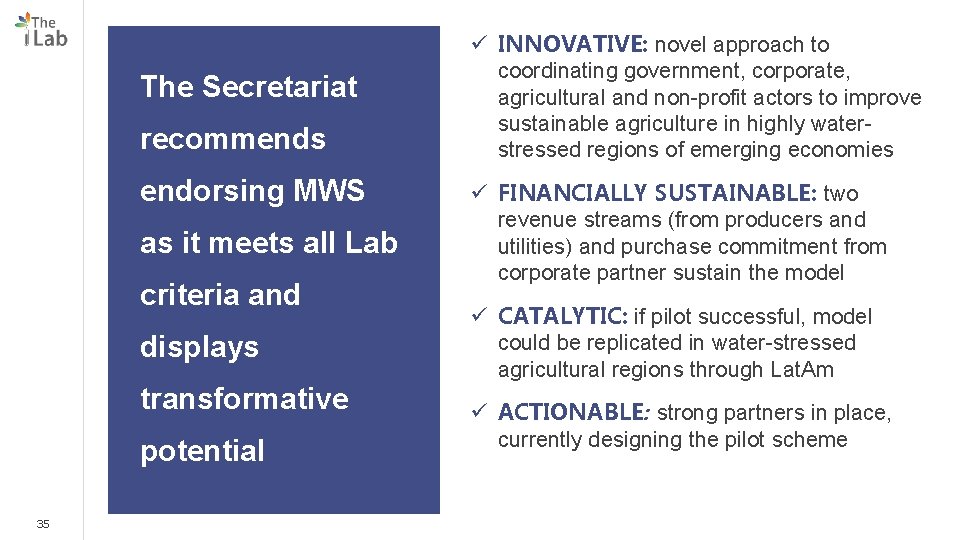
The Secretariat recommends endorsing MWS as it meets all Lab criteria and displays transformative potential 35 ü INNOVATIVE: novel approach to coordinating government, corporate, agricultural and non-profit actors to improve sustainable agriculture in highly waterstressed regions of emerging economies ü FINANCIALLY SUSTAINABLE: two revenue streams (from producers and utilities) and purchase commitment from corporate partner sustain the model ü CATALYTIC: if pilot successful, model could be replicated in water-stressed agricultural regions through Lat. Am ü ACTIONABLE: strong partners in place, currently designing the pilot scheme
Climate Adaptation Notes Morgan Richmond + Amanda Lonsdale Climate Policy Initiative Jonathan First GFA Climate & Infrastructure Heather Jackson Ashburton Investments
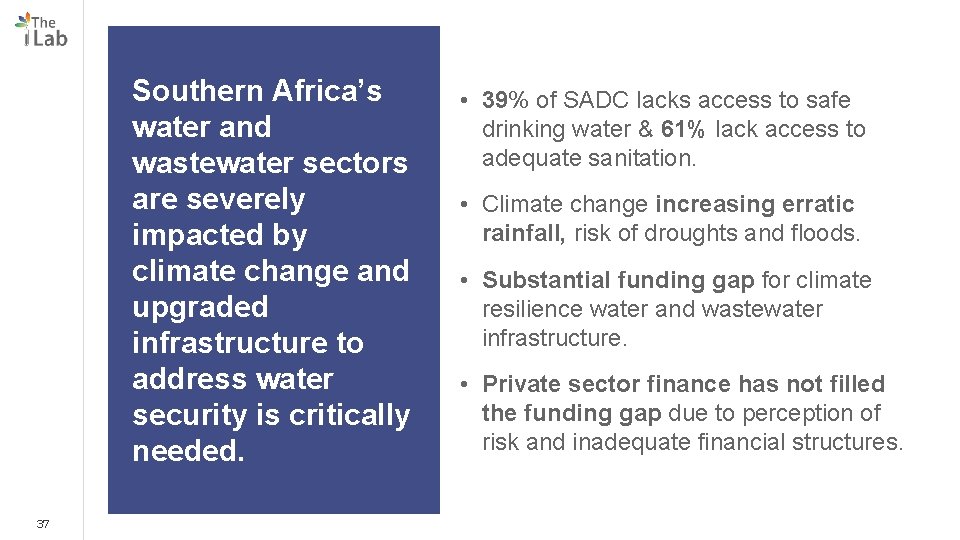
Southern Africa’s water and wastewater sectors are severely impacted by climate change and upgraded infrastructure to address water security is critically needed. 37 • 39% of SADC lacks access to safe drinking water & 61% lack access to adequate sanitation. • Climate change increasing erratic rainfall, risk of droughts and floods. • Substantial funding gap for climate resilience water and wastewater infrastructure. • Private sector finance has not filled the funding gap due to perception of risk and inadequate financial structures.
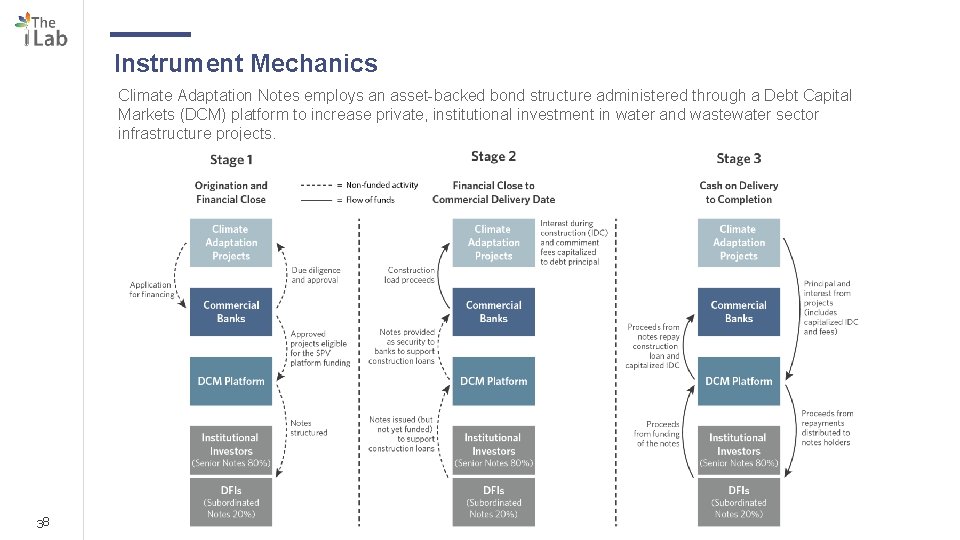
Instrument Mechanics Climate Adaptation Notes employs an asset-backed bond structure administered through a Debt Capital Markets (DCM) platform to increase private, institutional investment in water and wastewater sector infrastructure projects. 38
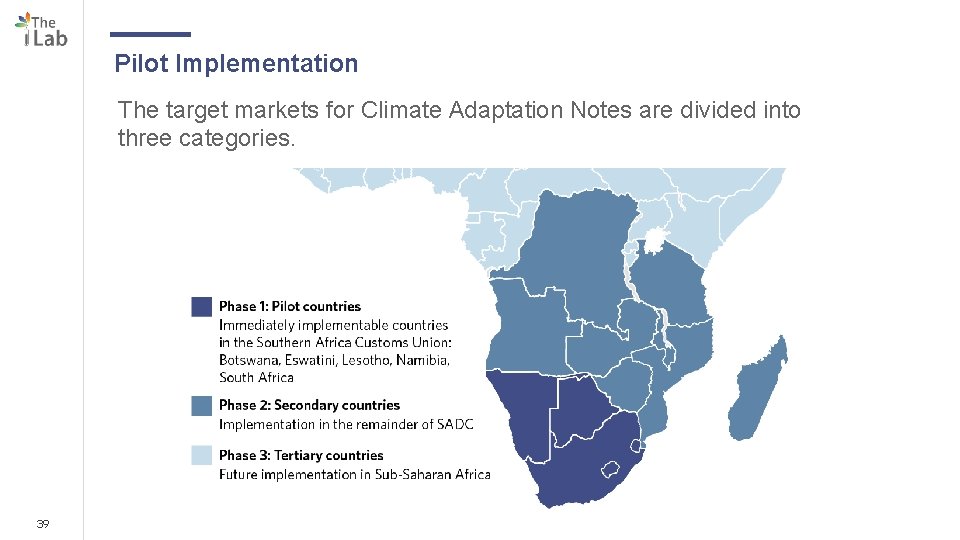
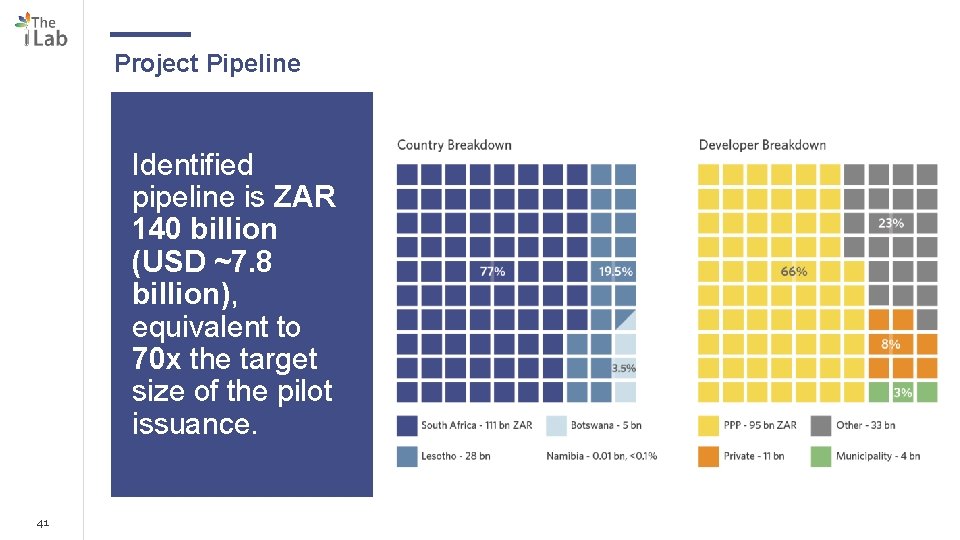
Pilot Implementation The target markets for Climate Adaptation Notes are divided into three categories. 39
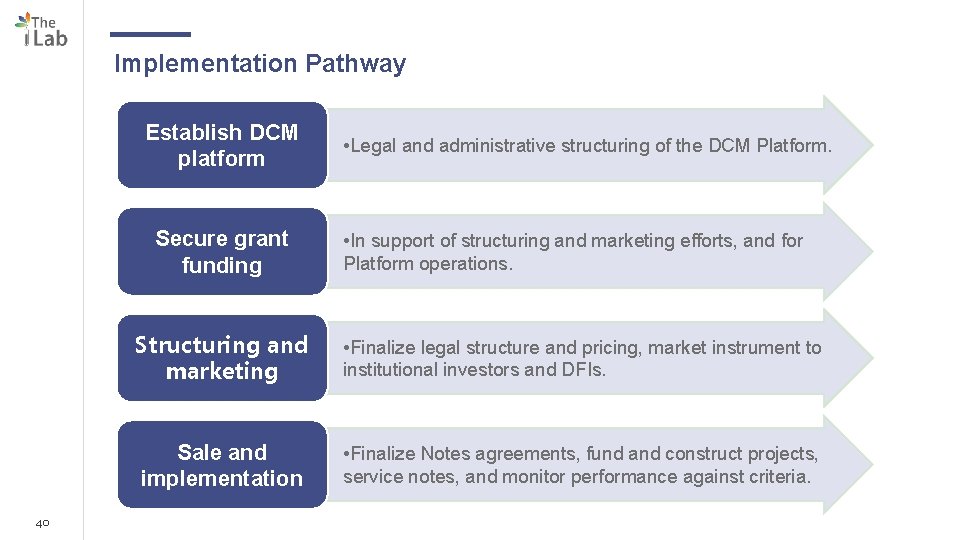
Implementation Pathway Establish DCM platform Secure grant funding 40 • Legal and administrative structuring of the DCM Platform. • In support of structuring and marketing efforts, and for Platform operations. Structuring and marketing • Finalize legal structure and pricing, market instrument to institutional investors and DFIs. Sale and implementation • Finalize Notes agreements, fund and construct projects, service notes, and monitor performance against criteria.
Project Pipeline Identified pipeline is ZAR 140 billion (USD ~7. 8 billion), equivalent to 70 x the target size of the pilot issuance. 41
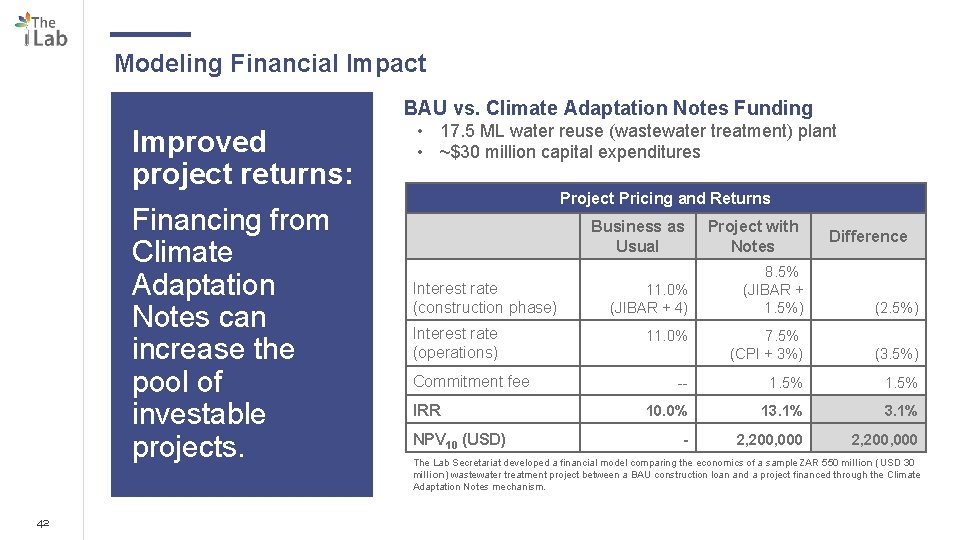
Modeling Financial Impact BAU vs. Climate Adaptation Notes Funding Improved project returns: Financing from Climate Adaptation Notes can increase the pool of investable projects. 42 • 17. 5 ML water reuse (wastewater treatment) plant • ~$30 million capital expenditures Project Pricing and Returns Interest rate (construction phase) Interest rate (operations) Commitment fee IRR NPV 10 (USD) Business as Usual Project with Notes Difference 8. 5% (JIBAR + 1. 5%) (2. 5%) 7. 5% (CPI + 3%) (3. 5%) -- 1. 5% 10. 0% 13. 1% - 2, 200, 000 11. 0% (JIBAR + 4) 11. 0% The Lab Secretariat developed a financial model comparing the economics of a sample ZAR 550 million (USD 30 million) wastewater treatment project between a BAU construction loan and a project financed through the Climate Adaptation Notes mechanism.
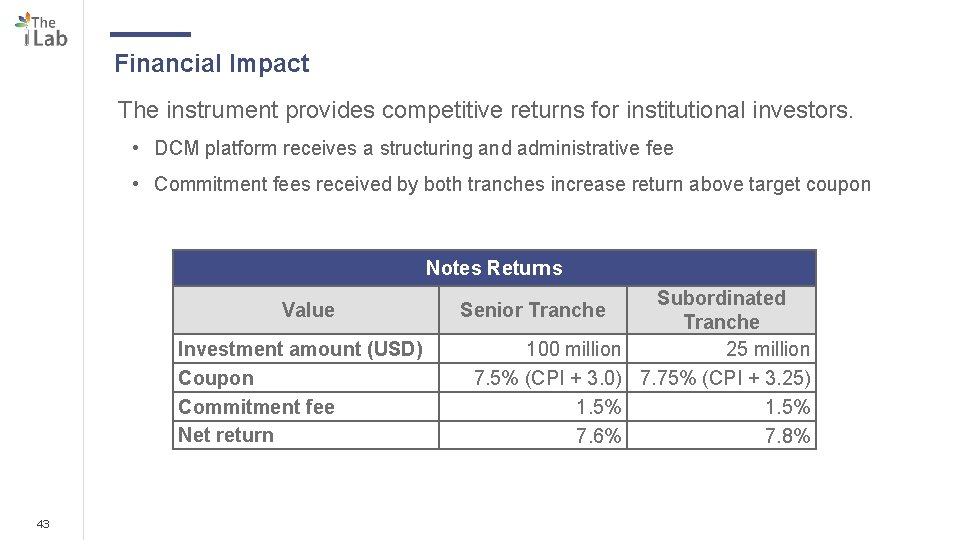
Financial Impact The instrument provides competitive returns for institutional investors. • DCM platform receives a structuring and administrative fee • Commitment fees received by both tranches increase return above target coupon Notes Returns Value Investment amount (USD) Coupon Commitment fee Net return 43 Senior Tranche 100 million 7. 5% (CPI + 3. 0) 1. 5% 7. 6% Subordinated Tranche 25 million 7. 75% (CPI + 3. 25) 1. 5% 7. 8%
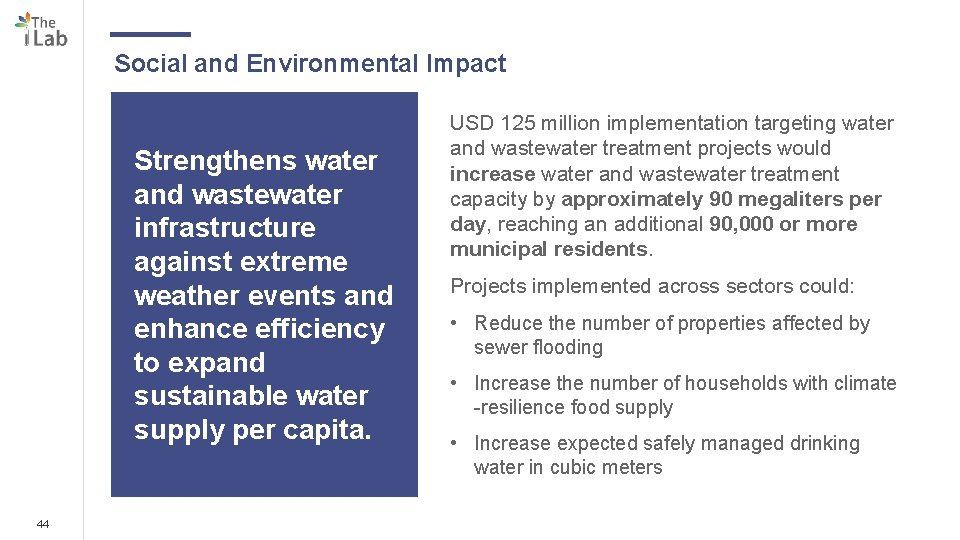
Social and Environmental Impact Strengthens water and wastewater infrastructure against extreme weather events and enhance efficiency to expand sustainable water supply per capita. 44 USD 125 million implementation targeting water and wastewater treatment projects would increase water and wastewater treatment capacity by approximately 90 megaliters per day, reaching an additional 90, 000 or more municipal residents. Projects implemented across sectors could: • Reduce the number of properties affected by sewer flooding • Increase the number of households with climate -resilience food supply • Increase expected safely managed drinking water in cubic meters
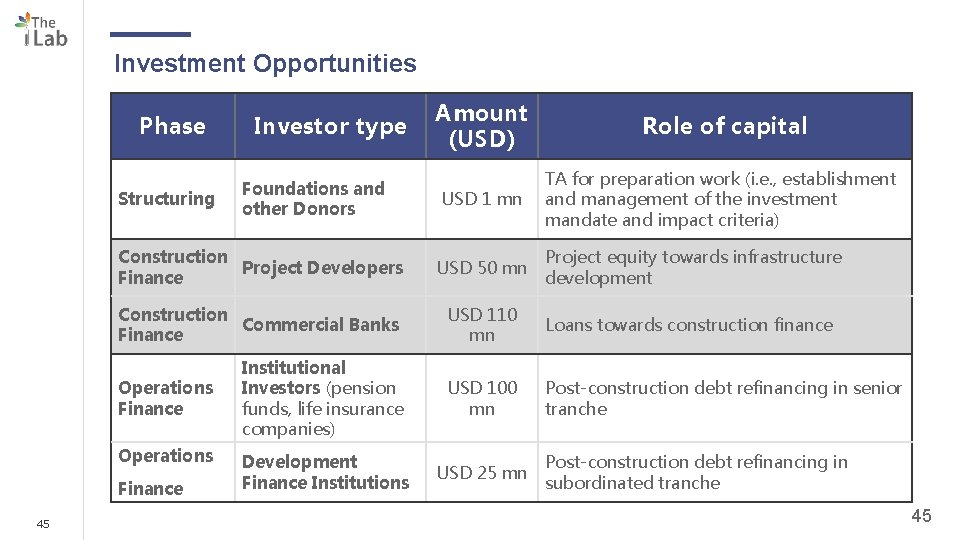
Investment Opportunities Phase Amount (USD) Role of capital USD 1 mn TA for preparation work (i. e. , establishment and management of the investment mandate and impact criteria) Construction Project Developers Finance USD 50 mn Project equity towards infrastructure development Construction Commercial Banks Finance USD 110 mn Loans towards construction finance Institutional Investors (pension funds, life insurance companies) USD 100 mn Post-construction debt refinancing in senior tranche Development Finance Institutions USD 25 mn Structuring Operations Finance 45 Investor type Foundations and other Donors Post-construction debt refinancing in subordinated tranche 45
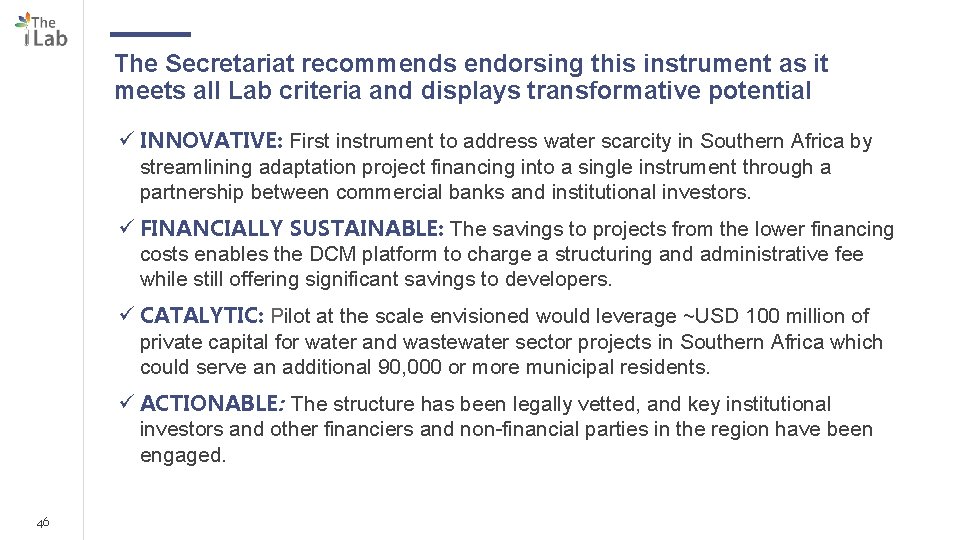
The Secretariat recommends endorsing this instrument as it meets all Lab criteria and displays transformative potential ü INNOVATIVE: First instrument to address water scarcity in Southern Africa by streamlining adaptation project financing into a single instrument through a partnership between commercial banks and institutional investors. ü FINANCIALLY SUSTAINABLE: The savings to projects from the lower financing costs enables the DCM platform to charge a structuring and administrative fee while still offering significant savings to developers. ü CATALYTIC: Pilot at the scale envisioned would leverage ~USD 100 million of private capital for water and wastewater sector projects in Southern Africa which could serve an additional 90, 000 or more municipal residents. ü ACTIONABLE: The structure has been legally vetted, and key institutional investors and other financiers and non-financial parties in the region have been engaged. 46
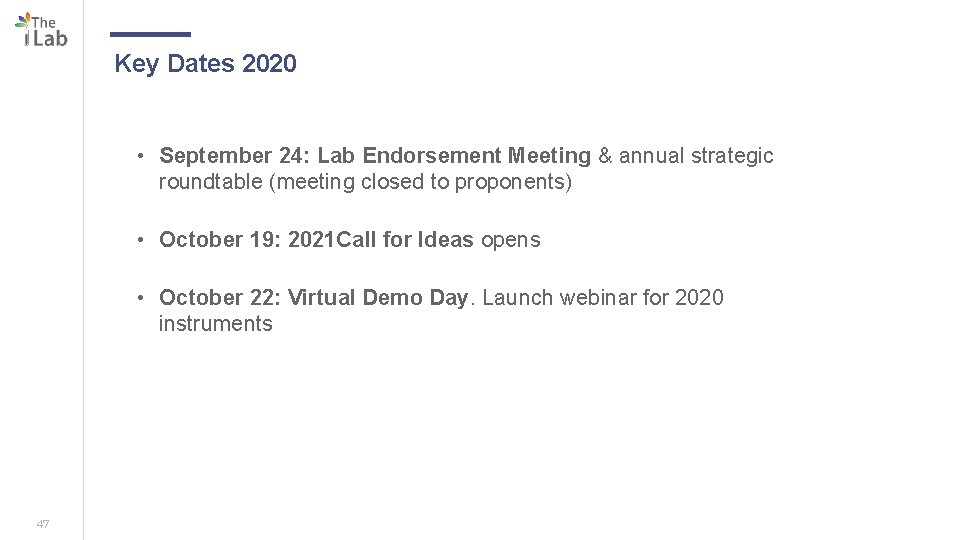
Key Dates 2020 • September 24: Lab Endorsement Meeting & annual strategic roundtable (meeting closed to proponents) • October 19: 2021 Call for Ideas opens • October 22: Virtual Demo Day. Launch webinar for 2020 instruments 47
ANNEX Green. Street
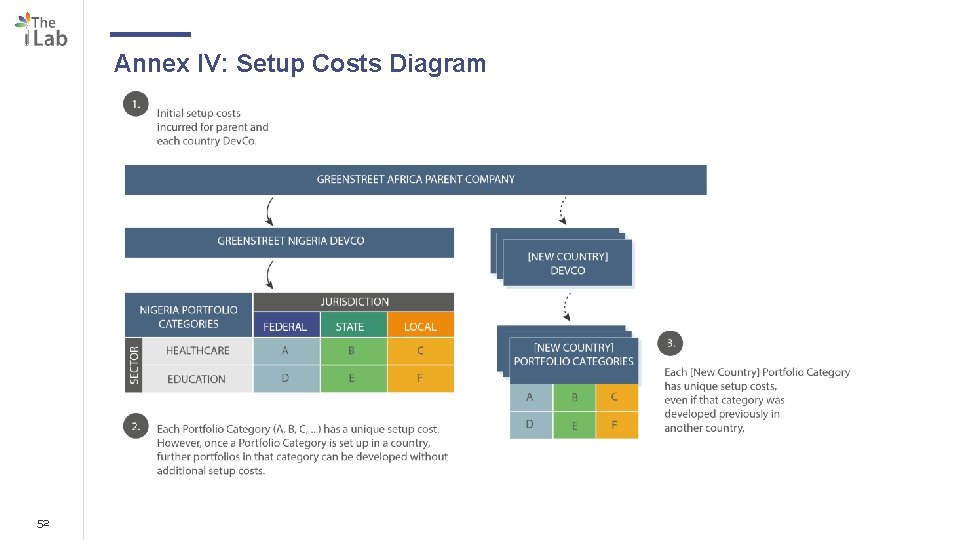
Annex I: Instrument Mechanics with Description • Green. St Dev. Co established in each country • Dev. Co works with local gov’ts to identify and prepare projects • Projects bundled into portfolios, tendered to IPP/ESCOS • Cost efficiency increases over time with subsequent portfolios cheaper to set up 49
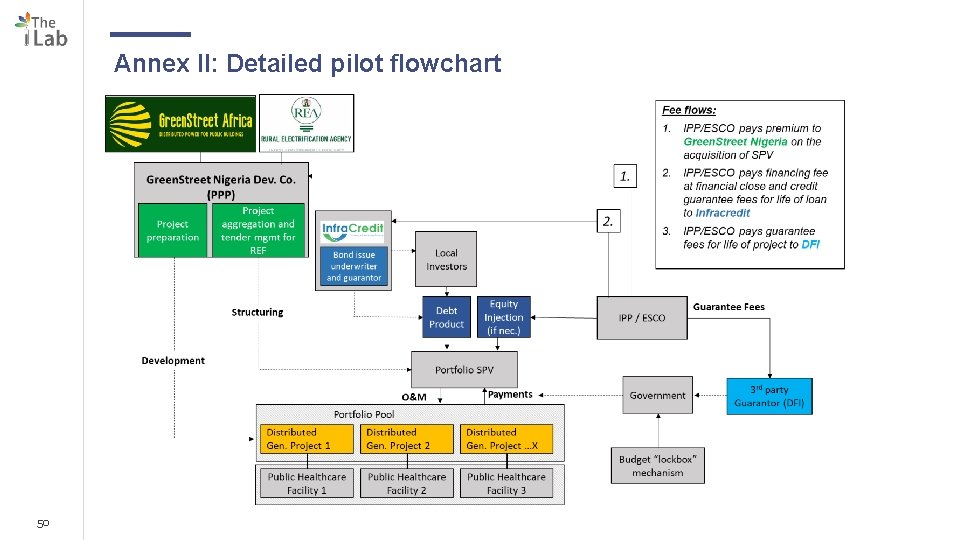
Annex II: Detailed pilot flowchart 50
Annex III: Private Finance Chart Pilot (Portfolio Prep #1) Portfolio Prep #2 Portfolio Prep #3 Portfolio Prep #4 Seed grant to kick off Initial grant reinvested Impact Investor match funds portfolio Additional Equity allows portfolio growth ~45 x Private to public finance mobilization multiple ~30 x ~15 x ~12 x Dev. Costs Grant ~US$2 M 51 Portfolio Size ~US$60 M ~US$30 M ~US$25 M Grant ~US$2 M ~US$90 M Impact Investors ~US$1. 5 M Grant ~US$2 M Impact Investors ~US$3 M Grant ~US$2 M
Annex IV: Setup Costs Diagram 52
ANNEX Sn. CF
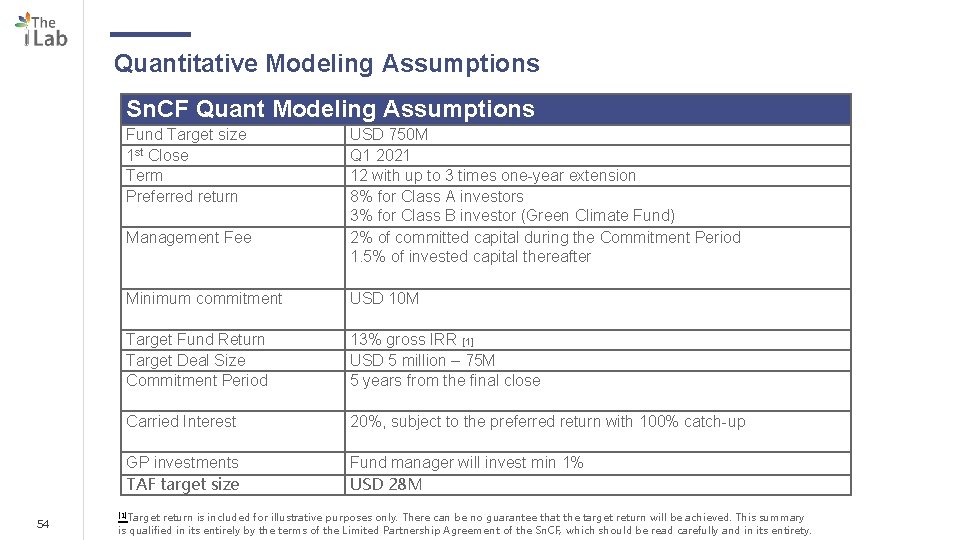
Quantitative Modeling Assumptions Sn. CF Quant Modeling Assumptions Fund Target size 1 st Close Term Preferred return Management Fee 54 USD 750 M Q 1 2021 12 with up to 3 times one-year extension 8% for Class A investors 3% for Class B investor (Green Climate Fund) 2% of committed capital during the Commitment Period 1. 5% of invested capital thereafter Minimum commitment USD 10 M Target Fund Return Target Deal Size Commitment Period 13% gross IRR [1] USD 5 million – 75 M 5 years from the final close Carried Interest 20%, subject to the preferred return with 100% catch-up GP investments TAF target size Fund manager will invest min 1% USD 28 M [1]Target return is included for illustrative purposes only. There can be no guarantee that the target return will be achieved. This summary is qualified in its entirely by the terms of the Limited Partnership Agreement of the Sn. CF, which should be read carefully and in its entirety.