
PreEmergent and Emergent Readers Created by Jennifer Richards
Pre-Emergent and Emergent Readers Created by Jennifer Richards EC-6 th Grade Certification Kindergarten Teacher
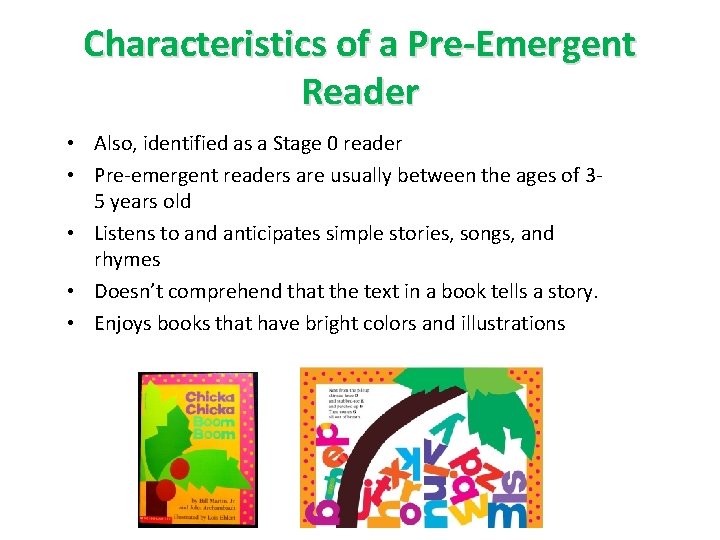
Characteristics of a Pre-Emergent Reader • Also, identified as a Stage 0 reader • Pre-emergent readers are usually between the ages of 35 years old • Listens to and anticipates simple stories, songs, and rhymes • Doesn’t comprehend that the text in a book tells a story. • Enjoys books that have bright colors and illustrations
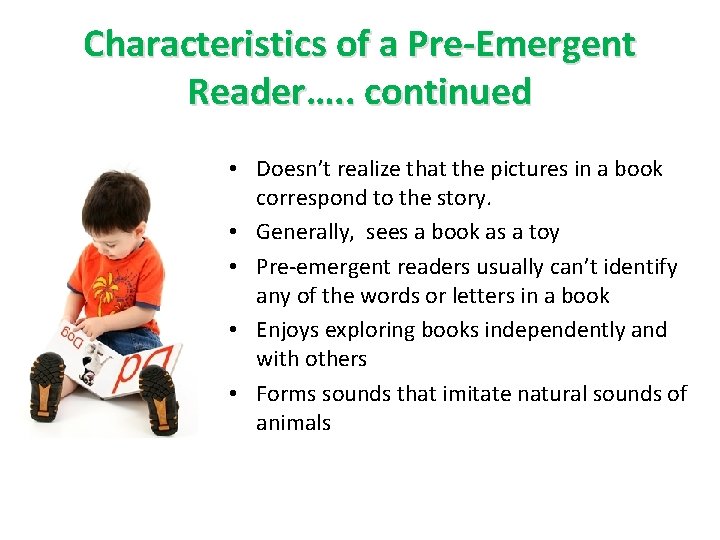
Characteristics of a Pre-Emergent Reader…. . continued • Doesn’t realize that the pictures in a book correspond to the story. • Generally, sees a book as a toy • Pre-emergent readers usually can’t identify any of the words or letters in a book • Enjoys exploring books independently and with others • Forms sounds that imitate natural sounds of animals
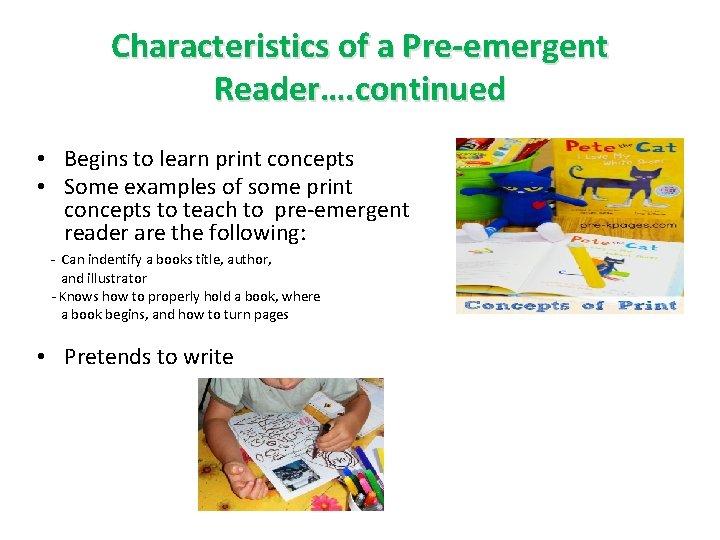
Characteristics of a Pre-emergent Reader…. continued • Begins to learn print concepts • Some examples of some print concepts to teach to pre-emergent reader are the following: - Can indentify a books title, author, and illustrator - Knows how to properly hold a book, where a book begins, and how to turn pages • Pretends to write
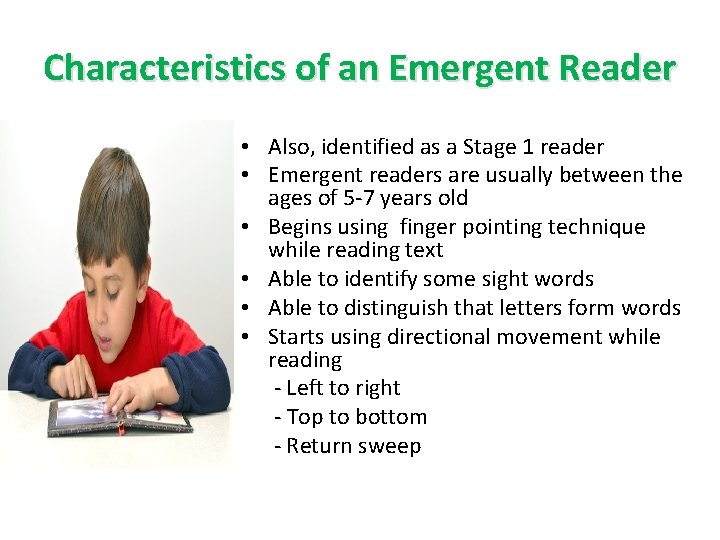
Characteristics of an Emergent Reader • Also, identified as a Stage 1 reader • Emergent readers are usually between the ages of 5 -7 years old • Begins using finger pointing technique while reading text • Able to identify some sight words • Able to distinguish that letters form words • Starts using directional movement while reading - Left to right - Top to bottom - Return sweep
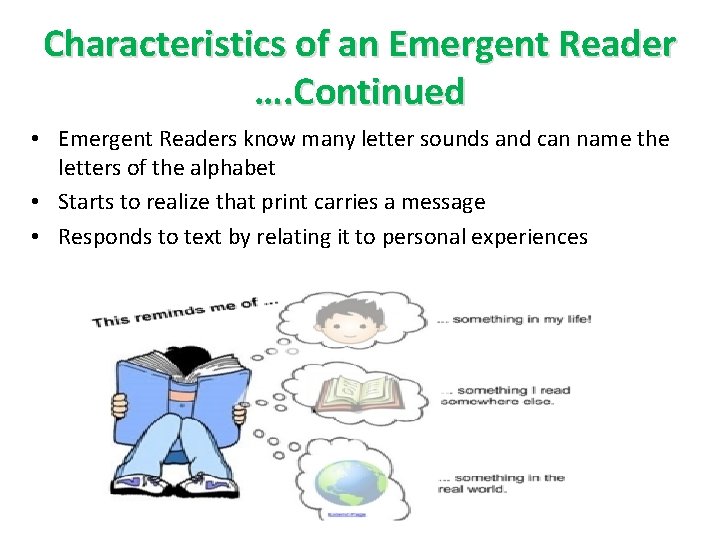
Characteristics of an Emergent Reader …. Continued • Emergent Readers know many letter sounds and can name the letters of the alphabet • Starts to realize that print carries a message • Responds to text by relating it to personal experiences
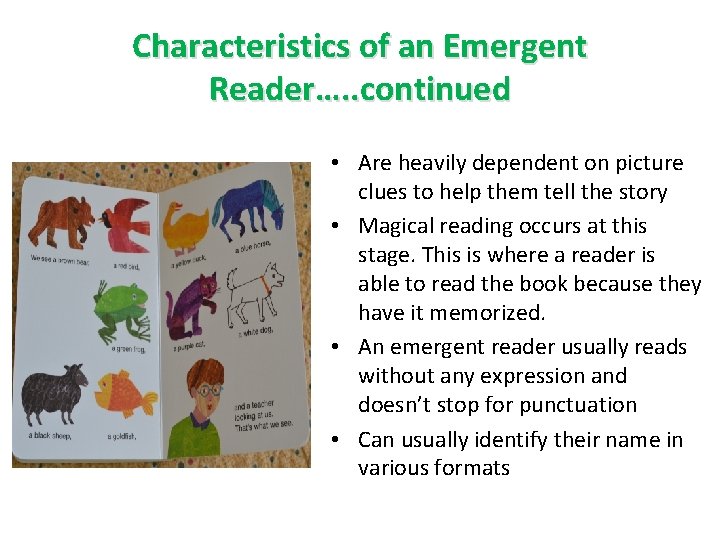
Characteristics of an Emergent Reader…. . continued • Are heavily dependent on picture clues to help them tell the story • Magical reading occurs at this stage. This is where a reader is able to read the book because they have it memorized. • An emergent reader usually reads without any expression and doesn’t stop for punctuation • Can usually identify their name in various formats
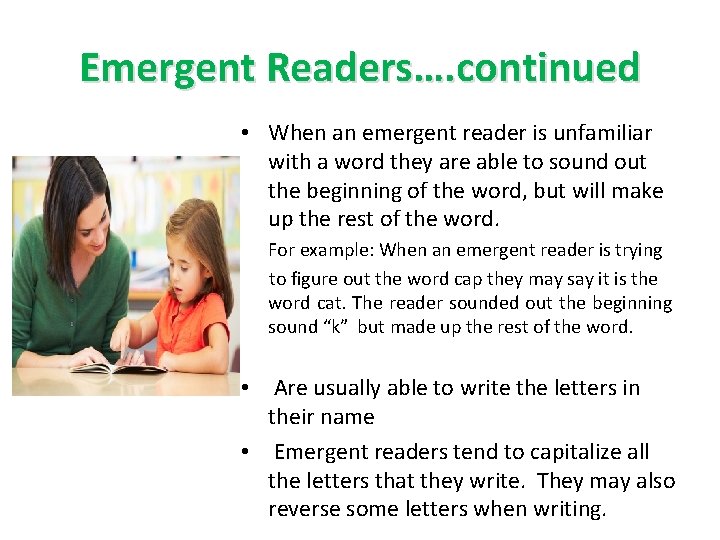
Emergent Readers…. continued • When an emergent reader is unfamiliar with a word they are able to sound out the beginning of the word, but will make up the rest of the word. For example: When an emergent reader is trying to figure out the word cap they may say it is the word cat. The reader sounded out the beginning sound “k” but made up the rest of the word. • Are usually able to write the letters in their name • Emergent readers tend to capitalize all the letters that they write. They may also reverse some letters when writing.
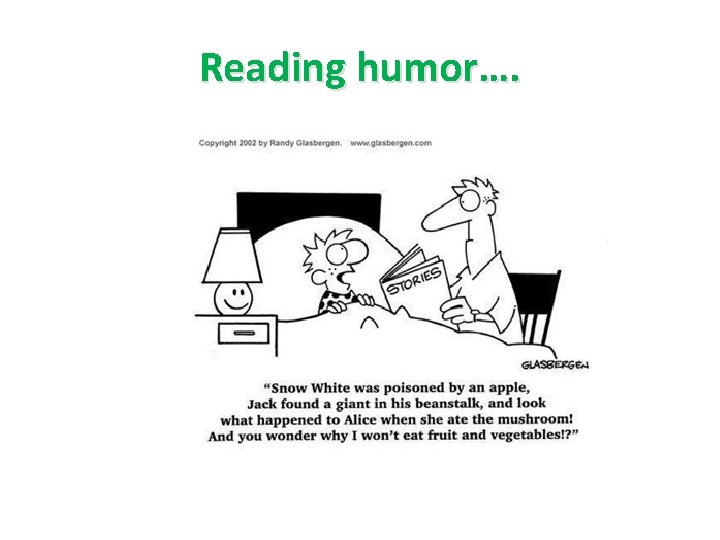
A little reading humor…. .

Skills That a Pre-emergent Reader Needs to Learn • Pre-emergent readers need to learn the following print concepts: - How to hold a book, identify the parts of a book, and how to properly read a book - Print has meaning - There is a difference between letters and words - Words are separated by spaces - Punctuation ends a sentence • https: //www. youtube. com/watch? v= AV 1 HY_TUcu. M (Video on Print Concepts)
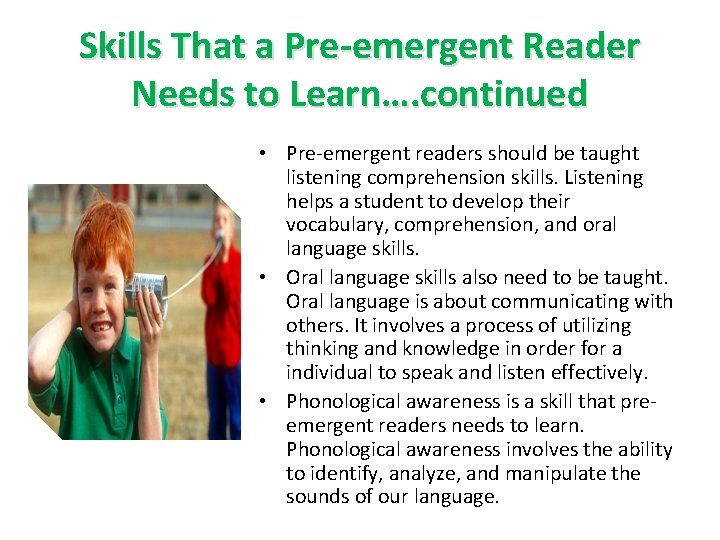
Skills That a Pre-emergent Reader Needs to Learn…. continued • Pre-emergent readers should be taught listening comprehension skills. Listening helps a student to develop their vocabulary, comprehension, and oral language skills. • Oral language skills also need to be taught. Oral language is about communicating with others. It involves a process of utilizing thinking and knowledge in order for a individual to speak and listen effectively. • Phonological awareness is a skill that preemergent readers needs to learn. Phonological awareness involves the ability to identify, analyze, and manipulate the sounds of our language.
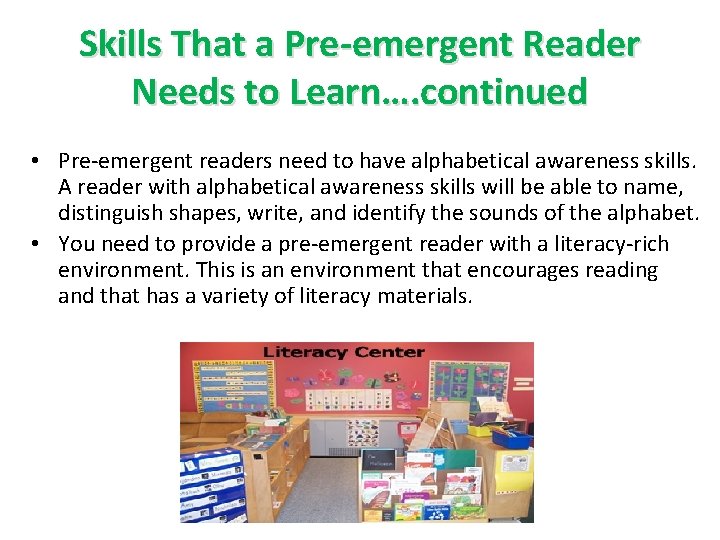
Skills That a Pre-emergent Reader Needs to Learn…. continued • Pre-emergent readers need to have alphabetical awareness skills. A reader with alphabetical awareness skills will be able to name, distinguish shapes, write, and identify the sounds of the alphabet. • You need to provide a pre-emergent reader with a literacy-rich environment. This is an environment that encourages reading and that has a variety of literacy materials.
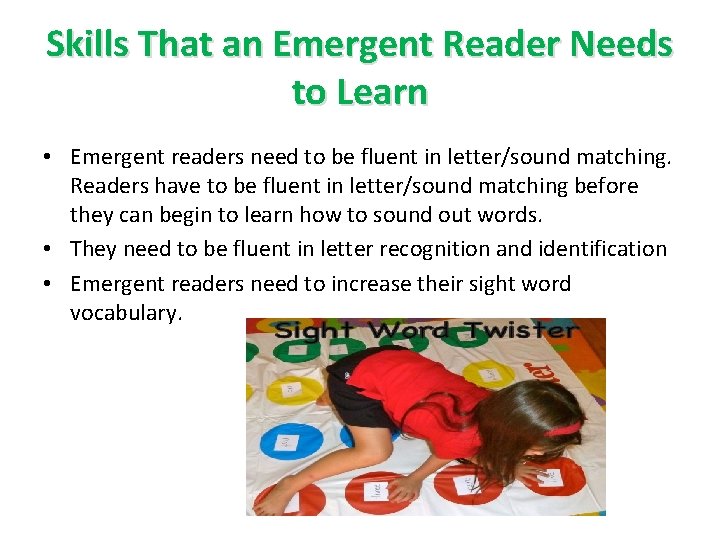
Skills That an Emergent Reader Needs to Learn • Emergent readers need to be fluent in letter/sound matching. Readers have to be fluent in letter/sound matching before they can begin to learn how to sound out words. • They need to be fluent in letter recognition and identification • Emergent readers need to increase their sight word vocabulary.
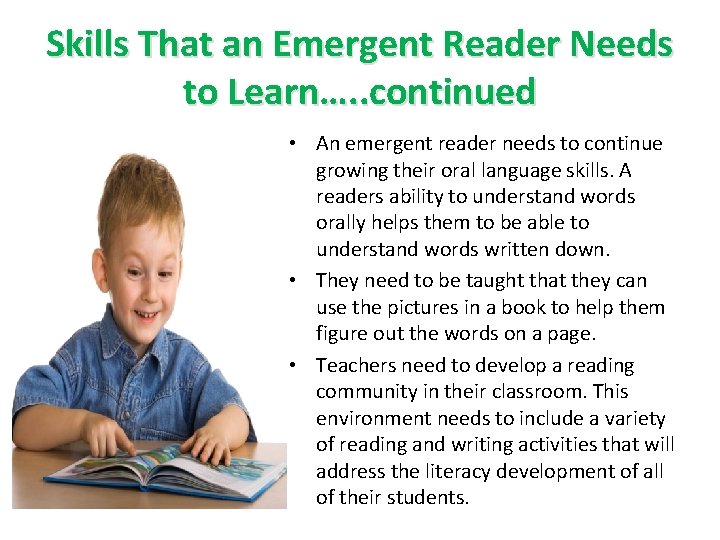
Skills That an Emergent Reader Needs to Learn…. . continued • An emergent reader needs to continue growing their oral language skills. A readers ability to understand words orally helps them to be able to understand words written down. • They need to be taught that they can use the pictures in a book to help them figure out the words on a page. • Teachers need to develop a reading community in their classroom. This environment needs to include a variety of reading and writing activities that will address the literacy development of all of their students.
Dr. Seuss…
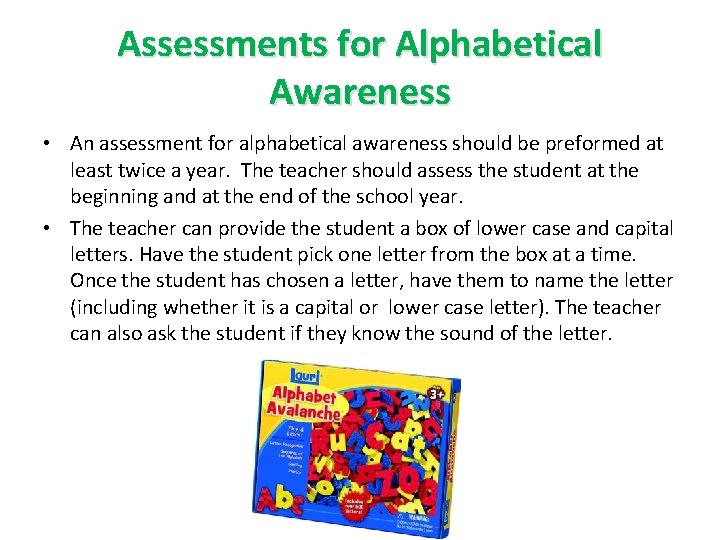
Assessments for Alphabetical Awareness • An assessment for alphabetical awareness should be preformed at least twice a year. The teacher should assess the student at the beginning and at the end of the school year. • The teacher can provide the student a box of lower case and capital letters. Have the student pick one letter from the box at a time. Once the student has chosen a letter, have them to name the letter (including whether it is a capital or lower case letter). The teacher can also ask the student if they know the sound of the letter.
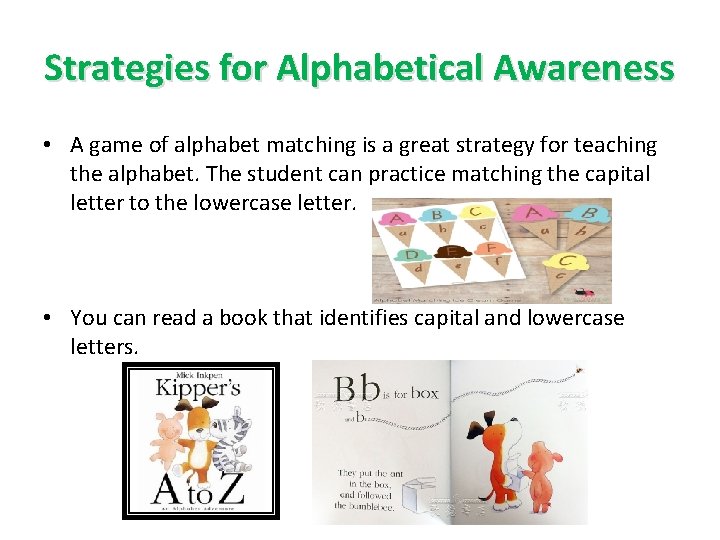
Strategies for Alphabetical Awareness • A game of alphabet matching is a great strategy for teaching the alphabet. The student can practice matching the capital letter to the lowercase letter. • You can read a book that identifies capital and lowercase letters.
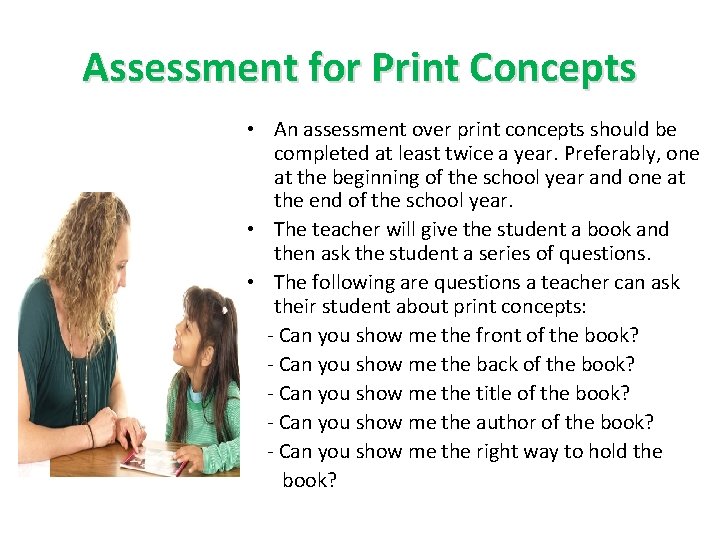
Assessment for Print Concepts • An assessment over print concepts should be completed at least twice a year. Preferably, one at the beginning of the school year and one at the end of the school year. • The teacher will give the student a book and then ask the student a series of questions. • The following are questions a teacher can ask their student about print concepts: - Can you show me the front of the book? - Can you show me the back of the book? - Can you show me the title of the book? - Can you show me the author of the book? - Can you show me the right way to hold the book?
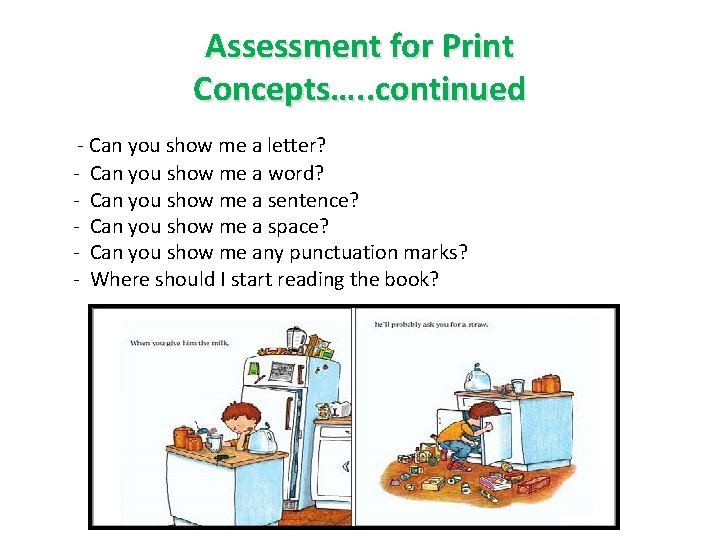
Assessment for Print Concepts…. . continued - Can you show me a letter? - Can you show me a word? - Can you show me a sentence? - Can you show me a space? - Can you show me any punctuation marks? - Where should I start reading the book?
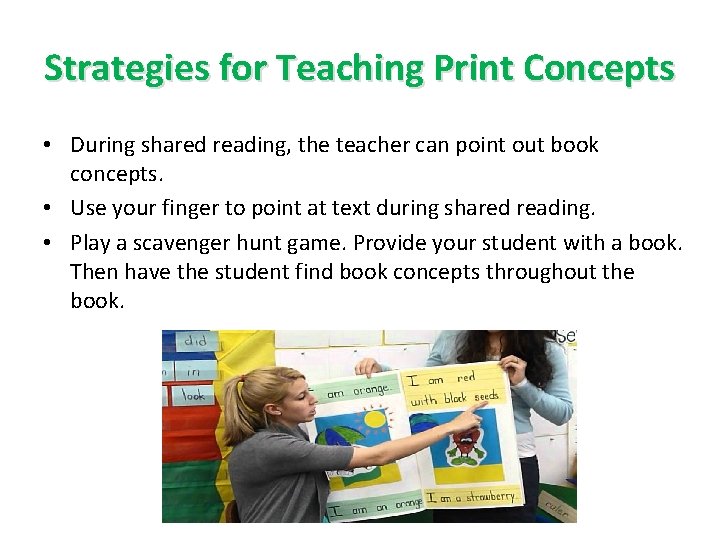
Strategies for Teaching Print Concepts • During shared reading, the teacher can point out book concepts. • Use your finger to point at text during shared reading. • Play a scavenger hunt game. Provide your student with a book. Then have the student find book concepts throughout the book.
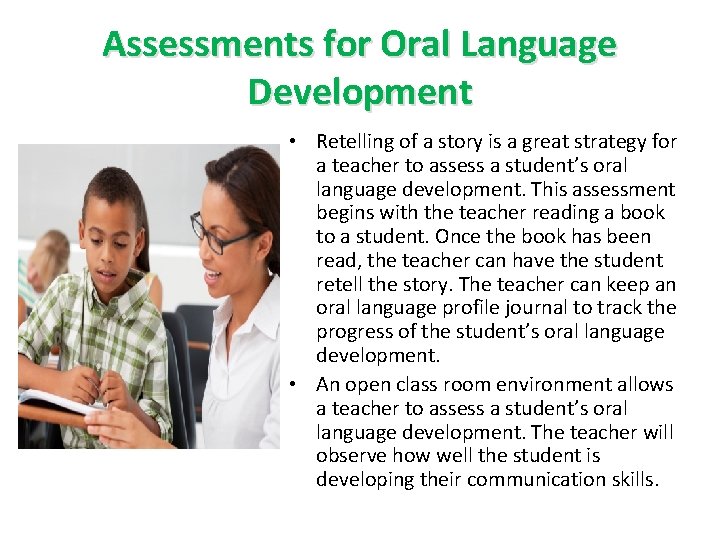
Assessments for Oral Language Development • Retelling of a story is a great strategy for a teacher to assess a student’s oral language development. This assessment begins with the teacher reading a book to a student. Once the book has been read, the teacher can have the student retell the story. The teacher can keep an oral language profile journal to track the progress of the student’s oral language development. • An open class room environment allows a teacher to assess a student’s oral language development. The teacher will observe how well the student is developing their communication skills.
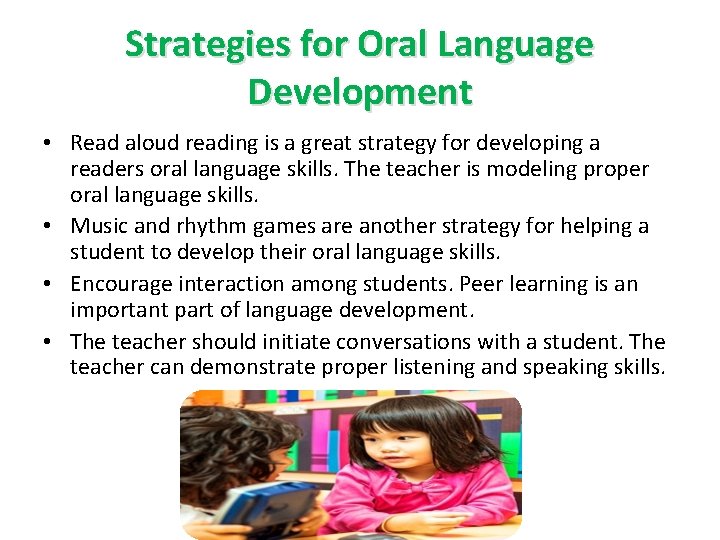
Strategies for Oral Language Development • Read aloud reading is a great strategy for developing a readers oral language skills. The teacher is modeling proper oral language skills. • Music and rhythm games are another strategy for helping a student to develop their oral language skills. • Encourage interaction among students. Peer learning is an important part of language development. • The teacher should initiate conversations with a student. The teacher can demonstrate proper listening and speaking skills.
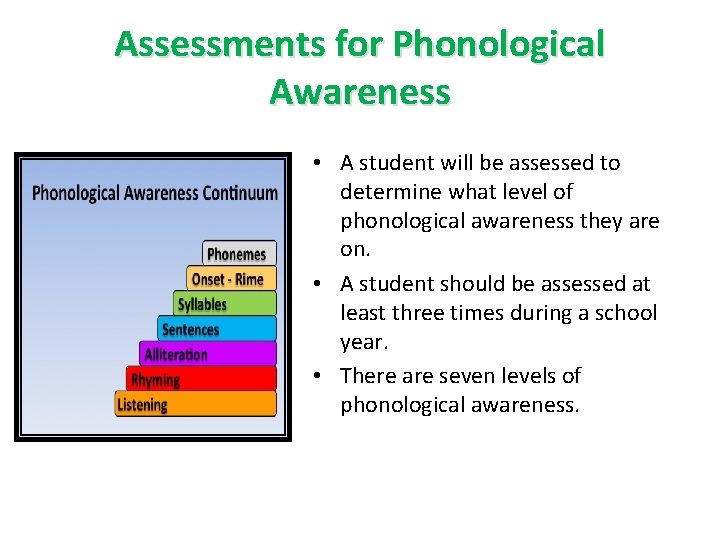
Assessments for Phonological Awareness • A student will be assessed to determine what level of phonological awareness they are on. • A student should be assessed at least three times during a school year. • There are seven levels of phonological awareness.
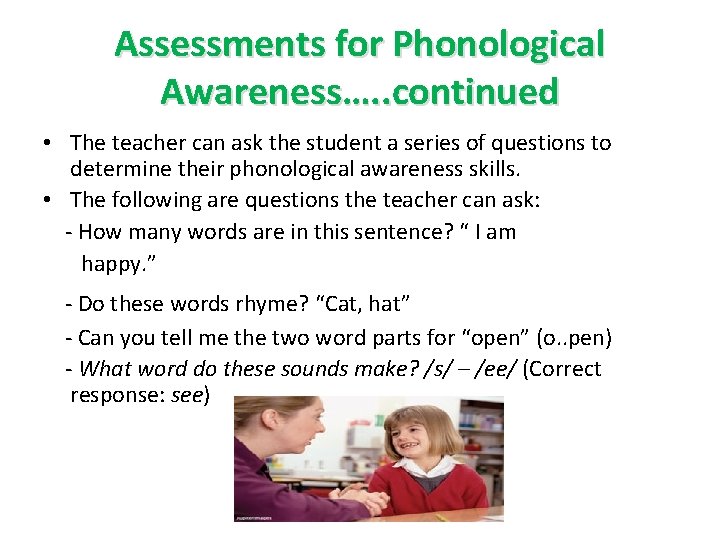
Assessments for Phonological Awareness…. . continued • The teacher can ask the student a series of questions to determine their phonological awareness skills. • The following are questions the teacher can ask: - How many words are in this sentence? “ I am happy. ” - Do these words rhyme? “Cat, hat” - Can you tell me the two word parts for “open” (o. . pen) - What word do these sounds make? /s/ – /ee/ (Correct response: see)
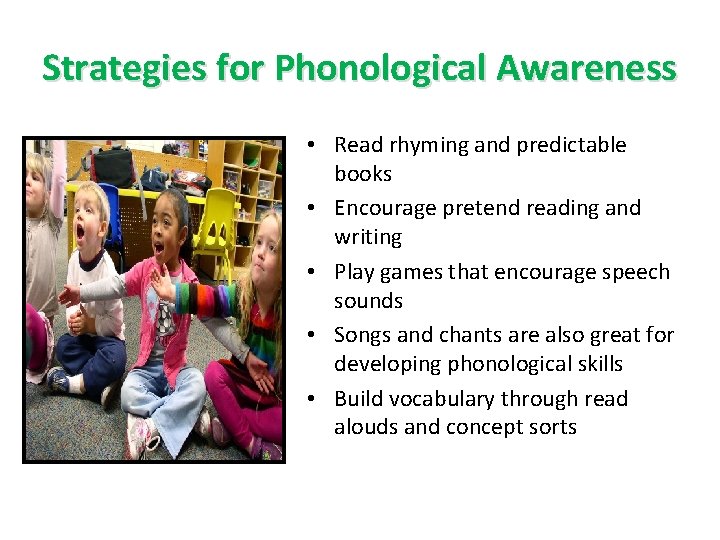
Strategies for Phonological Awareness • Read rhyming and predictable books • Encourage pretend reading and writing • Play games that encourage speech sounds • Songs and chants are also great for developing phonological skills • Build vocabulary through read alouds and concept sorts
Reading humor….
Reflection I have learned a lot from this assignment. One thing that I have learned is that I shouldn’t make assumptions about the literacy skills my students should have. For example, I use to assume that all readers entering kindergarten should have a grasp of book concepts. However, I now know that I need to assess each of my students to see what book concepts they can identify. I have also learned there is a lot more to assessing a student’s literacy skills. It doesn’t just involve a teacher identifying a student’s reading level. They need to assess their phonological awareness level and other literacy skills as well. I have also learned many assessments and strategies that can be fun for….
Reflection… …my students and me. A lot of the strategies and assessments that I learned involved playing games with the students. I think this is great because learning should be fun. I will be using all of these assessments and strategies in my classroom because I hope to be teaching kindergarten. My students will just be starting to develop their literacy skills. I am excited to put these assessments and strategies into practice!
Picture Sources • • • www. jcps. k 12. mo. us www. growingtreetoys. com www. happydaypreschool. com www. garfieldposters. com www. businetjournal. com www. teacherspayteachers. com www. family. wikinut. com www. ohmrstucker. com www. cli. org www. austinschools. org www. olli. decal. ga. gov
Picture Sources • • • www. brainpowerinitiative. com www. momto 2 poshlildivas. com www. thehouseoftales. com www. jonathansbookshelf. com www. readingrecovery. org www. the-best-childrens-books. org www. ebay. com. au www. sunshine-book. com. tw www. tutortime. com www. galleryhip. com www. oupeltglobalblog. com
Sources • http: //www. nmerrickschools. org/webpages/skuschner/resou rces. cfm? subpage=327241 • http: //www. pdst. ie/sites/default/files/Oral%20 Language%20 Booklet%20 PDF. pdf • http: //www 2. nefec. org/learn/teacher/early/alphabet/researc h/what. Is. htm • http: //idealcurriculum. com/oral-language-development. html • http: //www. readingrockets. org/article/concepts-printassessment • http: //primary 123 abc. weebly. com/print-concepts. html
Sources • http: //www. readingrockets. org/article/phonologicalawareness-assessment
- Slides: 32