
Preeclampsia Preeclampsia formerly known as PET preeclamptic toxaemia

- Slides: 20
Pre-eclampsia �-Pre-eclampsia (formerly known as PET: preeclamptic toxaemia) �- an idiopathic (= cause unknown) �-condition of pregnancy characterized by proteinuria and hypertension �- after 20 weeks of pregnancy in a woman who previously had normal blood pressure. �- can be mild, moderate or severe, and may be preeclampsia or eclampsia �-Pre-eclampsia occurs in 3% of all pregnancies
� -some will proceed to multisystem complications. � -maternal &fetal death recorded. � Pre-eclampsia known as a disease of theories � the path physiology is not fully understood. �it arises from the influence of placental tissue as it can arise in molar pregnancies (gestational trophoblastic disease) where there is placental tissue but no fetal tissue
�Management in pregnancy �-aspirin from 12 weeks of pregnancy until the baby is born. �Women at high risk have one of the following: �hypertensive disease during a previous pregnancy �chronic hypertension �chronic kidney disease �autoimmune disease, especially antiphospholipid syndrome (APS) or systemic lupus erythematosus (SLE)
A sso cia t e d f a ct o r s f o r de v e lo ping pr e - e cla m psia �Maternal factors � Primipaternity (first pregnancy with a new partner) � Extremes of maternal age (<20 and >40 years) � Family history of pre-eclampsia � Pre-eclampsia in a previous pregnancy � Pregnancy after assisted reproductive technology � Obesity � Pre-existing diabetes mellitus type 1 � Pre-existing hypertensive disease � Pre-existing medical conditions, e. g. renal disease, systemic lupus erythematosus (SLE), rheumatoid arthritis
Pregnancy related factors � First pregnancy � Multiple pregnancy � Developing a medical disorder during pregnancy, e. g. venous thromboembolic disease (VTE), such as antiphospholipid (Hughes) syndrome (APS), gestational diabetes, gestational hypertension � Developing infection with inflammatory response � Hydropic degeneration of the placenta(GTD) �-Early recognition of pre-eclampsia at an antenatal �- referral to an obstetrician is necessary for investigations, �- responsibility for the diagnosis lies with the doctor.
Pre-eclampsia can be recognized by: �blood pressure: systolic >140 mm. Hg or diastolic >90 mm. Hg �proteinuria �edema � Ankle edema is a common phenomenon in pregnancy and tends to diminish overnight. �More generalized edema that pits on pressure on the pre-tibial surface, hands, abdomen and sacrum, �The severity of the edema increases with the severity of the pre-eclampsia.
Investigation ; �Urine sample or 24 hour urine collection to quantify the proteinuria (>300 mg) and determine the ratio of protein to creatinine (>30 mg/mmol). �CBC ( platelet , haemolysis), haemoconcentration. �Urea and electrolytes �Liver enzymes. �ultrasound to monitor growth and volume of amniotic fluid and Doppler velocimetry of the umbilical arteries. �-hospital admission
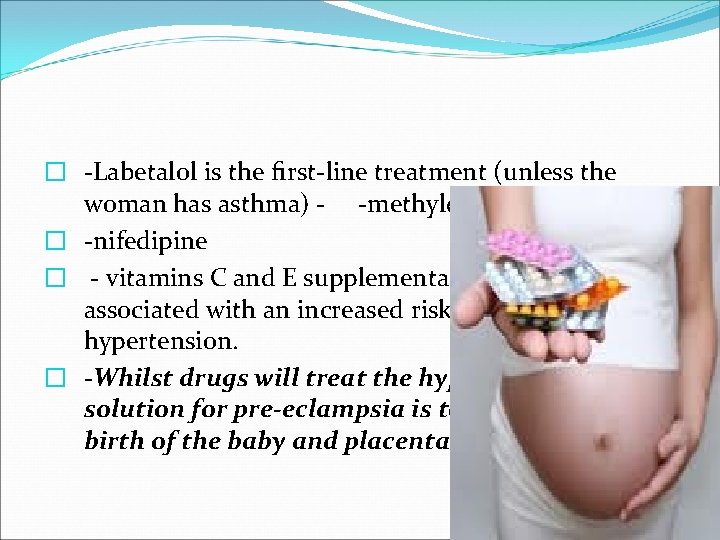
� -Labetalol is the first-line treatment (unless the woman has asthma) - -methyldopa � -nifedipine � - vitamins C and E supplementation to be associated with an increased risk of gestational hypertension. � -Whilst drugs will treat the hypertension, the solution for pre-eclampsia is to expedite the birth of the baby and placenta.
�-IOL at 37 weeks for mild pre-eclampsia �-at 34– 36 weeks for moderate pre-eclampsia �- at 34 weeks for severe hypertension �- corticosteroids to assist with fetal lung maturity �-Birth should be earlier in the ; �@event of uncontrolled blood pressure �@ fetal complications �@ antenatal complications
�C. S for: � 1 -urgent clinical situations � 2 - if the fetus is very preterm �Prepare neonatal intensive care and anaesthetist teams �
Management in labour �-continuous fetal monitoring. �- An epidural anaesthetic after review of the platelet count �-Oxytocin is used to control hemorrhage during the third stage of labour avoid syntometrine or ergometrine. �-Blood pressure measured hourly �- alert for signs of fulminant eclampsia
Postnatal management � -regular measurement of blood pressure �-Bp measured four times a day whilst in hospital �- recorded daily at home until the third day and once between days 3 to 5. �-midwife ask about severe headache and epigastric pain �-Methyldopa is usually discontinued or replaced by another antihypertensive drug.
�-If the BP is >150/100 mm. Hg refer the woman for medical care, where the dosage of antihypertensive is likely to be increased. �-Don’t discharge woman until BP & maternal condition becomes stable �-review after 2 weeks postnatally �- then between 6 and 8 weeks to assess the hypertension
Management of pregnancy with pre-eclampsia �De t e r m ining pr o t e inur ia in pr e g na ncy � If using a dipstix to test the urine, ensure the reagent strips are in date and read according to the stipulated times along the exterior label. � A mid-stream specimen of urine (MSSU) may be necessary to exclude urinary tract infection (UTI) as a cause of proteinuria. �.
�Significant proteinuria is diagnosed when the urinary protein : creatinine ratio is �>30 mg/mmol, or if a 24 -hour urine collection result shows > 300 mg protein. �Ensure 24 hour urine collections are complete before sending to the laboratory for analysis.
Severe pre-eclampsia and eclampsia � - high blood pressure of systole >160 mm. Hg or diastole � >110 mm. Hg on two occasions and significant proteinuria. � - Modern definitions also include women with moderate hypertension who have at least two of the features below: � low blood platelet count <100 × 106/l � abnormal liver function � liver tenderness � Haemolysis Elevated Liver enzymes and Low Platelet count (HELLP) syndrome � clonus (intermittent muscular contractions and relaxations) � papilloedema ( edema of the optic disc )due to increase intra cranial pressure � epigastric pain � vomiting � severe headache � visual disturbance (flashing light similar to migraine) � This condition, can lead to eclampsia with risk of mortality and morbidity.
�-The woman must be admitted to a high-risk obstetric ward for medical treatment to: � 1 - bring her blood pressure under control � 2 - reduce the risk of fluid overload � 3 - prevent seizures. �-Oral labetalol or nifedipine may be used �- if the BP is �>170/110 mm. Hg, intravenous (IV) labetalol or hydrallazine are given in bolus doses to lower the BP and then as a continuous IV infusion (IVI). �-Intravenous magnesium sulphate may also be administered as this drug can reduce the chance of an eclamptic seizure by 50%. �-
�Fluid restriction �- a low salt diet �-monitored a fluid balance chart �- regular urinalysis to assess proteinuria. �- be aware of magnesium toxicity as a reduced urine output � of <10 ml per hour. �increased risk of iatrogenic pre-term birth before 33 weeks �IUGR and consequent admission to neonatal intensive
�Fulminant eclampsia �acute worsening of symptoms �headache, epigastric pain and vomiting accompanied by high blood pressure, indicating that severe eclampsia is developing into eclampsia and that a convulsion is imminent. � emergency intervention is required.
Thank You…. .