
Predictive Multiscale Modeling of Chronic Wound Biofilms NIH
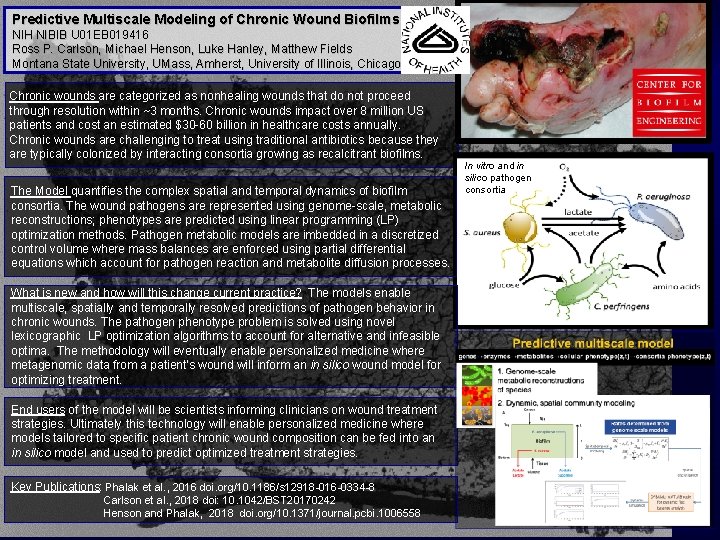
Predictive Multiscale Modeling of Chronic Wound Biofilms NIH NIBIB U 01 EB 019416 Ross P. Carlson, Michael Henson, Luke Hanley, Matthew Fields Montana State University, UMass, Amherst, University of Illinois, Chicago Chronic wounds are categorized as nonhealing wounds that do not proceed through resolution within ~3 months. Chronic wounds impact over 8 million US patients and cost an estimated $30 -60 billion in healthcare costs annually. Chronic wounds are challenging to treat using traditional antibiotics because they are typically colonized by interacting consortia growing as recalcitrant biofilms. The Model quantifies the complex spatial and temporal dynamics of biofilm consortia. The wound pathogens are represented using genome-scale, metabolic reconstructions; phenotypes are predicted using linear programming (LP) optimization methods. Pathogen metabolic models are imbedded in a discretized control volume where mass balances are enforced using partial differential equations which account for pathogen reaction and metabolite diffusion processes. What is new and how will this change current practice? The models enable multiscale, spatially and temporally resolved predictions of pathogen behavior in chronic wounds. The pathogen phenotype problem is solved using novel lexicographic LP optimization algorithms to account for alternative and infeasible optima. The methodology will eventually enable personalized medicine where metagenomic data from a patient’s wound will inform an in silico wound model for optimizing treatment. End users of the model will be scientists informing clinicians on wound treatment strategies. Ultimately this technology will enable personalized medicine where models tailored to specific patient chronic wound composition can be fed into an in silico model and used to predict optimized treatment strategies. Key Publications: Phalak et al. , 2016 doi. org/10. 1186/s 12918 -016 -0334 -8 Carlson et al. , 2018 doi: 10. 1042/BST 20170242 Henson and Phalak, 2018 doi. org/10. 1371/journal. pcbi. 1006558 In vitro and in silico pathogen consortia
- Slides: 1