
Predictive Genetic Testing of Children for Adult Onset
- Slides: 23
Predictive Genetic Testing of Children for Adult Onset Conditions Ingrid Holme I. Holme@soton. ac. uk
Overview § Professional guidelines § Rational behind the guidelines § Our project § New guidance 2
Clinical Genetic Society (CGS) § Set up in 1970 to bring together doctors and other professionals involved in the care of individuals and families with genetic disorders § In 1994 a working group chaired by Dr Angus Clarke, Senior Lecturer in Medical Genetics, Cardiff published professional guidelines 3
Key recommendations § 1 Appropriate where onset of the condition regularly occurs in childhood or there are useful medical interventions that can be offered (eg diet, medication, surveillance for complications). § 2 Predictive testing for an adult-onset disorder should generally not be undertaken if the child is healthy and there are no medical interventions established as useful that can be offered in the event of a positive test result. 4
§ …formal genetic testing should wait until the "children" request such tests for themselves, as autonomous adults. This respect for autonomy and confidentiality would entail the deferral of testing until the individual is either adult, or is able to appreciate not only the genetic facts of the matter but also the emotional and social consequences of the various possible test results. § 3 For some disorders, there is insufficient evidence to know whether a diagnosis in childhood is helpful in the medical management of the possibly (not yet) affected 5 child…
§ Consistent with existing medical guidance – Generally defer testing unless benefits during childhood – But ‘broad’ view of benefit § Dominated by concern around testing for conditions such as Huntington's Disease § Looking back guidelines seem to have been taken as prohibiting testing. 6
Rational behind guidelines § A person should choose for themselves to have a medical intervention, unless they are unable to consent and there is a medical need. § Professionals expected to act as advocates, defining scope of choice
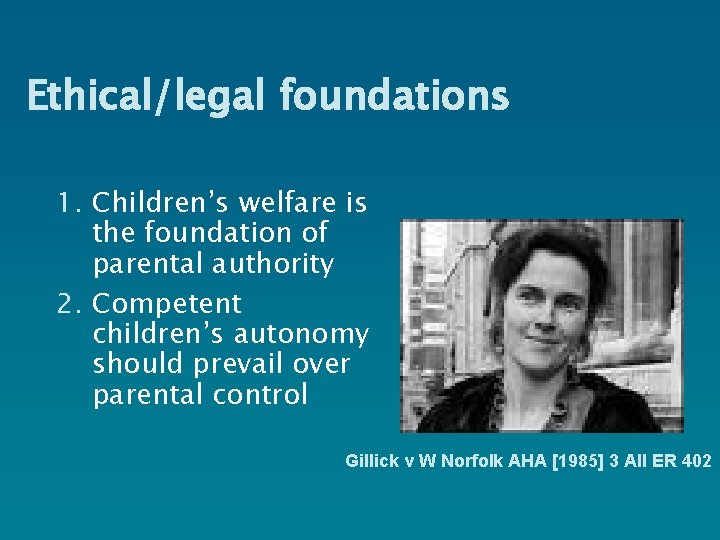
Ethical/legal foundations 1. Children’s welfare is the foundation of parental authority 2. Competent children’s autonomy should prevail over parental control Gillick v W Norfolk AHA [1985] 3 All ER 402
Parents not entitled to be informed about family planning advice and treatment (including abortion) Axon [2006] EWHC 37 (Admin)
Best interests ‘Best interests are used in the widest sense and include every kind of consideration capable of impacting on the decision. These include, non-exhaustively, medical, emotional, sensory (pleasure pain and suffering) and instinctive (the human instinct to survive) considerations. ’ Re MB [2006] para 16
Current project § Funded by the BUPA Foundation § Anneke Lucassen, Angela Fenwick, Gill Crawford, Jonathan Montgomery, Nina Hallowell, Ingrid Holme – Medical (Genetic Services) – Law – Sociology § Need to update guidelines 11
Aims § Explore the views of the different stakeholders about predictive genetic testing in children in order to improve and enhance communication between health care professionals and families. 1. Analyse current UK guidelines, policies and legislation affecting the provision of genetic testing of children 2. Design and develop an on-line survey of medical specialists involved in genetic testing to identify current opinions and practice. 12
3. Identify and analyse parents' young people's and patient representatives' views about predictive genetic testing, and the consequences arising from different decisions. 4. Explore HCPs' responses to requests for testing and the ethical reasoning behind these responses. 5. Contribute to the evidence base underlying professional guidelines and inform their revision. 6. Develop clinical guidelines and training packages for HCPs incorporating the results and work with patient groups to develop patient information. 13
Methodology § Documentary analysis § In-depth interviews – – Patient representative groups HCPs Parents Young people § Scoping survey of current practice 14
Families § Parents who have asked about their child being tested before it is considered to have a medical beneficial § Young people who were and were not tested in childhood. – parents must agreed for them to take part 15
Questions § What factors motivate parents and/or young people to request genetic testing before medical benefit or adulthood? § What reasons are given for such requests? § What do parents/young people think about the guidelines? § What problems/consequences do they associate with a test being undertaken /deferred/refused? § What impact does testing/refusal have on the family? § What information/support do they receive/need? § What were the consequences of testing or not testing? 16
Outcomes § Publications § Accessible research briefing paper § Clinical guidelines and health training packages for HCPs § Policy recommendations § Dissemination workshop other suggestions? 17
British Society for Human Genetics, 2010 § 1 Genetic testing in childhood often leads to better management of a child’s condition. Where this is the case, for example where testing aids immediate medical management such as the initiation or cessation of surveillance or treatment, it is unlikely to be contentious. Nevertheless, the possible longer term consequences for the child and family should, where feasible, be discussed prior to testing 18
§ 2 Where genetic testing is primarily predictive of illness or impairment in the future, or is predictive of future reproductive risks, a cautious approach should be adopted. We recommend that in such circumstances testing should normally be delayed until the young person can decide for him/herself when, or whether, to be tested. The rationale for this recommendation is that testing in childhood removes the opportunity of the future young person to make their own choices about such decisions, and that opportunity should not be denied to them without good reason. 19
§ 3. This does not mean that childhood testing for such conditions should never be done. For any particular child and family, the benefits of testing in childhood may outweigh the harms, but we believe that predictive genetic testing for a later onset condition should only happen when there are specific reasons not to wait until a child is older. 20
§ 4. In each case where parents request genetic testing of a child when this is of no direct or immediate medical benefit, an assessment should be made of the balance of harms and benefits of such testing taking into account that decisions ought to be made in the child’s best interests. § http: //www. bshg. org. uk/GTOC_2010_BSHG. pdf 21
§ 5. Even where a condition is likely to manifest during childhood, the principle of adopting a cautious approach still applies as there may be good reasons to defer testing until such time when surveillance might be implemented, including to enhance the opportunity for the child to participate in discussions. Where there is no realistic possibility of choice being exercised by the future young person before the condition might present clinically, the reasons to defer are weaker. 22
§ 6. In many situations, therefore, an immediate decision about testing is unlikely to do justice to the complexity of the issues; ample time for discussion and consideration of the timing of test with all relevant parties should be allowed. Health care professionals and parents should be enabled to spend time discussing the optimal timing of a predictive genetic test and facilitate, where appropriate, discussions within the family. Encouraging parents to talk to their children about their family history from a young age, so that they grow up knowing about it, will be integral to discussions about genetic testing. 23