
Predictive Factors for Bilateral Discoid Lateral Meniscus in
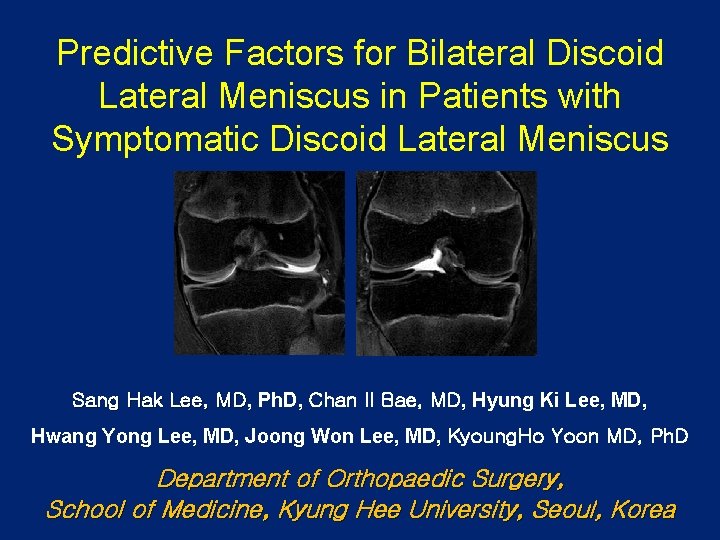
Predictive Factors for Bilateral Discoid Lateral Meniscus in Patients with Symptomatic Discoid Lateral Meniscus Sang Hak Lee, MD Ph. D, Chan Il Bae, MD, Hyung Ki Lee, MD, Hwang Yong Lee, MD, Joong Won Lee, MD, Kyoung. Ho Yoon MD, Ph. D Department of Orthopaedic Surgery, School of Medicine, Kyung Hee University, Seoul, Korea
Disclosures Sang Hak Lee, M. D. , Ph. D. No financial disclosure Or Conflict of interest
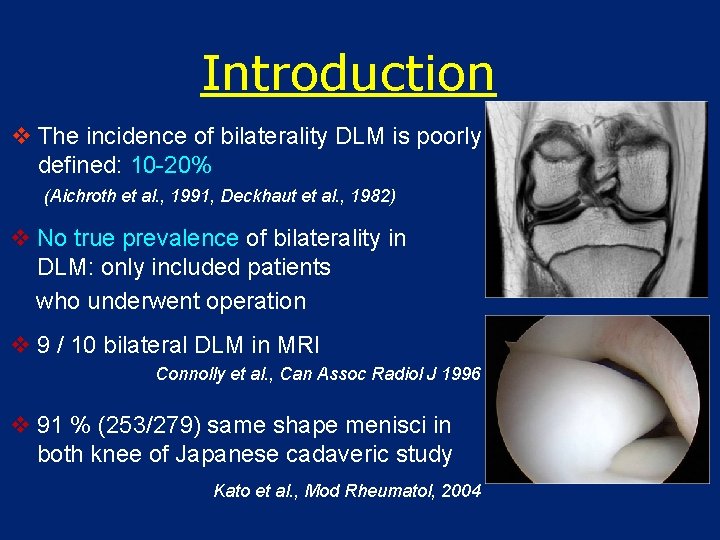
Introduction v The incidence of bilaterality DLM is poorly defined: 10 -20% (Aichroth et al. , 1991, Deckhaut et al. , 1982) v No true prevalence of bilaterality in DLM: only included patients who underwent operation v 9 / 10 bilateral DLM in MRI Connolly et al. , Can Assoc Radiol J 1996 v 91 % (253/279) same shape menisci in both knee of Japanese cadaveric study Kato et al. , Mod Rheumatol, 2004
Hypothesis and Purpose • Younger age or tear pattern of DLM may have significantly correlation with higher incidence of bilaterality and associated tears. • To prospectively analyze the predictive factors of contralateral DLM status of 76 patients who underwent an operation for a symptomatic DLM by performing MRI.
Materials and Methods • Consecutive 76 pts. (2011~ 2016) : complete type • Mean age : 33. 9 yrs (range, 3 to 59 yrs) • 36/76 were Left • 32/76 were males • Symptomatic DLM with arthroscopic surgery • Prospective (IRB approval) • Clinical and radiographic (MRI) evaluation
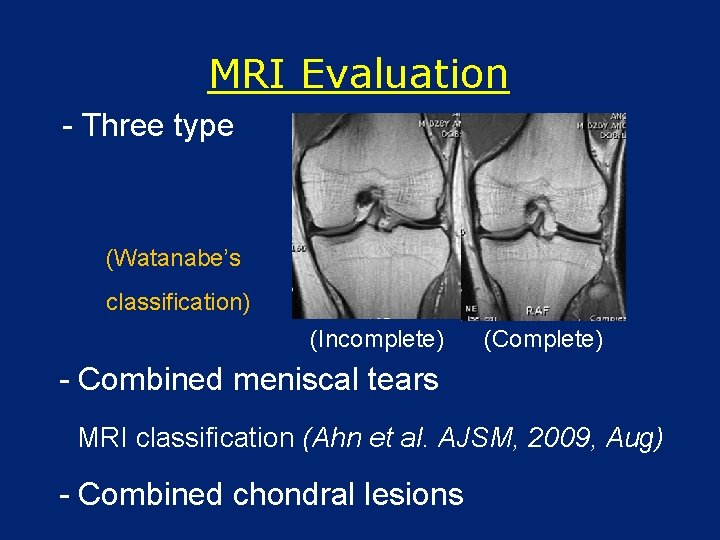
MRI Evaluation - Three type (Watanabe’s classification) (Incomplete) (Complete) - Combined meniscal tears MRI classification (Ahn et al. AJSM, 2009, Aug) - Combined chondral lesions
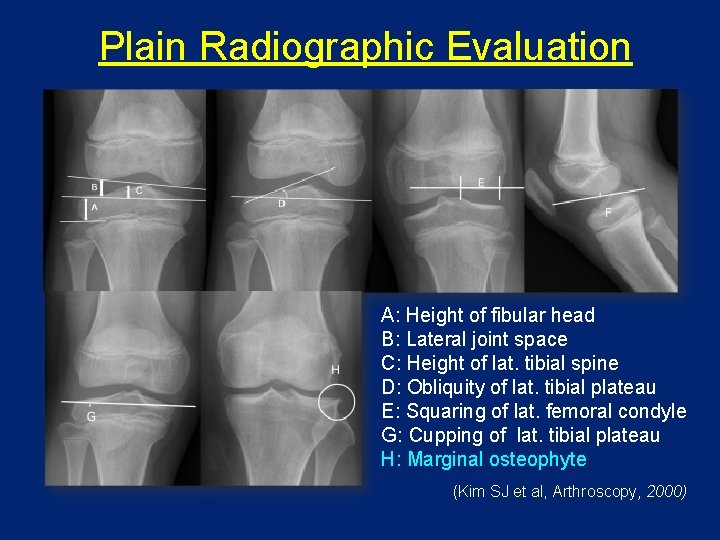
Plain Radiographic Evaluation A: Height of fibular head B: Lateral joint space C: Height of lat. tibial spine D: Obliquity of lat. tibial plateau E: Squaring of lat. femoral condyle G: Cupping of lat. tibial plateau H: Marginal osteophyte (Kim SJ et al, Arthroscopy, 2000)
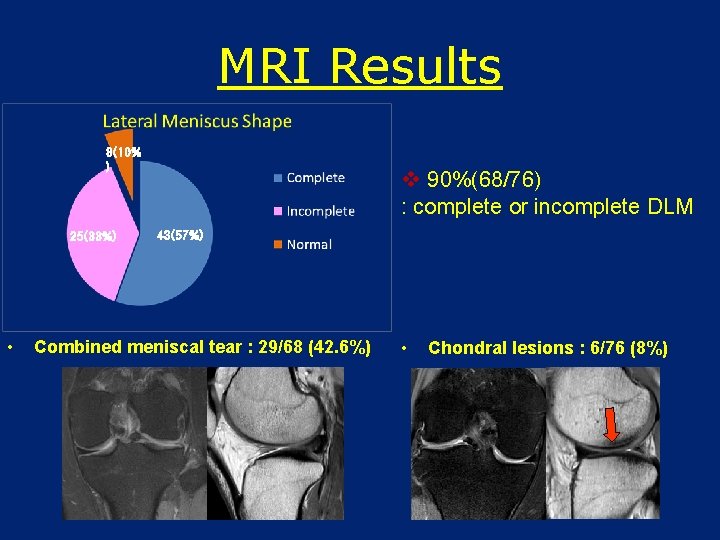
MRI Results 8(10% ) 25(33%) • v 90%(68/76) : complete or incomplete DLM 43(57%) Combined meniscal tear : 29/68 (42. 6%) • Chondral lesions : 6/76 (8%)
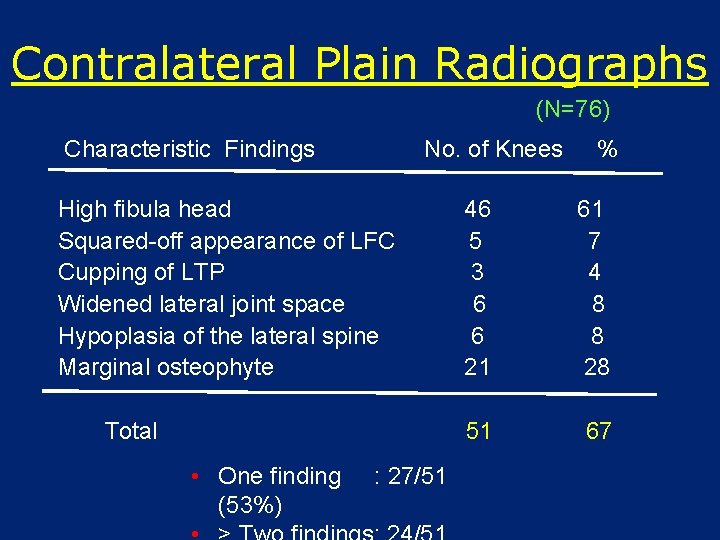
Contralateral Plain Radiographs (N=76) Characteristic Findings No. of Knees High fibula head Squared-off appearance of LFC Cupping of LTP Widened lateral joint space Hypoplasia of the lateral spine Marginal osteophyte Total • One finding (53%) : 27/51 % 46 5 3 6 6 21 61 7 4 8 8 28 51 67
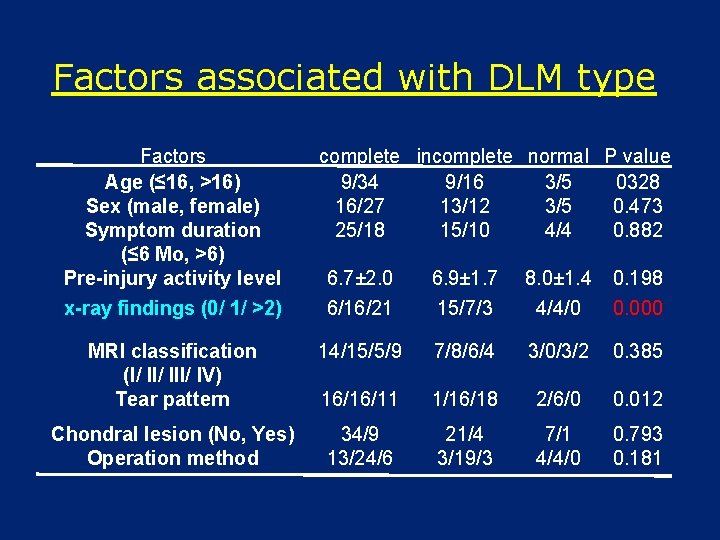
Factors associated with DLM type Factors Age (≤ 16, >16) Sex (male, female) Symptom duration (≤ 6 Mo, >6) Pre-injury activity level complete incomplete normal P value 9/34 9/16 3/5 0328 16/27 13/12 3/5 0. 473 25/18 15/10 4/4 0. 882 6. 7± 2. 0 6. 9± 1. 7 8. 0± 1. 4 0. 198 x-ray findings (0/ 1/ >2) 6/16/21 15/7/3 4/4/0 0. 000 MRI classification (I/ III/ IV) Tear pattern 14/15/5/9 7/8/6/4 3/0/3/2 0. 385 16/16/11 1/16/18 2/6/0 0. 012 Chondral lesion (No, Yes) Operation method 34/9 13/24/6 21/4 3/19/3 7/1 4/4/0 0. 793 0. 181
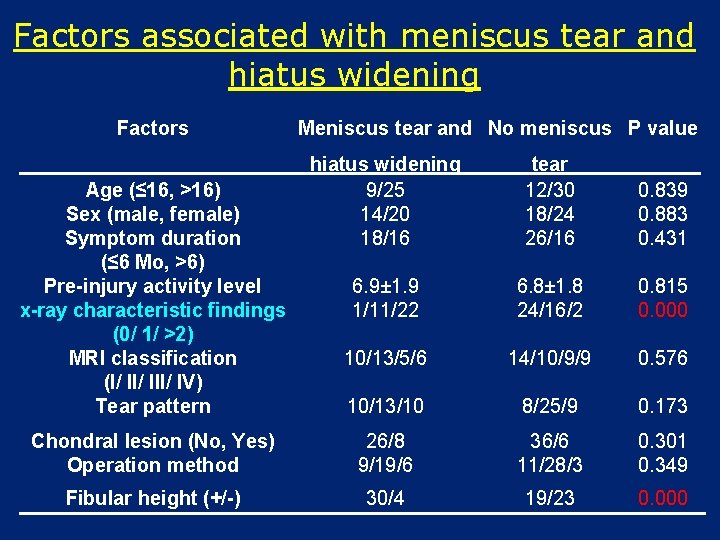
Factors associated with meniscus tear and hiatus widening Factors Meniscus tear and No meniscus P value hiatus widening 9/25 14/20 18/16 tear 12/30 18/24 26/16 0. 839 0. 883 0. 431 6. 9± 1. 9 1/11/22 6. 8± 1. 8 24/16/2 0. 815 0. 000 10/13/5/6 14/10/9/9 0. 576 10/13/10 8/25/9 0. 173 Chondral lesion (No, Yes) Operation method 26/8 9/19/6 36/6 11/28/3 0. 301 0. 349 Fibular height (+/-) 30/4 19/23 0. 000 Age (≤ 16, >16) Sex (male, female) Symptom duration (≤ 6 Mo, >6) Pre-injury activity level x-ray characteristic findings (0/ 1/ >2) MRI classification (I/ III/ IV) Tear pattern
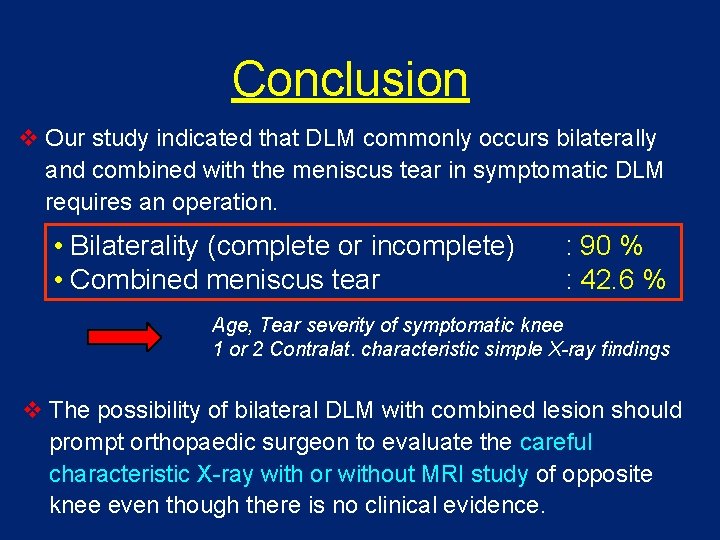
Conclusion v Our study indicated that DLM commonly occurs bilaterally and combined with the meniscus tear in symptomatic DLM requires an operation. • Bilaterality (complete or incomplete) • Combined meniscus tear : 90 % : 42. 6 % Age, Tear severity of symptomatic knee 1 or 2 Contralat. characteristic simple X-ray findings v The possibility of bilateral DLM with combined lesion should prompt orthopaedic surgeon to evaluate the careful characteristic X-ray with or without MRI study of opposite knee even though there is no clinical evidence.
References 1. Dickason JM, Del Pizzo W, Blazina ME, Fox JM, Friedman MJ, Snyder SJ. A series of ten discoid medial menisci. Clin Orthop Relat Res. 1982; 168: 75– 79. 2. Ikeuchi H. Arthroscopic Treatment of the Discoid Lateral Meniscus Technique and Long-term Results. Clin Orthop Relat Res. 1982; 167: 19– 28. 3. Dickhaut SC, De. Lee JC. The discoid lateral-meniscus syndrome. J Bone Joint Surg Am. 1982; 64(7): 1068– 1073. 4. Fritschy D, Gonseth D. Discoid lateral meniscus. Int Orthop. 1991; 15(2): 145– 147. 5. Kelly BT, Green DW. Discoid lateral meniscus in children. Curr Opin Pediatr. 2002; 14(1): 54– 61. 6. Yaniv M, Blumberg N. The discoid meniscus. J Child Orthop. 2007; 1(2): 89– 96. 7. Jordan MR. Lateral meniscal variants: evaluation and treatment. J Am Acad Orthop Surg. 1996; 4(4): 191– 200. 8. Aichroth PM, Patel DV, Marx CL. Congenital discoid lateral meniscus in children. A follow-up study and evolution of management. J Bone Joint Surg Br. 1991; 73(6): 932– 936. 9. Bellier G, Dupont J-Y, Larrain M, Caudron C, Carlioz H. Lateral discoid menisci in children. Arthroscopy. 1989; 5(1): 52– 56. 10. Ahn JH, Lee SH, Yoo JC, Lee HJ, Lee JS. Bilateral discoid lateral meniscus in knees: evaluation of the contralateral knee in patients with symptomatic discoid lateral meniscus. Arthroscopy. 2010; 26(10): 1348– 1356.
- Slides: 13