
Predictive data science for physical systems From model
- Slides: 42
Predictive data science for physical systems From model reduction to scientific machine learning Professor Karen E. Willcox ICIAM 2019 Valencia, Spain July 19, 2019
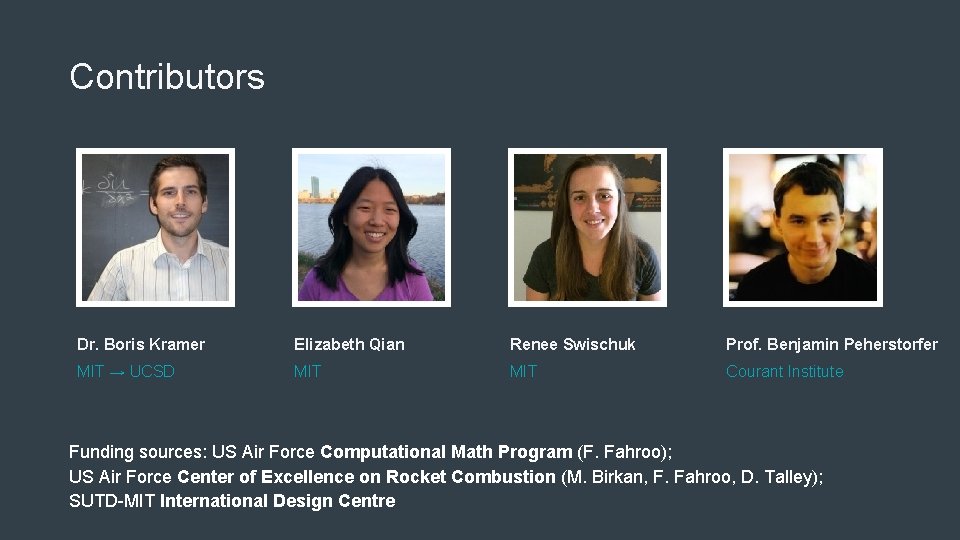
Contributors Dr. Boris Kramer Elizabeth Qian Renee Swischuk Prof. Benjamin Peherstorfer MIT → UCSD MIT Courant Institute Funding sources: US Air Force Computational Math Program (F. Fahroo); US Air Force Center of Excellence on Rocket Combustion (M. Birkan, F. Fahroo, D. Talley); SUTD-MIT International Design Centre
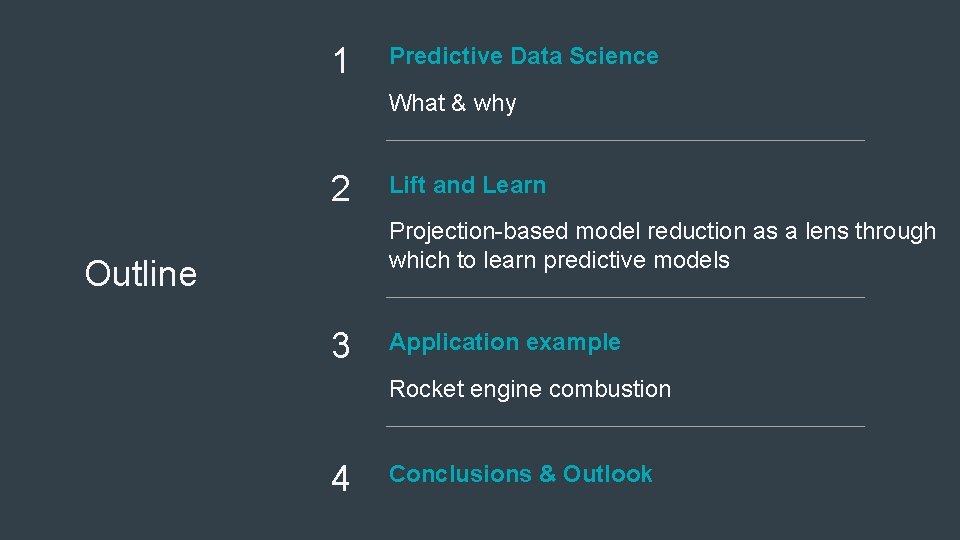
1 Predictive Data Science What & why 2 Lift and Learn Projection-based model reduction as a lens through which to learn predictive models Outline 3 Application example Rocket engine combustion 4 Conclusions & Outlook
1 Predictive Data Science 2 Lift & Learn 3 Application Example 4 Conclusions & Outlook Predictive Data Science What and Why
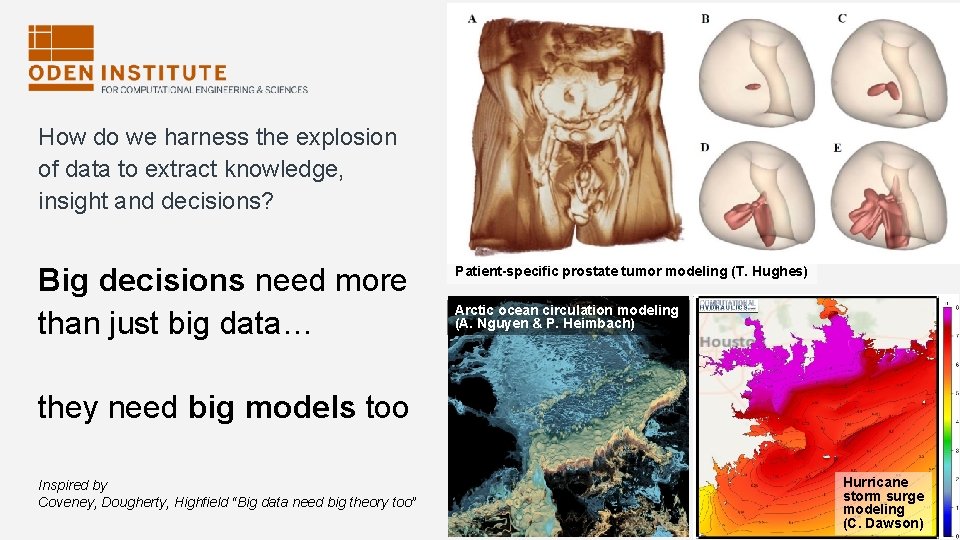
How do we harness the explosion of data to extract knowledge, insight and decisions? Big decisions need more than just big data… Patient-specific prostate tumor modeling (T. Hughes) Arctic ocean circulation modeling (A. Nguyen & P. Heimbach) they need big models too Inspired by Coveney, Dougherty, Highfield “Big data need big theory too” Hurricane storm surge modeling (C. Dawson)
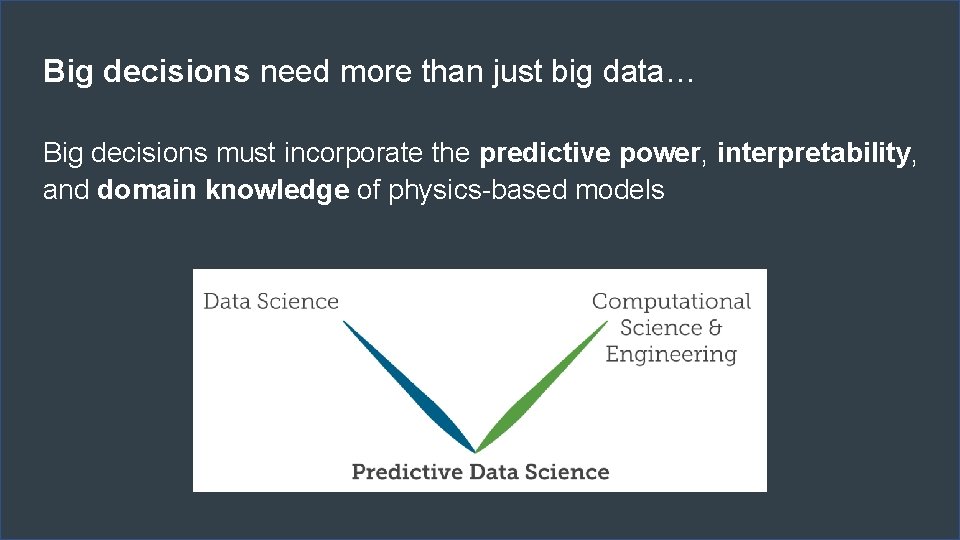
Big decisions need more than just big data… Big decisions must incorporate the predictive power, interpretability, and domain knowledge of physics-based models
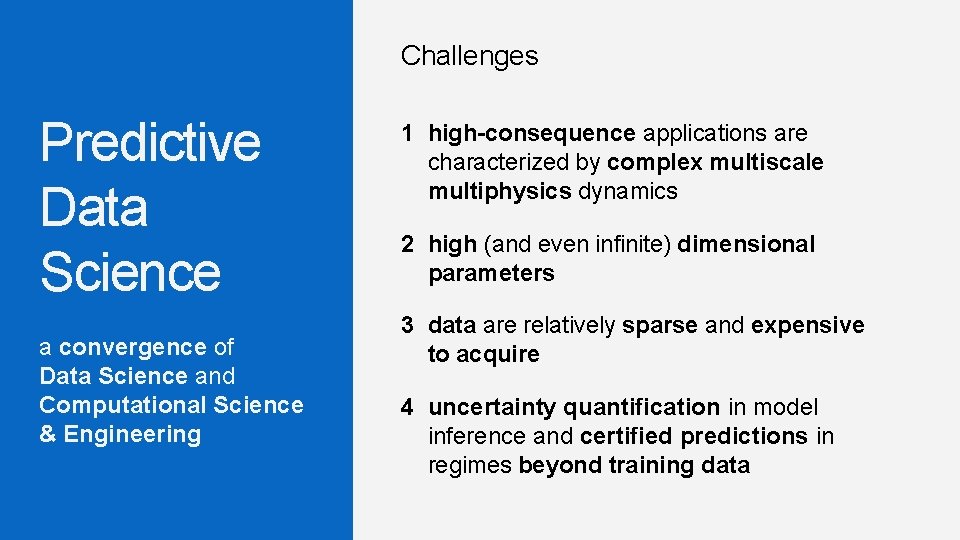
Challenges Predictive Data Science a convergence of Data Science and Computational Science & Engineering 1 high-consequence applications are characterized by complex multiscale multiphysics dynamics 2 high (and even infinite) dimensional parameters 3 data are relatively sparse and expensive to acquire 4 uncertainty quantification in model inference and certified predictions in regimes beyond training data
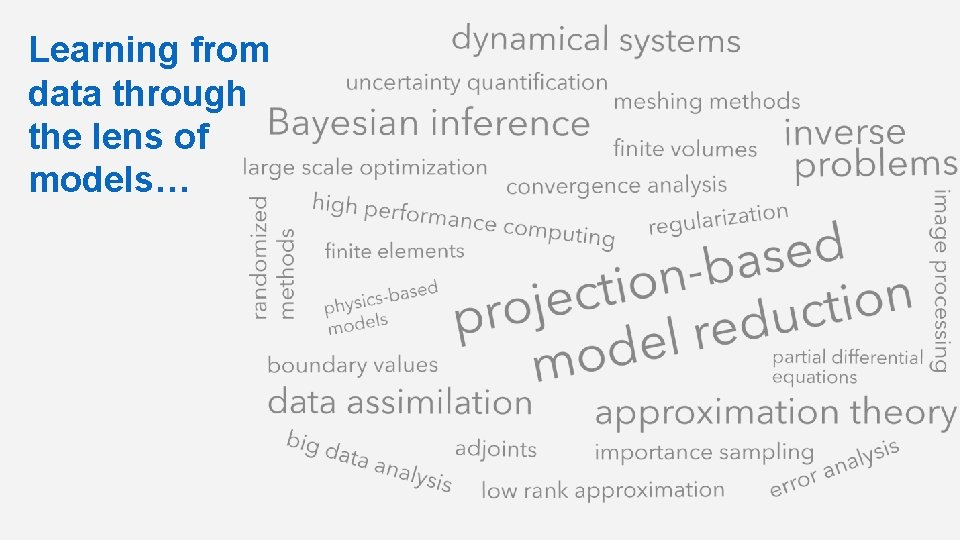
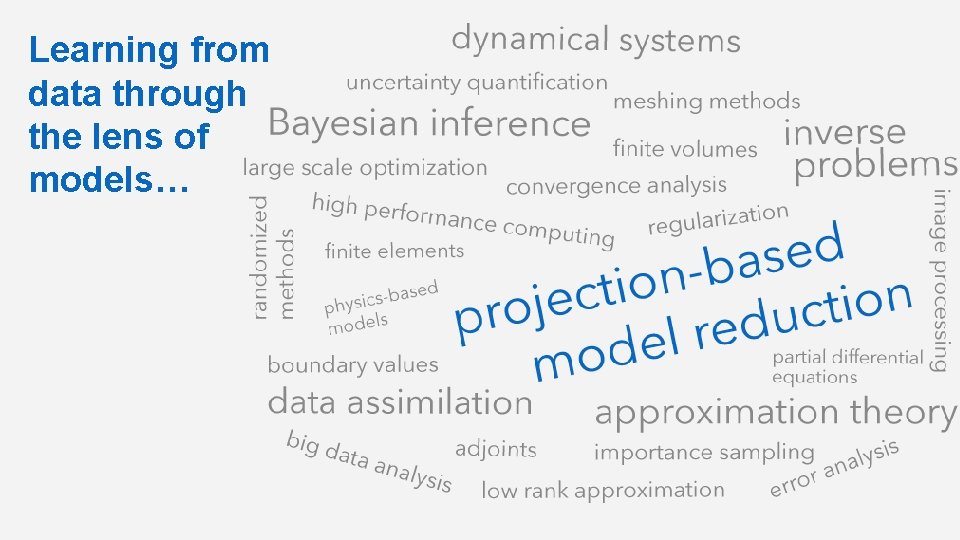
Learning from data through the lens of models…
Learning from data through the lens of models…
1 Predictive Data Science 2 Lift & Learn 3 Application Example Lift & Learn 4 Conclusions & Outlook Projection-based model reduction as a lens through which to learn predictive models
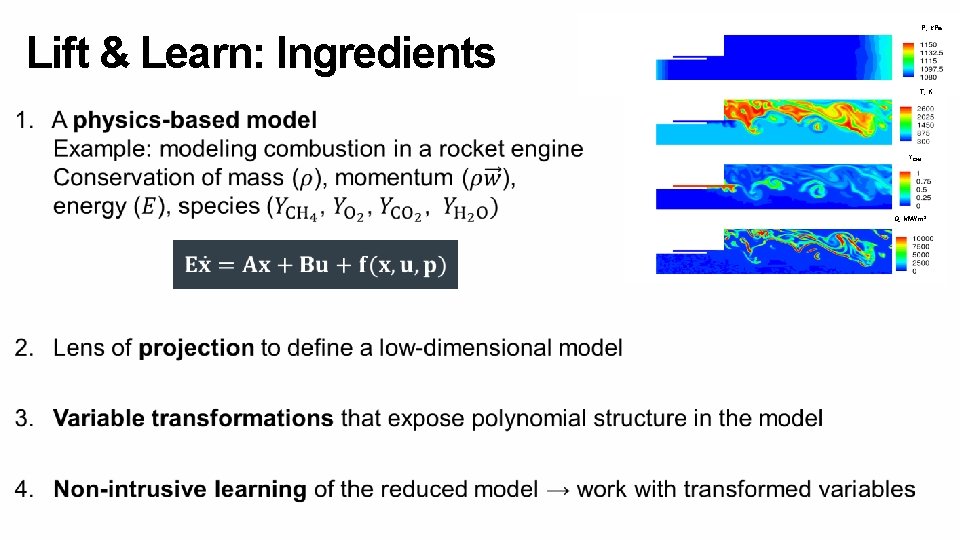
Lift & Learn: Ingredients P, k. Pa T, K YCH 4 Q, MW/m 3
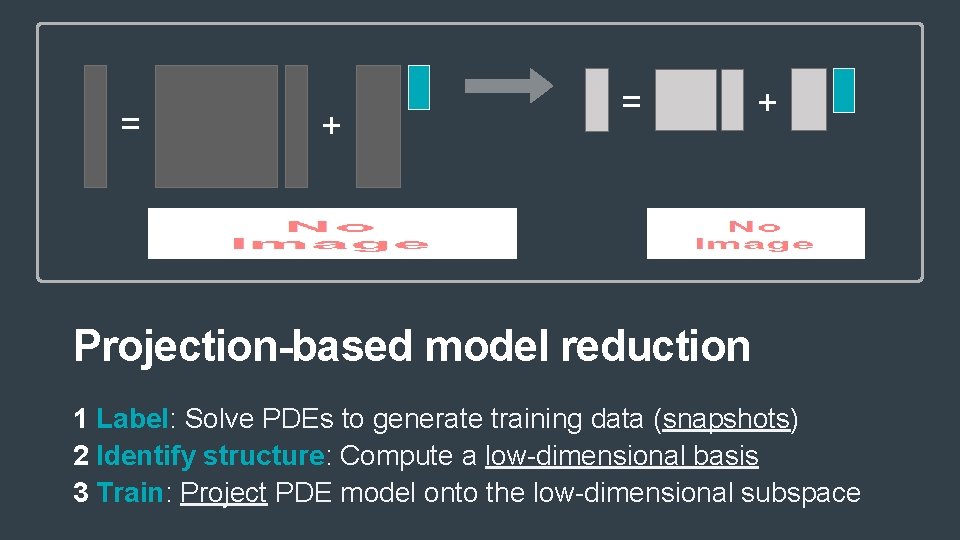
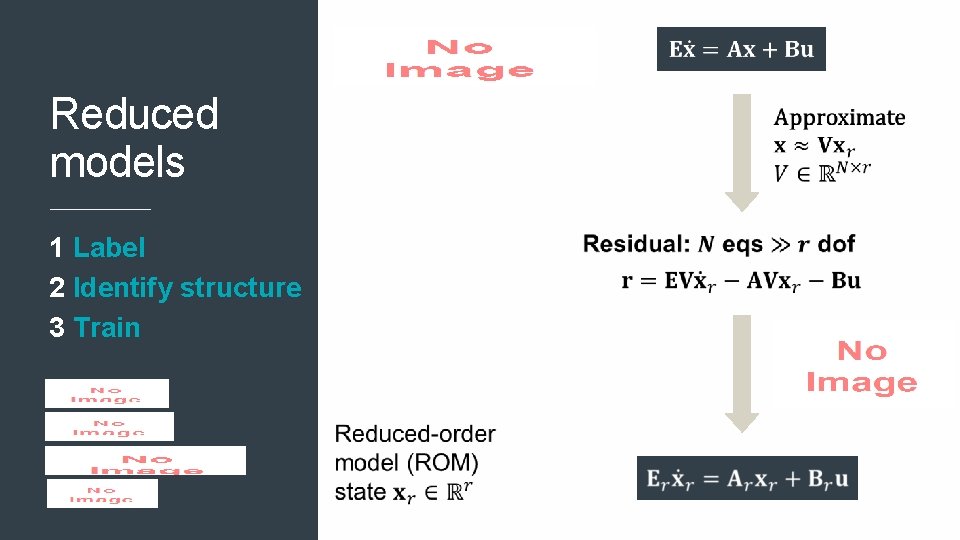
= + Projection-based model reduction 1 Label: Solve PDEs to generate training data (snapshots) 2 Identify structure: Compute a low-dimensional basis 3 Train: Project PDE model onto the low-dimensional subspace
Reduced models 1 Label 2 Identify structure 3 Train
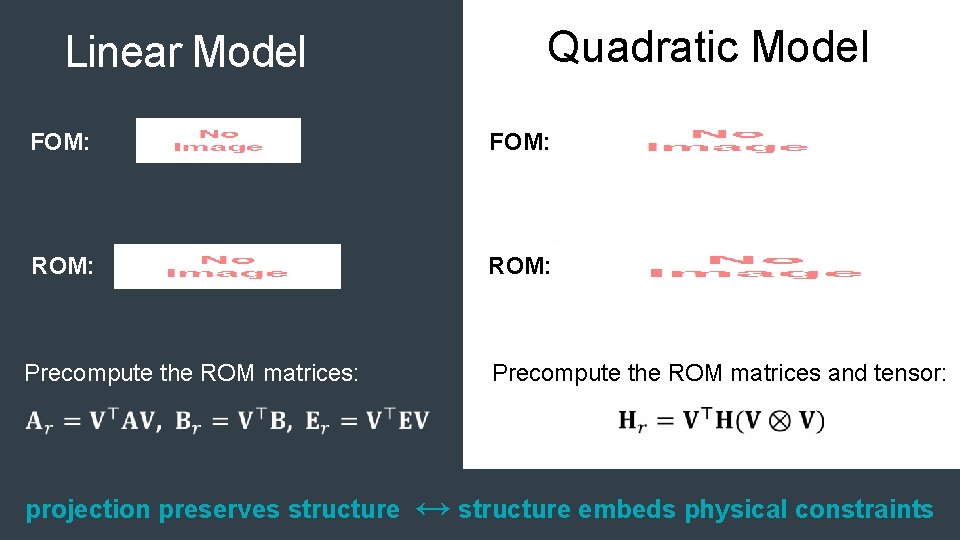
Linear Model Quadratic Model FOM: ROM: Precompute the ROM matrices: Precompute the ROM matrices and tensor: projection preserves structure ↔ structure embeds physical constraints 14
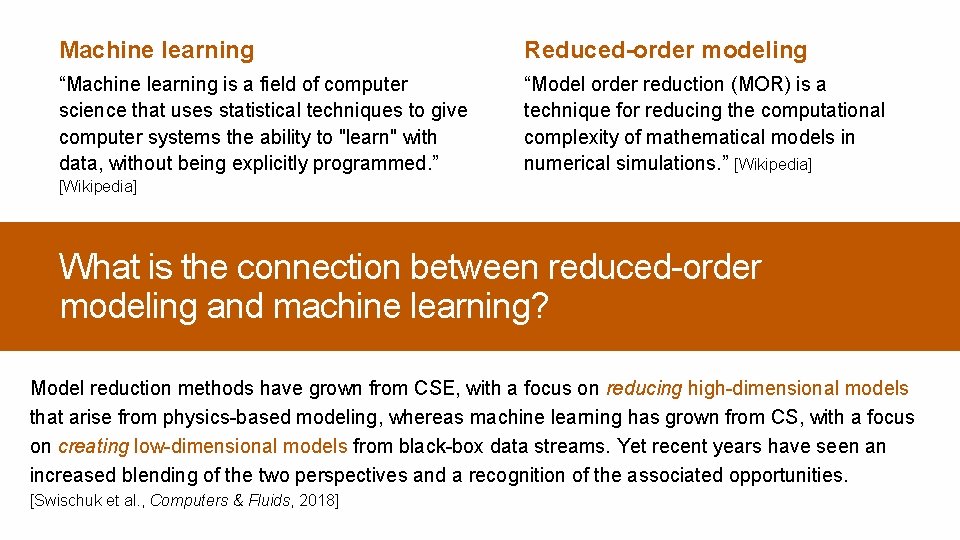
Machine learning Reduced-order modeling “Machine learning is a field of computer science that uses statistical techniques to give computer systems the ability to "learn" with data, without being explicitly programmed. ” “Model order reduction (MOR) is a technique for reducing the computational complexity of mathematical models in numerical simulations. ” [Wikipedia] What is the connection between reduced-order modeling and machine learning? Model reduction methods have grown from CSE, with a focus on reducing high-dimensional models that arise from physics-based modeling, whereas machine learning has grown from CS, with a focus on creating low-dimensional models from black-box data streams. Yet recent years have seen an increased blending of the two perspectives and a recognition of the associated opportunities. [Swischuk et al. , Computers & Fluids, 2018]
Variable Transformations & Lifting The physical governing equations reveal variable transformations and manipulations that expose polynomial structure 16
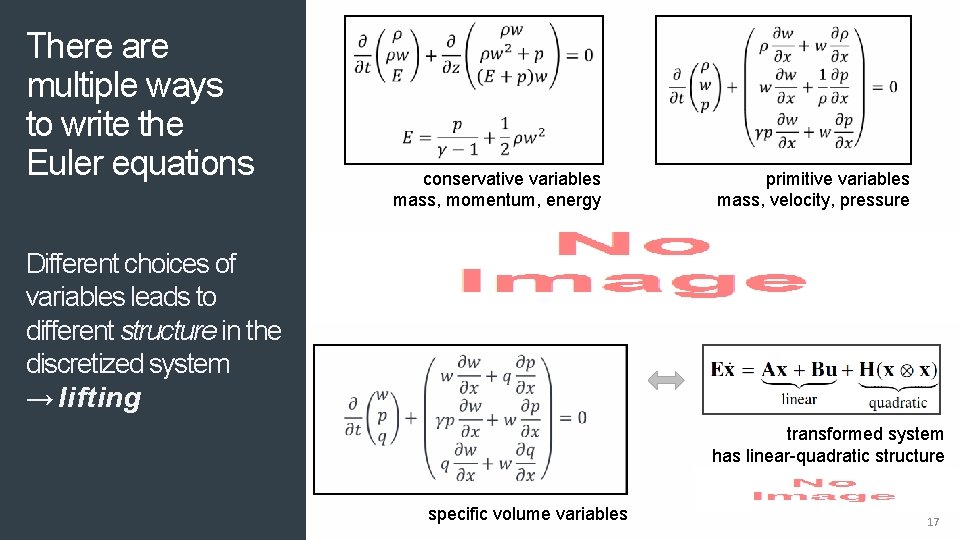
There are multiple ways to write the Euler equations conservative variables mass, momentum, energy primitive variables mass, velocity, pressure Different choices of variables leads to different structure in the discretized system → lifting transformed system has linear-quadratic structure specific volume variables 17
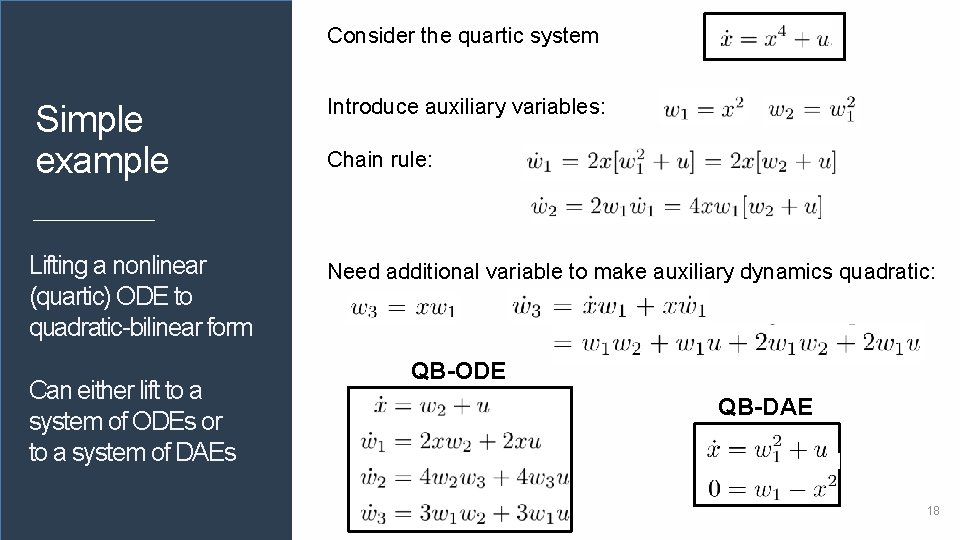
Consider the quartic system Simple example Lifting a nonlinear (quartic) ODE to quadratic-bilinear form Can either lift to a system of ODEs or to a system of DAEs Introduce auxiliary variables: Chain rule: Need additional variable to make auxiliary dynamics quadratic: QB-ODE QB-DAE 18
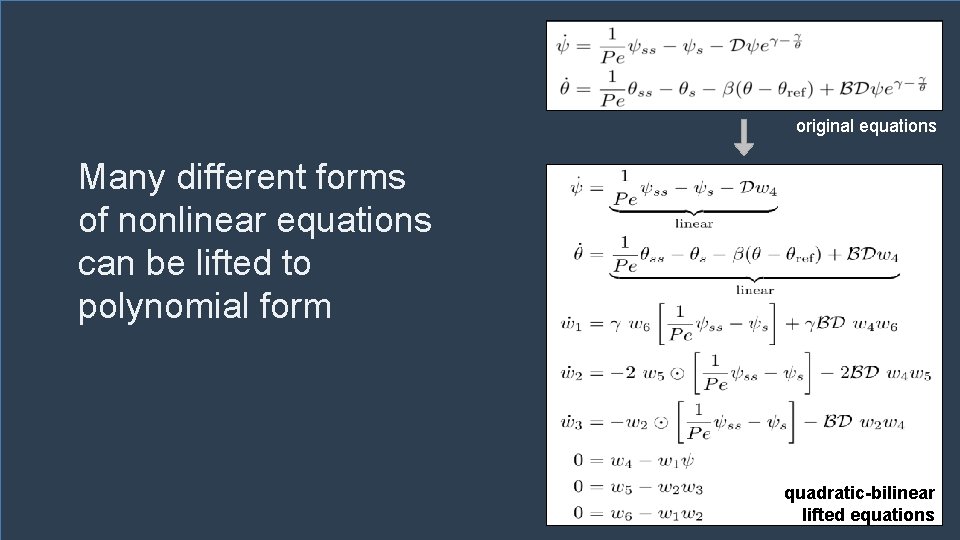
original equations Many different forms of nonlinear equations can be lifted to polynomial form quadratic-bilinear 19 lifted equations
Operator inference Non-intrusive learning of the reduced models from simulation snapshot data 20
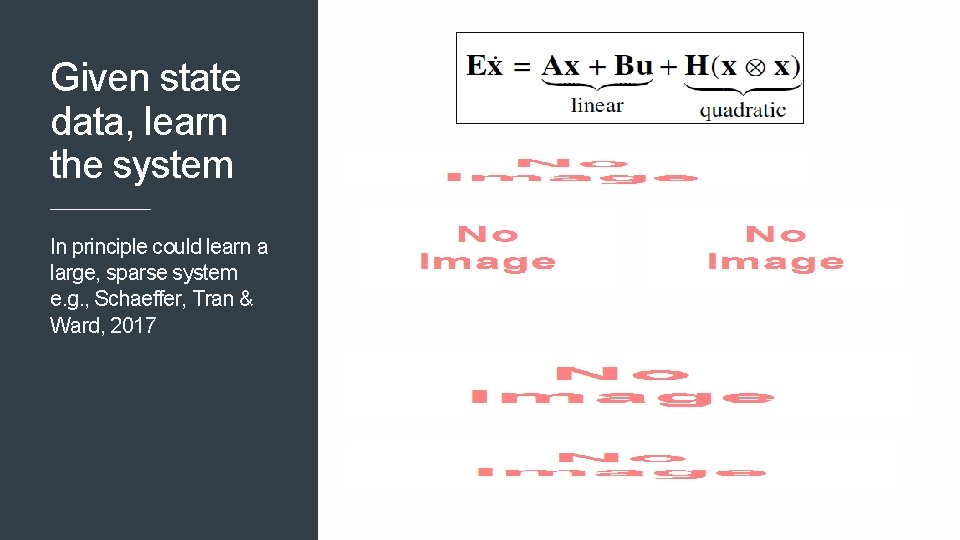
Given state data, learn the system In principle could learn a large, sparse system e. g. , Schaeffer, Tran & Ward, 2017
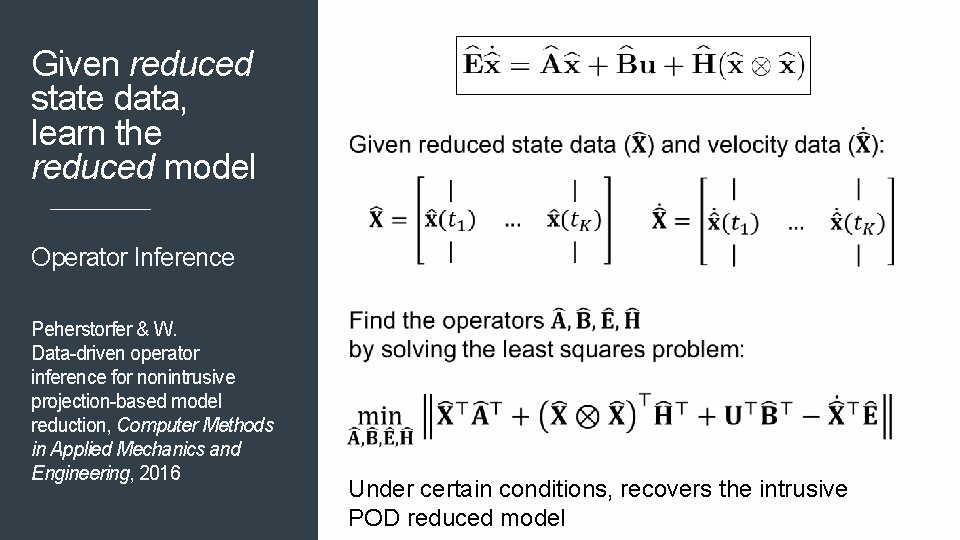
Given reduced state data, learn the reduced model Operator Inference Peherstorfer & W. Data-driven operator inference for nonintrusive projection-based model reduction, Computer Methods in Applied Mechanics and Engineering, 2016 Under certain conditions, recovers the intrusive POD reduced model
Lift & Learn Variable transformations to expose structure + non-intrusive learning that frees us to choose our variables 23
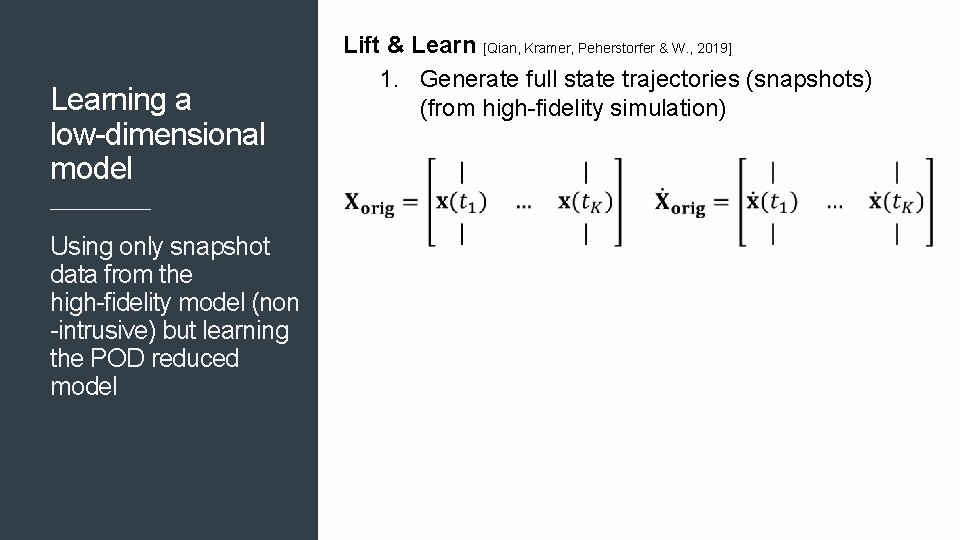
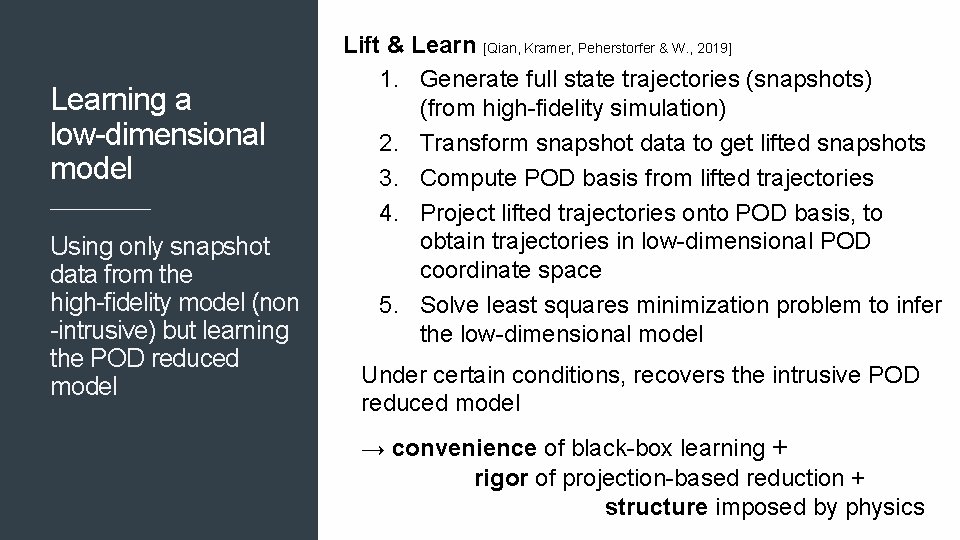
Learning a low-dimensional model Using only snapshot data from the high-fidelity model (non -intrusive) but learning the POD reduced model Lift & Learn [Qian, Kramer, Peherstorfer & W. , 2019] 1. Generate full state trajectories (snapshots) (from high-fidelity simulation)
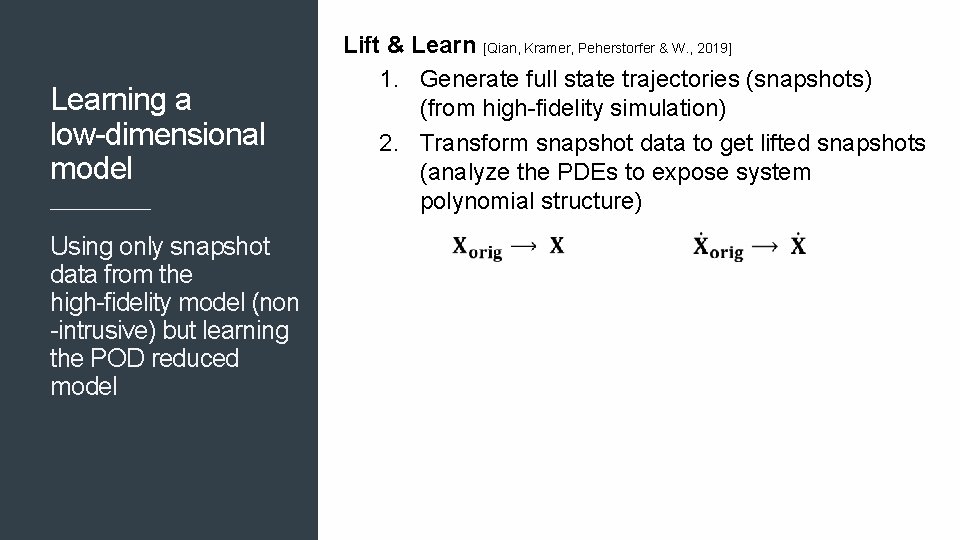
Learning a low-dimensional model Using only snapshot data from the high-fidelity model (non -intrusive) but learning the POD reduced model Lift & Learn [Qian, Kramer, Peherstorfer & W. , 2019] 1. Generate full state trajectories (snapshots) (from high-fidelity simulation) 2. Transform snapshot data to get lifted snapshots (analyze the PDEs to expose system polynomial structure)
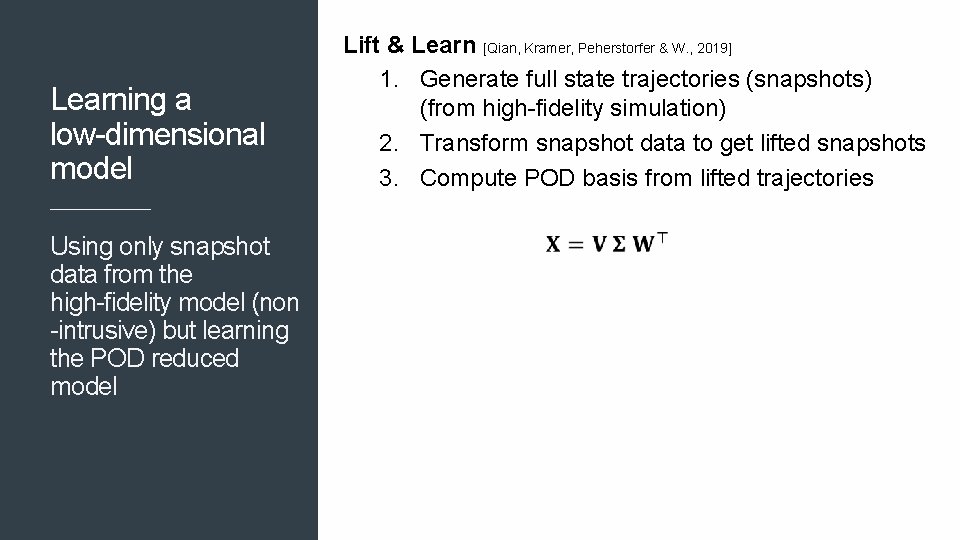
Learning a low-dimensional model Using only snapshot data from the high-fidelity model (non -intrusive) but learning the POD reduced model Lift & Learn [Qian, Kramer, Peherstorfer & W. , 2019] 1. Generate full state trajectories (snapshots) (from high-fidelity simulation) 2. Transform snapshot data to get lifted snapshots 3. Compute POD basis from lifted trajectories
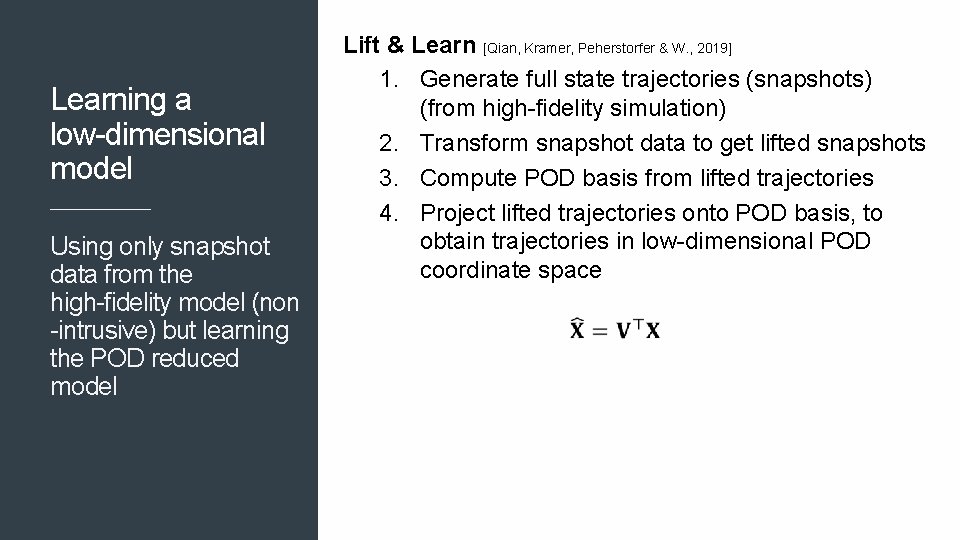
Learning a low-dimensional model Using only snapshot data from the high-fidelity model (non -intrusive) but learning the POD reduced model Lift & Learn [Qian, Kramer, Peherstorfer & W. , 2019] 1. Generate full state trajectories (snapshots) (from high-fidelity simulation) 2. Transform snapshot data to get lifted snapshots 3. Compute POD basis from lifted trajectories 4. Project lifted trajectories onto POD basis, to obtain trajectories in low-dimensional POD coordinate space
Learning a low-dimensional model Using only snapshot data from the high-fidelity model (non -intrusive) but learning the POD reduced model Lift & Learn [Qian, Kramer, Peherstorfer & W. , 2019] 1. Generate full state trajectories (snapshots) (from high-fidelity simulation) 2. Transform snapshot data to get lifted snapshots 3. Compute POD basis from lifted trajectories 4. Project lifted trajectories onto POD basis, to obtain trajectories in low-dimensional POD coordinate space 5. Solve least squares minimization problem to infer the low-dimensional model
Learning a low-dimensional model Using only snapshot data from the high-fidelity model (non -intrusive) but learning the POD reduced model Lift & Learn [Qian, Kramer, Peherstorfer & W. , 2019] 1. Generate full state trajectories (snapshots) (from high-fidelity simulation) 2. Transform snapshot data to get lifted snapshots 3. Compute POD basis from lifted trajectories 4. Project lifted trajectories onto POD basis, to obtain trajectories in low-dimensional POD coordinate space 5. Solve least squares minimization problem to infer the low-dimensional model Under certain conditions, recovers the intrusive POD reduced model → convenience of black-box learning + rigor of projection-based reduction + structure imposed by physics
1 Predictive Data Science 3 Application Example Rocket Engine Combustion 4 Conclusions & Outlook Lift & Learn reduced models for a complex Air Force combustion problem 2 Lift & Learn
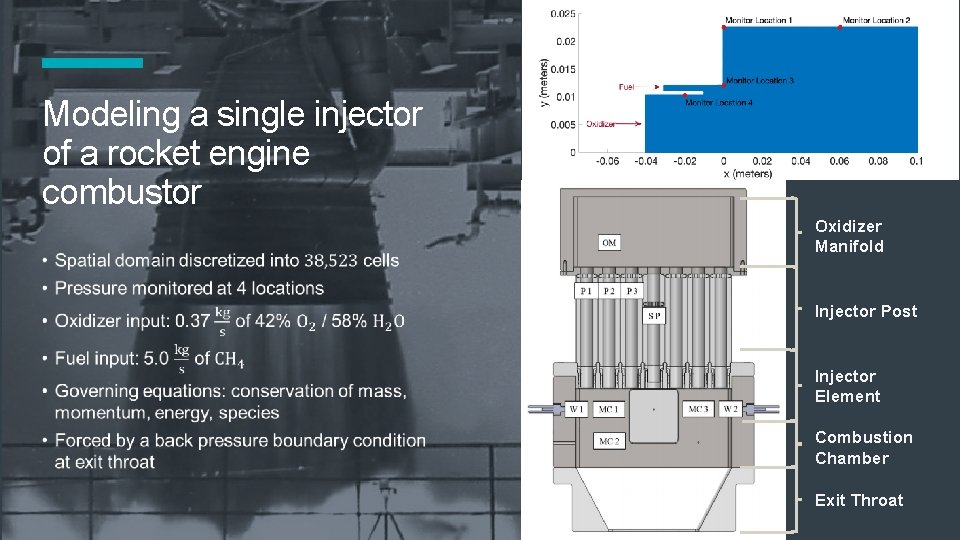
Modeling a single injector of a rocket engine combustor Oxidizer Manifold Injector Post Injector Element Combustion Chamber Exit Throat
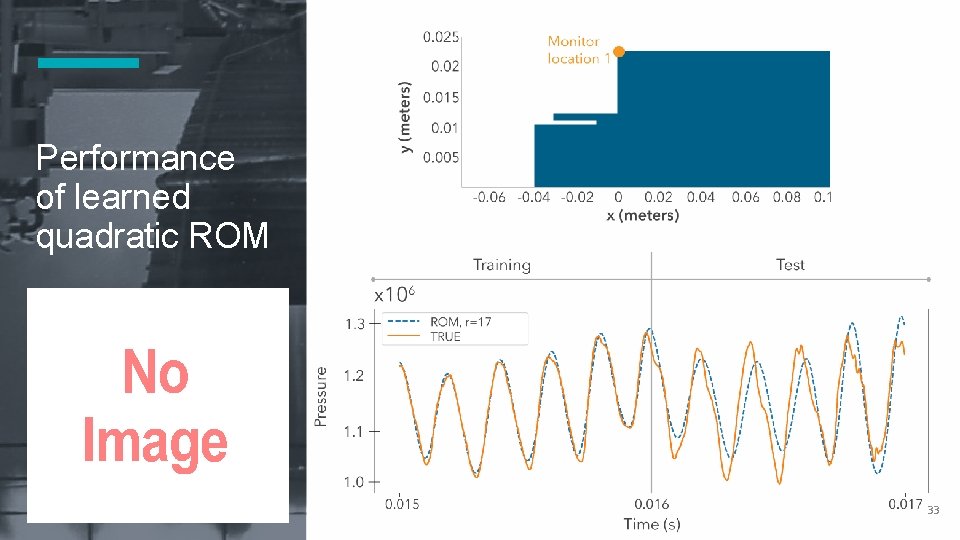
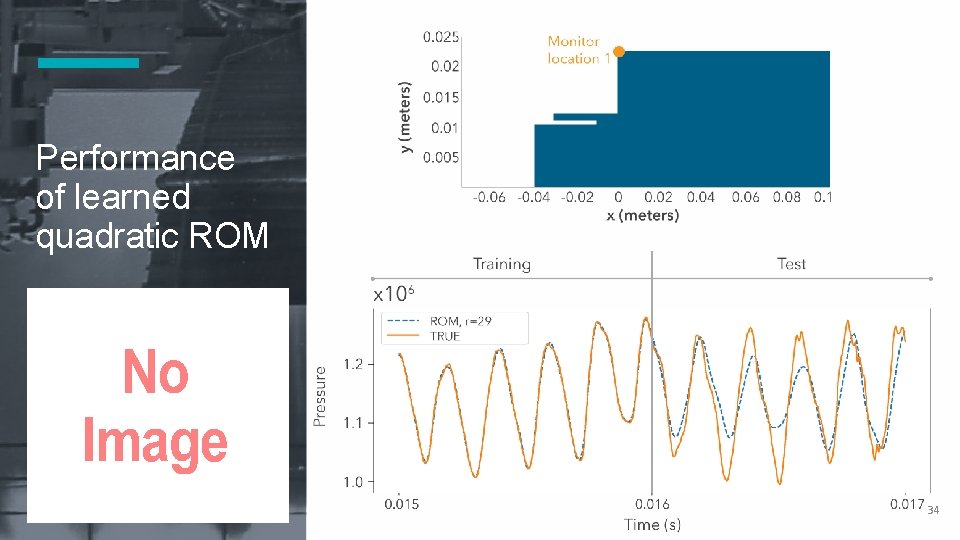
Modeling a single injector of a rocket engine combustor Test data Additional 1 ms of data at monitor locations (10, 000 timesteps)
Performance of learned quadratic ROM 33
Performance of learned quadratic ROM 34
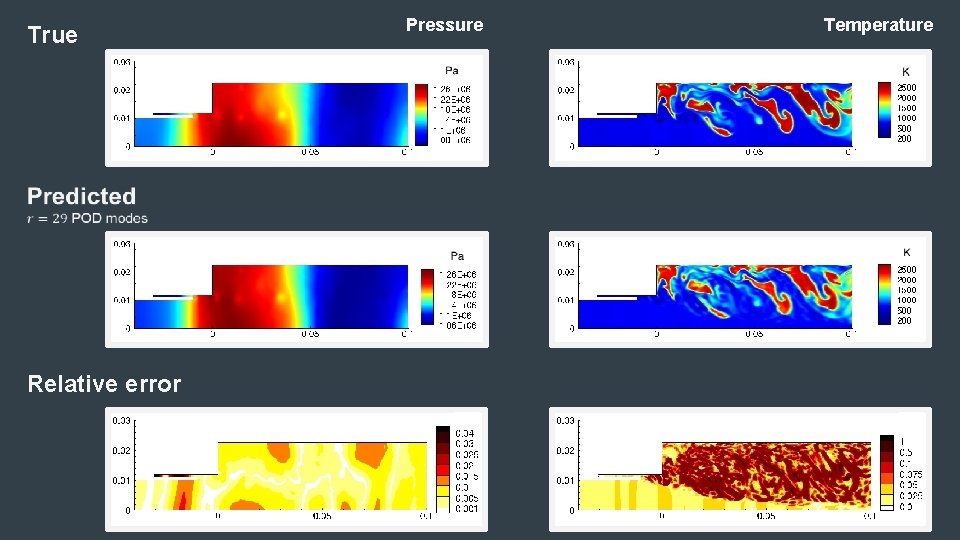
True Pressure Temperature Relative error 35
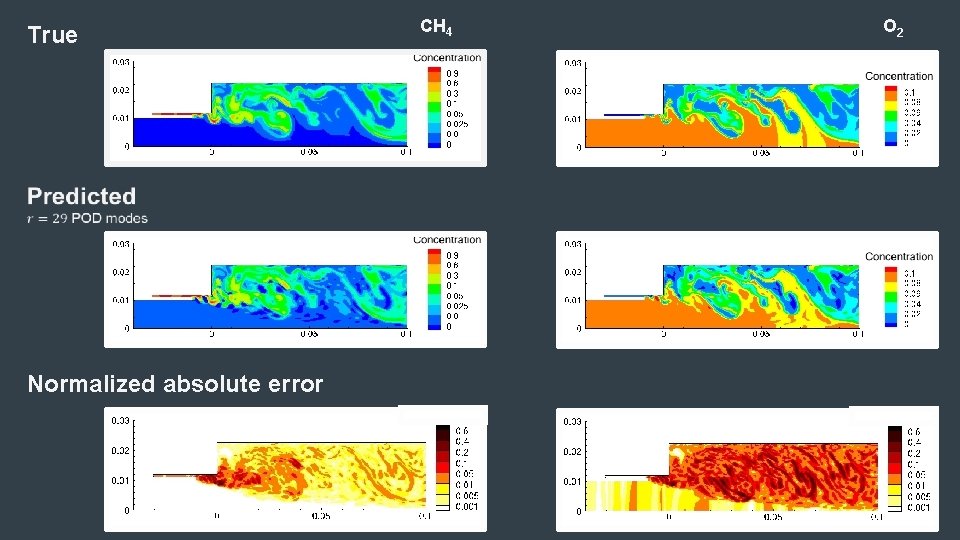
True CH 4 O 2 Normalized absolute error 36
1 Predictive Data Science 2 Concrete Example 3 Application Example 4 Conclusions & Outlook The future of Predictive Data Science
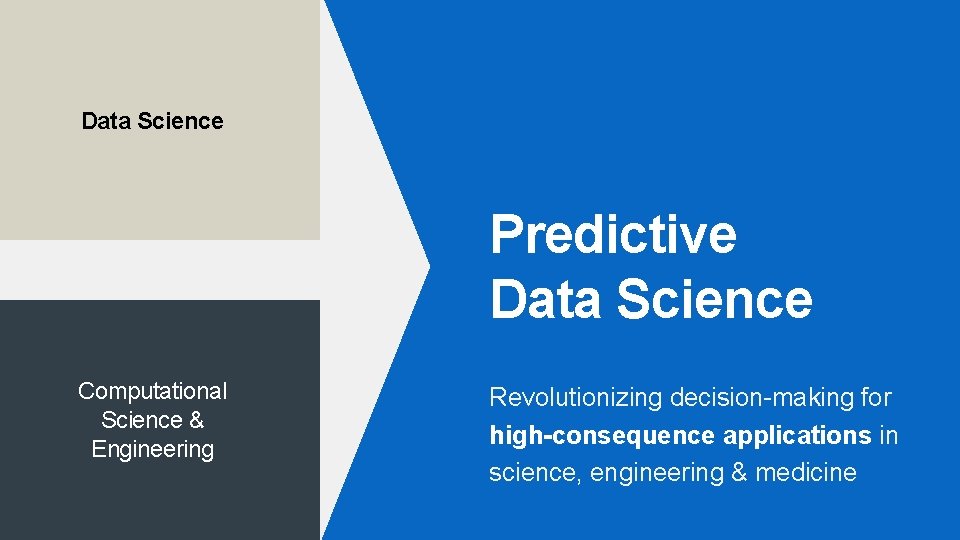
Data Science Predictive Data Science Computational Science & Engineering Revolutionizing decision-making for high-consequence applications in science, engineering & medicine
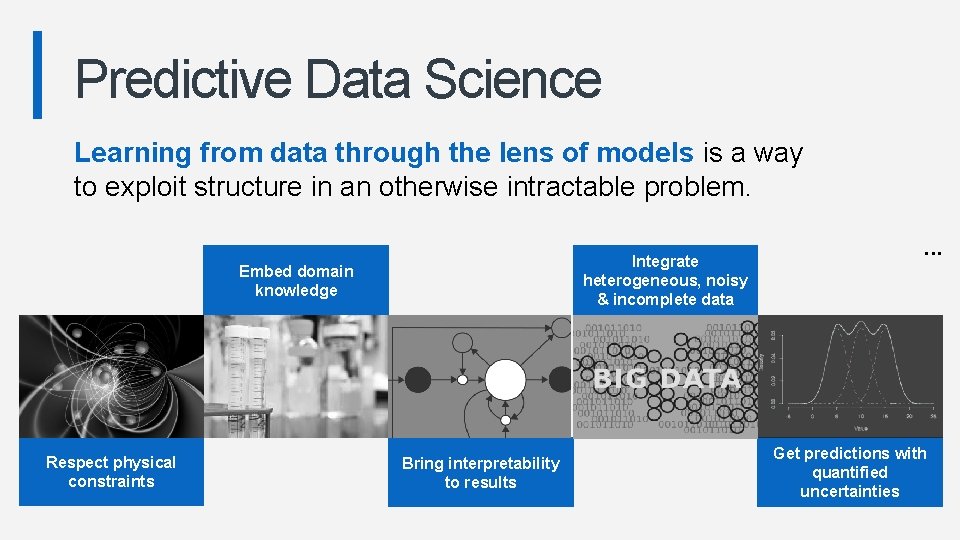
Predictive Data Science Learning from data through the lens of models is a way to exploit structure in an otherwise intractable problem. Integrate heterogeneous, noisy & incomplete data Embed domain knowledge Respect physical constraints Bring interpretability to results … Get predictions with quantified uncertainties
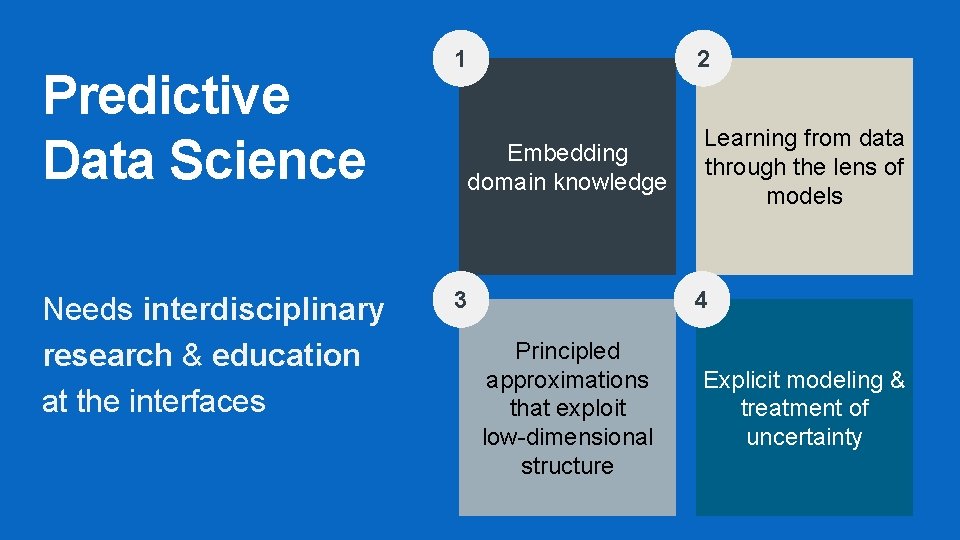
Predictive Data Science Needs interdisciplinary research & education at the interfaces 1 2 Embedding domain knowledge 3 Learning from data through the lens of models 4 Principled approximations that exploit low-dimensional structure Explicit modeling & treatment of uncertainty
Data-driven decisions building the mathematical foundations and computational methods to enable design of the next generation of engineered systems KIWI. ODEN. UTEXAS. EDU
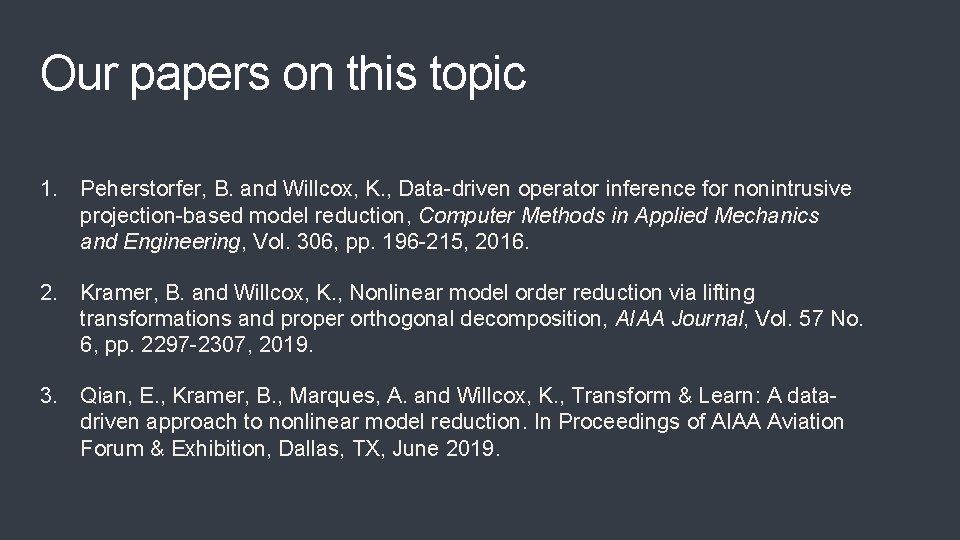
Our papers on this topic 1. Peherstorfer, B. and Willcox, K. , Data-driven operator inference for nonintrusive projection-based model reduction, Computer Methods in Applied Mechanics and Engineering, Vol. 306, pp. 196 -215, 2016. 2. Kramer, B. and Willcox, K. , Nonlinear model order reduction via lifting transformations and proper orthogonal decomposition, AIAA Journal, Vol. 57 No. 6, pp. 2297 -2307, 2019. 3. Qian, E. , Kramer, B. , Marques, A. and Willcox, K. , Transform & Learn: A datadriven approach to nonlinear model reduction. In Proceedings of AIAA Aviation Forum & Exhibition, Dallas, TX, June 2019.