
Prediction of Tight Turns In Protein Sequence G

- Slides: 36
Prediction of Tight Turns In Protein Sequence + G. P. S. Raghava, Ph. D. , F. N. A. Scientist and Head Bioinformatics Centre Institute of Microbial Technology, Sector-39 A, Chandigarh, India Email: raghava@imtech. res. in Web: http: //www. imtech. res. in/raghava/ Structure
Protein Structure Prediction • Experimental Techniques – X-ray Crystallography – NMR • Limitations of Current Experimental Techniques – Protein Data. Bank (PDB) -> 27000 protein structures – Swiss. Prot -> 100, 000 proteins – Non-Redudant (NR) -> 1, 000 proteins • Importance of Structure Prediction – Fill gap between known sequence and structures – Protein Engg. To alter function of a protein – Rational Drug Design
Techniques of Structure Prediction • Computer simulation based on energy calculation – Based on physio-chemical principles – Thermodynamic equilibrium with a minimum free energy – Global minimum free energy of protein surface • Knowledge Based approaches – Homology Based Approach – Threading Protein Sequence • Hierarchical Methods – Prediction of intermediate state (Secondary Structure) – Secondary to tertiary structure
Energy Minimization Techniques Energy Minimization based methods in their pure form, make no priori assumptions and attempt to locate global minma. • Static Minimization Methods – Classical many potential-potential can be construted – Assume that atoms in protein is in static form – Problems(large number of variables & minima and validity of potentials) • Dynamical Minimization Methods – Motions of atoms also considered – Monte Carlo simulation (stochastics in nature, time is not cosider) – Molecular Dynamics (time, quantum mechanical, classical equ. ) • Limitations – large number of degree of freedom, CPU power not adequate – Interaction potential is not good enough to model
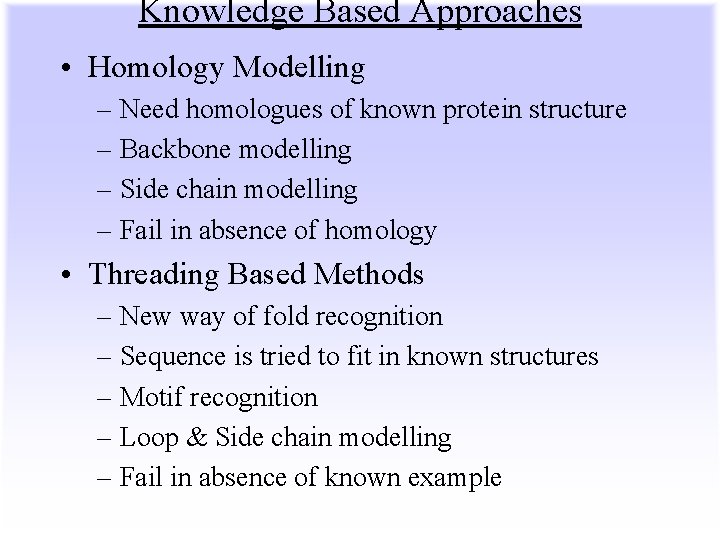
Knowledge Based Approaches • Homology Modelling – Need homologues of known protein structure – Backbone modelling – Side chain modelling – Fail in absence of homology • Threading Based Methods – New way of fold recognition – Sequence is tried to fit in known structures – Motif recognition – Loop & Side chain modelling – Fail in absence of known example
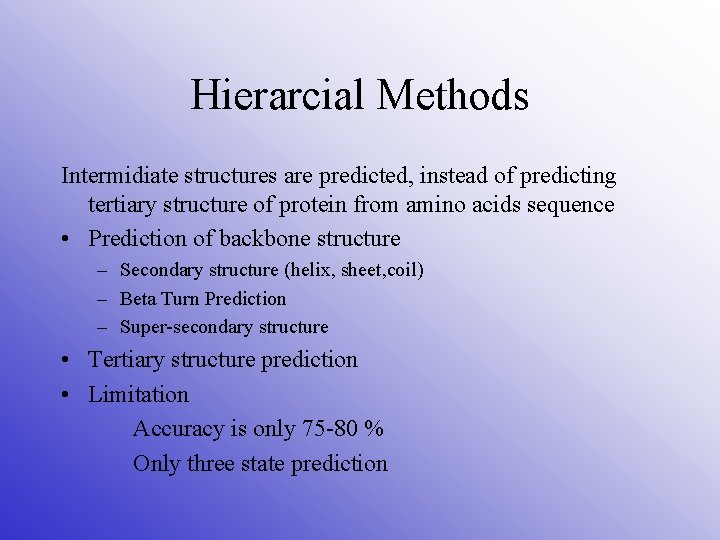
Hierarcial Methods Intermidiate structures are predicted, instead of predicting tertiary structure of protein from amino acids sequence • Prediction of backbone structure – Secondary structure (helix, sheet, coil) – Beta Turn Prediction – Super-secondary structure • Tertiary structure prediction • Limitation Accuracy is only 75 -80 % Only three state prediction
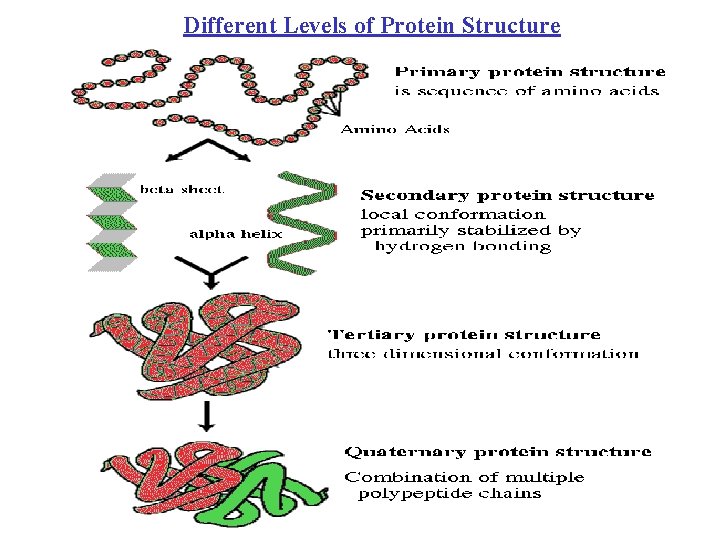
Different Levels of Protein Structure
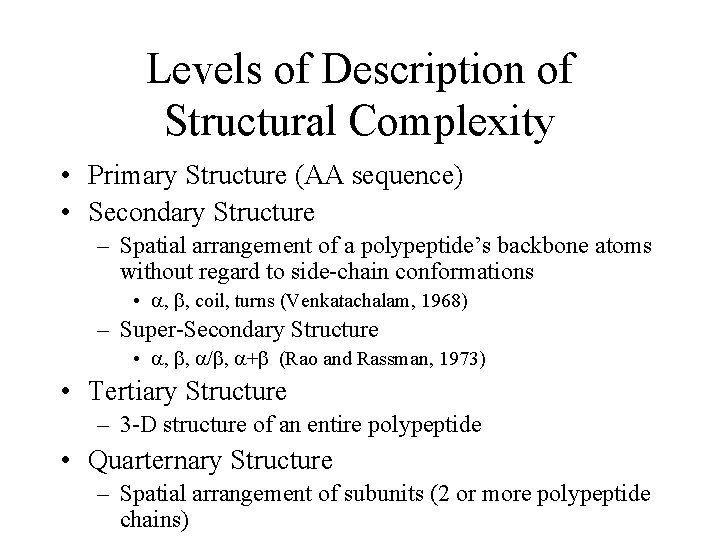
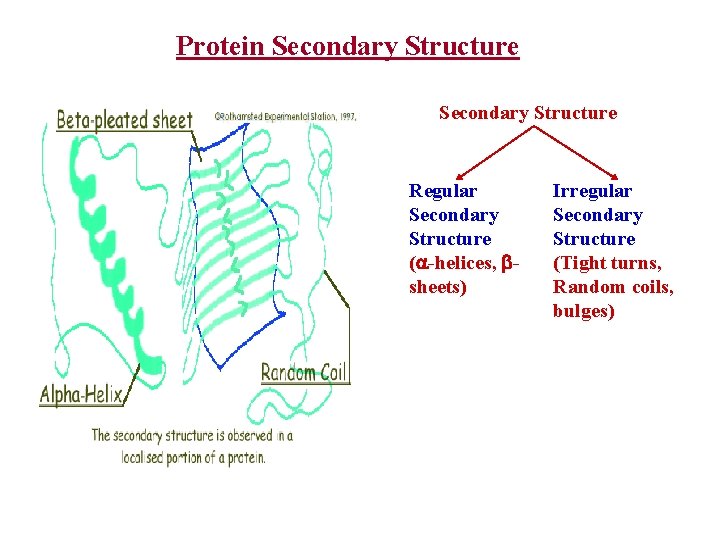
Levels of Description of Structural Complexity • Primary Structure (AA sequence) • Secondary Structure – Spatial arrangement of a polypeptide’s backbone atoms without regard to side-chain conformations • , , coil, turns (Venkatachalam, 1968) – Super-Secondary Structure • , , / , + (Rao and Rassman, 1973) • Tertiary Structure – 3 -D structure of an entire polypeptide • Quarternary Structure – Spatial arrangement of subunits (2 or more polypeptide chains)
Protein Secondary Structure Regular Secondary Structure ( -helices, sheets) Irregular Secondary Structure (Tight turns, Random coils, bulges)
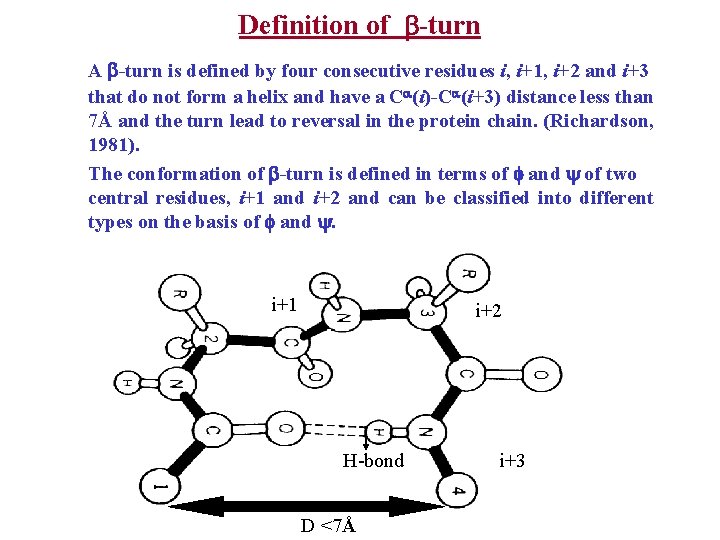
Definition of -turn A -turn is defined by four consecutive residues i, i+1, i+2 and i+3 that do not form a helix and have a C (i)-C (i+3) distance less than 7Å and the turn lead to reversal in the protein chain. (Richardson, 1981). The conformation of -turn is defined in terms of and of two central residues, i+1 and i+2 and can be classified into different types on the basis of and . i+1 i i+2 H-bond D <7Å i+3
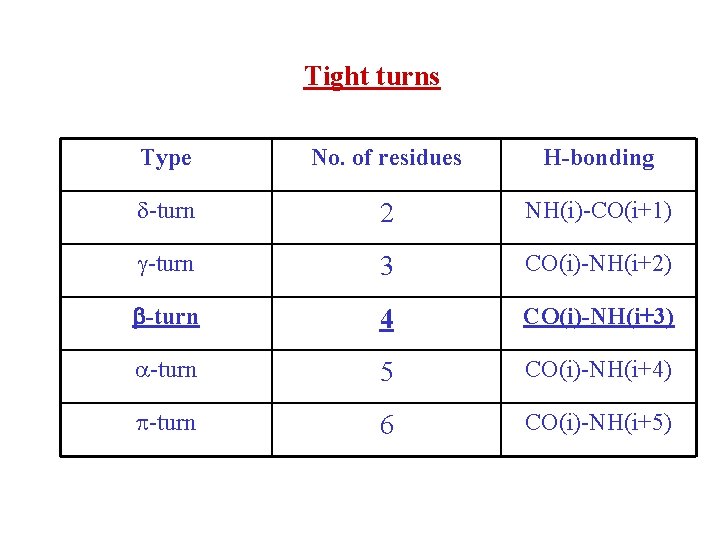
Tight turns Type No. of residues H-bonding -turn 2 NH(i)-CO(i+1) -turn 3 CO(i)-NH(i+2) -turn 4 CO(i)-NH(i+3) -turn 5 CO(i)-NH(i+4) -turn 6 CO(i)-NH(i+5)
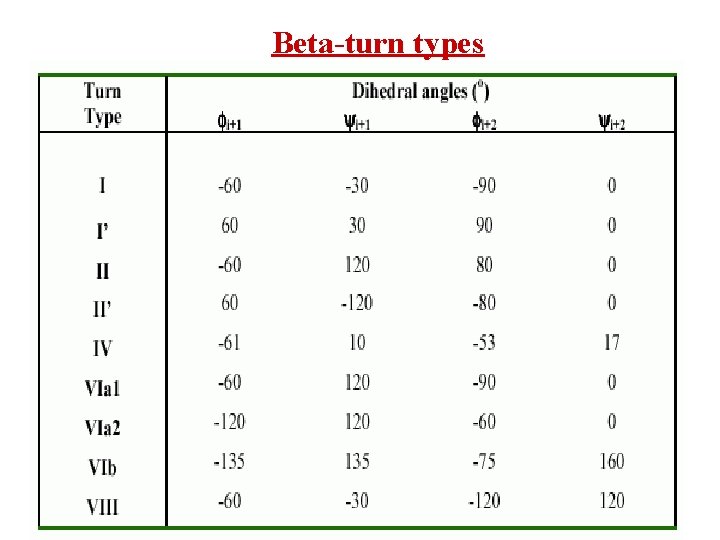
Beta-turn types
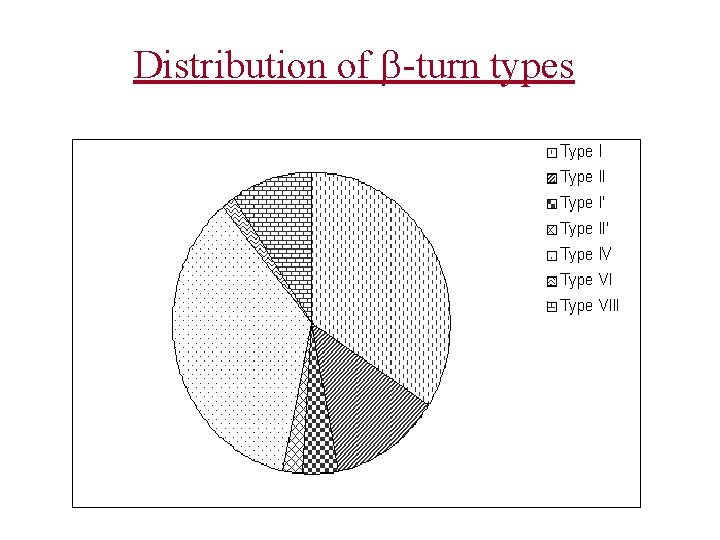
Distribution of -turn types
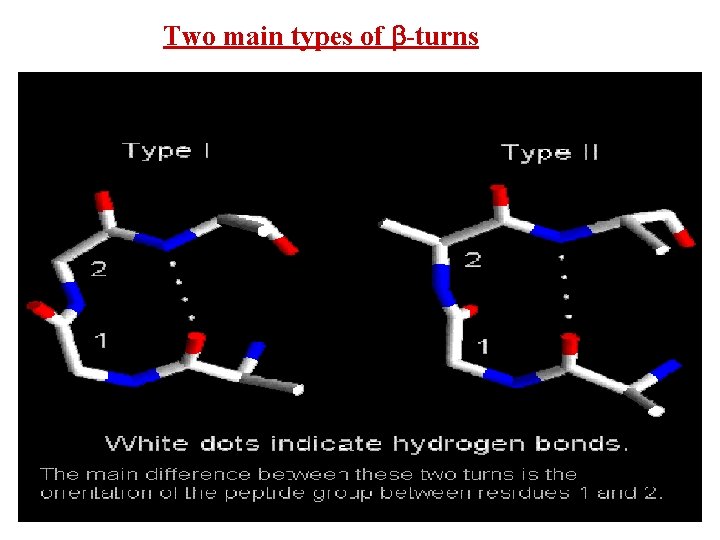
Two main types of -turns
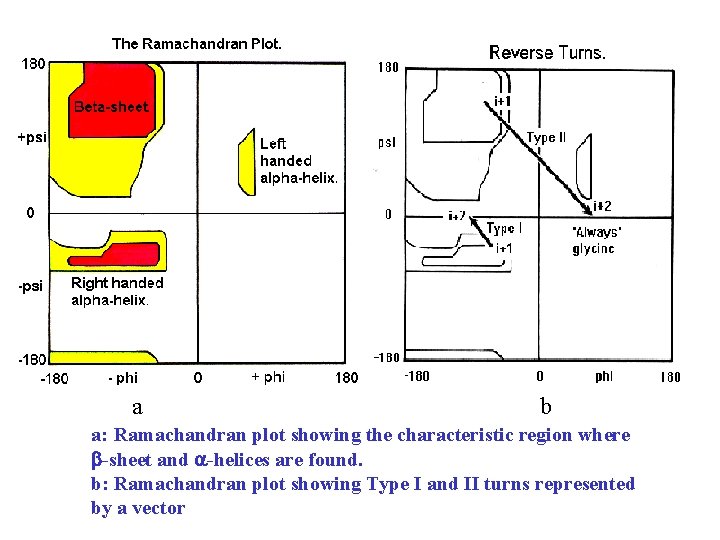
a b a: Ramachandran plot showing the characteristic region where -sheet and -helices are found. b: Ramachandran plot showing Type I and II turns represented by a vector
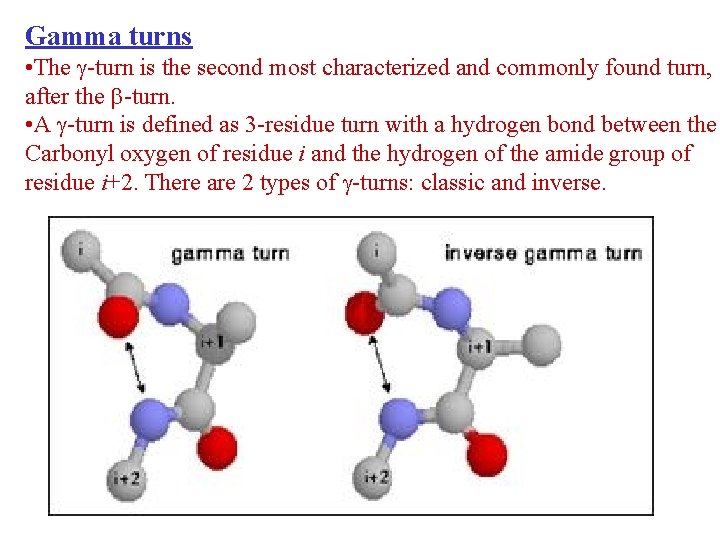
Gamma turns • The -turn is the second most characterized and commonly found turn, after the -turn. • A -turn is defined as 3 -residue turn with a hydrogen bond between the Carbonyl oxygen of residue i and the hydrogen of the amide group of residue i+2. There are 2 types of -turns: classic and inverse.
Other rare tight turns • -turn: The smallest is a -turn. It involves only two amino acid residues. The intra-turn hydrogen bond for a -turn is formed between the backbone NH(i) and the backbone CO(i+1). • -turn: An -turn involves five amino acid residues where the distance between C (i) and C (i+4) is less than 7Å and the pentapeptide chain is not a helical conformation. • -turn: The largest tight turn is a -turn, which involves six amino acid residues.
Prediction of tight turns • • • Prediction of -turns Prediction of -turn types Prediction of -turns Use the tight turns information, mainly -turns in tertiary structure prediction of bioactive peptides
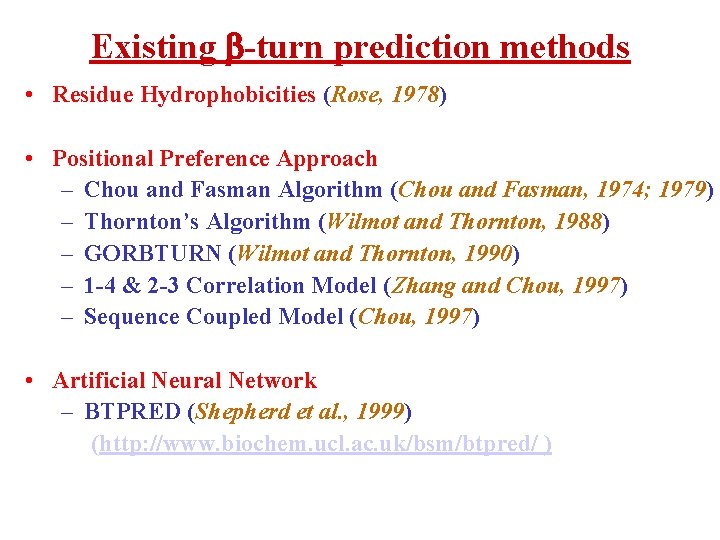
Existing -turn prediction methods • Residue Hydrophobicities (Rose, 1978) • Positional Preference Approach – Chou and Fasman Algorithm (Chou and Fasman, 1974; 1979) – Thornton’s Algorithm (Wilmot and Thornton, 1988) – GORBTURN (Wilmot and Thornton, 1990) – 1 -4 & 2 -3 Correlation Model (Zhang and Chou, 1997) – Sequence Coupled Model (Chou, 1997) • Artificial Neural Network – BTPRED (Shepherd et al. , 1999) (http: //www. biochem. ucl. ac. uk/bsm/btpred/ )
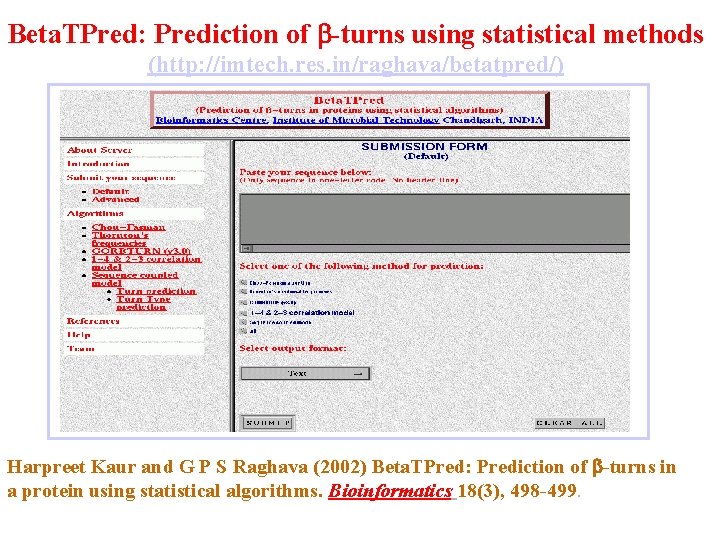
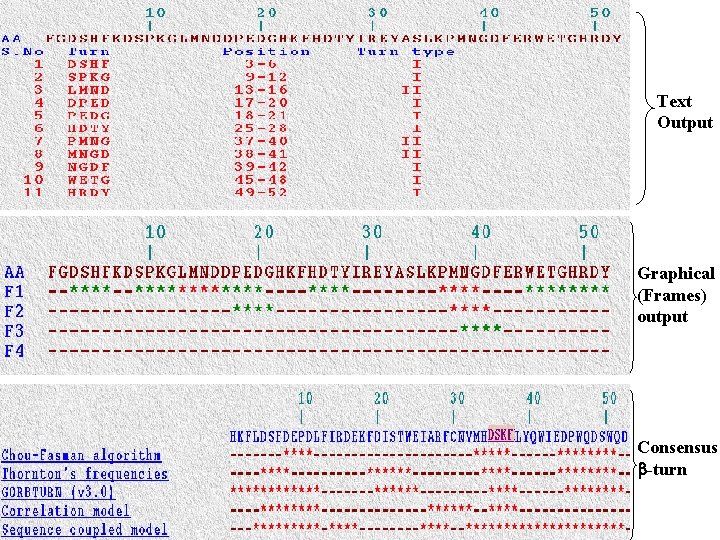
Beta. TPred: Prediction of -turns using statistical methods (http: //imtech. res. in/raghava/betatpred/) Harpreet Kaur and G P S Raghava (2002) Beta. TPred: Prediction of -turns in a protein using statistical algorithms. Bioinformatics 18(3), 498 -499.
Text Output Graphical (Frames) output Consensus -turn
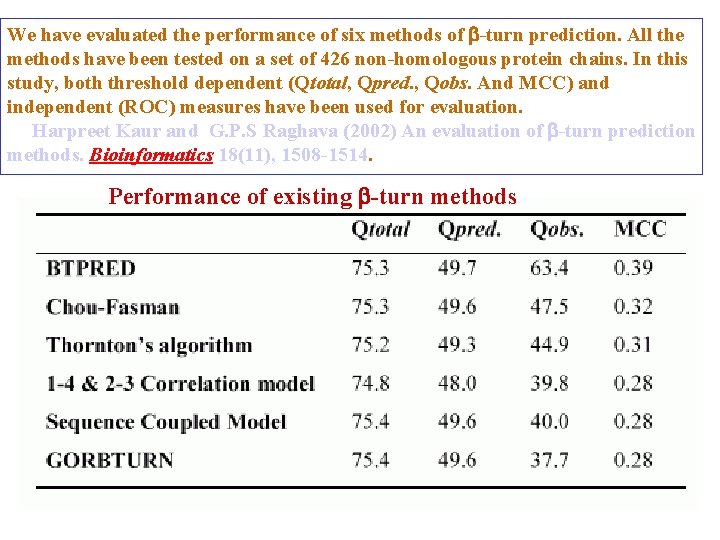
We have evaluated the performance of six methods of -turn prediction. All the methods have been tested on a set of 426 non-homologous protein chains. In this study, both threshold dependent (Qtotal, Qpred. , Qobs. And MCC) and independent (ROC) measures have been used for evaluation. Harpreet Kaur and G. P. S Raghava (2002) An evaluation of -turn prediction methods. Bioinformatics 18(11), 1508 -1514. Performance of existing -turn methods
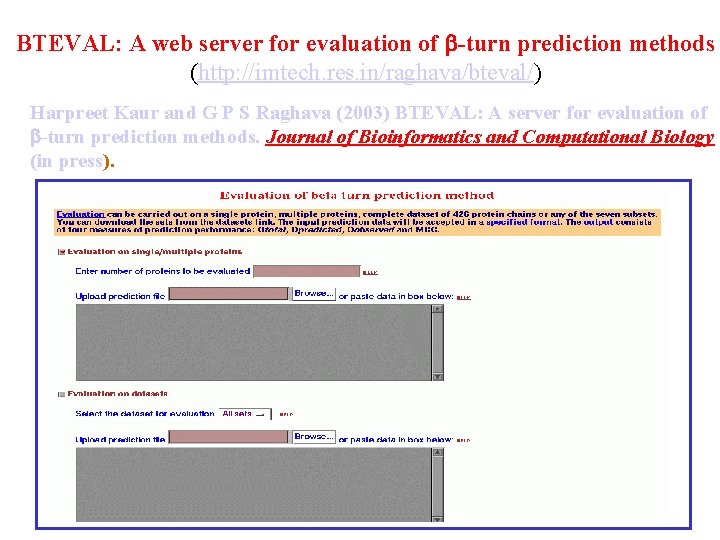
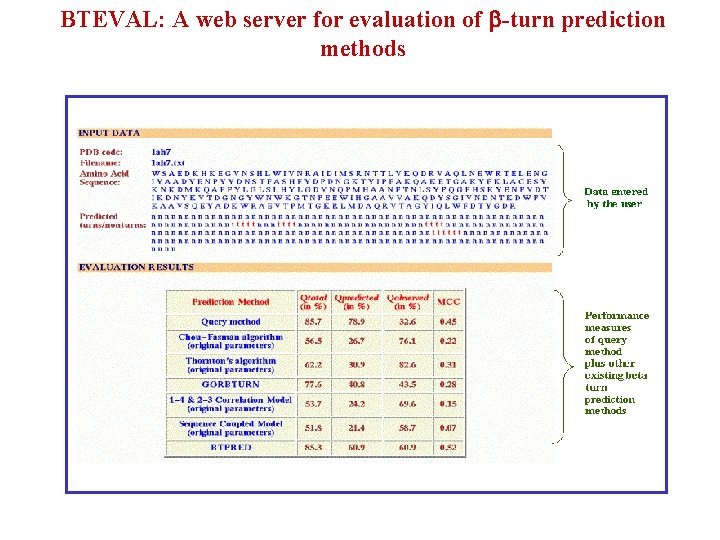
BTEVAL: A web server for evaluation of -turn prediction methods (http: //imtech. res. in/raghava/bteval/) Harpreet Kaur and G P S Raghava (2003) BTEVAL: A server for evaluation of -turn prediction methods. Journal of Bioinformatics and Computational Biology (in press).
BTEVAL: A web server for evaluation of -turn prediction methods
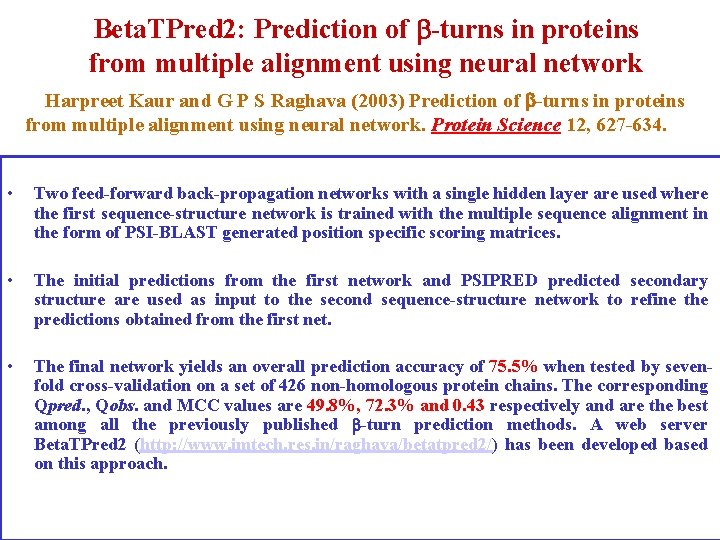
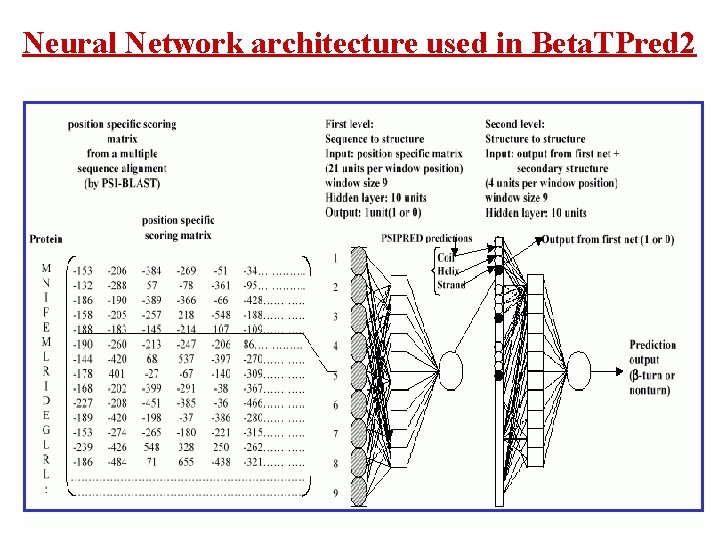
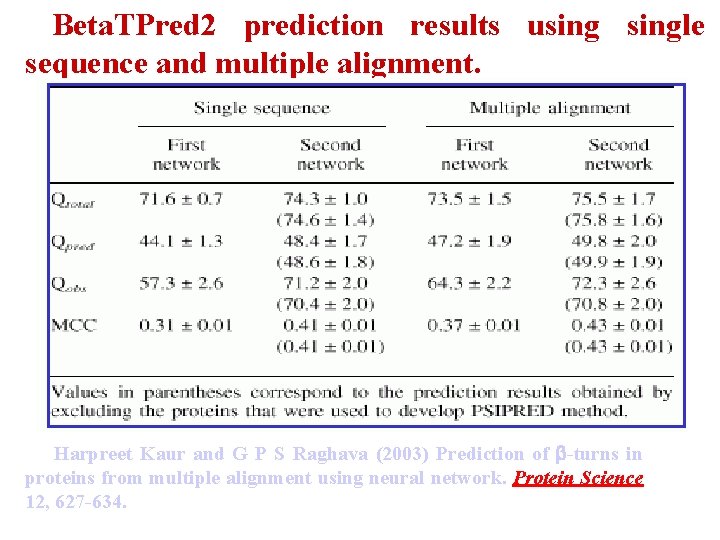
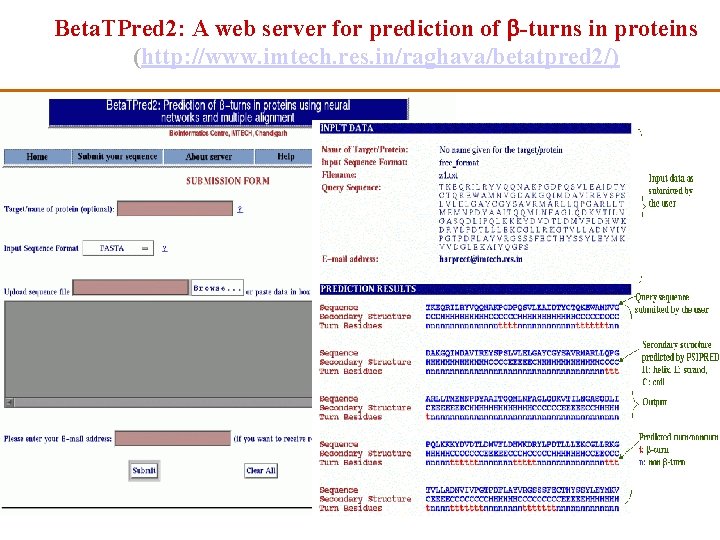
Beta. TPred 2: Prediction of -turns in proteins from multiple alignment using neural network Harpreet Kaur and G P S Raghava (2003) Prediction of -turns in proteins from multiple alignment using neural network. Protein Science 12, 627 -634. • Two feed-forward back-propagation networks with a single hidden layer are used where the first sequence-structure network is trained with the multiple sequence alignment in the form of PSI-BLAST generated position specific scoring matrices. • The initial predictions from the first network and PSIPRED predicted secondary structure are used as input to the second sequence-structure network to refine the predictions obtained from the first net. • The final network yields an overall prediction accuracy of 75. 5% when tested by sevenfold cross-validation on a set of 426 non-homologous protein chains. The corresponding Qpred. , Qobs. and MCC values are 49. 8%, 72. 3% and 0. 43 respectively and are the best among all the previously published -turn prediction methods. A web server Beta. TPred 2 (http: //www. imtech. res. in/raghava/betatpred 2/) has been developed based on this approach.
Neural Network architecture used in Beta. TPred 2
Beta. TPred 2 prediction results usingle sequence and multiple alignment. Harpreet Kaur and G P S Raghava (2003) Prediction of -turns in proteins from multiple alignment using neural network. Protein Science 12, 627 -634.
Beta. TPred 2: A web server for prediction of -turns in proteins (http: //www. imtech. res. in/raghava/betatpred 2/)
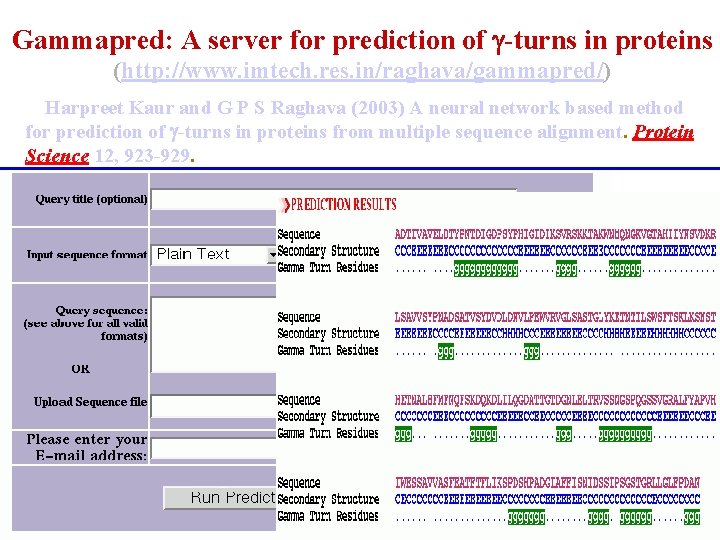
Gammapred: A server for prediction of -turns in proteins (http: //www. imtech. res. in/raghava/gammapred/) Harpreet Kaur and G P S Raghava (2003) A neural network based method for prediction of -turns in proteins from multiple sequence alignment. Protein Science 12, 923 -929.
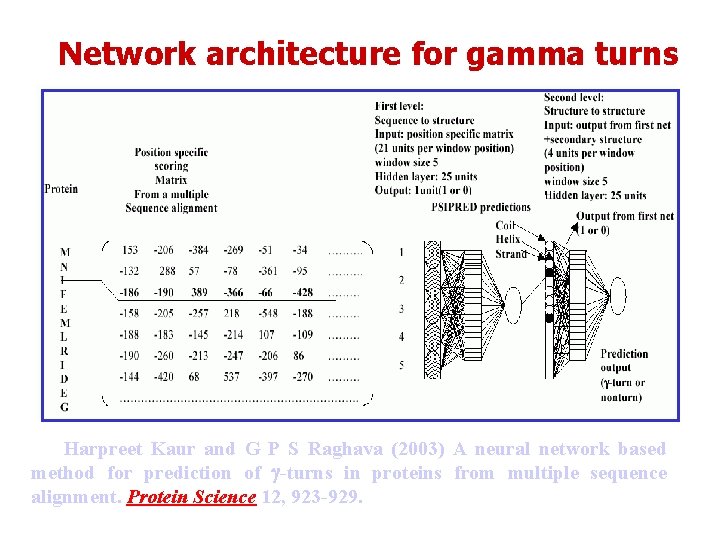
Network architecture for gamma turns Harpreet Kaur and G P S Raghava (2003) A neural network based method for prediction of -turns in proteins from multiple sequence alignment. Protein Science 12, 923 -929.
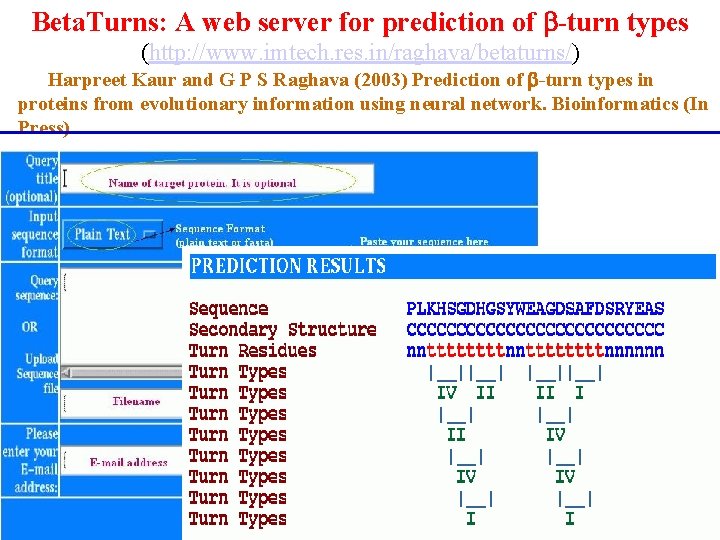
Beta. Turns: A web server for prediction of -turn types (http: //www. imtech. res. in/raghava/betaturns/) Harpreet Kaur and G P S Raghava (2003) Prediction of -turn types in proteins from evolutionary information using neural network. Bioinformatics (In Press)
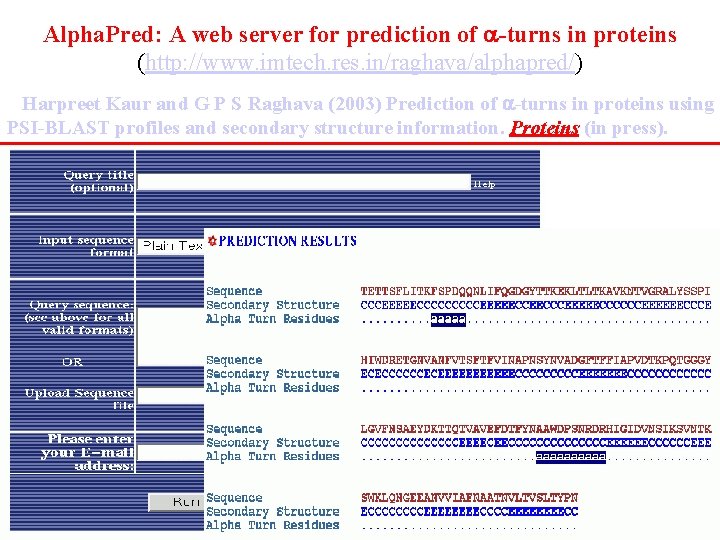
Alpha. Pred: A web server for prediction of -turns in proteins (http: //www. imtech. res. in/raghava/alphapred/) Harpreet Kaur and G P S Raghava (2003) Prediction of -turns in proteins using PSI-BLAST profiles and secondary structure information. Proteins (in press).
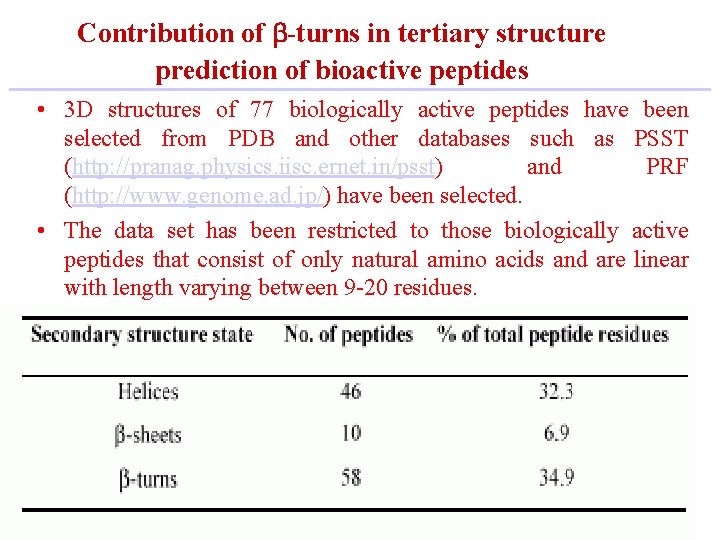
Contribution of -turns in tertiary structure prediction of bioactive peptides • 3 D structures of 77 biologically active peptides have been selected from PDB and other databases such as PSST (http: //pranag. physics. iisc. ernet. in/psst) and PRF (http: //www. genome. ad. jp/) have been selected. • The data set has been restricted to those biologically active peptides that consist of only natural amino acids and are linear with length varying between 9 -20 residues.
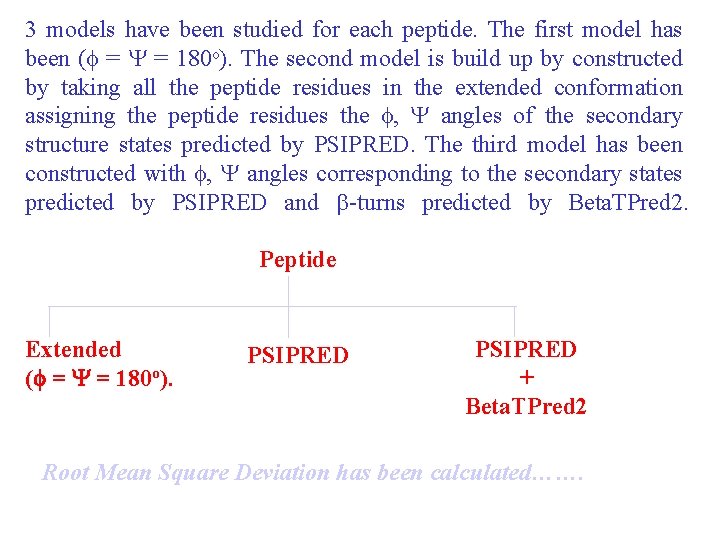
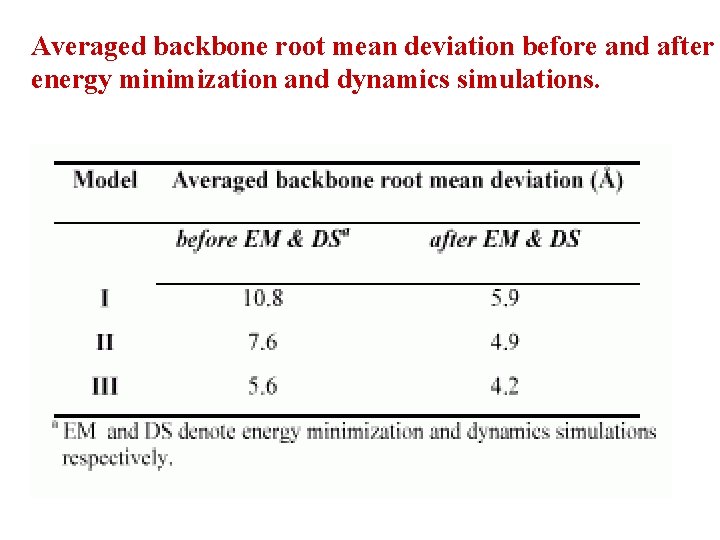
3 models have been studied for each peptide. The first model has been ( = = 180 o). The second model is build up by constructed by taking all the peptide residues in the extended conformation assigning the peptide residues the , angles of the secondary structure states predicted by PSIPRED. The third model has been constructed with , angles corresponding to the secondary states predicted by PSIPRED and -turns predicted by Beta. TPred 2. Peptide Extended ( = = 180 o). PSIPRED + Beta. TPred 2 Root Mean Square Deviation has been calculated…….
Averaged backbone root mean deviation before and after energy minimization and dynamics simulations.