
Prediction of the JCB Behavior of Bi2212 Wires
Prediction of the JC(B) Behavior of Bi-2212 Wires at High Field Authors: Michael D. Brown, J. Jiang, C. Tarantini, D. Abraimov, G. Bradford, J. Jarozynski, E. E. Hellstrom, D. C. Larbalestier Jan. 17, 2019 US‐MDP meeting ‐ M. D. Brown 1
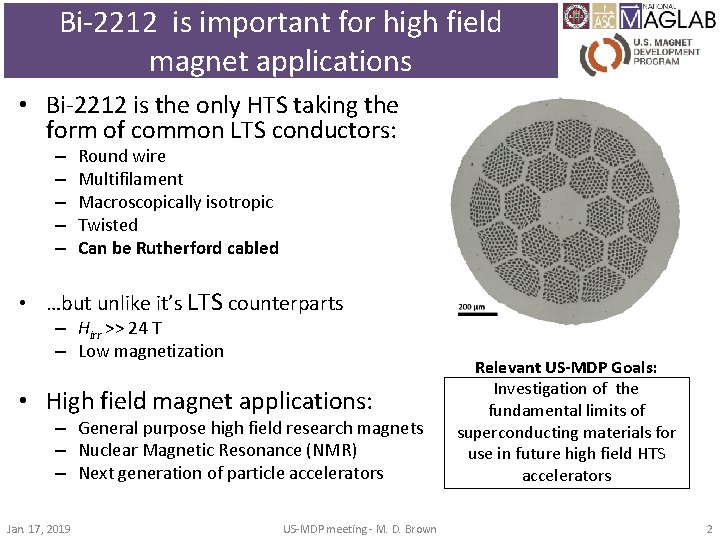
Bi‐ 2212 is important for high field magnet applications • Bi‐ 2212 is the only HTS taking the form of common LTS conductors: – – – Round wire Multifilament Macroscopically isotropic Twisted Can be Rutherford cabled • …but unlike it’s LTS counterparts – Hirr >> 24 T – Low magnetization • High field magnet applications: – General purpose high field research magnets – Nuclear Magnetic Resonance (NMR) – Next generation of particle accelerators Jan. 17, 2019 US‐MDP meeting ‐ M. D. Brown Relevant US-MDP Goals: Investigation of the fundamental limits of superconducting materials for use in future high field HTS accelerators 2
What is causing such large JC variations over the last decade? Why? ‐ We’ve had 9 years of development by DOE‐HEP ‐ a variety of wires with a wide range of JC(B) ‐ We believe JC (B) differences are due to connectivity ‐ Bi‐ 2212 is now ready for applications in the 20 T – 30 T range. ‐ We need up-to-date info on JC(B) for Bi-2212 How? ‐ Taking JC(B) measurements up to 31 T ‐ fitting to functional forms ‐ VSM measurements ranging from 4. 2 to 20 K. ‐ To probe vortex pinning differences between wire types Jan. 17, 2019 US‐MDP meeting ‐ M. D. Brown 3

The intrinsic properties of Bi‐ 2212 remains unchanged. • Jan. 17, 2019 US‐MDP meeting ‐ M. D. Brown 4
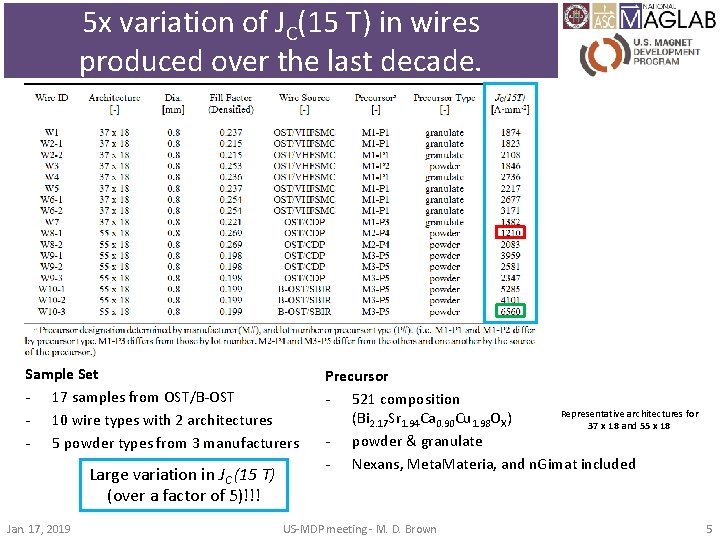
5 x variation of JC(15 T) in wires produced over the last decade. Sample Set ‐ 17 samples from OST/B‐OST ‐ 10 wire types with 2 architectures ‐ 5 powder types from 3 manufacturers Large variation in JC (15 T) (over a factor of 5)!!! Jan. 17, 2019 Precursor ‐ 521 composition Representative architectures for (Bi 2. 17 Sr 1. 94 Ca 0. 90 Cu 1. 98 OX) 37 x 18 and 55 x 18 ‐ powder & granulate ‐ Nexans, Meta. Materia, and n. Gimat included US‐MDP meeting ‐ M. D. Brown 5
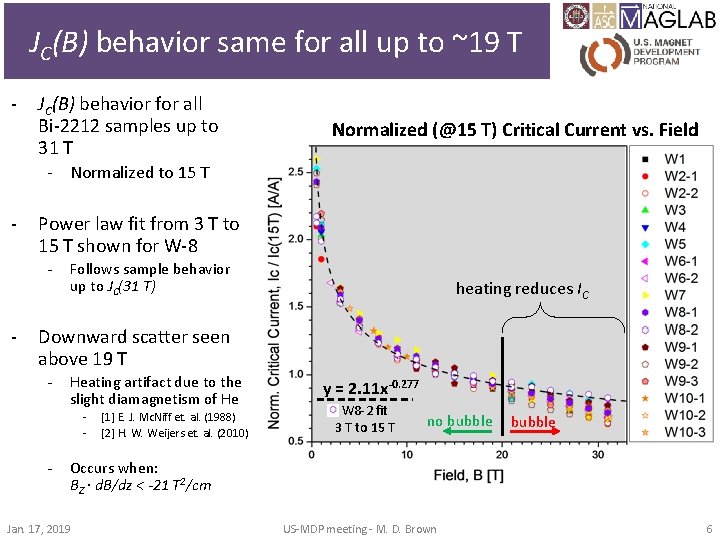
JC(B) behavior same for all up to ~19 T ‐ JC(B) behavior for all Bi‐ 2212 samples up to 31 T Normalized (@15 T) Critical Current vs. Field ‐ Normalized to 15 T ‐ Power law fit from 3 T to 15 T shown for W‐ 8 ‐ ‐ Follows sample behavior up to JC(31 T) heating reduces IC Downward scatter seen above 19 T ‐ Heating artifact due to the slight diamagnetism of He ‐ ‐ ‐ [1] E. J. Mc. Niff et. al. (1988) [2] H. W. Weijers et. al. (2010) y = 2. 11 x-0. 277 W 8‐ 2 fit 3 T to 15 T no bubble Occurs when: BZ ∙ d. B/dz < -21 T 2/cm Jan. 17, 2019 US‐MDP meeting ‐ M. D. Brown 6
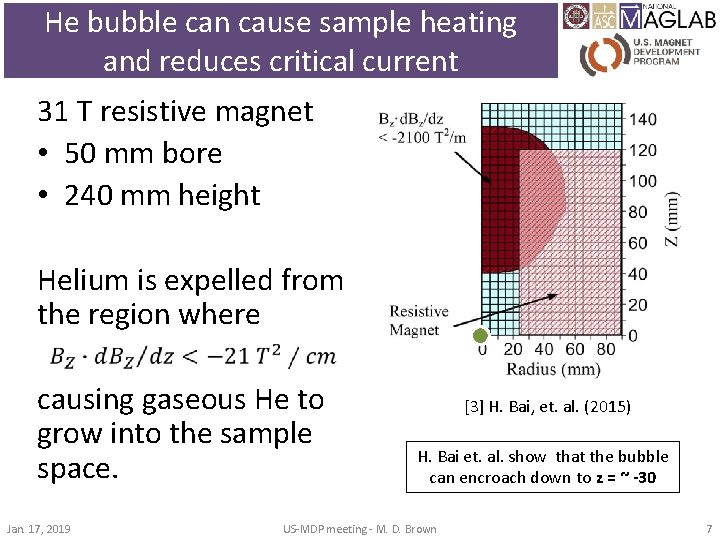
He bubble can cause sample heating and reduces critical current 31 T resistive magnet • 50 mm bore • 240 mm height Helium is expelled from the region where causing gaseous He to grow into the sample space. Jan. 17, 2019 [3] H. Bai, et. al. (2015) H. Bai et. al. show that the bubble can encroach down to z = ~ -30 US‐MDP meeting ‐ M. D. Brown 7
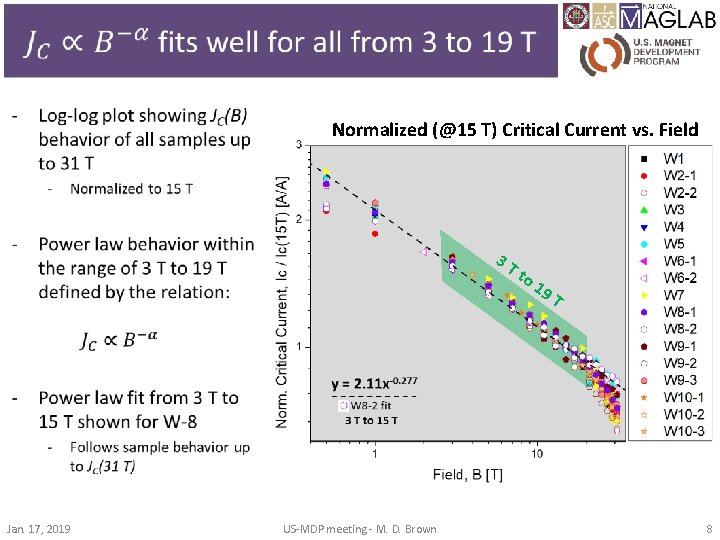
Normalized (@15 T) Critical Current vs. Field 3 T Jan. 17, 2019 US‐MDP meeting ‐ M. D. Brown to 19 T 8
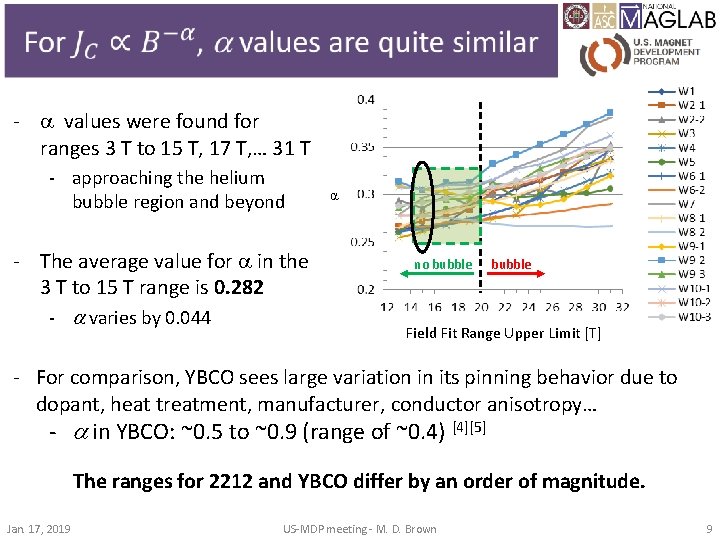
‐ values were found for ranges 3 T to 15 T, 17 T, … 31 T ‐ approaching the helium bubble region and beyond ‐ The average value for in the 3 T to 15 T range is 0. 282 ‐ varies by 0. 044 α no bubble Field Fit Range Upper Limit [T] ‐ For comparison, YBCO sees large variation in its pinning behavior due to dopant, heat treatment, manufacturer, conductor anisotropy… ‐ in YBCO: ~0. 5 to ~0. 9 (range of ~0. 4) [4][5] The ranges for 2212 and YBCO differ by an order of magnitude. Jan. 17, 2019 US‐MDP meeting ‐ M. D. Brown 9
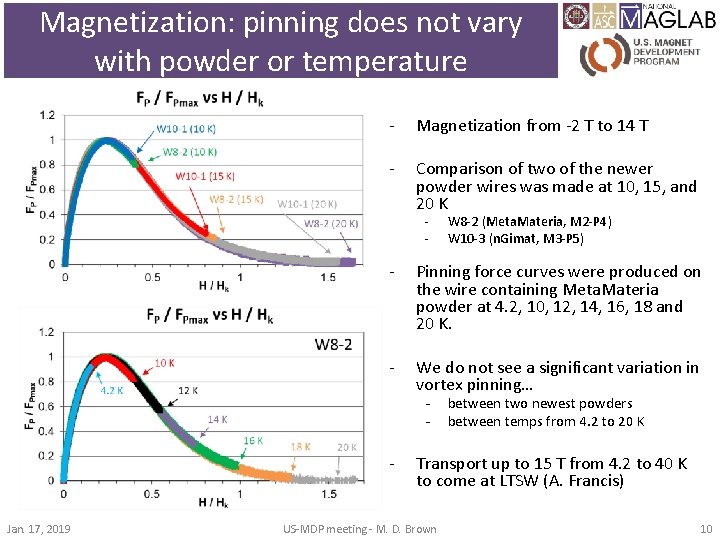
Magnetization: pinning does not vary with powder or temperature ‐ Magnetization from ‐ 2 T to 14 T ‐ Comparison of two of the newer powder wires was made at 10, 15, and 20 K ‐ ‐ ‐ Pinning force curves were produced on the wire containing Meta. Materia powder at 4. 2, 10, 12, 14, 16, 18 and 20 K. ‐ We do not see a significant variation in vortex pinning… ‐ ‐ ‐ Jan. 17, 2019 W 8‐ 2 (Meta. Materia, M 2‐P 4) W 10‐ 3 (n. Gimat, M 3‐P 5) between two newest powders between temps from 4. 2 to 20 K Transport up to 15 T from 4. 2 to 40 K to come at LTSW (A. Francis) US‐MDP meeting ‐ M. D. Brown 10
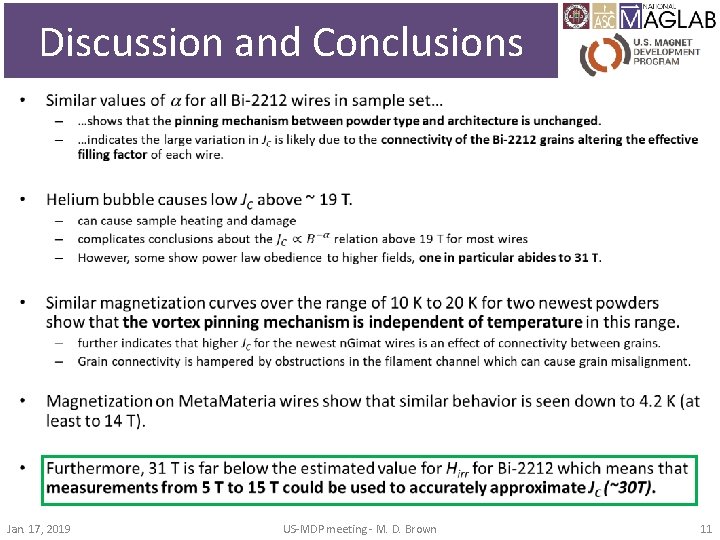
Discussion and Conclusions • Jan. 17, 2019 US‐MDP meeting ‐ M. D. Brown 11
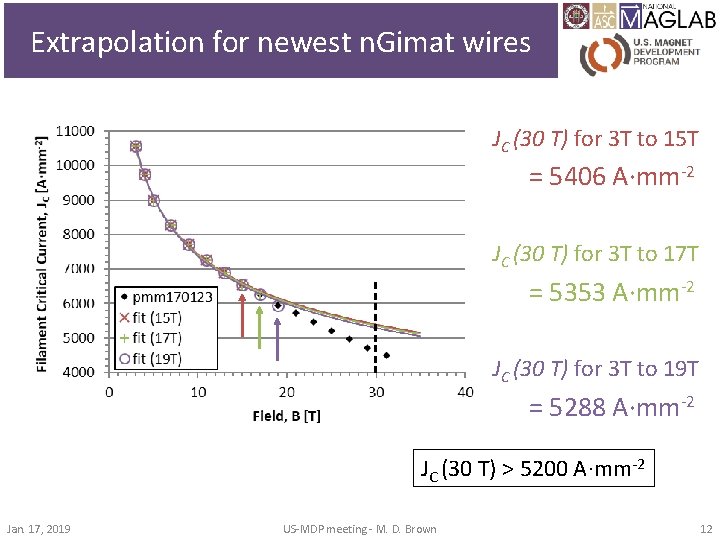
Extrapolation for newest n. Gimat wires JC (30 T) for 3 T to 15 T = 5406 A∙mm‐ 2 JC (30 T) for 3 T to 17 T = 5353 A∙mm‐ 2 JC (30 T) for 3 T to 19 T = 5288 A∙mm‐ 2 JC (30 T) > 5200 A∙mm‐ 2 Jan. 17, 2019 US‐MDP meeting ‐ M. D. Brown 12
![References [1] E. J. Mc. Niff, B. L. Brandt, S. Foner, L. G. Rubin,](http://slidetodoc.com/presentation_image_h2/014986ffc3159e3b5d3099e445f414b8/image-13.jpg "References [1] E. J. Mc. Niff, B. L. Brandt, S. Foner, L. G. Rubin,")
References [1] E. J. Mc. Niff, B. L. Brandt, S. Foner, L. G. Rubin, and R. J. Weggel, “Temperature anomalies observed in liquid 4 He columns in magnetic fields with field–field‐gradient products >21 T 2/cm, ” Review of Scientific Instruments, vol. 59, no. 11, pp. 2474– 2476, Nov. 1988. [2] H. W. Weijers et al. , “High Field Magnets With HTS Conductors, ” IEEE Transactions on Applied Superconductivity, vol. 20, no. 3, pp. 576– 582, Jun. 2010. [3] H. Bai et al. , “Impact of Trapped Helium Gas Bubble in Liquid Helium on the Cooling in High Magnetic Field, ” IEEE Transactions on Applied Superconductivity, vol. 25, no. 3, pp. 1– 4, Jun. 2015. [4] V. Braccini et al. , “Properties of recent IBAD–MOCVD coated conductors relevant to their high field, low temperature magnet use, ” Supercond. Sci. Technol. , vol. 24, no. 3, p. 035001, 2011. [5] Jan. 17, 2019 D. Abraimov et. al. , ASC 2014 slides US‐MDP meeting ‐ M. D. Brown 13
Acknowledgements This work was supported by a grant from the US Department of Energy, Office of High Energy Physics (DE-SC 0010421), from the NHMFL, which is supported by the NSF under NSF/DMR-1644779, and by the State of Florida. Technical support from Y. Oz & V. Griffin Jan. 17, 2019 US‐MDP meeting ‐ M. D. Brown 14
Extra slides Jan. 17, 2019 US‐MDP meeting ‐ M. D. Brown 15
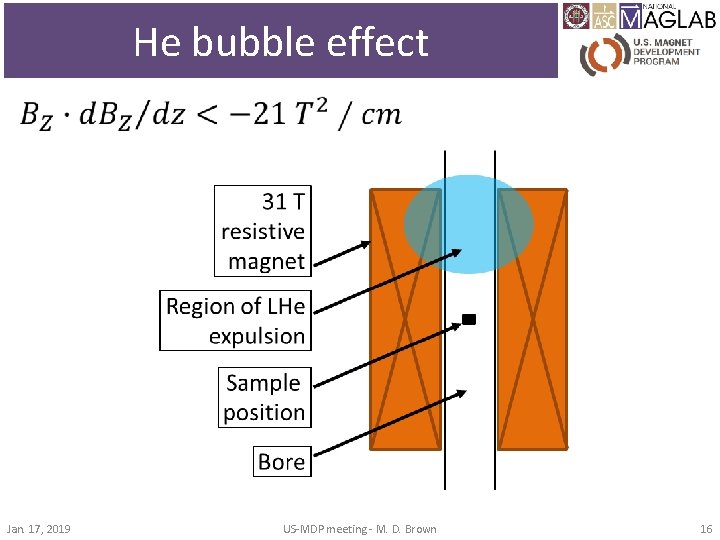
He bubble effect • 31 T resistive magnet Region of LHe expulsion Sample position Bore Jan. 17, 2019 US‐MDP meeting ‐ M. D. Brown 16
- Slides: 16