
Prediction of Binding Site and Docking Lecture 11
Prediction of Binding Site and Docking Lecture 11 Structural Bioinformatics Dr. Avraham Samson 81 -871 1
Approaches for prediction of binding sites 1. Homology based (sequence and structure) (accuracy >98%) 2. Geometry based (structure, physical properties) (accuracy <86%) 2
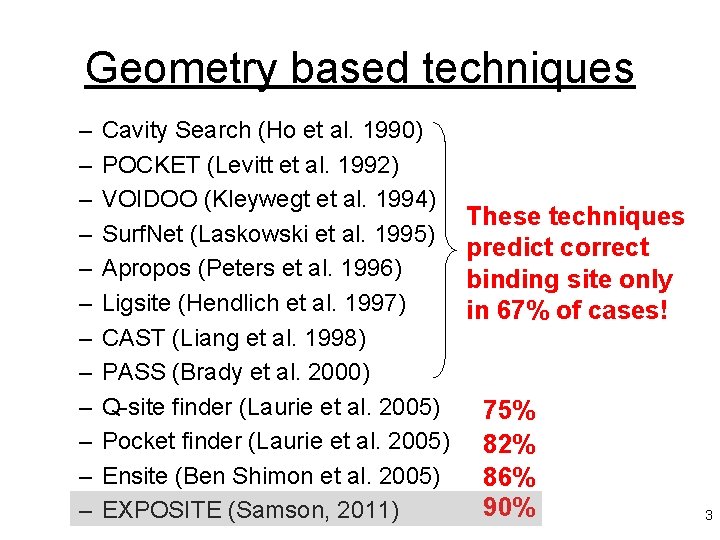
Geometry based techniques – – – Cavity Search (Ho et al. 1990) POCKET (Levitt et al. 1992) VOIDOO (Kleywegt et al. 1994) Surf. Net (Laskowski et al. 1995) Apropos (Peters et al. 1996) Ligsite (Hendlich et al. 1997) CAST (Liang et al. 1998) PASS (Brady et al. 2000) Q-site finder (Laurie et al. 2005) Pocket finder (Laurie et al. 2005) Ensite (Ben Shimon et al. 2005) EXPOSITE (Samson, 2011) These techniques predict correct binding site only in 67% of cases! 75% 82% 86% 90% 3
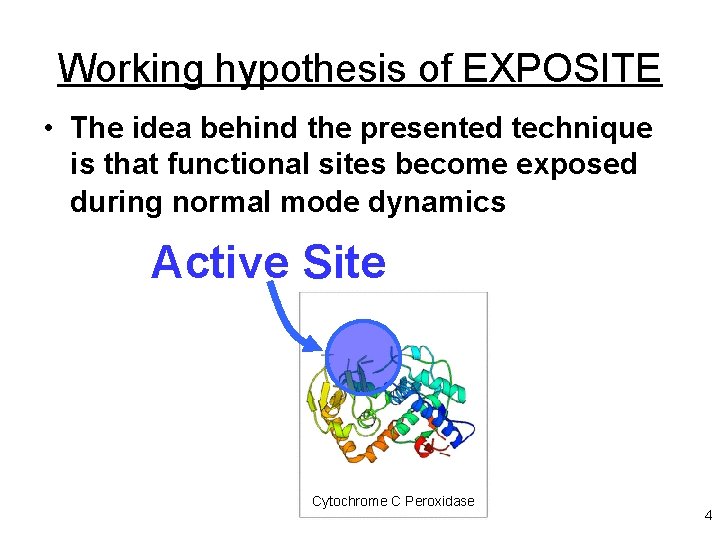
Working hypothesis of EXPOSITE • The idea behind the presented technique is that functional sites become exposed during normal mode dynamics Active Site Cytochrome C Peroxidase 4
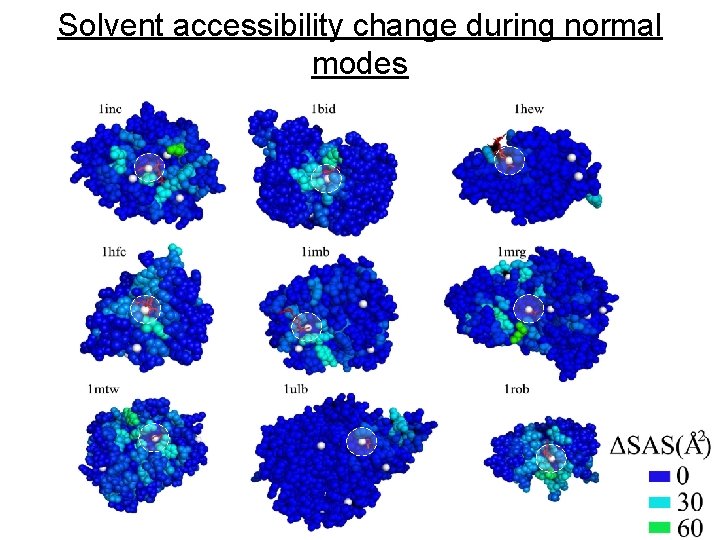
Solvent accessibility change during normal modes 5
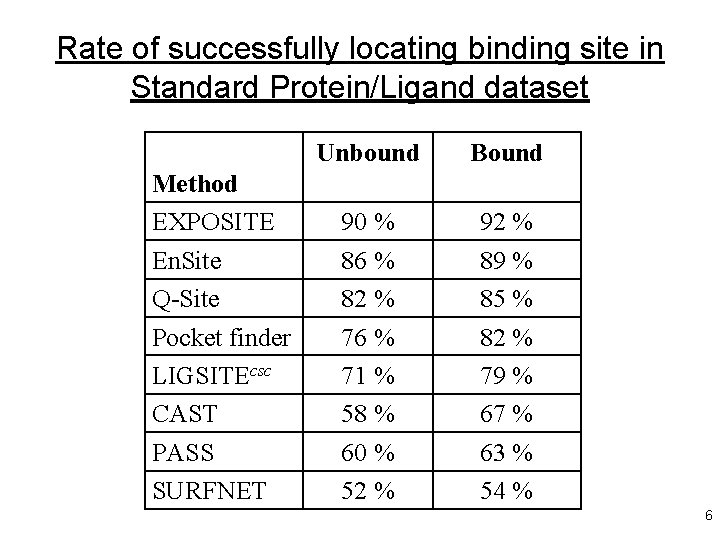
Rate of successfully locating binding site in Standard Protein/Ligand dataset Method EXPOSITE En. Site Q-Site Pocket finder LIGSITEcsc CAST PASS SURFNET Unbound Bound 90 % 86 % 82 % 76 % 71 % 58 % 60 % 52 % 92 % 89 % 85 % 82 % 79 % 67 % 63 % 54 % 6
Docking
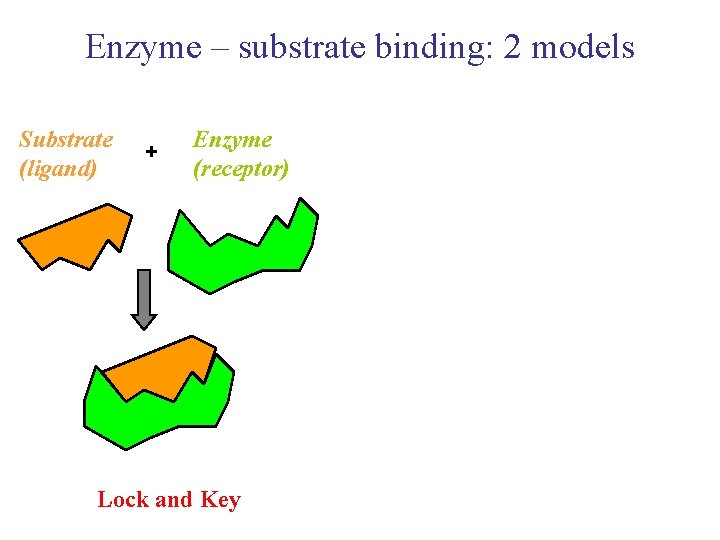
Enzyme – substrate binding: 2 models Substrate (ligand) + Enzyme (receptor) Lock and Key
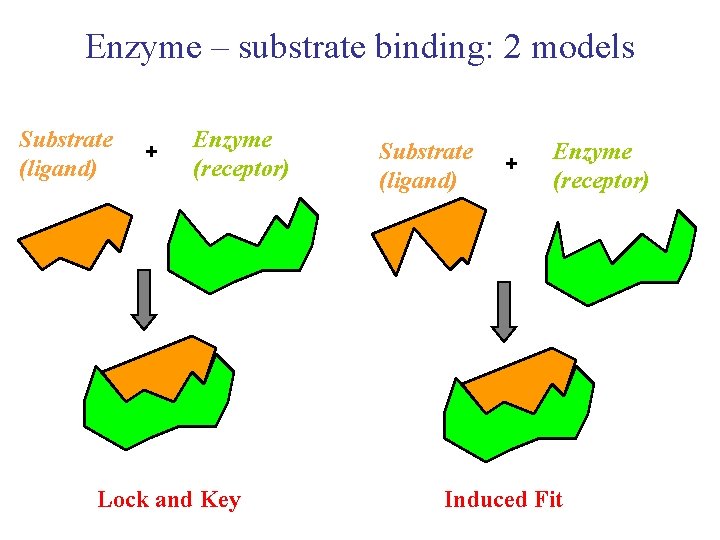
Enzyme – substrate binding: 2 models Substrate (ligand) + Enzyme (receptor) Lock and Key Substrate (ligand) + Enzyme (receptor) Induced Fit
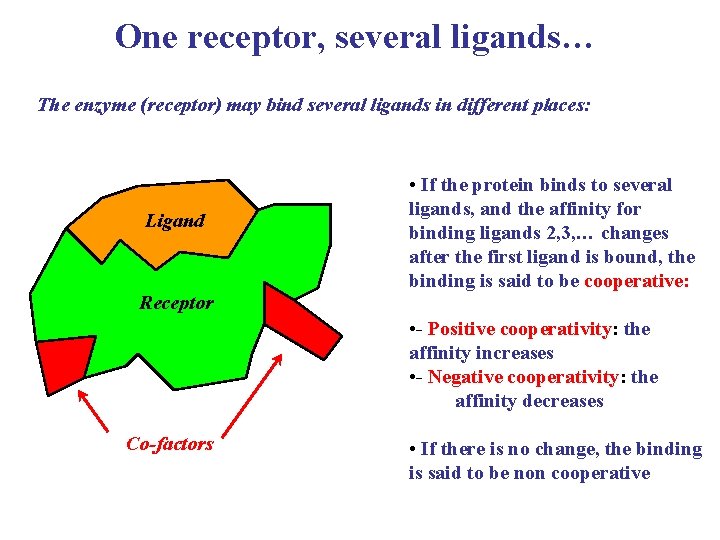
One receptor, several ligands… The enzyme (receptor) may bind several ligands in different places: Ligand • If the protein binds to several ligands, and the affinity for binding ligands 2, 3, … changes after the first ligand is bound, the binding is said to be cooperative: Receptor • - Positive cooperativity: the affinity increases • - Negative cooperativity: the affinity decreases Co-factors • If there is no change, the binding is said to be non cooperative
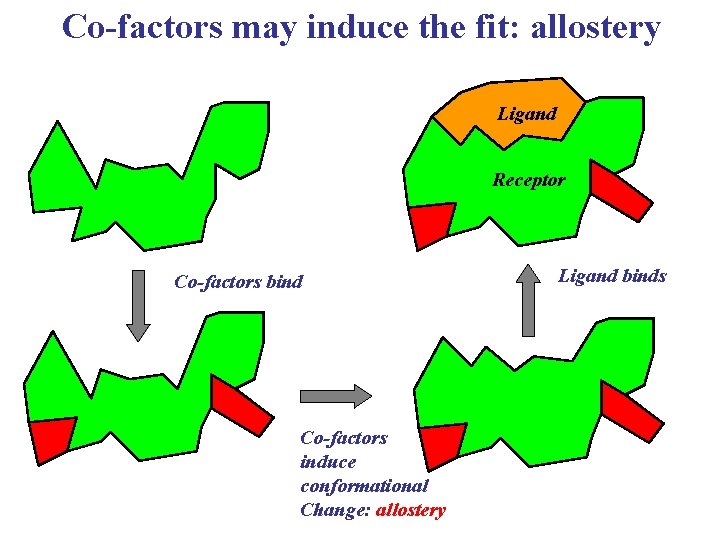
Co-factors may induce the fit: allostery Ligand Receptor Co-factors bind Co-factors induce conformational Change: allostery Ligand binds
Predicting binding • Computationally, Lock and Key is the simplest case to predict: – Little or no flexibility need be modeled – 6 degrees of freedom (DOF) • Induced fit is much more difficult – >> 6 degrees of freedom (3 rotations, 3 translations) – Algorithms may need to model the movements of • Side chains and backbone of the receptor • Ligands

Increasing difficulty “Docking” scenarios Rigid Receptor, Rigid Ligand “Historical” techniques: Lock and Key Rigid Receptor, Flexible Ligand Flexible Receptor, Rigid Ligand Flexible Receptor, Flexible Ligand Hopefully soon… Current Research area
Docking • What is Docking? • Why is docking important? • Why is docking hard? • Docking scoring criteria • Docking search strategies • CAPRI
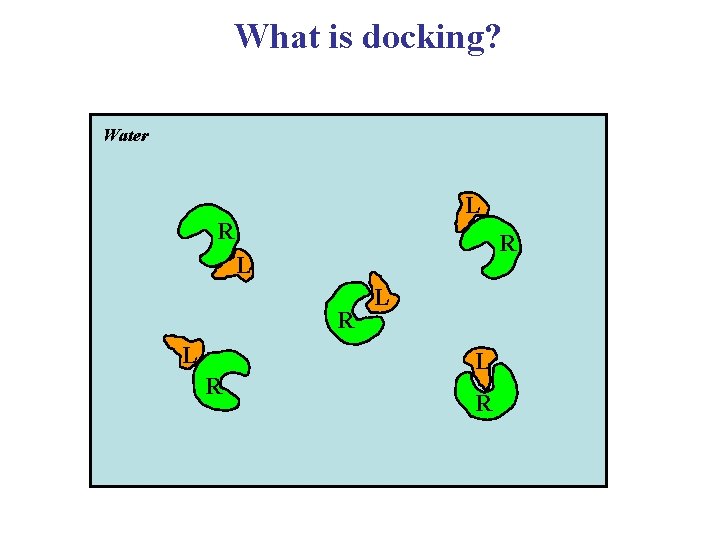
What is docking? Water L R R L R L L R
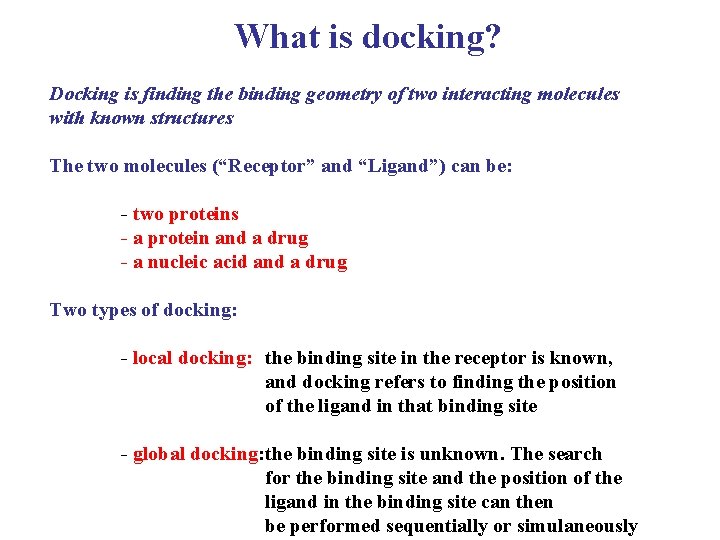
What is docking? Docking is finding the binding geometry of two interacting molecules with known structures The two molecules (“Receptor” and “Ligand”) can be: - two proteins - a protein and a drug - a nucleic acid and a drug Two types of docking: - local docking: the binding site in the receptor is known, and docking refers to finding the position of the ligand in that binding site - global docking: the binding site is unknown. The search for the binding site and the position of the ligand in the binding site can then be performed sequentially or simulaneously
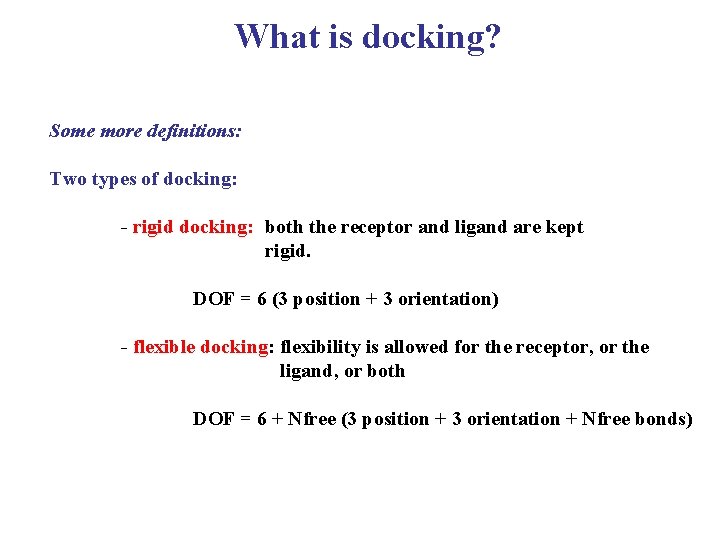
What is docking? Some more definitions: Two types of docking: - rigid docking: both the receptor and ligand are kept rigid. DOF = 6 (3 position + 3 orientation) - flexible docking: flexibility is allowed for the receptor, or the ligand, or both DOF = 6 + Nfree (3 position + 3 orientation + Nfree bonds)
What is docking? Two types of docking: - bound docking: the goal is to reproduce a known complex, where the starting structures for the receptor and ligand are taken from the structure of the complex (testing docking method) - unbound docking: the structures of the receptor and ligand are taken from data on the unbound molecules (actual docking)
Why is docking important? • Intellectual challenge? • Drug design (***) • Protein-protein interactions • ….
Why is docking hard? • The main problem is the dimension of the conformational space to be explored: - rigid structure alignment: 3 D (hard) - rigid docking: 6 D (hard) - flexible docking: 6 D + Nfb (impossible!)
Docking Scoring Criteria • Geometric match: – – Prevent overlap between atoms of the receptor and ligand Maximum shape compatibility Large surface burial No large cavity at interface • Energetic Match (Force-field + Statistical potential) – Good hydrogen bonding – Good charge complementarity – Polar/polar contacts favored, polar / non polar contacts disfavoured – Low “free energy”
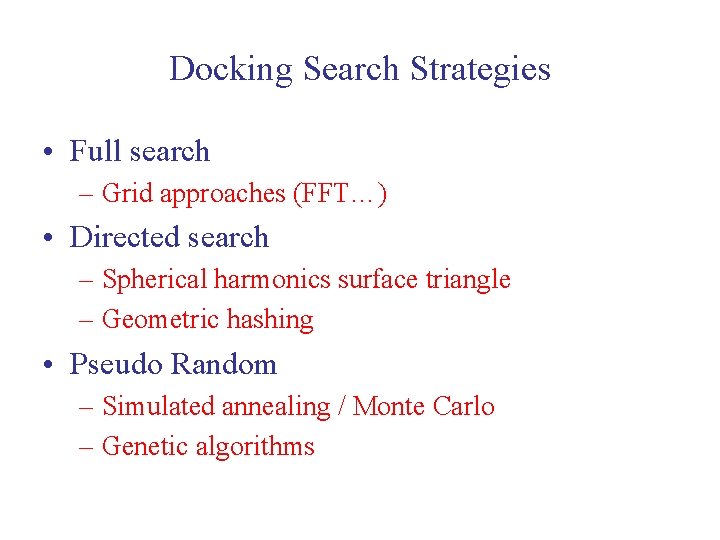
Docking Search Strategies • Full search – Grid approaches (FFT…) • Directed search – Spherical harmonics surface triangle – Geometric hashing • Pseudo Random – Simulated annealing / Monte Carlo – Genetic algorithms
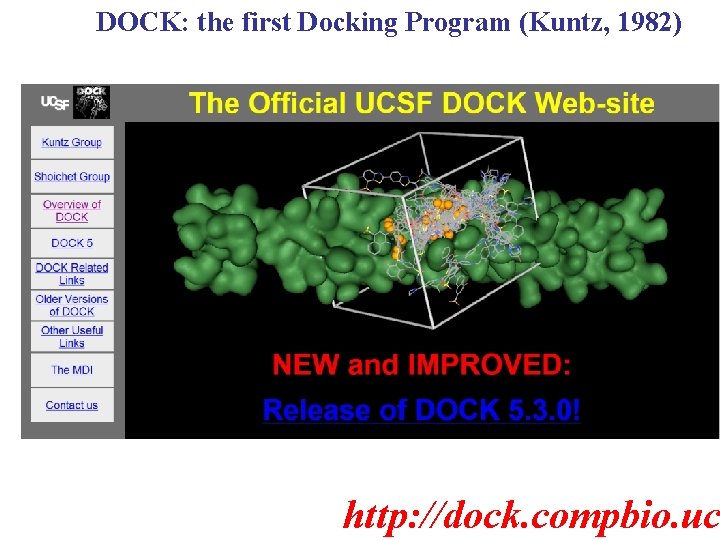
DOCK: the first Docking Program (Kuntz, 1982) http: //dock. compbio. uc
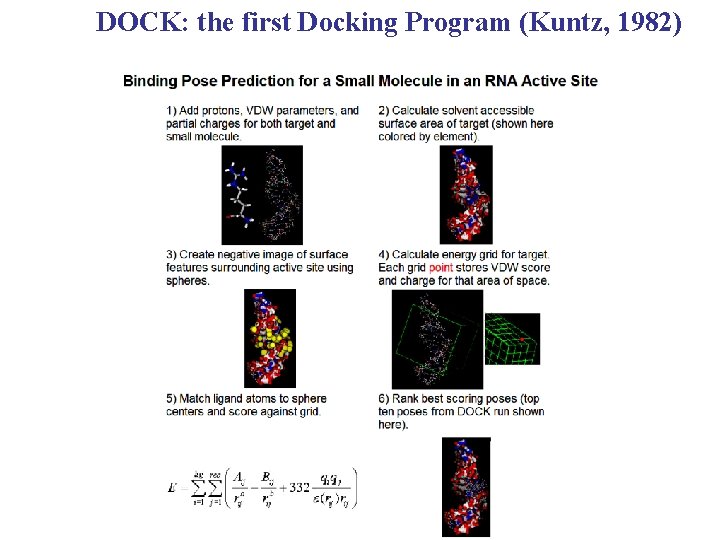
DOCK: the first Docking Program (Kuntz, 1982)
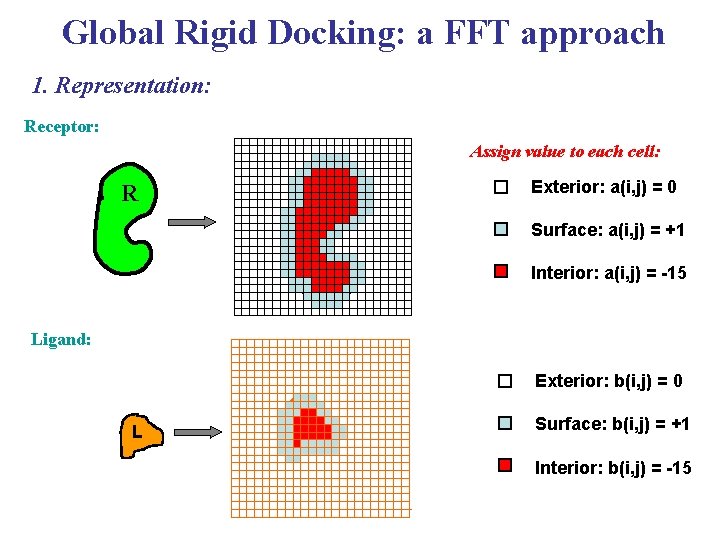
Global Rigid Docking: a FFT approach 1. Representation: Receptor: Assign value to each cell: R R Exterior: a(i, j) = 0 Surface: a(i, j) = +1 Interior: a(i, j) = -15 Ligand: Exterior: b(i, j) = 0 L L Surface: b(i, j) = +1 Interior: b(i, j) = -15
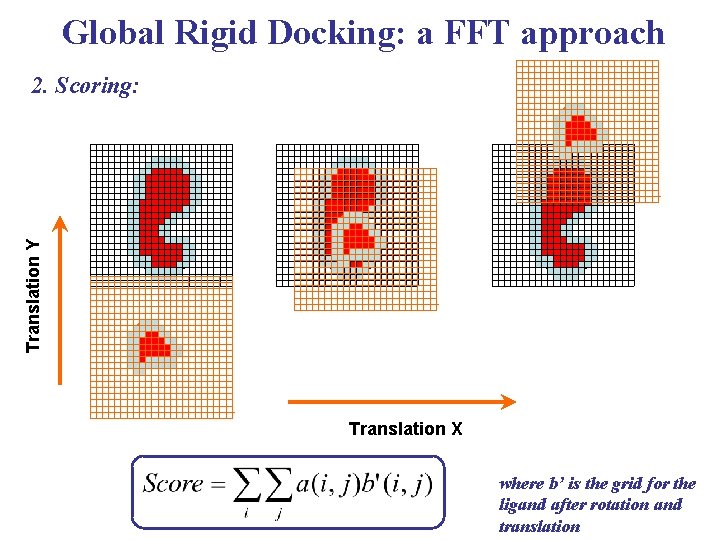
Global Rigid Docking: a FFT approach 2. Scoring: L Translation Y R R R L L Translation X where b’ is the grid for the ligand after rotation and translation
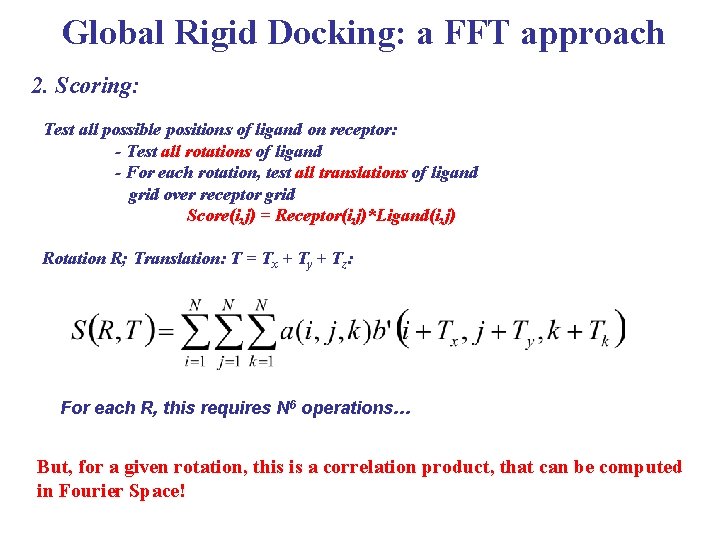
Global Rigid Docking: a FFT approach 2. Scoring: Test all possible positions of ligand on receptor: - Test all rotations of ligand - For each rotation, test all translations of ligand grid over receptor grid Score(i, j) = Receptor(i, j)*Ligand(i, j) Rotation R; Translation: T = Tx + Ty + Tz: For each R, this requires N 6 operations… But, for a given rotation, this is a correlation product, that can be computed in Fourier Space!
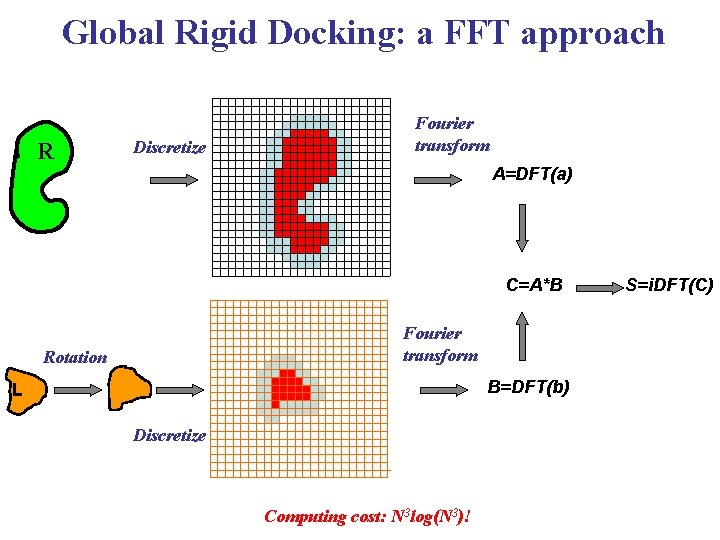
Global Rigid Docking: a FFT approach R Discretize R Fourier transform A=DFT(a) C=A*B Fourier transform Rotation L L Discretize Computing cost: N 3 log(N 3)! B=DFT(b) S=i. DFT(C)
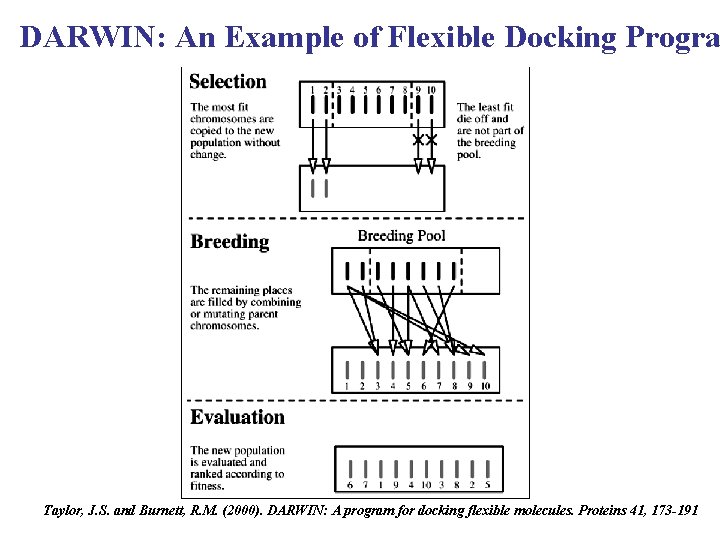
DARWIN: An Example of Flexible Docking Progra DARWIN uses a force field (CHARMM) for scoring, and a genetic algorithm for searching Genetic algorithm: - Every “solution” is represented by a binary string. - 3 genes describe the position (with 0. 5 Å resolution) - 3 genes describe the orientation (11. 25° resolution) - Each flexible bond is described by one parameter (60° resolution) - The population size is 100 -1000 and the number of generation is 10% the population size - The basic operations are: - mutation (P = 0. 2) - recombination with one cut (P = 0. 4) - recombination with two cuts (P=0. 4) - the “death rate” is 5% and the survival rate is 10 -30% Taylor, J. S. and Burnett, R. M. (2000). DARWIN: A program for docking flexible molecules. Proteins 41, 173 -191
DARWIN: An Example of Flexible Docking Progra Taylor, J. S. and Burnett, R. M. (2000). DARWIN: A program for docking flexible molecules. Proteins 41, 173 -191
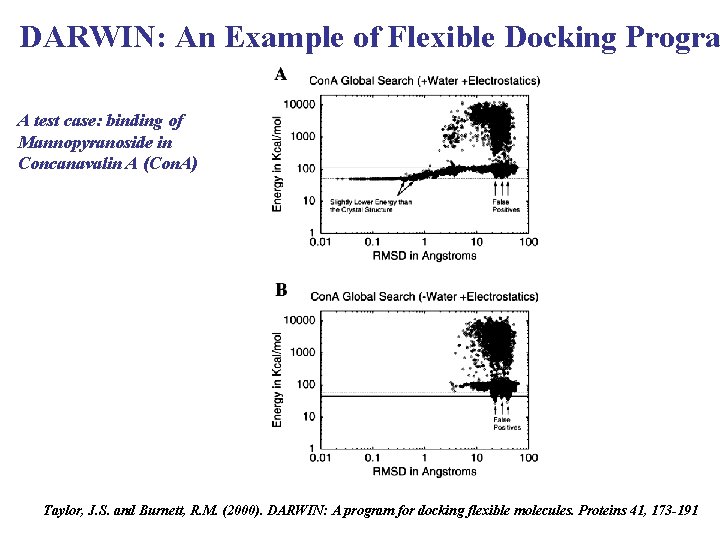
DARWIN: An Example of Flexible Docking Progra A test case: binding of Mannopyranoside in Concanavalin A (Con. A) Taylor, J. S. and Burnett, R. M. (2000). DARWIN: A program for docking flexible molecules. Proteins 41, 173 -191
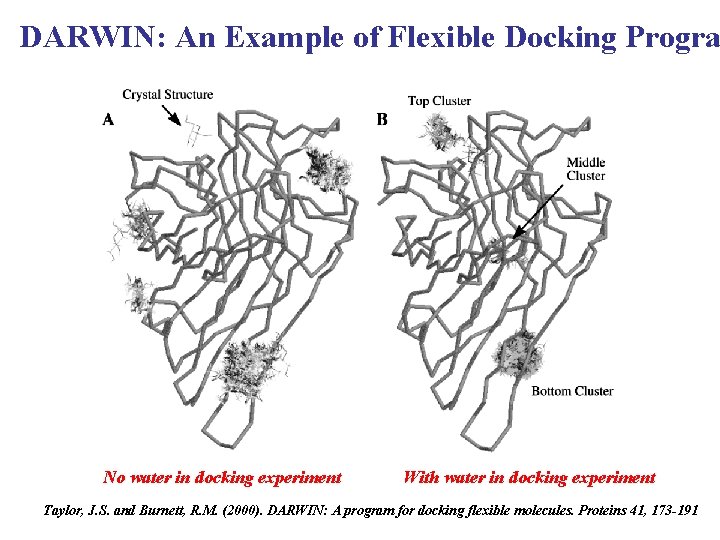
DARWIN: An Example of Flexible Docking Progra No water in docking experiment With water in docking experiment Taylor, J. S. and Burnett, R. M. (2000). DARWIN: A program for docking flexible molecules. Proteins 41, 173 -191
(Smith and Sternberg, COSB, 2002)
CAPRI Just like the CASP competition in the protein structure prediction field, there is a bi-annual competition called CAPRI, for the Critical Assessment of Predicted Interactions. J. Janin et al, “CAPRI: a Critical Assessment of Predicted Interactions”, Proteins (2003) 52: 2 -9 Mendez et al, “Assessment of blind predictions of protein-protein interactions: Current status of docking methods”, Proteins (2003) 52: 51 -67
http: //vakser. bioinformatics. ku. edu/resources/grammx
- Slides: 35