
Prediction of Availability and Charging Rate at Charging

Prediction of Availability and Charging Rate at Charging Stations for Electric Vehicles Can Bikcora 1, Nazir Refa 2, Lennart Verheijen 3, and Siep Weiland 1 1 Department of Electrical Engineering, Eindhoven University of Technology, The Netherlands 2 Elaad. NL, 6812 AR Arnhem, The Netherlands 3 Green. Flux B. V. , 1092 AD Amsterdam, The Netherlands PMAPS 2016, Beijing, China, Oct 16 -20.
Outline 1) Problem Description q Motivation for Probabilistic Load Forecasts q Importance of Forecasting PEV Demands 2) Model Description q Forecasting of the Availability q Forecasting of the Charging Rate q Model Structure Selection 3) Forecast Evaluation q Performance Metric q Performance Comparisons 4) Summary and Conclusions PAGE 1 of 17
Outline 1) Problem Description q Motivation for Probabilistic Load Forecasts q Importance of Forecasting PEV Demands 2) Model Description q Forecasting of the Availability q Forecasting of the Charging Rate q Model Structure Selection 3) Forecast Evaluation q Performance Metric q Performance Comparisons 4) Summary and Conclusions PAGE 2 of 17
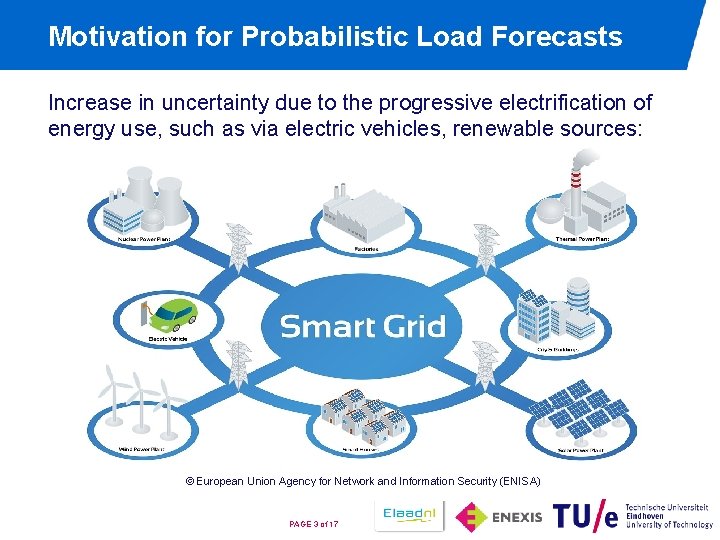
Motivation for Probabilistic Load Forecasts Increase in uncertainty due to the progressive electrification of energy use, such as via electric vehicles, renewable sources: © European Union Agency for Network and Information Security (ENISA) PAGE 3 of 17
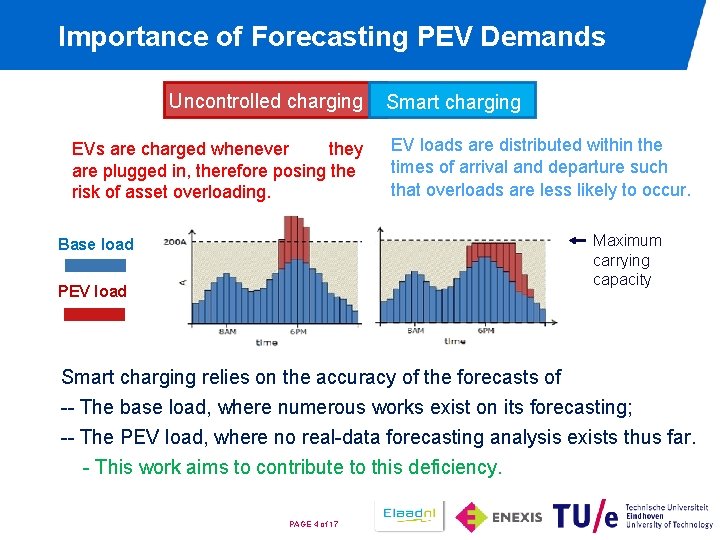
Importance of Forecasting PEV Demands Uncontrolled charging EVs are charged whenever they are plugged in, therefore posing the risk of asset overloading. Smart charging EV loads are distributed within the times of arrival and departure such that overloads are less likely to occur. Maximum carrying capacity Base load PEV load Smart charging relies on the accuracy of the forecasts of -- The base load, where numerous works exist on its forecasting; -- The PEV load, where no real-data forecasting analysis exists thus far. - This work aims to contribute to this deficiency. PAGE 4 of 17
Outline 1) Problem Description q Motivation for Probabilistic Load Forecasts q Importance of Forecasting PEV Demands 2) Model Description q Forecasting of the Availability q Forecasting of the Charging Rate q Model Structure Selection 3) Forecast Evaluation q Performance Metric q Performance Comparisons 4) Summary and Conclusions PAGE 5 of 17
Forecasting of the Availability • exogenous input link function PAGE 6 of 17
Forecasting of the Availability • PAGE 7 of 17
Forecasting of the Charging Rate • PAGE 8 of 17
Model Structure Selection q Variables to select: q Number of weeks to include in the training set (i. e. , most recent 1 -8 weeks). q Lagged measurements and exogenous variables. q Lags 96 (1 -day) and 672 (1 -week) are considered as possible options. q As exogenous inputs: 1) Intraday indicator (dummy) variables for each hour of a day; 2) Intraweek indicator variables for the days of a week; 3) Day-lagged and week-lagged binary/categorical variables from the nearby charging points of the same provider. q Utilized approach in the selection: q Cross-Validation: Compare various model options by simulating the exact forecast scenario on the training set, i. e. , forecast each day in the training set based on a model built from the weeks prior to that day. q Cross-validation fits better to our case in comparison to information criteria (e. g. , Akaike) due to the fact that: 1) We perform multi-step ahead (daily) forecasts. 2) We use a specific probabilistic evaluation metric. PAGE 9 of 17
Outline 1) Problem Description q Motivation for Probabilistic Load Forecasts q Importance of Forecasting PEV Demands 2) Model Description q Forecasting of the Availability q Forecasting of the Charging Rate q Model Structure Selection 3) Forecast Evaluation q Performance Metric q Performance Comparisons 4) Summary and Conclusions PAGE 10 of 17
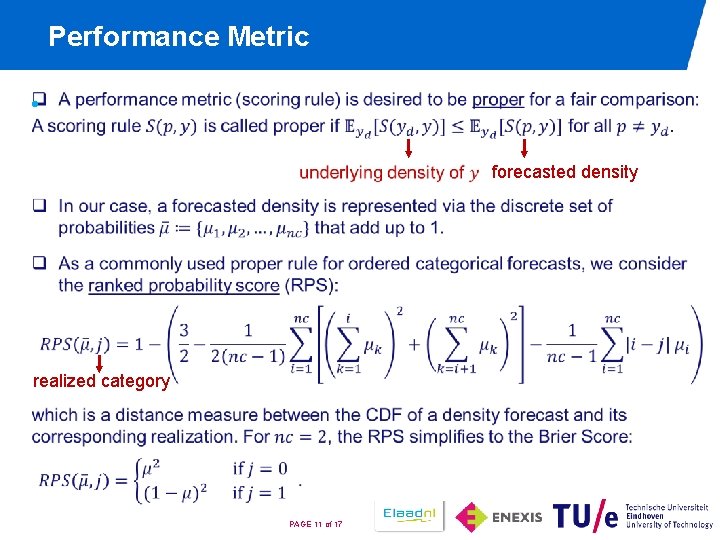
Performance Metric • realized category PAGE 11 of 17 forecasted density
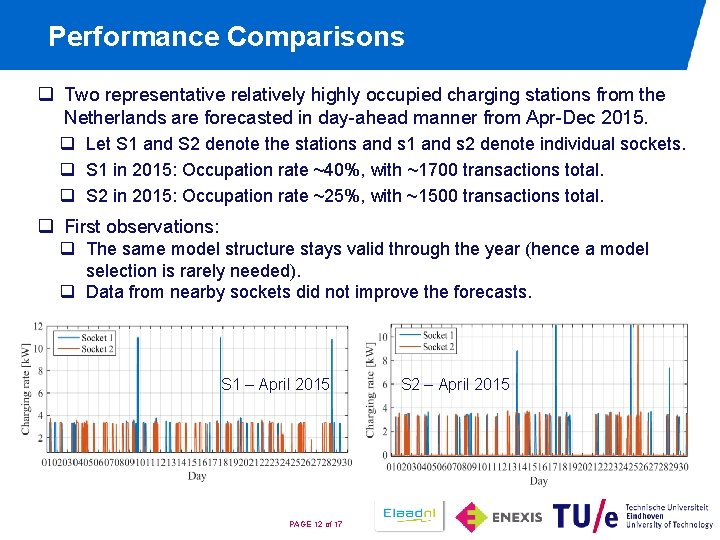
Performance Comparisons q Two representative relatively highly occupied charging stations from the Netherlands are forecasted in day-ahead manner from Apr-Dec 2015. q Let S 1 and S 2 denote the stations and s 1 and s 2 denote individual sockets. q S 1 in 2015: Occupation rate ~40%, with ~1700 transactions total. q S 2 in 2015: Occupation rate ~25%, with ~1500 transactions total. q First observations: q The same model structure stays valid through the year (hence a model selection is rarely needed). q Data from nearby sockets did not improve the forecasts. S 1 – April 2015 PAGE 12 of 17 S 2 – April 2015
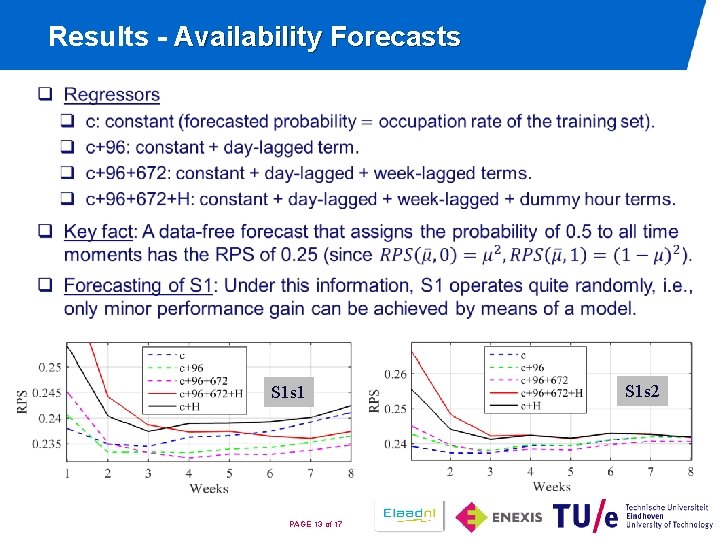
Results - Availability Forecasts S 1 s 1 PAGE 13 of 17 S 1 s 2
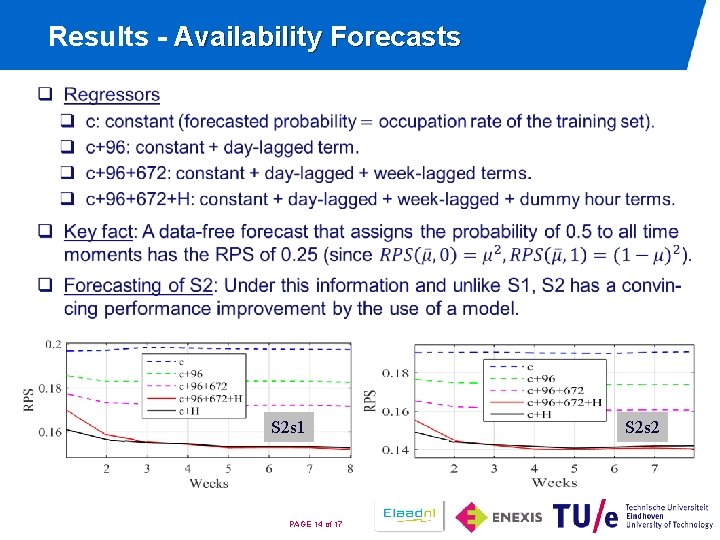
Results - Availability Forecasts S 2 s 1 PAGE 14 of 17 S 2 s 2
![Results - Charging Rate Forecasts [0, 0. 5] [3. 2, 3. 8] Plot of](http://slidetodoc.com/presentation_image_h/37d8188b88ad237c84a1ec776788cbad/image-16.jpg "Results - Charging Rate Forecasts [0, 0. 5] [3. 2, 3. 8] Plot of")
Results - Charging Rate Forecasts [0, 0. 5] [3. 2, 3. 8] Plot of forecasts during the days of April 2015 for S 2 s 2. Apparent from the figures, two categories dominate over the others. PAGE 15 of 17
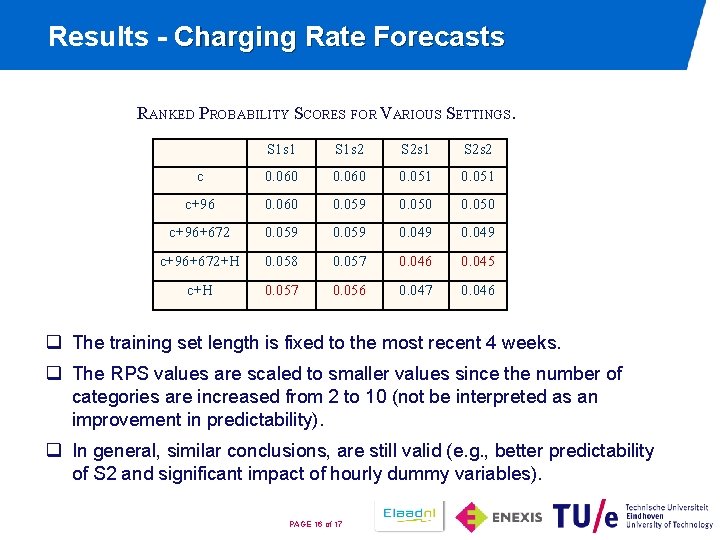
Results - Charging Rate Forecasts RANKED PROBABILITY SCORES FOR VARIOUS SETTINGS. S 1 s 1 S 1 s 2 S 2 s 1 S 2 s 2 c 0. 060 0. 051 c+96 0. 060 0. 059 0. 050 c+96+672 0. 059 0. 049 c+96+672+H 0. 058 0. 057 0. 046 0. 045 c+H 0. 057 0. 056 0. 047 0. 046 q The training set length is fixed to the most recent 4 weeks. q The RPS values are scaled to smaller values since the number of categories are increased from 2 to 10 (not be interpreted as an improvement in predictability). q In general, similar conclusions, are still valid (e. g. , better predictability of S 2 and significant impact of hourly dummy variables). PAGE 16 of 17
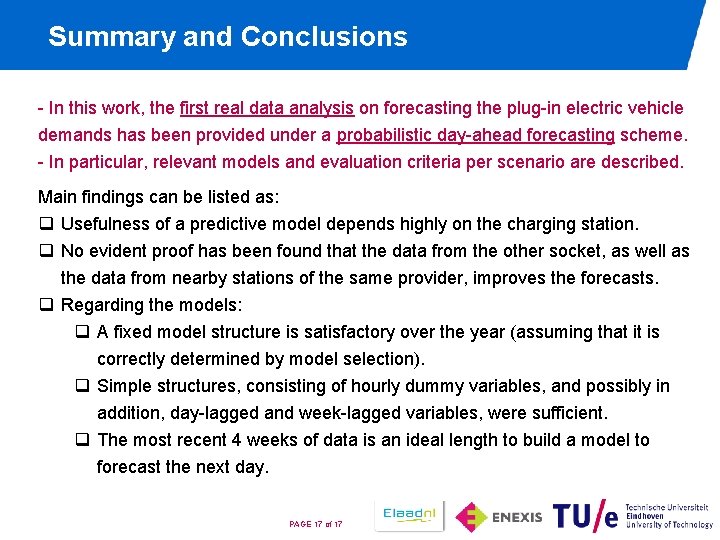
Summary and Conclusions - In this work, the first real data analysis on forecasting the plug-in electric vehicle demands has been provided under a probabilistic day-ahead forecasting scheme. - In particular, relevant models and evaluation criteria per scenario are described. Main findings can be listed as: q Usefulness of a predictive model depends highly on the charging station. q No evident proof has been found that the data from the other socket, as well as the data from nearby stations of the same provider, improves the forecasts. q Regarding the models: q A fixed model structure is satisfactory over the year (assuming that it is correctly determined by model selection). q Simple structures, consisting of hourly dummy variables, and possibly in addition, day-lagged and week-lagged variables, were sufficient. q The most recent 4 weeks of data is an ideal length to build a model to forecast the next day. PAGE 17 of 17

Thanks for your attention!
- Slides: 19