
Predicting the Sunspot Cycle Dr David H Hathaway
![The Sunspot or Wolf Cycle [Schwabe 1844] The average cycle lasts about 11 years,](https://slidetodoc.com/presentation_image/1c11734f0f49513ba32c5a34afe542aa/image-8.jpg "The Sunspot or Wolf Cycle [Schwabe 1844] The average cycle lasts about 11 years,")
![Equatorward Drift – Spörer’s Law [Carrington, 1858] Sunspots appear in two bands on either](https://slidetodoc.com/presentation_image/1c11734f0f49513ba32c5a34afe542aa/image-9.jpg "Equatorward Drift – Spörer’s Law [Carrington, 1858] Sunspots appear in two bands on either")
![Active Region Tilt- Joy’s Law [Hale et al. , 1919] Active regions are tilted](https://slidetodoc.com/presentation_image/1c11734f0f49513ba32c5a34afe542aa/image-10.jpg "Active Region Tilt- Joy’s Law [Hale et al. , 1919] Active regions are tilted")
![The Maunder Minimum [Maunder, 1894] The existence of the Maunder Minimum is now well](https://slidetodoc.com/presentation_image/1c11734f0f49513ba32c5a34afe542aa/image-11.jpg "The Maunder Minimum [Maunder, 1894] The existence of the Maunder Minimum is now well")
![Hale’s Magnetic Polarity Law [Hale, 1924] The magnetic polarity of the sunspots in active](https://slidetodoc.com/presentation_image/1c11734f0f49513ba32c5a34afe542aa/image-13.jpg "Hale’s Magnetic Polarity Law [Hale, 1924] The magnetic polarity of the sunspots in active")
![Polar Field Reversals [Babcock, 1959] The magnetic polarities of the Sun’s poles reverse from](https://slidetodoc.com/presentation_image/1c11734f0f49513ba32c5a34afe542aa/image-14.jpg "Polar Field Reversals [Babcock, 1959] The magnetic polarities of the Sun’s poles reverse from")

- Slides: 36
Predicting the Sunspot Cycle Dr. David H. Hathaway NASA Marshall Space Flight Center National Space Science and Technology Center
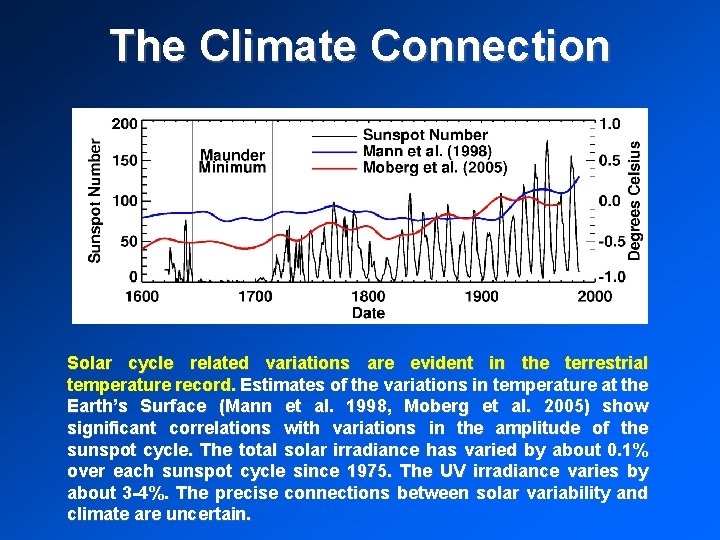
The Climate Connection Solar cycle related variations are evident in the terrestrial temperature record. Estimates of the variations in temperature at the Earth’s Surface (Mann et al. 1998, Moberg et al. 2005) show significant correlations with variations in the amplitude of the sunspot cycle. The total solar irradiance has varied by about 0. 1% over each sunspot cycle since 1975. The UV irradiance varies by about 3 -4%. The precise connections between solar variability and climate are uncertain.
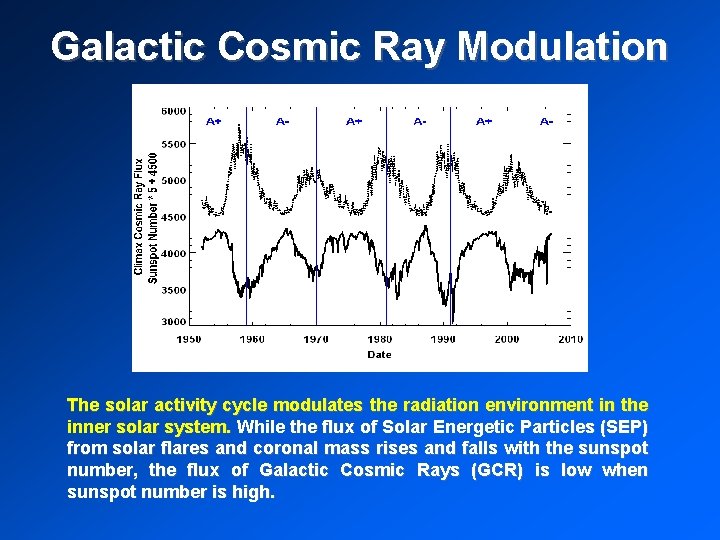
Galactic Cosmic Ray Modulation The solar activity cycle modulates the radiation environment in the inner solar system. While the flux of Solar Energetic Particles (SEP) from solar flares and coronal mass rises and falls with the sunspot number, the flux of Galactic Cosmic Rays (GCR) is low when sunspot number is high.
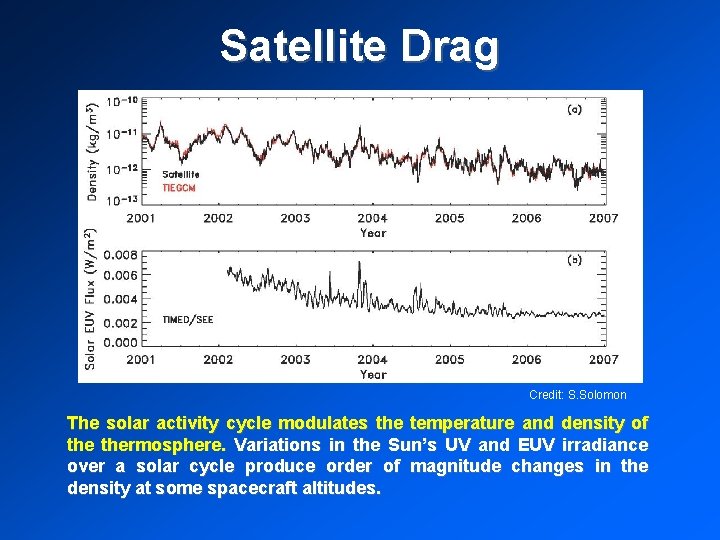
Satellite Drag Credit: S. Solomon The solar activity cycle modulates the temperature and density of thermosphere. Variations in the Sun’s UV and EUV irradiance over a solar cycle produce order of magnitude changes in the density at some spacecraft altitudes.
Outline • • • Sunspot Cycle Characteristics Predictions in General Statistical Methods Precursor Methods Dynamo Methods Conclusions – Will there be a Cycle 24?
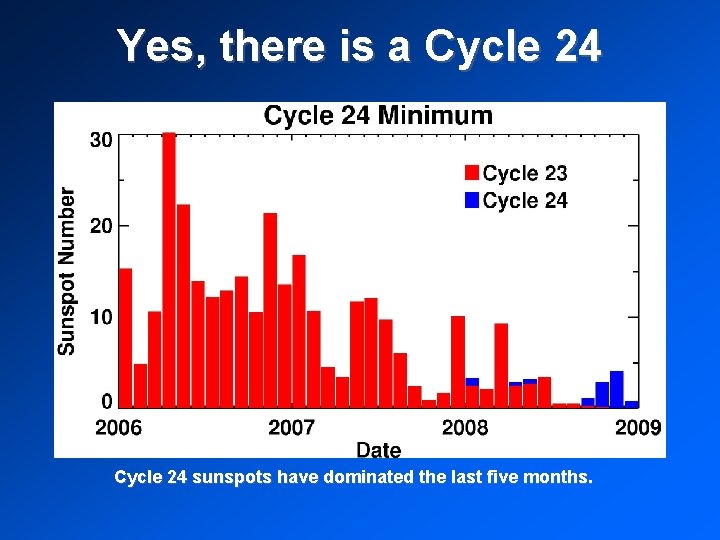
Yes, there is a Cycle 24 sunspots have dominated the last five months.
Sunspot Cycle Characteristics
The Sunspot or Wolf Cycle [Schwabe 1844] The average cycle lasts about 11 years, but with a range of 9 to 14. The average amplitude is about 100, but with a range of 50 to 200.
Equatorward Drift – Spörer’s Law [Carrington, 1858] Sunspots appear in two bands on either side of the equator. These bands drift toward the equator as the cycle progresses and cycles overlap by 2 -3 years at minimum.
Active Region Tilt- Joy’s Law [Hale et al. , 1919] Active regions are tilted with the leading spots closer to the equator than the following spots. This tilt increases with latitude.
The Maunder Minimum [Maunder, 1894] The existence of the Maunder Minimum is now well established by the efforts of Hoyt and Schatten. They have tabulated daily observations with nearly complete coverage over the period of the Maunder Minimum (1645 to 1715). Observations of sun-like stars also indicate similar periods of inactivity.
Magnetic Characteristics
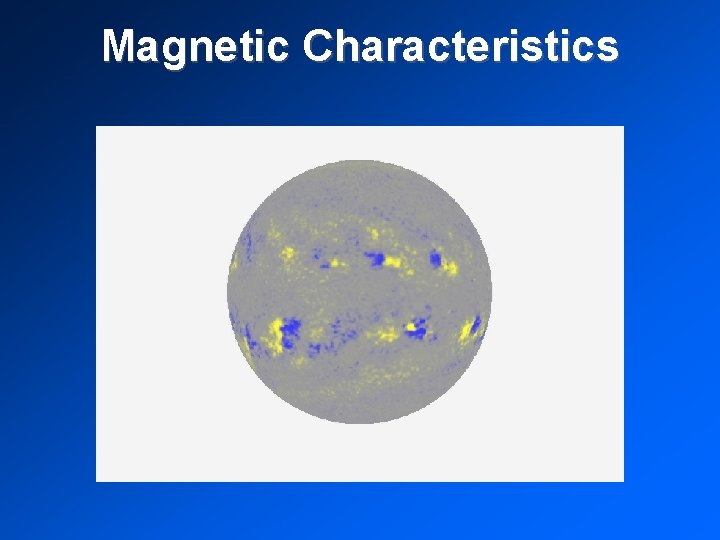
Hale’s Magnetic Polarity Law [Hale, 1924] The magnetic polarity of the sunspots in active regions switches from one hemisphere to the other and from one cycle to the next.
Polar Field Reversals [Babcock, 1959] The magnetic polarities of the Sun’s poles reverse from one cycle to the next at about the time of sunspot cycle maximum.
Predictions in General
Prediction is very difficult, especially about the future. Yogi Berra It ain’t over ‘til it’s over. Yogi Berra If I hadn’t believed it, I wouldn’t have seen it. Yogi Berra
Prediction is very difficult, especially about the future. Niels Bohr
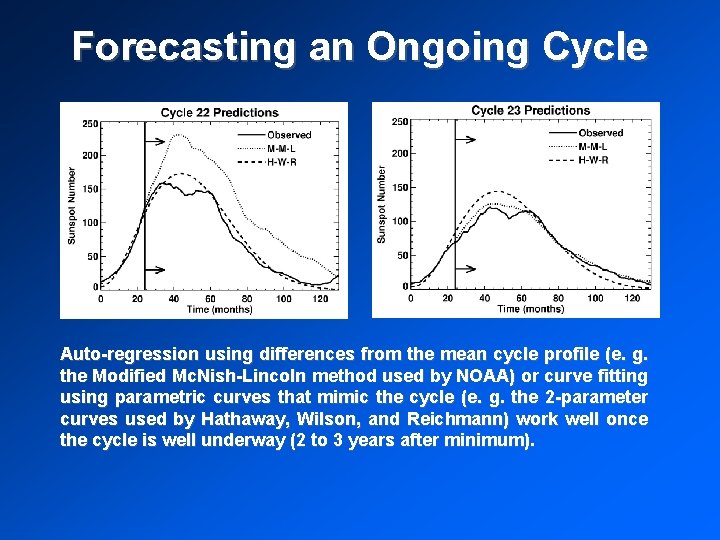
Forecasting an Ongoing Cycle Auto-regression using differences from the mean cycle profile (e. g. the Modified Mc. Nish-Lincoln method used by NOAA) or curve fitting using parametric curves that mimic the cycle (e. g. the 2 -parameter curves used by Hathaway, Wilson, and Reichmann) work well once the cycle is well underway (2 to 3 years after minimum).
Statistical Methods
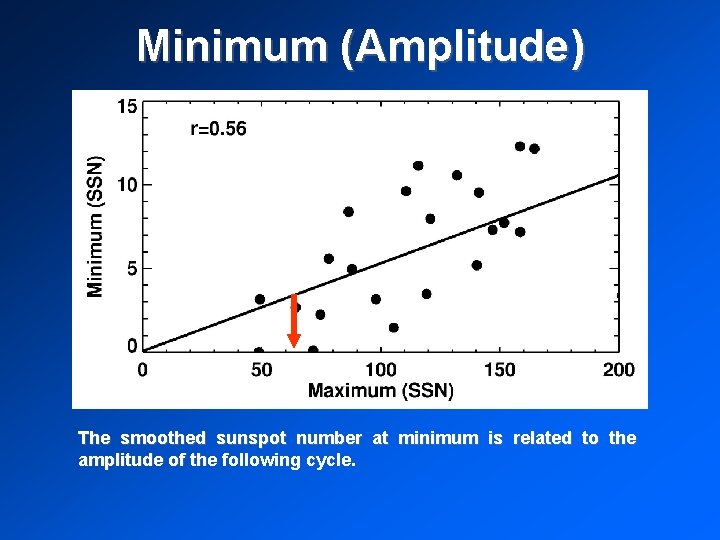
Minimum (Amplitude) The smoothed sunspot number at minimum is related to the amplitude of the following cycle.
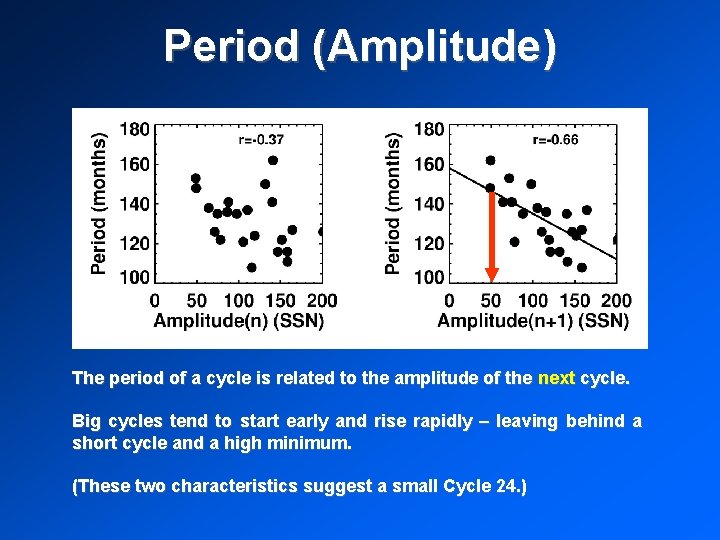
Period (Amplitude) The period of a cycle is related to the amplitude of the next cycle. Big cycles tend to start early and rise rapidly – leaving behind a short cycle and a high minimum. (These two characteristics suggest a small Cycle 24. )
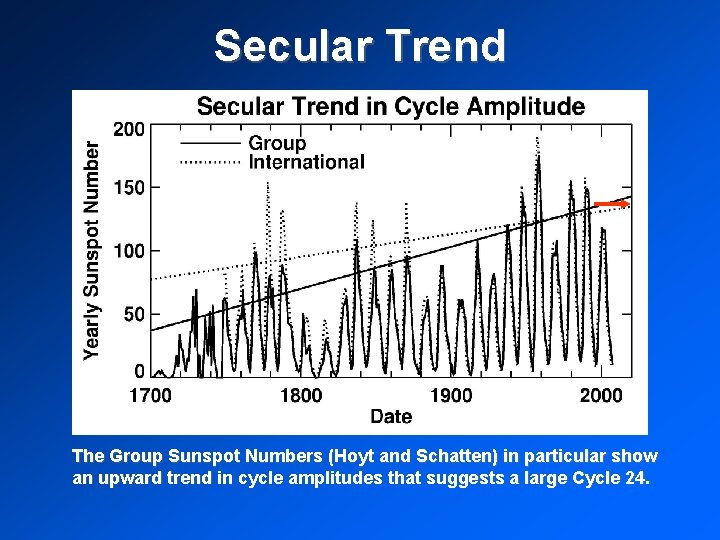
Secular Trend The Group Sunspot Numbers (Hoyt and Schatten) in particular show an upward trend in cycle amplitudes that suggests a large Cycle 24.
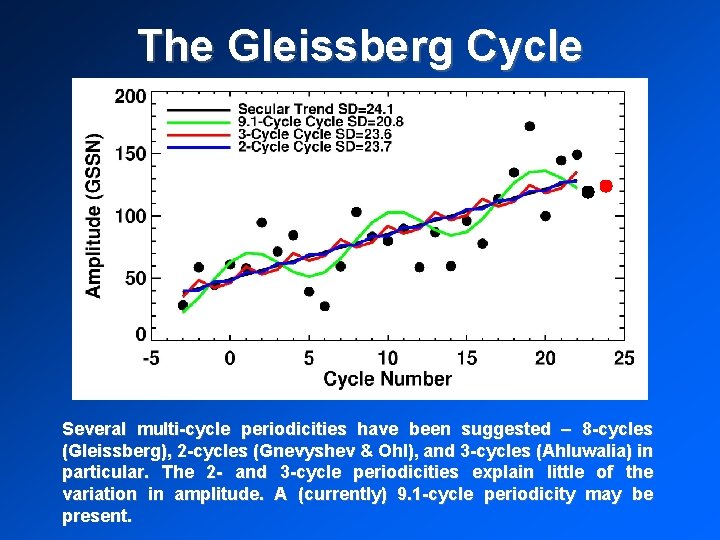
The Gleissberg Cycle Several multi-cycle periodicities have been suggested – 8 -cycles (Gleissberg), 2 -cycles (Gnevyshev & Ohl), and 3 -cycles (Ahluwalia) in particular. The 2 - and 3 -cycle periodicities explain little of the variation in amplitude. A (currently) 9. 1 -cycle periodicity may be present.
Precursor Methods
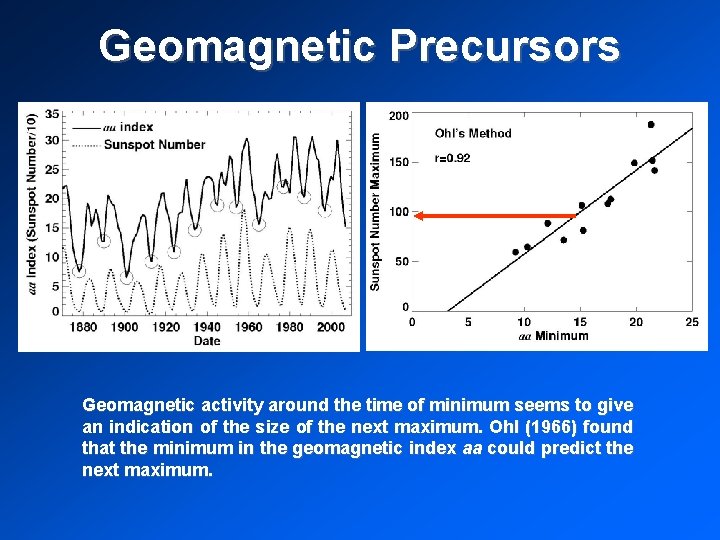
Geomagnetic Precursors Geomagnetic activity around the time of minimum seems to give an indication of the size of the next maximum. Ohl (1966) found that the minimum in the geomagnetic index aa could predict the next maximum.
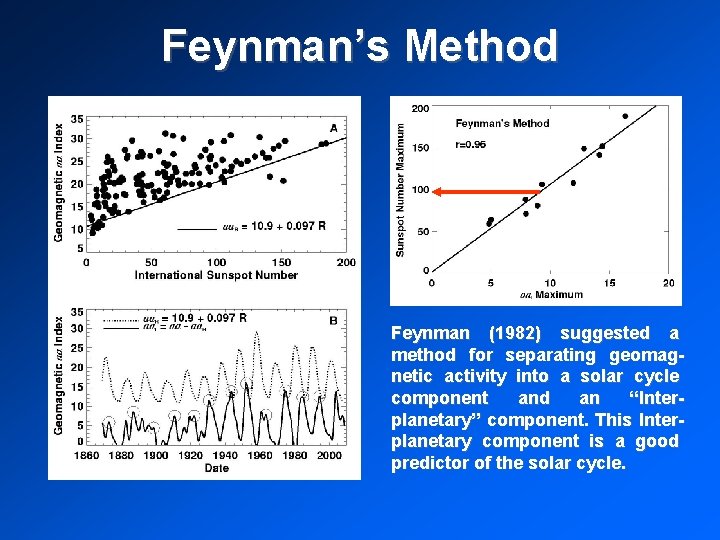
Feynman’s Method Feynman (1982) suggested a method for separating geomagnetic activity into a solar cycle component and an “Interplanetary” component. This Interplanetary component is a good predictor of the solar cycle.
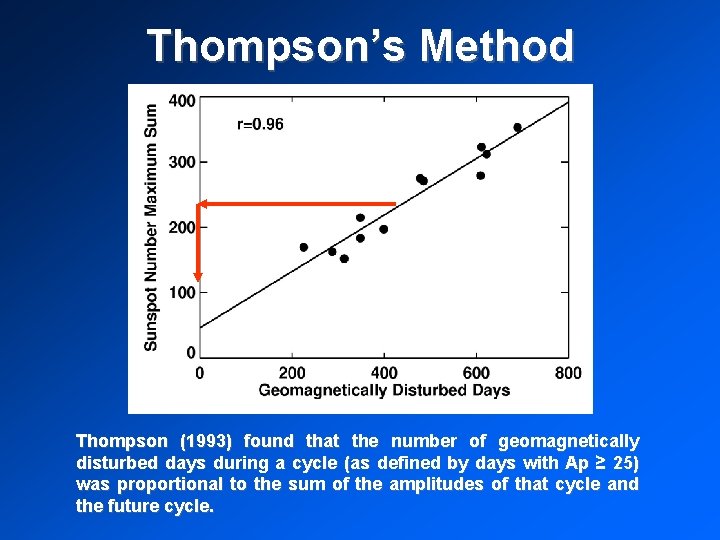
Thompson’s Method Thompson (1993) found that the number of geomagnetically disturbed days during a cycle (as defined by days with Ap ≥ 25) was proportional to the sum of the amplitudes of that cycle and the future cycle.
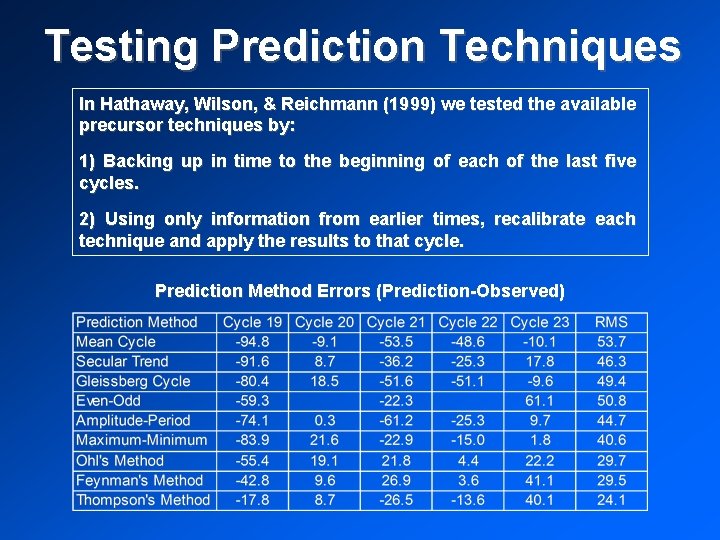
Testing Prediction Techniques In Hathaway, Wilson, & Reichmann (1999) we tested the available precursor techniques by: 1) Backing up in time to the beginning of each of the last five cycles. 2) Using only information from earlier times, recalibrate each technique and apply the results to that cycle. Prediction Method Errors (Prediction-Observed)
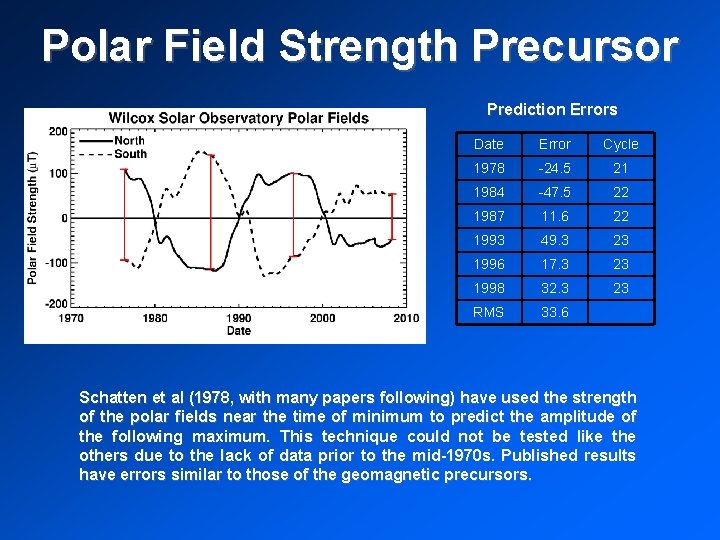
Polar Field Strength Precursor Prediction Errors Date Error Cycle 1978 -24. 5 21 1984 -47. 5 22 1987 11. 6 22 1993 49. 3 23 1996 17. 3 23 1998 32. 3 23 RMS 33. 6 Schatten et al (1978, with many papers following) have used the strength of the polar fields near the time of minimum to predict the amplitude of the following maximum. This technique could not be tested like the others due to the lack of data prior to the mid-1970 s. Published results have errors similar to those of the geomagnetic precursors.
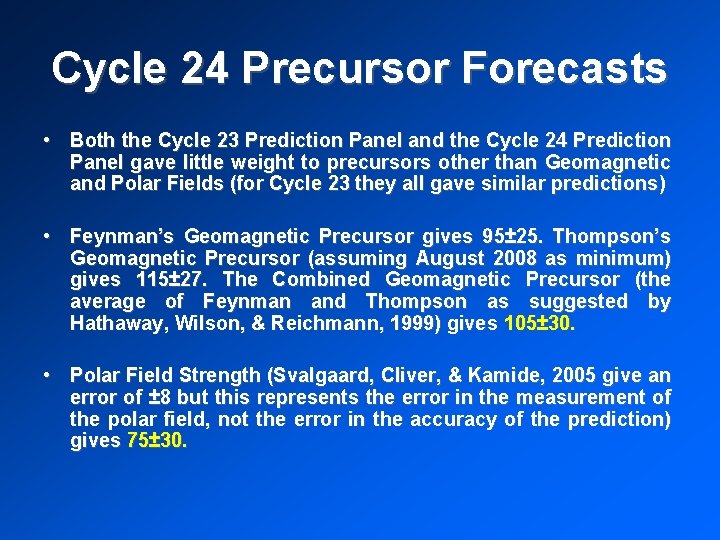
Cycle 24 Precursor Forecasts • Both the Cycle 23 Prediction Panel and the Cycle 24 Prediction Panel gave little weight to precursors other than Geomagnetic and Polar Fields (for Cycle 23 they all gave similar predictions) • Feynman’s Geomagnetic Precursor gives 95± 25. Thompson’s Geomagnetic Precursor (assuming August 2008 as minimum) gives 115± 27. The Combined Geomagnetic Precursor (the average of Feynman and Thompson as suggested by Hathaway, Wilson, & Reichmann, 1999) gives 105± 30. • Polar Field Strength (Svalgaard, Cliver, & Kamide, 2005 give an error of ± 8 but this represents the error in the measurement of the polar field, not the error in the accuracy of the prediction) gives 75± 30.
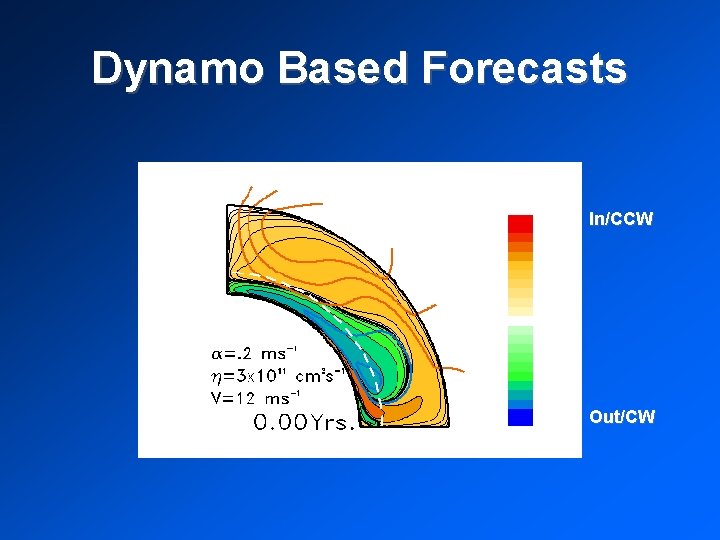
Dynamo Based Forecasts In/CCW Out/CW
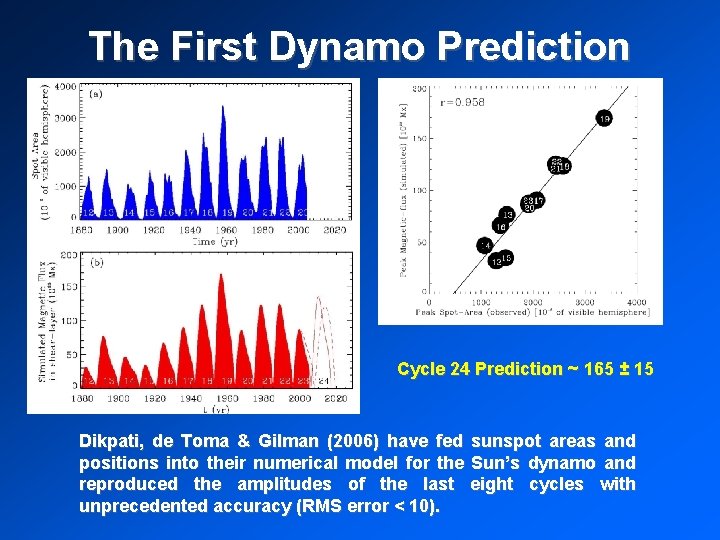
The First Dynamo Prediction Cycle 24 Prediction ~ 165 ± 15 Dikpati, de Toma & Gilman (2006) have fed sunspot areas and positions into their numerical model for the Sun’s dynamo and reproduced the amplitudes of the last eight cycles with unprecedented accuracy (RMS error < 10).
Caveats 1. They used our data for sunspot areas – which were 20% high for cycle 20. Their prediction for cycle 20 fit the erroneous value and later cycles were also predicted accurately in spite of the error in the input data. (They later ran the prediction again with the corrected values and found that the predictions didn’t change too much. ) 2. They kept the meridional flow speed constant. Yet, they allow it to change in cycle 23 and find a 10% change in the prediction. Similar variations in meridional flow speed should have occurred in the past.
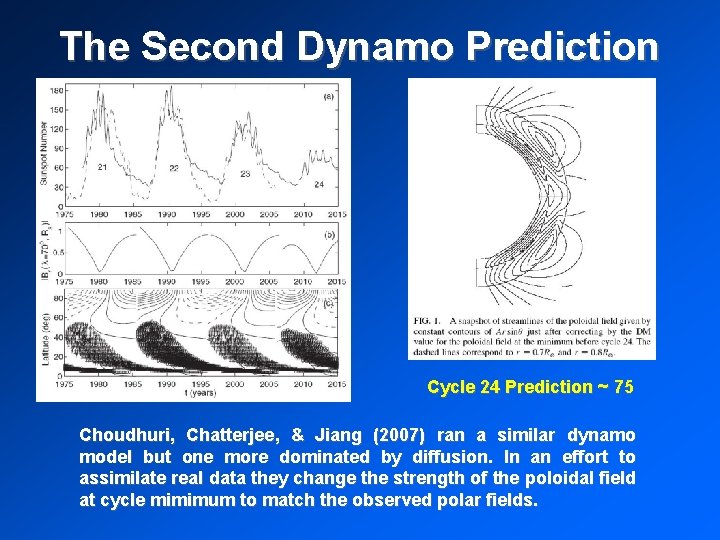
The Second Dynamo Prediction Cycle 24 Prediction ~ 75 Choudhuri, Chatterjee, & Jiang (2007) ran a similar dynamo model but one more dominated by diffusion. In an effort to assimilate real data they change the strength of the poloidal field at cycle mimimum to match the observed polar fields.
Caveats 1. They instantaneously change the poloidal field throughout most of the convection zone at each minimum. This effectively erases memory of previous cycles. 2. Their standard dynamo model gives 14 -year cycles. They tweak their parameters in these calculations to give 11 -year cycles but don’t indicate how these changes influence other aspects of their model’s fit to observations. 3. They only have 3 cycles for comparison.
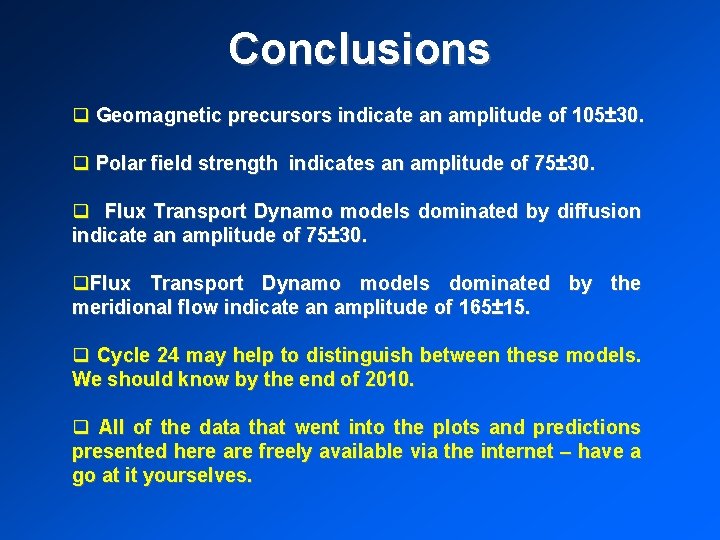
Conclusions q Geomagnetic precursors indicate an amplitude of 105± 30. q Polar field strength indicates an amplitude of 75± 30. q Flux Transport Dynamo models dominated by diffusion indicate an amplitude of 75± 30. q. Flux Transport Dynamo models dominated by the meridional flow indicate an amplitude of 165± 15. q Cycle 24 may help to distinguish between these models. We should know by the end of 2010. q All of the data that went into the plots and predictions presented here are freely available via the internet – have a go at it yourselves.