
Predicting Second to Third Year Retention Jinny Case
- Slides: 26
Predicting Second to Third Year Retention Jinny Case, Ph. D Office of Institutional Research The University of Texas at San Antonio, One UTSA Circle, San Antonio, TX 78249 1
Outline • • Overview of UTSA Background Literature review Predictive modeling process Variables Population Results Application The University of Texas at San Antonio, One UTSA Circle, San Antonio, TX 78249 2
Overview of UTSA – Established 1969 – Over 30, 000 students – Over 4, 500 FTIC students in fall 2017 – 95% in-state (48% Bexar County) – HSI – Majority minority – Over 40% first generation – Over 40% Pell recipients – Mission of access and excellence The University of Texas at San Antonio, One UTSA Circle, San Antonio, TX 78249 3
Background • Matriculation model • First term GPA model • Second to third year retention model The University of Texas at San Antonio, One UTSA Circle, San Antonio, TX 78249 4
Purpose • To determine probability of retention to the third year for students who made it to their second year • Develop a manageable target list of students likely to leave between their second and third year • Work with advising to contact students The University of Texas at San Antonio, One UTSA Circle, San Antonio, TX 78249 5
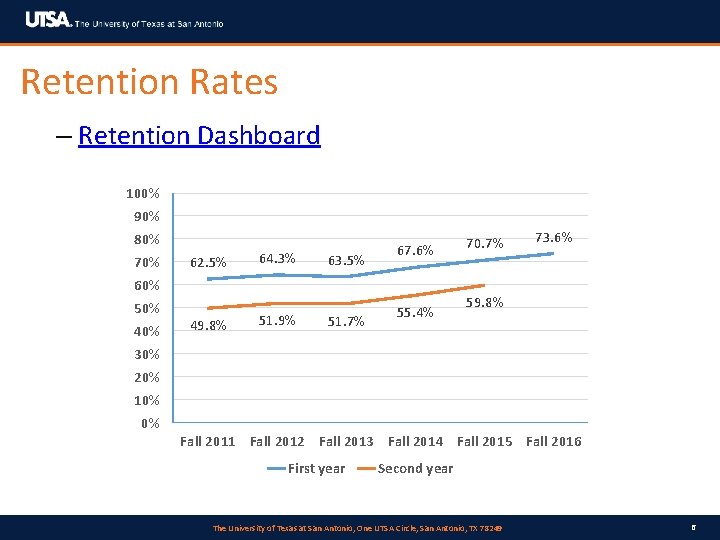
Retention Rates – Retention Dashboard 100% 90% 80% 70% 62. 5% 64. 3% 63. 5% 67. 6% 60% 50% 49. 8% 51. 9% 51. 7% 55. 4% 70. 7% 73. 6% 59. 8% 30% 20% 10% 0% Fall 2011 Fall 2012 Fall 2013 Fall 2014 Fall 2015 Fall 2016 First year Second year The University of Texas at San Antonio, One UTSA Circle, San Antonio, TX 78249 6
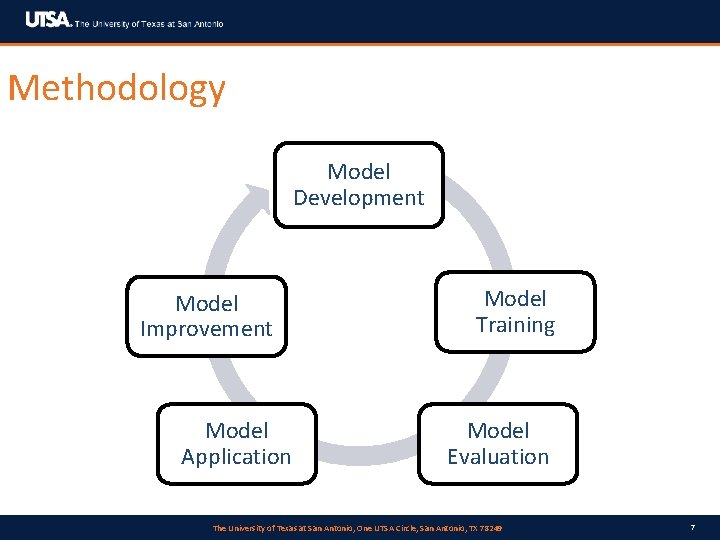
Methodology Model Development Model Improvement Model Application Model Training Model Evaluation The University of Texas at San Antonio, One UTSA Circle, San Antonio, TX 78249 7
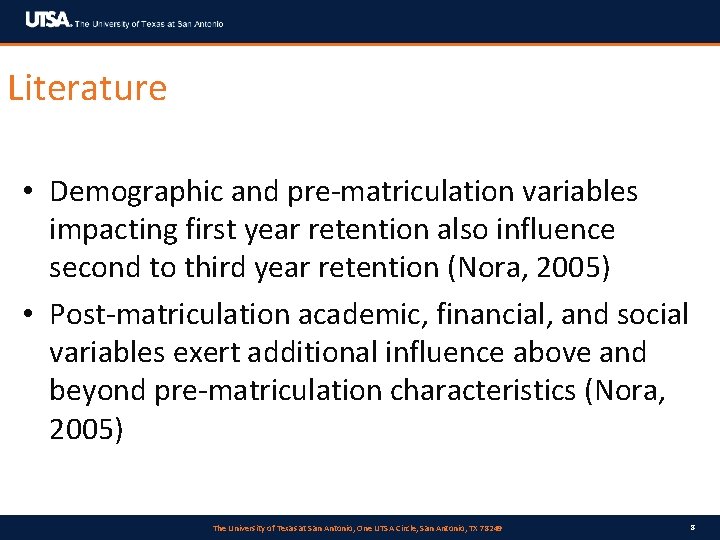
Literature • Demographic and pre-matriculation variables impacting first year retention also influence second to third year retention (Nora, 2005) • Post-matriculation academic, financial, and social variables exert additional influence above and beyond pre-matriculation characteristics (Nora, 2005) The University of Texas at San Antonio, One UTSA Circle, San Antonio, TX 78249 8
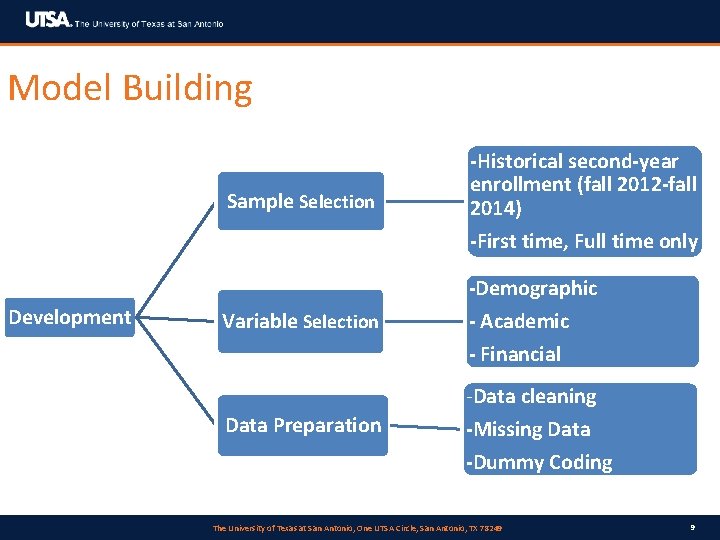
Model Building Development Sample Selection -Historical second-year enrollment (fall 2012 -fall 2014) -First time, Full time only Variable Selection -Demographic - Academic - Financial -Data cleaning Data Preparation -Missing Data -Dummy Coding The University of Texas at San Antonio, One UTSA Circle, San Antonio, TX 78249 9
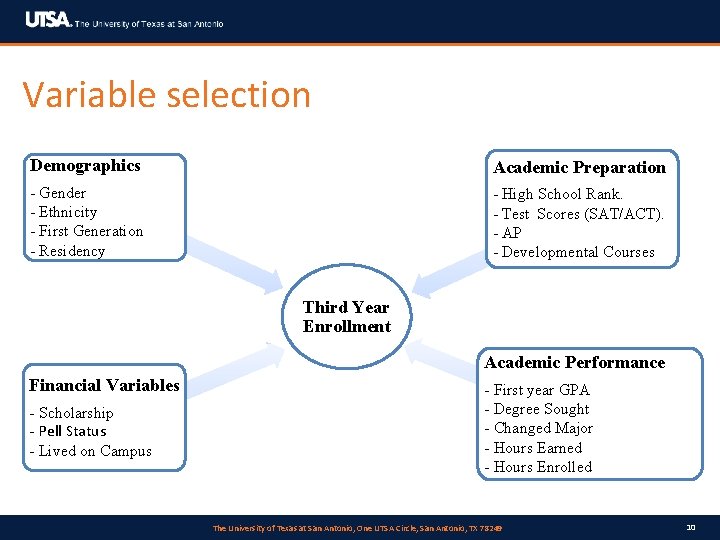
Variable selection Demographics Academic Preparation - Gender - Ethnicity - First Generation - Residency - High School Rank. - Test Scores (SAT/ACT). - AP - Developmental Courses Third Year Enrollment Academic Performance Financial Variables - Scholarship - Pell Status - Lived on Campus - First year GPA - Degree Sought - Changed Major - Hours Earned - Hours Enrolled The University of Texas at San Antonio, One UTSA Circle, San Antonio, TX 78249 10
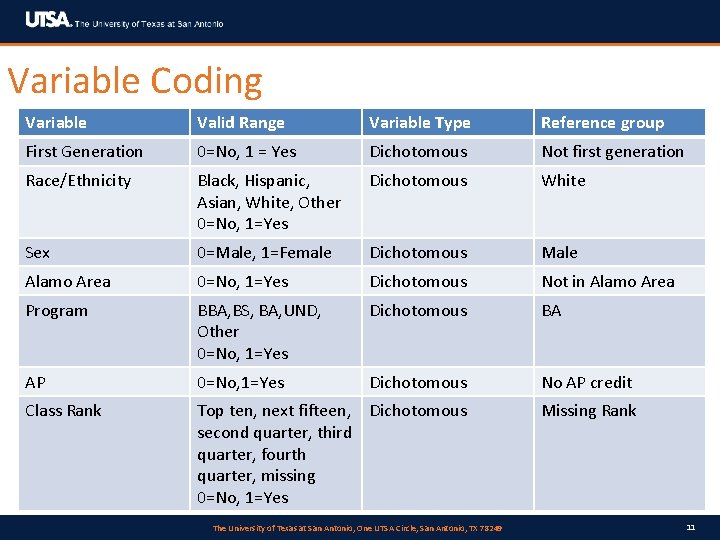
Variable Coding Variable Valid Range Variable Type Reference group First Generation 0=No, 1 = Yes Dichotomous Not first generation Race/Ethnicity Black, Hispanic, Asian, White, Other 0=No, 1=Yes Dichotomous White Sex 0=Male, 1=Female Dichotomous Male Alamo Area 0=No, 1=Yes Dichotomous Not in Alamo Area Program BBA, BS, BA, UND, Other 0=No, 1=Yes Dichotomous BA AP 0=No, 1=Yes Dichotomous No AP credit Class Rank Top ten, next fifteen, Dichotomous second quarter, third quarter, fourth quarter, missing 0=No, 1=Yes Missing Rank The University of Texas at San Antonio, One UTSA Circle, San Antonio, TX 78249 11
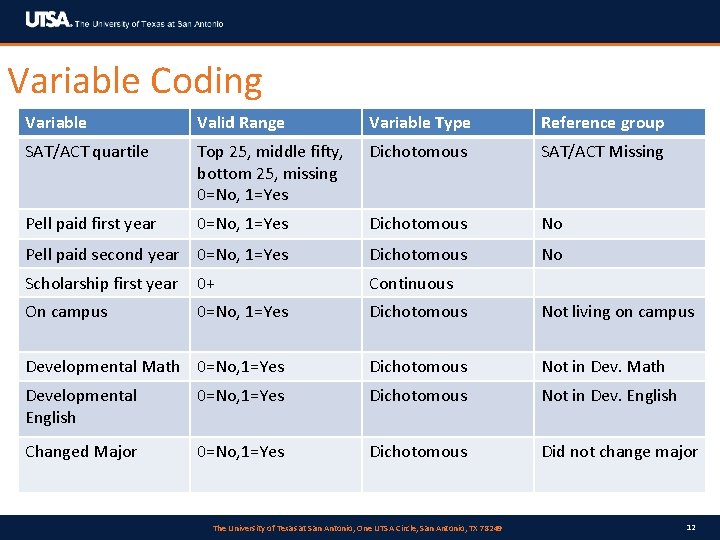
Variable Coding Variable Valid Range Variable Type Reference group SAT/ACT quartile Top 25, middle fifty, bottom 25, missing 0=No, 1=Yes Dichotomous SAT/ACT Missing Pell paid first year 0=No, 1=Yes Dichotomous No Pell paid second year 0=No, 1=Yes Dichotomous No Scholarship first year 0+ Continuous On campus 0=No, 1=Yes Dichotomous Not living on campus Developmental Math 0=No, 1=Yes Dichotomous Not in Dev. Math Developmental English 0=No, 1=Yes Dichotomous Not in Dev. English Changed Major 0=No, 1=Yes Dichotomous Did not change major The University of Texas at San Antonio, One UTSA Circle, San Antonio, TX 78249 12
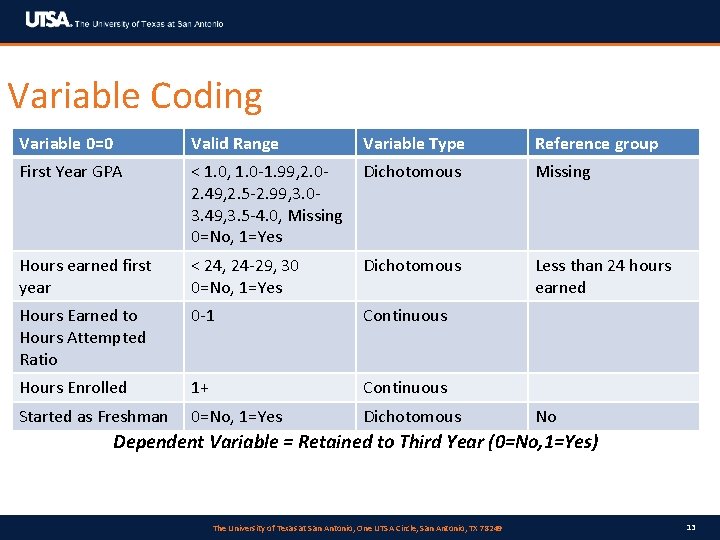
Variable Coding Variable 0=0 Valid Range Variable Type Reference group First Year GPA < 1. 0, 1. 0 -1. 99, 2. 02. 49, 2. 5 -2. 99, 3. 03. 49, 3. 5 -4. 0, Missing 0=No, 1=Yes Dichotomous Missing Hours earned first year < 24, 24 -29, 30 0=No, 1=Yes Dichotomous Less than 24 hours earned Hours Earned to Hours Attempted Ratio 0 -1 Continuous Hours Enrolled 1+ Continuous Started as Freshman 0=No, 1=Yes Dichotomous No Dependent Variable = Retained to Third Year (0=No, 1=Yes) The University of Texas at San Antonio, One UTSA Circle, San Antonio, TX 78249 13
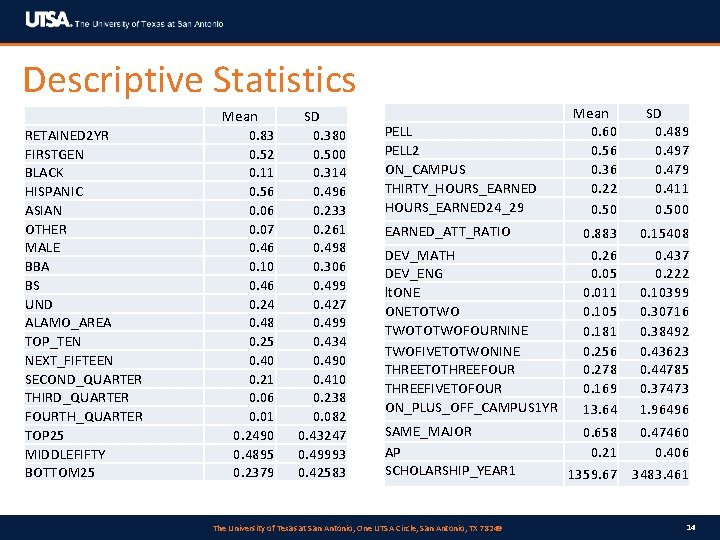
Descriptive Statistics RETAINED 2 YR FIRSTGEN BLACK HISPANIC ASIAN OTHER MALE BBA BS UND ALAMO_AREA TOP_TEN NEXT_FIFTEEN SECOND_QUARTER THIRD_QUARTER FOURTH_QUARTER TOP 25 MIDDLEFIFTY BOTTOM 25 Mean 0. 83 0. 52 0. 11 0. 56 0. 07 0. 46 0. 10 0. 46 0. 24 0. 48 0. 25 0. 40 0. 21 0. 06 0. 01 0. 2490 0. 4895 0. 2379 SD 0. 380 0. 500 0. 314 0. 496 0. 233 0. 261 0. 498 0. 306 0. 499 0. 427 0. 499 0. 434 0. 490 0. 410 0. 238 0. 082 0. 43247 0. 49993 0. 42583 Mean 0. 60 0. 56 0. 36 0. 22 0. 50 SD 0. 489 0. 497 0. 479 0. 411 0. 500 0. 883 DEV_MATH 0. 26 DEV_ENG 0. 05 lt. ONE 0. 011 ONETOTWO 0. 105 TWOTOTWOFOURNINE 0. 181 TWOFIVETOTWONINE 0. 256 THREETOTHREEFOUR 0. 278 THREEFIVETOFOUR 0. 169 ON_PLUS_OFF_CAMPUS 1 YR 13. 64 SAME_MAJOR 0. 658 AP 0. 21 SCHOLARSHIP_YEAR 1 1359. 67 0. 15408 0. 437 0. 222 0. 10399 0. 30716 0. 38492 0. 43623 0. 44785 0. 37473 1. 96496 0. 47460 0. 406 3483. 461 PELL 2 ON_CAMPUS THIRTY_HOURS_EARNED 24_29 EARNED_ATT_RATIO The University of Texas at San Antonio, One UTSA Circle, San Antonio, TX 78249 14
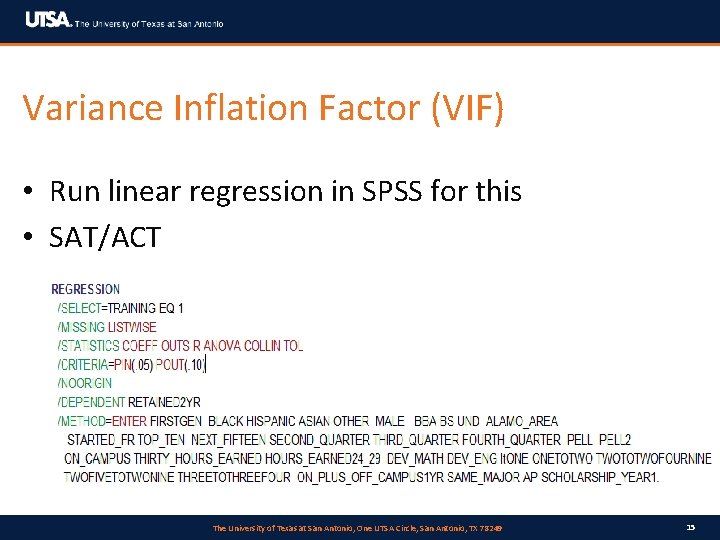
Variance Inflation Factor (VIF) • Run linear regression in SPSS for this • SAT/ACT The University of Texas at San Antonio, One UTSA Circle, San Antonio, TX 78249 15
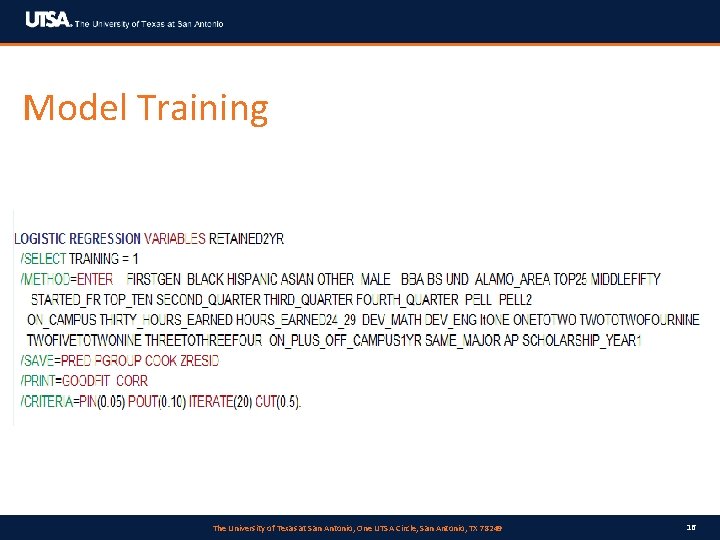
Model Training The University of Texas at San Antonio, One UTSA Circle, San Antonio, TX 78249 16
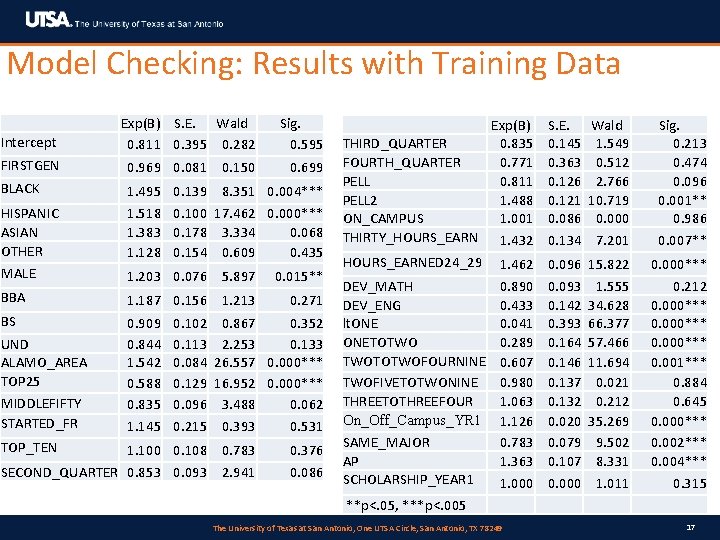
Model Checking: Results with Training Data Intercept FIRSTGEN BLACK HISPANIC ASIAN OTHER MALE Exp(B) S. E. Wald 0. 811 0. 395 0. 282 Sig. 0. 595 0. 969 0. 081 0. 150 0. 699 1. 495 1. 518 1. 383 1. 128 0. 139 0. 100 0. 178 0. 154 8. 351 0. 004*** 17. 462 0. 000*** 3. 334 0. 068 0. 609 0. 435 1. 203 0. 076 5. 897 0. 015** BBA 1. 187 0. 156 1. 213 0. 271 BS UND ALAMO_AREA TOP 25 MIDDLEFIFTY STARTED_FR 0. 909 0. 844 1. 542 0. 588 0. 835 1. 145 TOP_TEN 0. 102 0. 113 0. 084 0. 129 0. 096 0. 215 0. 867 0. 352 2. 253 0. 133 26. 557 0. 000*** 16. 952 0. 000*** 3. 488 0. 062 0. 393 0. 531 1. 100 0. 108 0. 783 SECOND_QUARTER 0. 853 0. 093 2. 941 0. 376 0. 086 Exp(B) THIRD_QUARTER 0. 835 FOURTH_QUARTER 0. 771 PELL 0. 811 PELL 2 1. 488 ON_CAMPUS 1. 001 THIRTY_HOURS_EARN 1. 432 HOURS_EARNED 24_29 1. 462 DEV_MATH DEV_ENG lt. ONETOTWO TWOTOTWOFOURNINE TWOFIVETOTWONINE THREETOTHREEFOUR On_Off_Campus_YR 1 SAME_MAJOR AP SCHOLARSHIP_YEAR 1 0. 890 0. 433 0. 041 0. 289 0. 607 0. 980 1. 063 1. 126 0. 783 1. 363 1. 000 S. E. 0. 145 0. 363 0. 126 0. 121 0. 086 0. 134 Wald 1. 549 0. 512 2. 766 10. 719 0. 000 7. 201 Sig. 0. 213 0. 474 0. 096 0. 001** 0. 986 0. 007** 0. 096 0. 093 0. 142 0. 393 0. 164 0. 146 0. 137 0. 132 0. 020 0. 079 0. 107 0. 000 15. 822 1. 555 34. 628 66. 377 57. 466 11. 694 0. 021 0. 212 35. 269 9. 502 8. 331 1. 011 0. 000*** 0. 212 0. 000*** 0. 001*** 0. 884 0. 645 0. 000*** 0. 002*** 0. 004*** 0. 315 **p<. 05, ***p<. 005 The University of Texas at San Antonio, One UTSA Circle, San Antonio, TX 78249 17
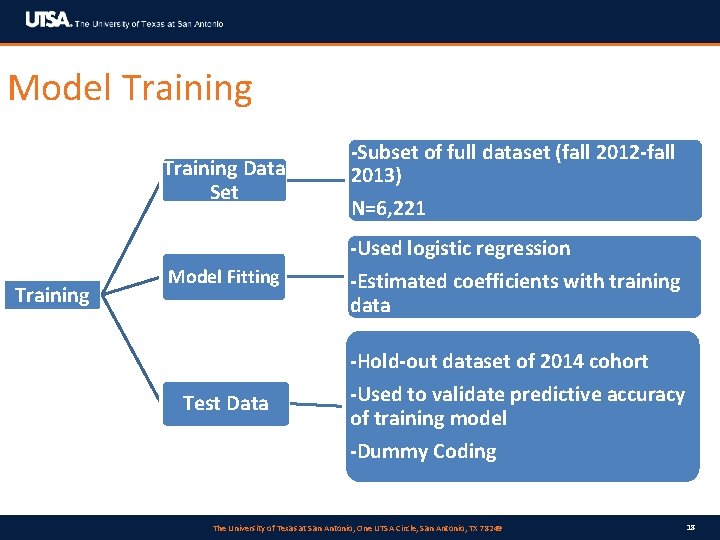
Model Training Data Set -Subset of full dataset (fall 2012 -fall 2013) N=6, 221 Model Fitting -Used logistic regression -Estimated coefficients with training data Test Data -Hold-out dataset of 2014 cohort -Used to validate predictive accuracy of training model -Dummy Coding The University of Texas at San Antonio, One UTSA Circle, San Antonio, TX 78249 18
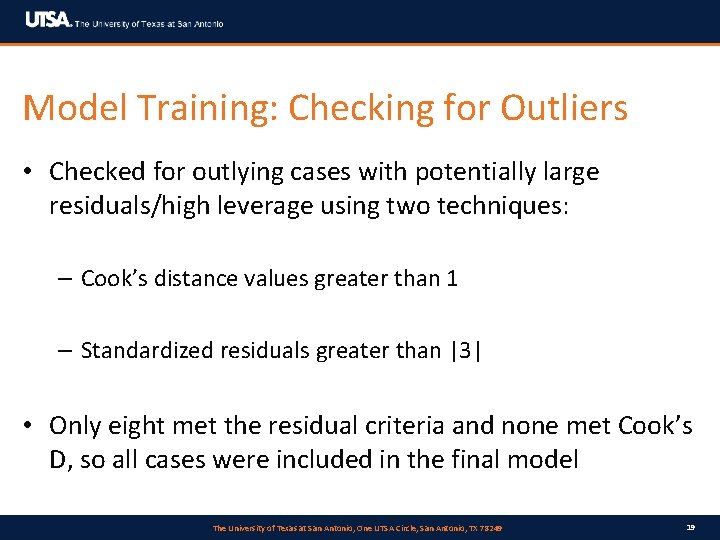
Model Training: Checking for Outliers • Checked for outlying cases with potentially large residuals/high leverage using two techniques: – Cook’s distance values greater than 1 – Standardized residuals greater than |3| • Only eight met the residual criteria and none met Cook’s D, so all cases were included in the final model The University of Texas at San Antonio, One UTSA Circle, San Antonio, TX 78249 19
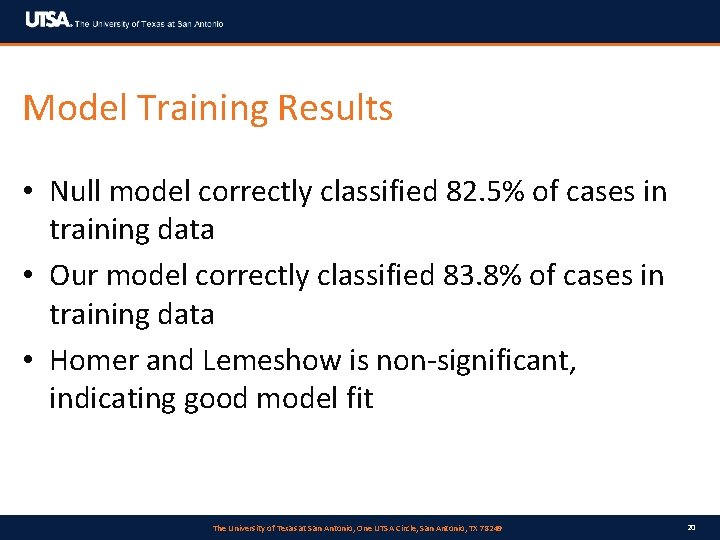
Model Training Results • Null model correctly classified 82. 5% of cases in training data • Our model correctly classified 83. 8% of cases in training data • Homer and Lemeshow is non-significant, indicating good model fit The University of Texas at San Antonio, One UTSA Circle, San Antonio, TX 78249 20
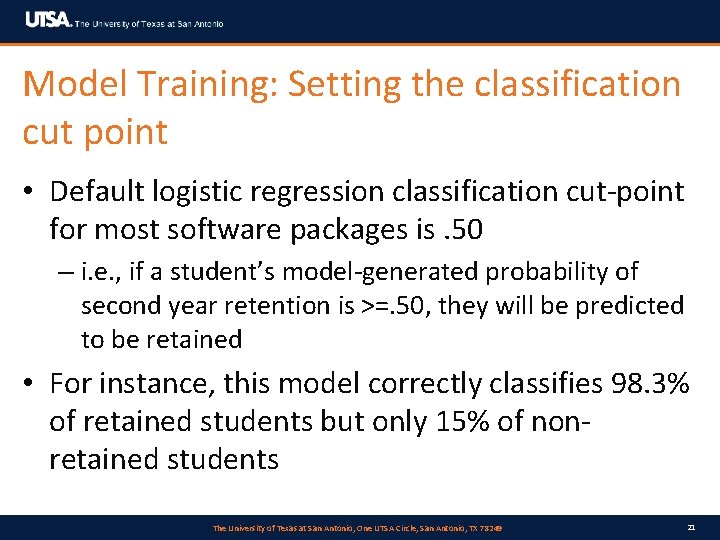
Model Training: Setting the classification cut point • Default logistic regression classification cut-point for most software packages is. 50 – i. e. , if a student’s model-generated probability of second year retention is >=. 50, they will be predicted to be retained • For instance, this model correctly classifies 98. 3% of retained students but only 15% of nonretained students The University of Texas at San Antonio, One UTSA Circle, San Antonio, TX 78249 21
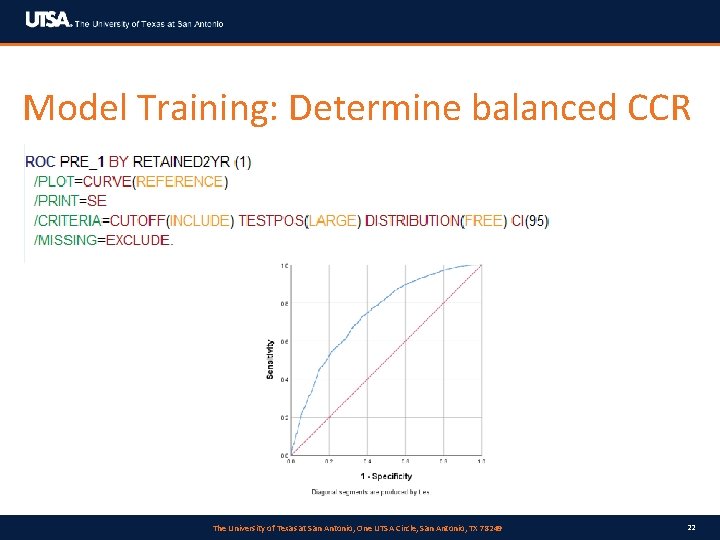
Model Training: Determine balanced CCR The University of Texas at San Antonio, One UTSA Circle, San Antonio, TX 78249 22
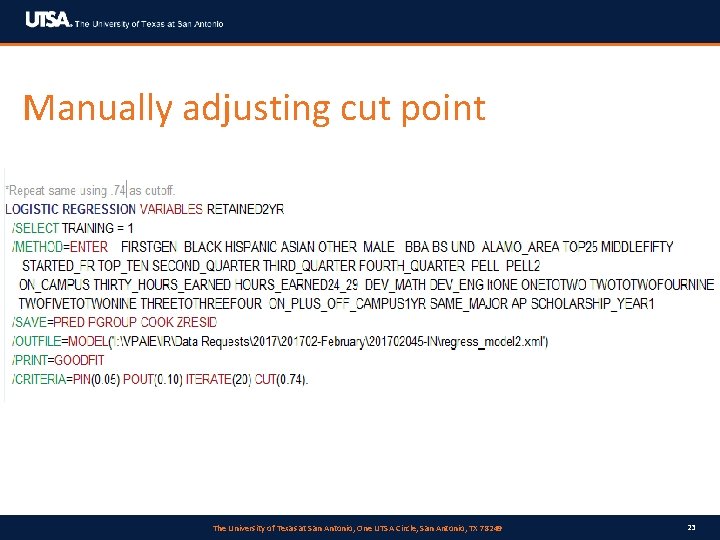
Manually adjusting cut point The University of Texas at San Antonio, One UTSA Circle, San Antonio, TX 78249 23
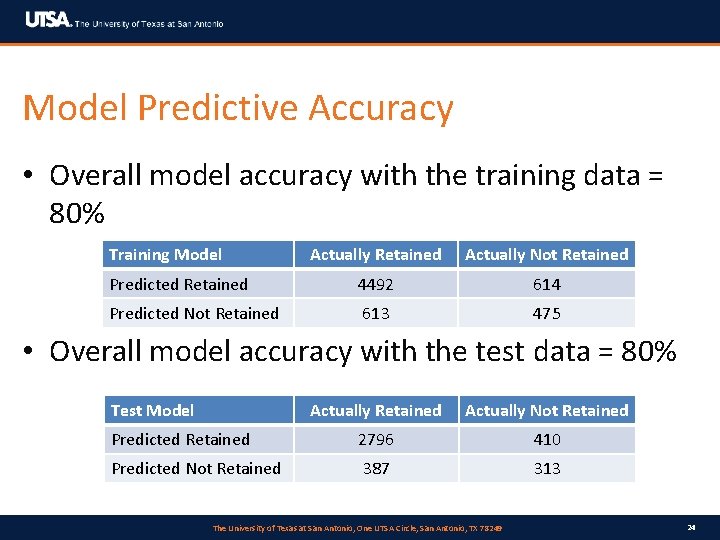
Model Predictive Accuracy • Overall model accuracy with the training data = 80% Training Model Actually Retained Actually Not Retained Predicted Retained 4492 614 Predicted Not Retained 613 475 • Overall model accuracy with the test data = 80% Test Model Actually Retained Actually Not Retained Predicted Retained 2796 410 Predicted Not Retained 387 313 The University of Texas at San Antonio, One UTSA Circle, San Antonio, TX 78249 24
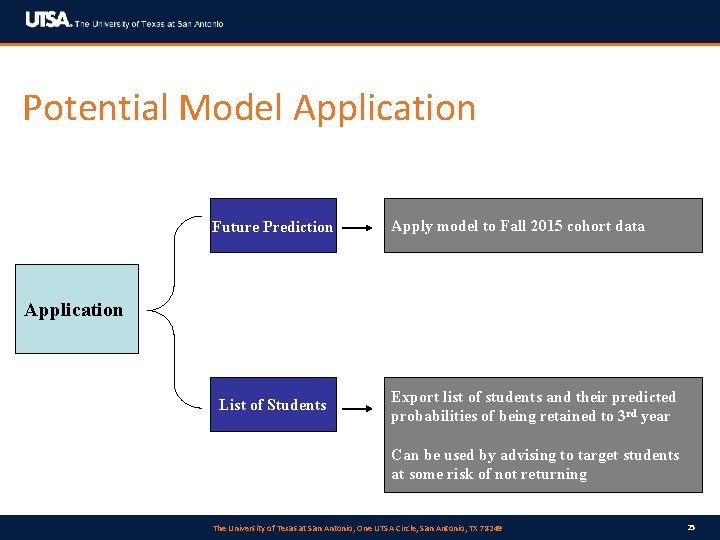
Potential Model Application Future Prediction Apply model to Fall 2015 cohort data Application List of Students Export list of students and their predicted probabilities of being retained to 3 rd year Can be used by advising to target students at some risk of not returning The University of Texas at San Antonio, One UTSA Circle, San Antonio, TX 78249 25
Resources • Nora, A. (2005) Student Persistence and Degree Attainment Beyond the First Year in College in Seidman, A. College student retention: formula for student success(pp 129 -153). Westport, CT: Praeger Publishers. The University of Texas at San Antonio, One UTSA Circle, San Antonio, TX 78249 26