
Predicting Products of Reactions Synthesis Reactants combine to
Predicting Products of Reactions • Synthesis: Reactants combine to form a single product – make sure the product has an acceptable formula (ions are correct charges, etc. ) • Decomposition: Reactant breaks down into simpler products – Binary compounds decompose into elements – Carbonates produce CO 2 and oxide • Na 2 CO 3 Na 2 O + CO 2 – Explosives produce gases
Predicting Products of Reactions • Single Replacement – Element replaces another element (generally, metal or hydrogen replace one another, nonmetal replaces nonmetal) • Double Replacement – Positive ions “switch” partners • Combustion – reaction with O 2 produces oxides (often H 2 O and CO 2)
Examples – Predict products and write balanced equations 1. Decomposition of calcium carbonate 2. Decomposition of aluminum oxide 3. Al + Cl 2 4. Zn + HCl 5. Combustion of butane (C 4 H 10) 6. Ca(NO 3)2 + K 2 CO 3 7. Ca + H 2 O
Energy and Chemical Reactions Endothermic – A process that absorbs heat energy from its surroundings. * Causes the temperature of surrounding substances to decrease. EXAMPLES? Exothermic – A process that gives off heat to its surroundings. * Causes the temperature of surrounding substances to increase. EXAMPLES?
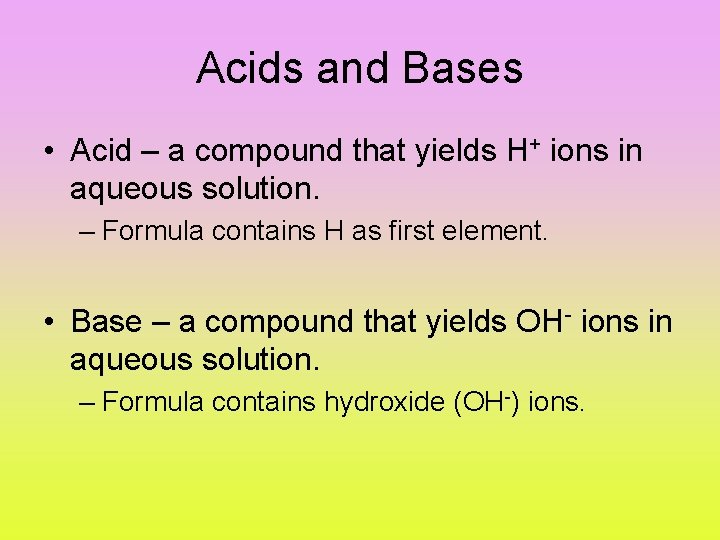
Acids and Bases • Acid – a compound that yields H+ ions in aqueous solution. – Formula contains H as first element. • Base – a compound that yields OH- ions in aqueous solution. – Formula contains hydroxide (OH-) ions.
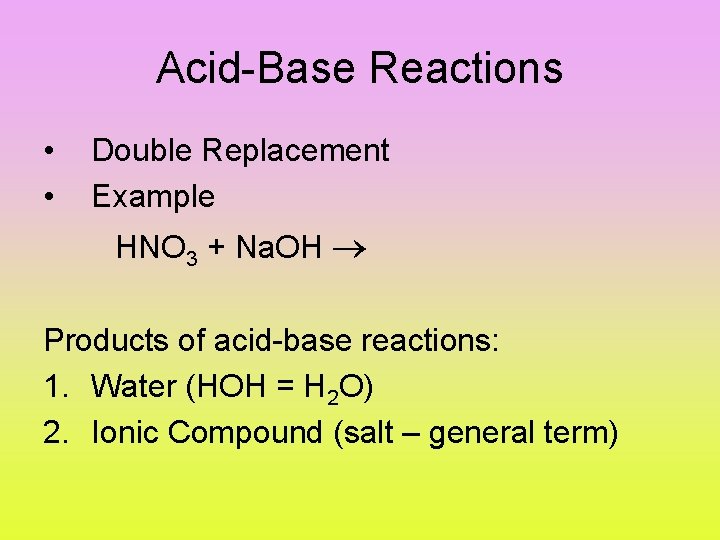
Acid-Base Reactions • • Double Replacement Example HNO 3 + Na. OH Products of acid-base reactions: 1. Water (HOH = H 2 O) 2. Ionic Compound (salt – general term)
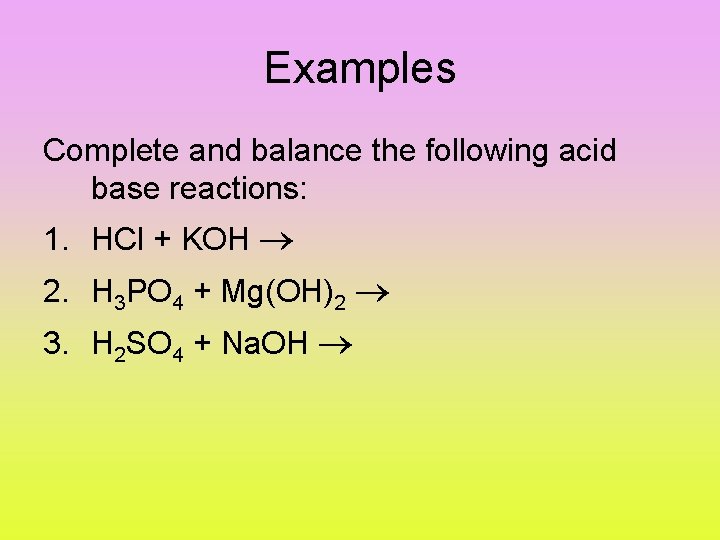
Examples Complete and balance the following acid base reactions: 1. HCl + KOH 2. H 3 PO 4 + Mg(OH)2 3. H 2 SO 4 + Na. OH
- Slides: 7