
Predicting peptide MHC interactions Morten Nielsen CBS Department
Predicting peptide MHC interactions Morten Nielsen, CBS, Department of Systems Biology, DTU
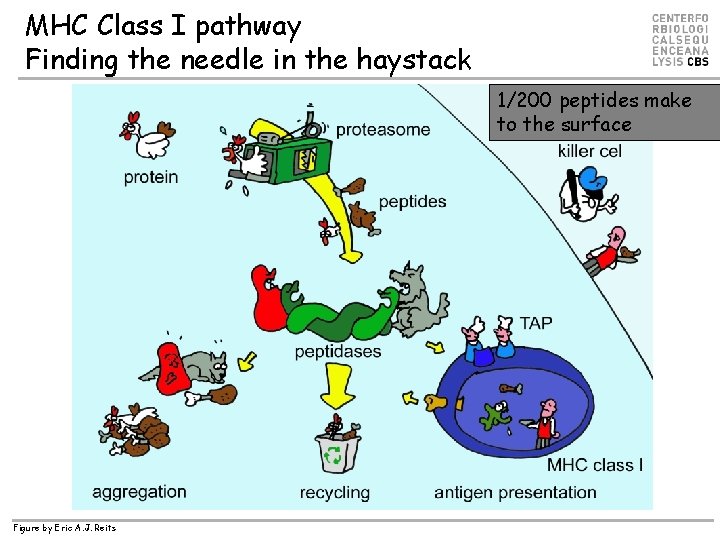
MHC Class I pathway Finding the needle in the haystack 1/200 peptides make to the surface Figure by Eric A. J. Reits
What defines a T cell epitope? • • • MHC binding Processing (Proteasomal cleavage, TAP)? Other proteases T cell repertoire MHC: peptide complex stability Source protein abundance, cellular location and function
Finding the needle in the haystack
Objectives • Visualization of binding motifs – Construction of sequence logos • Understand the concepts of weight matrix construction – One of the most important methods of bioinformatics • A few word on Artificial neural networks • MHC binding rules – No other factors in the MHC (I and II) pathways are (as) decisive for T cell epitope identification • All known T cell epitopes have specific MHC restrictions matching their host • MHC binding is the single most important feature for understanding cellular immunity
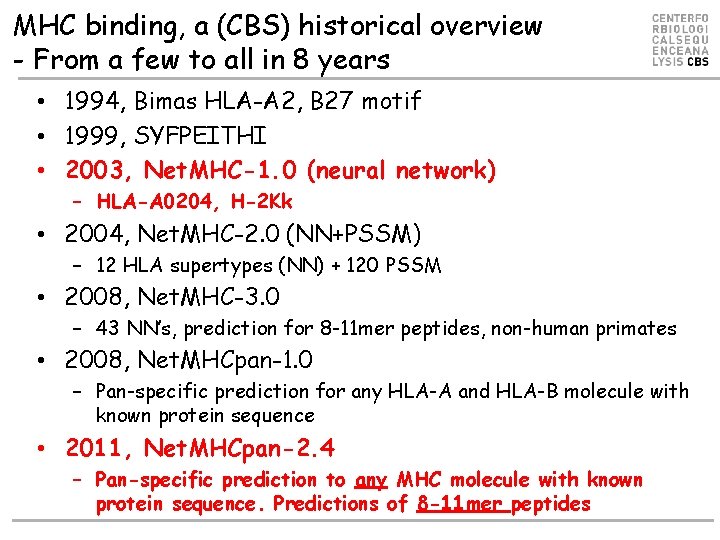
MHC binding, a (CBS) historical overview - From a few to all in 8 years • 1994, Bimas HLA-A 2, B 27 motif • 1999, SYFPEITHI • 2003, Net. MHC-1. 0 (neural network) – HLA-A 0204, H-2 Kk • 2004, Net. MHC-2. 0 (NN+PSSM) – 12 HLA supertypes (NN) + 120 PSSM • 2008, Net. MHC-3. 0 – 43 NN’s, prediction for 8 -11 mer peptides, non-human primates • 2008, Net. MHCpan-1. 0 – Pan-specific prediction for any HLA-A and HLA-B molecule with known protein sequence • 2011, Net. MHCpan-2. 4 – Pan-specific prediction to any MHC molecule with known protein sequence. Predictions of 8 -11 mer peptides
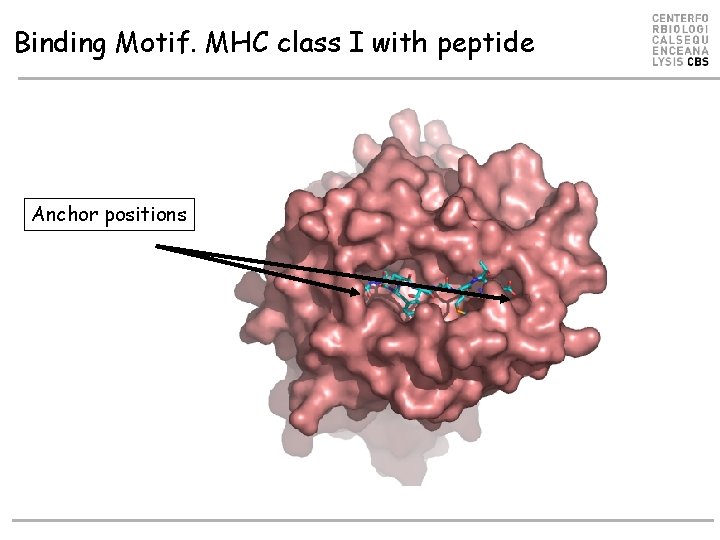
Binding Motif. MHC class I with peptide Anchor positions
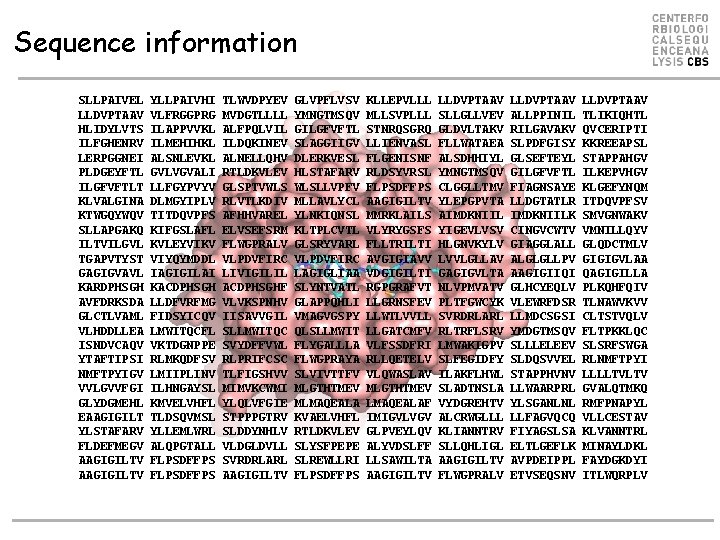
Sequence information SLLPAIVEL LLDVPTAAV HLIDYLVTS ILFGHENRV LERPGGNEI PLDGEYFTL ILGFVFTLT KLVALGINA KTWGQYWQV SLLAPGAKQ ILTVILGVL TGAPVTYST GAGIGVAVL KARDPHSGH AVFDRKSDA GLCTLVAML VLHDDLLEA ISNDVCAQV YTAFTIPSI NMFTPYIGV VVLGVVFGI GLYDGMEHL EAAGIGILT YLSTAFARV FLDEFMEGV AAGIGILTV YLLPAIVHI VLFRGGPRG ILAPPVVKL ILMEHIHKL ALSNLEVKL GVLVGVALI LLFGYPVYV DLMGYIPLV TITDQVPFS KIFGSLAFL KVLEYVIKV VIYQYMDDL IAGIGILAI KACDPHSGH LLDFVRFMG FIDSYICQV LMWITQCFL VKTDGNPPE RLMKQDFSV LMIIPLINV ILHNGAYSL KMVELVHFL TLDSQVMSL YLLEMLWRL ALQPGTALL FLPSDFFPS TLWVDPYEV MVDGTLLLL ALFPQLVIL ILDQKINEV ALNELLQHV RTLDKVLEV GLSPTVWLS RLVTLKDIV AFHHVAREL ELVSEFSRM FLWGPRALV VLPDVFIRC LIVIGILIL ACDPHSGHF VLVKSPNHV IISAVVGIL SLLMWITQC SVYDFFVWL RLPRIFCSC TLFIGSHVV MIMVKCWMI YLQLVFGIE STPPPGTRV SLDDYNHLV VLDGLDVLL SVRDRLARL AAGIGILTV GLVPFLVSV YMNGTMSQV GILGFVFTL SLAGGIIGV DLERKVESL HLSTAFARV WLSLLVPFV MLLAVLYCL YLNKIQNSL KLTPLCVTL GLSRYVARL VLPDVFIRC LAGIGLIAA SLYNTVATL GLAPPQHLI VMAGVGSPY QLSLLMWIT FLYGALLLA FLWGPRAYA SLVIVTTFV MLGTHTMEV MLMAQEALA KVAELVHFL RTLDKVLEV SLYSFPEPE SLREWLLRI FLPSDFFPS KLLEPVLLL MLLSVPLLL STNRQSGRQ LLIENVASL FLGENISNF RLDSYVRSL FLPSDFFPS AAGIGILTV MMRKLAILS VLYRYGSFS FLLTRILTI AVGIGIAVV VDGIGILTI RGPGRAFVT LLGRNSFEV LLWTLVVLL LLGATCMFV VLFSSDFRI RLLQETELV VLQWASLAV MLGTHTMEV LMAQEALAF IMIGVLVGV GLPVEYLQV ALYVDSLFF LLSAWILTA AAGIGILTV LLDVPTAAV SLLGLLVEV GLDVLTAKV FLLWATAEA ALSDHHIYL YMNGTMSQV CLGGLLTMV YLEPGPVTA AIMDKNIIL YIGEVLVSV HLGNVKYLV LVVLGLLAV GAGIGVLTA NLVPMVATV PLTFGWCYK SVRDRLARL RLTRFLSRV LMWAKIGPV SLFEGIDFY ILAKFLHWL SLADTNSLA VYDGREHTV ALCRWGLLL KLIANNTRV SLLQHLIGL AAGIGILTV FLWGPRALV LLDVPTAAV ALLPPINIL RILGAVAKV SLPDFGISY GLSEFTEYL GILGFVFTL FIAGNSAYE LLDGTATLR IMDKNIILK CINGVCWTV GIAGGLALL ALGLGLLPV AAGIGIIQI GLHCYEQLV VLEWRFDSR LLMDCSGSI YMDGTMSQV SLLLELEEV SLDQSVVEL STAPPHVNV LLWAARPRL YLSGANLNL LLFAGVQCQ FIYAGSLSA ELTLGEFLK AVPDEIPPL ETVSEQSNV LLDVPTAAV TLIKIQHTL QVCERIPTI KKREEAPSL STAPPAHGV ILKEPVHGV KLGEFYNQM ITDQVPFSV SMVGNWAKV VMNILLQYV GLQDCTMLV GIGIGVLAA QAGIGILLA PLKQHFQIV TLNAWVKVV CLTSTVQLV FLTPKKLQC SLSRFSWGA RLNMFTPYI LLLLTVLTV GVALQTMKQ RMFPNAPYL VLLCESTAV KLVANNTRL MINAYLDKL FAYDGKDYI ITLWQRPLV
Sequence Information • Say that a peptide must have L at P 2 in order to bind, and that A, F, W, and Y are found at P 1. Which position has most information? • How many questions do I need to ask to tell if a peptide binds looking at only P 1 or P 2?
Sequence Information • Say that a peptide must have L at P 2 in order to bind, and that A, F, W, and Y are found at P 1. Which position has most information? • How many questions do I need to ask to tell if a peptide binds looking at only P 1 or P 2? • P 1: 4 questions (at most) • P 2: 1 question (L or not) • P 2 has the most information
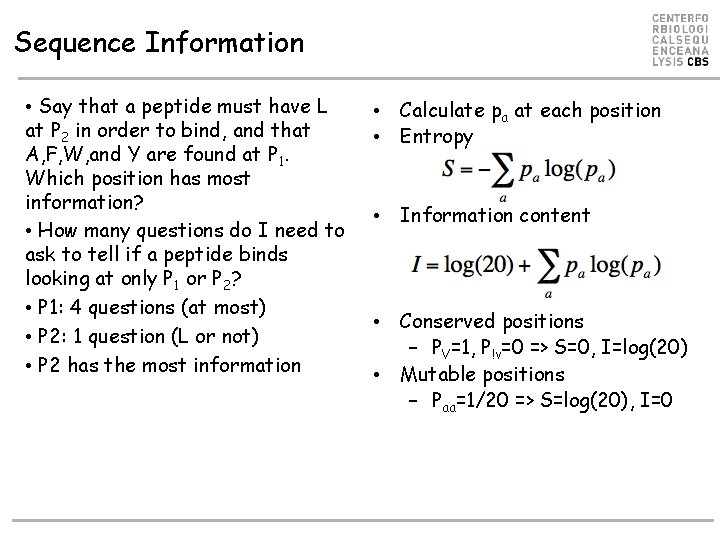
Sequence Information • Say that a peptide must have L at P 2 in order to bind, and that A, F, W, and Y are found at P 1. Which position has most information? • How many questions do I need to ask to tell if a peptide binds looking at only P 1 or P 2? • P 1: 4 questions (at most) • P 2: 1 question (L or not) • P 2 has the most information • Calculate pa at each position • Entropy • Information content • Conserved positions – PV=1, P!v=0 => S=0, I=log(20) • Mutable positions – Paa=1/20 => S=log(20), I=0
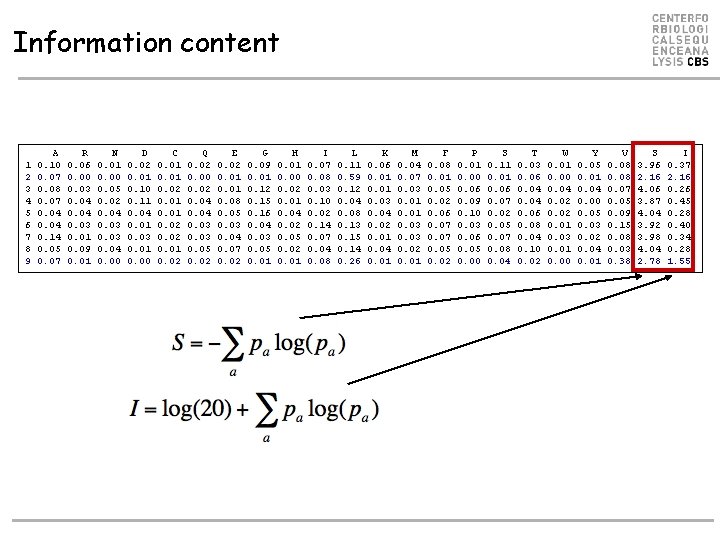
Information content 1 2 3 4 5 6 7 8 9 A 0. 10 0. 07 0. 08 0. 07 0. 04 0. 14 0. 05 0. 07 R 0. 06 0. 00 0. 03 0. 04 0. 03 0. 01 0. 09 0. 01 N 0. 01 0. 00 0. 05 0. 02 0. 04 0. 03 0. 04 0. 00 D 0. 02 0. 01 0. 10 0. 11 0. 04 0. 01 0. 03 0. 01 0. 00 C 0. 01 0. 02 Q 0. 02 0. 00 0. 02 0. 04 0. 03 0. 05 0. 02 E 0. 02 0. 01 0. 08 0. 05 0. 03 0. 04 0. 07 0. 02 G 0. 09 0. 01 0. 12 0. 15 0. 16 0. 04 0. 03 0. 05 0. 01 H 0. 01 0. 00 0. 02 0. 01 0. 04 0. 02 0. 05 0. 02 0. 01 I 0. 07 0. 08 0. 03 0. 10 0. 02 0. 14 0. 07 0. 04 0. 08 L 0. 11 0. 59 0. 12 0. 04 0. 08 0. 13 0. 15 0. 14 0. 26 K 0. 06 0. 01 0. 03 0. 04 0. 02 0. 01 0. 04 0. 01 M 0. 04 0. 07 0. 03 0. 01 0. 03 0. 02 0. 01 F 0. 08 0. 01 0. 05 0. 02 0. 06 0. 07 0. 05 0. 02 P 0. 01 0. 00 0. 06 0. 09 0. 10 0. 03 0. 06 0. 05 0. 00 S 0. 11 0. 06 0. 07 0. 02 0. 05 0. 07 0. 08 0. 04 T 0. 03 0. 06 0. 04 0. 06 0. 08 0. 04 0. 10 0. 02 W 0. 01 0. 00 0. 04 0. 02 0. 01 0. 03 0. 01 0. 00 Y 0. 05 0. 01 0. 04 0. 00 0. 05 0. 03 0. 02 0. 04 0. 01 V 0. 08 0. 07 0. 05 0. 09 0. 15 0. 08 0. 03 0. 38 S 3. 96 2. 16 4. 06 3. 87 4. 04 3. 92 3. 98 4. 04 2. 78 I 0. 37 2. 16 0. 26 0. 45 0. 28 0. 40 0. 34 0. 28 1. 55
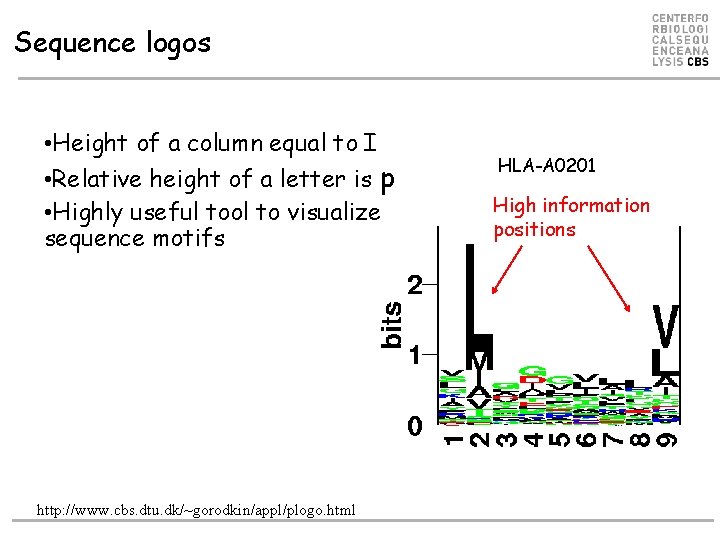
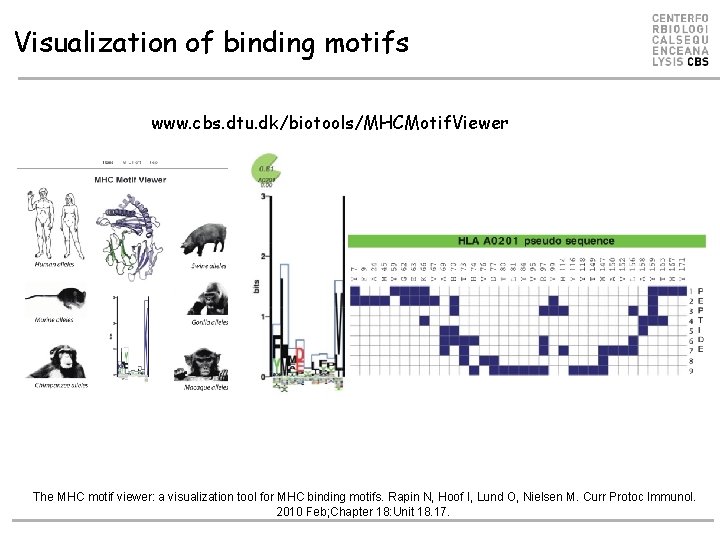
Sequence logos • Height of a column equal to I • Relative height of a letter is p • Highly useful tool to visualize sequence motifs http: //www. cbs. dtu. dk/~gorodkin/appl/plogo. html HLA-A 0201 High information positions
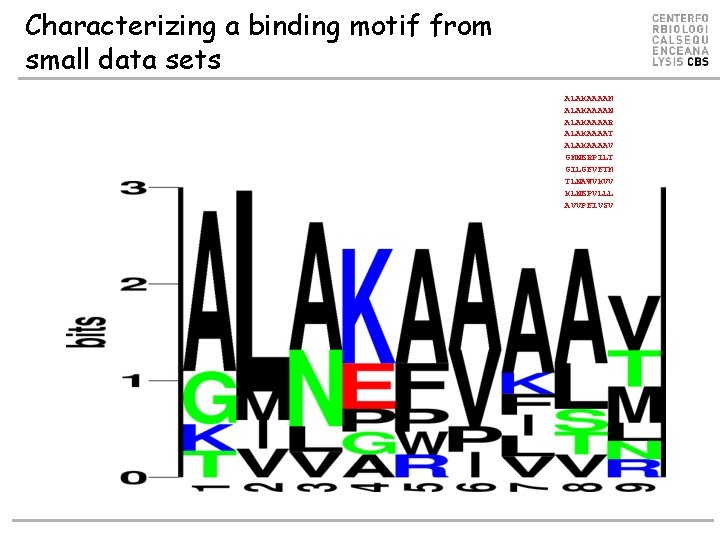
Characterizing a binding motif from small data sets ALAKAAAAM ALAKAAAAN ALAKAAAAR ALAKAAAAT ALAKAAAAV GMNERPILT GILGFVFTM TLNAWVKVV KLNEPVLLL AVVPFIVSV
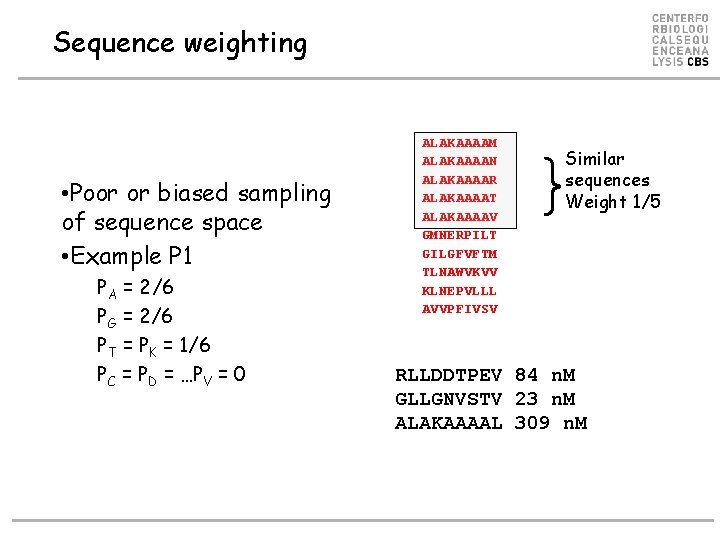
Sequence weighting • Poor or biased sampling of sequence space • Example P 1 PA = 2/6 PG = 2/6 PT = PK = 1/6 PC = PD = …PV = 0 ALAKAAAAM ALAKAAAAN ALAKAAAAR ALAKAAAAT ALAKAAAAV GMNERPILT GILGFVFTM TLNAWVKVV KLNEPVLLL AVVPFIVSV } Similar sequences Weight 1/5 RLLDDTPEV 84 n. M GLLGNVSTV 23 n. M ALAKAAAAL 309 n. M
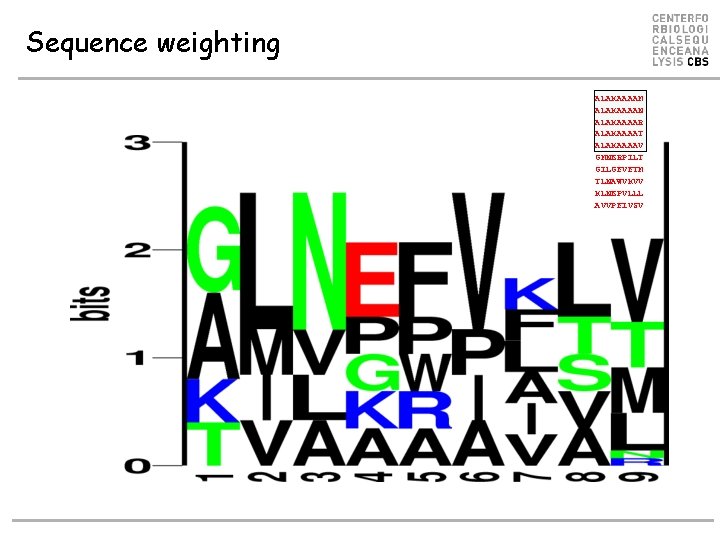
Sequence weighting ALAKAAAAM ALAKAAAAN ALAKAAAAR ALAKAAAAT ALAKAAAAV GMNERPILT GILGFVFTM TLNAWVKVV KLNEPVLLL AVVPFIVSV
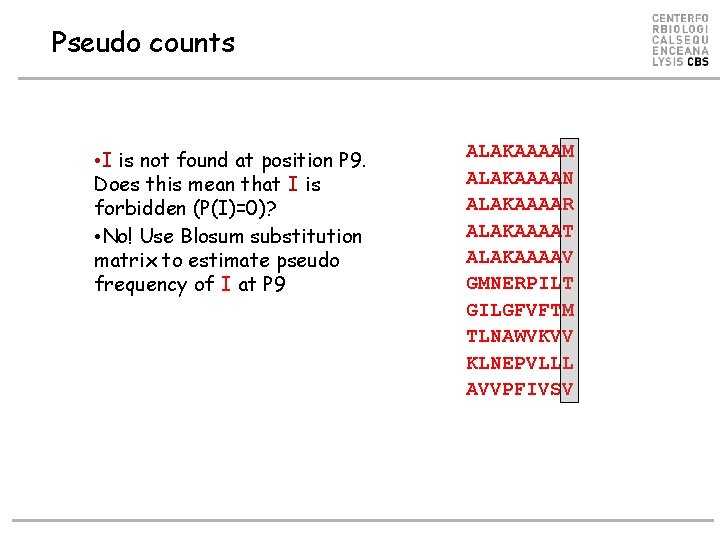
Pseudo counts • I is not found at position P 9. Does this mean that I is forbidden (P(I)=0)? • No! Use Blosum substitution matrix to estimate pseudo frequency of I at P 9 ALAKAAAAM ALAKAAAAN ALAKAAAAR ALAKAAAAT ALAKAAAAV GMNERPILT GILGFVFTM TLNAWVKVV KLNEPVLLL AVVPFIVSV
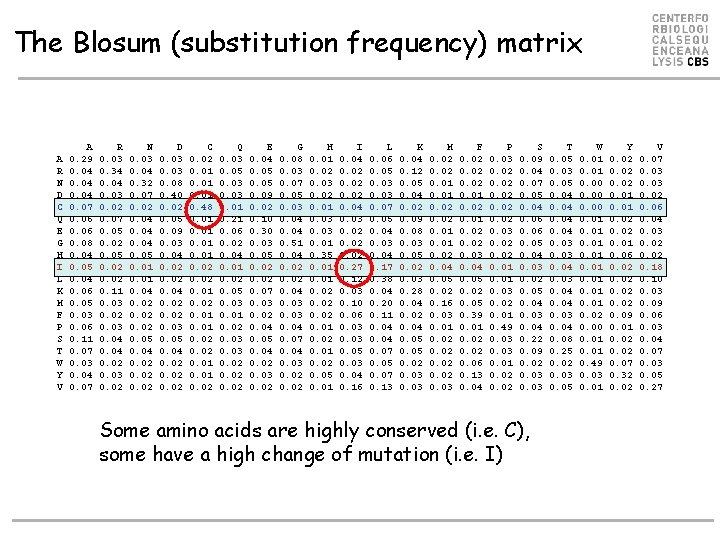
The Blosum (substitution frequency) matrix A R N D C Q E G H I L K M F P S T W Y V A 0. 29 0. 04 0. 07 0. 06 0. 08 0. 04 0. 05 0. 04 0. 06 0. 05 0. 03 0. 06 0. 11 0. 07 0. 03 0. 04 0. 07 R 0. 03 0. 34 0. 03 0. 02 0. 07 0. 05 0. 02 0. 11 0. 03 0. 02 0. 03 0. 04 0. 02 0. 03 0. 02 N 0. 03 0. 04 0. 32 0. 07 0. 02 0. 04 0. 05 0. 01 0. 04 0. 02 0. 05 0. 04 0. 02 D 0. 03 0. 08 0. 40 0. 02 0. 05 0. 09 0. 03 0. 04 0. 02 0. 03 0. 05 0. 04 0. 02 C 0. 02 0. 01 0. 48 0. 01 0. 02 0. 01 0. 02 Q 0. 03 0. 05 0. 03 0. 01 0. 21 0. 06 0. 02 0. 04 0. 01 0. 02 0. 05 0. 03 0. 01 0. 02 0. 03 0. 02 E 0. 04 0. 05 0. 09 0. 02 0. 10 0. 30 0. 03 0. 05 0. 02 0. 07 0. 03 0. 02 0. 04 0. 05 0. 04 0. 02 0. 03 0. 02 G 0. 08 0. 03 0. 07 0. 05 0. 03 0. 04 0. 51 0. 04 0. 02 0. 04 0. 03 0. 04 0. 07 0. 04 0. 03 0. 02 H 0. 01 0. 02 0. 03 0. 02 0. 01 0. 03 0. 01 0. 35 0. 01 0. 02 0. 05 0. 01 I 0. 04 0. 02 0. 04 0. 03 0. 02 0. 27 0. 12 0. 03 0. 10 0. 06 0. 03 0. 05 0. 03 0. 04 0. 16 L 0. 06 0. 05 0. 03 0. 07 0. 05 0. 04 0. 03 0. 04 0. 17 0. 38 0. 04 0. 20 0. 11 0. 04 0. 07 0. 05 0. 07 0. 13 K 0. 04 0. 12 0. 05 0. 04 0. 02 0. 09 0. 08 0. 03 0. 05 0. 02 0. 03 0. 28 0. 04 0. 02 0. 04 0. 05 0. 02 0. 03 M 0. 02 0. 01 0. 02 0. 04 0. 05 0. 02 0. 16 0. 03 0. 01 0. 02 0. 03 F 0. 02 0. 01 0. 02 0. 03 0. 04 0. 05 0. 02 0. 05 0. 39 0. 01 0. 02 0. 06 0. 13 0. 04 P 0. 03 0. 02 0. 01 0. 49 0. 03 0. 01 0. 02 S 0. 09 0. 04 0. 07 0. 05 0. 04 0. 06 0. 05 0. 04 0. 03 0. 02 0. 05 0. 04 0. 03 0. 04 0. 22 0. 09 0. 02 0. 03 Some amino acids are highly conserved (i. e. C), some have a high change of mutation (i. e. I) T 0. 05 0. 03 0. 05 0. 04 0. 03 0. 04 0. 08 0. 25 0. 02 0. 03 0. 05 W 0. 01 0. 00 0. 01 0. 02 0. 00 0. 01 0. 49 0. 03 0. 01 Y 0. 02 0. 01 0. 06 0. 02 0. 09 0. 01 0. 02 0. 07 0. 32 0. 02 V 0. 07 0. 03 0. 02 0. 06 0. 04 0. 03 0. 02 0. 18 0. 10 0. 03 0. 09 0. 06 0. 03 0. 04 0. 07 0. 03 0. 05 0. 27
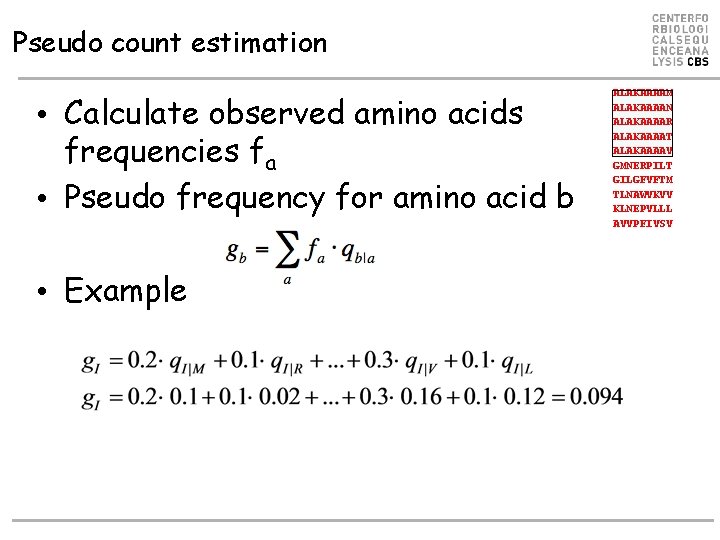
Pseudo count estimation • Calculate observed amino acids frequencies fa • Pseudo frequency for amino acid b • Example ALAKAAAAM ALAKAAAAN ALAKAAAAR ALAKAAAAT ALAKAAAAV GMNERPILT GILGFVFTM TLNAWVKVV KLNEPVLLL AVVPFIVSV
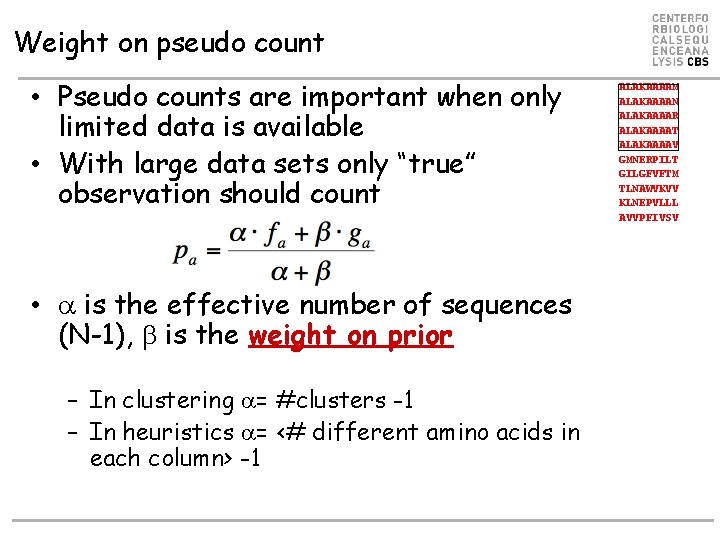
Weight on pseudo count • Pseudo counts are important when only limited data is available • With large data sets only “true” observation should count • is the effective number of sequences (N-1), is the weight on prior – In clustering = #clusters -1 – In heuristics = <# different amino acids in each column> -1 ALAKAAAAM ALAKAAAAN ALAKAAAAR ALAKAAAAT ALAKAAAAV GMNERPILT GILGFVFTM TLNAWVKVV KLNEPVLLL AVVPFIVSV
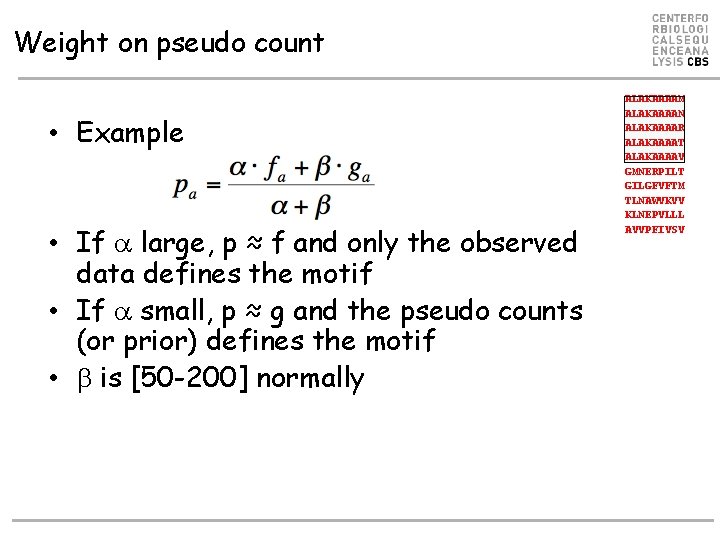
Weight on pseudo count • Example • If large, p ≈ f and only the observed data defines the motif • If small, p ≈ g and the pseudo counts (or prior) defines the motif • is [50 -200] normally ALAKAAAAM ALAKAAAAN ALAKAAAAR ALAKAAAAT ALAKAAAAV GMNERPILT GILGFVFTM TLNAWVKVV KLNEPVLLL AVVPFIVSV
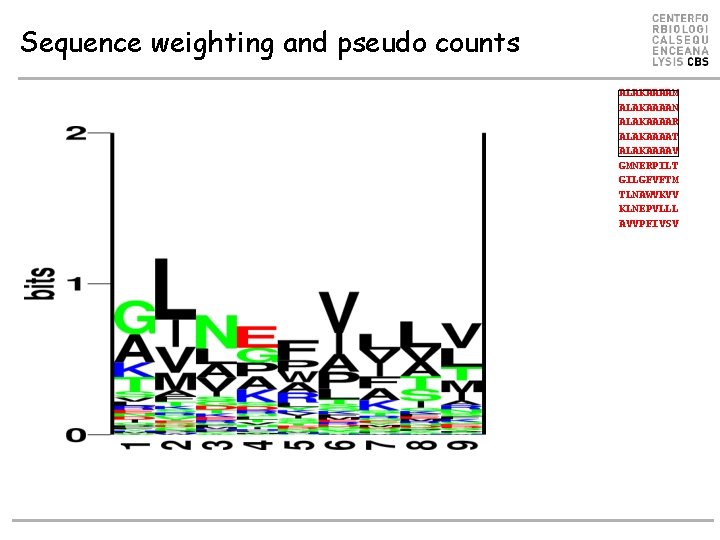
Sequence weighting and pseudo counts ALAKAAAAM ALAKAAAAN ALAKAAAAR ALAKAAAAT ALAKAAAAV GMNERPILT GILGFVFTM TLNAWVKVV KLNEPVLLL AVVPFIVSV
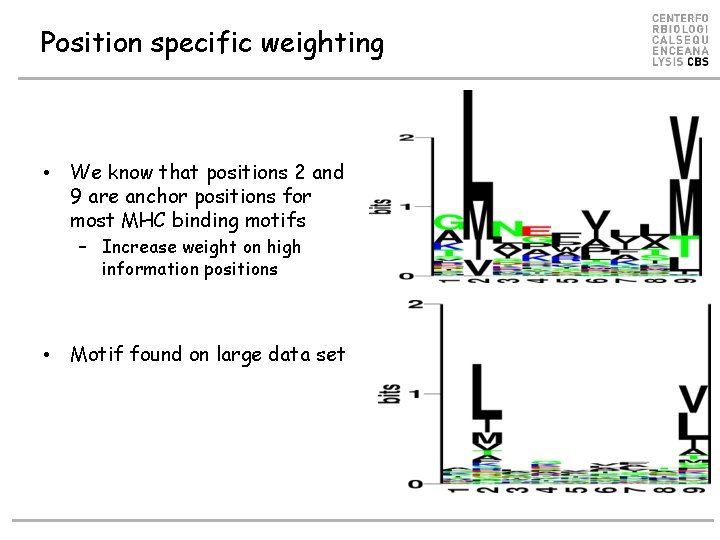
Position specific weighting • We know that positions 2 and 9 are anchor positions for most MHC binding motifs – Increase weight on high information positions • Motif found on large data set
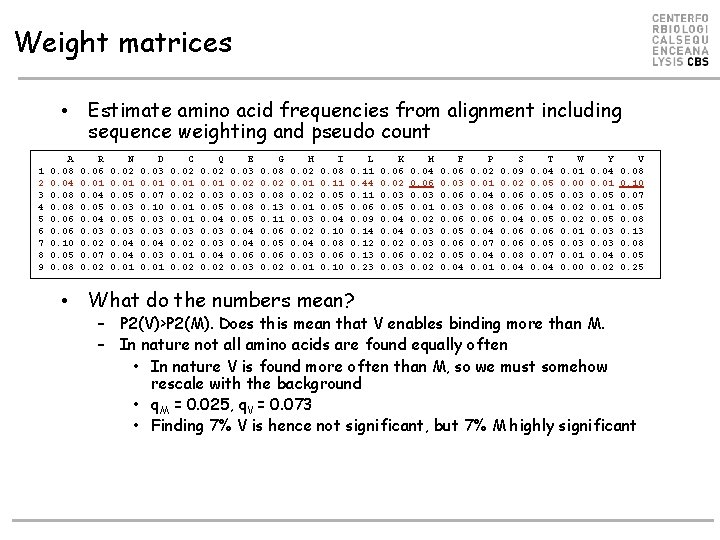
Weight matrices • Estimate amino acid frequencies from alignment including sequence weighting and pseudo count 1 2 3 4 5 6 7 8 9 A 0. 08 0. 04 0. 08 0. 06 0. 10 0. 05 0. 08 R 0. 06 0. 01 0. 04 0. 05 0. 04 0. 03 0. 02 0. 07 0. 02 N 0. 02 0. 01 0. 05 0. 03 0. 04 0. 01 D 0. 03 0. 01 0. 07 0. 10 0. 03 0. 04 0. 03 0. 01 C 0. 02 0. 01 0. 03 0. 02 0. 01 0. 02 Q 0. 02 0. 01 0. 03 0. 05 0. 04 0. 03 0. 04 0. 02 E 0. 03 0. 02 0. 03 0. 08 0. 05 0. 04 0. 06 0. 03 G 0. 08 0. 02 0. 08 0. 13 0. 11 0. 06 0. 05 0. 06 0. 02 H 0. 02 0. 01 0. 03 0. 02 0. 04 0. 03 0. 01 I 0. 08 0. 11 0. 05 0. 04 0. 10 0. 08 0. 06 0. 10 L 0. 11 0. 44 0. 11 0. 06 0. 09 0. 14 0. 12 0. 13 0. 23 • What do the numbers mean? K 0. 06 0. 02 0. 03 0. 05 0. 04 0. 02 0. 06 0. 03 M 0. 04 0. 06 0. 03 0. 01 0. 02 0. 03 0. 02 F 0. 06 0. 03 0. 06 0. 05 0. 04 P 0. 02 0. 01 0. 04 0. 08 0. 06 0. 04 0. 07 0. 04 0. 01 S 0. 09 0. 02 0. 06 0. 04 0. 06 0. 08 0. 04 T 0. 04 0. 05 0. 06 0. 05 0. 07 0. 04 W 0. 01 0. 00 0. 03 0. 02 0. 01 0. 03 0. 01 0. 00 Y 0. 04 0. 01 0. 05 0. 03 0. 04 0. 02 V 0. 08 0. 10 0. 07 0. 05 0. 08 0. 13 0. 08 0. 05 0. 25 – P 2(V)>P 2(M). Does this mean that V enables binding more than M. – In nature not all amino acids are found equally often • In nature V is found more often than M, so we must somehow rescale with the background • q. M = 0. 025, q. V = 0. 073 • Finding 7% V is hence not significant, but 7% M highly significant
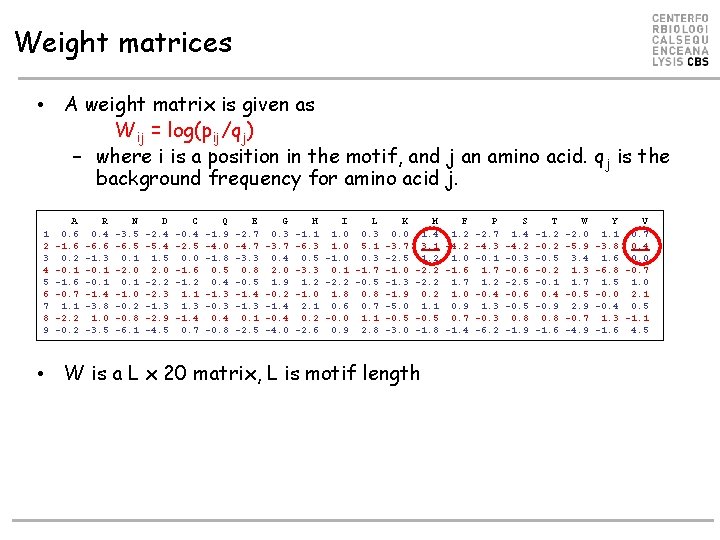
Weight matrices • A weight matrix is given as Wij = log(pij/qj) – where i is a position in the motif, and j an amino acid. q j is the background frequency for amino acid j. 1 2 3 4 5 6 7 8 9 A 0. 6 -1. 6 0. 2 -0. 1 -1. 6 -0. 7 1. 1 -2. 2 -0. 2 R 0. 4 -6. 6 -1. 3 -0. 1 -1. 4 -3. 8 1. 0 -3. 5 N -3. 5 -6. 5 0. 1 -2. 0 0. 1 -1. 0 -0. 2 -0. 8 -6. 1 D -2. 4 -5. 4 1. 5 2. 0 -2. 2 -2. 3 -1. 3 -2. 9 -4. 5 C -0. 4 -2. 5 0. 0 -1. 6 -1. 2 1. 1 1. 3 -1. 4 0. 7 Q -1. 9 -4. 0 -1. 8 0. 5 0. 4 -1. 3 -0. 3 0. 4 -0. 8 E -2. 7 -4. 7 -3. 3 0. 8 -0. 5 -1. 4 -1. 3 0. 1 -2. 5 G 0. 3 -3. 7 0. 4 2. 0 1. 9 -0. 2 -1. 4 -0. 4 -4. 0 H I L K M F -1. 1 1. 0 0. 3 0. 0 1. 4 1. 2 -6. 3 1. 0 5. 1 -3. 7 3. 1 -4. 2 0. 5 -1. 0 0. 3 -2. 5 1. 2 1. 0 -3. 3 0. 1 -1. 7 -1. 0 -2. 2 -1. 6 1. 2 -2. 2 -0. 5 -1. 3 -2. 2 1. 7 -1. 0 1. 8 0. 8 -1. 9 0. 2 1. 0 2. 1 0. 6 0. 7 -5. 0 1. 1 0. 9 0. 2 -0. 0 1. 1 -0. 5 0. 7 -2. 6 0. 9 2. 8 -3. 0 -1. 8 -1. 4 • W is a L x 20 matrix, L is motif length P -2. 7 -4. 3 -0. 1 1. 7 1. 2 -0. 4 1. 3 -0. 3 -6. 2 S 1. 4 -4. 2 -0. 3 -0. 6 -2. 5 -0. 6 -0. 5 0. 8 -1. 9 T -1. 2 -0. 5 -0. 2 -0. 1 0. 4 -0. 9 0. 8 -1. 6 W -2. 0 -5. 9 3. 4 1. 3 1. 7 -0. 5 2. 9 -0. 7 -4. 9 Y V 1. 1 0. 7 -3. 8 0. 4 1. 6 0. 0 -6. 8 -0. 7 1. 5 1. 0 -0. 0 2. 1 -0. 4 0. 5 1. 3 -1. 1 -1. 6 4. 5
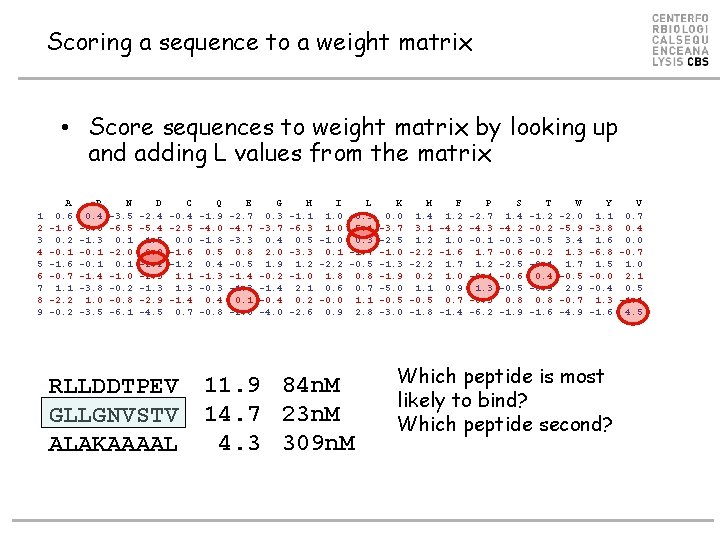
Scoring a sequence to a weight matrix • Score sequences to weight matrix by looking up and adding L values from the matrix 1 2 3 4 5 6 7 8 9 A 0. 6 -1. 6 0. 2 -0. 1 -1. 6 -0. 7 1. 1 -2. 2 -0. 2 R 0. 4 -6. 6 -1. 3 -0. 1 -1. 4 -3. 8 1. 0 -3. 5 N -3. 5 -6. 5 0. 1 -2. 0 0. 1 -1. 0 -0. 2 -0. 8 -6. 1 D -2. 4 -5. 4 1. 5 2. 0 -2. 2 -2. 3 -1. 3 -2. 9 -4. 5 C -0. 4 -2. 5 0. 0 -1. 6 -1. 2 1. 1 1. 3 -1. 4 0. 7 RLLDDTPEV GLLGNVSTV ALAKAAAAL Q -1. 9 -4. 0 -1. 8 0. 5 0. 4 -1. 3 -0. 3 0. 4 -0. 8 E -2. 7 -4. 7 -3. 3 0. 8 -0. 5 -1. 4 -1. 3 0. 1 -2. 5 G 0. 3 -3. 7 0. 4 2. 0 1. 9 -0. 2 -1. 4 -0. 4 -4. 0 H I L K M F -1. 1 1. 0 0. 3 0. 0 1. 4 1. 2 -6. 3 1. 0 5. 1 -3. 7 3. 1 -4. 2 0. 5 -1. 0 0. 3 -2. 5 1. 2 1. 0 -3. 3 0. 1 -1. 7 -1. 0 -2. 2 -1. 6 1. 2 -2. 2 -0. 5 -1. 3 -2. 2 1. 7 -1. 0 1. 8 0. 8 -1. 9 0. 2 1. 0 2. 1 0. 6 0. 7 -5. 0 1. 1 0. 9 0. 2 -0. 0 1. 1 -0. 5 0. 7 -2. 6 0. 9 2. 8 -3. 0 -1. 8 -1. 4 11. 9 84 n. M 14. 7 23 n. M 4. 3 309 n. M P -2. 7 -4. 3 -0. 1 1. 7 1. 2 -0. 4 1. 3 -0. 3 -6. 2 S 1. 4 -4. 2 -0. 3 -0. 6 -2. 5 -0. 6 -0. 5 0. 8 -1. 9 T -1. 2 -0. 5 -0. 2 -0. 1 0. 4 -0. 9 0. 8 -1. 6 W -2. 0 -5. 9 3. 4 1. 3 1. 7 -0. 5 2. 9 -0. 7 -4. 9 Y V 1. 1 0. 7 -3. 8 0. 4 1. 6 0. 0 -6. 8 -0. 7 1. 5 1. 0 -0. 0 2. 1 -0. 4 0. 5 1. 3 -1. 1 -1. 6 4. 5 Which peptide is most likely to bind? Which peptide second?
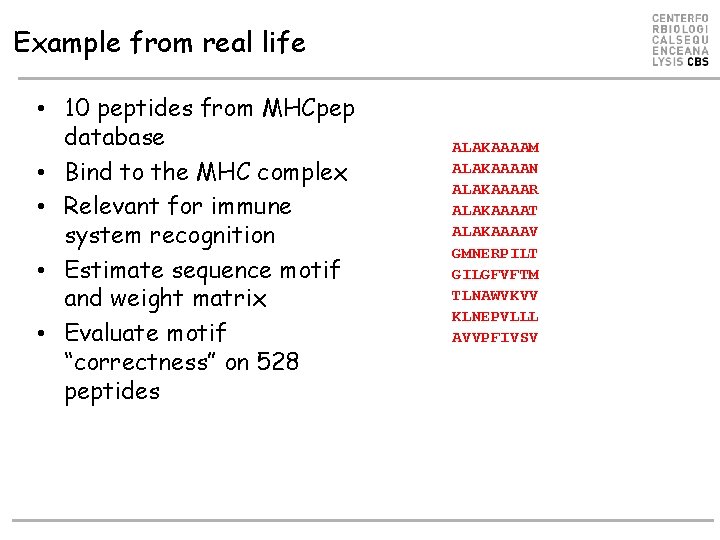
Example from real life • 10 peptides from MHCpep database • Bind to the MHC complex • Relevant for immune system recognition • Estimate sequence motif and weight matrix • Evaluate motif “correctness” on 528 peptides ALAKAAAAM ALAKAAAAN ALAKAAAAR ALAKAAAAT ALAKAAAAV GMNERPILT GILGFVFTM TLNAWVKVV KLNEPVLLL AVVPFIVSV
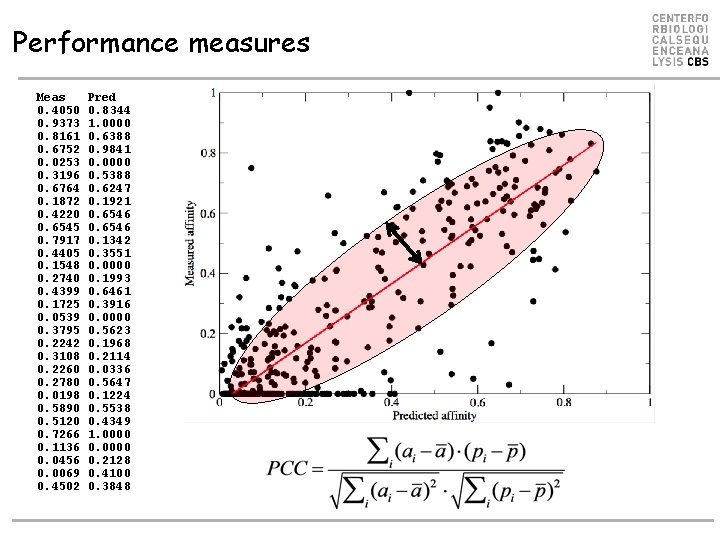
Performance measures Meas 0. 4050 0. 9373 0. 8161 0. 6752 0. 0253 0. 3196 0. 6764 0. 1872 0. 4220 0. 6545 0. 7917 0. 4405 0. 1548 0. 2740 0. 4399 0. 1725 0. 0539 0. 3795 0. 2242 0. 3108 0. 2260 0. 2780 0. 0198 0. 5890 0. 5120 0. 7266 0. 1136 0. 0456 0. 0069 0. 4502 Pred 0. 8344 1. 0000 0. 6388 0. 9841 0. 0000 0. 5388 0. 6247 0. 1921 0. 6546 0. 1342 0. 3551 0. 0000 0. 1993 0. 6461 0. 3916 0. 0000 0. 5623 0. 1968 0. 2114 0. 0336 0. 5647 0. 1224 0. 5538 0. 4349 1. 0000 0. 2128 0. 4100 0. 3848
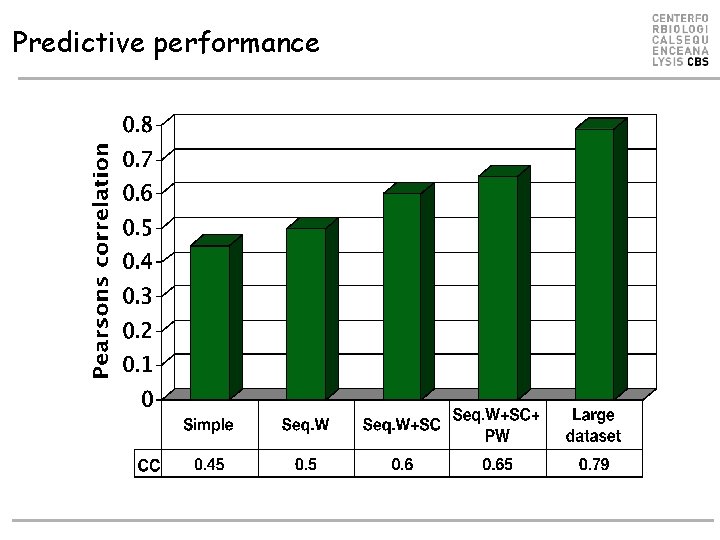
Predictive performance
Summary I. PSSMs • Sequence logo is a power tool to visualize (binding) motifs – Information content identifies essential residues for function and/or structural stability • Weight matrices and sequence profiles can be derived from very limited number of data using the techniques of – Sequence weighting – Pseudo counts
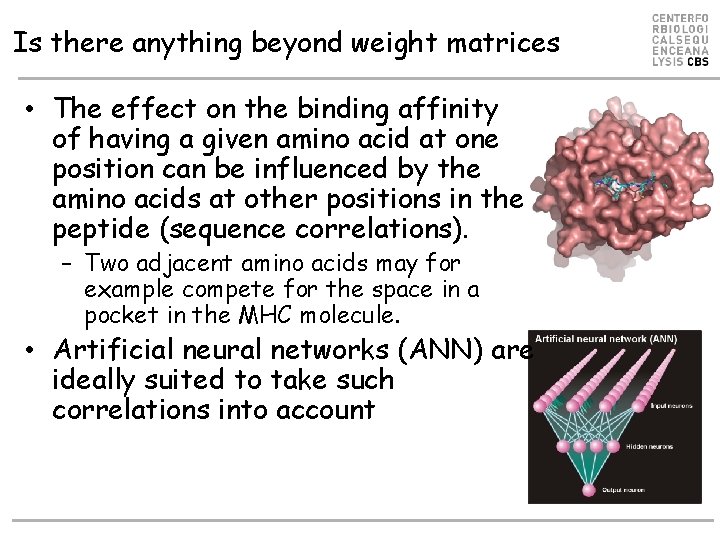
Is there anything beyond weight matrices • The effect on the binding affinity of having a given amino acid at one position can be influenced by the amino acids at other positions in the peptide (sequence correlations). – Two adjacent amino acids may for example compete for the space in a pocket in the MHC molecule. • Artificial neural networks (ANN) are ideally suited to take such correlations into account

HUNKAT

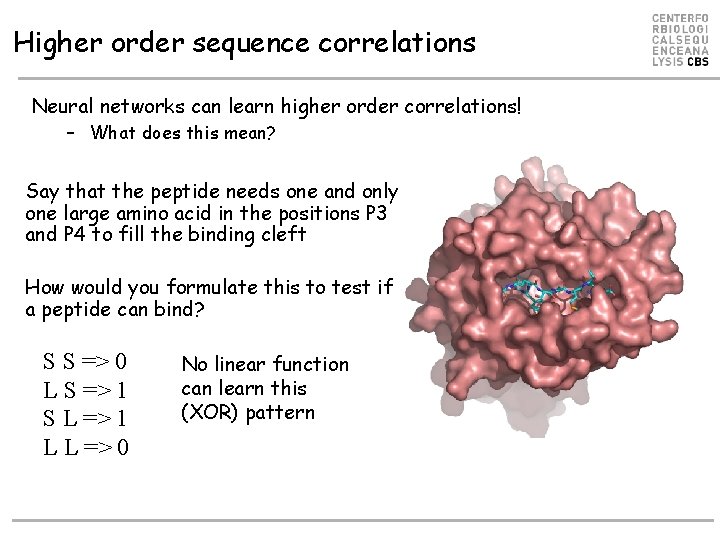
Higher order sequence correlations Neural networks can learn higher order correlations! – What does this mean? Say that the peptide needs one and only one large amino acid in the positions P 3 and P 4 to fill the binding cleft How would you formulate this to test if a peptide can bind? S S => 0 L S => 1 S L => 1 L L => 0 No linear function can learn this (XOR) pattern
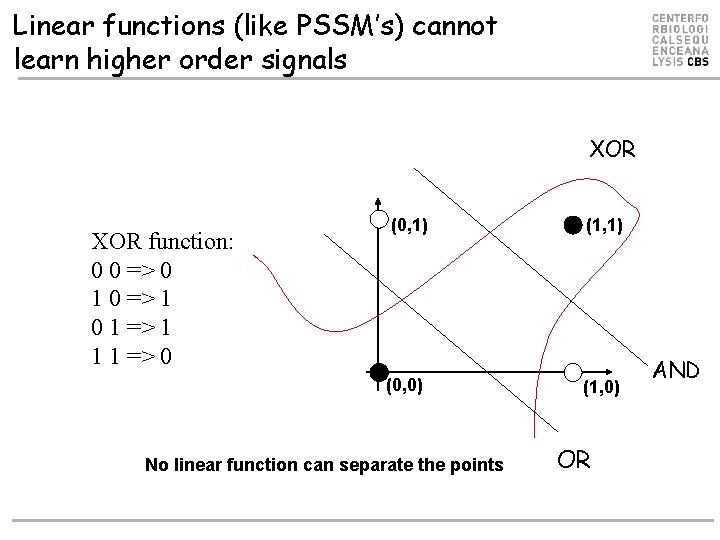
Linear functions (like PSSM’s) cannot learn higher order signals XOR function: 0 0 => 0 1 0 => 1 0 1 => 1 1 1 => 0 (0, 1) (0, 0) No linear function can separate the points (1, 1) (1, 0) OR AND
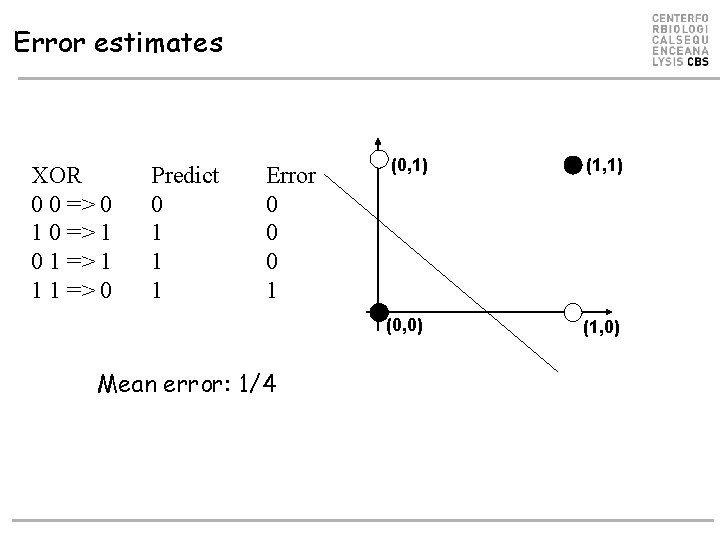
Error estimates XOR 0 0 => 0 1 0 => 1 0 1 => 1 1 1 => 0 Predict 0 1 1 1 Error 0 0 0 1 Mean error: 1/4 (0, 1) (1, 1) (0, 0) (1, 0)
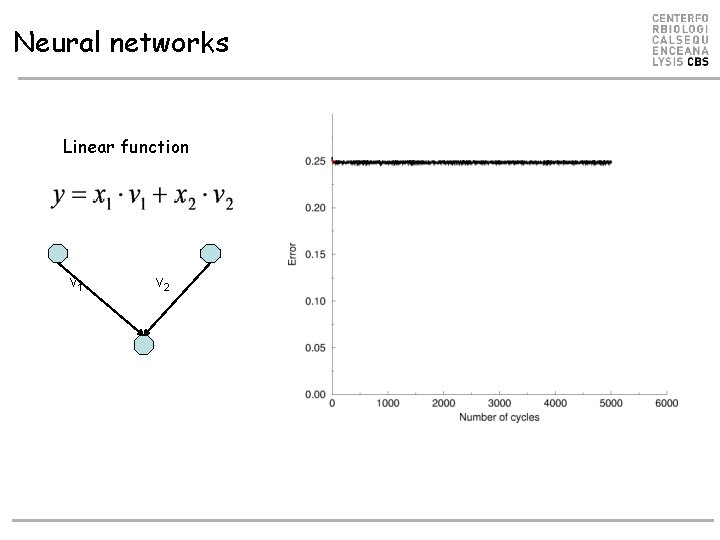
Neural networks Linear function v 1 v 2
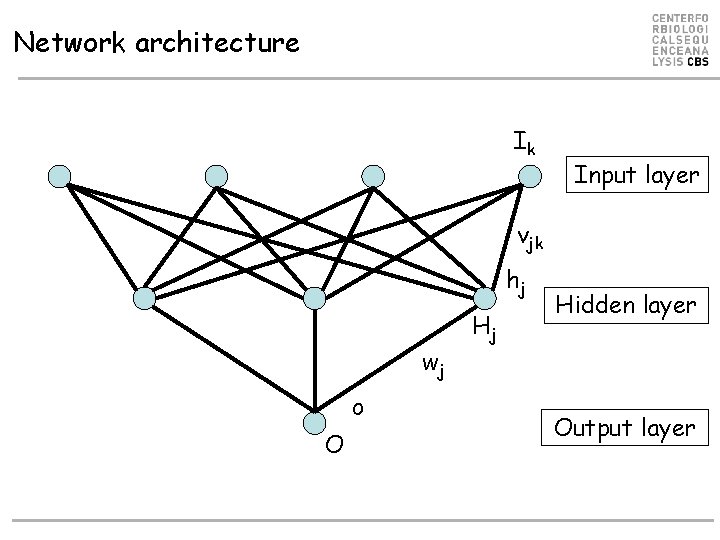
Network architecture Ik Input layer vjk hj wj o O Hj Hidden layer Output layer
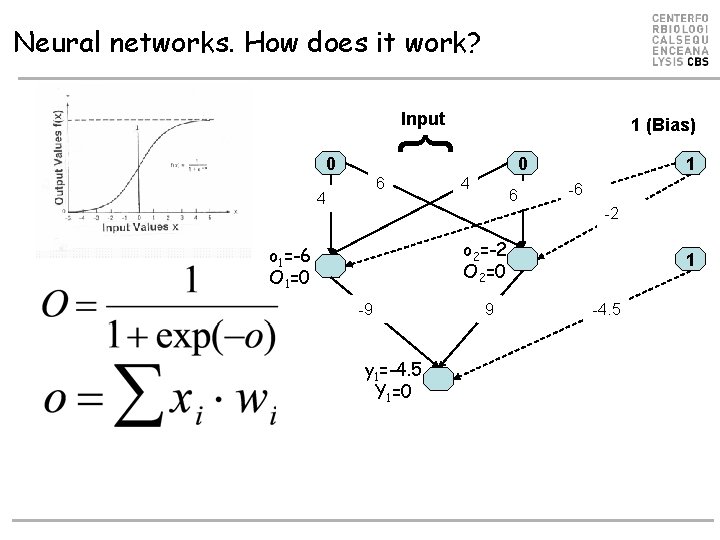
Neural networks. How does it work? Input { 1 (Bias) 0 6 4 0 4 6 1 -6 -2 o 2=-2 O 2=0 o 1=-6 O 1=0 -9 y 1=-4. 5 Y 1=0 9 1 -4. 5
Neural networks. How does it work? Hand out
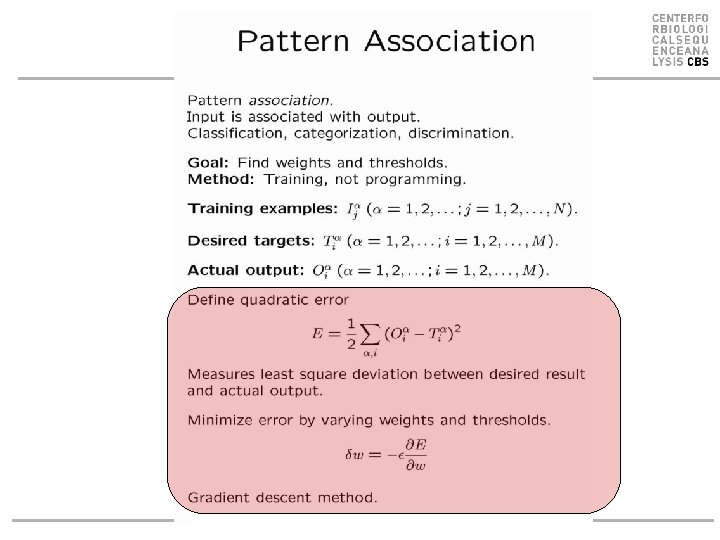
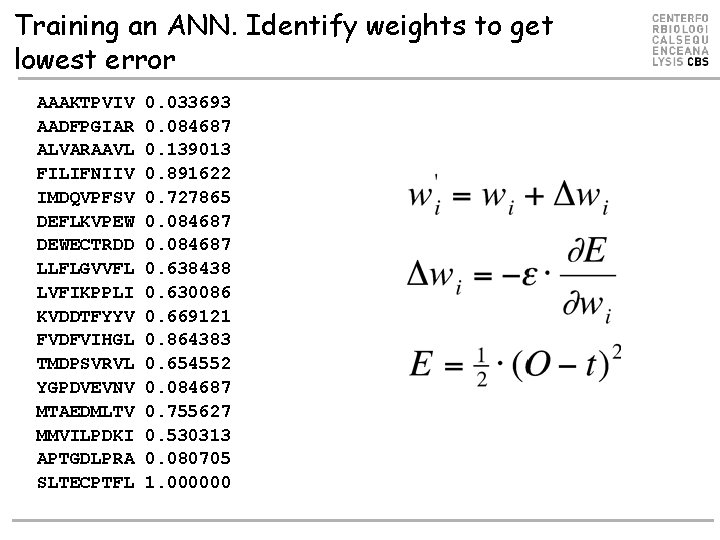
Training an ANN. Identify weights to get lowest error AAAKTPVIV AADFPGIAR ALVARAAVL FILIFNIIV IMDQVPFSV DEFLKVPEW DEWECTRDD LLFLGVVFL LVFIKPPLI KVDDTFYYV FVDFVIHGL TMDPSVRVL YGPDVEVNV MTAEDMLTV MMVILPDKI APTGDLPRA SLTECPTFL 0. 033693 0. 084687 0. 139013 0. 891622 0. 727865 0. 084687 0. 638438 0. 630086 0. 669121 0. 864383 0. 654552 0. 084687 0. 755627 0. 530313 0. 080705 1. 000000
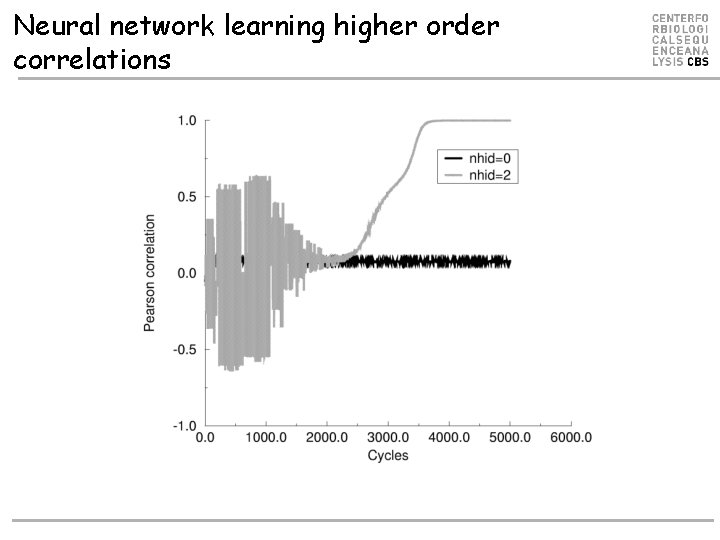
Neural network learning higher order correlations

Demo
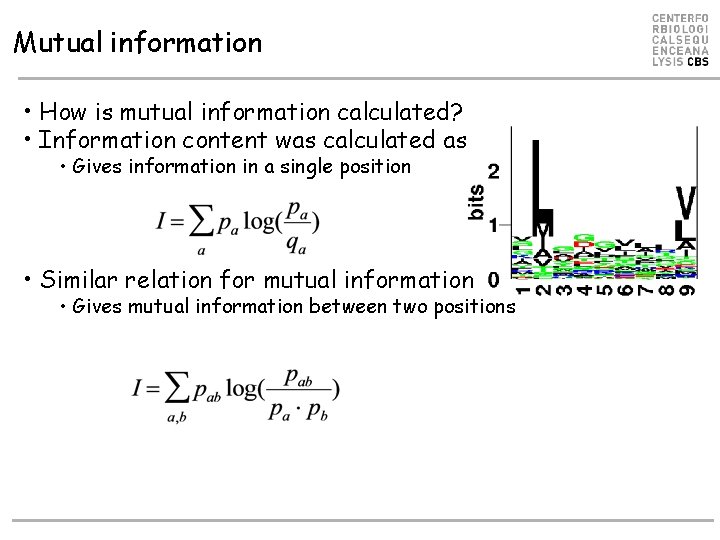
Mutual information • How is mutual information calculated? • Information content was calculated as • Gives information in a single position • Similar relation for mutual information • Gives mutual information between two positions
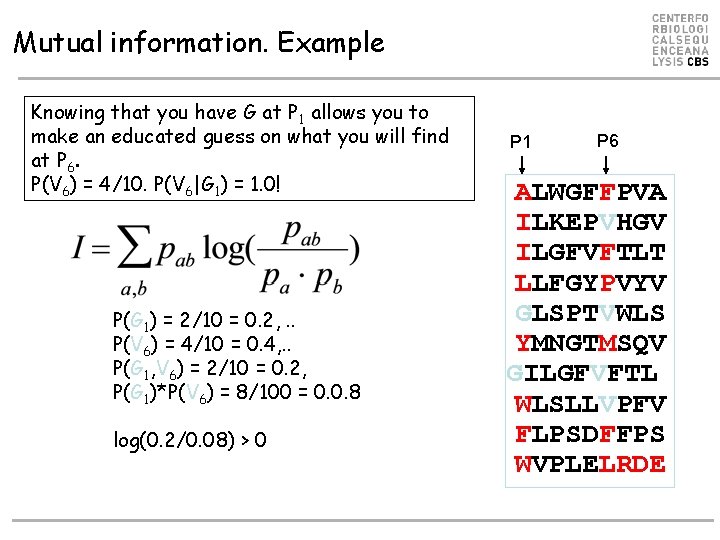
Mutual information. Example Knowing that you have G at P 1 allows you to make an educated guess on what you will find at P 6. P(V 6) = 4/10. P(V 6|G 1) = 1. 0! P(G 1) = 2/10 = 0. 2, . . P(V 6) = 4/10 = 0. 4, . . P(G 1, V 6) = 2/10 = 0. 2, P(G 1)*P(V 6) = 8/100 = 0. 0. 8 log(0. 2/0. 08) > 0 P 1 P 6 ALWGFFPVA ILKEPVHGV ILGFVFTLT LLFGYPVYV GLSPTVWLS YMNGTMSQV GILGFVFTL WLSLLVPFV FLPSDFFPS WVPLELRDE
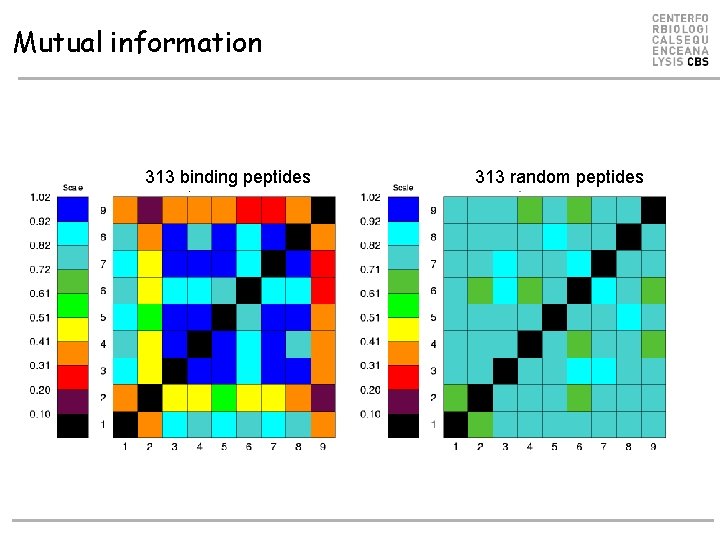
Mutual information 313 binding peptides 313 random peptides
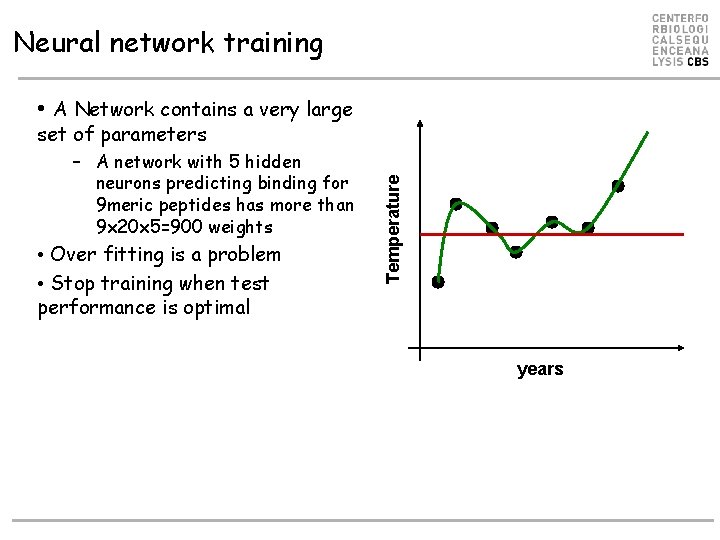
Neural network training • A Network contains a very large – A network with 5 hidden neurons predicting binding for 9 meric peptides has more than 9 x 20 x 5=900 weights • Over fitting is a problem • Stop training when test performance is optimal Temperature set of parameters years
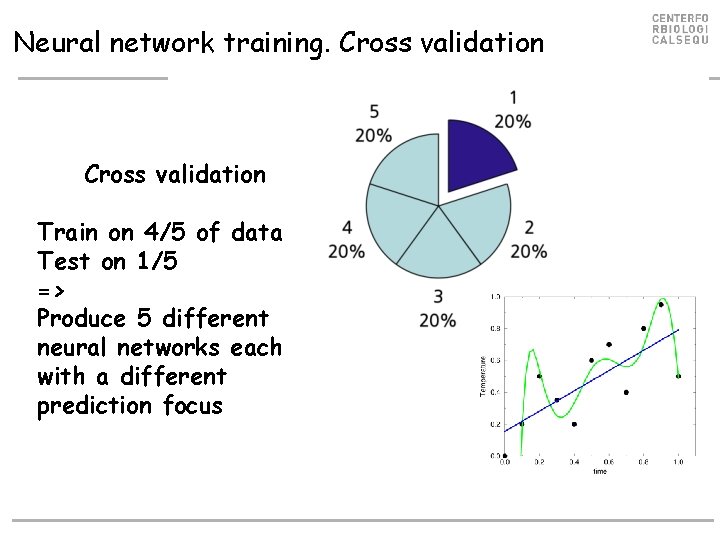
Neural network training. Cross validation Train on 4/5 of data Test on 1/5 => Produce 5 different neural networks each with a different prediction focus
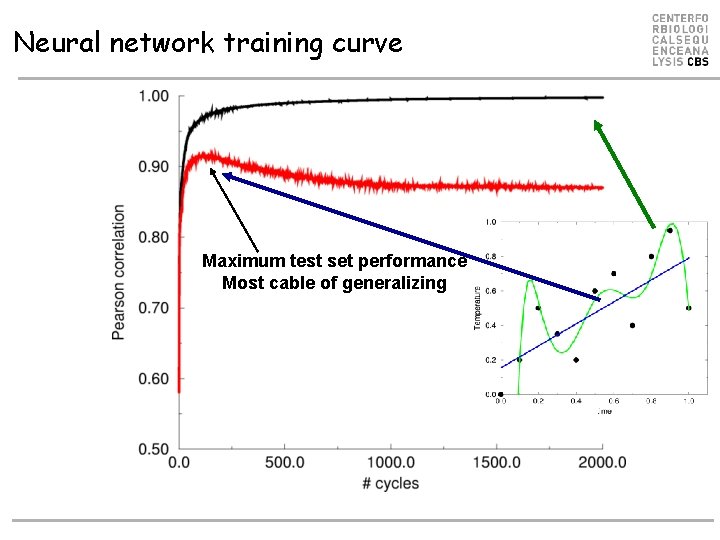
Neural network training curve Maximum test set performance Most cable of generalizing
Network ensembles
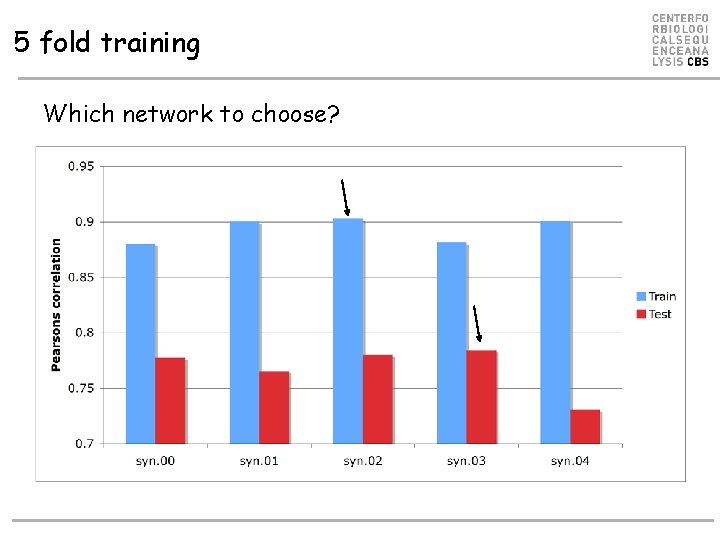
5 fold training Which network to choose?
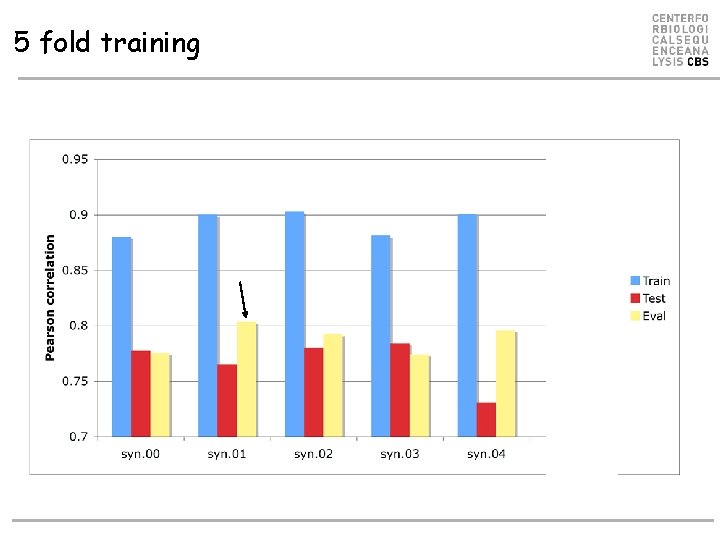
5 fold training

The Wisdom of the Crowds • The Wisdom of Crowds. Why the Many are Smarter than the Few. James Surowiecki One day in the fall of 1906, the British scientist Fracis Galton left his home and headed for a country fair… He believed that only a very few people had the characteristics necessary to keep societies healthy. He had devoted much of his career to measuring those characteristics, in fact, in order to prove that the vast majority of people did not have them. … Galton came across a weight-judging competition…Eight hundred people tried their luck. They were a diverse lot, butchers, farmers, clerks and many other no-experts…The crowd had guessed … 1. 197 pounds, the ox weighted 1. 198
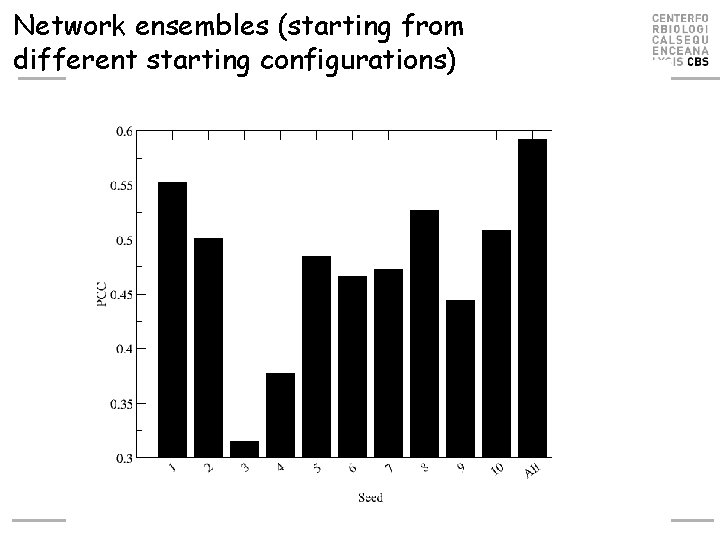
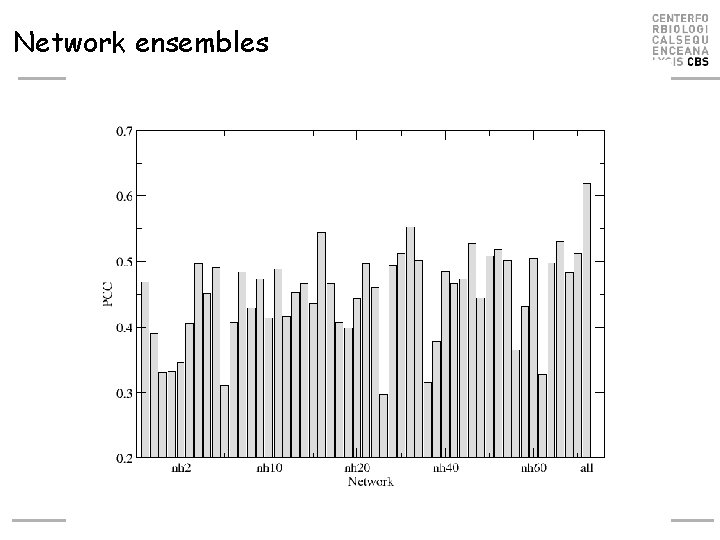
Network ensembles • No one single network with a particular architecture and sequence encoding scheme, will constantly perform the best • Also for Neural network predictions will enlightened despotism fail – For some peptides, BLOSUM encoding with a four neuron hidden layer can best predict the peptide/MHC binding, for other peptides a sparse encoded network with zero hidden neurons performs the best – Wisdom of the Crowd • Never use just one neural network • Use Network ensembles
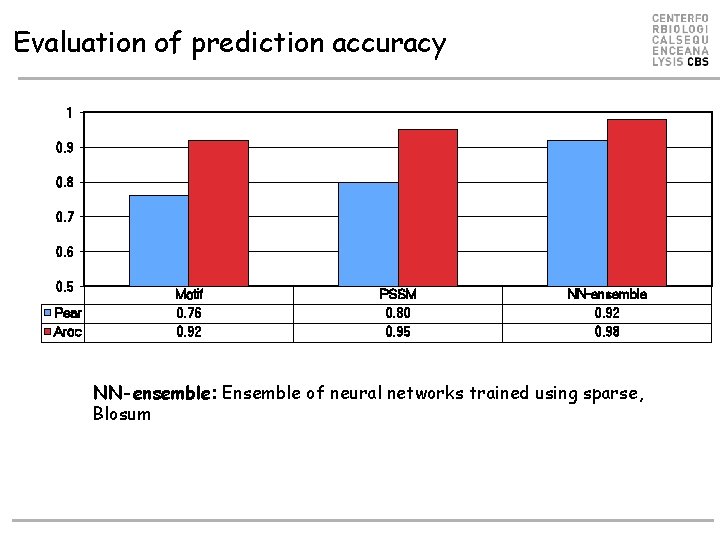
Evaluation of prediction accuracy 1 0. 9 0. 8 0. 7 0. 6 0. 5 Pear Aroc Motif 0. 76 0. 92 PSSM 0. 80 0. 95 NN-ensemble 0. 92 0. 98 NN-ensemble: Ensemble of neural networks trained using sparse, Blosum
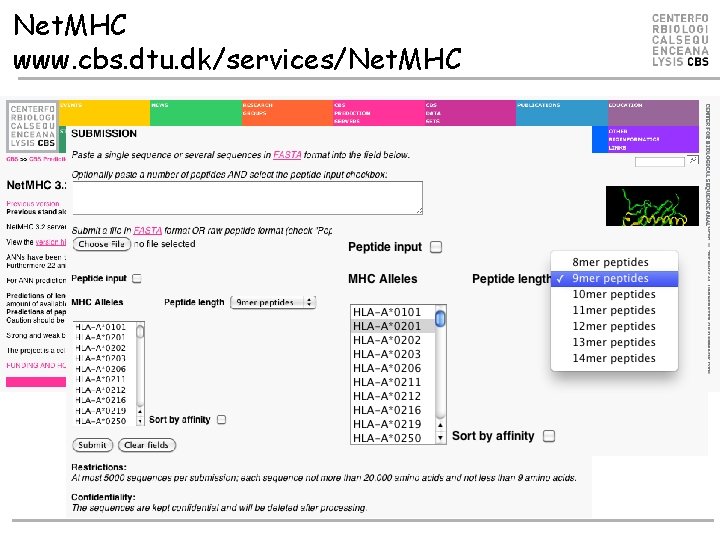
Net. MHC www. cbs. dtu. dk/services/Net. MHC
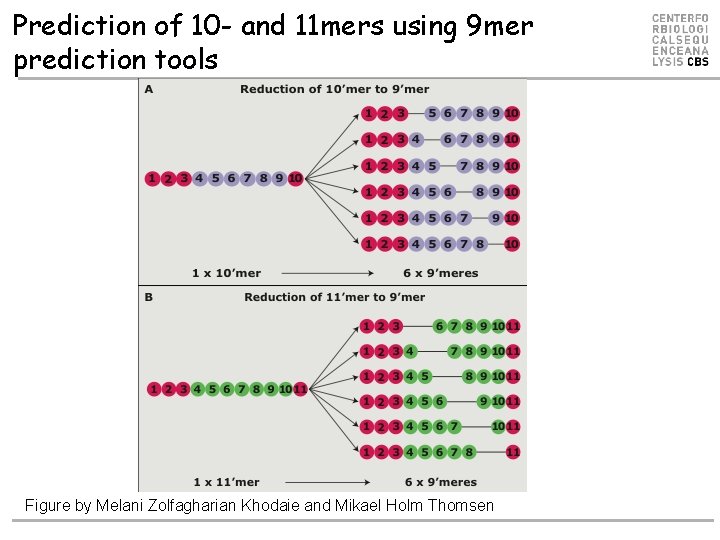
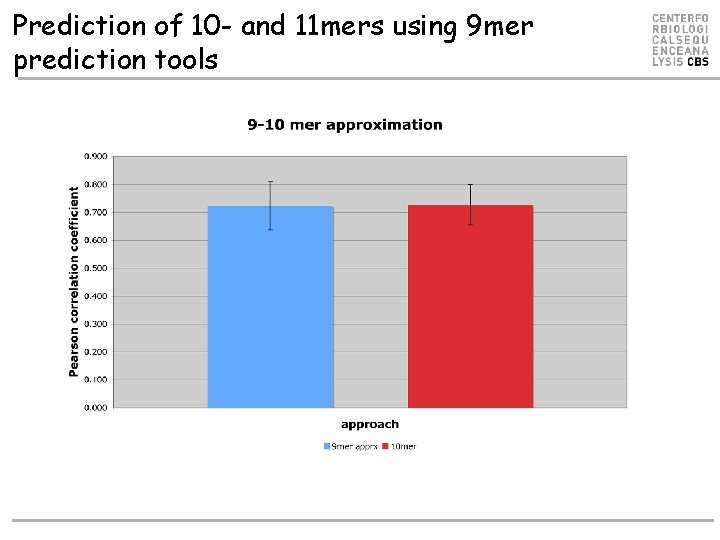
Prediction of 10 - and 11 mers using 9 mer prediction tools Figure by Melani Zolfagharian Khodaie and Mikael Holm Thomsen
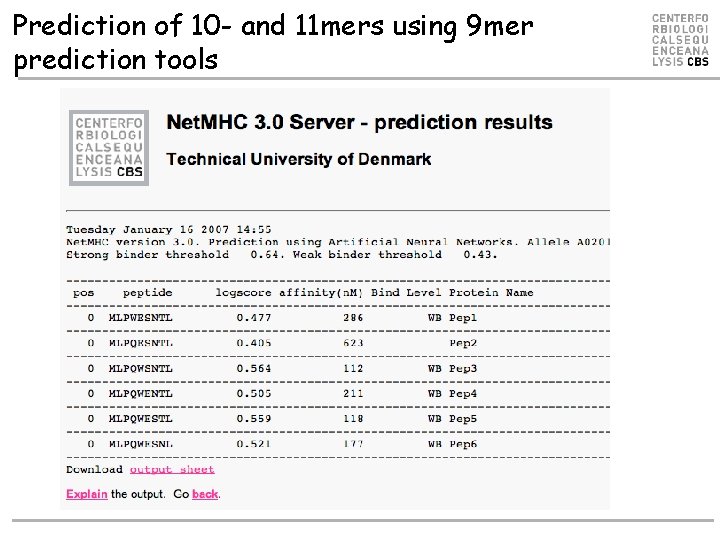
Prediction of 10 - and 11 mers using 9 mer prediction tools
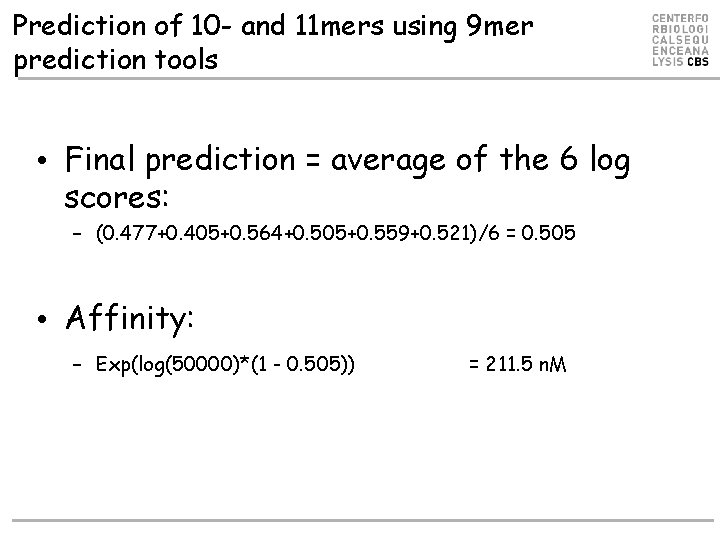
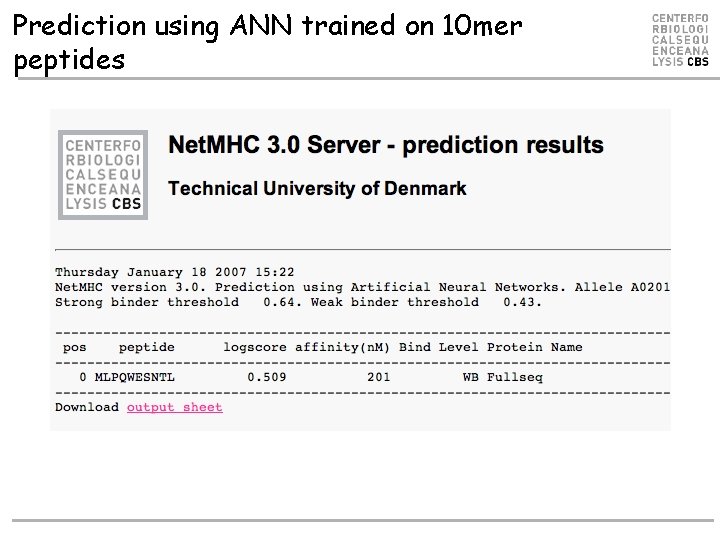
Prediction of 10 - and 11 mers using 9 mer prediction tools • Final prediction = average of the 6 log scores: – (0. 477+0. 405+0. 564+0. 505+0. 559+0. 521)/6 = 0. 505 • Affinity: – Exp(log(50000)*(1 - 0. 505)) = 211. 5 n. M
Prediction using ANN trained on 10 mer peptides
Prediction of 10 - and 11 mers using 9 mer prediction tools
Predicting binding for longer-mers Allele H 2 -Db H 2 -Ld HLA-A*0101 HLA-A*0201 HLA-A*0301 HLA-A*1101 HLA-A*3101 HLA-A*6801 HLA-B*0702 HLA-B*2702 HLA-B*3501 HLA-B*3508 HLA-B*4402 Length 11 12 11 11 12 11 11 13 11 11 11 14 12 13 12 11 HLA-B*5703 11 Peptide SGVENPGGYCL IPQSLDSWWTSL YSEHPTFTSQY SSDYVIPIGTY FLEGNEVGKTY MLMAQEALAFL GLAPPQHLIRV LLPENNVLSPL RLRDLLLIVTR ACQGVGGPGHK SVLGPISGHVLK STLPETTVVRR FVFPTKDVALR SPSVDKARAEL RPHERNGFTVL RPQGGSRPEFVKL RRARSLSAERY HPVGEADYFEY EPLPQGQLTAY LPAVVGLSPGEQEY TPRLPSSADVEF LPEPLPQGQLTAY CPSQEPMSIYVY SELFRSGLDSY KAFSPEVIPMF % Rank 1. 5 0. 1 0. 05 1. 5 0. 15 0. 8 1 1 15 0. 1 0. 8 0. 1 0. 4 0. 05 0. 3 0. 1 0. 2 0. 05 0. 8 0. 1 0. 05 0. 15 0. 4
So we can find the needle in the haystack • At least is some haystacks
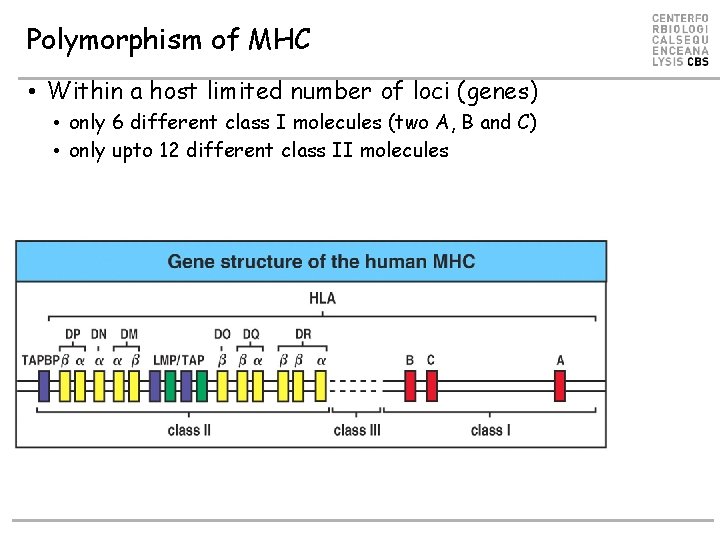
Polymorphism of MHC • Within a host limited number of loci (genes) • only 6 different class I molecules (two A, B and C) • only upto 12 different class II molecules • Within a population > 100 alleles per locus
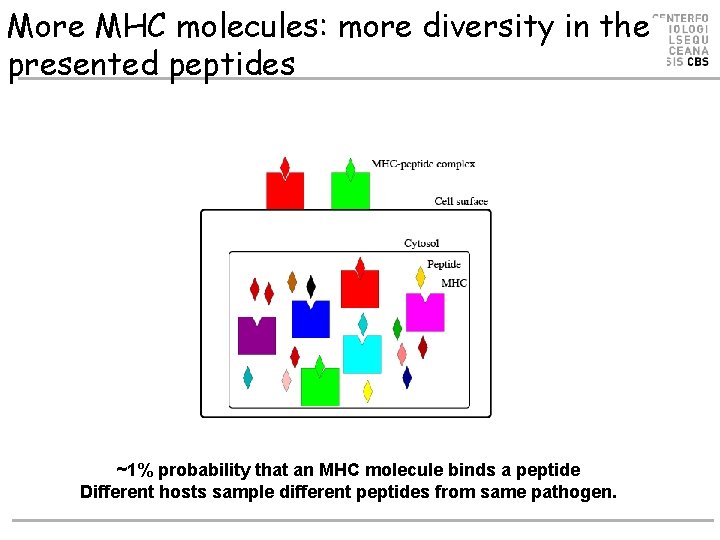
More MHC molecules: more diversity in the presented peptides ~1% probability that an MHC molecule binds a peptide Different hosts sample different peptides from same pathogen.
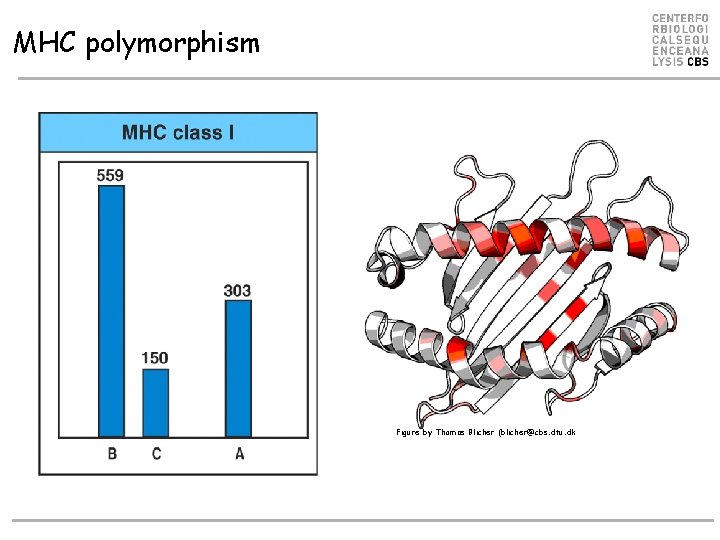
MHC polymorphism Figure by Thomas Blicher (blicher@cbs. dtu. dk
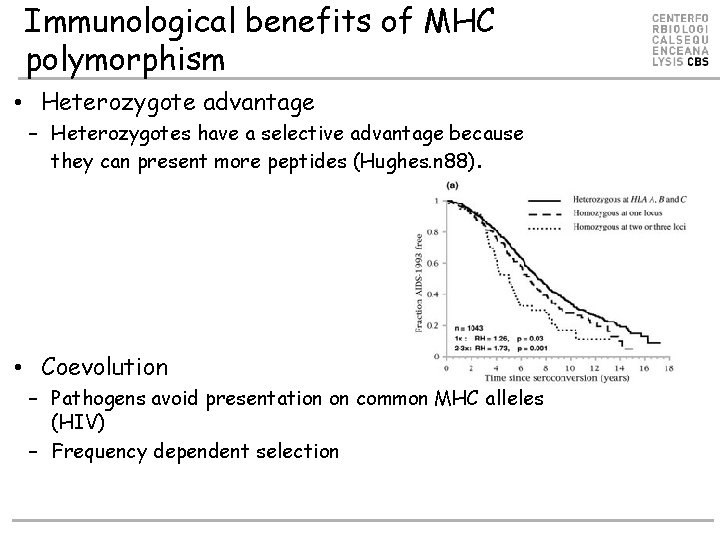
Immunological benefits of MHC polymorphism • Heterozygote advantage – Heterozygotes have a selective advantage because they can present more peptides (Hughes. n 88). • Coevolution – Pathogens avoid presentation on common MHC alleles (HIV) – Frequency dependent selection
Variations among populations • Allele frequency varies between populations • Databases of HLA and MHC frequencies – allelefrequencies. net – db. MHC
Heterozygote disadvantage! (for vaccine design) • Few human beings will share the same set of HLA alleles – Different persons will react to a pathogen infection in a non-similar manner • A CTL based vaccine must include epitopes specific for each HLA allele in a population – A CTL based vaccine must consist of ~800 HLA class I epitopes and ~400 class II epitopes
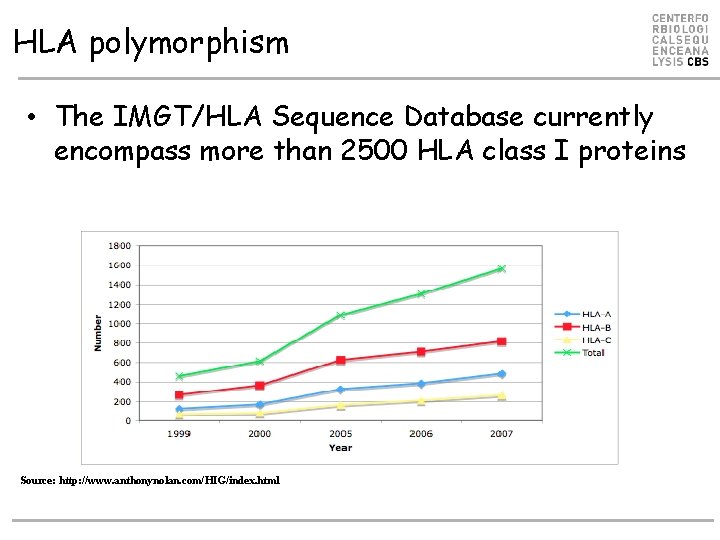
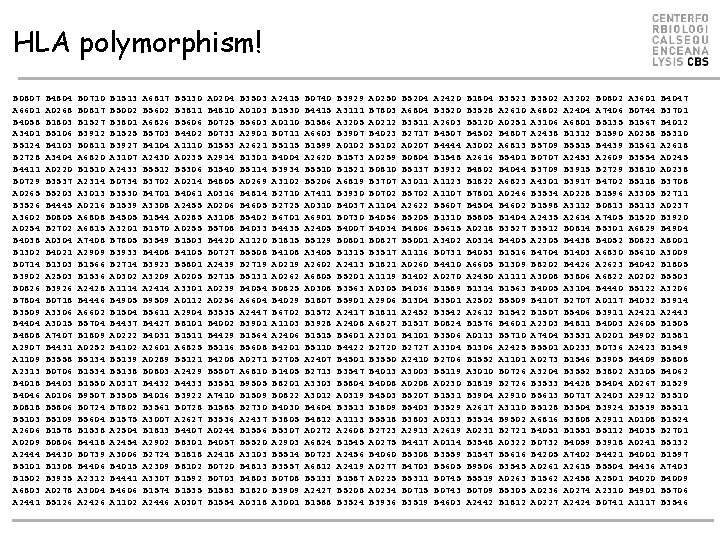
HLA polymorphism • The IMGT/HLA Sequence Database currently encompass more than 2500 HLA class I proteins Source: http: //www. anthonynolan. com/HIG/index. html
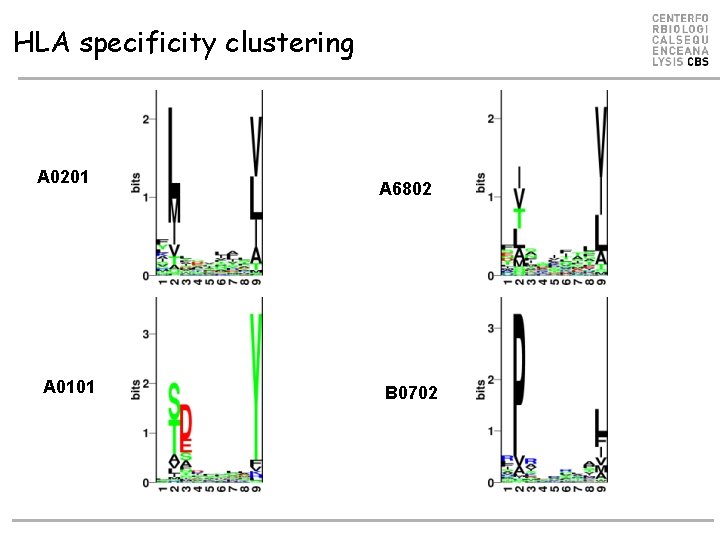
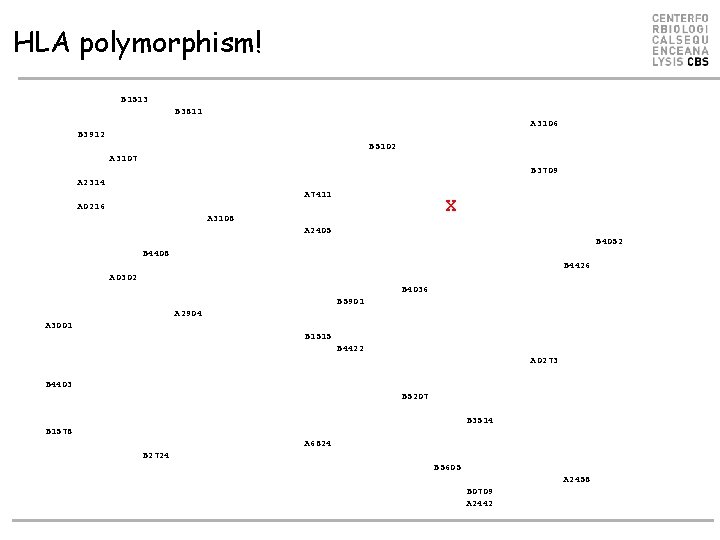
HLA specificity clustering A 0201 A 0101 A 6802 B 0702
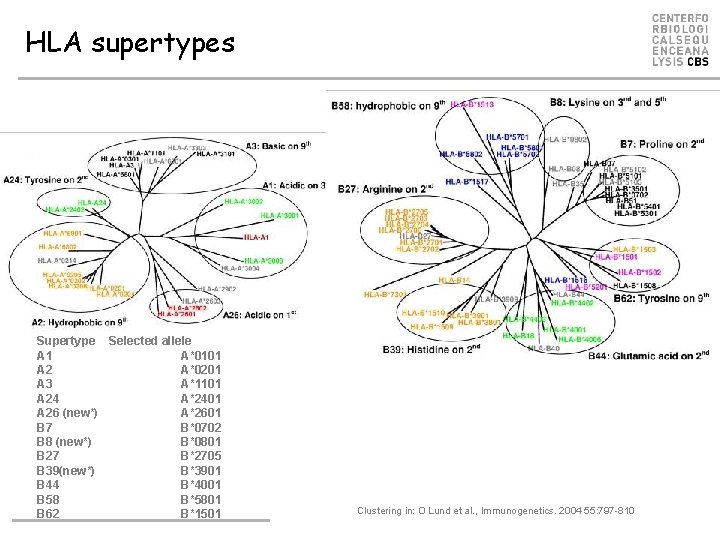
HLA supertypes Supertype Selected allele A 1 A*0101 A 2 A*0201 A 3 A*1101 A 24 A*2401 A 26 (new*) A*2601 B 7 B*0702 B 8 (new*) B*0801 B 27 B*2705 B 39(new*) B*3901 B 44 B*4001 B 58 B*5801 B 62 B*1501 Clustering in: O Lund et al. , Immunogenetics. 2004 55: 797 -810
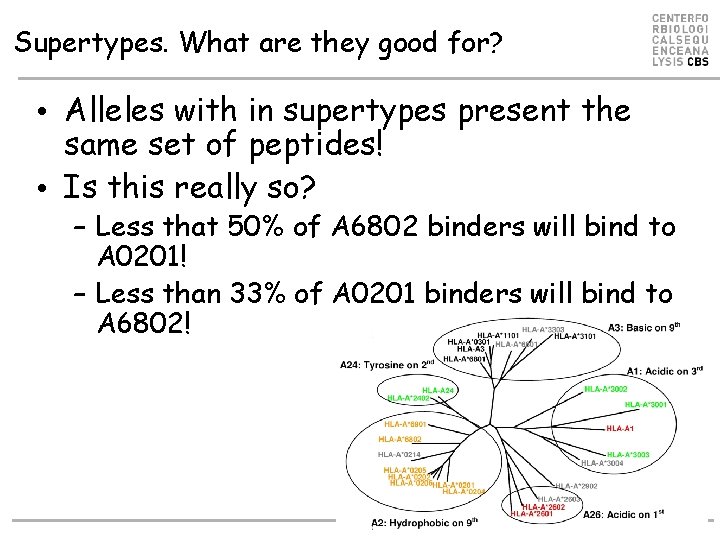
Supertypes. What are they good for? • Alleles with in supertypes present the same set of peptides! • Is this really so? – Less that 50% of A 6802 binders will bind to A 0201! – Less than 33% of A 0201 binders will bind to A 6802!
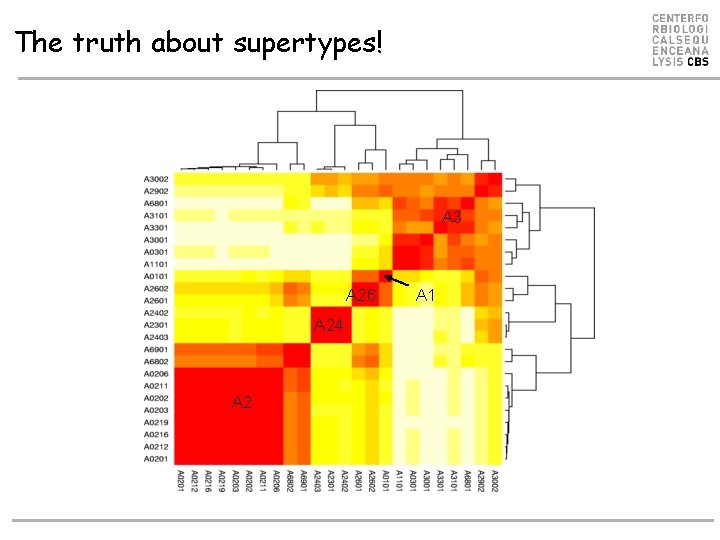
The truth about supertypes! A 3 A 26 A 24 A 2 A 1
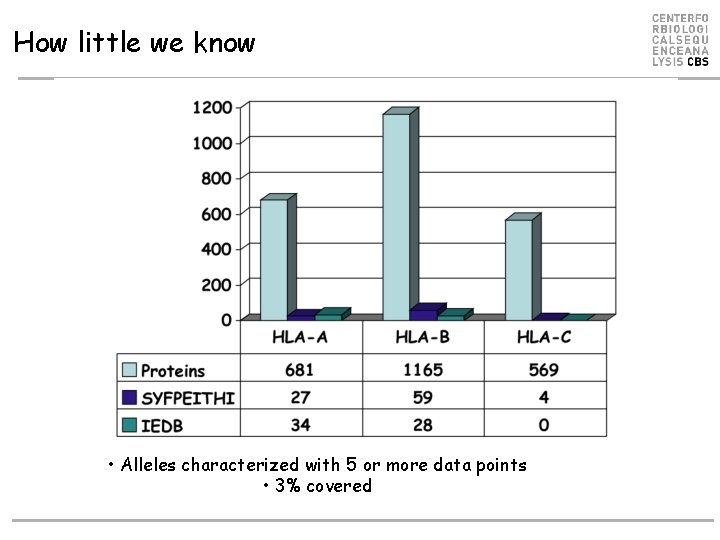
How little we know • Alleles characterized with 5 or more data points • 3% covered
HLA polymorphism • ~70 HLA alleles are characterized by binding data • Reliable MHC class I binding predictions (Net. MHC-3. 2) for ~50 HLA A and B molecules • Long way to cover 2500!
HLA polymorphism! B 0807 A 6601 B 4058 A 3401 B 5124 B 2728 B 4411 B 0729 A 0265 B 3526 A 3602 A 0254 B 4038 B 1302 B 0714 B 3902 B 0826 B 7804 B 3509 B 4404 B 4808 A 2907 A 1109 A 2313 B 4018 B 4046 B 0818 B 5103 A 2606 A 0209 A 2444 B 5101 B 1502 A 6803 A 2441 B 4804 A 0268 B 1803 B 5106 B 4103 A 3404 A 0220 B 3537 B 5203 B 4445 B 0805 B 2702 A 0304 B 4021 B 1303 A 2503 B 3926 B 0718 A 3306 A 3015 A 7407 B 4431 B 3558 B 0706 B 4403 A 0106 B 5806 B 5109 B 1578 B 0806 B 4430 B 1308 B 3935 A 0278 B 5126 B 0710 B 0817 B 1527 B 3912 B 0811 A 6820 B 1510 A 2314 A 3013 A 0216 A 6808 A 6815 A 7408 A 2909 B 1566 B 1536 A 2428 B 4446 A 6602 B 5704 B 1809 A 0252 B 5134 B 1550 B 9507 B 0724 B 5604 B 1538 B 4418 B 0739 B 4406 A 2312 A 3004 A 2426 B 1513 B 5002 B 3801 B 1525 B 3927 A 3107 A 2433 B 0734 B 3530 B 1539 B 4505 A 3201 B 7805 B 3933 B 2714 A 0302 A 1114 B 4905 B 1504 B 4437 A 0222 B 4102 B 5139 B 5138 A 0317 B 3505 B 7802 B 1575 A 2504 A 2454 A 3006 B 4015 B 4441 B 4606 A 1102 A 6817 B 5602 A 6826 B 5703 B 4104 A 2430 B 5512 B 3702 B 4701 A 3308 B 1544 B 1570 B 3549 B 4408 B 3923 A 3209 A 2414 B 9509 B 5611 B 4427 B 4031 A 2601 A 0289 B 0803 B 4432 B 4016 B 3561 A 3007 B 1813 A 2902 B 2724 A 2309 A 3307 B 1574 A 2446 B 5130 B 3811 B 5606 B 4402 A 1110 A 0235 B 5306 A 0214 B 4061 A 2455 A 0285 A 0255 B 1503 B 4105 B 5801 A 0205 A 3301 A 0112 A 2904 B 8101 B 1511 A 6825 B 5121 A 2429 B 4433 B 3922 B 0728 A 2627 B 4407 B 8301 B 1818 B 8102 B 1592 B 1535 A 0307 A 0204 B 4810 B 0725 B 0733 B 1553 A 2914 B 1540 B 4805 A 0316 A 0206 A 3108 B 5708 B 4420 B 0727 A 2439 B 2715 A 0239 A 0256 B 3535 B 4002 B 4429 B 5116 B 4208 B 5507 B 3551 A 7410 B 1585 B 3536 A 0244 B 4057 A 2418 B 0720 B 0703 B 1583 B 1554 B 3503 A 0103 B 5603 A 2901 A 2621 B 1301 B 5114 A 0269 B 4814 B 4605 B 5402 B 4033 A 1120 B 5508 B 2719 B 5131 B 4054 A 6604 A 2447 B 3901 B 1564 B 5608 A 0271 A 6810 B 9505 B 1509 B 2730 A 2437 B 1556 B 5520 A 3103 B 4813 B 4803 B 1820 A 0318 A 2415 B 1530 A 0110 B 0711 B 5115 B 4004 B 3934 A 3102 B 2710 B 2725 B 6701 B 4435 B 1815 B 4108 A 0219 A 0262 B 0825 B 4029 B 6702 A 1103 A 2406 B 4201 B 2705 B 1405 B 8201 B 0822 B 4030 B 3805 B 5307 A 2903 B 5514 B 3557 B 0708 B 3909 A 3001 B 0740 B 4415 B 1586 A 6603 B 1599 A 2620 B 5510 B 5206 A 7411 A 0310 A 6901 A 2405 B 5129 A 3405 A 2602 A 6805 A 0308 B 1807 B 1572 B 3928 B 1515 B 5110 A 2407 B 2713 A 3303 A 3012 B 4604 B 4812 A 0272 A 6824 B 0723 A 6812 B 5133 A 2427 B 1588 B 3929 A 3111 A 3205 B 3907 A 0102 B 1573 B 1521 A 6819 B 3930 B 4037 B 0730 B 4007 B 0801 B 1315 A 2413 B 5201 B 3563 B 5901 A 2417 A 2408 B 5601 B 4422 B 4501 B 3547 B 5804 A 0319 B 3513 A 1113 A 2608 B 1545 A 2456 A 2419 B 1587 B 5208 B 3524 A 0250 B 7803 A 0212 B 4023 B 5102 A 0259 B 0810 B 3707 B 0702 A 1104 B 4056 B 4034 B 0827 B 3517 B 1821 A 1119 A 0305 A 2906 B 1811 A 6827 A 2301 B 2720 B 3550 B 4013 B 4008 B 4503 B 3809 B 5518 B 2723 A 0275 B 4060 A 0277 A 0225 A 0234 B 3936 B 5204 A 6804 B 3511 B 2717 A 0207 B 0804 B 5137 A 3011 B 5702 A 2622 B 5205 B 4806 B 5001 A 1116 A 0260 B 1402 B 4036 B 1304 A 2452 B 1517 B 4101 B 2727 A 2410 A 3003 A 0208 B 5207 B 5403 B 3803 A 2913 B 4417 B 5308 B 4703 B 5311 B 0715 B 3519 A 2420 B 3520 A 2603 B 4507 B 4444 B 1548 B 3932 A 1123 A 1107 B 5607 B 1310 B 5615 A 3402 B 0731 B 4410 A 0270 B 1589 B 3501 B 3542 B 0824 B 3506 A 3304 B 2706 B 5119 A 0230 B 1531 B 3529 A 0313 A 2619 A 0114 B 3559 B 5605 B 0743 B 4603 B 1804 B 3528 B 5120 B 4502 A 3002 A 2616 B 4802 B 1822 B 7801 B 4504 B 5805 A 0218 A 0314 B 4053 A 6605 A 2450 B 1314 A 2502 A 2612 B 1576 A 0113 B 1306 B 1552 A 3010 B 1819 B 3904 A 2617 B 3514 A 0231 B 3548 B 1547 B 9506 B 5519 B 0709 A 2442 B 3523 A 2610 A 0251 B 4807 A 6813 B 5401 B 4044 A 6823 A 0246 B 4602 B 1404 B 3527 B 4405 B 1516 B 1309 A 1111 B 1563 B 5509 B 1542 B 4601 B 5710 A 2425 A 1101 B 0726 B 2726 A 2910 A 3110 B 9502 B 2721 A 0322 B 5616 B 3545 A 0263 B 5305 B 1812 B 3502 A 6802 A 3106 A 2438 B 5709 B 0707 B 3709 A 4301 B 3534 B 1598 A 2435 B 3512 A 2305 B 4704 B 8202 A 3008 B 4005 B 4107 B 1507 A 2303 A 7404 B 5501 A 0273 A 3204 B 3533 B 5613 B 5128 A 6816 B 4051 B 0732 B 4205 A 0261 B 1562 A 0236 A 0227 A 3202 A 2404 A 6801 B 1312 B 5515 A 2453 B 3915 B 3917 A 0228 A 3112 A 2614 B 0814 B 4438 B 1403 B 4426 B 3806 A 3104 B 2707 B 5406 B 4811 B 3531 A 0233 B 1546 B 3552 B 4428 B 0717 B 3504 B 3808 B 1551 B 4059 A 7402 A 2615 A 2458 A 0274 A 2424 B 0802 A 7406 B 5135 B 1590 B 4439 A 2609 B 2729 B 4702 B 1596 B 0813 A 7405 B 5301 B 4052 A 6830 A 2623 A 6822 B 4440 A 0117 B 3911 B 4003 A 0201 B 0736 B 3905 B 3802 B 5404 A 2403 B 3924 A 2911 B 5112 B 3918 B 4421 B 5504 A 2501 A 2310 B 0741 A 3601 B 0744 B 1567 A 0258 B 1561 B 3554 B 3810 B 5118 A 3305 B 5113 B 1520 A 6829 B 0823 B 5610 B 4042 A 0202 B 5122 B 4032 A 2421 A 2605 B 4902 A 2423 B 4409 A 3105 A 0267 A 2912 B 3539 A 0108 B 4035 A 0241 B 4001 B 4436 B 4020 B 4901 A 1117 B 4047 B 3701 B 4012 B 5310 A 2618 A 0245 A 0238 B 3708 B 2711 A 0237 B 3920 B 4904 A 8001 A 3009 B 1805 B 5503 A 3206 B 3914 A 2443 B 1505 B 1581 B 1549 B 5808 B 4062 B 1529 B 3510 B 5511 B 1524 B 2701 B 5132 B 1597 A 7403 B 4009 B 5706 B 3546
HLA polymorphism! B 1513 B 3811 A 3106 B 3912 B 5102 A 3107 B 3709 A 2314 A 7411 X A 0216 A 3108 A 2405 B 4052 B 4408 B 4426 A 0302 B 4036 B 5901 A 2904 A 3001 B 1515 B 4422 A 0273 B 4403 B 5207 B 3514 B 1578 A 6824 B 2724 B 5605 A 2458 B 0709 A 2442
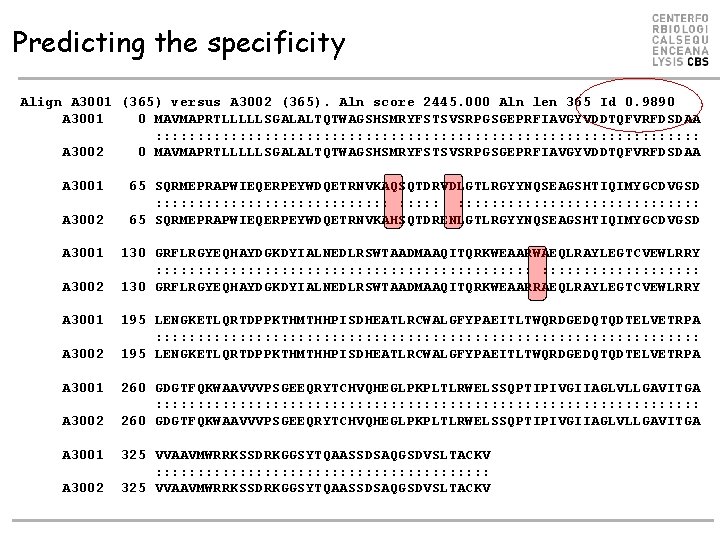
Predicting the specificity Align A 3001 (365) versus A 3002 (365). Aln score 2445. 000 Aln len 365 Id 0. 9890 A 3001 0 MAVMAPRTLLLLLSGALALTQTWAGSHSMRYFSTSVSRPGSGEPRFIAVGYVDDTQFVRFDSDAA : : : : : : : : : : : : : : : : : A 3002 0 MAVMAPRTLLLLLSGALALTQTWAGSHSMRYFSTSVSRPGSGEPRFIAVGYVDDTQFVRFDSDAA A 3001 A 3002 A 3001 A 3002 65 SQRMEPRAPWIEQERPEYWDQETRNVKAQSQTDRVDLGTLRGYYNQSEAGSHTIQIMYGCDVGSD : : : : : : : : : : : : : : : : 65 SQRMEPRAPWIEQERPEYWDQETRNVKAHSQTDRENLGTLRGYYNQSEAGSHTIQIMYGCDVGSD 130 GRFLRGYEQHAYDGKDYIALNEDLRSWTAADMAAQITQRKWEAARWAEQLRAYLEGTCVEWLRRY : : : : : : : : : : : : : : : : 130 GRFLRGYEQHAYDGKDYIALNEDLRSWTAADMAAQITQRKWEAARRAEQLRAYLEGTCVEWLRRY 195 LENGKETLQRTDPPKTHMTHHPISDHEATLRCWALGFYPAEITLTWQRDGEDQTQDTELVETRPA : : : : : : : : : : : : : : : : : 195 LENGKETLQRTDPPKTHMTHHPISDHEATLRCWALGFYPAEITLTWQRDGEDQTQDTELVETRPA 260 GDGTFQKWAAVVVPSGEEQRYTCHVQHEGLPKPLTLRWELSSQPTIPIVGIIAGLVLLGAVITGA : : : : : : : : : : : : : : : : : 260 GDGTFQKWAAVVVPSGEEQRYTCHVQHEGLPKPLTLRWELSSQPTIPIVGIIAGLVLLGAVITGA 325 VVAAVMWRRKSSDRKGGSYTQAASSDSAQGSDVSLTACKV : : : : : : : : : : 325 VVAAVMWRRKSSDRKGGSYTQAASSDSAQGSDVSLTACKV
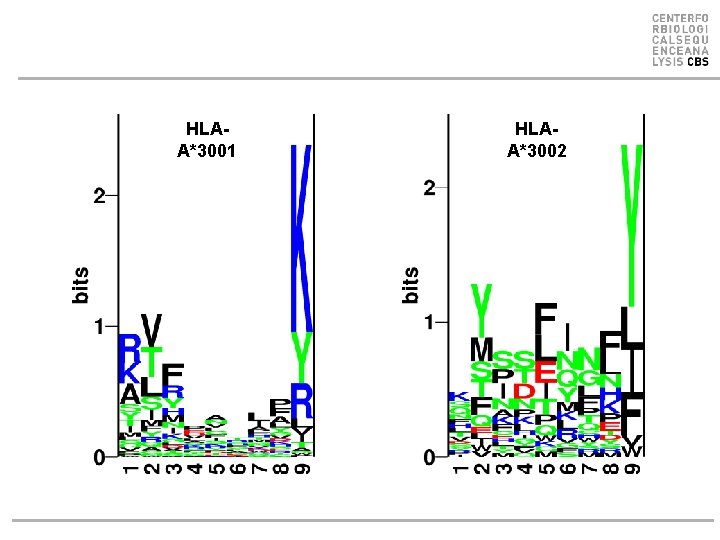
HLAA*3001 HLAA*3002
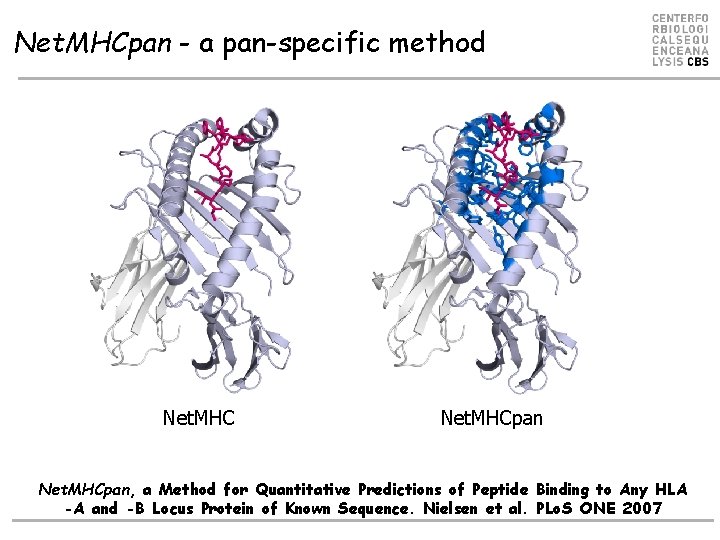
Net. MHCpan - a pan-specific method Net. MHCpan, a Method for Quantitative Predictions of Peptide Binding to Any HLA -A and -B Locus Protein of Known Sequence. Nielsen et al. PLo. S ONE 2007
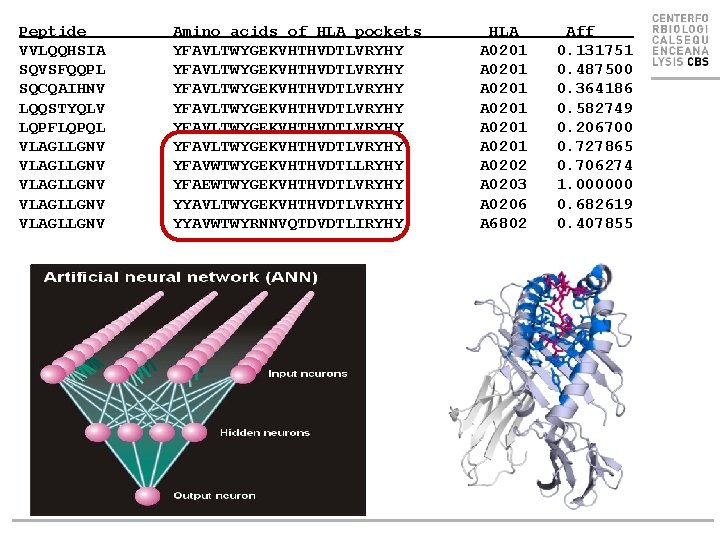
Example Peptide VVLQQHSIA SQVSFQQPL SQCQAIHNV LQQSTYQLV LQPFLQPQL VLAGLLGNV VLAGLLGNV Amino acids of HLA pockets YFAVLTWYGEKVHTHVDTLVRYHY YFAVLTWYGEKVHTHVDTLVRYHY YFAVWTWYGEKVHTHVDTLLRYHY YFAEWTWYGEKVHTHVDTLVRYHY YYAVLTWYGEKVHTHVDTLVRYHY YYAVWTWYRNNVQTDVDTLIRYHY HLA A 0201 A 0201 A 0202 A 0203 A 0206 A 6802 Aff 0. 131751 0. 487500 0. 364186 0. 582749 0. 206700 0. 727865 0. 706274 1. 000000 0. 682619 0. 407855
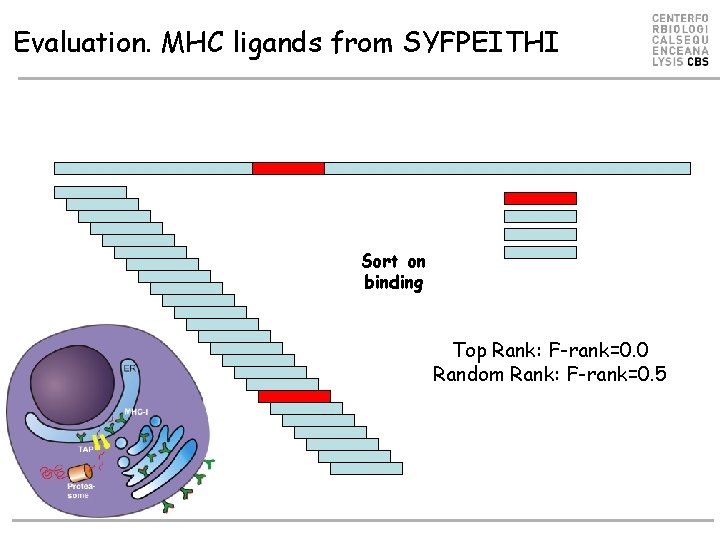
Evaluation. MHC ligands from SYFPEITHI Sort on binding Top Rank: F-rank=0. 0 Random Rank: F-rank=0. 5
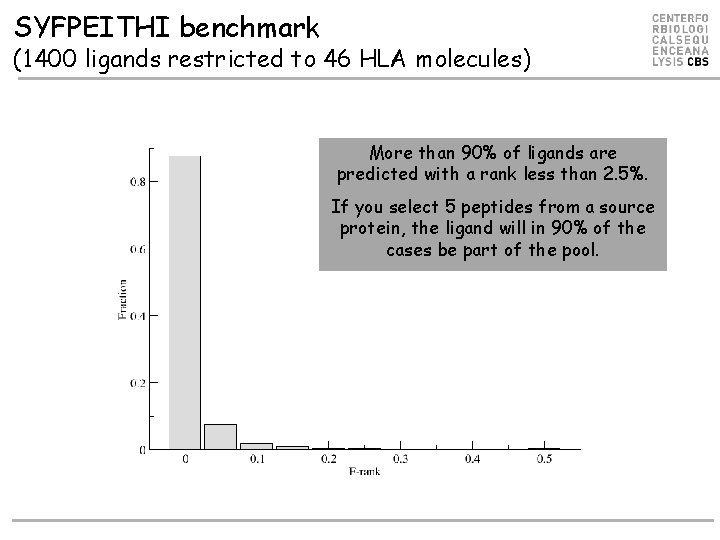
SYFPEITHI benchmark (1400 ligands restricted to 46 HLA molecules) More than 90% of ligands are predicted with a rank less than 2. 5%. If you select 5 peptides from a source protein, the ligand will in 90% of the cases be part of the pool.
Pan-specific predictions • Pan-specific MHC peptide binding prediction is the single most important recent (in silico) development for understanding presentation of T cell epitopes/ligands
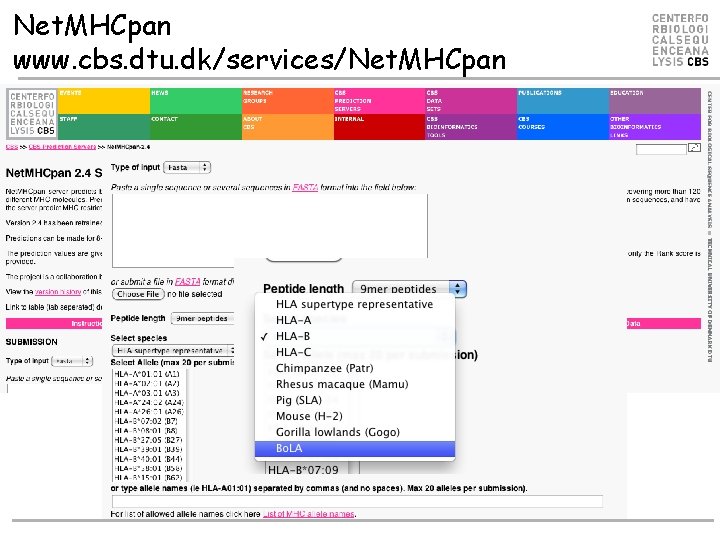
Net. MHCpan www. cbs. dtu. dk/services/Net. MHCpan
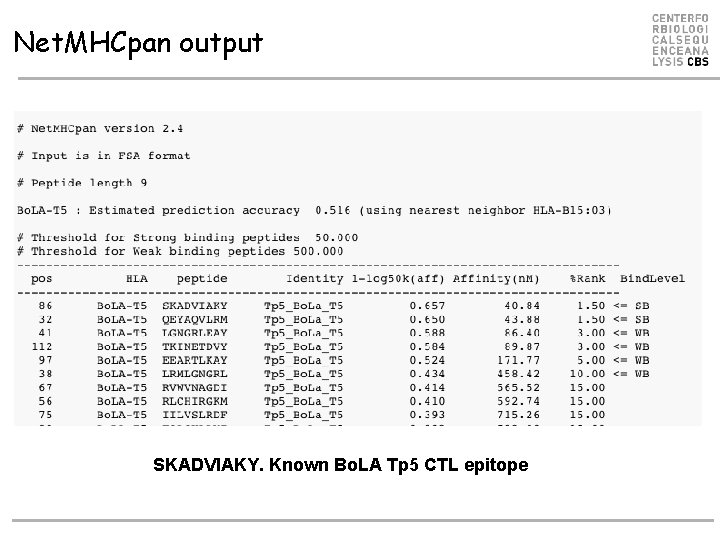
Net. MHCpan output SKADVIAKY. Known Bo. LA Tp 5 CTL epitope
What is the %rank score? • Different MHC molecules have very different number of binders (affinity < 500 n. M) – Take 100, 000 random natural 9 mer peptides • HLA-A 02: 01 will binding 5000 of these • HLA-A 01: 01 will bind 500 • HLA-C 06: 01 will bind 5 • Is this biology? And does it mean that different MHC molecules present peptides at different binding thresholds? • The rank score levels this difference
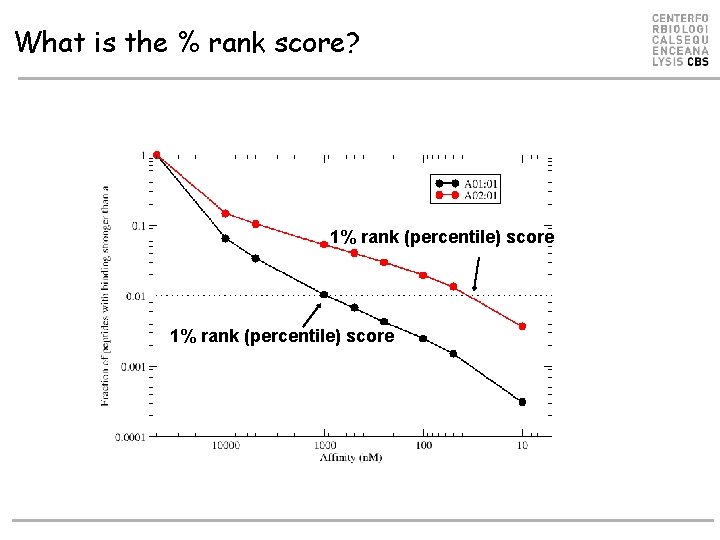
What is the % rank score? 1% rank (percentile) score
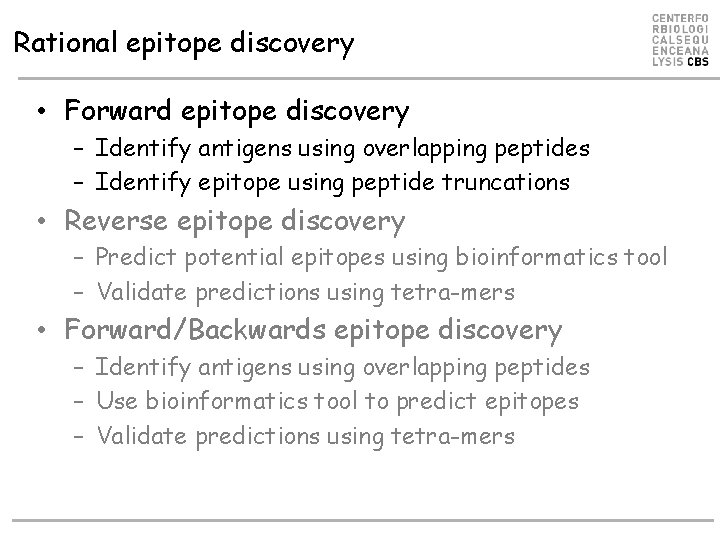
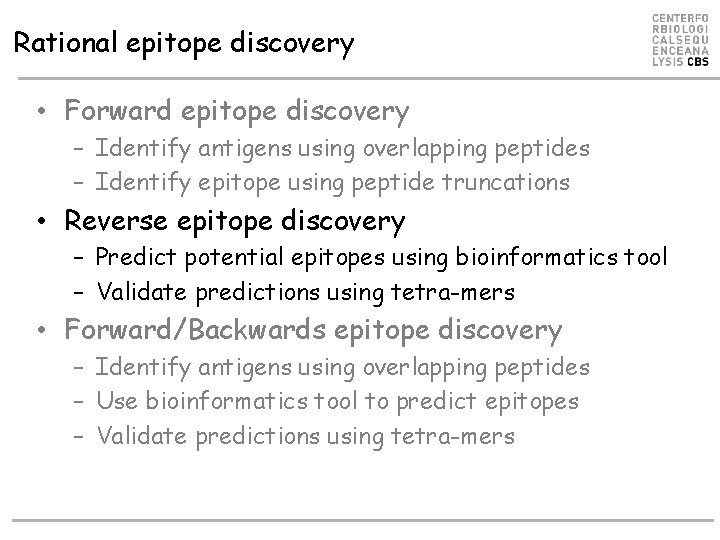
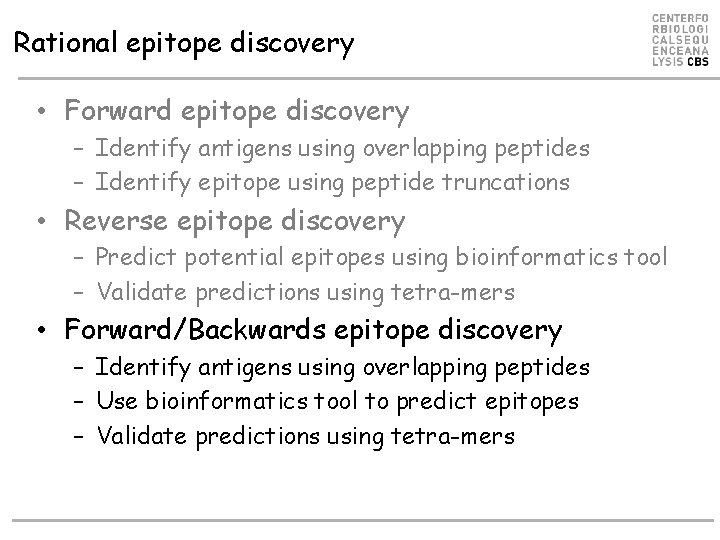
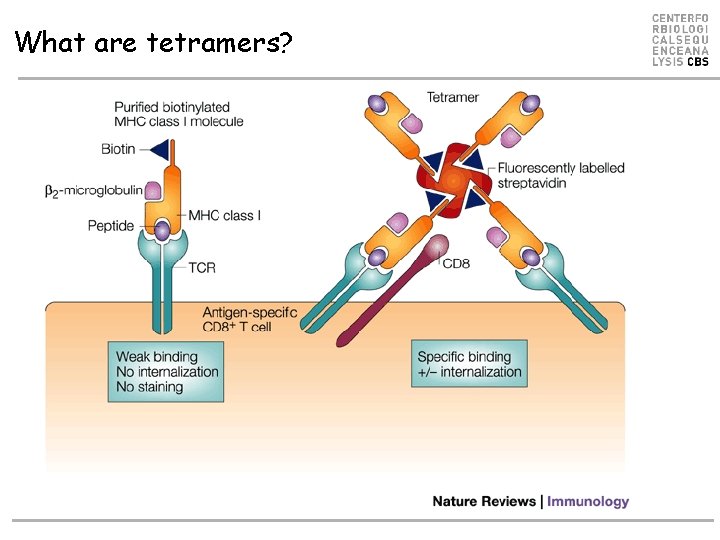
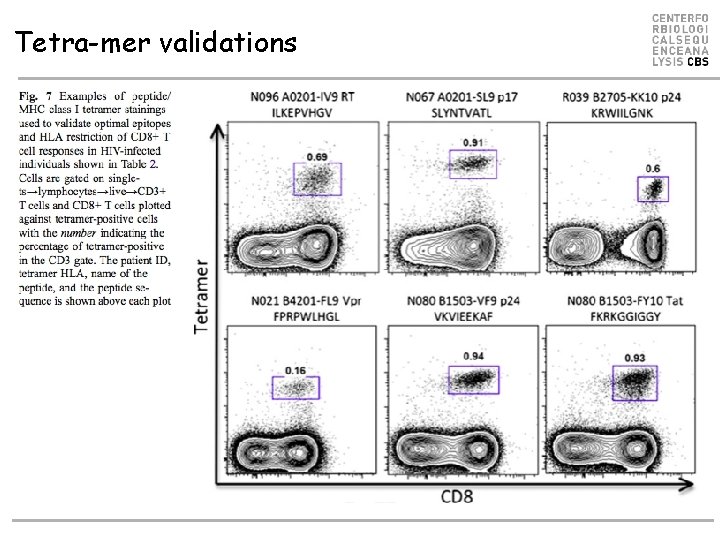
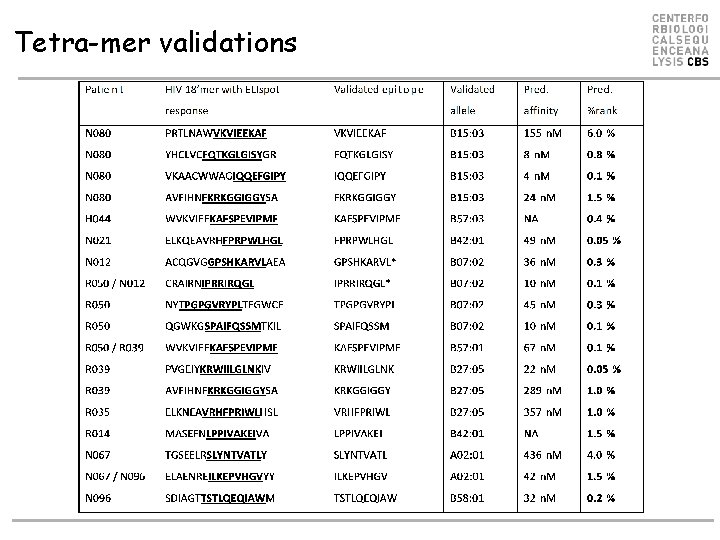
Rational epitope discovery • Forward epitope discovery – Identify antigens using overlapping peptides – Identify epitope using peptide truncations • Reverse epitope discovery – Predict potential epitopes using bioinformatics tool – Validate predictions using tetra-mers • Forward/Backwards epitope discovery – Identify antigens using overlapping peptides – Use bioinformatics tool to predict epitopes – Validate predictions using tetra-mers
Forward epitope discovery • Some numbers – YF (Yellow Fever) 3, 411 amino acids precursor protein – ~ 900 15 mers overlapping with 11 amino acids – One positive 15 mer peptide will contain to 26 submer peptides of length 8 -11 – Testing all 26 submer peptides to each of the 6 HLA alleles requires 156 validations
Rational epitope discovery • Forward epitope discovery – Identify antigens using overlapping peptides – Identify epitope using peptide truncations • Reverse epitope discovery – Predict potential epitopes using bioinformatics tool – Validate predictions using tetra-mers • Forward/Backwards epitope discovery – Identify antigens using overlapping peptides – Use bioinformatics tool to predict epitopes – Validate predictions using tetra-mers
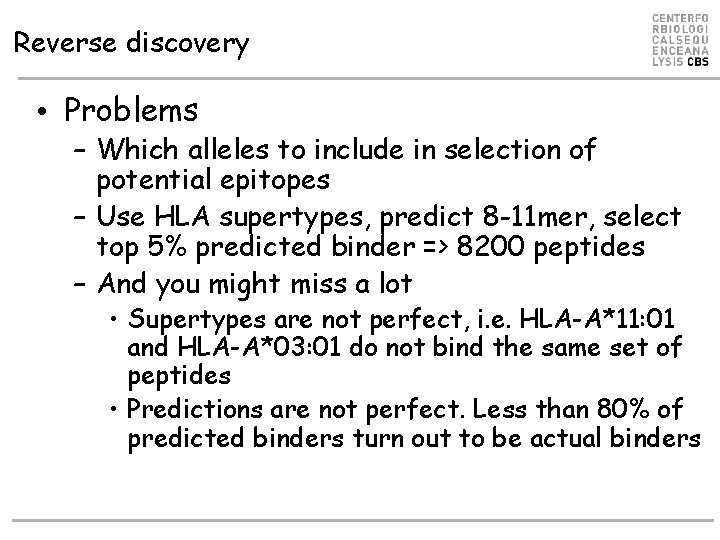
Reverse discovery • Problems – Which alleles to include in selection of potential epitopes – Use HLA supertypes, predict 8 -11 mer, select top 5% predicted binder => 8200 peptides – And you might miss a lot • Supertypes are not perfect, i. e. HLA-A*11: 01 and HLA-A*03: 01 do not bind the same set of peptides • Predictions are not perfect. Less than 80% of predicted binders turn out to be actual binders
Rational epitope discovery • Forward epitope discovery – Identify antigens using overlapping peptides – Identify epitope using peptide truncations • Reverse epitope discovery – Predict potential epitopes using bioinformatics tool – Validate predictions using tetra-mers • Forward/Backwards epitope discovery – Identify antigens using overlapping peptides – Use bioinformatics tool to predict epitopes – Validate predictions using tetra-mers
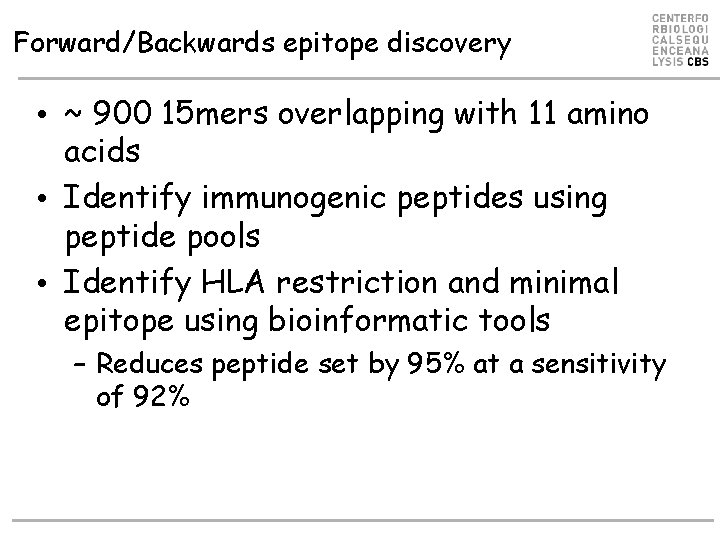
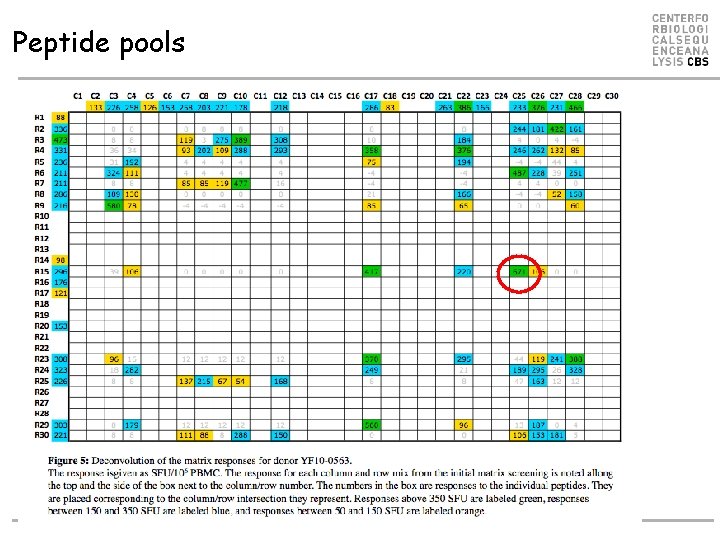
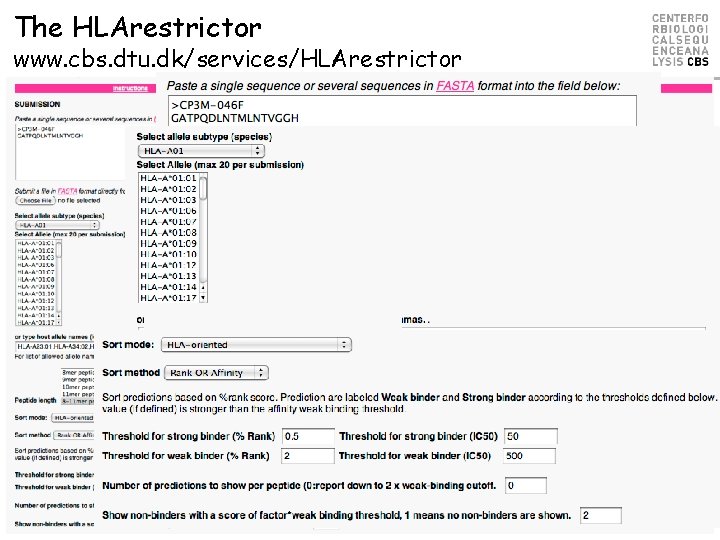
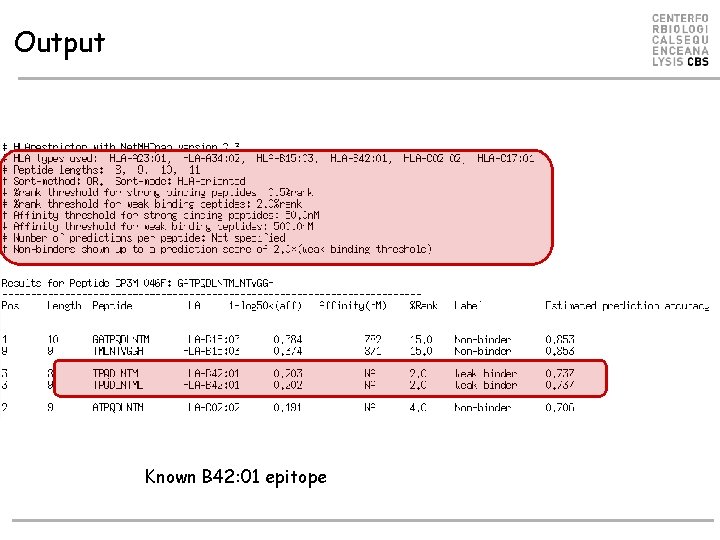
Forward/Backwards epitope discovery • ~ 900 15 mers overlapping with 11 amino acids • Identify immunogenic peptides using peptide pools • Identify HLA restriction and minimal epitope using bioinformatic tools – Reduces peptide set by 95% at a sensitivity of 92%
Peptide pools
The HLArestrictor www. cbs. dtu. dk/services/HLArestrictor
Output Known B 42: 01 epitope
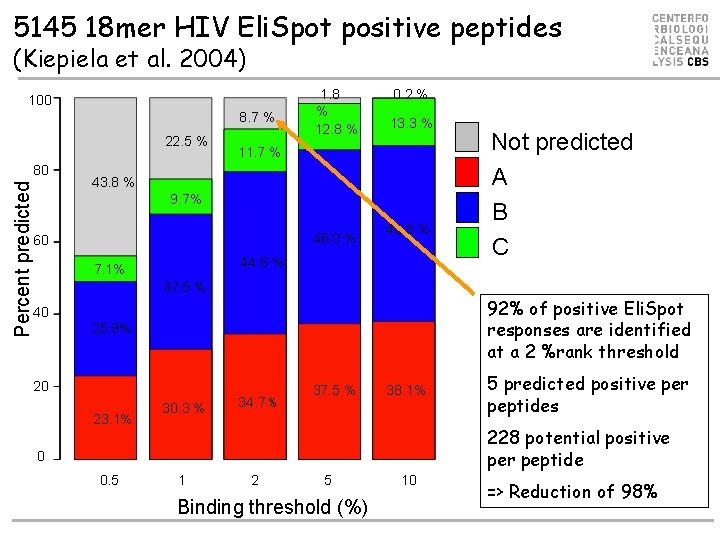
5145 18 mer HIV Eli. Spot positive peptides (Kiepiela et al. 2004) 100 8. 7 % 22. 5 % Percent predicted 80 0. 2 % 13. 3 % 11. 7 % 43. 8 % 9. 7% 48. 0 % 60 40 1. 8 % 12. 8 % 48. 5 % 44. 8 % 7. 1% Not predicted A B C 37. 5 % 92% of positive Eli. Spot responses are identified at a 2 %rank threshold 25. 9% 20 23. 1% 30. 3 % 34. 7 % 37. 5 % 38. 1% 228 potential positive per peptide 0 0. 5 5 predicted positive per peptides 1 2 5 Binding threshold (%) 10 => Reduction of 98%
What are tetramers?
Tetra-mer validations
Tetra-mer validations
Visualization of binding motifs www. cbs. dtu. dk/biotools/MHCMotif. Viewer The MHC motif viewer: a visualization tool for MHC binding motifs. Rapin N, Hoof I, Lund O, Nielsen M. Curr Protoc Immunol. 2010 Feb; Chapter 18: Unit 18. 17.
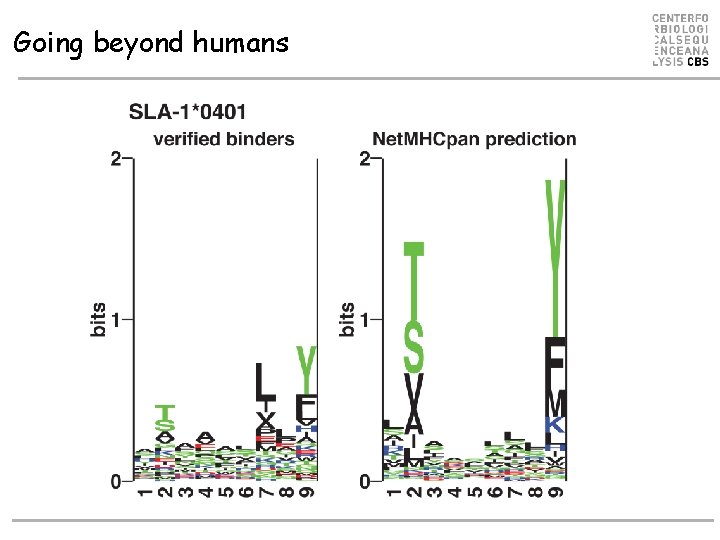
Going beyond humans
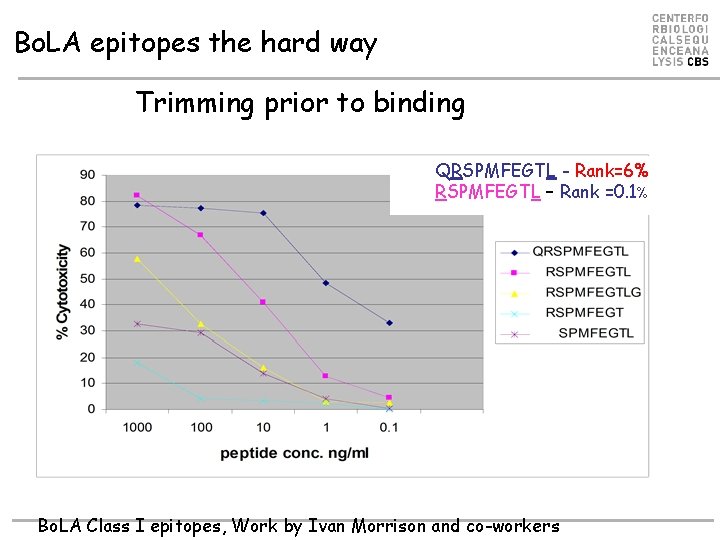
Bo. LA epitopes the hard way Trimming prior to binding QRSPMFEGTL - Rank=6% RSPMFEGTL – Rank =0. 1% Bo. LA Class I epitopes, Work by Ivan Morrison and co-workers
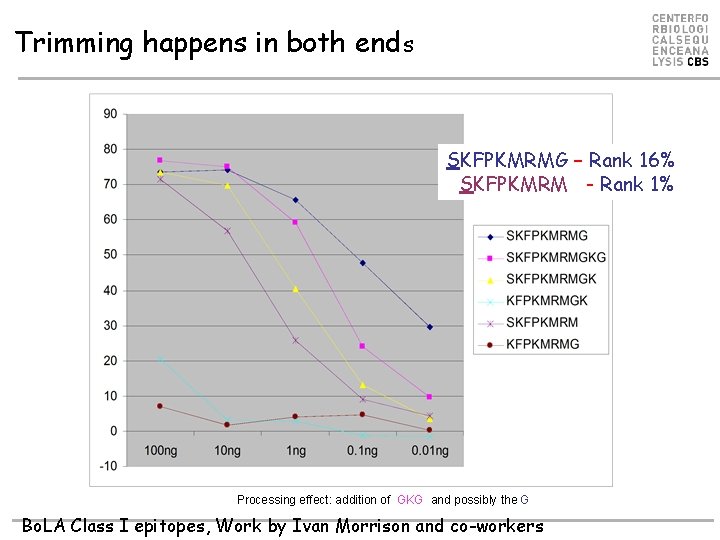
Trimming happens in both ends SKFPKMRMG – Rank 16% SKFPKMRM - Rank 1% Processing effect: addition of GKG and possibly the G Bo. LA Class I epitopes, Work by Ivan Morrison and co-workers
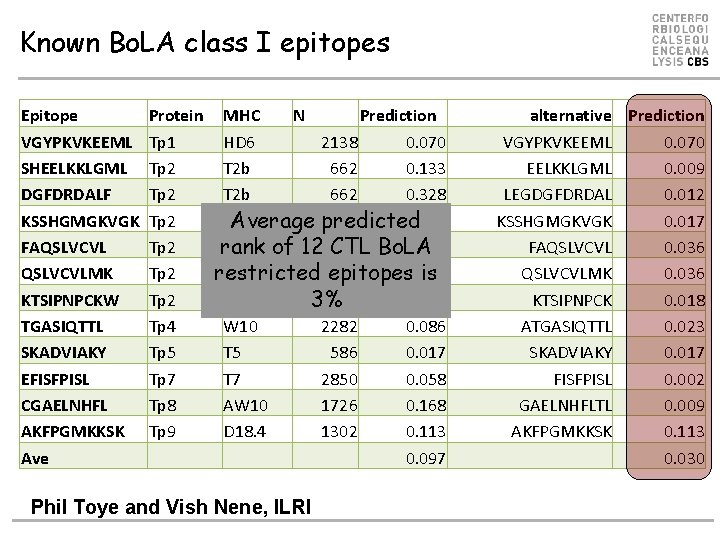
Known Bo. LA class I epitopes Epitope VGYPKVKEEML SHEELKKLGML DGFDRDALF KSSHGMGKVGK FAQSLVCVLMK KTSIPNPCKW TGASIQTTL SKADVIAKY EFISFPISL CGAELNHFL AKFPGMKKSK Ave Protein Tp 1 Tp 2 Tp 2 Tp 4 Tp 5 Tp 7 Tp 8 Tp 9 MHC N Prediction HD 6 2138 0. 070 T 2 b 662 0. 133 T 2 b 662 0. 328 T 2 a 662 0. 017 Average predicted T 2 c of 12 662 0. 036 rank CTL Bo. LA T 2 a 662 0. 036 restricted epitopes is T 2 a 662 0. 104 3% W 10 2282 0. 086 T 5 586 0. 017 T 7 2850 0. 058 AW 10 1726 0. 168 D 18. 4 1302 0. 113 0. 097 Phil Toye and Vish Nene, ILRI alternative Prediction VGYPKVKEEML 0. 070 EELKKLGML 0. 009 LEGDGFDRDAL 0. 012 KSSHGMGKVGK 0. 017 FAQSLVCVL 0. 036 QSLVCVLMK 0. 036 KTSIPNPCK 0. 018 ATGASIQTTL 0. 023 SKADVIAKY 0. 017 FISFPISL 0. 002 GAELNHFLTL 0. 009 AKFPGMKKSK 0. 113 0. 030
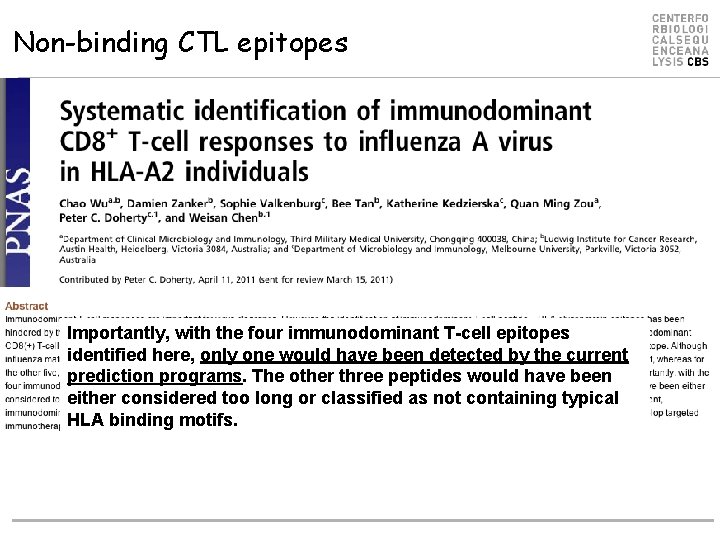
Non-binding CTL epitopes Importantly, with the four immunodominant T-cell epitopes identified here, only one would have been detected by the current prediction programs. The other three peptides would have been either considered too long or classified as not containing typical HLA binding motifs.
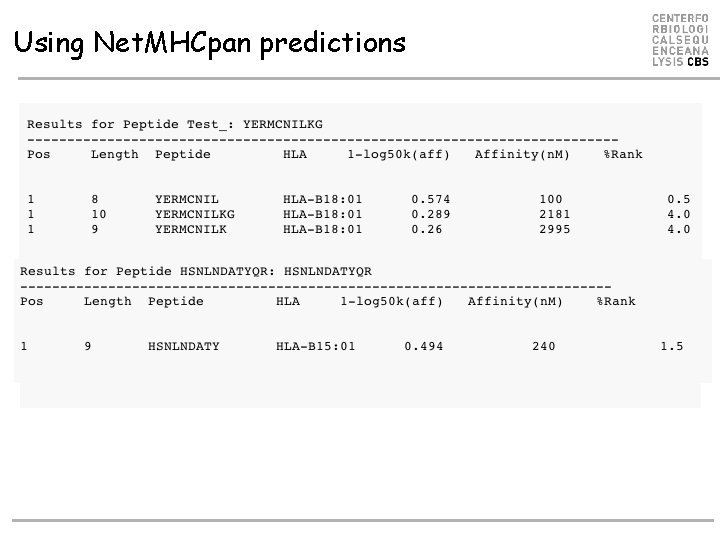
Using Net. MHCpan predictions
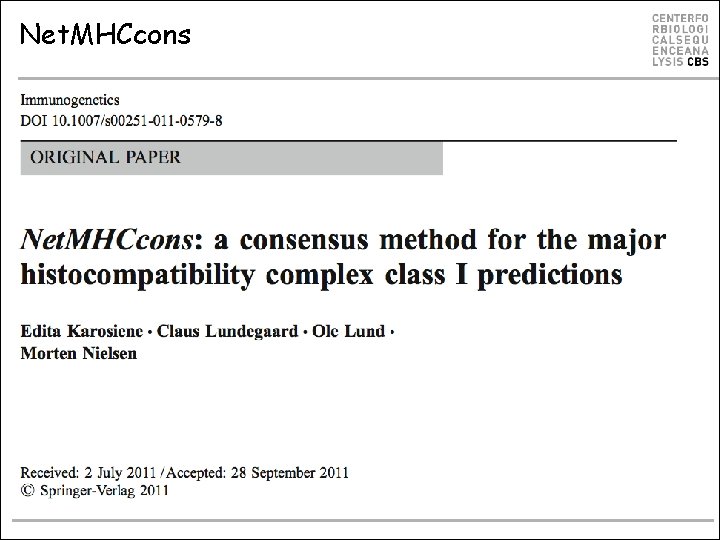
Net. MHCcons
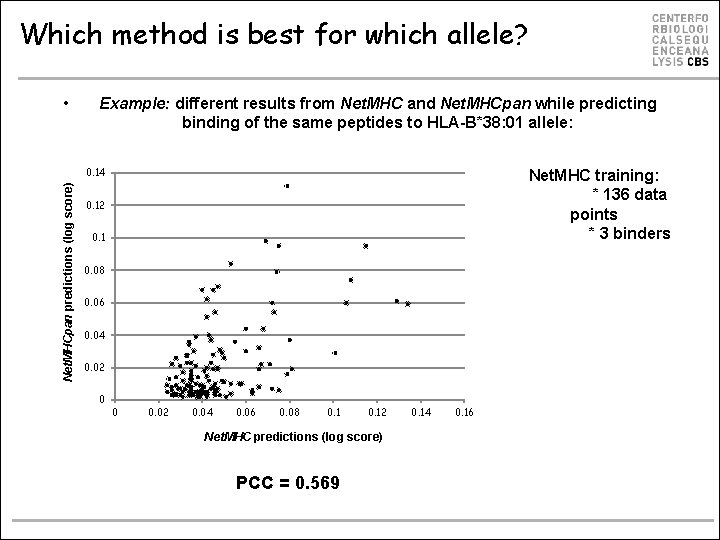
Which method is best for which allele? • Example: different results from Net. MHC and Net. MHCpan while predicting binding of the same peptides to HLA-B*38: 01 allele: Net. MHCpan predictions (log score) 0. 14 Net. MHC training: * 136 data points * 3 binders 0. 12 0. 1 0. 08 0. 06 0. 04 0. 02 0 0 0. 02 0. 04 0. 06 0. 08 0. 12 Net. MHC predictions (log score) PCC = 0. 569 0. 14 0. 16
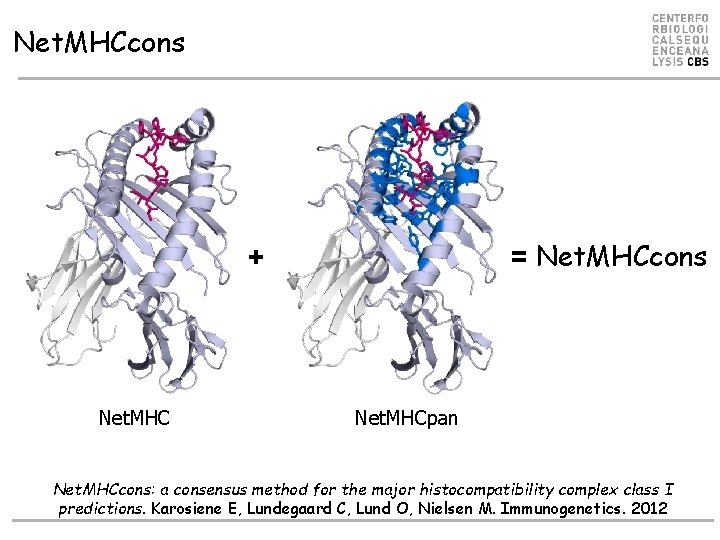
Net. MHCcons = Net. MHCcons + Net. MHCpan Net. MHCcons: a consensus method for the major histocompatibility complex class I predictions. Karosiene E, Lundegaard C, Lund O, Nielsen M. Immunogenetics. 2012
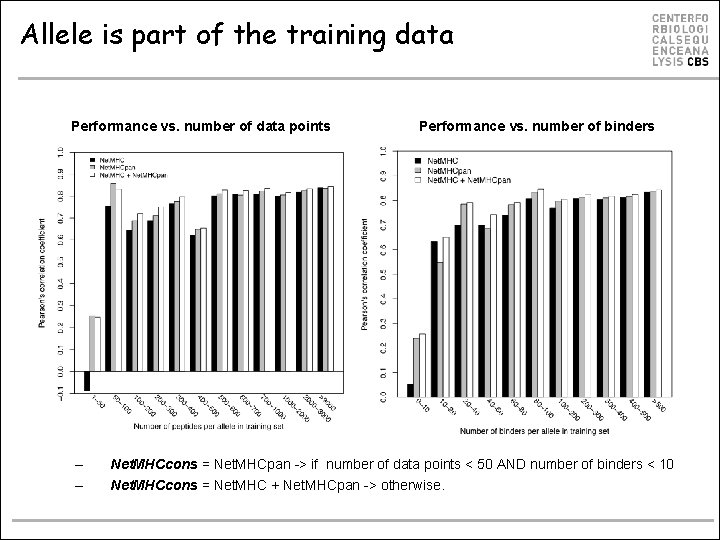
Allele is part of the training data Performance vs. number of data points – – Performance vs. number of binders Net. MHCcons = Net. MHCpan -> if number of data points < 50 AND number of binders < 10 Net. MHCcons = Net. MHC + Net. MHCpan -> otherwise.
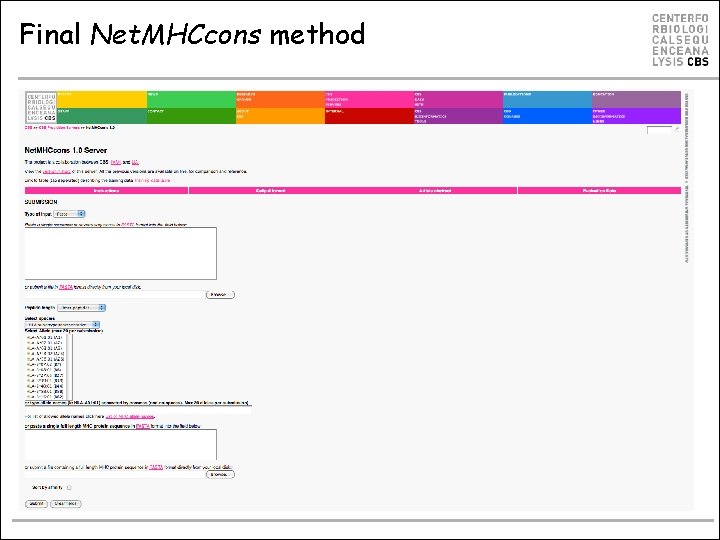
Final Net. MHCcons method
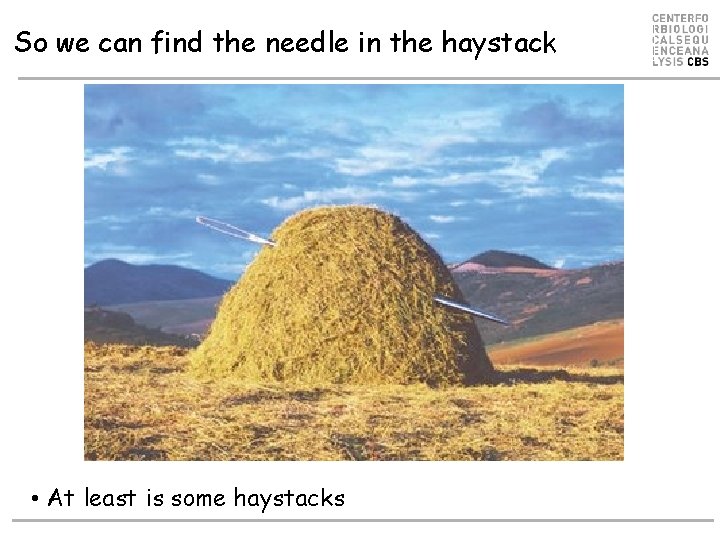
So, we can find the needle in the haystack • Given a protein sequence and an HLA molecule, we can accurately predict with peptides will bind (70 -95%) • 15 -80% of these will in turn be epitopes
Conclusions II. MHC binding • Pan-specific MHC prediction method can deal with the immense MHC polymorphism and is (in my opinion) the most significant recent contribution to our understanding of cellular immune responses • Rational epitope discovery is feasible – Prediction methods are an important guide for epitope identification – Given a protein sequence and an HLA molecule, we can predict the peptide binders (find the needle in the haystack)
What defines a T cell epitope? • • • Processing (Proteasomal cleavage, TAP)? MHC binding Other proteases T cell repertoire MHC: peptide complex stability Source protein abundance, cellular location and function
Is there anything beyond MHC binding?
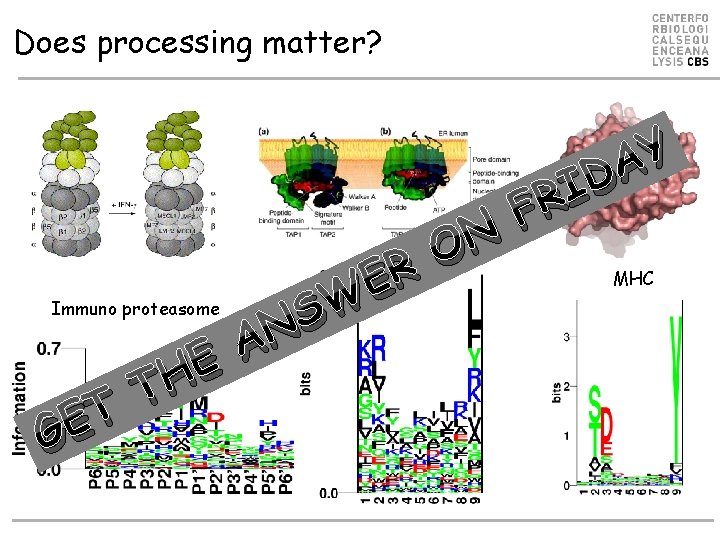
Does processing matter? Immuno proteasome A E H T T E G W S N ER TAP N O F Y A D I R MHC
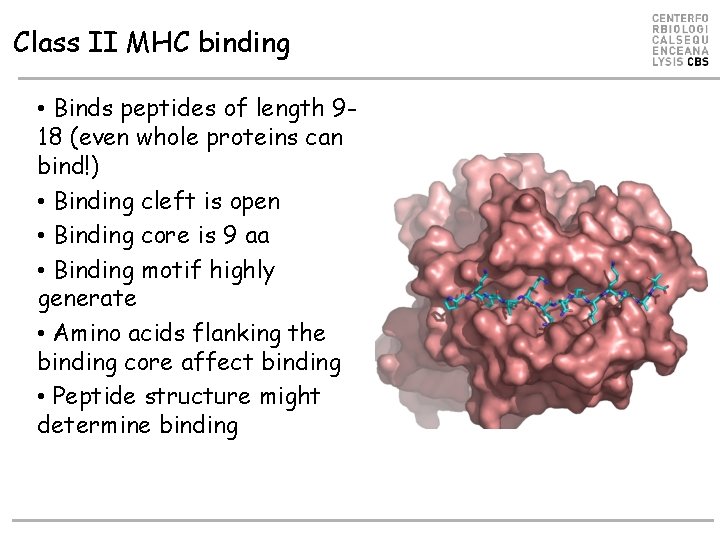
Class II MHC binding • Binds peptides of length 918 (even whole proteins can bind!) • Binding cleft is open • Binding core is 9 aa • Binding motif highly generate • Amino acids flanking the binding core affect binding • Peptide structure might determine binding
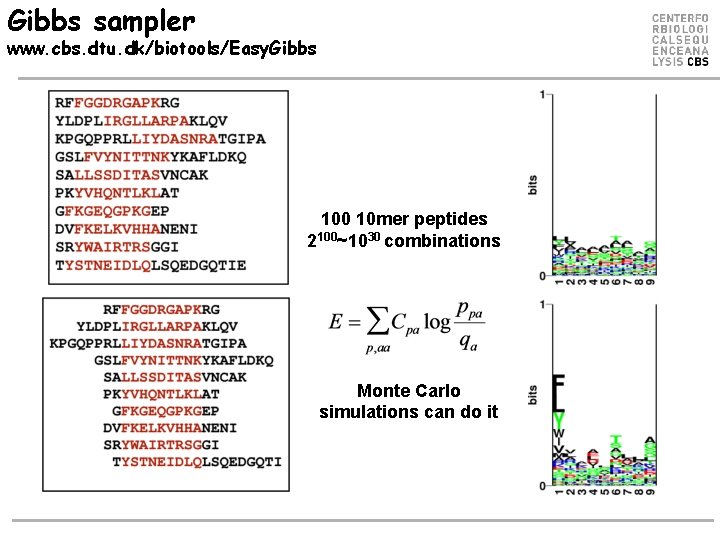
Gibbs sampler www. cbs. dtu. dk/biotools/Easy. Gibbs 100 10 mer peptides 2100~1030 combinations Monte Carlo simulations can do it
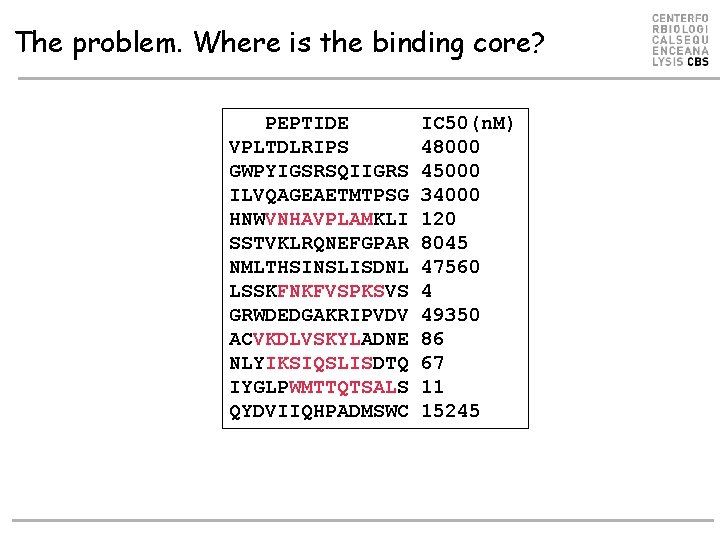
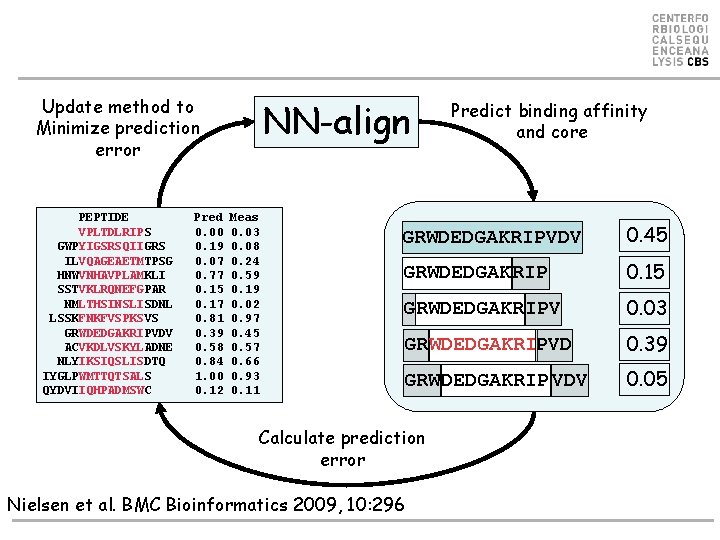
The problem. Where is the binding core? PEPTIDE VPLTDLRIPS GWPYIGSRSQIIGRS ILVQAGEAETMTPSG HNWVNHAVPLAMKLI SSTVKLRQNEFGPAR NMLTHSINSLISDNL LSSKFNKFVSPKSVS GRWDEDGAKRIPVDV ACVKDLVSKYLADNE NLYIKSIQSLISDTQ IYGLPWMTTQTSALS QYDVIIQHPADMSWC IC 50(n. M) 48000 45000 34000 120 8045 47560 4 49350 86 67 11 15245
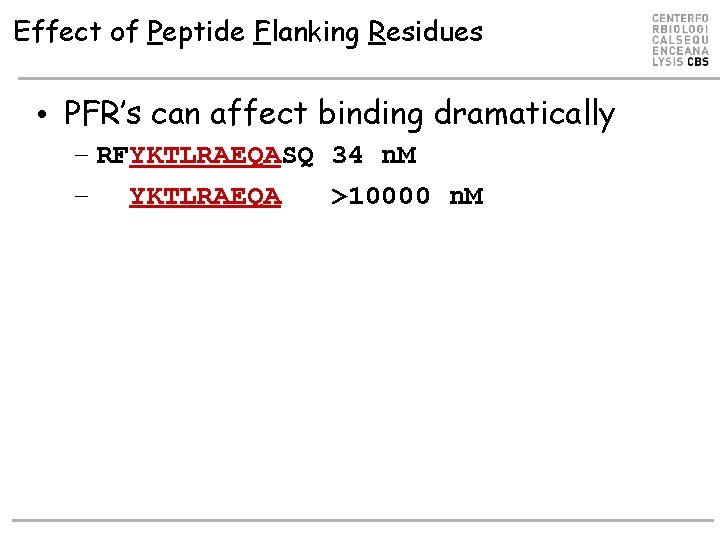
Effect of Peptide Flanking Residues • PFR’s can affect binding dramatically – RFYKTLRAEQASQ 34 n. M – YKTLRAEQA >10000 n. M
Update method to Minimize prediction error PEPTIDE VPLTDLRIPS GWPYIGSRSQIIGRS ILVQAGEAETMTPSG HNWVNHAVPLAMKLI SSTVKLRQNEFGPAR NMLTHSINSLISDNL LSSKFNKFVSPKSVS GRWDEDGAKRIPVDV ACVKDLVSKYLADNE NLYIKSIQSLISDTQ IYGLPWMTTQTSALS QYDVIIQHPADMSWC Pred 0. 00 0. 19 0. 07 0. 77 0. 15 0. 17 0. 81 0. 39 0. 58 0. 84 1. 00 0. 12 NN-align Meas 0. 03 0. 08 0. 24 0. 59 0. 19 0. 02 0. 97 0. 45 0. 57 0. 66 0. 93 0. 11 Predict binding affinity and core GRWDEDGAKRIPVDV 0. 45 GRWDEDGAKRIP 0. 15 G RWDEDGAKRIPV 0. 03 GR WDEDGAKRIPVD 0. 39 GRW DEDGAKRIP VDV 0. 05 Calculate prediction error Nielsen et al. BMC Bioinformatics 2009, 10: 296
Net. MHCII (NN-align) P<0. 001 P<0. 05 Nielsen et al. BMC Bioinformatics 2009, 10: 296 P<0. 05

The Wisdom of the Crowds • The Wisdom of Crowds. Why the Many are Smarter than the Few. James Surowiecki One day in the fall of 1906, the British scientist Fracis Galton left his home and headed for a country fair… He believed that only a very few people had the characteristics necessary to keep societies healthy. He had devoted much of his career to measuring those characteristics, in fact, in order to prove that the vast majority of people did not have them. … Galton came across a weight-judging competition…Eight hundred people tried their luck. They were a diverse lot, butchers, farmers, clerks and many other no-experts…The crowd had guessed … 1. 197 pounds, the ox weighted 1. 198
Network ensembles (starting from different starting configurations)
Network ensembles
Could you do it your self? • We have developed a series of methods suitable to identify the binding motif of a receptor given a set of peptide binding data • Could the non-expert end-user apply these to derive the binding motif and a subsequent predictor for a novel receptor? • The NNAlign server allows this
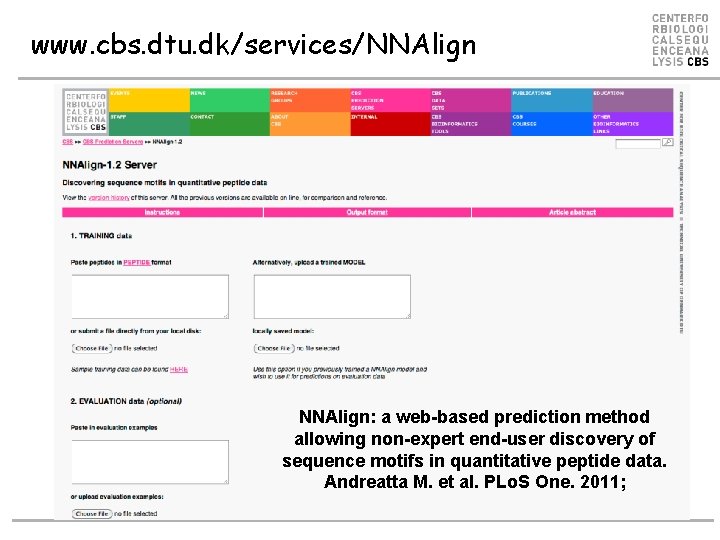
www. cbs. dtu. dk/services/NNAlign: a web-based prediction method allowing non-expert end-user discovery of sequence motifs in quantitative peptide data. Andreatta M. et al. PLo. S One. 2011;
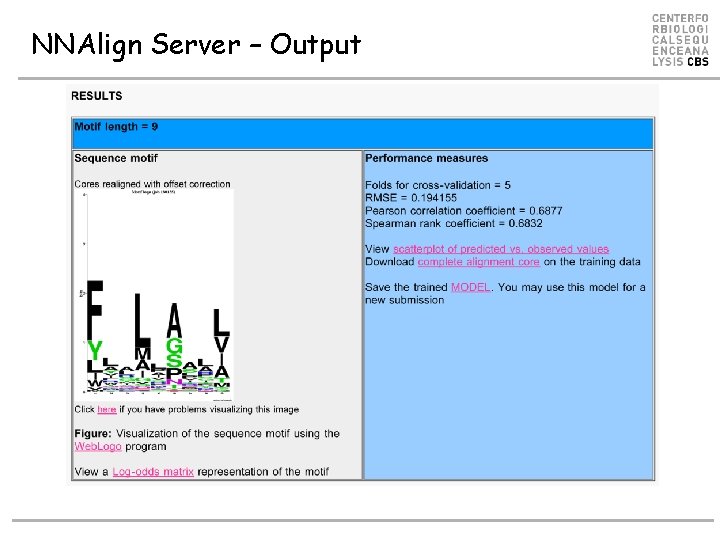
NNAlign Server – Output
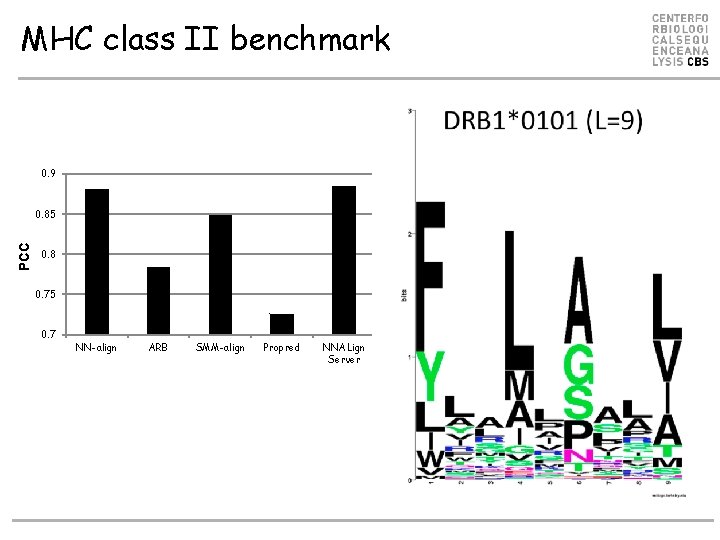
MHC class II benchmark 0. 9 PCC 0. 85 0. 8 0. 75 0. 7 NN-align ARB SMM-align Propred NNALign Server
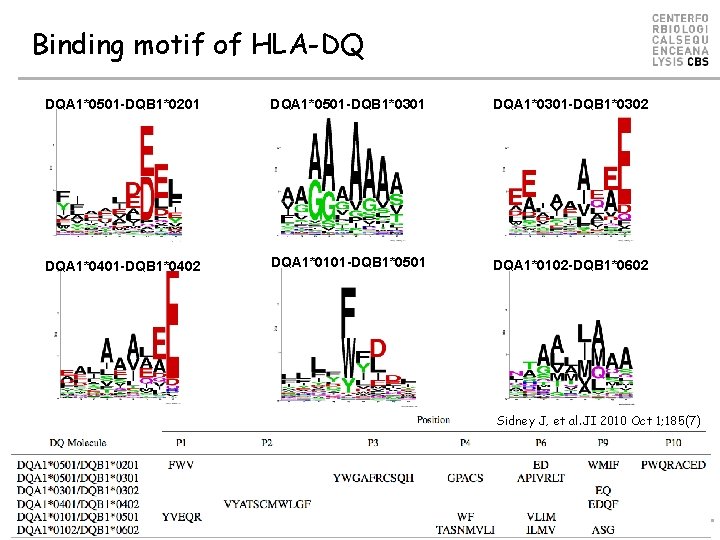
Binding motif of HLA-DQ DQA 1*0501 -DQB 1*0201 DQA 1*0501 -DQB 1*0301 DQA 1*0301 -DQB 1*0302 DQA 1*0401 -DQB 1*0402 DQA 1*0101 -DQB 1*0501 DQA 1*0102 -DQB 1*0602 Sidney J, et al. JI 2010 Oct 1; 185(7)
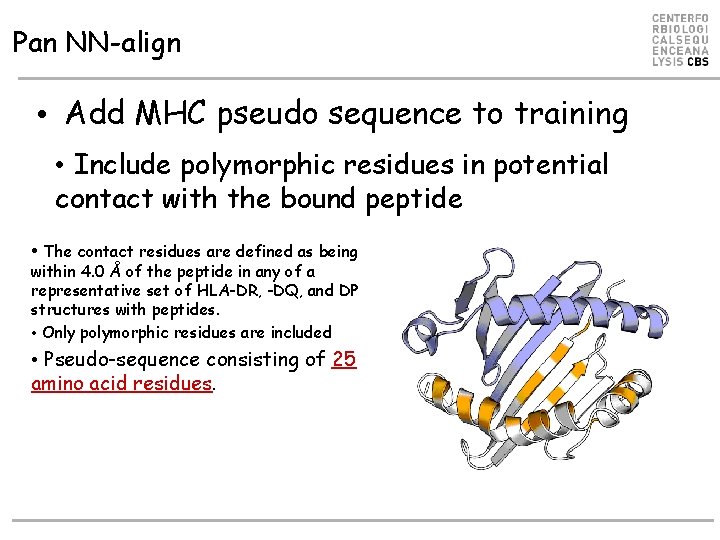
Pan NN-align • Add MHC pseudo sequence to training • Include polymorphic residues in potential contact with the bound peptide • The contact residues are defined as being within 4. 0 Å of the peptide in any of a representative set of HLA-DR, -DQ, and DP structures with peptides. • Only polymorphic residues are included • Pseudo-sequence consisting of 25 amino acid residues.
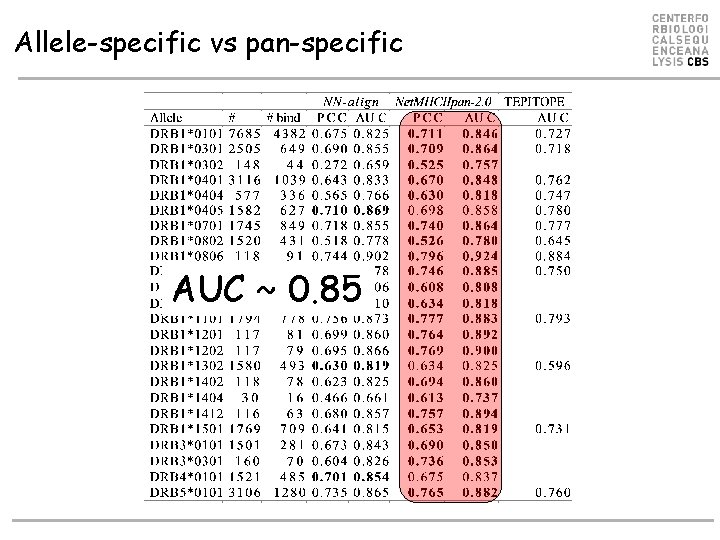
Allele-specific vs pan-specific AUC ~ 0. 85
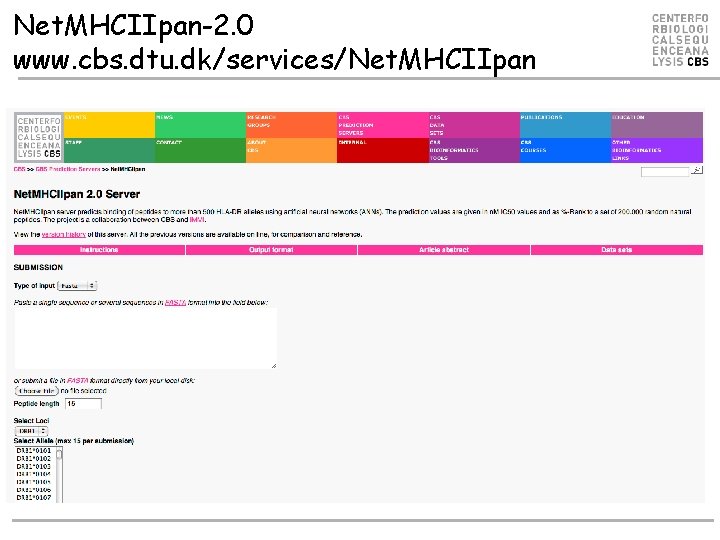
Net. MHCIIpan-2. 0 www. cbs. dtu. dk/services/Net. MHCIIpan
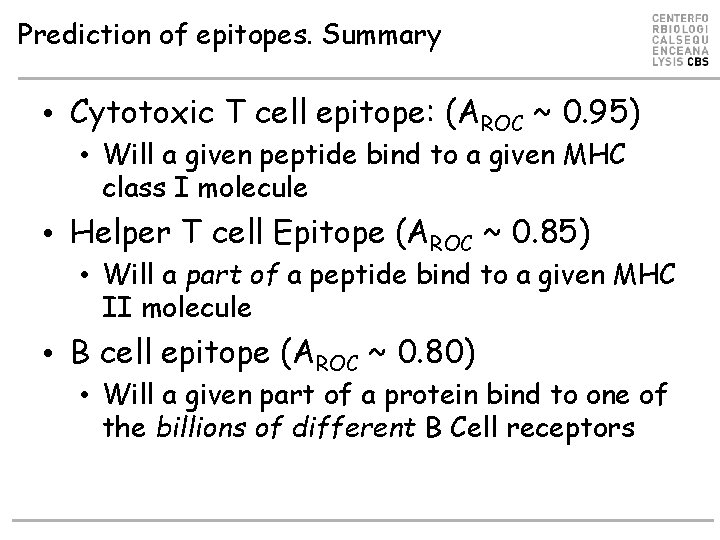
Prediction of epitopes. Summary • Cytotoxic T cell epitope: (AROC ~ 0. 95) • Will a given peptide bind to a given MHC class I molecule • Helper T cell Epitope (AROC ~ 0. 85) • Will a part of a peptide bind to a given MHC II molecule • B cell epitope (AROC ~ 0. 80) • Will a given part of a protein bind to one of the billions of different B Cell receptors
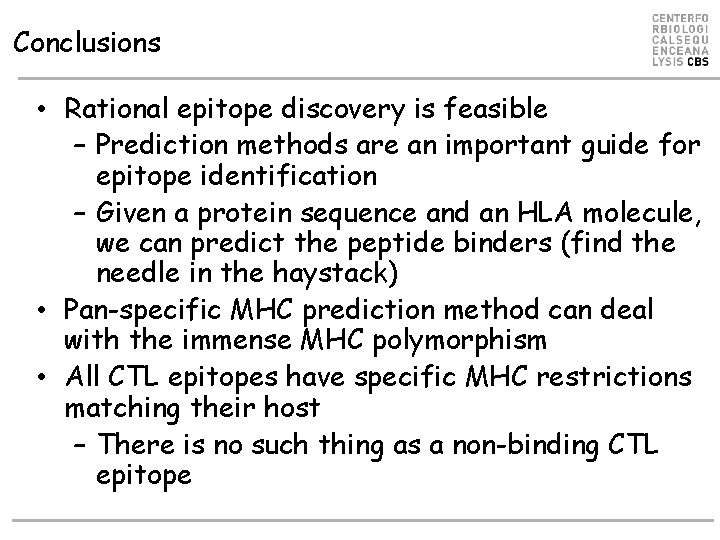
Conclusions • Rational epitope discovery is feasible – Prediction methods are an important guide for epitope identification – Given a protein sequence and an HLA molecule, we can predict the peptide binders (find the needle in the haystack) • Pan-specific MHC prediction method can deal with the immense MHC polymorphism • All CTL epitopes have specific MHC restrictions matching their host – There is no such thing as a non-binding CTL epitope
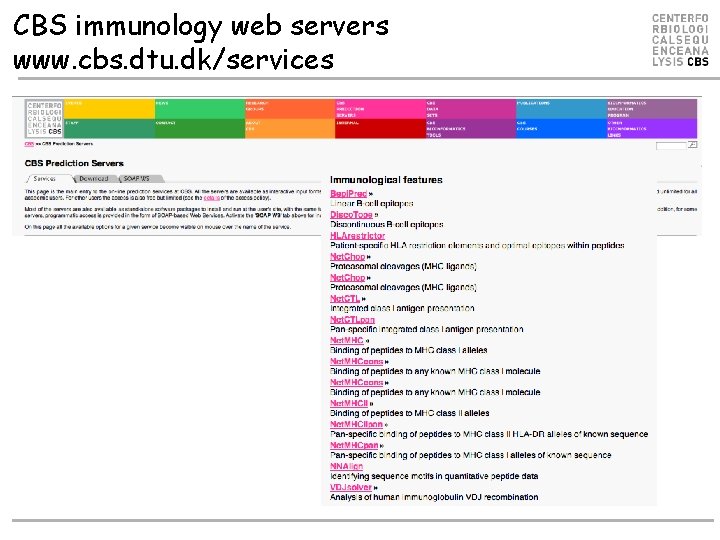
CBS immunology web servers www. cbs. dtu. dk/services
Acknowledgements Immunological Bioinformatics group, CBS, DTU • – Ole Lund - Group leader – Claus Lundegaard - Data bases, HLA binding predictions • Collaborators – IMMI, University of Copenhagen • Søren Buus: MHC binding – La Jolla Institute of Allergy and Infectious Diseases • A. Sette, B. Peters: Epitope database • and many, many more www. cbs. dtu. dk/services
- Slides: 141