
Predicting Miscellaneous Electrical Loads MELs in Commercial Buildings

Predicting Miscellaneous Electrical Loads (MELs) in Commercial Buildings: A Time Series Analysis Presented by: Behzad Esmaeili, Ph. D. April 26 th, 2018
Overview of Research ØSignificance ØKnowledge Gap ØResearch Objectives ØResearch Methods ØConclusions
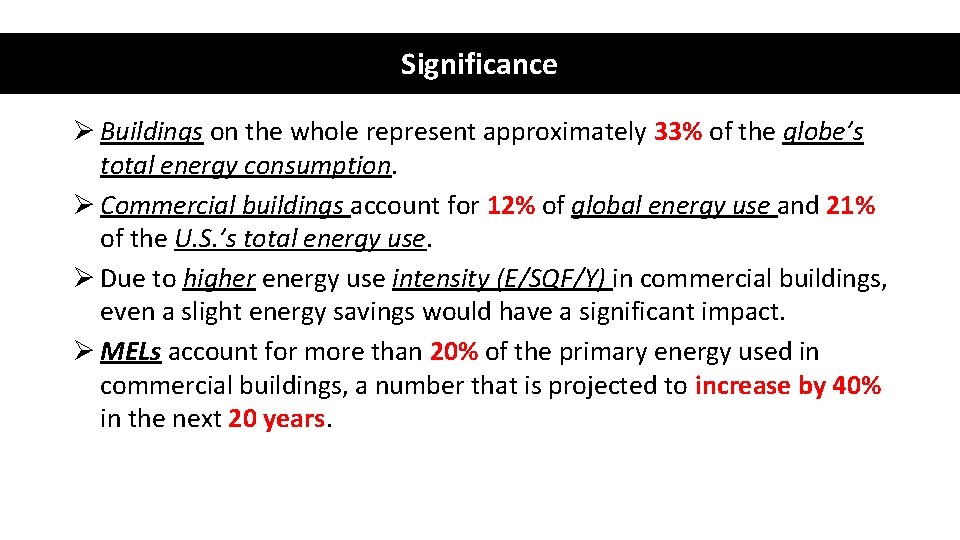
Significance Ø Buildings on the whole represent approximately 33% of the globe’s total energy consumption. Ø Commercial buildings account for 12% of global energy use and 21% of the U. S. ’s total energy use. Ø Due to higher energy use intensity (E/SQF/Y) in commercial buildings, even a slight energy savings would have a significant impact. Ø MELs account for more than 20% of the primary energy used in commercial buildings, a number that is projected to increase by 40% in the next 20 years.
Significance Reducing plug-load consumption in commercial buildings offers an excellent opportunity for achieving net-zero energy buildings.
Knowledge Gap ØPrevious studies did not consider occupants’ individual energy-use behavior to provide well-timed, personalized, and targeted energy efficiency feedback to induce further energy efficiency. ØSustainable behavioral change is a challenge which has not yet been thoroughly addressed.
Research Objectives ØTo determine effective interventions that will reduce energy consumption in commercial buildings: 1. Track MELs’ energy use and apply MLA to subsequently predict individual energy consumption; 2. Build and validate a new, NILM technique for measuring individual plug loads from a single point using time-series analysis; 3. Create an infrastructure to collect MELs’ energy use in Volgenau School of Engineering for at least 5 years.
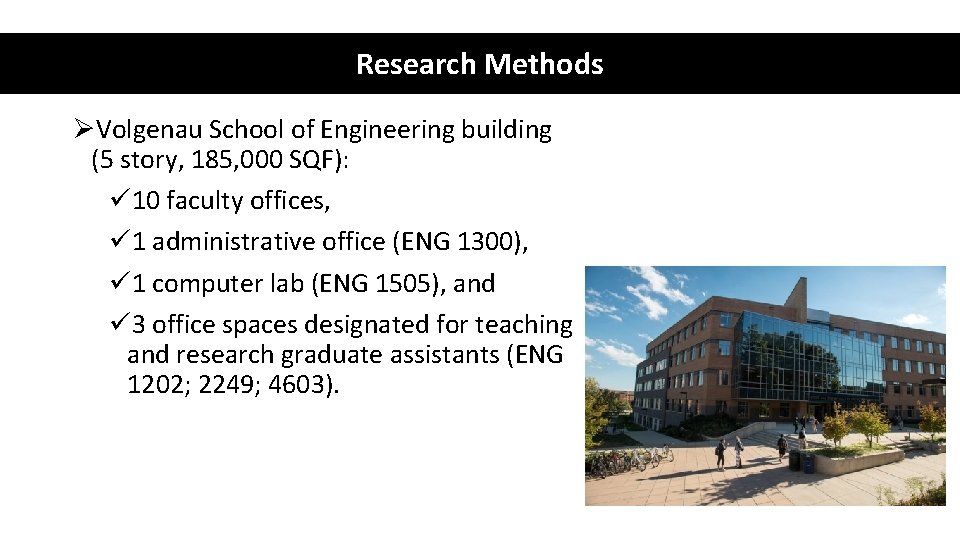
Research Methods ØVolgenau School of Engineering building (5 story, 185, 000 SQF): ü 10 faculty offices, ü 1 administrative office (ENG 1300), ü 1 computer lab (ENG 1505), and ü 3 office spaces designated for teaching and research graduate assistants (ENG 1202; 2249; 4603).
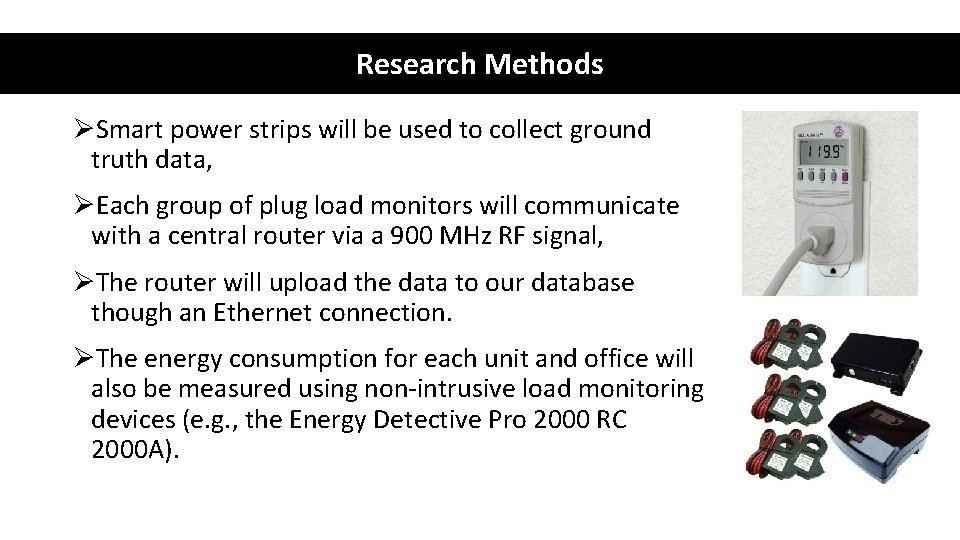
Research Methods ØSmart power strips will be used to collect ground truth data, ØEach group of plug load monitors will communicate with a central router via a 900 MHz RF signal, ØThe router will upload the data to our database though an Ethernet connection. ØThe energy consumption for each unit and office will also be measured using non-intrusive load monitoring devices (e. g. , the Energy Detective Pro 2000 RC 2000 A).
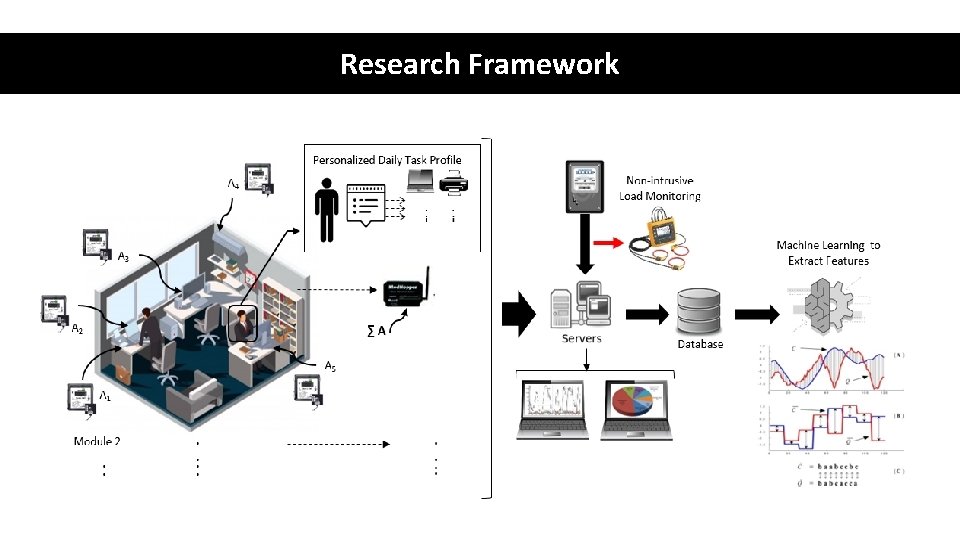
Research Framework
Research Methods ØUsing SVM and k means clustering techniques to construct individual energy-use profiles; ØDevelop a set of predictive models to forecast energy consumption based upon a limited set of features; and ØUsing Symbolic Aggregate approximation (SAX) to disaggregate and identify appliances and their operational states. q The results of this analysis will help us to more accurately determine MLE’s energy consumption using NIEL techniques. q Feedbacks will be provided to change behavior of occupants to reduce energy consumption.
Contributions ØOur success will lay the foundation for several solutions and interventions for occupant-level energy-efficiency programs such as automated energy-efficiency notifications and cellphone based feedback.
Contributions ØUsers will be able to predict broader energy consumption via MELs’ energy use; ØFacility managers and building owners will be able to provide feedback to building occupants and will support the implementation of strategies to reduce energy use; ØUtilities will be able to manage existing electricity supply chains more efficiently; ØBuilding designers will be able to alter their designs based on more precise predictions of energy consumption; and ØThe database of MELs energy use developed in this study can be later used as a benchmark or input for simulation models.

ANY QUESTIONS? Thanks for your Time and Attention!
- Slides: 13