
PREDICTING INTERPLANETARY SHOCKS USING NEURAL NETWORKS A brahim
PREDICTING INTERPLANETARY SHOCKS USING NEURAL NETWORKS A. İbrahim PALA METU Aerospace Engineering Department Senior Student 21. 12. 2005
OUTLINE ØWHAT IS AN INTERPLANETARY SHOCK? ØWHAT IS A NEURAL NETWORK? ØHOW THE NEURAL NETWORKS ARE USED TO PREDICT THE INTERPLANETARY SHOCKS? ØCONCLUSION

INTERPLANETARY SHOCKS Ø Charged particles are constantly streaming outward from the Sun. Ø When events such as Coronal Mass Ejections (CMEs) occur on the Sun, an Interplanetary (IP) shock may be generated.

INTERPLANETARY SHOCKS ØThe abrupt boundary formed at the front of a plasma cloud moving much faster than the rest of the solar wind, as it pushes its way through interplanetary space.
NEURAL NETWORKS Ø NEURONS SYNAPSE (INPUT->WEIGHTS) COLLECTOR ACTIVATION FUNCTION->OUTPUT
NEURAL NETWORKS Ø CONSTRUCTING A NEURAL NETWORK BY BRINGING LOTS OF NEURONS TOGETHER AND INTERCONNECTING AND TRAINING THEM Ø SYSTEM PARALLELISM AND STRUCTURAL DISTRIBUTION OF OVERALL FUNCTION ->compensating the errors due to a nonfunctional neuron Ø GENERALIZATION AND LEARNING ABILITY ->giving meaningful outputs for also the nontrained inputs
PREDICTING THE ARRIVAL OF IP SHOCKS BY NEURAL NETWORKS ØIP Shocks causes the incoming particle flux observed at or near Earth to increase by orders of magnitude. Ø Sharp increases in particle intensity are called Energetic Storm Particle (ESP) events

PREDICTING THE ARRIVAL OF IP SHOCKS BY NEURAL NETWORKS INPUTS: Observations from two ACE instruments: Ø The Electron, Proton, and Alpha Monitor (EPAM): particle intensity at five different energy levels. This data is used to detect the onset of an event, several days in advance, and to predict the ESP event / IP shock arrival.
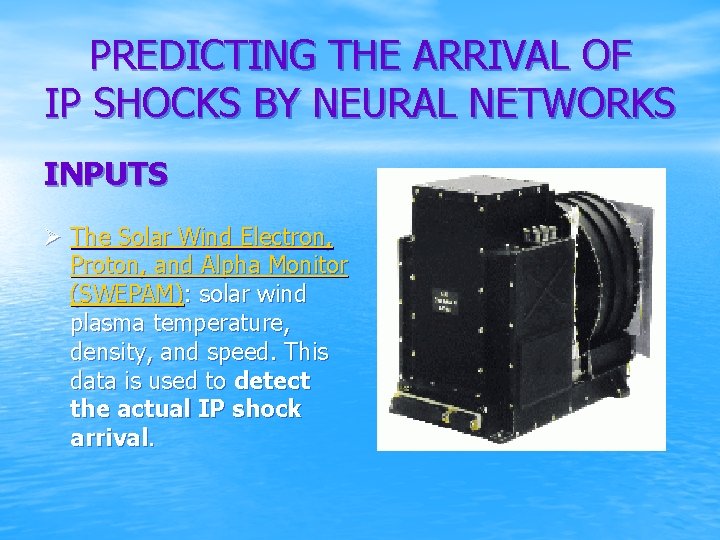
PREDICTING THE ARRIVAL OF IP SHOCKS BY NEURAL NETWORKS INPUTS Ø The Solar Wind Electron, Proton, and Alpha Monitor (SWEPAM): solar wind plasma temperature, density, and speed. This data is used to detect the actual IP shock arrival.
PREDICTING THE ARRIVAL OF IP SHOCKS BY NEURAL NETWORKS (Real-time Interplanetary Shock Prediction (RISP) System ) ØTRAINING THE ARTIFICIAL NEURAL NETWORK TO PREDICT THE TIME REMAINING UNTIL THE SHOCK ARRIVES ØTRAINED BY 37 OF THE 56 SELECTED SHOCKS ØPERFORMANCE ASSESSED BY FORECASTING ARRIVAL TIME COUNTDOWNS FOR 19 SHOCKS NOT USED DURING TRAINING
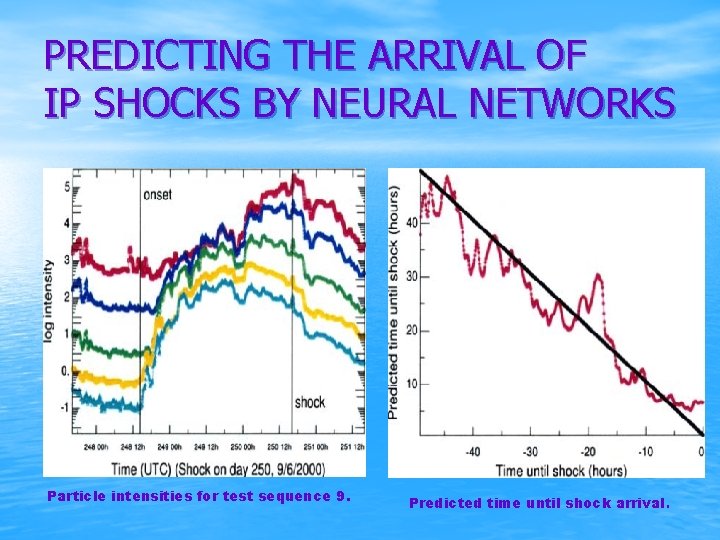
PREDICTING THE ARRIVAL OF IP SHOCKS BY NEURAL NETWORKS Particle intensities for test sequence 9. Predicted time until shock arrival.
REFERENCES Ø www. physics. usyd. edu. au/~cairns/teaching/lecture 11/node 5. html+i nterplanetary+shocks&hl=tr Ø http: //www-spof. gsfc. nasa. gov/Education/wgloss. html Ø http: //sd-www. jhuapl. edu/ACE/EPAM/RISP/ Ø Vandegriff , J. , Wagstaff, K. , Ho , G. , Plauger, J. Forecasting space weather: Predicting interplanetary shocks using neural networks. Adv. Space Res. 36, 2323 -2327, 2005. Ø www. srl. caltech. edu/ACE/ Ø Efe, M. Ö. , Kaynak, O. , Yapay sinir ağları ve uygulamaları, Bogazici University, 2005
- Slides: 12