
Predicting Health Care Utilization with the Patient Activation


- Slides: 28
Predicting Health Care Utilization with the Patient Activation Measure and a Single Item General-Self Rated Health Measure Daniel Ziebell Jonas Lee, MD University of Wisconsin—Madison School of Medicine and Public Health December 4, 2014
Disclosures • We have no disclosures to report!
Educational Goals Upon completion of this session, participants should be able to: • Describe the outcomes associated with patient activation • Describe the outcomes associated with the Single Item General Self-Rated Health measure • Describe how these tools performed in an urban, underserved, residency clinic population
Introduction • The Problem: High utilization – Five percent of patients account for >50% of health care expenditures in the US – Changing funding environment – How can we identify/predict high resource use patients?
Prediction Models • Criteria for a utilization prediction tool – Rapid to perform/implement – Easy to interpret – Accurate and meaningful
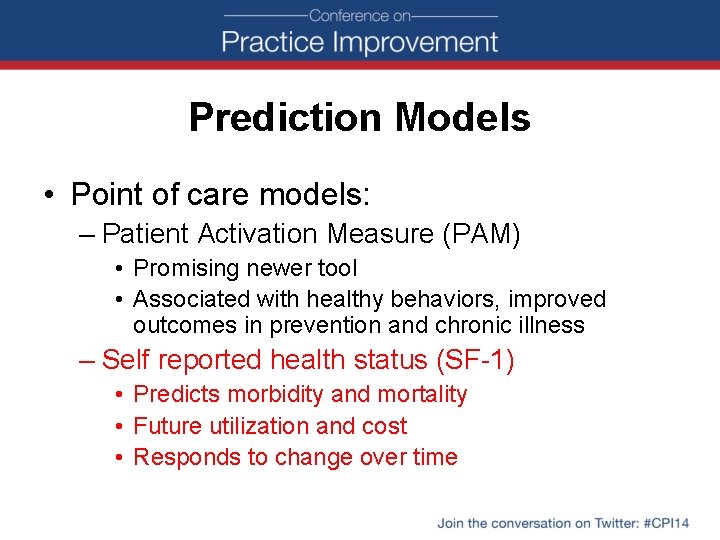
Prediction Models • Point of care models: – Patient Activation Measure (PAM) • Promising newer tool • Associated with healthy behaviors, improved outcomes in prevention and chronic illness – Self reported health status (SF-1) • Predicts morbidity and mortality • Future utilization and cost • Responds to change over time
Patient Activation Measure – 13 item survey – 4 point Likert scale – Converted to “activation score” – Higher scores = higher knowledge, skill, confidence
PAM Sample Questions • “Taking an active role in my own health care is the most important thing that affects my health. ” • “I am confident that I can follow through on medical treatments I may need to do at home. ” • “I understand my health problems and what causes them. ” • “I am confident I can figure out solutions when new situations or problems arise with my health. ” • “I am confident that I can maintain lifestyle changes, like eating right and exercise, even during times of stress. ”
Prediction Models • Point of care models: – Patient Activation Measure (PAM) • Promising newer tool • Associated with healthy behaviors, improved outcomes in prevention and chronic illness – Self reported health status (SF-1) • Predicts morbidity and mortality • Future utilization and cost • Responds to change over time
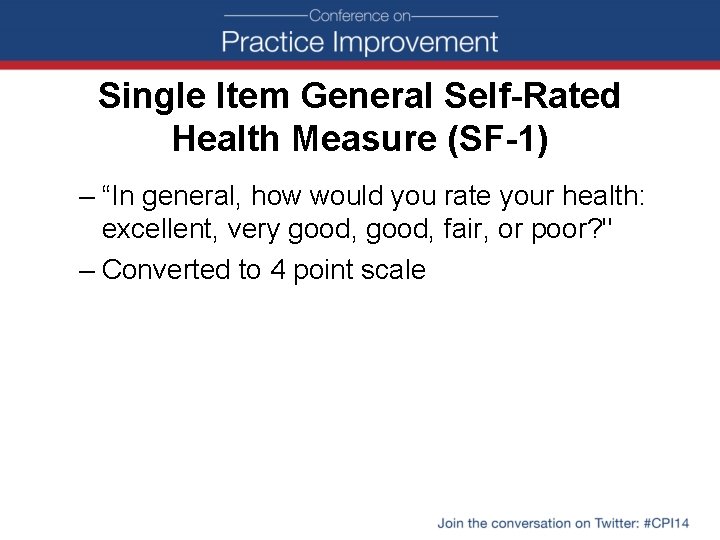
Single Item General Self-Rated Health Measure (SF-1) – “In general, how would you rate your health: excellent, very good, fair, or poor? " – Converted to 4 point scale
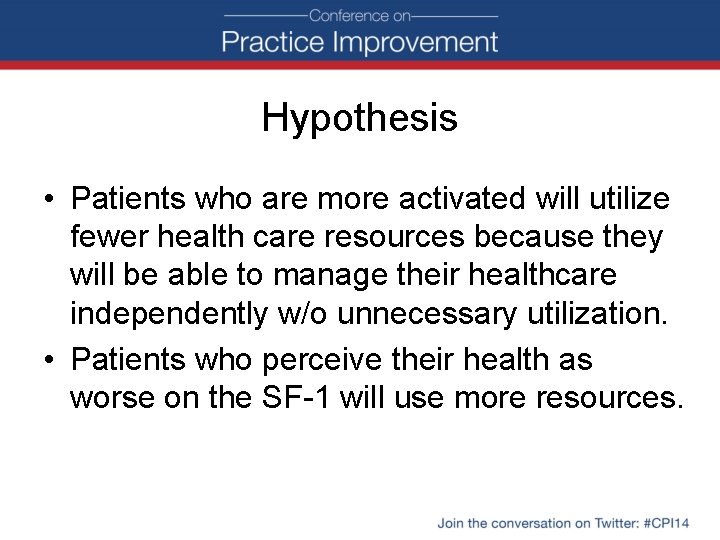
Hypothesis • Patients who are more activated will utilize fewer health care resources because they will be able to manage their healthcare independently w/o unnecessary utilization. • Patients who perceive their health as worse on the SF-1 will use more resources.
Clinical Question Does patient activation predict utilization as well as SF-1 in family medicine residencycommunity health center population?
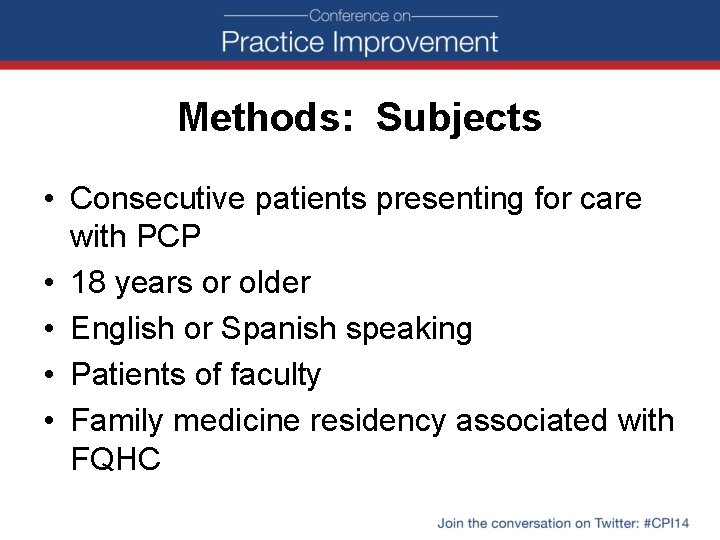
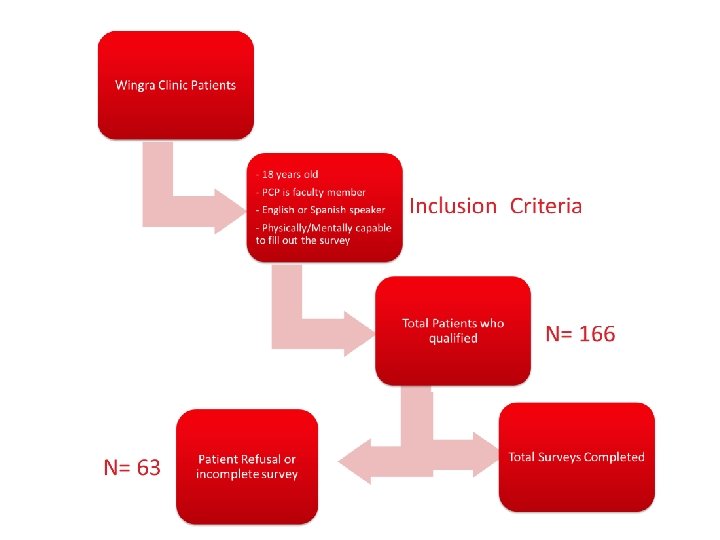
Methods: Subjects • Consecutive patients presenting for care with PCP • 18 years or older • English or Spanish speaking • Patients of faculty • Family medicine residency associated with FQHC
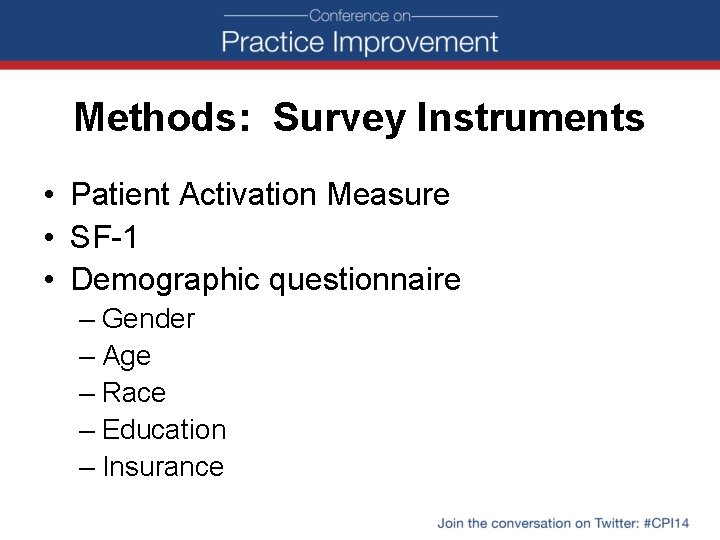
Methods: Survey Instruments • Patient Activation Measure • SF-1 • Demographic questionnaire – Gender – Age – Race – Education – Insurance
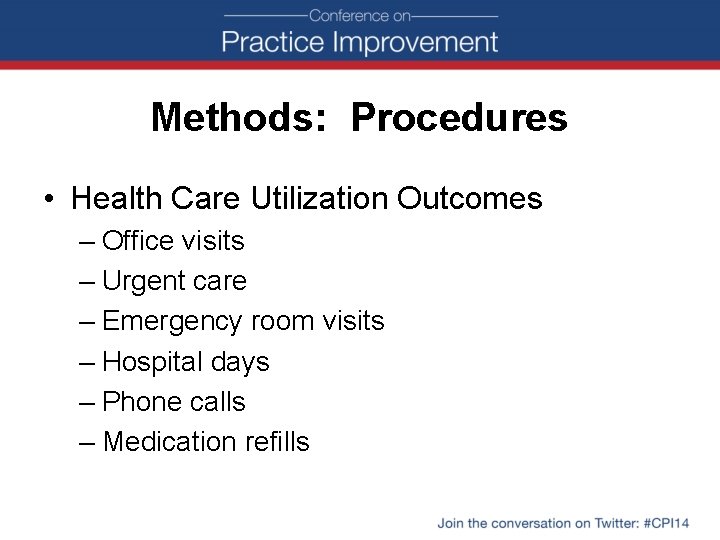
Methods: Procedures • Health Care Utilization Outcomes – Office visits – Urgent care – Emergency room visits – Hospital days – Phone calls – Medication refills
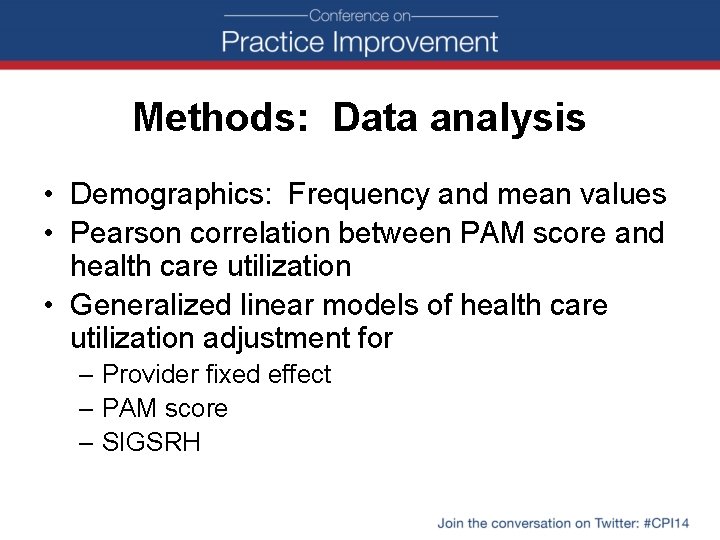
Methods: Data analysis • Demographics: Frequency and mean values • Pearson correlation between PAM score and health care utilization • Generalized linear models of health care utilization adjustment for – Provider fixed effect – PAM score – SIGSRH
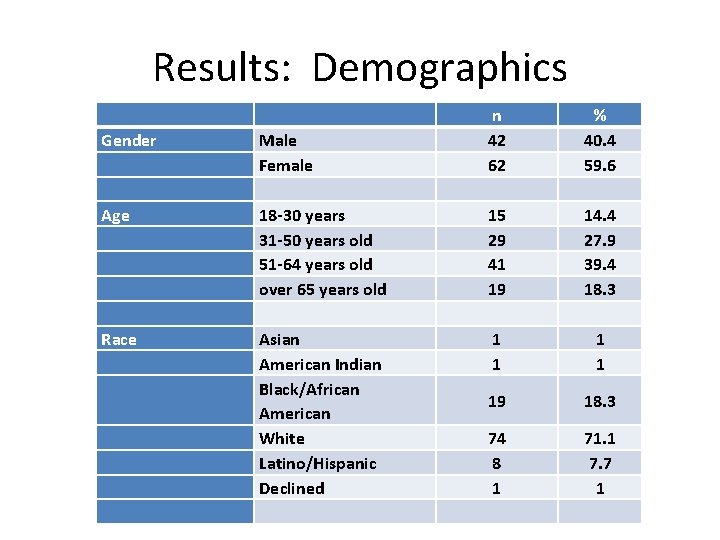
Results: Demographics Gender Male Female n 42 62 % 40. 4 59. 6 Age 18 -30 years 31 -50 years old 51 -64 years old over 65 years old 15 29 41 19 14. 4 27. 9 39. 4 18. 3 Race Asian American Indian Black/African American White Latino/Hispanic Declined 1 1 19 18. 3 74 8 1 71. 1 7. 7 1
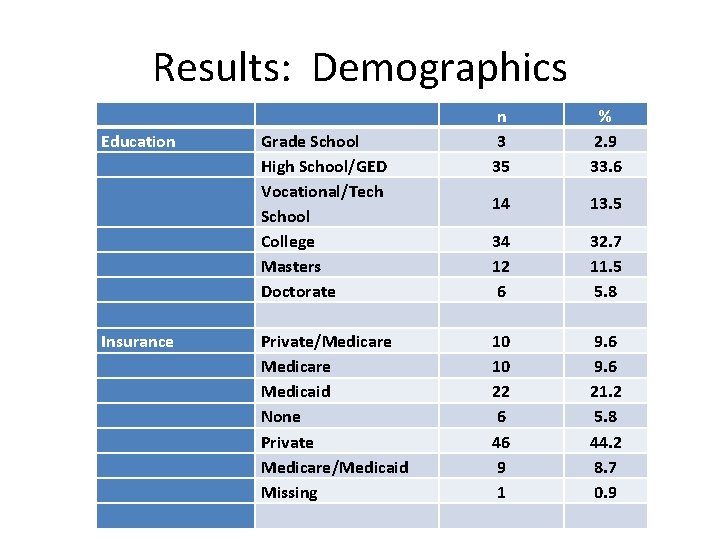
Results: Demographics Education Insurance Grade School High School/GED Vocational/Tech School College Masters Doctorate Private/Medicare Medicaid None Private Medicare/Medicaid Missing n 3 35 % 2. 9 33. 6 14 13. 5 34 12 6 32. 7 11. 5 5. 8 10 10 22 6 46 9 1 9. 6 21. 2 5. 8 44. 2 8. 7 0. 9
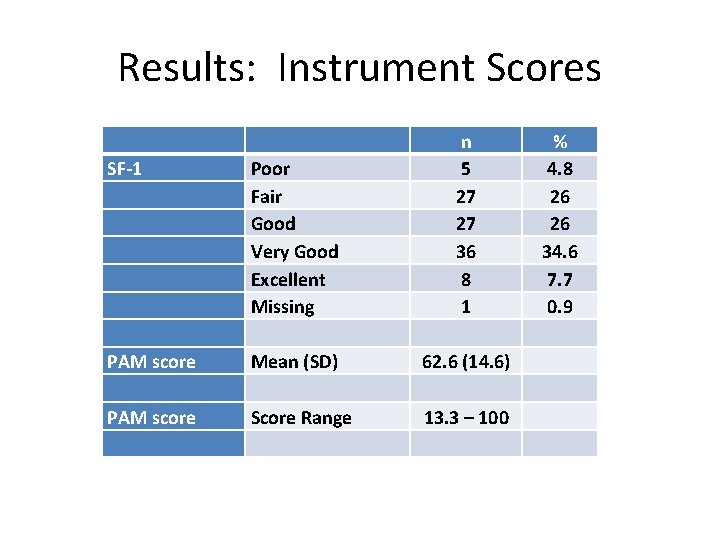
Results: Instrument Scores SF-1 Poor Fair Good Very Good Excellent Missing n 5 27 27 36 8 1 PAM score Mean (SD) 62. 6 (14. 6) PAM score Score Range 13. 3 – 100 % 4. 8 26 26 34. 6 7. 7 0. 9
Pearson Correlation between PAM Score and Health Care Utilization from EHR (N=99)a in the past 12 months Utilization Count mean Correlation with PAM score Significance Office visits, past 12 months Urgent care visits, past 12 months 11. 1 -0. 25 0. 011* 0. 4 -0. 13 0. 187 ER visits, past 12 months 1. 5 -0. 09 0. 350 Hospital days, past 12 months 1. 7 -0. 13 0. 195 Phone calls, past 12 months 8. 7 -0. 13 0. 196 Refills, past 12 months 5. 3 -0. 08 0. 452
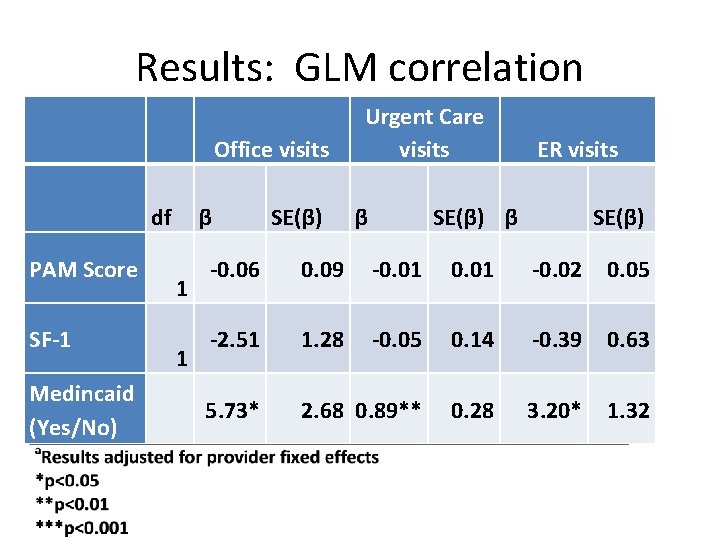
Results: GLM correlation Office visits df PAM Score SF-1 Medincaid (Yes/No) β 1 1 SE(β) Urgent Care visits β ER visits SE(β) β SE(β) -0. 06 0. 09 -0. 01 -0. 02 0. 05 -2. 51 1. 28 -0. 05 0. 14 -0. 39 0. 63 5. 73* 2. 68 0. 89** 0. 28 3. 20* 1. 32
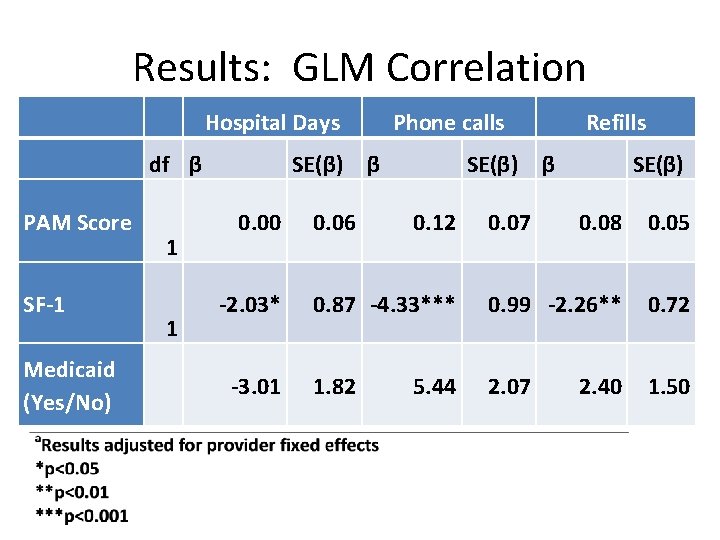
Results: GLM Correlation Hospital Days df β PAM Score SF-1 Medicaid (Yes/No) 1 1 Phone calls SE(β) β 0. 00 -2. 03* -3. 01 0. 06 Refills SE(β) β 0. 12 0. 08 0. 05 0. 87 -4. 33*** 0. 99 -2. 26** 0. 72 1. 82 2. 07 1. 50 5. 44 0. 07 SE(β) 2. 40
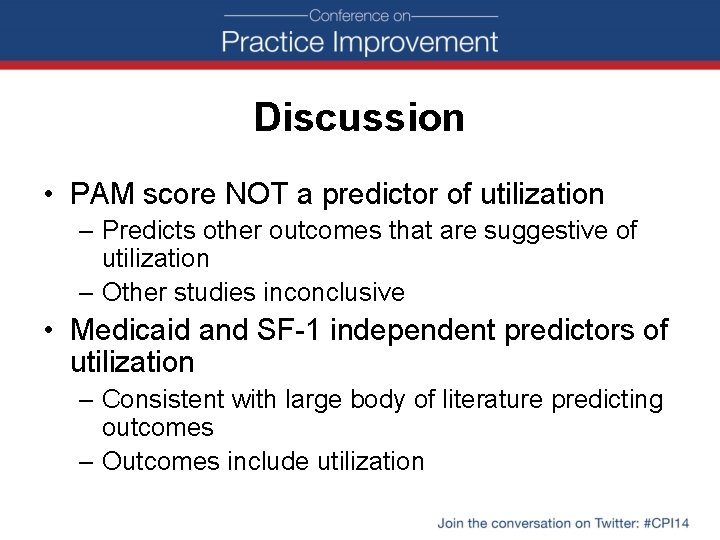
Discussion • PAM score NOT a predictor of utilization – Predicts other outcomes that are suggestive of utilization – Other studies inconclusive • Medicaid and SF-1 independent predictors of utilization – Consistent with large body of literature predicting outcomes – Outcomes include utilization
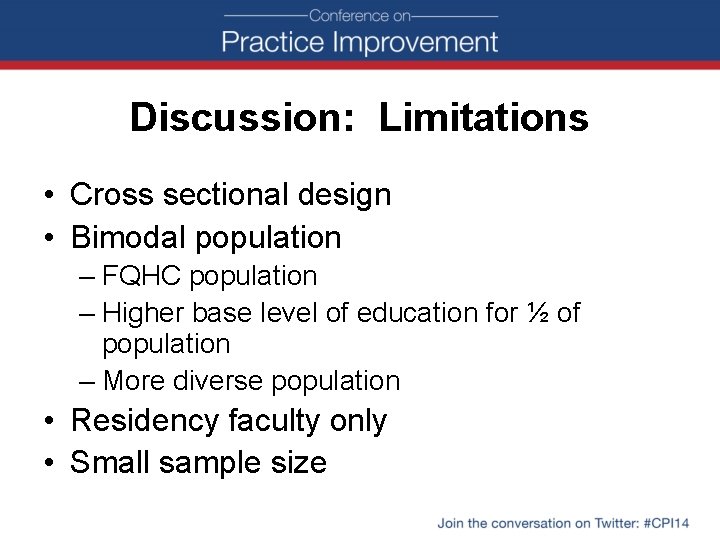
Discussion: Limitations • Cross sectional design • Bimodal population – FQHC population – Higher base level of education for ½ of population – More diverse population • Residency faculty only • Small sample size
Conclusion • First direct comparison of PAM to SF-1 • SF-1 may perform better than PAM in identifying high utilizer population
Special Thanks! • • Larissa Zakletskaia David Rabago, MD Mindy Smith, MD Wan Jen Tuan
Please evaluate this session at: stfm. org/sessionevaluation